









How to enjoy our new magazine:
Just scroll!
Click or tap the table of contents icon in the menu bar to find any article.
Read any article by clicking or tapping the read full article button below each article intro.
Jump back to your previous browsing spot from any article using the menu bar or back to issue button.






COMETH

to see what R3 can do for you.


-
The Importance Of Customer ReviewsPage 14
-
Powering A Smarter Self-Storage ModelPage 18
-
The Best Self-Storage Software AvailablePage 22
-
A Guide To B2B Content MarketingPage 26














-
Self-Storage In The Gateway To South AmericaPage 84
-
Development In The Land Down UnderPage 88
-
CubeSmart in Jacksonville, Fla.Page 92
-
Upgrades That Boost Your Bottom LinePage 94
-
Re-Strategizing Your Social Media For AI-SearchPage 98
-
Evaluating Your Next AcquisitionPage 100
- Chief Executive Opinion by Travis Morrow6
- Publisher’s Letter by Poppy Behrens9
- Meet The Team10
- Women In Self-Storage: Shannon Conrady by Alejandra Zilak31
- Who’s Who In Self-Storage: Nicholas Bergmann by Victória Oliveira35
- Innovation Spotlight: PFlow Industries by Brad Hadfield104
- Self Storage Association Update107
- The Last Word: Tom Nicholson III108
For the latest industry news, visit our comprehensive website, ModernStorageMedia.com.








s you read this issue and think to yourself, “I have more stores than them,” and “I should be on this list,” ask yourself why you didn’t submit your portfolio’s info. Top Operators want to know where they rank, and they want to market where they rank. If they don’t update us with current information, how are we to know where they rank?
This year’s Top Ops will also be getting some additional benefits in 2026 from MSM that will be announced in the coming weeks. In future years, you won’t want to forget to send in your information!

He’s also the president of National Self Storage.

-
PUBLISHER
Poppy Behrens
-
Creative Director
Jim Nissen
-
Director Of Sales & Marketing
Lauri Longstrom-Henderson
(800) 824-6864 -
Circulation & Marketing Coordinator
Carlos “Los” Padilla
(800) 352-4636 -
Editor
Erica Shatzer
-
Lead Writer / Web Manager
Brad Hadfield
-
Storelocal® Media Corporation
Travis M. Morrow, CEO
-
Website
-
Visit Messenger Online!
Visit our Self-Storage Resource Center online at
www.ModernStorageMedia.com
where you can research archived articles, sign up for a subscription, submit a change of address, and more. 
- All correspondence and inquiries should be addressed to:
MSM
PO Box 608
Wittmann, AZ 85361-9997
Phone: (800) 352-4636



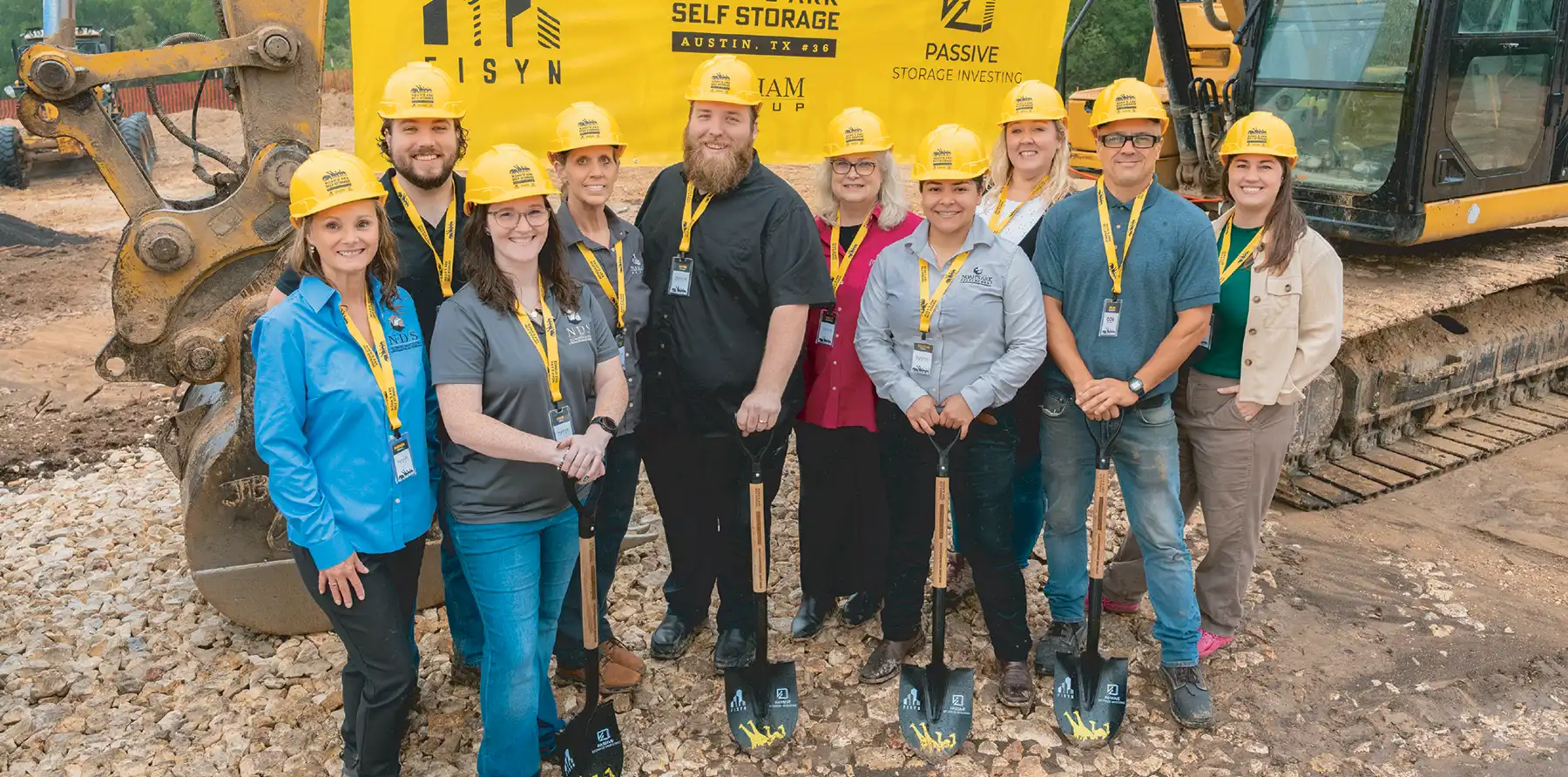

theparhamgroup.com
hen I first started in this industry, I met the Parhams (Mike, Ann, and Rachel) and I was amazed at how they were more than eager to answer my novice industry questions. Over the next 25 years, they became more than just self-storage colleagues; they were like family. I admired Rachel for going back to Texas to join the family business, National Development Services (NDS Construction). I didn’t know what it was at the time, but I recognized that Rachel was destined for something special in this industry, alongside her dad.
In 2010, shortly after I arrived in Florida for the annual tradeshow, I received a devastating call; my dad was on life support, and I needed to get home as soon as possible. The Parhams were there with hugs and encouraging words, and it was Mike who made sure I got a cab to the airport. That meant so much at such a horrible time.
Four short years later, I received another devastating call; Mike had passed away unexpectedly. I knew that Rachel was devastated. But at that moment, I also knew why she had come back to the industry. She needed to carry on in her dad’s footsteps! And indeed, she has done just that.
Our cover story in this edition, starting on page 46, explores Rachel’s journey away from self-storage and back again. Today she is the proud owner and CEO of NDS, the company her father started so many years ago. She has become an entrepreneur and businesswoman in her own right as she carries on the family business.
Rachel, I am so proud of you! And I know your dad is looking down on you with a big smile, because he is the proudest of all!
Enjoy!

Publisher

hen I first started in this industry, I met the Parhams (Mike, Ann, and Rachel) and I was amazed at how they were more than eager to answer my novice industry questions. Over the next 25 years, they became more than just self-storage colleagues; they were like family. I admired Rachel for going back to Texas to join the family business, National Development Services (NDS Construction). I didn’t know what it was at the time, but I recognized that Rachel was destined for something special in this industry, alongside her dad.
In 2010, shortly after I arrived in Florida for the annual tradeshow, I received a devastating call; my dad was on life support, and I needed to get home as soon as possible. The Parhams were there with hugs and encouraging words, and it was Mike who made sure I got a cab to the airport. That meant so much at such a horrible time.
Our cover story in this edition, starting on page 46, explores Rachel’s journey away from self-storage and back again. Today she is the proud owner and CEO of NDS, the company her father started so many years ago. She has become an entrepreneur and businesswoman in her own right as she carries on the family business.
Rachel, I am so proud of you! And I know your dad is looking down on you with a big smile, because he is the proudest of all!
Enjoy!
Publisher

Now, our online edition has received a new look for the new year! The guide has been relocated to the MSM website for better security, easier access, improved features, and greater SEO for everyone.
You’ll love the dynamic new search function.
You’ll love the new features:
- A unique link to a dedicated company page
- Ability to include more content, images, video, and social
- Access to dynamic layouts and designs










he nature of how customers approach businesses has gradually changed over time, from word of mouth to online reviews. Whether someone is using Yelp, Google Reviews, or simply hearing a recommendation from a friend, reviews can be defining for the success or downfall of a business.
First impressions are extremely important, and they must be followed with substantial customer service in order to provide a positive experience for customers and clients. A customer’s first interaction with a business may be arriving in person, or it may be glancing at a public review of a business. Either way, consistently exercising quality service, friendliness, and upholding a professional atmosphere will provide for positive reviews and garner higher traffic for your business. While good reviews are crucial, managing negative feedback is just as important for business growth.
Diane Gibson, owner and president of Cox’s Armored Mini Storage Management, Inc., immediately clarifies that she addresses reviews as “very important … we actually ask people to give us reviews. Any kind of contact we have with our tenants, we always have the QR code there to take them to the review page to make it as easy as possible for them to do that.” This strategy reminds customers to leave reviews online for Cox’s Armored Mini Storage Management, Inc. and leans into the positive impact reviews can have. She takes it further, saying that the company “tries to respond to all the reviews in 24 hours,” thanking people for their review and confirming any experience they had at their facilities.
While it is standard for a business to implement initial strategies to ensure customer satisfaction, taking some extra steps can assist in securing a positive online presence. Carol Mixon, owner and president of SkilCheck Services, Inc., notes that some of her establishments bring the customers water on hot days; while they are independently renting, they are still valued clients that the managers are there to assist.
Mixon also implements mystery shopping, where they have unidentified workers pose as customers for an authentic interaction with staff to gauge their customer service. This experience can help identify and seed out any negative behavior before it reaches a valuable customer. “The point of it is to reform and give feedback,” she says, “and this has proven to improve reviews.” It’s a great approach to reduce negative occurances and increase positive ones.
Bad reviews can range from unhelpful feedback to genuine issues with management. Taking the negative review, assessing it with the involved team member(s), and then executing a methodical response to the customer is the course of action many business owners execute.
Gibson outlines her process. “If we get a bad review, we’ll contact the site first and we’ll confirm if it is a tenant,” she says. “Once we get the full story, we can assess; sometimes it is different from the manager versus the person who is upset.” Addressing the customer in a kind, understanding way, instead of ignoring their review, can make all the difference. This reflects well on any review site and shows that the business is making every effort to correct any mistakes and ensure customers feel heard and understood.
While good reviews garner more traffic and promote a business, responses are intregal to bad reviews. “The bad reviews are the most important to respond to,” says Mixon, “especially if they’re renting from you.”
Responses to bad reviews, in addition to the good reviews, will show customers how attentive a business can be. It is important to expect bad reviews from time to time, and how one proceeds to handle them is paramount. Gibson responds to them by “inquiring and kindly ask them to explain, along with an apology.” This extra step can flip a bad review to a positive experience with the customer, allowing them to reach a compromise and/or potentially be content with a resolution.
There is also the point of interacting with the staff. Mixon “goes over bad reviews with the managers, addressing what we can do differently, or they can do differently,” noting that she “sees the value in addressing a bad review because, on top of the good reviews, it goes a long way.”
Taking in every factor and appraising the situation is important, as the customer may be justified in their complaints, or they may simply be in disagreement with a policy. “We don’t get that many bad reviews, but in the instance that we do, we will address their issue by thanking them and saying we will try to do better, or we will reaffirm what our policy is,” Gibson says. “We are industry standard, so if they disagree with it, we can’t do anything.”
Clients are the soul of any self-storage facility, and their reviews matter. Taking on the challenge of a bad review, while cherishing the good ones, will provide a balance that strikes new customers with assurance and ease as they glance at your profile on Google, Yelp, or any other reviewing platform.
Ultimately, reviews serve as a two-way mirror, reflecting both the customer’s experience and the company’s commitment to improvement. They allow businesses to refine their services, motivate their teams, and build long-term trust with their community. Actively seeking feedback, listening closely, and responding with empathy shows that a business is not only willing to evolve, but also values every individual who walks through their doors or visits their page.
The digital age has made customer voices louder and more visible than ever before. Businesses that embrace this transparency, rather than shy away from it, will be the ones to thrive in both reputation and revenue.

online.
Being an SEO expert shouldn’t be on your list.

Your Management
he self-storage industry has undergone significant transformations in recent years, with the market cap of REITs growing from 63.31 billion in 2019 to 101.59 billion in 2023 and being driven by changing consumer behavior, digitization, and an evolving economic landscape. One of the most notable solutions to these shifts is the adoption of hybrid management models, which blend traditional on-site staffing with remote, technology-driven operations. Rather than fully replacing human roles with automation or clinging to traditional staffing models, hybrid management offers a balanced approach that blends technology with human interaction. This fusion addresses the increasing need for efficiency, flexibility, and enhanced customer engagement.
Where traditional management relies heavily on full-time, on-site staff and fully automated models remove almost all human interaction, hybrid management thrives in the middle. The strength of this model lies in its ability to balance customer service with operational efficiency.
Remote personnel, such as leasing agents, customer support representatives, and regional managers, operate from centralized hubs or virtual environments. They oversee multiple facilities using real-time dashboards, video feeds, and workflow platforms. High-touch service is at the heart of their communication, ensuring all interactions feel personal, despite the distance.
However, on-site staff remain vital, handling maintenance, in-person interactions, and managing during high-demand periods. Rather than serving in purely administrative roles, these team members become brand representatives and issue resolvers, using digital platforms to augment their responsiveness and alleviate confusion.
Moreover, live video further enhances this model by strengthening both internal collaboration and external customer engagement. Internally, it enables remote leadership to stay connected with site teams by conducting walkthroughs and facilitating team meetings without being physically present. Live video can also be used for training, coaching, and culture building, offering consistency and immediacy across multiple locations. Externally, it transforms customer service by allowing face-to-face communication through kiosks or mobile devices, replicating the trust and familiarity of in-person interactions.
These live interactions revitalize the emotional depth that’s often lost in automated channels. For real-time troubleshooting, the presence of a visible, empathetic employee creates a stronger customer relationship. Ultimately, successful hybrid management relies on creating an interdependent system that seamlessly integrates digital platforms, remote teams, and human support, rather than prioritizing any single element. Each part enhances the other, resulting in operations that are not only efficient and scalable but also human-centered.
At the same time, the model improves customer accessibility. Tenants today expect service on their terms, whether that’s through an app, phone, or live video. Hybrid systems allow businesses to offer personalized experiences without being bound by physical location or traditional business hours.
Maintenance and risk management are also streamlined using technology. Video reporting and IoT sensors help identify issues, while teams can coordinate responses more effectively. This reduces downtime, minimizes disputes, and preserves facility integrity.
On the staffing side, hybrid management encourages optimal resource use. Facilities can operate with flexible staffing schedules, allocating human presence based on traffic patterns or occupancy trends. This reduces fixed costs and supports long-term growth.
One of the most impactful developments is the use of live video to support virtual tours and leasing consultations. Unlike static photos or pre-recorded walkthroughs, live video allows prospective tenants to ask questions, view specific units in real time, and get a feel for the facility—all from their phone or computer. This immediacy builds trust and helps convert interest into action, especially for out-of-town renters or customers looking for contactless service. In fact, according to industry surveys performed by Radius+, approximately 80 percent of customers prefer contactless rentals when booking a unit.
In a hybrid setup, regional leasing specialists can cover multiple locations without sacrificing the quality of engagement. Equipped with video kiosks or mobile links, these specialists can instantly connect with walk-in visitors or online prospects. This centralized approach ensures consistent messaging, faster response times, and a professional experience that aligns with brand standards, regardless of location.
Marketing campaigns also benefit from the hybrid model. Because many systems are now built on integrated platforms that combine CRM, video, and analytics, teams can track lead sources, customer behavior, and service outcomes with higher accuracy. This means operators can refine their advertising spend in real time, focusing on the channels that deliver the highest return.
However, an issue can lie with the reduction in upselling opportunities that often occur during face-to-face interactions. Nevertheless, video calls and digital workflows can be strategically designed to introduce value-added services, maintaining revenue potential. Rather than relying on a front-desk employee to mention climate-controlled units or insurance options, these offers can be built into remote video interactions and supported by on-screen visuals or live demos. This helps keep sales conversations engaging and informative while avoiding the pressure that can come with in-person pitches.
Lastly, a hybrid approach makes it easier to A/B test new offerings, such as bundling services or testing flexible lease terms. Because centralized teams can manage multiple locations, it’s easier to roll out new ideas in select markets and gather insights quickly, without disrupting the entire operation.
As competition intensifies and customer expectations rise, self-storage operators must think beyond cost cutting. Hybrid management enables a more responsive, sophisticated sales and marketing engine—one that’s fast, flexible, and built to meet the evolving demands of modern renters.
Data-driven personalization is becoming more common. Systems that recognize returning tenants or tailor promotions based on behavior history are enhancing loyalty and satisfaction. When combined with instant video support, these insights help create experiences that feel both smart and personal.
Hybrid management also supports sustainability goals. With fewer daily commutes and more efficient operations, these systems reduce environmental impact. Video platforms help avoid unnecessary site visits, while predictive maintenance prevents energy waste. Operators are further enhancing this with eco-friendly building features like solar panels and smart lighting.
Additionally, legal compliance is still an important factor. Managing remote operations in different regions can create legal and procedural challenges. But the solution lies in leveraging technology to automate compliance checks and alerts.
Employee morale may also be affected during transitions. When staff roles are changing, they require both training and clear communication for effective operations. Investing in professional development and involving employees in the change process can ease this shift.
Lastly, reliance on a single vendor or proprietary system can lead to inflexibility. Open platforms that support API integrations help avoid vendor lock-in and support future adaptability.
Develop a Clear Hybrid Strategy
Use Tiered Staffing Models
- Tier 1 – Fully automated with remote oversight.
- Tier 2 – One part-time staff member plus remote support.
- Tier 3 – Full-time staff with limited remote augmentation.
Create Humanized Digital Interactions
It also creates opportunities for staff to develop new skills in tech fluency, remote collaboration, and customer engagement, positioning them for advancement in a changing market.
This boom has necessitated a rethinking of management models, especially amid labor shortages and rising operational costs. Hybrid management allows operators to navigate these challenges while keeping customer needs front and center.
Hybrid models offer operators a compelling path forward, one that supports rapid expansion, enhances customer satisfaction, and reduces operational costs. Live video platforms, AI platforms, and centralized systems are transforming the concept from a tactical option into a strategic imperative.
Companies that successfully integrate this technology will be better equipped to navigate uncertainty, meet shifting consumer demands, and lead in a competitive landscape. More than a trend, hybrid management represents a sustainable, scalable framework for modern storage operations.
Hybrid management is more than a cost-saving trend; it’s a strategic evolution in self-storage operations. It provides the flexibility to scale, the platforms to enhance customer experience, and the agility to navigate an increasingly competitive market.
While it comes with its own set of challenges, forward-thinking operators who implement hybrid models strategically by blending people, platforms, and processes stand to gain long-term profitability and customer loyalty.
As the industry continues to embrace digital transformation, hybrid management will likely serve as the bridge between legacy operations and the smart facilities of the future. Success will depend not only on technology but on how well it is integrated into the human-centered experience that continues to define the storage industry’s core value. In the end, hybrid management isn’t about replacing people with machines; it’s about putting the right machines in the right hands.

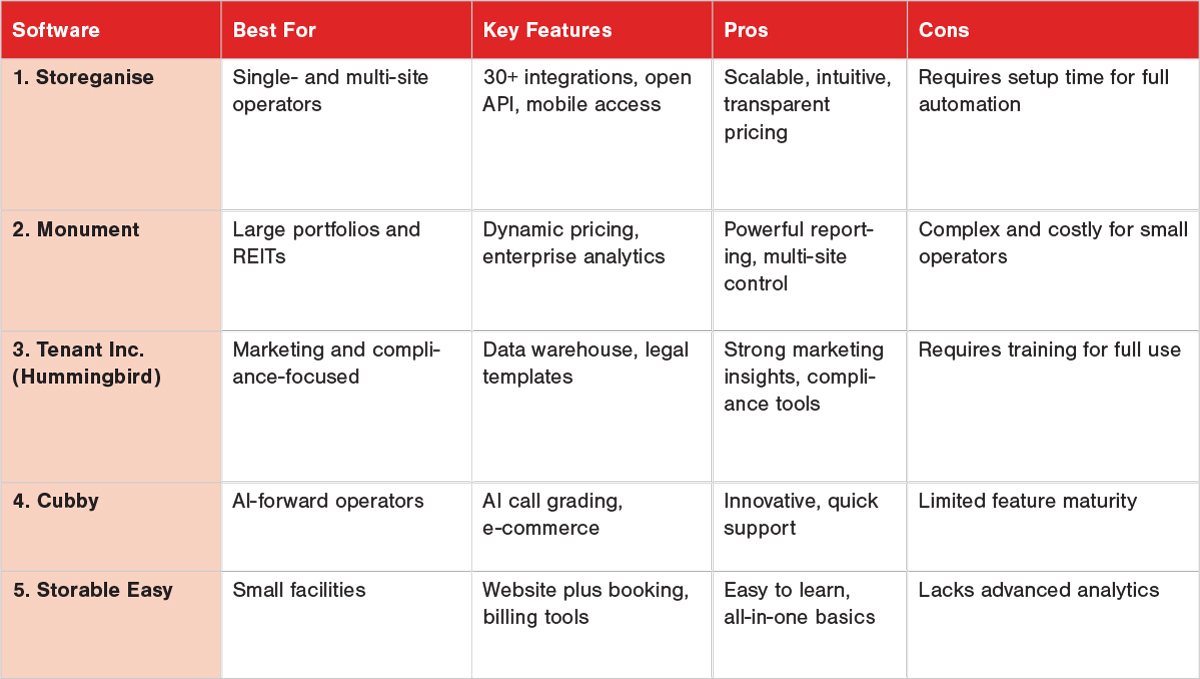
elf-storage software is no longer optional—it’s the backbone of modern facility management. The market was worth $2.5 billion in 2024, and it’s growing at 12.7 percent annually, driven by automation, real-time analytics, and contactless services.
Operators now expect more than basic booking tools. The leading platforms deliver contactless reservations, automated billing, portfolio-wide dashboards, seamless integrations, and built-in communication systems. The payoff: lower overhead, higher occupancy, and a better tenant experience.This guide compares five of the top self-storage software platforms available in 2025, helping operators identify the solution that best fits their business goals.
Each platform was reviewed against the core needs of facility owners, including booking automation, billing accuracy, reporting depth, ease of integration, and tenant communication tools.
By combining real-world operational insights with structured feature analysis, this guide offers recommendations that balance technical capabilities with practical, everyday usability for self-storage businesses.
storeganise
With 30-plus native integrations and a flexible open API, Storeganise adapts to virtually any workflow. Operators can oversee bookings, payments, and access control from a single dashboard, while tenants can manage bookings, payments, and accounts entirely online. This reduces admin workload and boosts customer satisfaction. Mobile access keeps both staff and tenants connected, enabling key tasks to be completed anytime, anywhere.
- It has transparent pricing starting around $50 per month for 100 units.
- Scalable for operators of all sizes, from independent sites to large portfolios
- Customizable localization for tax, currency, and language settings
- Interactive site maps with color-coded occupancy
- GDPR compliance and secure logins for data protection
- Setup and training are required to unlock its full automation capabilities.
Storeganise stands out for its balance of operational efficiency, ease of use, and global scalability, making it a strong choice for operators who want automation without sacrificing flexibility.
Monument
The platform’s unified dashboard provides an instant view of occupancy, financial metrics, and operational tasks across all facilities. Dynamic pricing tools adjust rental rates based on demand and competitor data, while smart leasing features, such as e-signatures and automated follow-ups, help reduce vacancy periods. Monument also integrates with leading gate access and payment systems, ensuring seamless operations from move-in to payment processing.
- Powerful, portfolio-wide reporting and analytics
- Dynamic pricing to maximize revenue based on market conditions
- Strong automation for leasing and operational workflows
- Integration with major access control and payment systems
- Its complexity may overwhelm small operators.
- Pricing is available only via a custom quote, making it potentially higher than other options.
Monument’s depth of analytics and enterprise-level capabilities make it ideal for owners managing multiple facilities who need granular insights and advanced revenue optimization tools.
Tenant Inc. (Hummingbird)
Its integrated data warehouse links rental activity to advertising campaigns and customer reviews, allowing operators to see which marketing channels deliver the best ROI. Built-in compliance features, including verified lease templates and state-specific lien notices, help operators meet legal requirements without additional tools. Automated workflows manage routine tasks like reminders, notices, and reporting, freeing staff to focus on customer service.
- Direct connection between marketing analytics and rental activity
- Built-in legal compliance tools for leases and notices
- Automated workflows to reduce manual administrative work
- It’s designed by storage industry professionals for real-world use.
- Training may be required to fully leverage data and automation features.
Hummingbird is best suited to operators ready to adopt a data-driven approach, combining operational tools with marketing insight to improve decision-making and compliance.
Cubby
The platform’s AI communication tools transcribe and grade incoming calls, helping staff identify missed sales opportunities and improve service quality. A centralized messaging hub consolidates all tenant communications (email, SMS, and calls) into a single view. Cubby also includes e-commerce functionality, allowing operators to launch custom booking sites or embed checkout tools directly into their existing website.
- AI-powered call transcription and performance grading
- Centralized communication hub for all customer interactions
- Built-in e-commerce booking tools
- Fast development cycles and responsive support
- Its feature set is still expanding compared to more established platforms.
Cubby is best for tech-forward operators who value innovation, want to integrate AI into daily workflows, and are open to adopting a platform that evolves quickly with new capabilities.
Storable Easy
Operators can offer online reservations and payments, automate recurring billing, and manage tenant communications via SMS, email, or voice—all within the same platform. Real-time financial reporting helps track deposits, income, and performance at a glance. Cloud-based access allows owners to handle move-ins, lockouts, and other tasks remotely without being on site.
- Simple interface with minimal learning curve
- Website, booking, and billing tools are included.
- Built-in SMS, email, and phone communication features
- Cloud-based remote management
- It lacks the advanced analytics and revenue optimization tools needed for growth-focused operators.
Storable Easy is an ideal choice for small facilities or new operators who prioritize ease of use and affordability over advanced customization and enterprise-grade reporting.
The right self-storage software can streamline operations, improve occupancy, and provide a better tenant experience. While several platforms stand out, Storeganise offers a strong mix of automation, scalability, and ease of use, making it a solid choice for many operators.
However, the best fit depends on your facility’s size, challenges, and growth plans. Test each option, check integrations, and consider long-term costs before committing. In a rapidly evolving industry, investing in adaptable, data-driven software will keep your business competitive and ready for future opportunities.






Partner
Content Marketing

or B2B vendors in the self-storage industry, the traditional sales playbook is losing its punch. This is true whether you’re selling software, security systems, insurance, or construction. The modern operator is a sharp business owner. They make decisions based on the long-term value of their asset. They don’t have time for a sales pitch, and they’re looking for a strategic partner who understands their business.
Content marketing is a powerful tool to become that partner. The strategy is simple. Your goal should be to show operators you understand their problems, not just tell them how great your product is. That’s how you build a relationship based on trust. This guide breaks down the operator’s mindset and gives you a playbook for using content to establish yourself as a thought leader and generate valuable B2B leads.
Operators are managing an investment, not just a property. Every decision gets filtered through that lens. They focus on financial performance, especially numbers like net operating income (NOI) and asset valuation. Anything that impacts the bottom line gets their attention. They are also constantly trying to improve operational efficiency and reduce wasted time. In a crowded market, the tenant experience is a huge factor. A bad experience with a website or a faulty gate can lose a customer. Operators are also well aware of the risks to their business, like construction delays or data breaches.
Operators have no patience for corporate jargon. They want direct, professional communication. A list of product features is meaningless to them. They want to know how those features solve a specific problem. An operator with a portfolio of urban facilities facing intense competition has a different set of needs than a rural operator who is the only game in town. They expect you to understand those nuances. Your content must be built on this foundation of empathy. Each piece of content should be a direct answer to one of their core concerns.
Blog Posts
Your blog is where you consistently prove you understand the industry. The key is to move beyond generic articles. Create content with real, tangible value. A software vendor shouldn’t write “Five Features Every PMS Should Have.” A better title would be “A Five-Step Audit to Improve Manager Efficiency.” This reframes the conversation around their problem. A security vendor can position themselves as an expert with a title like “A Threat Assessment Checklist for the Modern Self-Storage Facility,” not just “The Best Cameras for Your Facility.” This shows you’re thinking about their business, not just your product. An insurance provider can build trust with “The Anatomy of a Lien Sale Lawsuit: Three Common Mistakes That Put Operators at Risk.” This provides valuable legal insight that builds trust. A construction company can show they understand the entire development lifecycle with “The Feasibility Study Checklist: 10 Critical Questions to Ask Before You Break Ground.” Each of these titles offers a solution to a problem, not just a promotion of a product.
Webinars
Webinars are a powerful tool for a more in-depth, educational conversation. You can host a 30-minute, no-pitch “Strategic Briefing” on a high-level topic. For example, a construction company could present “Value Engineering Your Next Build: How to Reduce Costs Without Sacrificing Quality.” Another effective format is the “Case Study Deep Dive.” Here, you partner with a successful customer and let them tell their story. Hearing from a peer is often more impactful than hearing from a vendor. A security company could co-host a session with an operator who recently upgraded their system to discuss the process and the results. You can also position a key team member as an industry expert with an “Ask Me Anything” (AMA) session. An insurance provider, for instance, could host their top underwriter to discuss the most common and costly claims. This transparency builds a huge amount of credibility.
Case Studies
Sophisticated operators are driven by data and results. A well-crafted case study is the best way to provide the social proof they need. Frame it as a story. Start with the specific challenge the operator was facing. Was their facility experiencing a high number of break-ins? Was their new construction project falling behind schedule? Be specific. Move to the solution, explaining not just what product or service they implemented but why they chose it. What was the decision-making process? The final and most important part is the results. This section must use hard numbers. Instead of “improved security,” say “a 75 percent reduction in reported incidents in the first six months.” Instead of “a faster build,” say “completed construction 30 days ahead of schedule, allowing the facility to open before peak season.” An authentic quote from the operator is more valuable than any marketing copy you could write. It’s the proof that your solution, service, or product works in the real world.
Research Reports And White Papers
For complex topics, a well-researched report can establish you as the definitive authority in your niche. A security vendor could publish an annual “state of the industry” report on security trends. This would become a go-to resource. A construction company could create a comprehensive guide to converting a big-box retail store into a modern self-storage facility. This would be an incredibly valuable resource for developers. A software company with access to aggregated, anonymized user data can publish a report on key industry benchmarks. Topics like average length of stay or the impact of online reviews on occupancy are always relevant. This kind of proprietary data is something that only you can provide, and it positions you as a true thought leader.
Video Content
Video is a great way to build a human connection. This is a relationship-driven industry, and video lets you put a face to your brand. It makes complex ideas easier to understand. For example, a construction company could show a time-lapse of a recent build. A security vendor can make short “Tech Tip” videos about things like camera placement. A software company can create quick tutorials to solve common problems. You don’t need a huge budget for this. A simple, authentic video shot on a smartphone often works better than a slick corporate production.
Content Distribution
Creating great content is only half the battle. A deliberate distribution strategy is essential. The goal is to share insights and start conversations, not just drop links. Your team should engage with operators’ posts and participate in industry groups. This makes you part of the community. A monthly or quarterly email newsletter is also a great way to deliver your best content. Just make sure it’s a valuable resource, not a sales pitch. Over time, being consistently helpful will build an audience that trusts you.











hannon Conrady loves flowers: growing them, arranging them, and using them to brighten her surroundings. That same appreciation for beauty carries into her role as marketing director at Central States Building Works, a division of Central States Inc., a 100 percent employee-owned, nationwide manufacturer of metal roofing, siding, and building components. Her story proves life doesn’t always need a blueprint; sometimes the next step appears when you’re ready to take it.
That early exposure to discipline laid the foundation for her future career. “I didn’t realize it at the time,” she says, “but managing all those responsibilities taught me how to prioritize and stay calm under pressure.”
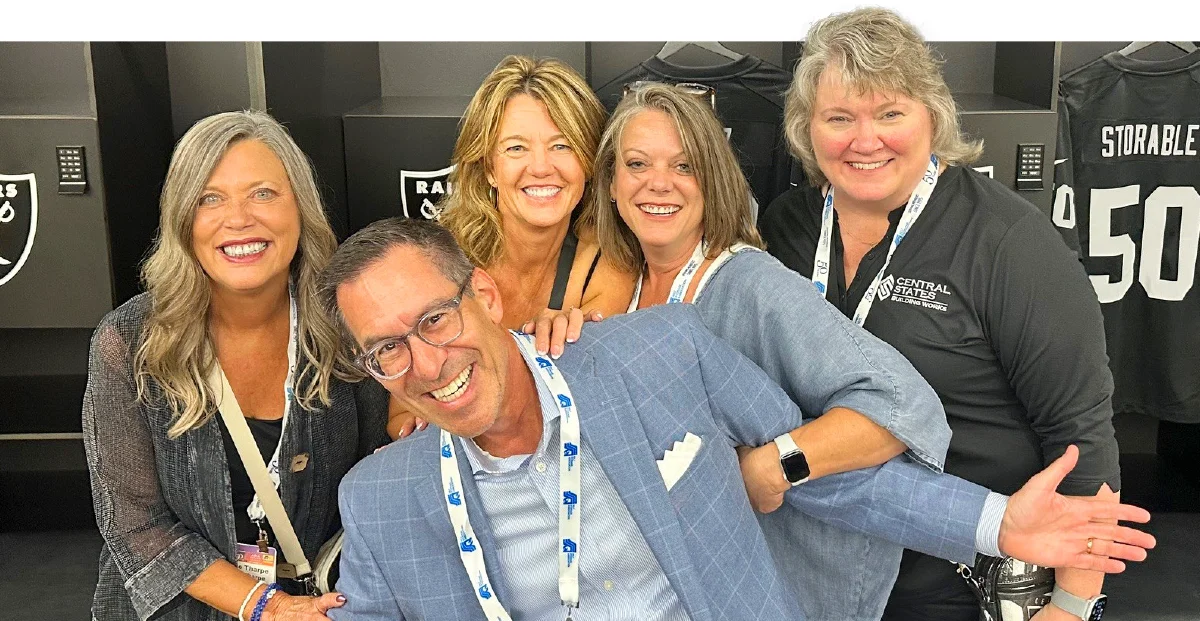
When her family relocated to Arkansas for her father’s career, she transferred to Arkansas State—sweetened by the promise of a new car—and joined Phi Mu to build new friendships fast. “It was a big change, but it taught me how to adapt quickly and find community wherever I go.”
Her first job was at Windsor Door in Little Rock. When her family moved back to North Carolina, Conrady transferred to Windsor’s Atlanta location to be closer to them, and that move changed everything. She reconnected with Tom Conrady, her next-door neighbor during high school, and they eventually married. “I learned Tom was in Atlanta and reached out to network,” she says. “And we just celebrated our 30th wedding anniversary this year.”
Work took them to Baltimore briefly, but longing to return to the Southeast, Conrady landed a sales role at DBCI through a former colleague. The move brought them closer to family, and soon after settling in Georgia, they welcomed two daughters, now aged 26 and 25.
Conrady spent seven years at DBCI before joining Janus International in 2002, one of the first employees to make the leap when the company was founded.
One of her early marketing efforts led to a memorable moment: a misprinted toll-free number in an ad accidentally routed callers to an adult chat line. “I was mortified,” she says through laughter. “I told my boss, ‘I understand if you have to fire me.’” But he just smiled and said, “Why would I fire you? It will be a great story someday!”
That moment became a turning point, not just in her career but in her confidence. “It taught me that mistakes happen, but how you respond matters more. I learned to own it, fix it, and move forward.”

Her ability to wear multiple hats became one of her greatest strengths. “I’ve always loved learning new things. Whether it was troubleshooting systems or mentoring new team members, I enjoyed being part of the solution.”
Then the COVID-19 pandemic hit. “That turned everything on its side,” she says. “I felt like I needed a different challenge.” That opportunity came through Storage Structures, where she led marketing and IT efforts and helped introduce the patented Alpha Framing System to the market. “We had monumental growth in the first two years. It was exciting.”
In 2023, Central States acquired Storage Structures and rebranded it to Elevate Structures. Conrady was then given the opportunity to do more with Central States. The timing could not have been more perfect. “Our family was fully grown. Our oldest daughter had moved to Savannah, and Tom, our youngest daughter, and I decided that we should try something new.” So, they packed their bags and moved to Arkansas.
“Since Central States is 100 percent employee owned, I feel empowered to make business decisions for the company and the shareholders because I am a shareholder.”
Today, she’s dedicated to Central States Building Works. “We are intent on building true partnerships with our customers, being ready with the engineering expertise, project management, and manufacturing agility.” She adds that Building Works is gaining momentum, expanding its in-house capabilities, and strengthening its brand to better serve customers. “Behind the scenes, we’re adding the right expertise and refining our processes to create raving fans and deliver the kind of partnership our customers deserve.”
She’s especially grateful for the self-storage industry. “There’s real generosity here. People are kind, open, and genuinely willing to share what they’ve learned to help others succeed. It’s a close-knit community where everyone seems to know each other, and that spirit of support is especially encouraging when you’re new. I’ve come to think of it as a ‘prosperity for all’ mindset, and I really appreciate that.”
She also encourages women entering the industry to be intentional about their career paths and to seek environments where their strengths are recognized and their contributions valued. “Finding the right fit is key,” she says. “When you’re in a place that aligns with your values, it unlocks your full potential and you bloom. Never be afraid to ask questions. Curiosity is a powerful tool for growth.”
Mentorship is also something Conrady values deeply. “I’ve had mentors who believed in me before I believed in myself. That’s something I try to pay forward, especially to women who are just starting.”
She also loves gardening. “I enjoy flowers so much,” she says enthusiastically. “They’re so important. They change your attitude at home and work. I always have fresh flowers all around my house.”
And she enjoys wrapping gifts. “I really like making them beautiful. It’s not just about what’s inside. It’s fun to see people’s faces light up when they receive a gift.” When she was in Georgia, she would gift wrap on the side for her friends, family, and coworkers.
“To me, a beautifully wrapped gift is like a bouquet of fresh flowers. Both speak volumes before a single word is exchanged. They create a moment of joy, even before the contents are revealed. I love giving gifts and flowers because I love seeing faces light up. That reaction is the real gift.”
Whether she’s helping a customer, launching a new product, mentoring a colleague, or arranging a bouquet, Conrady brings intention and heart to everything she does. Just like the flowers she loves, her career continues to bloom—beautifully and with purpose.



ow the president of Capco, Nicholas Bergmann entered the construction workforce earlier than most, spending every summer of his childhood around construction zones and working alongside his dad, a master plumber. “I grew up in the construction industry with my father being a master plumber. I used to work with him when I was a little kid on different job sites and some residential.”
He remembers the experience with fondness, as he mentioned working as a plumber between college and later joining the Navy. “[I joined] with a construction battalion of the Navy,” he says. “I was in the reserve unit in San Antonio for eight years, and in college I graduated with a construction management degree from UTSA.”
His first job after graduation was with a commercial contractor in Austin, where he was soon invited to move with the company to Houston as they opened a new office in the city. “I worked with that company for over 10 years. I got to do many different things in construction, starting off at the trade level, working my way up to a superintendent, project management, and then pre-construction manager.”

He joined the company back in 2014, and now he’s the owner of Capco. “I’m really proud of the company that we built here—our company, our core values, our integrity, dedication, and authenticity.”
For Bergmann, the greatest opportunities for growth lie in expanding the geographical footprint. “Historically, we worked in 38 different states for over 40 years. But we really consolidate operations down into the southern part of the country,” he says. “For one, winters aren’t as harsh, so we can work year-round. Plus, the overall business climate is friendly in those areas, and we are a very friendly company.”
He goes on to say, “The other factor is the cost of capital. Capital interest rates have been elevated from a couple of years ago, and in my personal opinion, it’s here to stay. Having lower rental rates, construction costs being a little bit high, and the cost of capital high, it’s clear all three of those are challenges for our customers. A lot of our customers are figuring out how to navigate that.”
To effectively keep projects financially viable without compromising quality, he says communication and signing up within the early stages of the job on a design bill are crucial. “One of the strategies I think is the most important is communication and to sign early at the front end of the job on a design bill,” he says. “We’re able, through that course of design, to look at different drawings and to make recommendations. At Capco, we recommend architects and engineers with industry-specific experience who have a lot of knowledge about the industry and are able to provide that kind of assistance.”
Not having an architect and design team familiar with self-storage is also the most common mistake he sees peers make. “Some of the biggest mistakes I’ve seen are developers who will use architects or design teams that are not familiar with self-storage. They may be a great office building architect or a great retail architect, but if they haven’t done self-storage, and if they don’t bring in the contractor to help direct and guide that process, it can be very problematic,” he adds. “I remember a self-storage deal that we were asked to look at, and the owner had an office building architect design it. It was really beautiful on the outside, with a lot of fancy finishes, but the project was just too expensive for the developer to build, so that was a costly mistake, and we wish that they had come just a little bit earlier to us because we could have guided them through that process.”
Bergmann affirms that most of the time, when working on a project, they will eventually face unexpected challenges and need to remediate quickly. “We did a project a few years ago in San Antonio, and we had to remove 10 feet of dirt that was going to be beneath the slab. Afterwards, instead of bringing in new dirt, we decided to install a basement, taking the product from three floors to four floors,” he says. “It was really insignificant, but we were able to save the owner a lot of money by reducing the amount of dirt work and also giving them a lot more rentable square footage.”
Pre-planning the project in advance can help construct it at a lower cost. “The longer we know about a project, the sooner we can start planning. We may be able to pre-purchase materials and sign up some subcontractors early so that we can get some price breaks on materials that are going to be used for their project. Another factor is material pricing; we’re always tracking and trying to study that and figure out ways to lock that up.”
Finally, when choosing a construction lot, he warns to keep an eye on traffic patterns. “The best areas have a lot of residential density, whether that be housing or whether that’s apartments, but there needs to be a lot of residential density around the self-storage project, and traffic pattern matters; you really want to have a self-storage that is easy to get into and easy to get out of.”




here are many forms of marketing, but as SEO, AI, and technology overall play a vital role in marketing, adapting to a data sourced form of extracting customer information is integral to tracking growth.
The self-storage industry has long been known for its resilience and adaptability. From economic downturns to shifting consumer habits, operators have found ways to meet the demands of their local markets and maintain a steadfast environment. Data-driven marketing is ultimately playing a key role in business’ tracking of losses, gains, and future improvement.
Data-driven marketing has become a cornerstone of modern facility management, reshaping how companies price units, attract customers, and retain long-term renters. While word of mouth and location once carried much of the weight in bringing in business, today’s operators have access to sophisticated tools that track customer behavior, optimize revenue, and provide insight into how to spend every marketing dollar.
Industry professionals agree that leaning into data—and the technologies that collect and analyze it—is no longer optional. It is the path forward for operators seeking to stay competitive in an increasingly crowded market.
“Quality of the marketing platform is critical for competent management,” says Chris Sonne of Newmark Valuation. “The ability for customer data helps marketing and it’s really useful in pricing models—what to charge in rent, how to raise prices, or even how to get customers to rent at all.”
Data isn’t just about filling units; it’s about creating a total pricing strategy that takes into account customer behavior, market competition, and long-term profitability. Big data models track details such as whether a rental came from an online search, a phone call, or a walk-in visit. These insights reveal not only how customers find a facility but also how they prefer to interact with it.
“It varies per place,” Sonne says. “How you attract or keep that customer depends on looking at those behavioral trends.”
This shift in perspective highlights the growing sophistication of revenue management in self-storage. Instead of simply posting a fixed rental rate, operators now use dynamic pricing models similar to those in the airline and hospitality industries. By leveraging data, they can adjust prices based on demand, seasonality, and competitor actions, ultimately maximizing revenue while still offering customers fair and competitive rates.
Armand Aghadjanians of RHW Capital explains how his company applies data directly to marketing decisions. “Much of the data we utilize has to do with customer behavior at every particular site to understand revenue management and optimization,” he says. “We track how consumers behave during office hours or online to better optimize our expenditures—how we use our marketing budget, what our office hours should be, etc.”
Aghadjanians emphasizes the importance of deliberate spending. Instead of casting a wide net with general brand awareness campaigns, his team focuses on capturing renters when they are actively seeking storage. “We use our marketing budget very deliberately to capture rentals when consumers present a need,” he says. “Rather than running broader campaigns focused on brand awareness, we focus on conversions when the consumer is ready.”
This approach relies heavily on technology. For underwriting in new markets, RHW Capital uses TractIQ, while their existing facilities rely on Veritec for revenue management. These tools allow the company to analyze local market conditions, monitor consumer behavior, and make informed decisions about pricing and marketing allocation.
The benefits are clear. “Data-focused marketing allows us to help drive significant traffic to our sites beyond just drive-by traffic,” Aghadjanians says. “We embrace it, and frankly, it benefits us if fewer competitors adopt the same tools.”
“Self-storage is 70 percent smaller operators,” Sonne states. “Even they have tools and resources with existing software. When you figure out how to optimize these, it can enhance your performance.”
Management software platforms now include built-in marketing and revenue management features that provide valuable insights without requiring specialized staff. From tracking online rental conversions to identifying which advertising channels generate the most leads, these tools give smaller operators the ability to compete strategically.
“People who invest in tech and management software are much more complex today compared to 10 years ago,” says Sonne. “Facilities that keep up and use these technologies, their investment in technology pays off.” While the demographics fluctuate in their self-storage needs, so should the approach to marketing.
Operators on the fence about adopting advanced tools need to realize that data-driven technology is no longer a luxury—it is an investment with measurable financial returns.
“Marketing has gotten more expensive as the competitive set continues to adopt and compete on the same platforms,” Aghadjanians says. This makes it even more important for operators to use data to guide their marketing budgets. Knowing which channels generate the highest interactions and return on investment can mean the difference between wasted time and money versus quantitative growth.
Sonne echoes this sentiment, noting that operators must avoid complacency. “Don’t settle for easy or fine,” he says. “In this industry, there’s a separation among operators—those utilizing technology available and those falling behind. Nothing is wrong, but there is room for improvement.”
While there is apprehension surrounding new marketing platforms, it is forward-thinking, innovative, and beneficial to take on the support that will allow for a much more effective reach towards customers and further understanding their needs and behaviors.
Sonne emphasizes caution when using customer data. “Be careful of profiling,” he says. “It’s about how you attract or keep that customer, not about pigeonholing them.”
This perspective reminds operators that while data provides invaluable insights, it must be applied responsibly. Customers expect personalization, but they also value trust and respect. Striking the right balance is essential for long-term loyalty.
Many operators in the self-storage industry value the personable experience that their facilities provide. There is a balance that can be struck between maintaining the invaluable face-to-face customer service while also expanding their outreach via online marketing platforms.
“Marketing resources related to data science are available,” Sonne says. “Lean into it—it’s good for the industry. Why not maximize your returns?”
For operators who are willing to invest time and money, the rewards are significant. Whether through pricing optimization, targeted advertising, or operational efficiency, data-driven strategies allow facilities to enhance performance and profitability.
Aghadjanians sums it up by saying, “We have a fairly tight team. Decisions are made quickly, and we try to reduce the barriers of processes and procedures by empowering our operations teams to take action based on the platforms we utilize.”
This ability to turn data into action is what sets leading operators apart. It’s not just about collecting information but about making decisions that directly impact growth.
For smaller operators, the message is one of opportunity. With accessible tools and management software, even facilities with limited resources can compete on a level playing field.
Ultimately, data-driven marketing is not just a trend—it is the future of self-storage.
elf-storage sector stabilization progresses slowly. Self-storage REITs posted mixed Q2 2025 results as the sector continues a slow and uneven path toward stabilization following a period of declining fundamentals. Weighted-average same-store revenues declined 0.3 percent in Q2, a deceleration from -0.2 percent last quarter, driven by a 40-basis-point decrease in average quarterly occupancy to 91.8 percent and flat realized rent growth. Although occupancy has not improved, encouraging growth in new customer rates has helped stabilize in-place rents. Demand is normalizing, but recovery varies by region—dense urban areas and coastal metros are posting revenue growth, while Sun Belt markets remain under pressure from elevated supply and a weak housing market. However, expense growth—driven by higher property taxes, insurance, and marketing—continues to outpace revenue, pressuring NOI. Full-year guidance was revised, with total revenue now expected to range from -1.2 percent to 0.6 percent and NOI from -2.9 percent to -0.4 percent. Operators expect a gradual but uneven recovery in the second half, supported by fewer new deliveries, improving rate trends and ongoing operational efficiencies. A rebound in housing and migration-driven demand remains the key swing factor that could accelerate growth in 2026. Yardi Matrix covered these trends and more in the self-storage national outlook webinar on Aug. 27, 2025.
National rates dip slightly year over year, but many top metros see increases. Asking rates and demand trends continued to show signs of stabilization in July. National advertised rates were flat at 0.0 percent year over year, with an annualized average rent per square foot of $16.91. This compares to 0.0 percent in June and -0.4 percent in May. Rates declined 0.6 percent month over month, signaling an earlier end to the leasing season.
While half of the top Yardi Matrix metros recorded year-over-year increases in advertised rates in July, the rate momentum in most markets has decelerated compared to the previous month. Year-over-year rates for non-climate-controlled (NCC) units increased in 11 of the top 30 metros, while climate-controlled (CC) rates increased in 20 of the top 30 metros.
Nationally, Yardi Matrix tracks a total of 3,043 self-storage properties in various stages of development, including 703 under construction, 1,944 planned, and 396 prospective properties. Yardi Matrix also maintains operational profiles for 31,277 completed self-storage facilities in the U.S., bringing the total dataset to 34,320. We are happy to announce the release of our new Springfield, Ill.; Lebanon, Vt.; and Valdosta, Ga., storage markets.
Self-storage REITs continued to outpace non-REITs in rate performance. Same-store advertised rents at REIT properties increased 1.1 percent year over year, compared to -0.6 percent for non-REITs in the same markets. However, REITs saw a slight deceleration in growth, with July’s 1.1 percent increase down from 1.4 percent in June. Additionally, REITs saw a 0.2 percent month-over-month decline in advertised rates.
See July 2025 Year-Over-Year Rent Change for Main Unit Sizes chart.
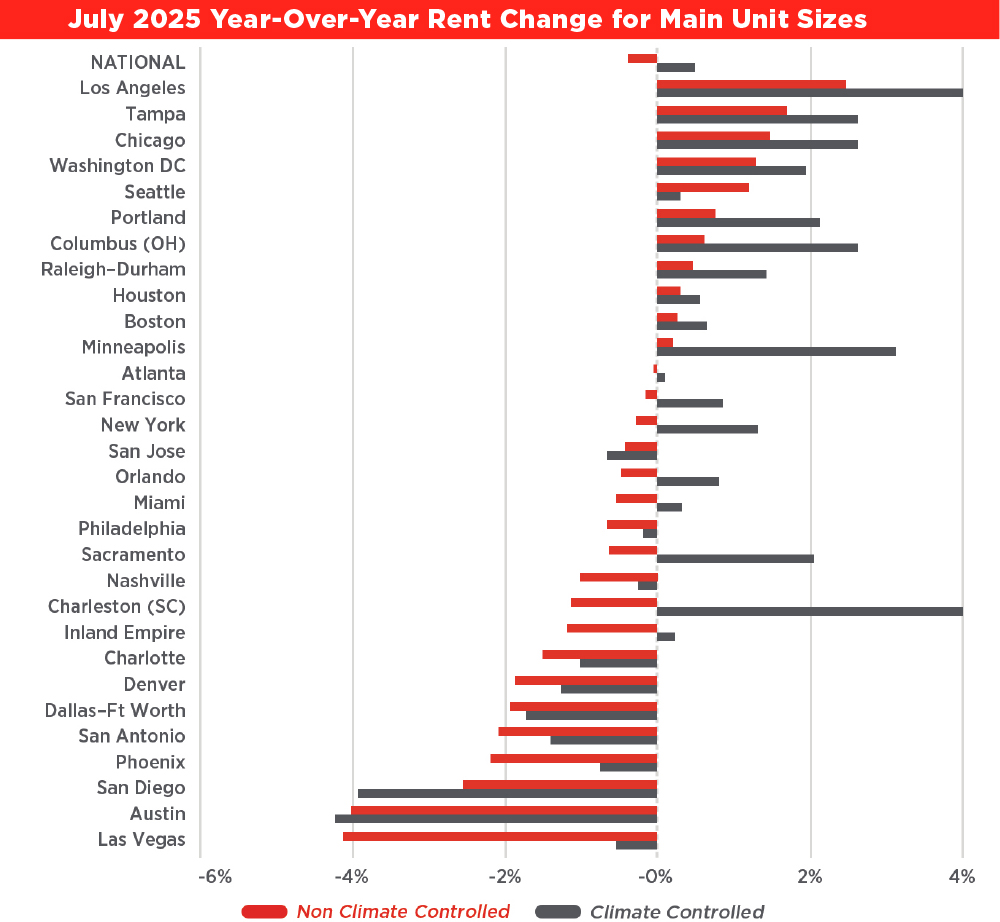
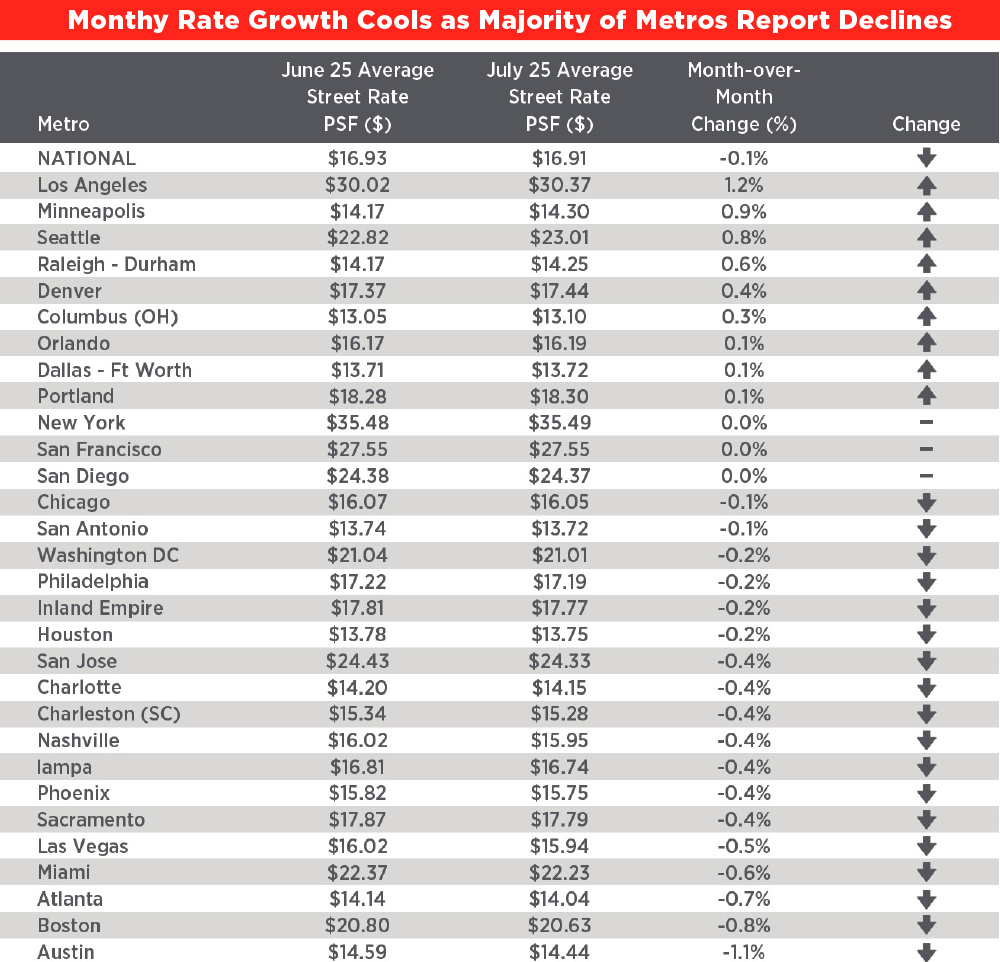
While July had metro-level variability in sequential rates, the majority of metros saw asking rates decline, with same-store advertised rents dropping in 18 of the top 30 month over month.
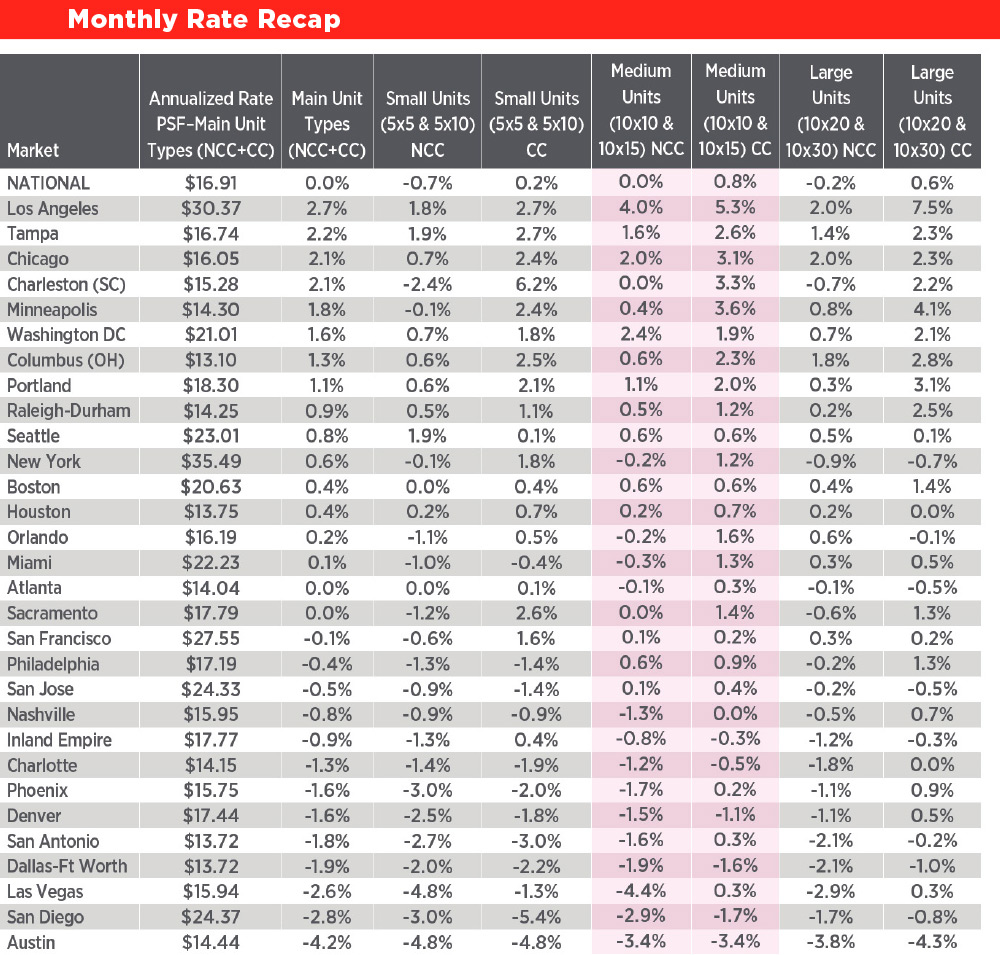
Asking rates in Los Angeles outperformed the other top metros in July, leading the nation in month-over-month (+1.2 percent) as well as year-over-year (+2.7 percent) growth. Storage operators continued to raise advertised rates to compensate for L.A.’s wildfire-related restrictions on existing-customer rent increases, led by storage REITs, which increased rates in L.A. by 1.8 percent month over month and 6.3 percent year over year in July.
See Metro table and National Average Street Rates PSF for Main Unit Types chart.
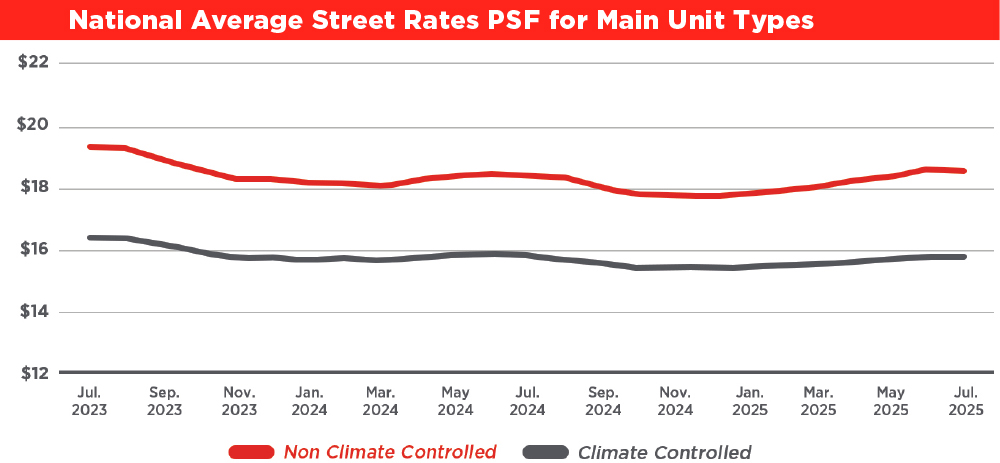
Meanwhile, Austin, Denver, and San Diego are being impacted by weak demand, largely driven by underperforming housing and apartment markets. In Austin, advertised rate growth was among the worst both month over month and year over year in July, despite low lease-up supply, suggesting a demand-side issue likely tied to reduced migration and a weak housing market impacting both the for sale and for rent sides. Denver and San Antonio are experiencing similar trends, with multifamily rent declines a sign of weak self-storage demand, which is putting downward pressure on asking rents.
See Self-Storage Major Metro Summary chart.
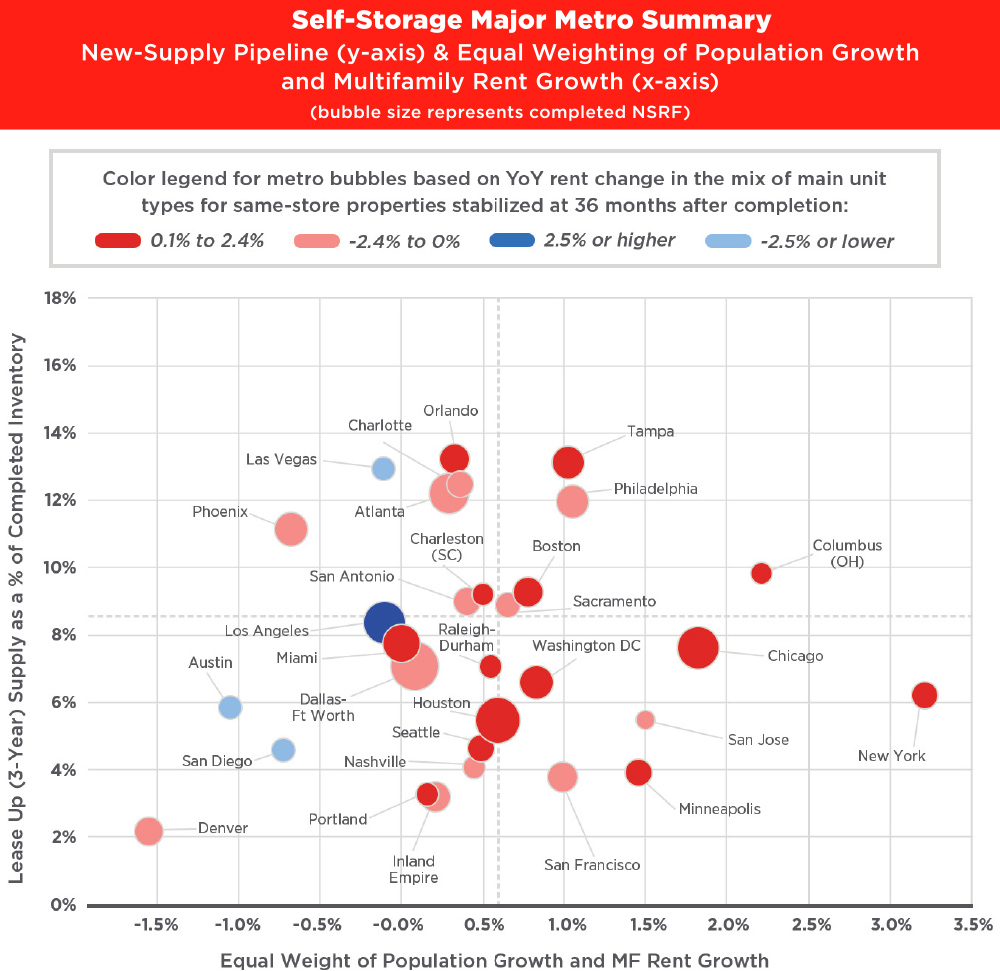
At the metro level, 19 of Yardi Matrix’s top 30 metros saw an increase in three-year lease-up supply over the past year. Leading the pack were Sacramento, Columbus, Charlotte, San Antonio, Orlando, and Tampa.
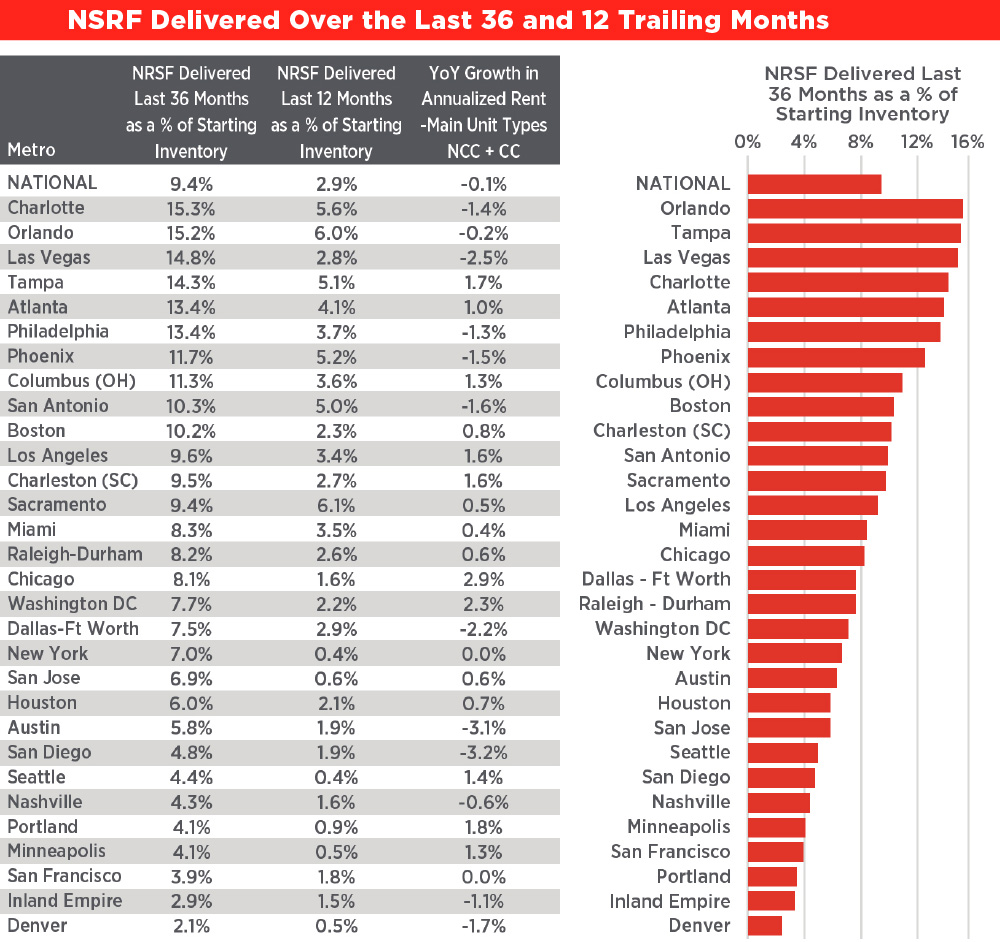
Conversely, New York, Portland, and Minneapolis experienced the largest declines in trailing 36-month deliveries. In July, New York’s three-year supply fell to 6.2 percent, a 510-basis-point drop from the previous year. This reduction in new supply contributed to New York’s largest year-over-year increase in asking rates since December 2023, up 0.6 percent.
See NRSF Delivered Over the Last 36 and 12 Trailing Months chart.
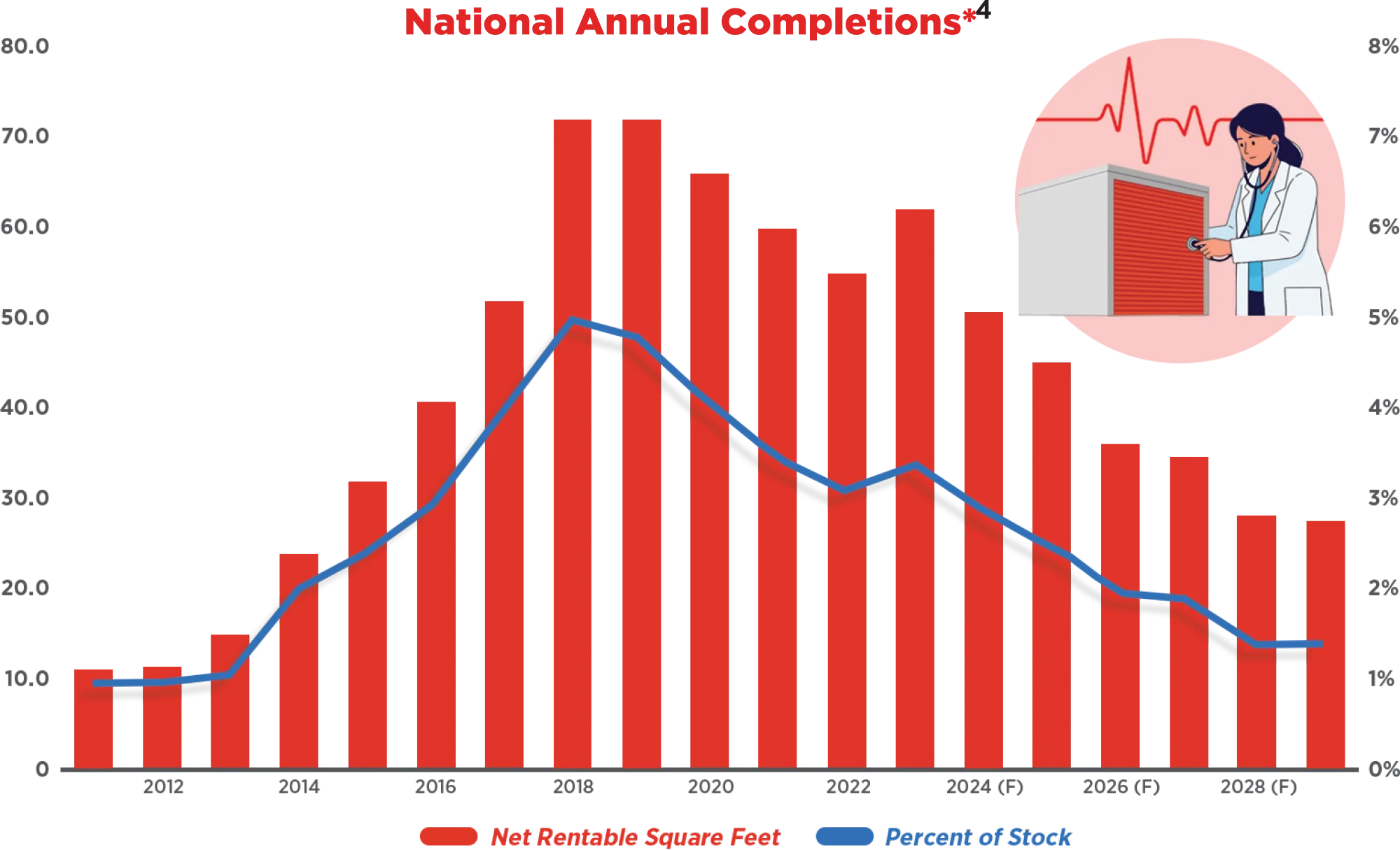
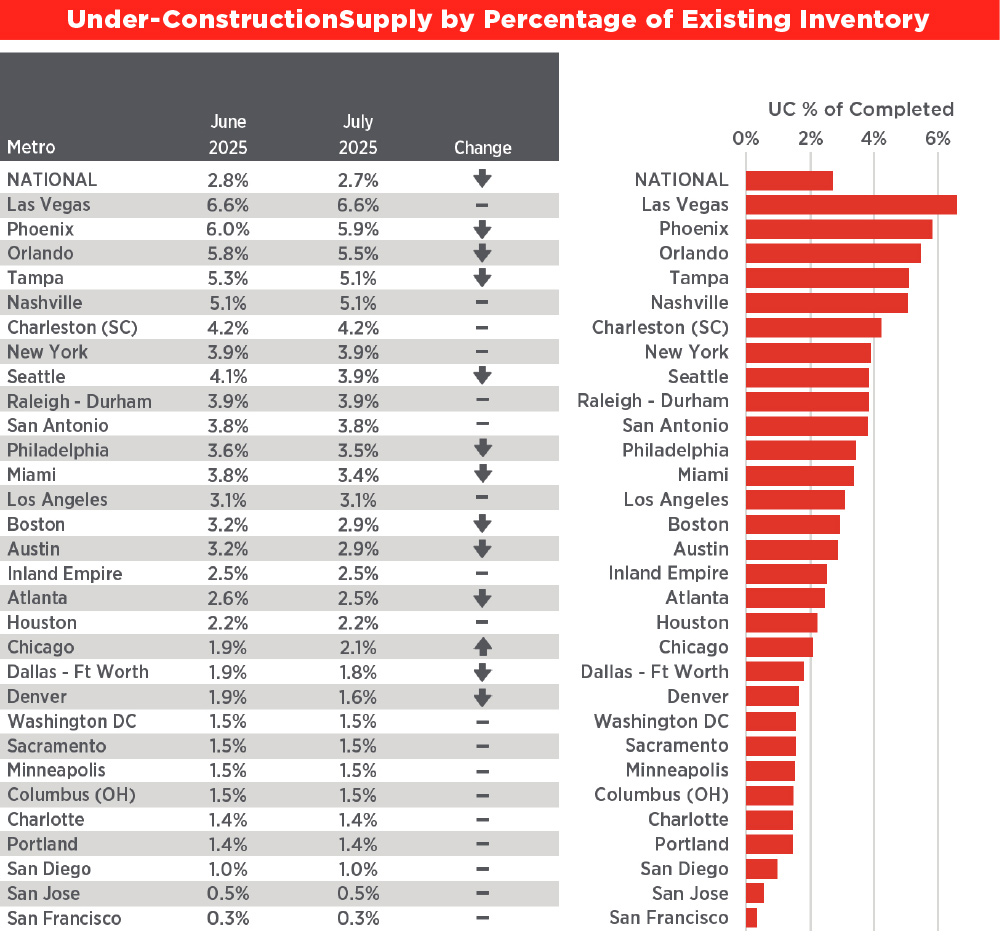
The Q3 2025 Yardi Matrix Self Storage supply forecast remains largely consistent with the Q2 update, continuing to reflect a slowdown in development activity. New construction starts totaled 19.9 million NRSF in the first half of 2025, a 13.2 percent decline compared to the same period in 2024. Looking ahead, new square footage is expected to decline by 15 percent in 2025, 18 percent in 2026, and 8 percent in 2027. The prospective pipeline continues to contract, falling 3.5 percent quarter over quarter and 22.5 percent year over year.
A number of top 30 markets have a higher level of supply under construction than trailing 12-month deliveries, which will be a headwind for rent growth over the next 12 to 24 months. Las Vegas saw a break in supply over the past year but has seen the biggest increase in supply under construction recently, followed by Nashville, New York, and Seattle. On the other hand, Sacramento and Charlotte have the least amount of supply under construction relative to trailing 12-month supply, which should help recently delivered supply get absorbed.
See Under-Construction Supply by Percentage of Existing Inventory chart and Monthly Rate Recap table.
From Power To Purpose
achel Parham’s life story is something straight out of an NBC prime-time series; something that would fit in perfectly in a show lineup with “Scandal,” “Quantico,” and “Law and Order,” except that it wasn’t written by Shonda Rhimes and providence made sure that despite all her action-packed stints in Washington, D.C., she would pivot her career completely to work in the self-storage industry.
Her life is also a testament of all the great things that can happen when you trust your instincts, even when you don’t know why they’re calling you to do something, and above everything else, to trust that life always finds a way of working itself out.
But before we talk about how she ended up on that career path, let’s go back to our timeline. Sixteen months after she was born, her sister Rebecca came along; then, when she was 8, her brother David joined the family. “We had prayed so much for a little brother,” says Rachel; “and when he finally came, we were so happy to have him!”
Their childhood was idyllic. She rode horses. Her sister was a theater kid and scuba diver. Her brother played basketball and video games. “Our parents were very involved in our lives, and they let us pursue our interests,” Rachel says. “We were also always very involved in the family business, cleaning out units, going to 3 a.m. concrete pours with dad, and shopping competitors.”
“That was pretty cool,” she recalls. “I trained at Quantico, and we’d raid houses,” she says as casually as telling you that it’s Tuesday, yet providing context that seems straight out of a movie. “In 2008 to 2009, there was a massive meth problem across the U.S. The No. 1 issue with these facilities is that meth is very explosive, and some of the dealers would set up traps in these homes so that they’d blow up during a raid.” The team she was interning with would track people purchasing the drugs and who was running each lab; they also learned how to handle these dangerous traps.
Waterboarding was a big issue at the time too. “I had to put out briefings for attorneys at the attorney general’s office, as well as for other people in the Department of Justice.”
She loved that time of her life because it was her first time experiencing what it was like to be in an office environment. “I appreciate internship programs because that’s when the real training starts to happen—answering emails in a professional manner, learning what HR does, paying attention to detail. Come in early, stay late. I outworked and outperformed everyone, and I don’t say this to toot my own horn. It was how I was brought up—the work ethic I learned from my parents—and back then, I thought my career path would be in D.C.”

While working on her master’s, Rachel held several side jobs: headhunter at Novus Medical, bus driver at a sports camp that took kids to and from an afterschool program, and bartending on weekends. “I worked all the time when I wasn’t in school.”
Then she was awarded the Texas A&M Agriculture and Natural Resources Policy internship in the House of Representatives for Congressman Lamar Smith. During this time, she had a big awakening about life in D.C. “Capitol Hill is run on the backs of 20-year-olds,” says Rachel. “You do a lot of work and make no money. It’s also very clique-ish and sleazy.”
While there were people with integrity working alongside her, Rachel says it was hard to find them. “It made me not like politics. I do believe the U.S. has the best democracy, and I’m glad I live here, but I have a problem not calling out injustices or not mentioning the elephant in the room, and as much as I wanted to be in politics my entire life, working there changed my outlook on all of it.” Overall, it was a demoralizing realization. “Here I was, with three degrees, and my dream had imploded.”
At first, she thought it would be a good idea to work for her dad, then start her own business. Her father was surprised, especially since she asked to come work with him so soon after the 2008 to 2009 economic crisis. “Back then, he was shocked by my request because he was so near retirement, so he asked me why I’d want to do that. I didn’t quite understand why, but I wanted to be with my family.”
Since she had grown up being a part of the business, it was easy for her to fit in. She also brought more structure to their processes. “My dad always kept his word, so up until that point he was fine doing handshake deals, but I put everyone under contract.” They developed additional properties, even winning Messenger’s prestigious Facility of the Year award for some of them along the way. Rachel served as project manager for many of those facilities. She loved everything about her new career, and she especially loved spending so much time with her family and learning so much from her dad.
But not everything was going well. In 2014, she noticed her dad wasn’t his usual self. “He was sick, and we didn’t know it,” she says sadly. In November of that year, when they had just started construction for Love’s Storage Solutions in El Paso, Texas, Mike passed away following a massive heart attack. Eleven years later, the heartbreak is still very palpable when Rachel tells the story.
“It was life altering,” she says. “If you know anything about my dad, he was a legend. He helped start a lot of the self-storage associations. He developed consulting criteria and demand analysis. He was a huge contributor to this industry. Both of my parents were.”
When he passed, the Parham family wondered whether to sell or close NDS Construction and just continue to manage the 10-plus Noah’s Ark facilities they currently owned or move forward with future developments. Her mom played a key role in their decision to continue with all Parham Group companies. “My mom, the great thing about her is that you just don’t get her down. She’s an amazing person—a trailblazer. She was one of the first women to graduate from ROTC when women were first allowed to join. She became a commissioned officer. After my dad’s death, we looked at each other and decided not to let the development and construction company go.” This was yet another pivot her life would take, since her plan when she moved back to Texas was to learn the business, then start her own. But her dad’s passing made her want to stay and continue what he had built.
“At the beginning, it all felt like a burden,” says Rachel. “Everything was so hard without my dad here, and I lived in fear that I’d let everyone down.”
Her faith was crucial in getting her through these difficult moments. “That feeling I had back in D.C. to come back home didn’t happen by chance,” she says. “There’s a reason why God called me to come home. That urge had come out of nowhere, and it’s a miracle we’re still here. There were a lot of times when things shouldn’t have worked out, but they did. And I know it’s all been blessings from God. If He wasn’t a part of it, I don’t know where I would be today.”
She’s also clear on her priorities in life. “I’m a Christian first, then comes family, and I feel a strong obligation towards them. Same with the people who work here. Some started in the ‘90s. We have people who’ve been here for over 20 years. My dad loved them, and they loved him back. They take good care of the company. I don’t have to worry about things running smoothly at work. It’s been an eye-opening experience and a blessing to come out on the other side of everything and look at everything we’ve learned and accomplished. It’s also taught me to trust that things will work out, even when they seem difficult at first.”
Today, she feels very optimistic. “The sky’s the limit. I have great people I work with. We’re all on the same mission. I love that we have so many generations here. It’s a good balance. My mom is retired now, but she’s still actively involved because she doesn’t know how to be retired.”
When not working, Rachel loves to read. “I read two books a month: one about leadership or professional development and one for fun.” She loves murder mysteries, the Harry Potter series, “Lord of the Rings,” and “The Hunger Games.” Of course, someone with an unwavering faith like hers is also a fan of C.S. Lewis. She’s also very involved in her church, Community Bible Church, and loves to write. “I’ve been writing since I was really young, and I want to write novels someday.”
Rachel ikes to stay informed about what’s happening in the economy and the world too. “It’s part of my due diligence for the investments and growing our clients.”
And if you’re wondering how she has the time to juggle the million things she does, once again, she credits her faith. “Once I started prioritizing my relationship with God, everything else has fallen into place. It’s amazing how that works. It’s very freeing. I do a lot more because I can balance my time a lot better.”
Looking back at her life, Rachel feels a great sense of peace and accomplishment. “I never thought I’d own my family’s company, have all these successful projects under my belt, and have tons of new projects in predevelopment or under construction. But now that it’s all been said and done, I love it. I wake up every day thrilled that I work with the people that I work with, that we get to do what we do, and that I get to work with my family.”
Being the oldest, Rachel can’t help but take pride in her younger siblings. Singing their praises, she says, “My sister [Rebecca] is an animator and a famous YouTuber. Look up her channel, Let Me Explain Studios. She creates stories about her life and our family, and we’re all in there as cartoon characters.” As for David, in 2024, thanks in part to his exceptional people skills, he became CEO and president of Joshua Management, one of the three companies that make up The Parham Group (alongside NDS and Noah’s Ark Development). She is always quick to point out that he is the perfect Parham for the position!

David

Rebecca

Rachel

Storage
espite economic uncertainty from tariffs and inflation, as well as higher mortgage rates that kept many people from buying new homes, self-storage operators seemed to sail through 2025 with ease. In fact, portfolio growth was reported by many of this year’s top 100 operators.
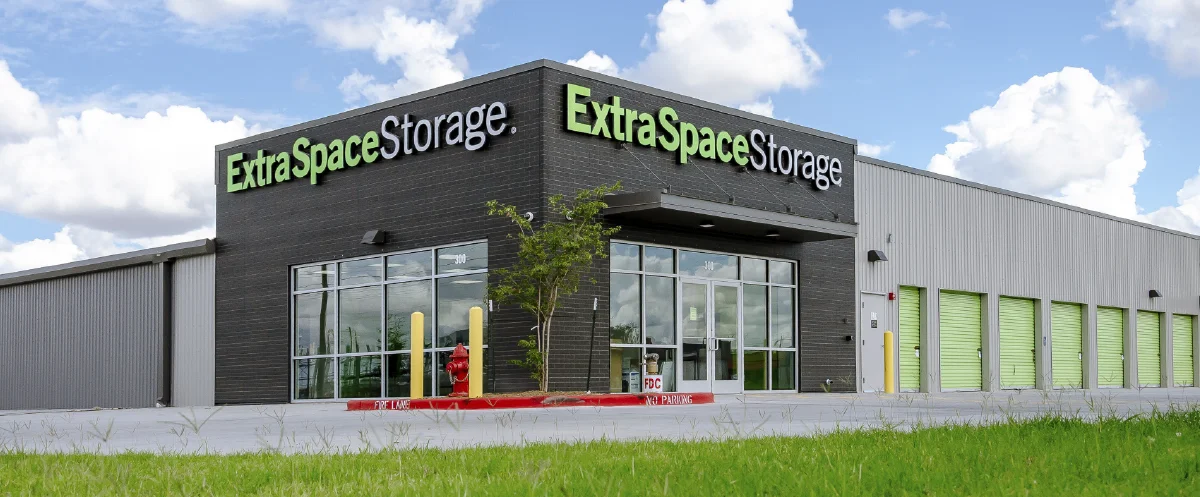
At No. 1 for the third year in a row is Extra Space Storage, which expanded its portfolio by nearly 30 million net rentable square feet (NRSF) over the past 12 months; that’s an addition of three times as much NRSF than the approximately 10 million NRSF added from 2023 to 2024. On top of that astonishing growth, this year the REIT has reported that it manages roughly 17 million NRSF more than it owns.
Like 2024, Public Storage, the second-largest operator, grew its portfolio by another approximately 11 million NRSF. Although about half of that amount (approximately 5 million NRSF) was added to the management side of its portfolio, Extra Space Storage still manages five times as much net rentable square feet in the United States than Public Storage.
Once again claiming third place is CubeSmart, which manages almost 2 million more NRSF than it owns. And with approximately 53.2 million NRSF of storage managed, roughly 20 million more than Public Storage, CubeSmart has the second-largest third-party management portfolio in the self-storage industry. Storage Asset Management (SAM), ranked No. 6, has the third-largest third-party management portfolio at 37,620,000 net rentable square feet.
Rounding out the top five are U-Haul International (No. 4) and National Storage Affiliates Trust (No. 5). Their ranks remain unchanged from 2024, even though they each added about 1 million NRSF to their portfolios since the last Top Operators list was published.
After SAM comes SmartStop Self Storage in 7th place—a climb of four places since ranking No. 11 in 2024. SmartStop’s quick growth can be attributed to it becoming a publicly traded company in 2025. Its initial public offering (IPO) was completed in April, listing on the New York Stock Exchange (NYSE). Four months later, SmartStop Self Storage REIT was added to the Morgan Stanley Capital International U.S. Real Estate Investment Trust (MSCI US REIT) Index. Then, after MSM’s 2025 Top Operators survey had ended, SmartStop acquired Argus Professional Storage Management (APSM) in a deal that closed on October 1st. APSM is ranked No. 16 this year, dropping six spots from 2024.
Ranking No. 8 is The William Warren Group, which operates facilities under the StorQuest brand; it ranked 13th last year. In nineth is Storage Rentals of America (SROA), an operator that wasn’t listed in the 2024 list but has been ranked in previous years. It owns and operates nearly 32 million NRSF from 683 facilities across the United States, 12 in England, and three in Scotland. Other high-ranking newcomers to the 2025 list include White Label Storage at No. 13, City Line Capital at No. 15, and Absolute Storage Management at No. 25.
Finally, due to the addition of SROA and upward movement from The William Warren Group and SmartStop, as well as a slight decline in portfolio size, StorageMart has dropped from seventh to tenth.
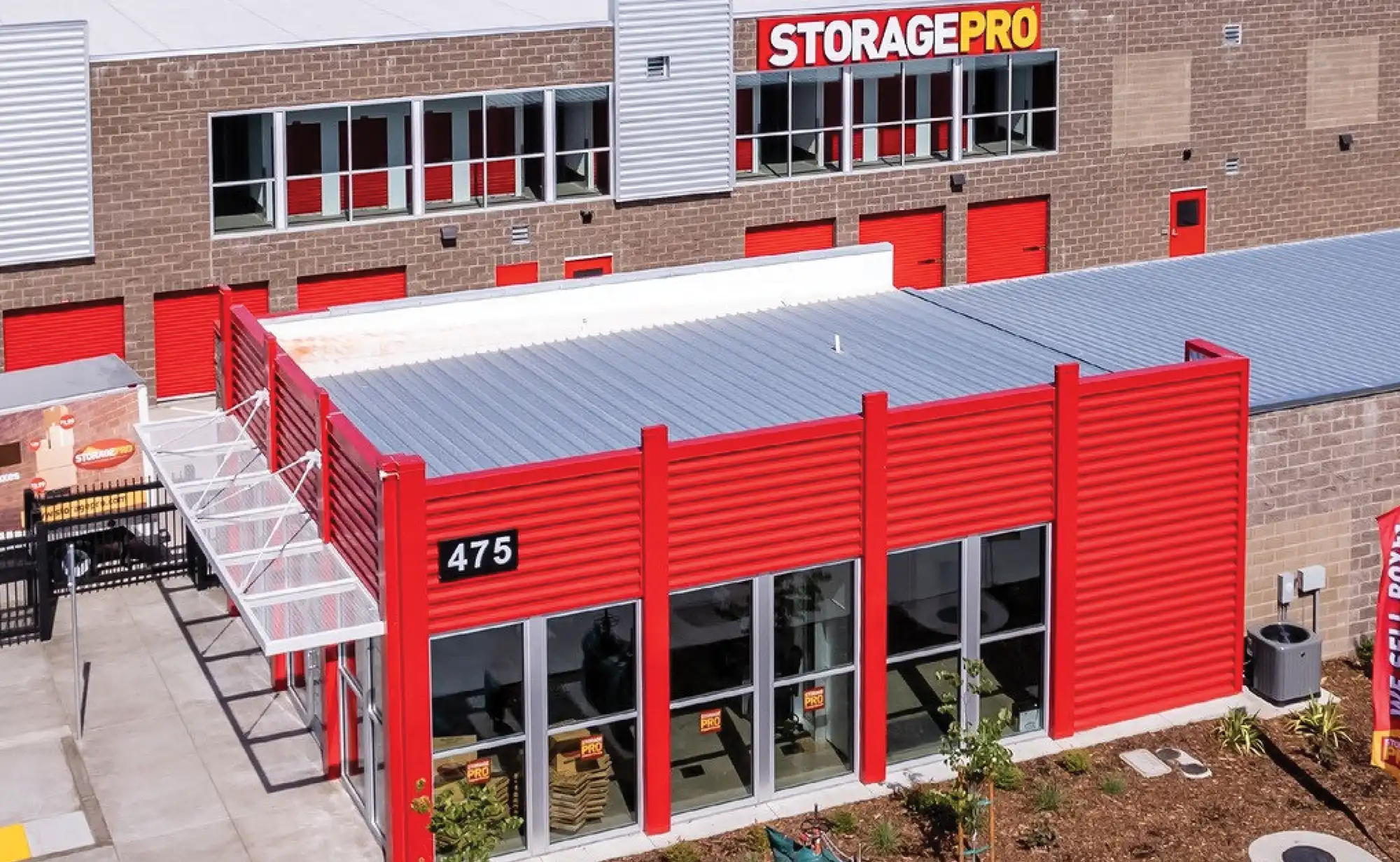
In total, 27 companies on the 2025 list were not ranked on 2024 list. Some of these companies have been ranked in previous lists, but consolidation has (and will continue) to make way for new entrants, such as No. 26 StoragePRO’s acquisition of Storage Investment Management, Inc. (SIMI) in January.
On the following pages, we present the 2025 Top Operators. As in the past, the list is compiled solely from information submitted in MSM’s annual Top Operators survey and ranked by total net rentable square feet. Please note: Self-storage facilities that are owned and managed by the same company are only tallied in the “Facilities Owned” section of the table. International facilities are included in the grand totals but not listed within the table; that data can be found in MSM’s Top Operators kit.
We would like to extend our congratulations to all the top operators for their ability to navigate choppy waters and the tides of uncertainty. Their fortitude and flexibility are certainly worthy of admiration and applause!
- Extra Space Storage
- Public Storage**
- CubeSmart
- U-Haul International
- National Storage Affiliates Trust
- Storage Asset Management
- SmartStop Self Storage**
- The William Warren Group (StorQuest)
- Storage Rentals of America**
- StorageMart**
- Merit Hill Capital
- Prime Group Holdings (Prime Storage)**
- White Label Storage
- Derrels Mini Storage, Inc.
- City Line Capital
- Argus Professional Storage Management LLC
- Westport Properties, Inc.
- Andover Properties
- Go Store It
- Devon Self Storage
- Morningstar Properties
- West Coast Self-Storage
- Mini Mall Storage**
- Reliant Real Estate Management
- Absolute Storage Management
- StoragePRO Management
- Amsdell Cos (Compass Self Storage)
- KO Storage
- SecureSpace Self Storage
- 10 Federal Storage
- Storelocal Storage***
- Space Shop Self Storage
- Store Space Self Storage
- Brookwood Properties
- Rosewood Property Company
- Atomic Storage Group
- Spartan Investment Group
- TnT Self Storage Management
- Universal Storage Group
- Baranof Holdings
- Safeguard Self Storage
- Strat Property Management
- Trojan Storage
- Urban Self Storage Inc.
- Arcland Property Company
- Security Public Storage (Baco Properties)
- Right Move Storage, LLC
- Pogoda Companies
- A-1 Self Storage
- Copper Storage Management
- Trusted Self Storage Professionals
- Metro Mini Storage
- Cubix Asset Management
- Boardwalk Development Group
- Dahn Corporation
- Purely Storage
- Guardian Storage
- Prestige Capital Management
- Crescendo Properties & Self Storage Management
- Packed Planet Self Storage Management (The Nicholson Companies)
- Budget Store & Lock Self Storage
- Five Star Storage
- All Aboard Storage
- Adams Property Group
- All-Purpose Storage
- National Self Storage
- 4217 Storage Management LLC
- The Storage Mall Management Group
- Towne Storage Management Co.
- Value Store It Management, Inc.
- SKS Management LLC
- SAFStor
- Superior Storage
- Wentworth Property Company
- DXD Capital
- StorageMax
- Storage of America
- Donald Jones Consulting & Service
- Sentry Self Storage Management
- Gulf Atlantic Asset Management
- JustStorage
- Storage Etc
- Haviland Storage Services
- Northwest Building LLC
- Ojai Oil Company (Golden State Storage)
- McGregor Interests Inc
- Synergy Storage Group
- Columbia Storage Group
- Cox’s Armored Mini Storage Management, Inc.
- Tierra Corporation
- StorSafe Self Storage Management
- Epic Storage Group
- The Storage Manager
- Advantage Consulting & Management
- NitNeil Partners
- Artisan Properties, Inc.
- Storage Corner Group
- Ziff Real Estate Partners
- RHW Capital Management Group LLC
- Nova Storage
-
2795 E. Cottonwood Parkway
Salt Lake City, UT 84121Phone: (801) 562-5556
Email: info@extraspace.com
Website(s): www.extraspace.com
OWNER/PRESIDENT: Publicly Traded
Contact: Corporate Communications Team
Founded: 1977
Number of Facilities: 4,179
Total net rentable square footage: 321,456,661
Number of Facilities in Development: Extra Space has two projected openings in partnership with joint ventures opening in 2025 and two projected openings also in partnership with JVs opening in 2026.
Expansion plans: Extra Space’s plan is to continue to grow aggressively and strategically in both its owned and managed properties. -
701 Western Avenue
Glendale, CA 91201Phone: (818) 244-8080
Website(s): www.publicstorage.com
OWNER/PRESIDENT: Joe Russell
Founded: 1972
Number of Facilities: 3,843
Total net rentable square footage: 274,861,420
Number of Facilities in Development: 25
Expansion plans: Public Storage plans to continue to grow through acquisition, development, and redevelopment. -
5 Old Lancaster Road
Malvern, PA 19355Phone: (610) 535-5000
Email: sspina@cubesmart.com
Website(s): www.cubesmart.com
OWNER/PRESIDENT: Chris Marr
Contact: Guy Middlebrooks
Founded: 2006
Number of Facilities: 1,523
Total net rentable square footage: 104,757,645
Number of Facilities in Development: 2
Expansion plans: CubeSmart will continue to evaluate expansion opportunities. -
2727 N. Central Avenue
Phoenix, AZ 85004Phone: (602) 263-6811
Email: publicrelations@Uhaul.com
Website(s): www.Uhaul.com
OWNER/PRESIDENT: EJ Joe Shoen
Contact: Dennis O’Connor
Founded: 1945
Number of Facilities: 1,958
Total net rentable square footage: 90,704,374
Number of Facilities in Development: 130
Expansion plans: U-Haul plans to expand through new construction, acquisitions, and build out of existing facilities. -
8400 E. Prentice Avenue
Greenwood Village, CO 80111Phone: (720) 630-2160
Email: ghoglund@nsareit.net
Website(s): www.nsastorage.com
OWNER/PRESIDENT: David Cramer
Contact: George Hoglund
Founded: 2013
Number of Facilities: 1,067
Total net rentable square footage: 69,673,181 -
3501 Concord Road
York, PA 17402Phone: (717) 779-0044
Email: info@storageasset.com
Website(s): www.storageassetmanagement.com
OWNER/PRESIDENT: Alyssa Quill
Contact: Melissa Stiles
Founded: 2010
Number of Facilities: 625
Total net rentable square footage: 37,620,000
Number of Facilities in Development: 12 contracts in development
Expansion plans: The company plans to continue to do a good job for its current properties and be awarded management contracts. -
10 Terrace Road
Ladera Ranch, CA 92694Phone: (949) 429-6600
Email: info@smartstop.com
Website(s): www.smartstop.com
OWNER/PRESIDENT: H. Michael Schwartz
Contact: Rhonda Williams
Founded: 2005
Number of Facilities: 473
Total net rentable square footage: 36,562,000
Expansion plans: The company plans to grow through targeted growth and stabilized assets in markets across the U.S. where it can achieve economies of scale. In addition, it’s targeting growth in the Greater Toronto Area and other major CMAs across Canada. The company will also be looking to grow its third-party management business in the U.S. and Canada. -
100 Wilshire Boulevard, Suite 400
Santa Monica, CA 90401Phone: (310) 497-2543
Email: jciminillo@williamwarren.com
Website(s): www.williamwarren.com
OWNER/PRESIDENT: Bill Hobin
Contact: Jennifer Ciminillo
Founded: 1994
Number of Facilities: 354
Total net rentable square footage: 35,500,000
Number of Facilities in Development: 11
Expansion plans: The company plans to expand its portfolio by 25 new locations. -
2751 S. Dixie Highway
West Palm Beach, FL 33401Phone: (561) 412-4719
Email: contact@sroa.com
Website(s): www.sroa.com
OWNER/PRESIDENT: Benjamin Macfarland
Founded: 2013
Number of Facilities: 698
Total net rentable square footage: 31,851,987
Number of Facilities in Development: 5
Expansion plans: The company plans to expand by approximately 1,000,000 GSF of storage.
-
215 N. Stadium Boulevard, Suite 207
Columbia, MO 65203Phone: (573) 268-0997
Email: sarah.little@storage-mart.com
Website(s): www.storage-mart.com
OWNER/PRESIDENT: Mike Burnam
Contact: Sarah Elizabeth Little
Founded: 1999
Number of Facilities: 354
Total net rentable square footage: 31,683,045
Number of Facilities in Development: 5
Expansion plans: StorageMart is driving global growth through acquisitions and third-party management, expanding its digital footprint, and elevating the customer experience through innovation and strategic partnerships. -
41 Flatbush Avenue
Brooklyn, NY 11217Phone: (929) 283-6785
Email: ir@merithillcapital.com
Website(s): www.merithillcapital.com
OWNER/PRESIDENT: Liz Raun Schlesinger
Contact: Jane Jones
Founded: 2016
Number of Facilities: 406
Total net rentable square footage: 26,016,389 -
395 Broadway
Saratoga Springs, NY 12866Phone: (518) 615-0552
Email: mitchell.rager@goprimegroup.com
Website(s): www.goprimegroup.com
OWNER/PRESIDENT: Robert J. Moser
Contact: Mitchell Rager
Founded: 2013
Number of Facilities: 325
Total net rentable square footage: 24,478,400 -
214 Greene Avenue
Brooklyn, NY 11238Phone: (410) 693-5166
Email: contact@whitelabelstorage.com
Website(s): www.whitelabelstorage.com
CEO/CO-FOUNDER: Peter Smyth
Co-Founder: Alex Hartman
Contact: Liisi Fall
Founded: 2018
Number of Facilities: 279
Total net rentable square footage: 22,593,300
Expansion plans: The company will continue to seek new management contracts across the country. -
3239 W. Ashlan Avenue
Fresno, CA 93722Phone: (559) 224-9900
Email: tgiuffrida@derrels.com
Website(s): www.derrels.com
CEO: Derrel A. Ridenour
Contact: Tosha Giuffrida, VP Operations
Founded: 1962
Number of Facilities: 69
Total net rentable square footage: 20,750,500
Number of Facilities in Development: 2
Expansion plans: The company plans to expand its portfolio by 700,000 square feet. -
1 Presidential Boulevard
Bala Cynwyd, PA 19004Phone: (484) 434-8654
Email: eginsburg@citylinecapital.com
Website(s): www.citylinecapital.com
OWNER/PRESIDENT: Richard Schontz
Founded: 2017
Number of Facilities: 323
Total net rentable square footage: 19,500,000 -
2953 S. Peoria Street, Suite 200
Aurora, CO 80014Phone: (520) 320-9135
Email: info@argusprofessionalstoragemanagement.com
Website(s): www.argusprofessionalstoragemanagement.com
OWNER/PRESIDENT: Ben Vestal and Korey Hanson
Contact: Amy Hitchingham
Founded: 2012
Number of Facilities: 240
Total net rentable square footage: 17,423,633
Expansion plans: The company will continue to expand its footprint in existing and new markets. -
660 Newport Center Drive, Suite 1450
Newport Beach, CA 92660Phone: (949) 748-5900
Email: info@westportproperties.net
Website(s): www.westportproperties.net
OWNER/PRESIDENT: Drew Hoeven
Contact: Jason Lopez
Founded: 1985
Number of Facilities: 212
Total net rentable square footage: 15,280,392
Number of Facilities in Development: 4
Expansion plans: The company plans to expand through acquisitions, third-party management, and development in the major MSAs and in any areas where it has a strategic presence. -
780 Third Avenue, 33rd Floor
New York, NY 10017Phone: (212) 813-0141
Email: info@andoverprop.com
Website(s): www.andoverprop.com; www.storagekingusa.com
OWNER/PRESIDENT: Brian Cohen
Contact: Carly Causey
Founded: 2003
Number of Facilities: 169
Total net rentable square footage: 14,248,247
Expansion plans: Andover continually aims to grow its portfolio, organically through expansions as well as through acquisitions. It also has other verticals, such as small bay industrial, car washes, and a lending platform, all of which are also growth areas for the company. -
4210 Yancey Road
Charlotte, NC 28217Phone: (704) 275-0433
Email: beau@gostoreit.com
Website(s): www.gostoreit.com
OWNER/PRESIDENT: Ryan Hanks
Contact: Beau Agnello
Founded: 2013
Number of Facilities: 200
Total net rentable square footage: 13,722,940
Number of Facilities in Development: 10
Expansion plans: The company plans to acquire facilities with at least 40,000 net rentable square feet in the Sun Belt and West Coast markets. It will also pursue 10 to 15 ground-up developments annually, targeting high-barrier-to-entry submarkets and continue to partner with independent owners and institutional investors for third-party management services.
-
2901 Butterfield Road
Oak Brook, IL 60523Phone: (513) 497-8810
Email: vrovekamp@devonselfstorage.com
Website(s): www.devonselfstorage.com
OWNER/PRESIDENT: Kenneth Nitzberg and Matthew Tice
Contact: Vanessa Rovekamp
Founded: 1983
Number of Facilities: 204
Total net rentable square footage: 12,989,437
Number of Facilities in Development: 1
Expansion plans: Devon Self Storage’s expansion plan for the next 12 months is centered on strategic growth through both new developments and adaptive reuse conversions across key U.S. markets. With over 200 properties already under management, the company is actively pursuing additional acquisitions and third-party management agreements that align with its data-driven revenue models and Class-A facility standards. Several projects—including ground-up builds and the transformation of retail and industrial structures into modern storage facilities—are scheduled to deliver in the coming year, enhancing Devon’s presence in high-demand regions. Complementing this physical growth, Devon will continue to invest in advanced marketing automation, digital leasing technology, and brand-consistent facility upgrades to strengthen market share and deliver exceptional customer experiences. Together, these efforts position Devon to accelerate portfolio expansion, optimize occupancy, and reinforce its reputation as a trusted leader in the self-storage industry. -
725 Park Center Drive
Matthews, NC 28105Phone: (704) 578-5225
Email: mshapiro@mstarproperties.com
Website(s): www.morningstarstorage.com
CEO: David Benson
PRESIDENT/CIO: Matthew Shapiro
Contact: Matt Shapiro
Founded: 1981
Number of Facilities: 116
Total net rentable square footage: 11,732,908 -
808 134th Street SW, Suite 211-B
Everett, WA 98204Phone: (206) 501-2234
Email: jeisenbarth@wcselfstorage.com
Website(s): www.WestCoastSelfStorage.com
OWNER/PRESIDENT: Jim McNamee
Founded: 2006
Number of Facilities: 159
Total net rentable square footage: 11,543,085
Number of Facilities in Development: 3
Expansion plans: The company plans for continued growth on the West Coast through management, acquisition, and development, likely 12 to 15 additional properties a year. -
1201 Glenmore Trail SW
Calgary, AB T2V 4Y8Phone: (403) 698-0929
Email: limcdonald@minimallstorage.com
Website(s): www.minimallstorage.com
OWNER/PRESIDENT: Adam Villard
Contact: Tammy Cho
Founded: 1977
Number of Facilities: 255
Total net rentable square footage: 10,766,655 -
1146 Canton Street
Roswell, GA 30075Phone: (770) 609-8276
Email: tallen@reliant-mgmt.com
Website(s): www.reliant-mgmt.com; www.midgardselfstorage.com
OWNER/PRESIDENT: Todd Allen, Lew Pollack
Contact: John Cordova
Founded: 2009
Number of Facilities: 110
Total net rentable square footage: 9,849,374
Number of Facilities in Development: 2
Expansion plans: The company plans to purchase value-add and stabilized facilities in its footprint while also connecting SE to IN. It will also selectively pursue ground-up and conversion opportunities. -
1630 Bonnie Lane, Suite 106
Cordova, TN 38016Phone: (678) 779-1978
Email: jasmin.allen@absolutemgmt.com
Website(s): www.absoutASM.com
OWNER/PRESIDENT: Scott Beatty
Contact: Jasmin Allen
Founded: 2002
Number of Facilities: 168
Total net rentable square footage: 9,674,297
Number of Facilities in Development: 3
Expansion plans: Absolute Storage Management is expanding across the Southeast market with seamless property transitions, dynamic pricing, and strong branding. By maximizing revenue and building trusted client partnerships, Absolute is positioned for long-term growth. -
1615 Bonanza Street
Walnut Creek, CA 94596Phone: (800) 393-8373
Email: results@storagepro.com
Website(s): www.storagepromanagement.com
OWNER/PRESIDENT: Steve Mirabito
Contact: Melissa Shandor
Founded: 1975
Number of Facilities: 156
Total net rentable square footage: 9,615,812
Expansion plans: The company plans to expand throughout the East Coast and in major MSAs nationwide. -
20445 Emerald Parkway Drive, Suite 220
Cleveland, OH 44135Phone: (216) 458-0670
Email: dpetry@amsdellcompanies.com
Website(s): www.compassselfstorage.com
OWNER/PRESIDENT: Todd C. Amsdell
Contact: Katie Fete
Founded: 2007
Number of Facilities: 116
Total net rentable square footage: 8,633,079
Number of Facilities in Development: 3
Expansion plans: The company will continue to look for quality self-storage facilities to acquire, develop new sites, and convert existing buildings into self-storage. -
10301 Wayzata Boulevard
Minnetonka, MN 55305Phone: (952) 201-5382
Email: charles@kostorage.com
Website(s): www.kostorage.com
OWNER/PRESIDENT: Andrew Freeman, Jon Marshalla/Charles Gardiner
Contact: Charles Gardiner
Founded: 2019
Number of Facilities: 224
Total net rentable square footage: 8,604,706
Expansion plans: The company plans for growth through acquisitions as well as third-party management contracts. -
2015 Manhattan Beach Boulevard, Suite 104
Redondo Beach, CA 90278Phone: (866) 521-8292
Email: marketing@securespace.com
Website(s): www.securespace.com
OWNER/PRESIDENT: Chip Brown
Contact: Juan Castellanos
Founded: 2019
Number of Facilities: 82
Total net rentable square footage: 7,588,082
-
3301 Atlantic Avenue
Raleigh, NC 27604Phone: (855) 744-1010
Email: support@10federalstorage.com
Website(s): www.10federalstorage.com
OWNER/PRESIDENT: Andrew Capranos
Contact: James Miralia
Founded: 2010
Number of Facilities: 118
Total net rentable square footage: 7,438,163
Number of Facilities in Development: 5
Expansion plans: 10 Federal has completed fundraising for its fourth fund, 10FSSAC4, successfully raising $115 million in equity. This fund supports both new acquisitions and expansion projects across its portfolio. To complement this, the company secured a $100 million credit facility with First Horizon Bank, helping fund over $25 million in planned expansions. Recent activity includes the acquisition of a three-property portfolio in Keller, Texas, totaling 177,353 NRSF, along with large-scale expansions in Magnolia and Montgomery, Texas, adding more than 100,000 square feet and 650 new units now in lease-up. Additionally, the company will continue to onboard new third-party management relationships across the country, with the latest additions including properties in Virginia, New Hampshire, Oklahoma, Texas, and Washington. 10 Federal also continues to grow through development, with four Class-A, multistory, climate-controlled projects underway in high-growth markets including Austin, Savannah, Charlotte, and suburban Atlanta. The first delivery is expected in Q4 2025. In Q1 2025, 10 Federal launched its fifth fund, 10FSSAC5, with a target of $150 million in equity commitments. Fundraising will continue over the next 12 months as it looks to expand further. -
5281 California Avenue, Suite 300
Irvine, CA 92617Phone: (520) 390-7095
Email: travis.morrow@storelocal.com
Website(s): www.storelocal.com
OWNER/PRESIDENT: Travis Morrow
Contact: Travis Morrow
Founded: 2020
Number of Facilities: 90
Total net rentable square footage: 7,300,000
Number of Facilities in Development: 11
Expansion plans: The company plans to continue to expand across the U.S. through both existing and new customers. -
5607 Glenridge Drive, Suite 200
Atlanta, GA 30342Phone: (678) 904-9609
Email: cliff@spaceshopselfstorage.com
Website(s): www.spaceshopselfstorage.com
OWNER/PRESIDENT: Cliff Hite
Contact: Cliff Hite
Founded: 2013
Number of Facilities: 89
Total net rentable square footage: 7,120,215
Number of Facilities in Development: 25
Expansion plans: The company’s expansion plans include continued growth in third-party management. -
330 E. Crown Point Road
Winter Garden, FL 34787Phone: (833) 786-7366
Email: inquiries@storespace.com
Website(s): www.storespace.com
OWNER/PRESIDENT: Chris Harris and Rob Consalvo
Contact: Rob Consalvo
Founded: 2018
Number of Facilities: 89
Total net rentable square footage: 6,959,687
Number of Facilities in Development: 8
Expansion plans: The company plans to purchase existing facilities nationwide, with a focus on value-add and conversion deals, along with selective development. -
10202 Jefferson Highway
Baton Rouge, LA 70809Phone: (225) 769-1250
Email: rpiper@thestoragecenter.com
Website(s): www.thestoragecenter.com
OWNER/PRESIDENT: Craig Smith
Contact: Robert Piper
Founded: 1986
Number of Facilities: 70
Total net rentable square footage: 6,800,000
Number of Facilities in Development: 7
Expansion plans: The company plans to expand through ground-up development in Texas, Louisiana, and Alabama. -
2101 Cedar Springs Road, Suite 1600
Dallas, TX 75201Phone: (214) 849-9041
Email: bcooke@rosewood.com
Website(s): www.rosewoodproperty.com
OWNER/PRESIDENT: Rick Perdue
Contact: Brandon Cooke
Founded: 1982
Number of Facilities: 84
Total net rentable square footage: 6,616,837
Number of Facilities in Development: 1
Expansion plans: The company will continue to grow its portfolio through strategic acquisitions, development, and expansions. -
5958 Snow Hill Road, Suite 144, No.137
Ooltewah, TN 37363Phone: (801) 347-5956
Email: info@atomicstoragegroup.com
Website(s): www.atomicstoragegroup.com
CEO: Rick Beal
PRESIDENT: Magen Smith
Contact: Rick Beal
Founded: 2019
Number of Facilities: 147
Total net rentable square footage: 6,494,123
Expansion plans: The company plans to expand its third-party management portfolio. -
17301 W. Colfax Avenue, Suite 120
Golden, CO 80401Phone: (720) 370-7837
Email: investors@spartan-investors.com
Website(s): www.spartan-investors.com
CEO/CO-FOUNDER: Scott Lewis
PRESIDENT/CIO/CO-FOUNDER: Ryan Gibson
Contact: Erin Sabo
Founded: 2014
Number of Facilities: 83
Total net rentable square footage: 6,345,164
Number of Facilities in Development: 3
Expansion plans: With plans to close the year with over $200 million in acquisitions, the company aims to not just meet but exceed this level of growth by acquiring a diverse range of properties, from raw land for development to stabilized individual properties and portfolios. -
1260 N. Hancock Street
Anaheim, CA 92807Phone: (714) 777-2015
Email: Ray@tntmgmt.com
Website(s): www.TnTselfstoragemanagement.com
OWNER/PRESIDENT: Ray Tuohy
Contact: Ray Tuohy
Founded: 1997
Number of Facilities: 70
Total net rentable square footage: 6,213,762 -
3350 Riverwood Parkway
Atlanta, GA 30339Phone: (347) 804-6832
Email: kim@universalstoragegroup.com
Website(s): www.Universalstoragemanagement.com
OWNER/PRESIDENT: Kim Hoelting
Founded: 1993
Number of Facilities: 89
Total net rentable square footage: 6,108,772
Expansion plans: The company’s plans are yet to be determined.
-
2850 N. Harwood Street, Suite 1000
Dallas, TX 75201Phone: (972) 402-9710
Email: Rfoley@baranofholdings.com
Website(s): www.baranofholdings.com
OWNER/PRESIDENT: Andrew Aiken/Andy Hendricks
Contact: Reaghan Foley
Founded: 2015
Number of Facilities: 91
Total net rentable square footage: 5,929,703
Number of Facilities in Development: 2 under construction, 2 pre-development
Expansion plans: The company plans to build two and acquire 25-plus properties. -
3348 Peachtree Road NE, Suite 940
Atlanta, GA 30326Phone: (404) 231-4000
Email: kurt@safeguardit.com
Website(s): www.safeguardit.com
OWNER/PRESIDENT: Mark Degner
Contact: Kurt Kleindienst
Founded: 1989
Number of Facilities: 90
Total net rentable square footage: 5,260,600
Number of Facilities in Development: 20
Expansion plans: The company intends to add 20 to 30 facilities per year. It has also become very active in the acquisition market, closing on a facility in only 30 days. -
2055 Third Avenue
San Diego, CA 92101Phone: (619) 295-2211
Email: dbuchheit@stratprop.com
Website(s): www.stratprop.com
OWNER/PRESIDENT: Donald Clauson
Contact: Diana Buchheit
Founded: 1999
Number of Facilities: 59
Total net rentable square footage: 4,764,060
Expansion plans: The company plans to add or build facilities in its current markets. -
222 N. Pacific Coast Highway
El Segundo, CA 90245Phone: (310) 372-8600
Email: service@trojanstorage.com
Website(s): www.trojanstorage.com
OWNER/PRESIDENT: Brett Henry and John Koudsi
Contact: Pedro Florida
Founded: 2007
Number of Facilities: 53
Total net rentable square footage: 4,713,952 -
918 S. Horton Street, Suite 1000
Seattle, WA 98134Phone: (206) 322-4868
Email: info@urbanstorage.com
Website(s): www.urbanstorage.com
OWNER/PRESIDENT: Patrick Reilly
Contact: Patrick Reilly
Founded: 1986
Number of Facilities: 82
Total net rentable square footage: 4,555,366
Number of Facilities in Development: 32 facilities, 19,223 units, and 2,195,840 square feet
Expansion plans: The company plans to continue to develop and expand within the western U.S. -
1055 Thomas Jefferson Street NW
Washington, DC 20007Phone: (202) 298-9222
Email: info@arc.land
Website(s): www.arc.land
OWNER/PRESIDENT: Noah Mehrkam
Contact: Anthony Piscitelli
Founded: 2006
Number of Facilities: 52
Total net rentable square footage: 4,400,000
Number of Facilities in Development: 15
Expansion plans: The company plans to expand in strategic markets by building and buying well-designed and well-located facilities. -
128 King Street, Suite 400
San Francisco, CA 94107Phone: (415) 281-3700
Email: mgifford@bacoproperties.com
Website(s): www.bacoproperties.com
OWNER/PRESIDENT: Ben Eisler
Contact: Matt Gifford
Founded: 1983
Number of Facilities: 53
Total net rentable square footage: 4,273,515
Expansion plans: The company plans to acquire existing storage facilities or develop and build new facilities, whether through ground-up construction or conversion of an existing warehouse or large building in high-barrier-to-entry, highly dense, landlord favorable supply-demand imbalance submarkets. -
2550 Gray Falls Drive, Suite 400
Houston, TX 77077Phone: (713) 789-2200
Email: tgresky@rightmovestorage.com
Website(s): www.rightmovestorage.com
OWNER/PRESIDENT: Darren Kelley
Contact: Darren Kelley
Founded: 2014
Number of Facilities: 64
Total net rentable square footage: 4,107,847
Number of Facilities in Development: 3
Expansion plans: The company plans to continue to embrace cutting-edge technology that provides a competitive advantage in the markets in which it operates while expanding its brand for both managed and remote properties. -
32300 Northwestern Highway, Suite 110
Farmington Hills, MI 48334Phone: (248) 855-9676
Email: daniel@storenational.com
Website(s): www.nationalstoragemgmt.com
OWNER/PRESIDENT: Maurice Pogoda
Contact: Daniel Pogoda
Founded: 1987
Number of Facilities: 67
Total net rentable square footage: 4,100,000
Expansion plans: The company is looking to acquire or manage stores with 40,000 square feet or more in major metropolitan areas in the Midwest. It expects to buy four to six properties every year and obtain three to five third-party management accounts. The company is on an aggressive growth path. -
4579 Mission Gorge Place, Suite A
San Diego, CA 92120Phone: (310) 796-6047
Email: bcaster@castergrp.com
Website(s): www.a1storage.com
OWNER/PRESIDENT: Brian Caster
Contact: Margo Tannewitz
Founded: 1983
Number of Facilities: 54
Total net rentable square footage: 4,040,967
Expansion plans: The company plans to buy or build two to four facilities per year.
-
174 Island Breeze Avenue
Daytona Beach, FL 32124Phone: (571) 277-9299
Email: tess.toth@coppersm.com
Website(s): www.copperstoragemanagement.com
OWNER/PRESIDENT: Brett Copper, Bob Copper, Bill Copper, Jacob Copper
Contact: Tess Toth
Founded: 2019
Number of Facilities: 128
Total net rentable square footage: 3,942,719
Expansion plans: The company plans to add multiple facilities to its management portfolio over the next year across the U.S. -
6200 Grissom Road
San Antonio, TX 78238Phone: (210) 355-7074
Email: vianney@pmitx.com
Website(s): www.trustedselfstorage.com
OWNER/PRESIDENT: Vianney Jasik
Contact: Vianney Jasik
Founded: 2010
Number of Facilities: 47
Total net rentable square footage: 3,910,954
Expansion plans: The company is open to growth and development as opportunities arise. -
100 Metro Parkway
Pelham, AL 35124Phone: (205) 966-5491
Email: shane@metroministorage.com
Website(s): www.metroministorage.com
OWNER/PRESIDENT: Eddie Lumpkin
Contact: Shane Sisk
Founded: 1978
Number of Facilities: 25
Total net rentable square footage: 3,650,000
Number of Facilities in Development: 1
Expansion plans: The company is actively expanding two facilities. -
PO Box 699
Danvielle, CA 94526Phone: (925) 323-7522
Email: sean@cubixstorage.com
Website(s): www.cubixassetmanagement.com
OWNER/PRESIDENT: Sean Venezia
Contact: Sean Venezia
Founded: 2007
Number of Facilities: 50
Total net rentable square footage: 3,644,640
Expansion plans: The company is currently in contract for one acquisition and has one entitlement deal in progress. It also anticipates adding approximately eight new management customers within the next 12 months. -
1325 Satellite Boulevard NW
Suwanee, GA 30024Phone: (770) 640-0022
Email: raj@boardwalkstorage.com
Website(s): www.boardwalkselfstorage.com
OWNER/PRESIDENT: Raj Sheth
Contact: amy@boardwalkstorage.com
Founded: 2015
Number of Facilities: 28
Total net rentable square footage: 3,625,212
Number of Facilities in Development: 6
Expansion plans: The company will continue to acquire and develop self-storage and boat and RV storage facilities. -
4675 MacArthur Court, #1400
Newport Beach, CA 92660Phone: (949) 752-1282
Email: RBradley@DahnCorp.com
Website(s): www.miniustorage.com
OWNER/PRESIDENT: Brian A. Dahn
Contact: Michelle Morrissey
Founded: 1970
Number of Facilities: 48
Total net rentable square footage: 3,429,418
Expansion plans: The company plans to build or acquire three to five projects per year. -
20371 Irvine Avenue, Suite 100
Newport Beach, CA 92660Phone: (949) 281-6017
Email: parker@purelystorage.com
Website(s): www.purelystorage.com
OWNER/PRESIDENT: Brad Lund
Contact: Parker Lund
Founded: 2009
Number of Facilities: 43
Total net rentable square footage: 3,199,997
Expansion plans: The company plans to add three properties to its portfolio. -
5879 Centre Avenue
Pittsburgh, PA 15206Phone: (412) 661-7938
Email: coz@guardianstorage.com
Website(s): www.GuardianStorage.com
OWNER/PRESIDENT: Steven Cohen
Founded: 1987
Number of Facilities: 38
Total net rentable square footage: 3,124,516
Number of Facilities in Development: 2
Expansion plans: Guardian Storage will continue to build new ground-up developments and acquire existing properties in locations that meet its criteria. -
383 N. Front Street
Columbus, OH 43215Phone: (614) 930-6021
Email: Cory@prestigestorage.com
Website(s): www.prestigestorage.com
OWNER/PRESIDENT: Cory Bonda
Contact: Cory Bonda
Founded: 2016
Number of Facilities: 66
Total net rentable square footage: 3,020,116
Expansion plans: The company plans to acquire 10 to 12 new storage locations over the next 12 months, with a primary focus on expansion in the Midwest region. -
3001 Lava Ridge Court, Suite 220
Roseville, CA 95661Phone: (916) 276-6202
Email: jordan@cpinc.us
Website(s): www.propertymanagement.storage
OWNER/PRESIDENT: Greg Drennan, Kenny Pratt, and Jordan Mills
Contact: Jordan Mills
Founded: 2016
Number of Facilities: 44
Total net rentable square footage: 2,996,000
Expansion plans: The company plans to aggressively grow in markets across the western U.S.
-
819 W. Little Creek Road
Norfolk, VA 23505Phone: (757) 998-8481
Email: camille@packedplanet.com
Website(s): www.packedplanet.com
OWNER/PRESIDENT: Tom Nicholson III
Contact: Camille Broom
Founded: 1973
Number of Facilities: 45
Total net rentable square footage: 2,879,830
Expansion plans: The company is hoping to add more management accounts to its portfolio. -
1090 MacArthur Road
Whitehall, PA 18052Phone: (610) 952-2122
Email: budgetstorageus@yahoo.com
Website(s): www.budgetstorageandlock.com
OWNER/PRESIDENT: Joe Mooney, Mike Moyer
Contact: Mike Moyer
Founded: 1997
Number of Facilities: 48
Total net rentable square footage: 2,674,000
Expansion plans: The company plans to build or acquire three to four facilities a year. -
3255 43rd Street South
Fargo, ND 58104Phone: (701) 293-1701
Email: ben@fivestarstorage.biz
Website(s): www.fivestarstorage.biz
OWNER/PRESIDENT: Ben Hendricks
Contact: Eric Gardner
Founded: 2004
Number of Facilities: 45
Total net rentable square footage: 2,643,000
Expansion plans: The company has plans to expand its existing locations. It will continue to partner with owners for third-party management. It’s seeking strategic acquisitions across target markets. -
5111 S. Ridgewood Avenue, Suite 201
Port Orange, FL 32127Phone: (386) 299-3217
Email: eclark@goallaboard.com
Website(s): www.allaboardstorage.com
OWNER/PRESIDENT: Andy Clark
Contact: Emma Clark
Founded: 1983
Number of Facilities: 31
Total net rentable square footage: 2,579,007
Expansion plans: The company is expanding three of its current locations and plans to continue to expand by two to three properties each year. -
2298 Mount Pleasant Street
Charleston, SC 29403Phone: (843) 941-4001, ext. 111
Email: mtart@adamspropgroup.com
Website(s): www.adamspropgroup.com
OWNER/PRESIDENT: Franklin Adams
Contact: Miles Tart
Founded: 2008
Number of Facilities: 31
Total net rentable square footage: 2,511,129
Expansion plans: The company plans to continue growing in the Southeast with existing and new third-party management clients. -
250 Marlboro Street
Keene, NH 03431Phone: (603) 967-4000
Email: jenniferb@storeallpurpose.com
Website(s): www.storeallpurpose.com
OWNER/PRESIDENT: Diane Cyr
Contact: Jennifer Barroqueiro
Founded: 1998
Number of Facilities: 70
Total net rentable square footage: 2,500,000
Number of Facilities in Development: 11
Expansion plans: The company plans to expand its portfolio by two properties. -
12071 N. Thornydale Drive
Marana, AZ 85658Phone: (520) 977-5777
Email: adill@nationalselfstorage.com
Website(s): www.nationalselfstorage.com
OWNER/PRESIDENT: Travis Morrow
Contact: Arlo Dill
Founded: 1974
Number of Facilities: 29
Total net rentable square footage: 2,483,192 -
4217 Lakeway Boulevard
Lakeway, TX 78734Phone: (281) 235-3528
Email: hugh@4217storagemanagement.com
OWNER/PRESIDENT: Hugh Bellomy
Contact: Brooke White
Founded: 2018
Number of Facilities: 27
Total net rentable square footage: 2,458,455
Expansion plans: The company has plans for aggressive growth. -
1214 Brooks Avenue
Rochester, NY 14618Phone: (585) 766-5944
Email: pat@thestoragemall.com
Website(s): www.thestoragemall.com
OWNER/PRESIDENT: Patrick Bailey
Contact: Brittany Bouvy
Founded: 2000
Number of Facilities: 61
Total net rentable square footage: 2,454,271
Expansion plans: The company’s goal is to add on average one facility per month to its management platform. It will also be acquiring two owned facilities by end of year; it’s working with capital partners to invest $10 million to $15 million into owned stores in the next 18 to 24 months. -
527 E. Pioneer Road, Suite 240
Draper, UT 84020Phone: (385) 308-2011
Email: burkeb@townestorage.com
Website(s): www.townestoragemanagement.com
OWNER/PRESIDENT: Burke Bradshaw
Contact: Burke Bradshaw
Founded: 2002
Number of Facilities: 38
Total net rentable square footage: 2,443,809
Number of Facilities in Development: 2
Expansion plans: The company plans to acquire 30 new properties and add 20 new third-party contracts.
-
455 Fairway Drive
Deerfield Beach, FL 33431Phone: (305) 758-8898
Email: info@valuestoreit.com
Website(s): www.valuestoreit.com
OWNER/PRESIDENT: Carlos Diaz
Contact: zfahey@valuestoreit.com
Founded: 2009
Number of Facilities: 32
Total net rentable square footage: 2,412,351
Number of Facilities in Development: 2 -
7901 Stoneridge Drive, Suite 504
Pleasanton, CA 94588Phone: (510) 273-8887
Email: nochi@sksmgmt.com
Website(s): www.sksmgmt.com
OWNER/PRESIDENT: Natolie Ochi
Founded: 1998
Number of Facilities: 29
Total net rentable square footage: 2,389,048
Expansion plans: The company plans to add more third-party management locations to its portfolio. -
1175 Peachtree Street NE, Suite 1600
Atlanta, GA 30361Phone: (386) 234-2200
Email: info@safstor.com
Website(s): www.safstor.com
OWNER/PRESIDENT: Andrew Young
Contact: Ryan Rapolas
Founded: 2017
Number of Facilities: 30
Total net rentable square footage: 2,369,840
Number of Facilities in Development: 8
Expansion plans: The company plans to continue to develop 12-plus ground-up, gen-V self-storage facilities that fit its disciplined investment requirements across the U.S. -
74 Halbach Court
Fond du Lac, WI 54937Phone: (920) 267-6210
Email: steve@superiorstorage.com
Website(s): www.superiorstorage.com
OWNER/PRESIDENT: Steve Juiris
Contact: Steve Juiris
Founded: 2014
Number of Facilities: 31
Total net rentable square footage: 2,190,691
Expansion plans: The company plans to acquire facilities when strategic opportunities present themselves. -
802 N. Third Avenue
Phoenix, AZ 85003Phone: (214) 304-2740
Email: jnolte@wentprop.com
Website(s): www.wentworthproperty.com
OWNER/PRESIDENT: James R. Wentworth
Contact: Stephanie Gordon
Founded: 2005
Number of Facilities: 26
Total net rentable square footage: 2,169,982
Number of Facilities in Development: 10
Expansion plans: Wentworth is actively pursuing development and acquisition opportunities across the U.S. -
PO Box 92137
Albuquerque, NM 87199Phone: (505) 415-0666
Email: drew@dxd.capital
Website(s): www.dxd.capital
OWNER/PRESIDENT: Drew Dolan and Cory Sylvester
Contact: Jefferson King
Founded: 2020
Number of Facilities: 30
Total net rentable square footage: 2,126,954 -
599B Steed Road
Ridgeland, MS 39157Phone: (601) 573-2504
Email: nick@stomax.com
Website(s): www.Stomax.com
OWNER/PRESIDENT: Robert Lloyd
Contact: Nick Newcomb
Founded: 1993
Number of Facilities: 35
Total net rentable square footage: 2,106,149
Number of Facilities in Development: 1
Expansion plans: The company plans to continue to acquire and develop new locations throughout the Southeast. -
4225 W. 62nd Street
Indianapolis, IN 46268Phone: (801) 652-3134
Email: dwalker@storageofamerica.com
Website(s): www.storageofamerica.com
OWNER/PRESIDENT: Robert Walker
Contact: Derek Walker
Founded: 2003
Number of Facilities: 28
Total net rentable square footage: 2,001,917
Number of Facilities in Development: 5
Expansion plans: The company will continue to develop ground-up facilities throughout the Midwest. -
4533 Rancho Blanca Court
Fort Worth, TX 76108Phone: (817) 676-5574
Email: info@donaldjonesconsulting.com
Website(s): www.selfstorage-management.com
OWNER/PRESIDENT: Donald and Candice Jones
Founded: 2003
Number of Facilities: 37
Total net rentable square footage: 1,997,304
Number of Facilities in Development: 10 -
12375 W. Sample Road
Coral Springs, FL 33065Phone: (954) 341-4940
Email: contact_us@crucialclicks.com
Website(s): www.sentry-selfstorage.com
OWNER/PRESIDENT: Norman Schulman
Contact: Scott McLaughlin
Founded: 1998
Number of Facilities: 26
Total net rentable square footage: 1,841,111
Number of Facilities in Development: 1
Expansion plans: The company plans to expand its portfolio by one or more facilities.
-
6299-9 Powers Avenue
Jacksonville, FL 32217Phone: (813) 918-1314
Email: jamesnault@mystoragezone.com
Website(s): www.mystoragezone.com
OWNER/PRESIDENT: James P. Nault
Contact: James P. Nault
Founded: 1986
Number of Facilities: 35
Total net rentable square footage: 1,753,727
Expansion plans: The company plans to add two facilities or 100,000 square feet to its portfolio per year by acquiring older, underperforming properties. -
21800 Burbank Boulevard
Woodland Hills, CA 91367Phone: (425) 387-8355
Email: aallen@justselfstorage.com
Website(s): www.justselfstorage.com
PRESIDENT: Dale Payne
Contact: Danielle Haney at dhaney@dealpointmerrill.com
Founded: 2024 (parent company Deal Point Merrill founded in 1985)
Number of Facilities: 18
Total net rentable square footage: 1,700,000
Number of Facilities in Development: Several in various stages of negotiation
Expansion plans: The company has officially launched its third-party management platform and is proud to have one of the industry’s most respected development leaders, Dale Payne, stepping in as its new president. The next 12 months will be an exciting period of growth and expansion for JustStorage. -
2870 Los Feliz Place
Los Angeles, CA 90039Phone: (323) 454-3923
Email: AWillis@StorageEtc.com
Website(s): www.StorageEtc.com
OWNER/PRESIDENT: Chris Lyons
Contact: Theo Lisberger
Founded: 1999
Number of Facilities: 16
Total net rentable square footage: 1,632,506
Expansion plans: The company is expanding its third-party management portfolio for both traditional self-storage and flex industrial. -
8810 Cuyamaca Street
Santee, CA 92071Phone: (760) 401-0297
Email: Sue@HavilandStorageServices.com
Website(s): www.havilandstorageservices.com
OWNER/PRESIDENT: Sue Haviland
Contact: Kylie Haviland
Founded: 2008
Number of Facilities: 14
Total net rentable square footage: 1,558,543
Expansion plans: The company plans to add two to three new management sites to its portfolio. -
10230 NE Points Drive, Suite 410
Kirkland, WA 98033Phone: (206) 587-2665
Email: rogerw@mgnco.com
Website(s): www.nwbld.com
OWNER/PRESIDENT: Privately Held
Founded: 1979
Number of Facilities: 24
Total net rentable square footage: 1,517,600
Number of Facilities in Development: 11
Expansion plans: The company plans to develop two new facilities and continue seeking new acquisition opportunities. -
4081 Mission Oaks Boulevard, Suite A
Camarillo, CA 93012Phone: (805) 388-5858
Email: DCE@OjaiOil.com
Website(s): www.GoldenStateStorage.com
PRESIDENT: C. Douglas Off
Contact: DCE@OjaiOil.com
Founded: 1900
Number of Facilities: 20
Total net rentable square footage: 1,509,447
Number of Facilities in Development: 1 -
11750 Stonegate Circle
Omaha, NE 68164Phone: (402) 334-2123
Email: jake@mcgregorint.com
Website(s): www.mcgregorint.com
OWNER/PRESIDENT: Geoff McGregor
Contact: Jake Hillwick
Founded: 1982
Number of Facilities: 21
Total net rentable square footage: 1,472,682
Number of Facilities in Development: 1
Expansion plans: The company plans to expand its existing properties. -
275 First Avenue South, Suite 2005
St. Petersburg, FL 33701Phone: (727) 224-9540
Email: SynergyStorage@aol.com
Website(s): www.store-it.com
Contact: James L. Gail
Founded: 1991
Number of Facilities: 23
Total net rentable square footage: 1,435,284
Number of Facilities in Development: 2
Expansion plans: The company plans to expand through select management in existing marketing and the development of two facilities. -
7 Columbia Turnpike
Florham Park, NJ 07932Phone: (862) 227-2010
Email: randall@columbiastoragegroup.com
Website(s): www.columbiaselfstorage.com
OWNER/PRESIDENT: Randall P. Mosca
Contact: Randall Mosca, Jr.
Founded: 2012
Number of Facilities: 28
Total net rentable square footage: 1,368,294
Expansion plans: The company always has an interest in growing. -
7777 W. Deer Valley Road
Peoria, AZ 85382Phone: (602) 997-9690
Email: storagelady@coxarmored.com
Website(s): www.armored-mini-storage.com
OWNER/PRESIDENT: Diane M. Gibson
Contact: Diane Gibson
Founded: 1995
Number of Facilities: 17
Total net rentable square footage: 1,366,987
Expansion plans: The company plans to add two to three more third-party management contracts to its portfolio.
-
4437 Twain Avenue
San Diego, CA 92120Phone: (619) 641-7851
Email: kharris@tierracorp.com
Website(s): www.aspselfstorage.com
OWNER/PRESIDENT: Kristen Harris
Founded: 1976
Number of Facilities: 13
Total net rentable square footage: 1,318,291
Number of Facilities in Development: Acquired adjacent lot. Expanding and adding 13,400 RSF.
Expansion plans: The company is evaluating a 25,000-rentable-square-foot expansion at an existing facility as part of its ongoing growth initiatives while also remaining active in pursuing acquisition opportunities. -
5301 Dempster Street, Suite 300
Skokie, IL 60077Phone: (847) 732-6819
Email: tbretz@elmdalepartners.com
Website(s): www.storsafe.com
OWNER/PRESIDENT: Thomas Bretz
Contact: Thomas Bretz/Adam Freeman/Kelli Kosmatka
Founded: 2021
Number of Facilities: 29
Total net rentable square footage: 1,241,233
Number of Facilities in Development: 4
Expansion plans: The company is planning to add 300,000 square feet to its portfolio in 2026. -
1601 Eastman Avenue, #100
Ventura, CA 93003Phone: (805) 642-4773
Email: bill@epicgroup.us
Website(s): www.getepicstorage.com
OWNER/PRESIDENT: William Kendall
Contact: Ellen Rueth
Founded: 1985
Number of Facilities: 17
Total net rentable square footage: 1,229,195
Number of Facilities in Development: 1 -
1420 Carroll Street
Macomb, IL 61455Phone: (309) 421-0801
Email: gary.edmonds@thestoragemanager.com
Website(s): www.thestoragemanager.com
OWNER/PRESIDENT: Gary Edmonds
Contact: Gary Edmonds
Founded: 2020
Number of Facilities: 41
Total net rentable square footage: 1,220,941
Expansion plans: The company plans to add 12 facilities to its portfolio. -
7577 Central Park Boulevard, Suite 205
Mason, OH 45040Phone: (678) 491-7984
Email: Brad@AcmStorage.com
Website(s): www.AcmStorage.com
OWNER/PRESIDENT: Brad North
Contact: Brad North
Founded: 2002
Number of Facilities: 17
Total net rentable square footage: 1,210,000
Number of Facilities in Development: Actively looking but nothing in the pipeline
Expansion plans: The company is looking to acquire or develop one to two locations over the next 12 months. -
1447 Peachtree Street, Suite 470
Atlanta, GA 30309Phone: (678) 701-9305
Email: nitesh@nitneilpartners.com
Website(s): www.nitneilpartners.com
OWNER/PRESIDENT: Neil Sapra and Nitesh Sapra
Contact: Nitesh Sapra
Founded: 1985
Number of Facilities: 12
Total net rentable square footage: 1,169,960
Number of Facilities in Development: 2 under construction and 2 in pre-development.
Expansion plans: NitNeil Partners plans to continue to expand through development, acquisitions, and joint ventures. -
1639 Bradley Park Drive, Suite 500 PMB 281
Columbus, GA 31904Phone: (706) 596-9800
Email: Will@ArtisanPropertiesInc.com
Website(s): www.ArtisanPropertiesInc.com
OWNER/PRESIDENT: Fred Rickman
Contact: Will Potts
Founded: 1995
Number of Facilities: 13
Total net rentable square footage: 1,118,773
Expansion plans: Company plans are in the works to take over management of a North Carolina/South Carolina portfolio of 10 facilities. -
180 Second Street
Los Altos, CA 94022Phone: (650) 888-7938
Email: bwagstaff@storagecorner.com
Website(s): www.storagecornergroup.com
OWNER/PRESIDENT: Theodore Kokernak
Contact: Benjamin Wagstaff, Partner
Founded: 2015
Number of Facilities: 21
Total net rentable square footage: 1,075,000
Expansion plans: The company will continue to acquire one new property per quarter, as well as continuing to expand and optimize existing assets. -
210 Wingo Way, Suite 400
Mount Pleasant, SC 29464Phone: (843) 724-3404
Email: gdaza@ziffcre.com
Website(s): www.Ziffcre.com
OWNER/PRESIDENT: Steven Ziff
Founded: 1991
Number of Facilities: 16
Total net rentable square footage: 1,000,000
Number of Facilities in Development: 2
Expansion plans: The company plans to acquire or develop six properties. -
1820 W. Orangewood Avenue, Suite 203
Orange, CA 92868Phone: (657) 224-9444
Email: rrogers@storehere.com
Website(s): www.storehere.com
OWNER/PRESIDENT: Ryan T. Rogers
Contact: Ryan Rogers
Founded: 2012
Number of Facilities: 13
Total net rentable square footage: 931,015
Expansion plans: The company plans to grow its footprint in core markets through acquisitions and development and increase its third-party management platform. -
14800 Rinaldi Street
Mission Hills, CA 91364Phone: (310) 494-1114
Email: arankin@novadevco.com
Website(s): www.NovaStorage.com
OWNER/PRESIDENT: Andrew Rankin
Contact: Andrew Rankin
Founded: 1982
Number of Facilities: 10
Total net rentable square footage: 900,000
Expansion plans: The company plans to grow by acquisition.
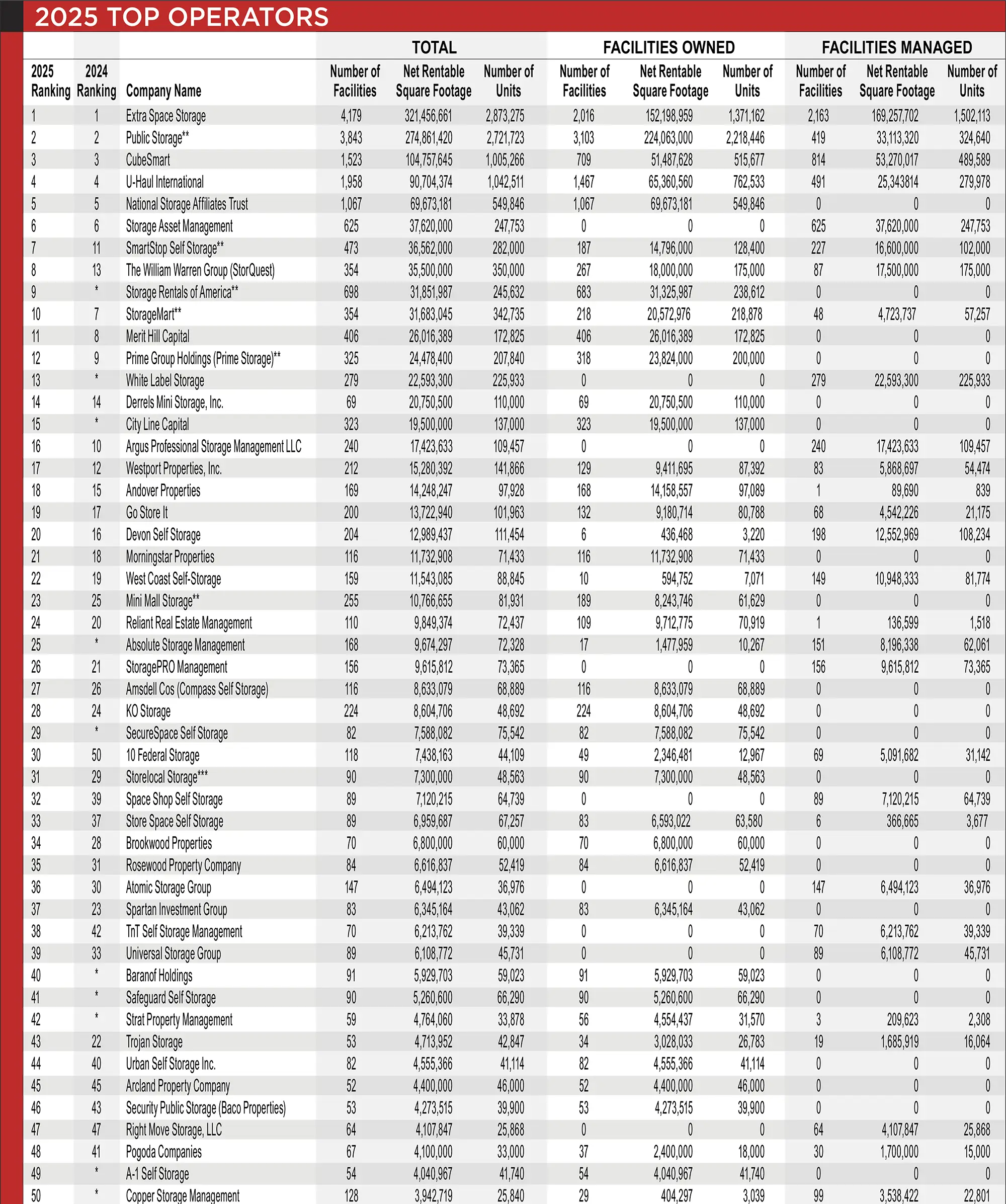
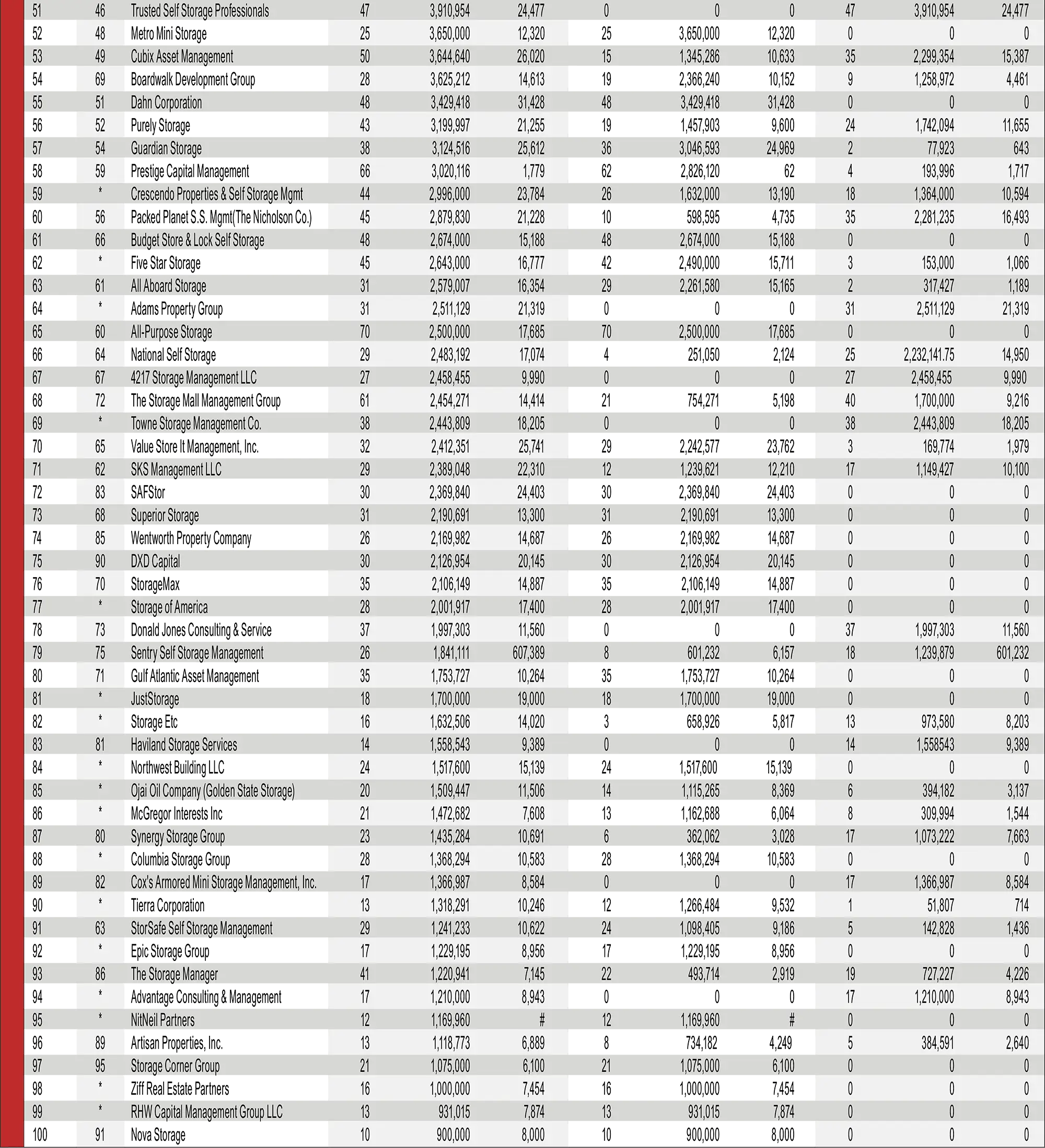















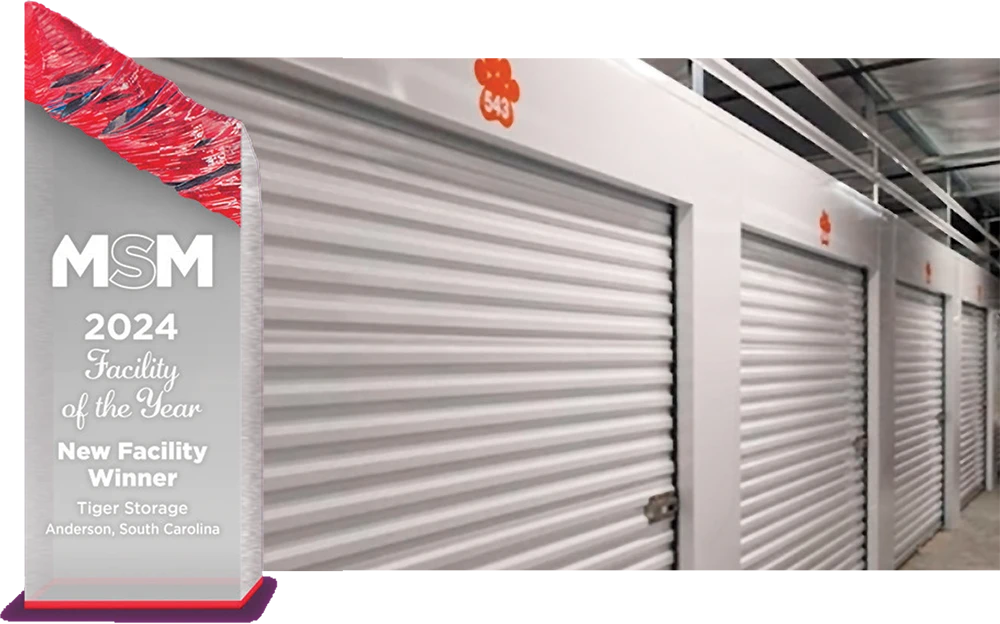

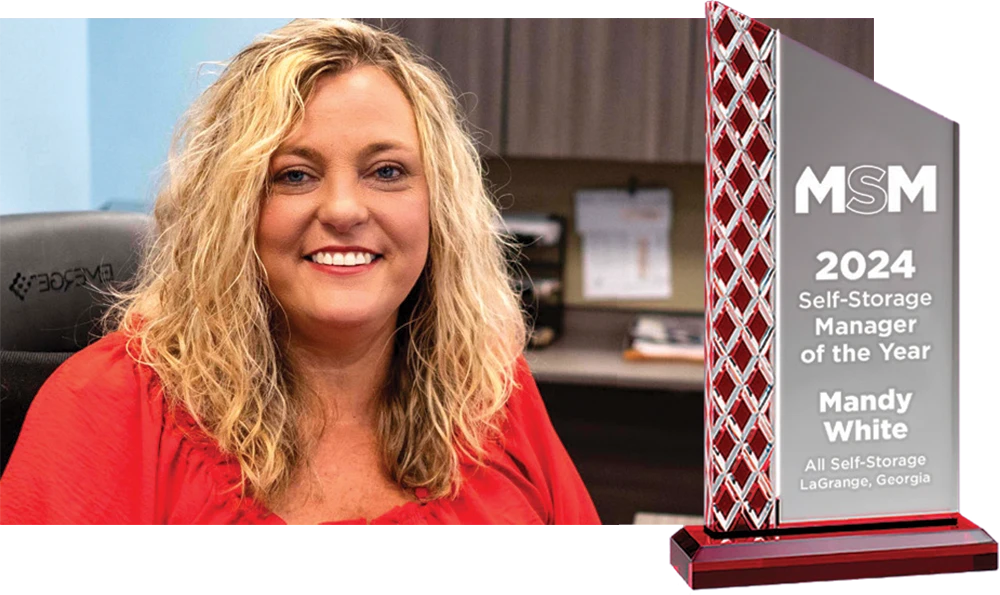


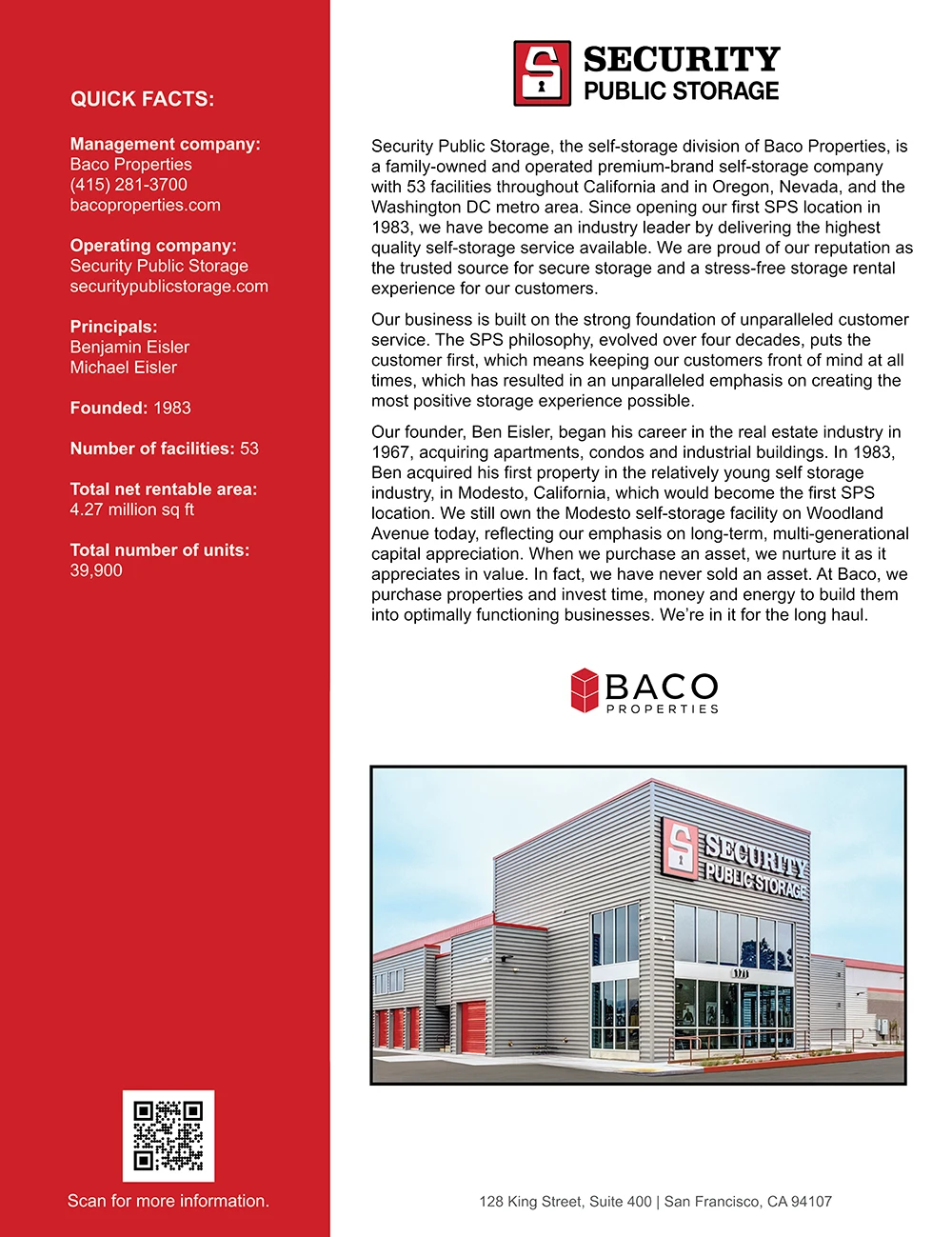








At STORE Management, we run facilities with the same sophistication you expect in Class-A real estate — delivering stronger occupancy, healthier NOI, and an experience customers value.

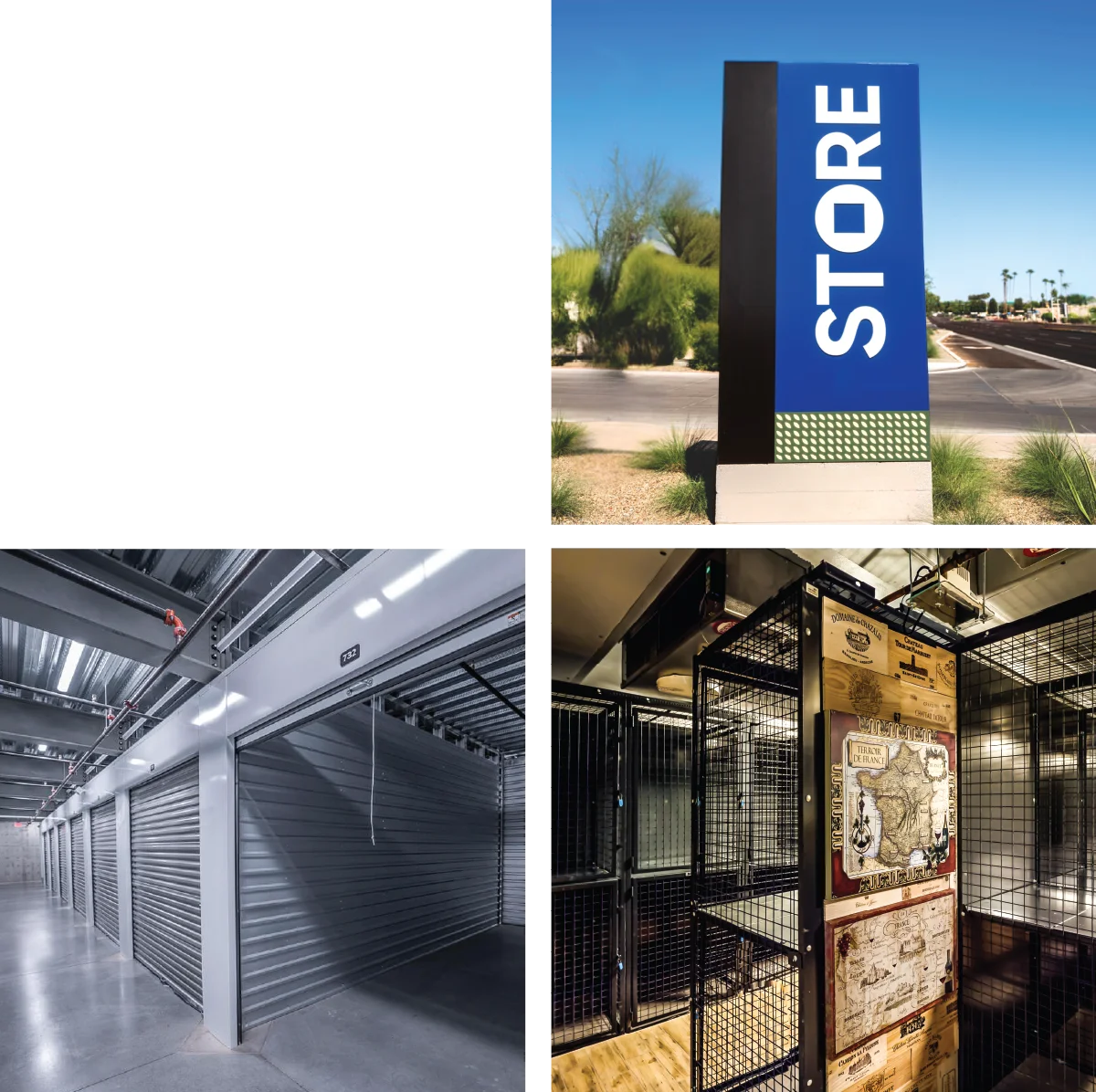
At STORE Management, we run facilities with the same sophistication you expect in Class-A real estate — delivering stronger occupancy, healthier NOI, and an experience customers value.

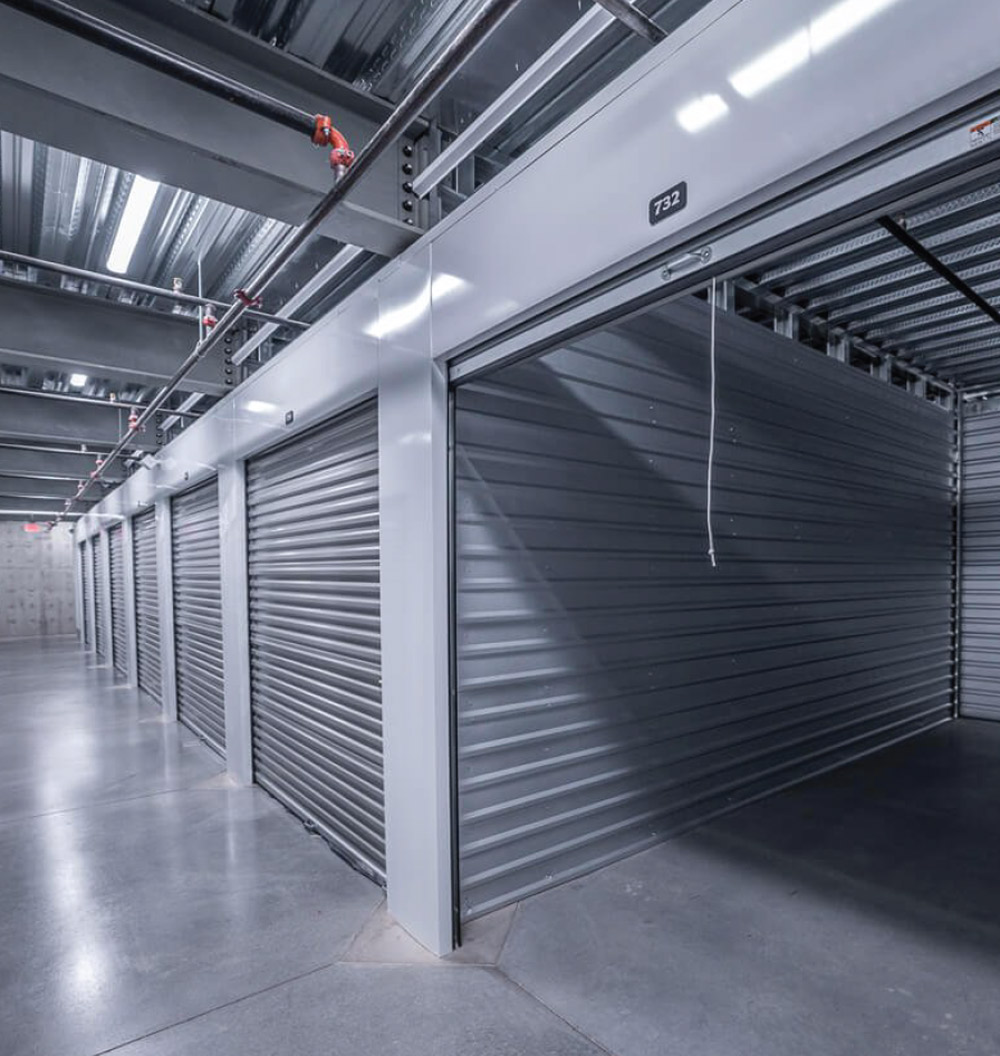
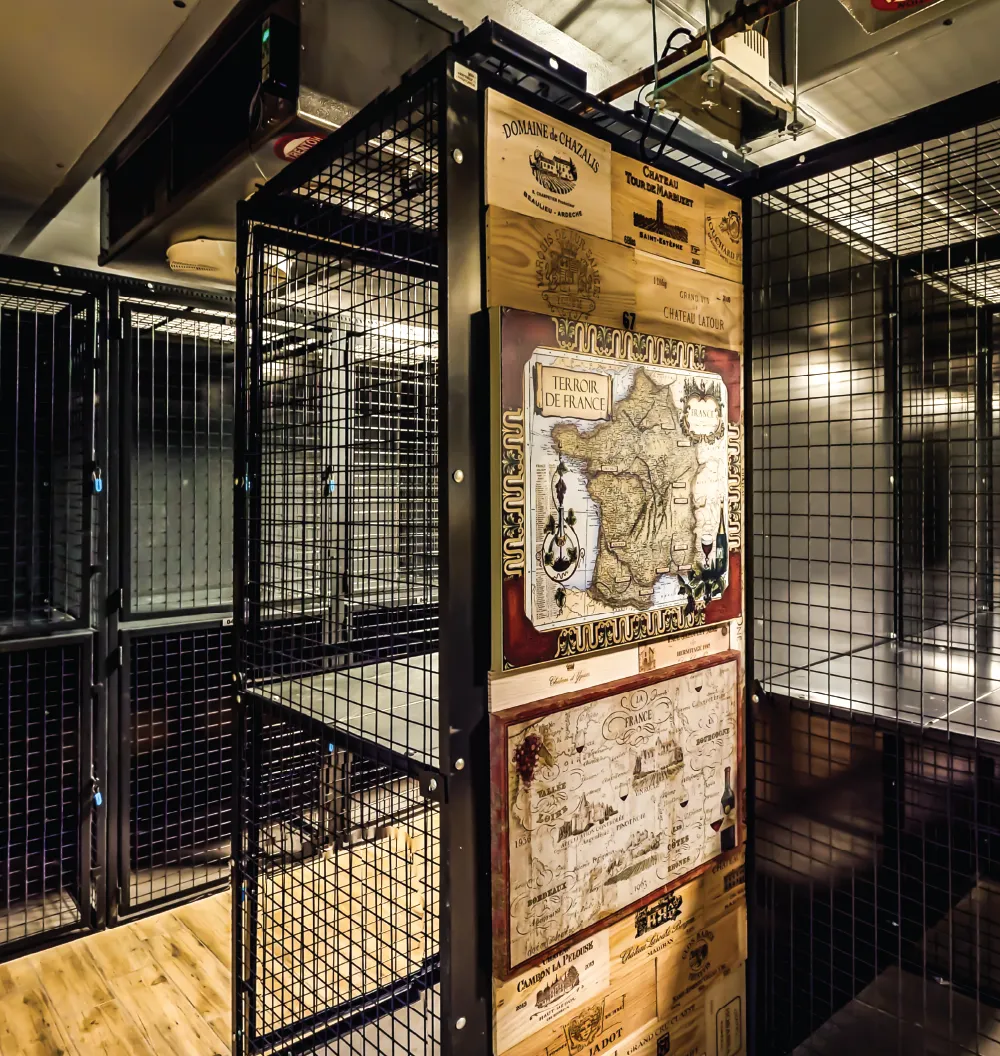

Recovery Plans
ires in California. Tornadoes in Kansas. Hurricanes in Florida. Floods in North Carolina. Natural disasters can strike anywhere, causing lost lives, destroyed homes, and damaged communities.
Businesses are not spared. Those left behind can find themselves dealing with collapsed structures, destroyed inventory, and disrupted supply lines. It’s no wonder one out of four businesses does not open again after a disaster, according to the Small Business Administration (SBA).
“Damage from disasters can be especially great for smaller operations with insufficient financial cushions,” says Erica Bornemann, vice president of planning and risk reduction at AC Disaster Consulting. “In the worst case, a disaster can put a company out of business.”
A well-designed plan will help a company not only preserve assets during a disaster but also return to commercial viability sooner. “Getting back into business quickly after an incident can translate into goodwill with customers,” says Justin Kates, an emergency management consultant.
Recovery procedures must be tailored for each operation. “It’s tempting to download a boilerplate plan from the internet and call the job done,” says Kates, “but a general, all-purpose plan reflects neither the risks specific to an enterprise, nor the special mix of available resources.”
Conversely, a tailored plan will ensure that employees make the right moves when disaster strikes. That’s important, because the emotional impact of a serious event can make it hard to think clearly. “People often become paralyzed when disaster strikes,” says Rebecca Rice, an assistant professor of crisis communications at the University of Nevada. “Too often, they have no idea what to do.”
A successful recovery plan starts with a thorough risk assessment that identifies a company’s unique vulnerabilities. What hazards are most common in the area? Is the company facility located in a floodplain, near a local highway where trucks with hazardous materials go by, or in a fire-prone region?
Help with identifying local risks is available from the Federal Emergency Management Agency (FEMA). “A good, free, and easy tool for doing a basic risk assessment for your location is FEMA’s National Risk Index,” says Kates. “You can search your address online and assess your area’s overall disaster risk level, as well as the most likely categories of events.” An online search tool is at www.fema.gov. An interactive risk index map is available at https://hazards.fema.gov/nri/map.
Businesses can also seek advice from their county or city offices of emergency management, which often post lists of a region’s salient threats. “Local agencies often have area-specific emergency management plans that highlight issues otherwise overlooked,” says Rice. “They can serve as useful starting points.”
When identifying common risks, it’s wise to look beyond the walls of the enterprise and consider how damage to suppliers can trickle down to local operations. “It’s important to consider how your business will be affected by transportation and supply chain interruptions,” says Bornemann.
Bonus tip: When identifying risks, keep in mind that even small-scale events can wreak havoc. “A burst water pipe can cause costly water damage,” says Bornemann. “A flu outbreak can affect every worker assigned to a facility.”
Once the most likely disasters are identified, the business should create a plan for maintaining its most important business activities, from receiving and filling orders to collecting amounts due.
Once again, help is available from outside sources. “FEMA has established a website called Ready Business [ready.gov/business] with templates and tools that walk a business all the way from developing an emergency plan to preparing employees so they’re ready to get back to work after a crisis,” says Kates. The organization maintains a website and has local emergency management offices that can be helpful.
The Small Business Administration (SBA) also has a web page dedicated to business continuity. Go to sba.gov, click on “Business Guide,” then “Manage Your Business” and “Prepare for Emergencies.”
Yet another resource is the National Fire Protection Association (nfpa.org), which offers guidelines for fire safety and risk mitigation.
“There are also benefits to joining the National Emergency Management Association [nemaweb.org] and participating in its private sector committee activities to learn about useful resources,” says Bailey Farrell, senior director of project management at AC Disaster Consulting.
Local organizations can also help. “Many city and state emergency management agencies, chambers of commerce, and small business development councils [SBDCs] have put together tools and templates, and even technical assistance, for different types of emergency plans and risk assessments,” says Kates. “They are attuned to the specific hazards common to a region.”
Finally, an organization’s insurer can provide useful information. “Companies should take advantage of an insurance company’s expertise based on its experience with other operations in the same region,” says Peterson.
Bonus tip: Involve your staff. “Too many businesses ignore input from their employees during emergency response planning,” says Davis. “Front line personnel can often suggest practical procedures that will mitigate harm from severe events.”
The prudent plan will also address the importance of preparing the staff to respond appropriately and quickly when a disaster strikes. “Everyone needs to understand what the plan is for different types of emergencies,” says Kates. One of the first steps is to communicate information about the event to employees, customers, and suppliers.
Too often though, operational disarray keeps the word from getting out. “Businesses often discover they have not planned for efficient communications when disaster strikes,” says Davis. “Indeed, a breakdown in communication is the most common cause of business disruption.”
Again, advance planning comes to the rescue. Every company should maintain a comprehensive list of employees in a document called a “calling tree” that specifies who will contact whom when disaster strikes. A well-organized protocol will obviate redundancy and ensure everyone is informed. “You don’t want to end up with signals crossed when multiple people try to contact each other,” says Rice.
Internet disruption may obviate the use of email, so the calling tree should also contain phone numbers, physical addresses, and the names of each individual’s alternative contacts in the form of friends and family.
Finally, the calling tree should specify who will reach out to customers, suppliers, and service firms that can undertake repairs.
Having a plan is one thing. Ensuring everyone understands it is another. Regularly scheduled drills will help employees react automatically when an event occurs. “We recommend regular exercises during which team members talk through potential scenarios,” says Kates. “These rehearsals ensure the plan is realistic and will actually work during a crisis.”
“Insurance policies must cover the specific perils identified by a company’s risk assessment initiative,” says Kates. “Too often, businesses discover they don’t have the right coverage for the damages encountered.”
Coverage levels also need to be regularly updated. “The cost of building materials keeps going up,” says Rice. “Policies must be updated to ensure the company has sufficient funds for rebuilding.”
Businesses should also consider taking out business interruption insurance to replace lost income, extra expense coverage for the higher moving costs and rents possible at a new location, and contingent business interruption insurance for lost income when a damaged supplier is unable to deliver.
Finally, there is the growing challenge of policy availability. Many insurers are exiting unprofitable markets, leaving businesses with limited choices.
“There’s a lot of concern today about what is going to happen regarding insurance policies in areas that are particularly disaster prone, such as Florida and California,” says Kates. The fires that recently ripped through portions of the latter state have resulted in insurance becoming extremely difficult to obtain.
Flood insurance can be a special problem anywhere. “The frequency and severity of extreme weather events have increased,” says John Peterson, chief growth officer at World Insurance Associates, an insurance brokerage. “Consequently, flood insurance is becoming very difficult to obtain in certain geographies.”
Bonus tip: Flood insurance must cover not only damage from rainstorms and burgeoning streams, but also from blocked storm drains, broken water towers, and damaged pipes or boilers.
The tendency to leave the topic on the back burner means it can be a struggle to get key leadership on board. Front office attitudes, though, are undergoing change. “We are seeing more disasters in the news, and that is creating more urgency around the whole topic of emergency planning,” says Kates. “Companies are starting to realize they need to put good plans in place and train their teams to handle these crises.”
The alternative is not acceptable. “The human cost of disasters, along with the levels of destruction, is increasing every year,” says Rice. “We might feel like a disaster will never happen to us, but the things we imagine will never happen seem to be happening more and more, and costing more time and money than ever before. And that’s really the ultimate reason that businesses should have disaster plans.”

Will your business survive a disaster such as a fire, hurricane, or windstorm? Find out by taking this quiz. Give yourself 10 points for each “yes” answer to these questions, then total your points.
Have you …
_ Performed a regional risk assessment?
_ Developed an emergency response plan?
_ Sought input from your city or county?
_ Involved employees in developing the plan?
_ Arranged for continual data backup?
_ Prepared a “calling tree” for post-disaster communication?
_ Trained employees on emergency response procedures?
_ Identified a remote site for temporary quarters?
_ Prepared a list of vendors for emergency repairs?
_ Reviewed insurance for sufficient coverage of unique risks?
_ TOTAL
What’s your total score? Over 80: You are in a safe zone. Between 60 and 80: Time to dust off your emergency plan. Below 60: Take steps now to get your recovery plan up to speed.
he self-storage industry is relatively new in Colombia, with the first formal facility opening in 2005. Previously, storage needs were met by traditional warehouse services or informal operations.
Now, the “bodegas,” as the facilities are called in Colombia, have attracted significant attention from both customers and investors, including multinationals eager to invest in the country.
With 15 years of experience in the business, Más Metros offers a combination of self-storage and moving solutions. “It’s one of our most important differentiators. It’s not common for storage companies in Colombia to also offer moving services, but in our case, it complements the value proposition very well,” says the company’s commercial director, Juan Aponte.
Unlike most people in the business worldwide, Aponte didn’t create the company with inspiration from the U.S. market. “The idea of storage came up when I had clients who needed a place to keep their goods. At my father’s house, we had a garage, and that’s where the idea of renting it out occurred to me. That was my first contact with the business, and I realized there was an unmet need for safe storage space.”
Coming from a transportation background, their unique business model allows him to continue his father’s legacy while making his own. “From a very young age, I was involved in the world of transportation and trucks, since my father worked in that field. That environment gave me the foundations to understand logistics, operations, and above all, the importance of providing reliable service to customers.”
In fact, Aponte calls customer service a scarcity in the country’s self-storge sector—a value-add that is not only noticed by customers but also an advantage that keeps them coming back. “[The most common mistakes companies make are] neglecting customer service and not investing in security. Often, the focus is only on infrastructure, but customers value trust and support more.”
Their marketing efforts consist mostly of word-of-mouth and digital marketing. “About 50 percent of new customers come through referrals, which speaks a lot about our service experience. The rest comes from digital advertising, mainly social media and Google,” he says. “Word of mouth remains very powerful, but also investment in digital channels, especially Google and social media, [has been generating a lot of interest, as it is] where we can showcase real cases and client testimonials.”
Another smart marketing effort that he mentions as having been making an impact in the business was Más Metros’ partnership with real estate agencies and developers to offer storage as added value for their clients, especially due to the downsizing in square footage of new builds. “We’ve started forming partnerships with developers and real estate agencies,” says Aponte. “It’s a way to offer comprehensive solutions to families who are moving or buying homes.”
Increasing penetration rates is a big part of the business in Colombia. “Many customers are still unaware that storage units are a flexible, safe, and accessible solution,” he says. “It’s necessary to show that they’re not only useful during moves but also for organizing spaces, businesses, and personal projects.”
As for their average customer profile, Aponte says, “Most are individual users, although the corporate segment has been growing strongly, especially for records, inventories, and temporary storage. The most frequent profiles are families and young professionals who need extra space. We’ve also seen growth in the business segment, especially small companies that use storage units as office extensions or warehouses.”
According to Aponte, the market has managed to “consolidate itself in major cities like Bogotá, Medellín, and Cali, but it’s still underdeveloped in smaller towns and mid-sized cities, where there is great growth potential,” he says, making sure to highlight the potential of other cities. “There’s great potential in cities like Villavicencio, Ibagué, or Pasto. However, the main focus is still on the major capitals, where the market is already better known.”
Eduardo Baena, the manager of Rentabox, shares his beliefs. “In Colombia, mini-storage facilities exist only in five or six major cities, and that is because they belong to a company operating at the national level. The rest are run by local operators. There is great potential to set up facilities in mid-sized cities, but the mini-storage model is expanding timidly.”
Rentabox’s business model is quite unique in the country, according to Baena. “We initially focused on serving small importing companies by offering container-type mini-storage units, that is, metal storage units built with the dimensions of import containers: 40 and 20 feet,” he states. “During the pandemic, we expanded the market to individuals, with 10- and 5-foot units.”
“All our mini-storage units are outdoors and located on the ground floor, and the 40- and 20-foot ones face internal roads six meters wide that occupy 50 percent of our total area. I believe we are the only storage facility in Colombia with internal roads for customer service,” says Baena.
Like in many other countries, the COVID-19 pandemic completely changed the industry, as the company’s occupancy rate rose to above 100 percent. “In our case, the pandemic triggered our occupancy rate, even above 100 percent. Student apartments closed, small businesses that couldn’t withstand the crisis, restaurants closed due to lack of customers … a long list of new clients,” Baena says.
Another factor driving business forward is the decrease in apartment sizes. “Every day businesses make it easier for consumers to acquire products,” he says, “and every day apartments have less space, so mini-storage units will increasingly become necessary to store what doesn’t fit at home.”
Due to their business model, their customer base is mostly made up of businesses. “There is abundant demand from both types of clients [commercial and residential], but we place more emphasis on serving corporate clients. Their contracts tend to be long term and their payment habits healthier,” Baena states. “In our case, the predominant profile is small and medium-sized businesses first, and individuals second. Large companies use other types of facilities.”
Due to the low penetration rate, a part of their marketing efforts is spent teaching clients about the industry. “We take advantage of every contact we have with a potential client to teach them about the mini-storage model, explain the different types of services, etc., in such a way that the client becomes a multiplier of the system within their network,” says Baena.




hen Neville Kennard left for a work trip to California in 1972, he didn’t expect to come across an up-and-coming business industry that he would later replicate in his hometown within Australia, creating an entirely new industry in the country that would eventually become not only a successful business but a legacy.
It was in 1973 that he first built a total of six 6-meter-by-3-meter storage units behind the Kennards Hire Centre at Newbridge Road, the birthplace of the self-storage industry in the country. A few decades later, the initially small Kennards Mini Storage would become Kennards Self Storage, with over 110 locations worth more than $3.3 billion.
The company is now headed by his son, Sam Kennard, the current CEO, who started to learn the ins and outs of the business back in 1991, officially following in his father’s footsteps in his current position back in 1994. In the past 31 years, he expanded the then 12 storage centers to a mega empire, which currently employs a total of 350 people in Australia and New Zealand, taking his father’s legacy to a whole new level.
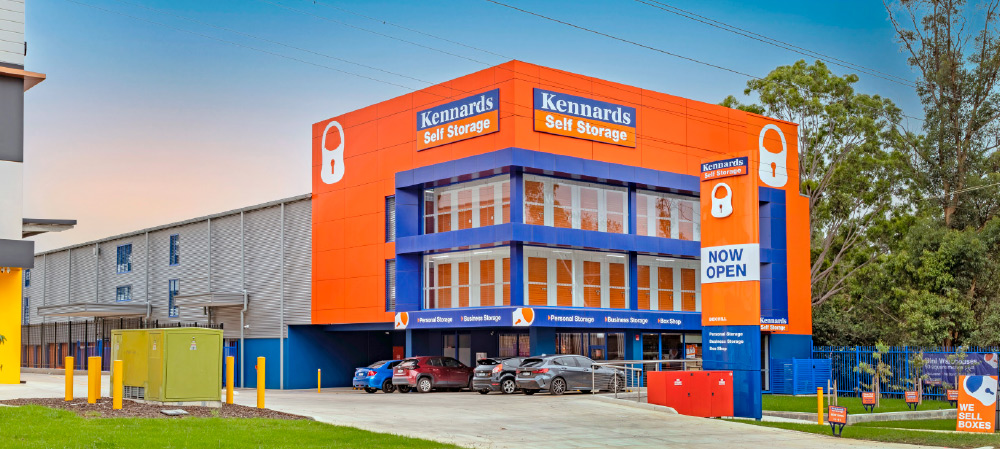
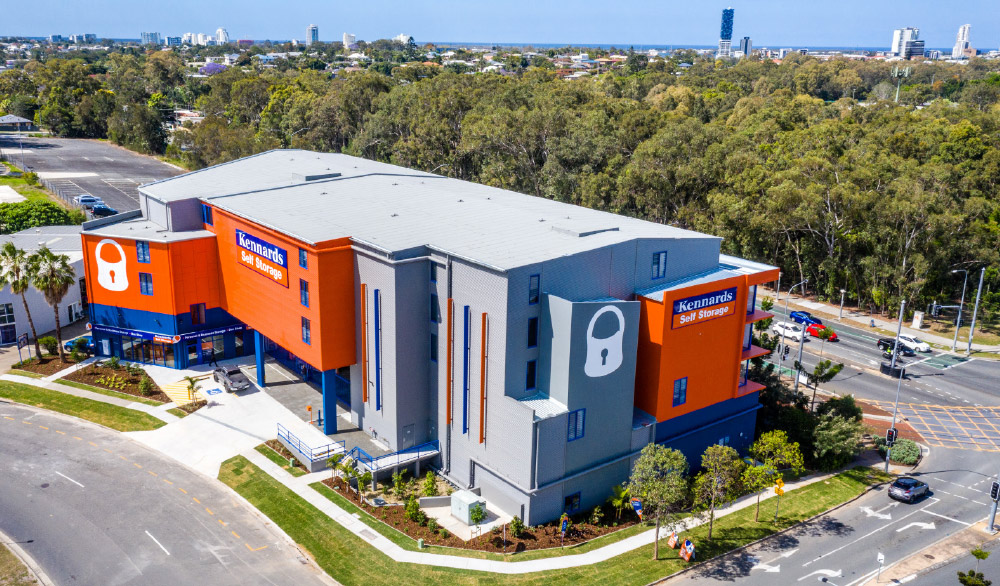
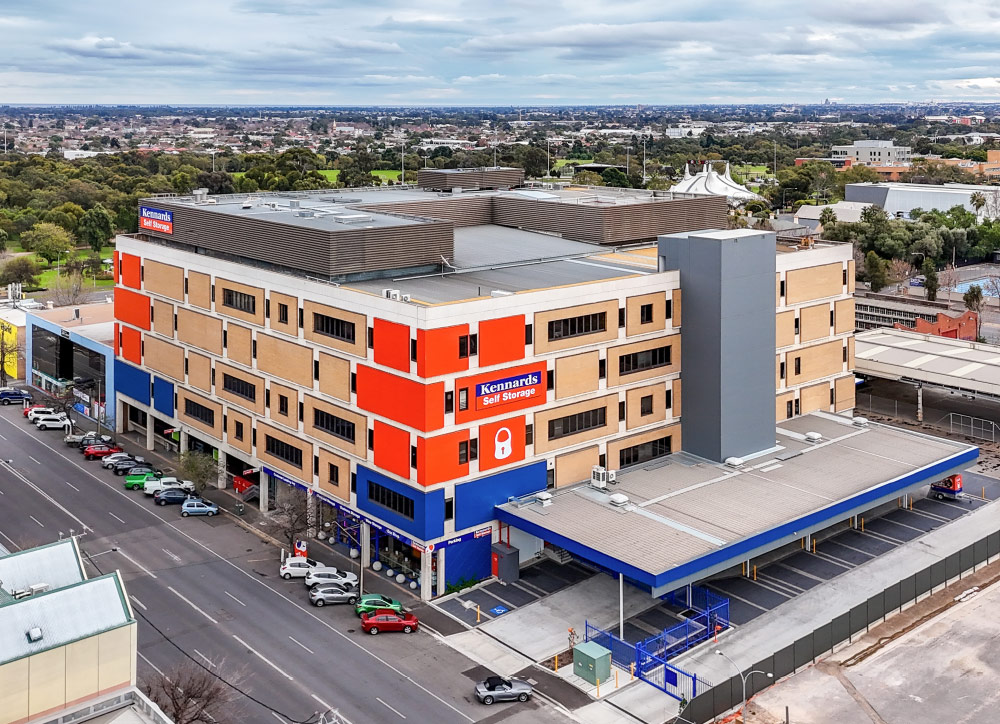
As for trends he is noticing in the industry, Kennard says, “Around 80 percent of the population lives in major cities. Australia’s one of the most urbanized countries in the world, so it means there’s an increasing density of housing, and lots of people are moving into smaller and smaller accommodations. So, first-generation storage that was built 20 or 30 years ago is proving to be too small, so what we’re doing is going back to our first-generation stores and adding. We are either demolishing single-level buildings, somehow finding space to add more supply, and adding significantly more supply into the existing locations in those infill areas where the density’s increasing.”
Like the U.S. market, the Australian and New Zealand markets are also having to adapt to the 21st century, as businesses are now expected to have state-of-the-art technology solutions. “Obviously, there’s an improvement in technology, an improvement in customer awareness, and customer sophistication,” he says. “Having higher expectations around the quality of a storage facility should be similar to the U.S.; you can’t get away with being a very grungy, industrial, crude development anymore. You need to have a sophisticated, user-friendly, high-entity user experience. And consumers expect that more and more in everything they touch.”
In New Zealand, a particular matter that new facilities must pay attention to when building or expanding is the country’s geographical location and susceptibility for earthquakes. “Some of the construction measures around seismic strength are important and expensive, so that’s unique to New Zealand. As far as I know, obviously some parts of the U.S. and other parts of the world might have that, but New Zealand has a very high threshold of seismic strength, as far as I can tell,” says Kennard. “That’s a big differential, because that’s not something you really have to worry about when you are in Australia. Geology-wise, here we are safe on an earthquake front.”
According to Kennard, businesses currently make up 25 percent of his company’s customer base, which is just under 40 percent of their revenue. Another market trend in the countries is specialty storage, from gun lockers to wine cellars. “After the Port Arthur Massacre in 1996, the gun laws in Australia were tightened. Including storage of firearms, that meant putting them in a steel compartment, lockable and secure, so guns couldn’t be stolen, but also so guns couldn’t be easily accessed by children,” he states. “They can be kept in your home, but they could also be kept off site. So, we recognized that opportunity back then and started to experiment with putting gun lockers into our storage centers. And found that there was a demand for people to have off-site gun storage away from their family, and it meant that people in apartment buildings who didn’t like to have [it around at their place], or they’re renting their house and they’re not allowed to keep the safe in there, or they’re not allowed to bolt it to the floor … There are lots of reasons why people want to have the gun off site, and so we put a bunch of those in, and we’ve got a few now.”
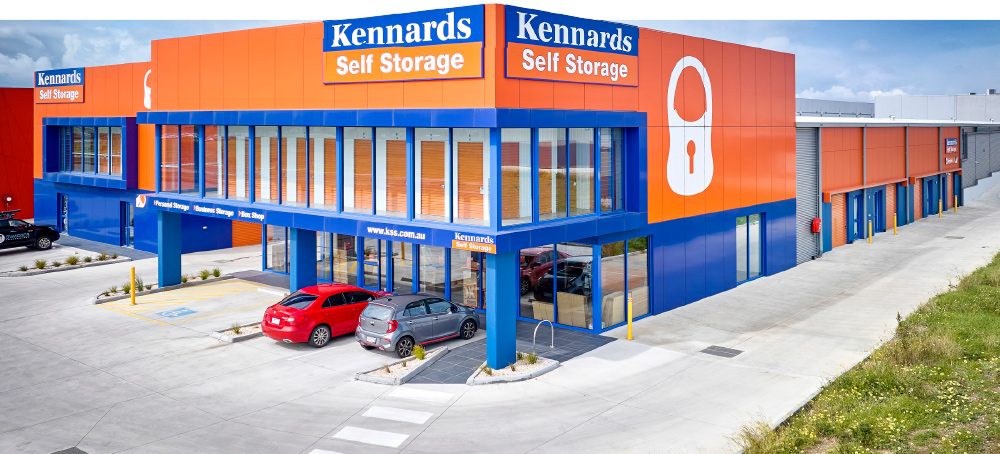
Kennard also points out the market is currently getting a lot of foreign investors. “There’s a lot of sophisticated money coming into the sector. Large global institutional money is coming in; it’ll be interesting to see how they play through a period in the sector, and they’re driven to get money out the door and deploy investment money, and that gives them a fee,” he states. “Australia is probably one of the most active investment markets currently in the last 12 months. With global money, we have Warburg Pincus investing in Australia through a company called StoreHub. We have Blackstone investing in Australia, and they’ve been buying portfolios and assembling a portfolio through a couple of brands. We have BlackRock, who has just partnered with Store Local; and so, we’ve got all of this kind of global money playing in our sector at the moment, which is quite interesting for such a small market. We’ll see how it plays out.”
In her decade-long experience in the sector, she was able to see the market mature and grow. “The Australasian self-storage market has matured into a standalone asset class and is well positioned for stable, long-term growth. Macroeconomic factors, such as population growth, housing market challenges, and lifestyle shifts, continue to underpin demand,” Castelli states. “Interest from institutional capital continues to grow, attracted by the sector’s strong fundamentals and resilience. Despite ongoing consolidation and the growth of large and major operators, independent operators and family businesses still represent approximately half the market. Record levels of self-storage supply are anticipated from 2025 to 2027-plus, leading to a shift in market dynamics, especially in capital cities.”
Since the COVID-19 pandemic, both countries have been evolving. “In a post-pandemic climate, three key shifts are changing how we live. Smaller living spaces, working from home, and the move to the regions are all driving demand for self-storage in Australasia. Business usage remains steady at around 25 percent in most facilities, but use cases are shifting from the retail economy to the trade economy,” she says. “What is becoming more evident is the blurring between business and personal use in self-storage, with more customers utilizing their storage unit for both. The Australasian self-storage industry experienced exceptional growth in the post-pandemic period. Increases in both occupancy and average storage fee rates drove strong returns, outperforming traditional asset classes.”
Technology-wise, the industry in the country is undergoing its own digital renaissance. According to the SSAA State of the Industry 2024 report, “Seven in 10 potential storers expect a fully digital journey, while for operators, retention and rising labor costs risk making traditional staffing models unsustainable. For owners and operators, this means modernizing the rental process or risking being left behind. Those who invest in the digitization of self-storage, including remote management, smart access, and seamless customer experiences, will lead the next era of self-storage.”
Castelli highlights that the fast-growing industry has been working to adhere to the remote management models. “Remote management models are emerging with technology set to enable further changes,” she says. “While the technology that enables facility automation is here, consumer demand is still outpacing the rate at which facilities are adopting digital solutions. Seven in 10 Australasian customers likely to use storage in the next two years want a digitally enabled experience. More than 50 percent of operators surveyed reported they are planning to adopt new technology to enhance customer experiences and improve operational performance in the next year. Nearly 40 percent expect to increase the capacity at their facility or begin construction of a new facility.”
Another trend spotlighted by the SSAA State of the Industry 2024 report is the use of AI for dynamic pricing. “AI-driven revenue management is now optimizing unit pricing dynamically, helping operators to find the Goldilocks zone and maximize every square meter,” the report states. “AI-driven platforms continuously analyze local demand, competitor pricing, and historical occupancy trends to optimize rental rates [by] providing granular insights into competitor activity and digital performance to help operators understand their local market, [allowing] operators to forecast seasonal demand shifts and preemptively adjust pricing to avoid revenue dips; and instead of relying on blanket promotions, AI triggers discounts only when necessary, protecting profitability.”
Like in many parts of the world, sustainability has been gaining importance in the industry. “Sustainability is an increasing focus across the Australasian self-storage sector. LED lighting remains the most widely adopted solution by existing facilities (80 percent), followed by a growing trend toward rooftop solar installations (44 percent). Developers are broadly adopting green building practices for new builds, particularly for larger metropolitan facilities,” Castelli says.
For investors looking to join the market, Castelli mentions that, just like in the U.S., the industry is very friendly, and you can learn a lot by contacting industry moguls. “A hallmark of the Australasian self-storage sector is its collegiate spirit. Many experienced owners and operators are willing to share their experiences, so seek advice early on and build a trusted, local team of advisors and suppliers who are experienced in self-storage.”
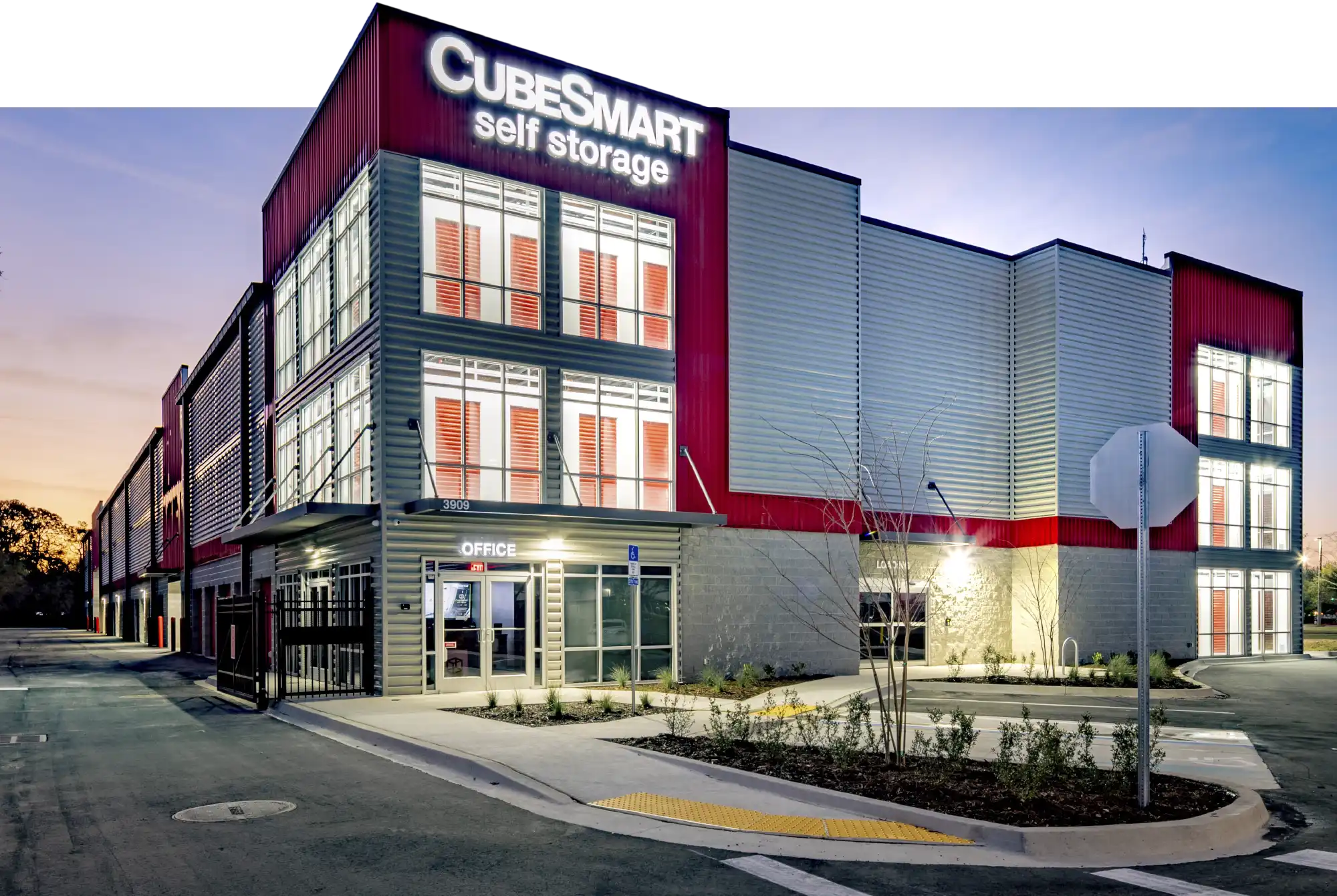
acksonville, Fla., is the largest U.S. city by land area, making self-storage a necessity. Now, “Jaxsons” have a new place to store their belongings with the March opening of CubeSmart at 3909 Philips Highway. Owned by Live Oak Capital Partners, DYO Investments, and MacArthur Holdings, the three-story facility spans 83,250 net rentable square feet and houses 705 climate-controlled units, including 30 drive-ups. It took less than one year to build—earlier than expected and under budget, despite facing challenging underground sands and clays requiring reinforcement from rigid inclusions.
Facility features include PTI’s 24/7 video surveillance, gated perimeters, and controlled access points; Janus doors and hallways; energy-efficient HVAC and lighting; contactless leasing; and a covered loading zone. Designed to match the surrounding industrial area with metal paneling and split-faced block, it contrasts beautifully with CubeSmart’s signature red. Its location off U.S. 1 strategically places it near the upscale San Marco and Miramar neighborhoods and the commercial Southbank area. It came together thanks to ARCO Murray’s design/engineering team, CubeSmart’s management team, and legal reps handling entitlements.
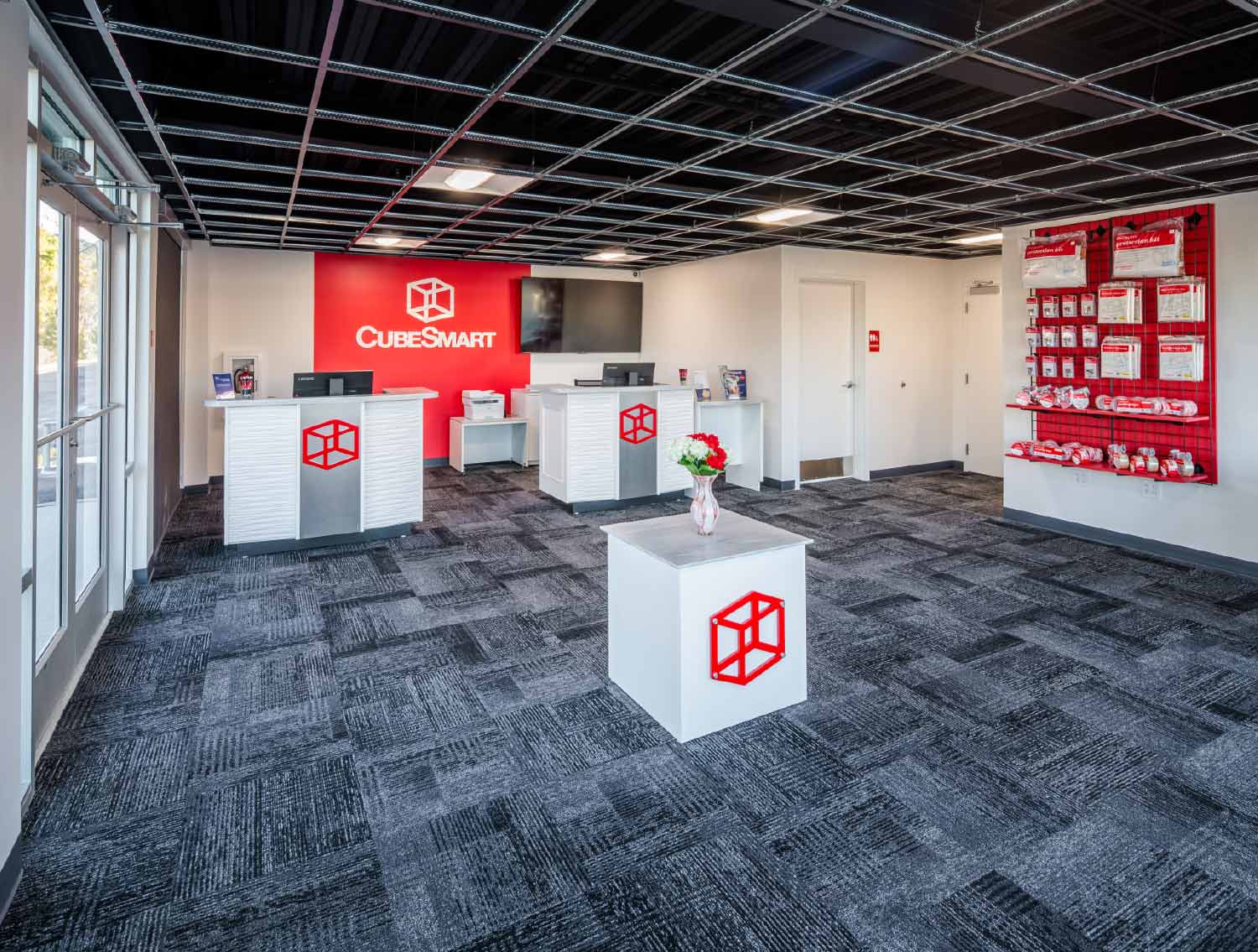
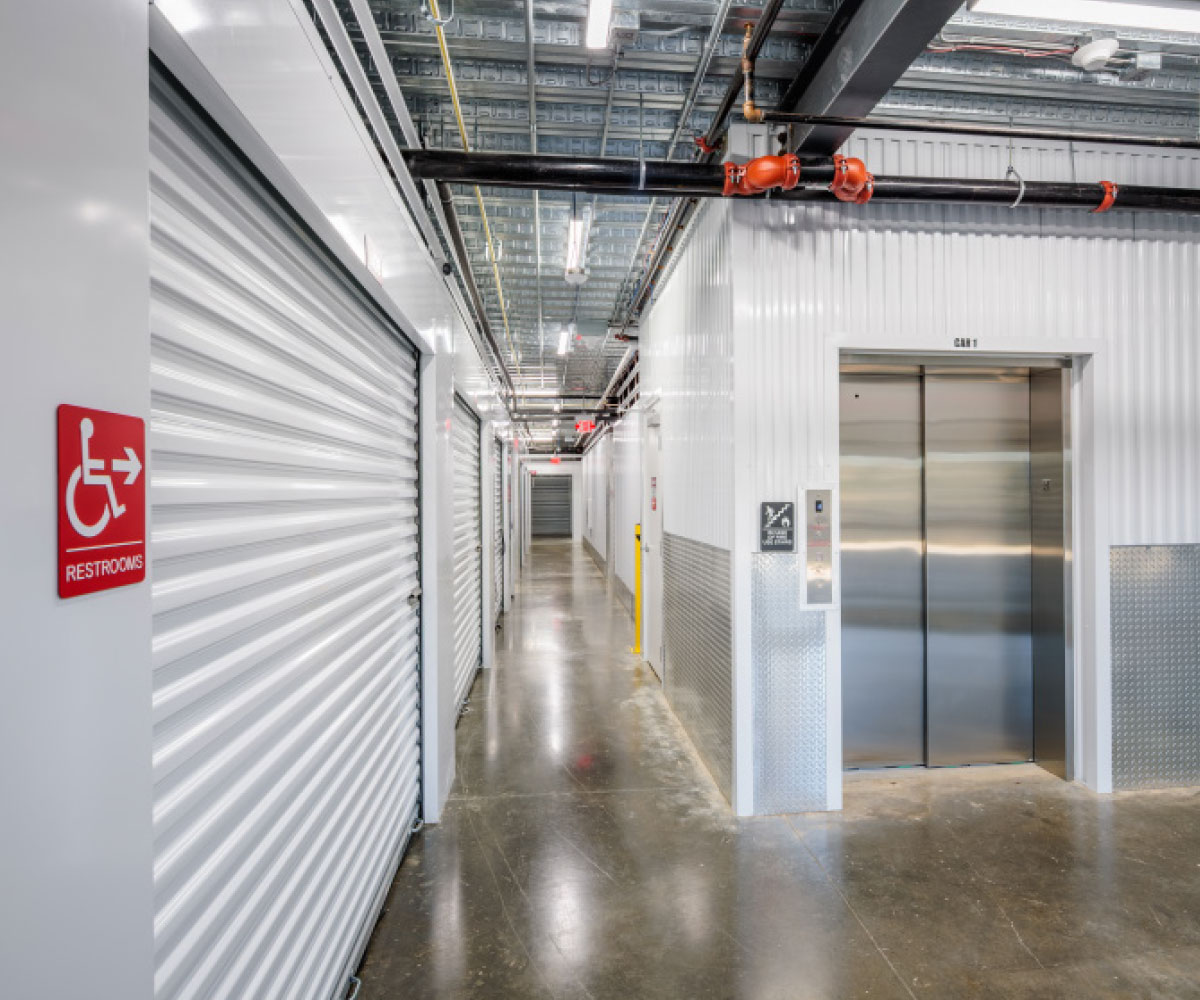
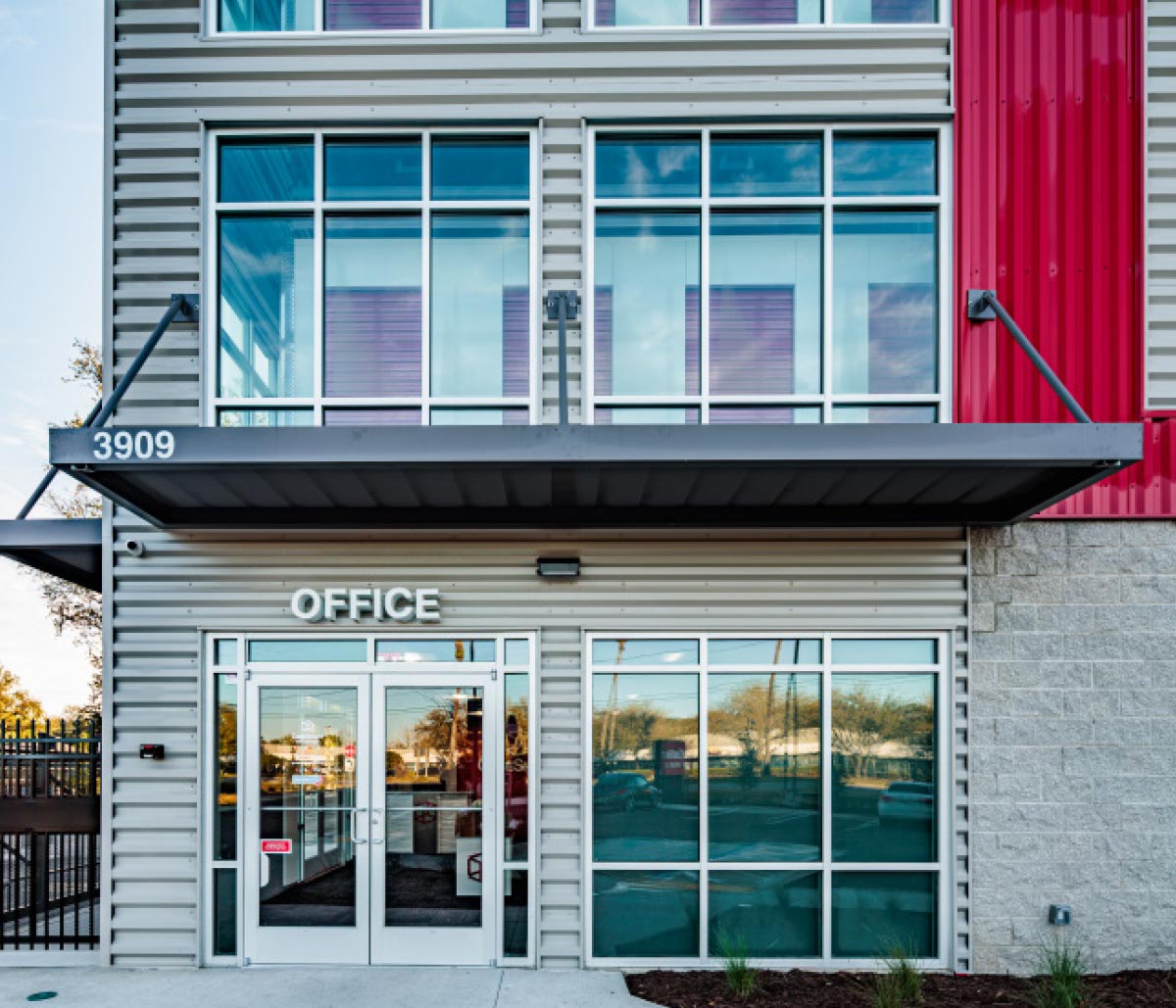
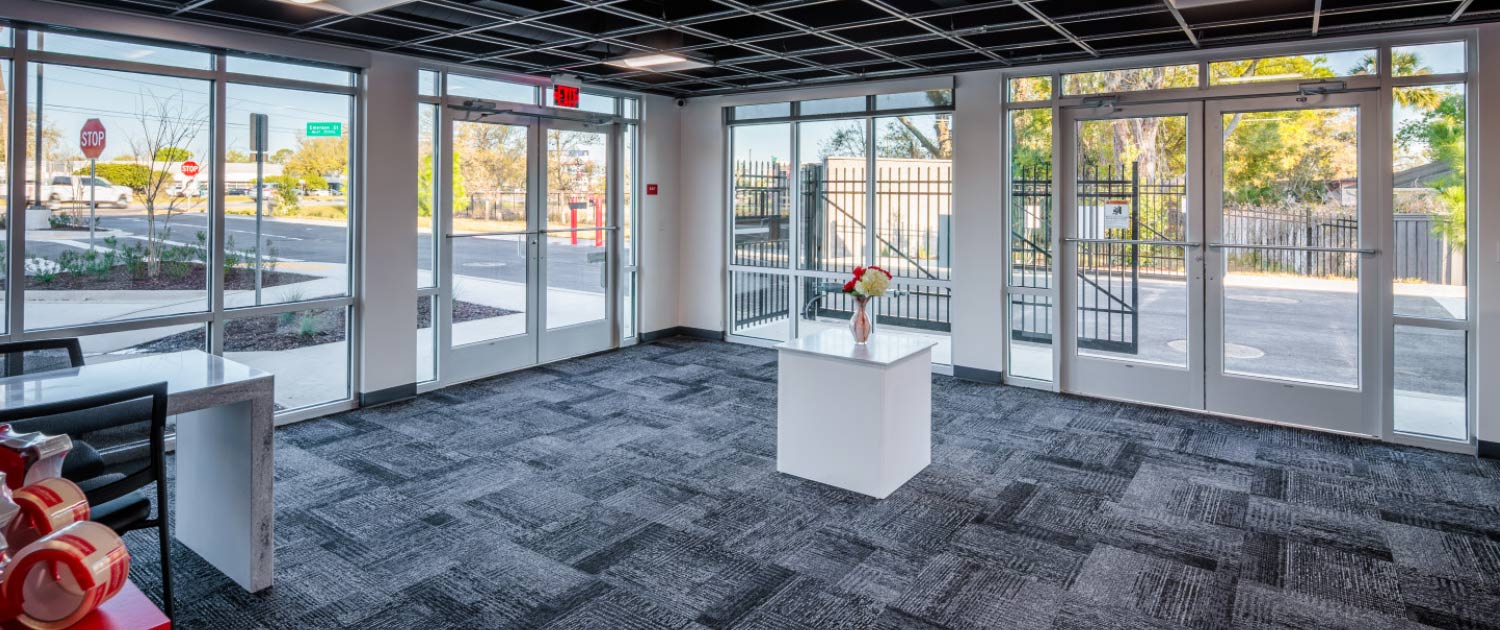
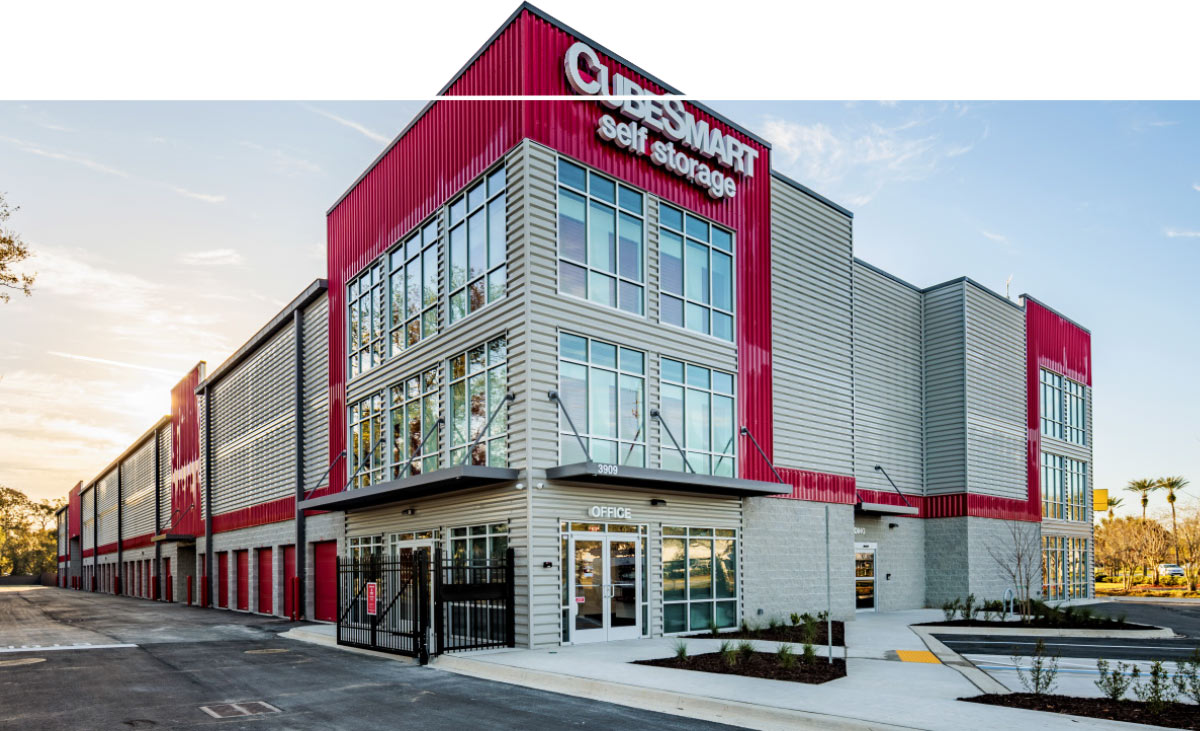

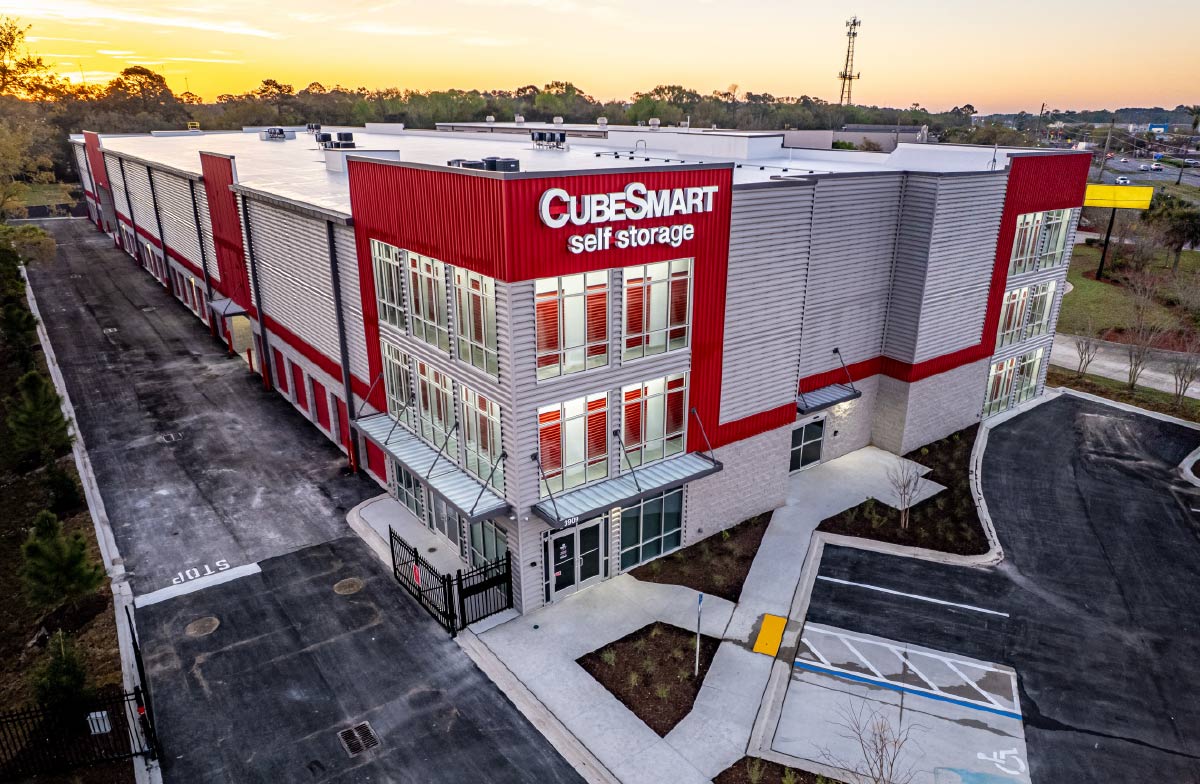
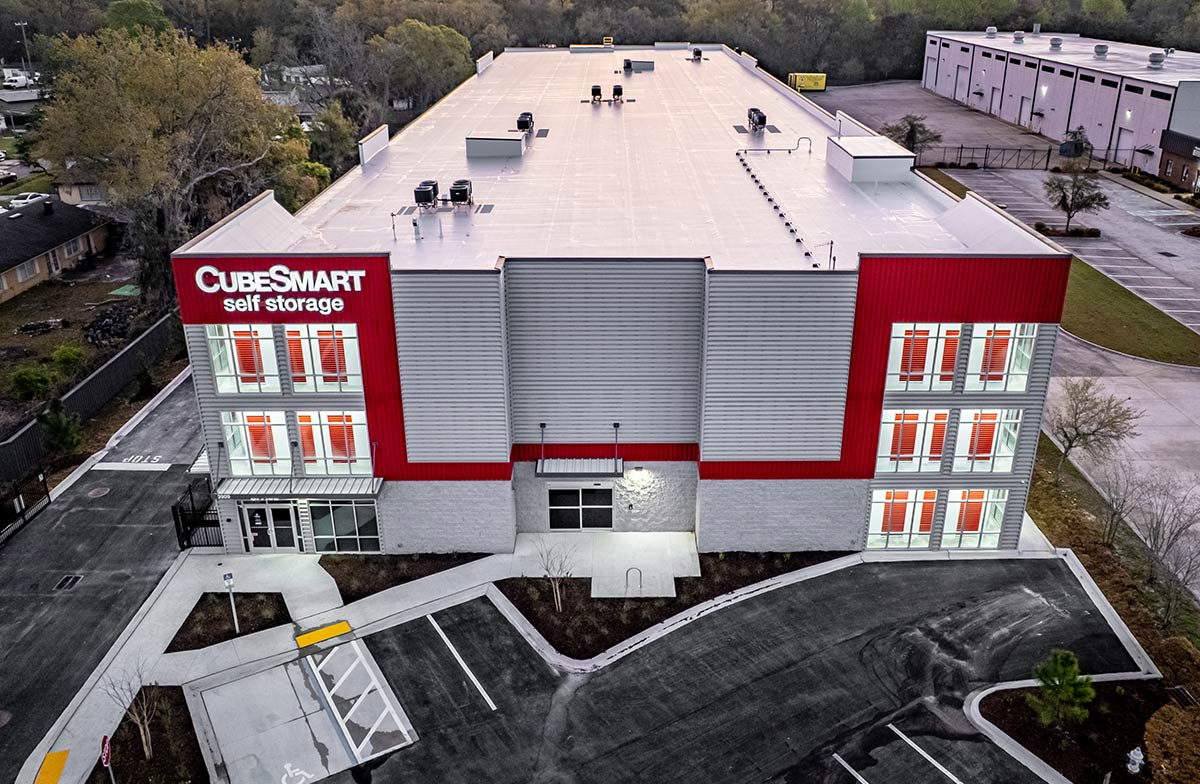
n the self-storage industry, profitability hinges not only on occupancy rates and rental pricing but also on operational efficiency and long-term durability. While many facility owners focus on marketing and expansion to drive revenue, the silent profit killer—maintenance—often goes overlooked. Every hour spent repairing doors, replacing springs, or troubleshooting hardware is time not spent serving customers or growing revenue. Fortunately, a wave of innovations in materials, design, and component engineering are helping operators shift from reactive maintenance to proactive profitability. These strategic upgrades reduce downtime, extend product life, and enhance customer experience, ultimately boosting your bottom line.

- Reinforced Bottom Bars – These are engineered to resist dents and deformation from frequent use or accidental impact. By maintaining door alignment, they reduce the need for realignment or replacement, keeping units rentable and secure.
- Higher-Grade Steel Springs – Traditional roll-up doors often rely on standard springs that degrade over time. New innovations, such as ASTM 228 “music grade” wire springs, offer superior fatigue, shear, and tensile strength. These springs also demonstrate exceptional corrosion resistance, even under extended salt spray exposure, making them ideal for coastal or humid environments.
- Heavier Gauge Steel – Not all steel is created equal. Thicker, high-quality steel enhances weather resistance and longevity. Products like the Sentry door line feature double-seamed curtains and reinforced seams, setting a new standard for durability in the industry.
- High-Tension Springs – These springs maintain tension longer, reducing the need for frequent adjustments. This translates into fewer service calls and less downtime.
- No-Grease Springs – Thanks to higher grade materials, certain door springs now require no lubrication, even after 15,000 cycles. This innovation removes the common maintenance task, reducing mess and labor.
- Aluminum Components – While steel remains dominant, aluminum is increasingly used in areas prone to corrosion, such as bottom bars. Its natural resistance to rust makes it a smart choice for long-term reliability.
- Diamond Plate – Protect high-traffic areas like entryways, walls, and floors with a reinforcement that defends from dents, scratches, and other common forms of damage. Preventing this damage can be effective in reducing maintenance and replacements.
- Kick Plates – These important add-ons serve as a shield for lower wall surfaces, guarding them from the everyday bumps, scrapes, and dents caused by foot traffic, moving equipment, or shifting boxes. By absorbing these impacts, kick plates help prevent unsightly marks and structural damage, keeping your storage units looking new for longer.
- Burglar Bars – Break-ins can be both financially costly and tarnish the storage property’s reputation with prospective customers. Adding something as small as burglar bars to storage units can provide robust physical protection, deterring break-ins and theft by making it extremely difficult for intruders to gain entry. Their presence alone sends a clear message that your facility takes security seriously, offering peace of mind to tenants and property owners alike.

- Lockers and Swing Doors – Add locker doors above roll-up door units to extend usable space and create an additional revenue stream. Look for areas of the storage facility that are too small to accommodate a traditional roll-up door; instead, incorporate swing doors to maximize rentable space.
- Canopy Storage – Add valuable rental space by considering the addition of canopy storage for boat and RV storage. These units can be efficiently designed to maximize the number of vehicles covered, require fewer metal panels than traditional storage units, and fetch a premium price for the storage area.
- Advanced Paints – Modern coatings incorporate polyesters, resins, and polymers that resist scratches, fading, and UV damage. These additives help maintain a fresh, professional look year after year.
- Corrosion-Resistant Coatings – Galvanized and galvalume finishes are essential for facilities in humid or coastal regions. They prevent rust-related failures and extend the life of metal components.
- Extended Paint Warranties – Look for products offering 40-year warranties against chipping, peeling, and fading. These warranties not only protect your investment but also signal quality to prospective tenants.
- Universal Hardware – Fasteners and brackets that fit multiple components simplify inventory and reduce the need for specialized tools. This standardization speeds up repairs and lowers costs.
- Industry Standard Colors – Choosing widely used paint shades allows facility owners to source replacement parts more easily. It also ensures visual consistency across expansions or repairs. Choosing a paint color that is offered by multiple manufacturers can enable storage owners to get multiple quotes and shop for the best options for their projects. Keep in mind that some manufacturers upcharge for premium colors, while others have standard pricing.

- Latches and Guides – These parts can be replaced in minutes, minimizing downtime and keeping units available for rent.
- Modular Framing Kits – Pre-engineered to fit together seamlessly, these kits eliminate the need for cutting, welding, or custom fabrication. They simplify structural upgrades and reduce labor costs.
- Maximize Uptime – Fewer repairs mean more rentable units and less disruption to tenants.
- Lower Labor Costs – Simplified repairs reduce the need for specialized technicians.
- Enhance Tenant Experience – A well-maintained facility builds trust and encourages long-term leases.
- Protect Capital Investments – Durable materials and extended warranties safeguard against premature replacements.
In a competitive market, these advantages can make the difference between a facility that merely survives and one that thrives.
In short, the smartest way to spend more time making money is to spend less time maintaining your buildings and their components.

igital marketing is in the midst of an AI evolution with the eruption of artificial intelligence. AI offers time-saving tools not just for search but for content creation and marketing planning. Nevertheless, it’s disrupting search engine optimization (SEO), content, and social media marketing.
Then came the evolution of social media—Instagram, Facebook, YouTube, LinkedIn, Pinterest, and Twitter (now X). We all had to adapt and adopt, and re-strategize to these new media channels. That’s why I started my business over 13 years ago. I saw a need to show small business owners how to effectively promote their businesses in this new-fangled media.
If needed, you put them in an email automation system to nurture them into a sale. Without content and social media, you wouldn’t get the traffic to your website. Without traffic to your website, you won’t get those conversions!
Furthermore, if you don’t like Google, go over to Bing and try Microsoft’s Copilot, which uses the popular ChatGPT. Seventy-seven percent of Americans use ChatGPT as a search engine; it has over 700 million weekly active users. Additionally, we have Grok, Perplexity, Claude, NotebookLM, and over 100 other AIs!
- 50 percent for information,
- 34 percent for navigation,
- 14.8 percent for conversion (They are looking to buy.), and
- 0.8 percent for a transaction (They are ready to buy.).
If your target customer has a question, a problem, or a pain point, they’re now, more than likely, going to ask their favorite AI search tool. The question is, which tools? Where are they searching? What are they asking? How do you know when they’re ready to make a decision? How do you get your content cited in the AI search results? (Note: These stats are changing by the minute.)
You still need to be a content magnet, but it’s for the AI-bots instead of the end user.
I used to tell people to write for the human reader with the search engine in mind, but now it’s to write for the human reader with the AI search bot in mind.
Now more than ever, EEAT is crucial. What is EEAT?
- Experience: This is something AI cannot provide—your personal experience on a subject.
- Expertise: Does the content showcase your expertise and high level of knowledge or skill?
- Authority: Are you the go-to person on this subject?
- Trustworthiness: Is the information provided correct? Can you trust it? Are you legit or a fly-by-night operation? You do not want to sound fake. Remember this; it is important! This is what Google and the AI bots look for! Google Reviews factor here big time. Check out my article in the October issue of Messenger.
Without strategic content and strategic social media posts, the AI bots won’t find you—neither will your potential customers!
That makes sense! I’ve been saying since I started my business that if you want to be known as an expert in your field, get on LinkedIn. Naturally, you need more than just your professional listing, your resume, and a company profile. You have to work it!
Repurpose your blog posts from your website on LinkedIn, either from your personal page or your business page, whichever has the most followers. Now you can feature a video (under 15 minutes) as your cover (at the top) on a LinkedIn article.
You can write the article while it’s uploading. If you have a transcript, simply copy and paste it. My videos are presentations with voiceovers, so my presenter notes serve as my transcript. Add a few screenshots, and in less than 30 minutes you have an article with a video featured on top. What’s really cool is the video plays the timeline!
Copy the link and share it with your groups. The more exposure you get, the better. As often as you blog on your website, copy the article to LinkedIn. As often as you do videos (keep them under 15 minutes), feature them in an article on LinkedIn. Doing this regularly should enhance your EEAT factor not just with Google but with the AI search engines.
In my next article, I’ll dive deeper into Reddit and Quora, which are two other prominent sources for the AI search bots. Plus, I’ll share a cool AI tool trick to beat the competition.
The speed at which AI is developing is mind-blowing. Follow or connect with me on LinkedIn, www.linkedin.com/in/giselleaguiar/, where I share the latest news in AISEO and digital marketing.
Gamble!

he self-storage industry continues to attract investors and entrepreneurs seeking recession-resistant income and long-term asset appreciation.
But not all investments are good investments. Despite self-storage’s consistent financial value, it’s entirely possible to make a bad investment. Market factors or facility conditions can easily turn a well-priced acquisition into a money pit.
In this article, we’ll break down the critical components of evaluating a self-storage acquisition—from initial market research to operational assessments—so you can make informed decisions, avoid costly mistakes, and maximize your ROI.
If you want to know the true value of an asset, you must understand the market dynamics where that facility exists.
1. COMPETITION
Self-storage is prone to overbuilding, and it only takes one new facility to change the entire outlook for a market. Thankfully, identifying your competition is relatively simple. Use tools like Radius+, StorTrack, or Google Maps to find facilities within a three- to five-mile radius of the property you’re considering.
2. DEMOGRAPHICS
Economic Stability
Wealthier markets can generally support higher rates, making them more promising investment opportunities. While many investors look at median home income, you should look at medium home value as a signifier of a market’s prosperity. This data point alone doesn’t guarantee a facility will immediately hit 90 percent occupancy, but it’s a reliable indicator of the local community’s spending power.
Population
Most renters live within 20 minutes of a self-storage facility, so you’ll want to understand the population within five miles of your site. Is the population of the market increasing, decreasing, or stagnant? Stagnation isn’t necessarily a deal breaker, but you obviously want to build in markets where the population is growing. A decreasing population is a red flag. To find population data, you can check the census of the city in question or utilize one of the many tools on the market.
3. MARKET FEASIBILITY
Occupancy
Calculating the occupancy of other facilities on the market can be a great indicator of how your facility will perform. If local properties are consistently renting 85 percent or more of their units, then that’s an indicator there’s strong demand for self-storage.
Square Footage Per Capita
While identifying competitors in a three- to five-mile radius is a good start, there’s a more scientific way to calculate the self-storage supply in a market: square footage per capita. Finding this number involves a simple equation: the total population in a three- to five-mile radius divided by the square footage of storage in that area. Investors typically look for a number at or below eight. If square footage per capita exceeds that threshold, the market may be oversaturated.
Upcoming Construction Projects
Self-storage relies on two primary types of customers: renters and commercial businesses. Renters, particularly those in apartments, are on a constant search for extra space to store their possessions. Similarly, businesses often need space to store tools, vehicles, and machinery they utilize to perform their work. Although, this segment makes up a smaller percentage of tenants overall. If new apartments are being built near a facility—or even in the market at all—it’s a very good sign that an influx of potential tenants is on the way. You want a facility in a market with unmet demand, rising population trends, and limited new construction.
Key features to evaluate:
- Size and layout – How many units are there? What’s the total net rentable square footage? Is the layout functional for tenant access and staff oversight?
- Unit mix – Does the self-storage unit mix align with local demand? In suburban and urban areas, smaller units like 10-by-10s and 5-by-10s are more desirable. However, in rural areas, larger units are often more popular.
- Facility Condition – What’s the state of the roofing, pavement, HVAC, security systems, and lighting? A detailed property condition assessment (PCA) can reveal deferred maintenance.
- Amenities – Are there climate-controlled units? Does the site offer 24/7 access, modern security, or smart access features? Amenities can be compelling ways to differentiate your facility and encourage more move-ins.
- Expandability – Is there land available to build more units? Expansion potential adds long-term upside because you can add RV and car parking or add to the number of traditional units.
Make sure to document everything during your site visit. Even small repairs add up—and can become negotiation points.
What to review:
- Gross revenue and rent per occupied square foot – Gross rent includes base rents, late fees, admin fees, insurance sales, retail merchandise, and any ancillary services. To calculate rent per square foot simply divide monthly rental income by the square feet of occupied units.
- Operating expenses – Gross revenue is one thing, but to understand the financial health of a facility you have to understand what it costs to keep it running. Utilities, payroll, repairs and maintenance, insurance, property taxes, marketing, and legal services are all common operating expenses.
- Net operating income (NOI) – Income is what’s left over from your revenue after you subtract expenses. This figure excludes debt service, capital expenditures (CapEx), depreciation, and amortization, making it a clean indicator of a property’s operating performance.
- Occupancy rates – There are two types of occupancy: physical occupancy and economic occupancy. Physical occupancy measures the percentage of units or square footage currently rented. Meanwhile economic occupancy is the percentage of potential rental income the facility is collecting.
- Delinquency trends – Delinquency can be a serious issue. That’s why there are so many tools, like our very own StorBill, that help operators reduce delinquency.
Be sure to check the delinquency rate on any potential purchase, because out of control delinquency can clog your cash flow and totally change the economics of your facility.
Common value-add levers include:
- Raise under-market rents.
- Implement dynamic pricing or revenue management software.
- Add ancillary revenue streams (truck rentals, tenant insurance, boxes).
- Upgrade security and technology (keyless access, cameras).
- Convert unused space or build additional units.
- Improve digital marketing and lead capture.
Use a proforma to forecast how these changes would affect NOI and asset value. The formula for estimating value in self-storage is simple: Value equals NOI divided by cap rate.
Small NOI improvements can dramatically increase value, especially in low cap rate markets.
How to analyze cap rates:
- Compare cap rates of similar recent sales in the market (use brokerage reports or speak to local brokers).
- If you’re buying below market cap rate, make sure you’re confident in your upside assumptions.
- Consider your financing terms. Debt service coverage ratio (DSCR) should be at least 1.25 times.
If you have just purchased a facility and need help maximizing performance, third-party self-storage management could be the answer. Schedule a free demo with our team and learn how we can help.


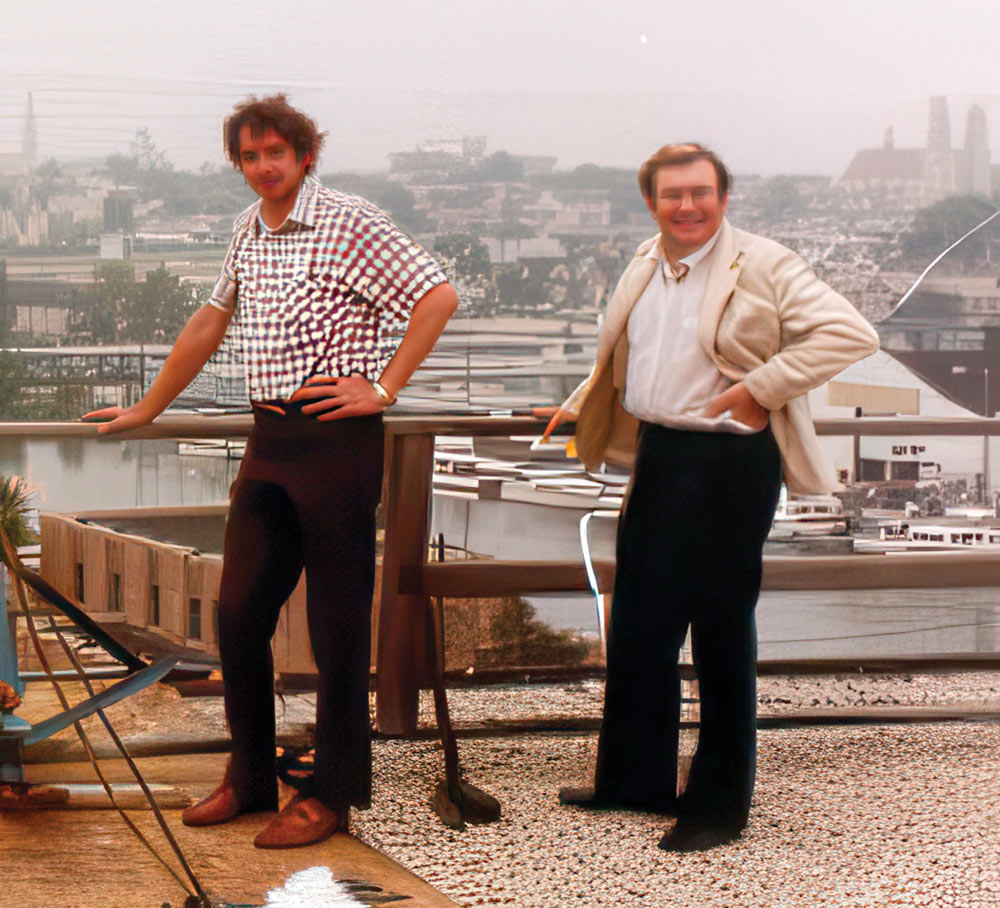
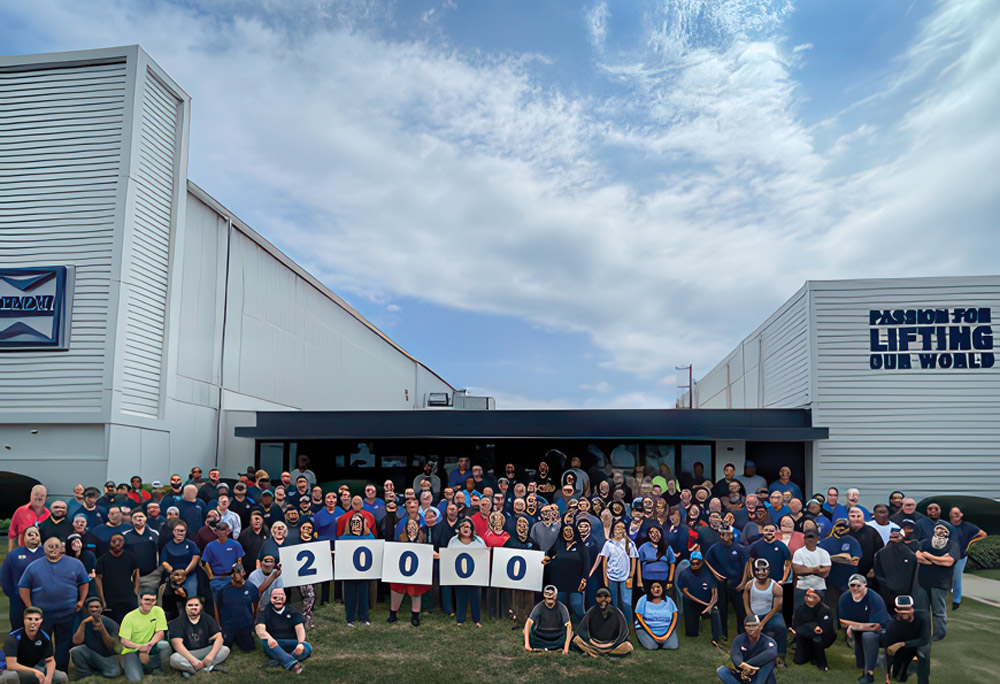



t was 1977 when Bob Pfleger decided to leave a successful 20-year career in the dock business at The Kelley Company and venture out on his own. His idea: manufacturing inclined vertical conveyors oriented at a 70-degree angle to move materials. He incorporated PFlow Industries and quickly brought his long-time friend and coworker Herb Ruehl on board.
Within a year, elevator inspectors began shutting down operation of PFlow’s incline lifts, insisting they did not comply with elevator codes. PFlow fought back, arguing its conveyors moved materials, not people, and should not be held to the same code requirements. In 1981, the ASME ruled in PFlow’s favor, but state and local agencies continued to push back.
While the fight with the elevator industry continued, fueled by determination and innovation, Pfleger pioneered the vertical reciprocating conveyor (VRC)—a versatile material lift that redefined multilevel material handling. PFlow VRCs quickly became a go-to solution across industries, from factories to the fast-growing self-storage industry. By 1987, PFlow had prevailed in having VRCs be governed in all 50 states by the ASME B20.1 conveyor code instead of the A17.1 people-moving code.

Helping fill the void was Ruehl’s son, Ted, who joined PFlow in 1981 and had already been playing a key leadership role. Ted was instrumental in purchasing the 125,000-square-foot former Kelley Company building, where Pfleger and his father worked side by side for 20 years. “I wish Bob had been alive to see it happen; he would have been thrilled to be the owner of his former employer’s building,” said Ted. Growth continued with a 21,000-square-foot neighboring building to accommodate expansion.
In 2019, Ted was named CEO and Pat Koppa joined as president, marking a new chapter in PFlow’s leadership. Today Pfleger’s legacy lives on through the “PFlow PFamily,” who carry forward his vision of delivering exceptional products and fostering a culture that is driven to get the job done.
Although there are fewer regulatory requirements when moving materials versus people, Hext explains that VRCs still incorporate a range of code-required and optional safety features that help protect both the materials being moved and the people using the VRC. “Several states prohibit the operation of VRCs by the general public, so only authorized facility staff can operate the equipment, securing drop bars or gates and operating the push button controls to send the VRC to another floor level once loaded.”
Hext says VRCs have become very popular in building conversions. “Because they’re regulated under conveyor code, they avoid many costly rider-safety provisions and frequent code-required inspections, which can result in a lower lifetime cost of ownership—a win for your budget and tenants!”
Of course, every facility has its own challenges, but Hext says PFlow VRCs overcome them. “No two PFlow VRCs are alike—each is engineered around a facility’s specific requirements, from carriage size and capacity to the number of floors it serves and the exact way goods are loaded and unloaded at each level.”
While freight elevators require concrete fire-rated enclosures or dedicated machine rooms, VRCs can allow for more flexibility in placement because they do not have these structural requirements.
“A VRC can be integrated seamlessly inside a building or placed on the exterior, where it can be enclosed against the elements without consuming valuable rentable square footage,” says Hext. “By tailoring every system to operational needs and physical space, PFlow delivers material lifting solutions that improve efficiency and safety while maximizing the return on every square foot of your facility.”
The right VRC starts with understanding your space and operations. “We have a nationwide network of material-handling dealers who conduct on-site visits to review facility layout,” says Hext. “We provide a tailored quote, and once approved, our engineering team designs a custom lift that fits those exact operational and space requirements.”
Where does PFlow go from here? According to Hext, “From the day Bob started PFlow, we’ve continually redefined how materials move. Whatever materials you need to lift, PFlow engineers safe, efficient solutions tailored to your operation. While our technology evolves, our commitment remains the same: delivering the industry’s best lifting solutions, backed by world-class service and support.”

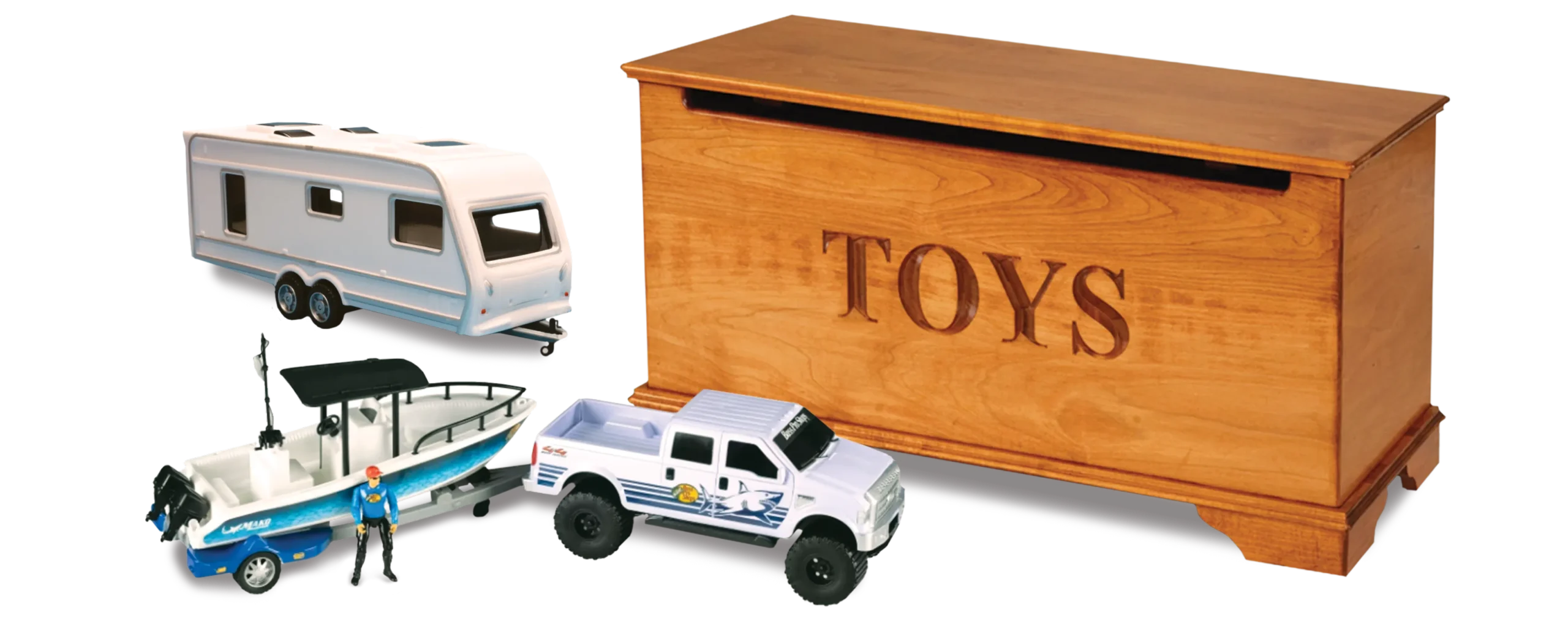

f you were one of the more than 3,800 attendees at the Self Storage Association Fall Conference & Trade Show in Las Vegas, I hope you stayed until the end to hear from the all-star panel of industry attorneys. Regardless of whether you were there, I want to share three takeaways that stood out to me.
First, our industry’s leaders have always been forward-looking. As I mentioned in last month’s column in SSA Magazine, some of the attorneys in the industry’s early days debated whether self-storage was a bailment relationship or landlord-tenant relationship. In short, bailment involves much more liability exposure to the business and would have greatly hampered the industry’s growth.
Contrary to the attorneys, however, panelist Carlos Kaslow explained that owners were always clear that they were landlords and pushed the industry in that direction. This position was solidified when the earliest self-storage laws, which the industry’s pioneers pushed through grassroots lobbying, defined self-service storage facility.

Third, the panelists discussed how certain technological innovations are making it easier for tenants to behave poorly. The issue could be tenants storing lithium-ion batteries that pose a fire risk for the whole facility. Or it could be tenants reading Reddit forums to learn how to game the system (e.g., using a family member’s credit card to get out of lien status, then the family member makes a chargeback request). Finally, it could be tenants using AI to write (often meritless) lawsuits—cough, cough—better than many attorneys.
Whatever form they take, troublesome tenants are as certain as death and taxes, and they are finding creative new ways to nettle operators. The panelists had great advice for dealing with these specific circumstances, but CubeSmart Chief Legal Officer and Secretary Jeff Foster said it best when he urged attendees not to allow tenants’ problems to fester and to seek swift resolutions to tenant complaints or problems.
In my experience, it’s a mathematical certainty that these types of tenants are behind most of the negative legislation that the industry battles. A commitment from all operators to swiftly resolve tenant complaints whenever possible, even or especially when the tenant is wrong, benefits the whole industry.
If you weren’t in Las Vegas this year to hear about the latest legal trends, be sure to come to next year’s SSA conferences in San Antonio and/or Las Vegas or to the state/regional show where you operate.

’ve seen a lot of changes during the almost 50 years that I’ve been in the self-storage business, most of which I would describe as incremental or gradual changes. Others are truly profound industry shifts or game-changers. From my vantage point, there have only been a handful of those.
For example, the introduction of climate-controlled storage in the late 80s not only introduced a new product line but began to change the way the public viewed self-storage and was part of what propelled it out of industrial parks and into acceptance as a mainstream retail use.
The operational transition from the live-in, on-site caretaker couple to a single, nonresident manager that began in the late ‘90s impacted everything from marketing to the advent of call centers. Why call centers? We studied it early on and discovered that a single manager, no matter how well trained, simply cannot answer the phone all the time. In fact, we found that our managers were missing about 50 percent of inbound calls, hence the installation of our first call center. And by the way, if you think your single manager is doing much better than that, you’re kidding yourself.
The introduction of multistory construction in the late ‘90s and early 2000s solidified the place of self-storage among other retail uses and facilitated obtaining difficult re-zonings and use permits for locations that would have been impossible a decade earlier.
The rapid demise of the old Yellow Pages and other print media in favor of online everything, from sophisticated websites offering customers online rentals, video chat, and QR codes (which half of the boomers have no idea how to use) and facilitating sophisticated, real-time revenue management for operators, has truly revolutionized modern-day marketing. And finally, the introduction of AI (which at this point almost no one understands how to use) promises to accelerate the development of all the above.
The latest game-changer, which is going on right now as I write this, is the transition from the fully staffed management model to the remotely operated facility with no on-site staff. There are various factors propelling this transition, but I’m confident that it’s here to stay and that the industry will look very different 10 or even five years from now as a result. (Yes, I’m aware that some of you out there are saying, “What’s he talking about? I’ve been running my facility out of my body shop a mile up the road for years!”)
In short, it’s an exciting time for our industry, and you can either embrace it or be dragged kicking and screaming into the future; either way, these changes are happening, so get ready!
• Fully integrated solutions with in-house baȷa Engineers for faster, easier projects
• Pre-Fabricated Framing Systems with Bolted Connections – No field welding
• Snow Loads from 20psf to 100psf – Wind Speed rated to 170MPH