

elf-storage sector stabilization progresses slowly. Self-storage REITs posted mixed Q2 2025 results as the sector continues a slow and uneven path toward stabilization following a period of declining fundamentals. Weighted-average same-store revenues declined 0.3 percent in Q2, a deceleration from -0.2 percent last quarter, driven by a 40-basis-point decrease in average quarterly occupancy to 91.8 percent and flat realized rent growth. Although occupancy has not improved, encouraging growth in new customer rates has helped stabilize in-place rents. Demand is normalizing, but recovery varies by region—dense urban areas and coastal metros are posting revenue growth, while Sun Belt markets remain under pressure from elevated supply and a weak housing market. However, expense growth—driven by higher property taxes, insurance, and marketing—continues to outpace revenue, pressuring NOI. Full-year guidance was revised, with total revenue now expected to range from -1.2 percent to 0.6 percent and NOI from -2.9 percent to -0.4 percent. Operators expect a gradual but uneven recovery in the second half, supported by fewer new deliveries, improving rate trends and ongoing operational efficiencies. A rebound in housing and migration-driven demand remains the key swing factor that could accelerate growth in 2026. Yardi Matrix covered these trends and more in the self-storage national outlook webinar on Aug. 27, 2025.
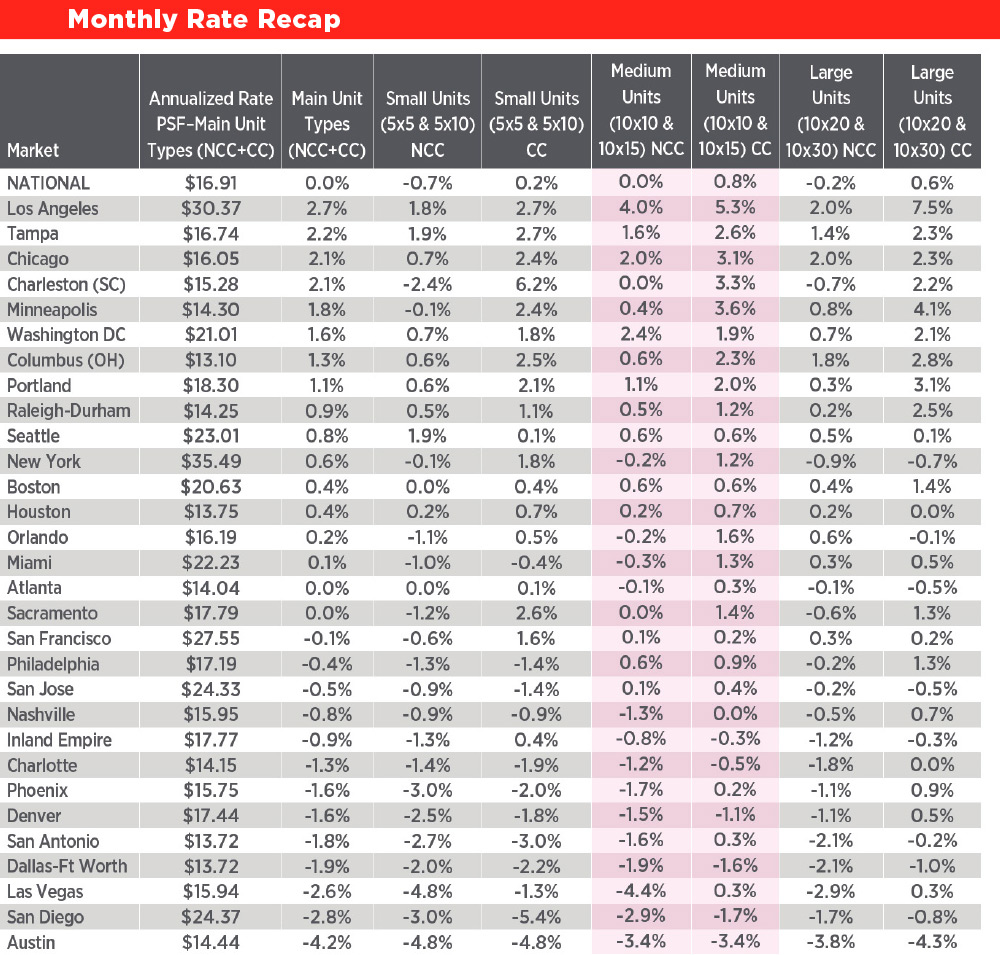
National rates dip slightly year over year, but many top metros see increases. Asking rates and demand trends continued to show signs of stabilization in July. National advertised rates were flat at 0.0 percent year over year, with an annualized average rent per square foot of $16.91. This compares to 0.0 percent in June and -0.4 percent in May. Rates declined 0.6 percent month over month, signaling an earlier end to the leasing season.
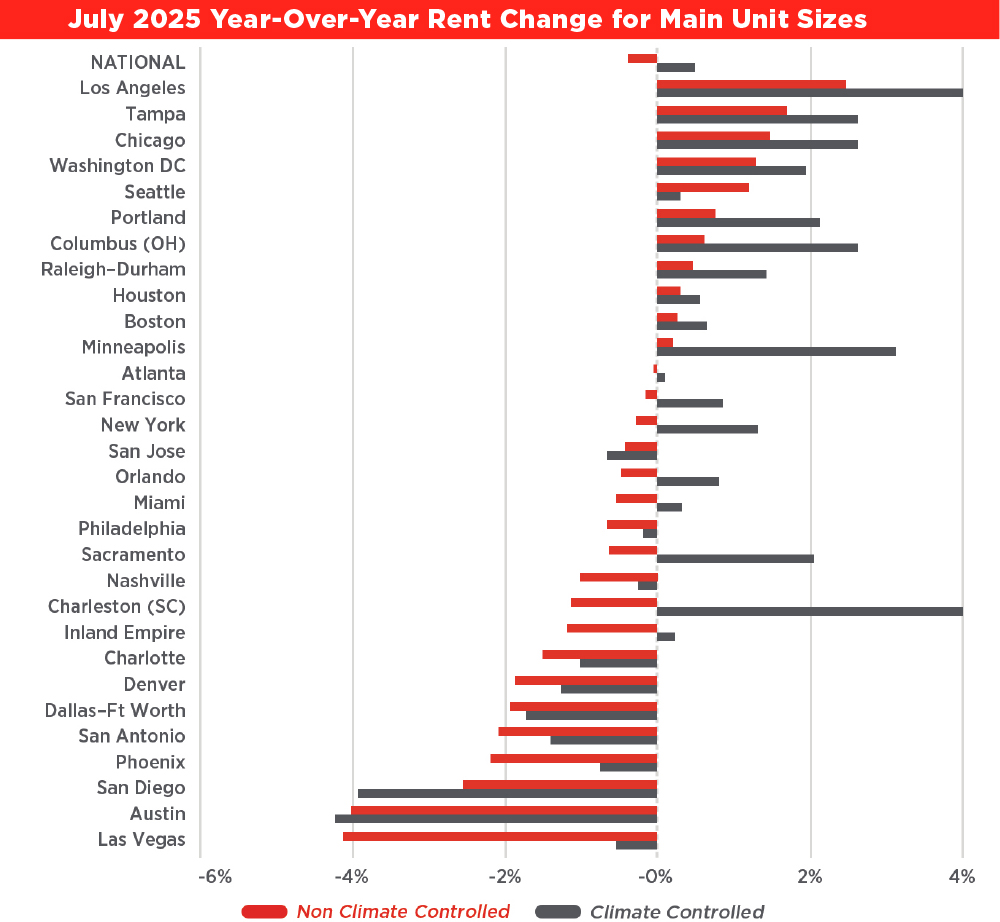
While half of the top Yardi Matrix metros recorded year-over-year increases in advertised rates in July, the rate momentum in most markets has decelerated compared to the previous month. Year-over-year rates for non-climate-controlled (NCC) units increased in 11 of the top 30 metros, while climate-controlled (CC) rates increased in 20 of the top 30 metros.
Nationally, Yardi Matrix tracks a total of 3,043 self-storage properties in various stages of development, including 703 under construction, 1,944 planned, and 396 prospective properties. Yardi Matrix also maintains operational profiles for 31,277 completed self-storage facilities in the U.S., bringing the total dataset to 34,320. We are happy to announce the release of our new Springfield, Ill.; Lebanon, Vt.; and Valdosta, Ga., storage markets.
Self-storage REITs continued to outpace non-REITs in rate performance. Same-store advertised rents at REIT properties increased 1.1 percent year over year, compared to -0.6 percent for non-REITs in the same markets. However, REITs saw a slight deceleration in growth, with July’s 1.1 percent increase down from 1.4 percent in June. Additionally, REITs saw a 0.2 percent month-over-month decline in advertised rates.
See July 2025 Year-Over-Year Rent Change for Main Unit Sizes chart.
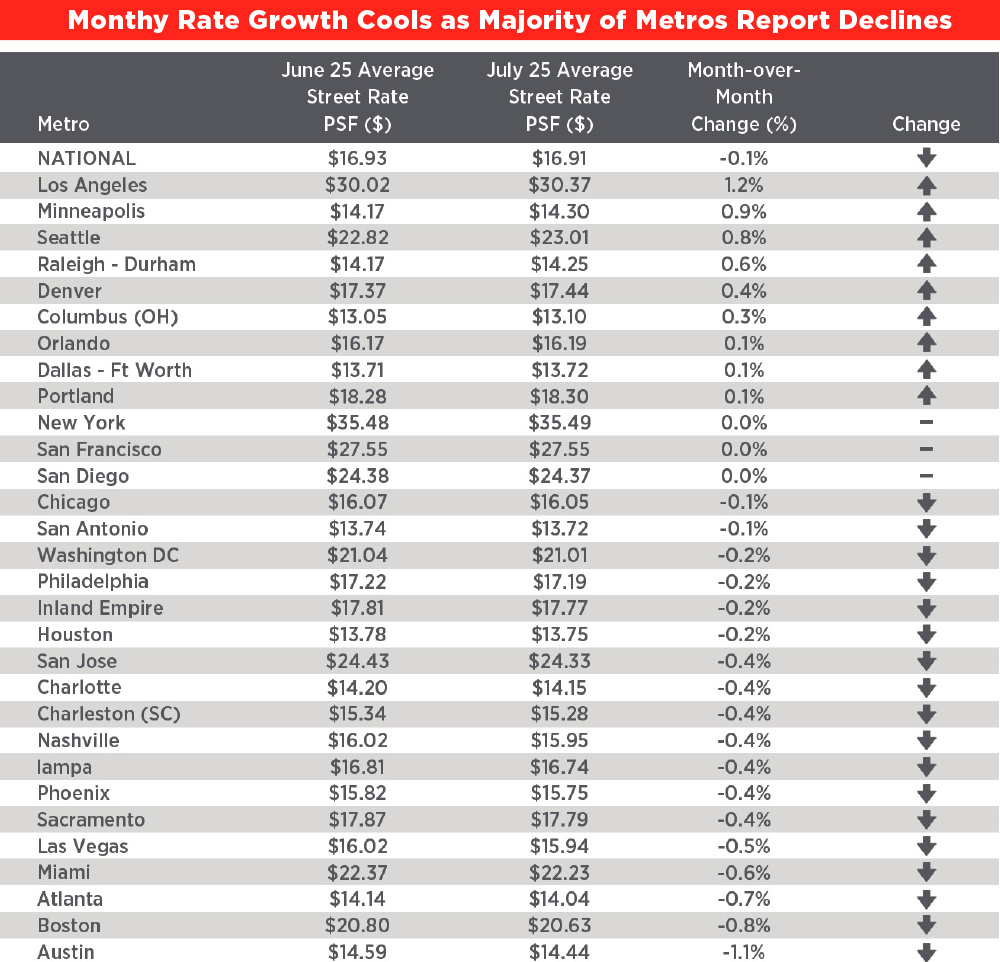
While July had metro-level variability in sequential rates, the majority of metros saw asking rates decline, with same-store advertised rents dropping in 18 of the top 30 month over month.
Asking rates in Los Angeles outperformed the other top metros in July, leading the nation in month-over-month (+1.2 percent) as well as year-over-year (+2.7 percent) growth. Storage operators continued to raise advertised rates to compensate for L.A.’s wildfire-related restrictions on existing-customer rent increases, led by storage REITs, which increased rates in L.A. by 1.8 percent month over month and 6.3 percent year over year in July.
See Metro table and National Average Street Rates PSF for Main Unit Types chart.
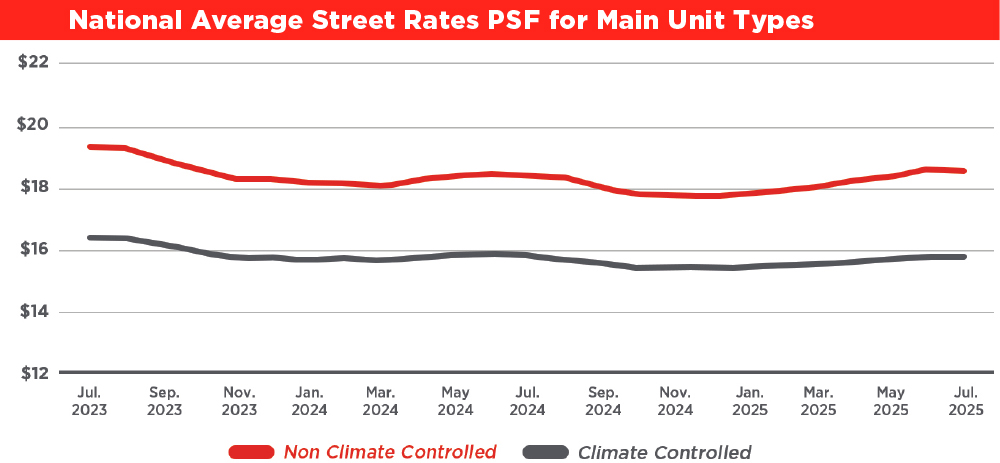
Meanwhile, Austin, Denver, and San Diego are being impacted by weak demand, largely driven by underperforming housing and apartment markets. In Austin, advertised rate growth was among the worst both month over month and year over year in July, despite low lease-up supply, suggesting a demand-side issue likely tied to reduced migration and a weak housing market impacting both the for sale and for rent sides. Denver and San Antonio are experiencing similar trends, with multifamily rent declines a sign of weak self-storage demand, which is putting downward pressure on asking rents.
See Self-Storage Major Metro Summary chart.
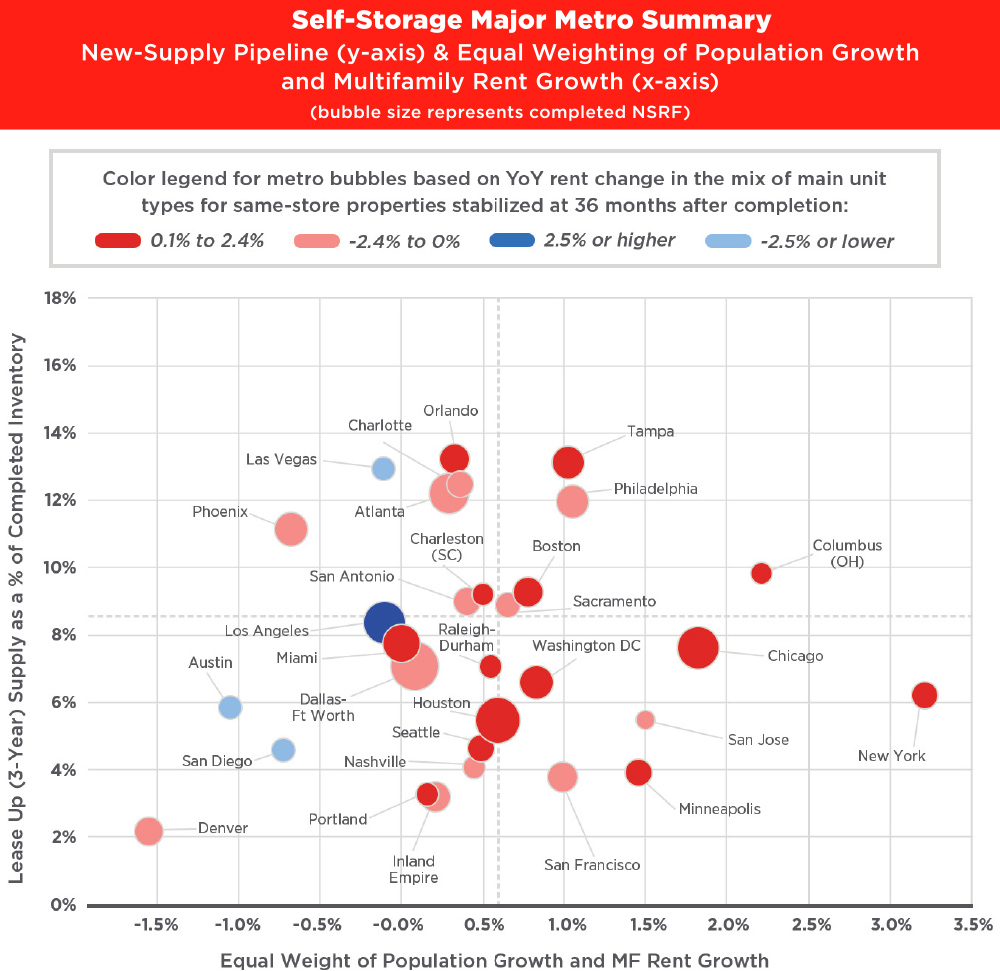
At the metro level, 19 of Yardi Matrix’s top 30 metros saw an increase in three-year lease-up supply over the past year. Leading the pack were Sacramento, Columbus, Charlotte, San Antonio, Orlando, and Tampa.
Conversely, New York, Portland, and Minneapolis experienced the largest declines in trailing 36-month deliveries. In July, New York’s three-year supply fell to 6.2 percent, a 510-basis-point drop from the previous year. This reduction in new supply contributed to New York’s largest year-over-year increase in asking rates since December 2023, up 0.6 percent.
See NRSF Delivered Over the Last 36 and 12 Trailing Months chart.
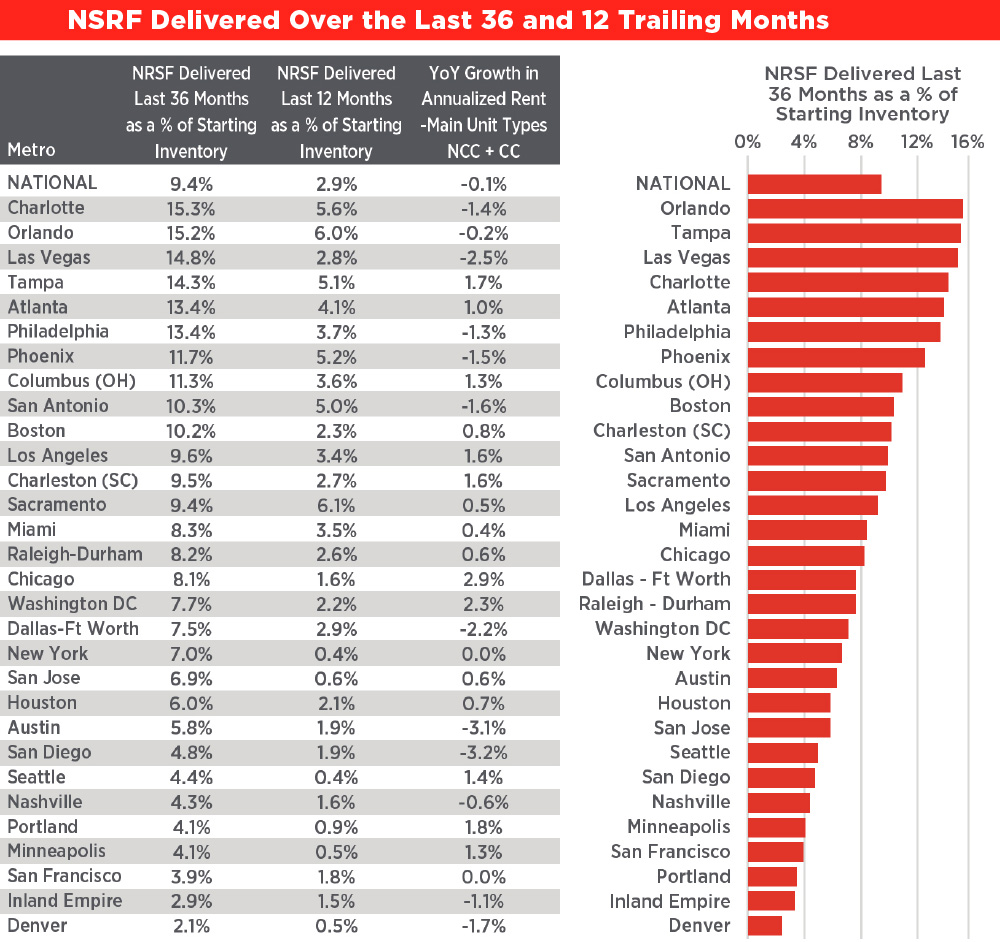
The Q3 2025 Yardi Matrix Self Storage supply forecast remains largely consistent with the Q2 update, continuing to reflect a slowdown in development activity. New construction starts totaled 19.9 million NRSF in the first half of 2025, a 13.2 percent decline compared to the same period in 2024. Looking ahead, new square footage is expected to decline by 15 percent in 2025, 18 percent in 2026, and 8 percent in 2027. The prospective pipeline continues to contract, falling 3.5 percent quarter over quarter and 22.5 percent year over year.
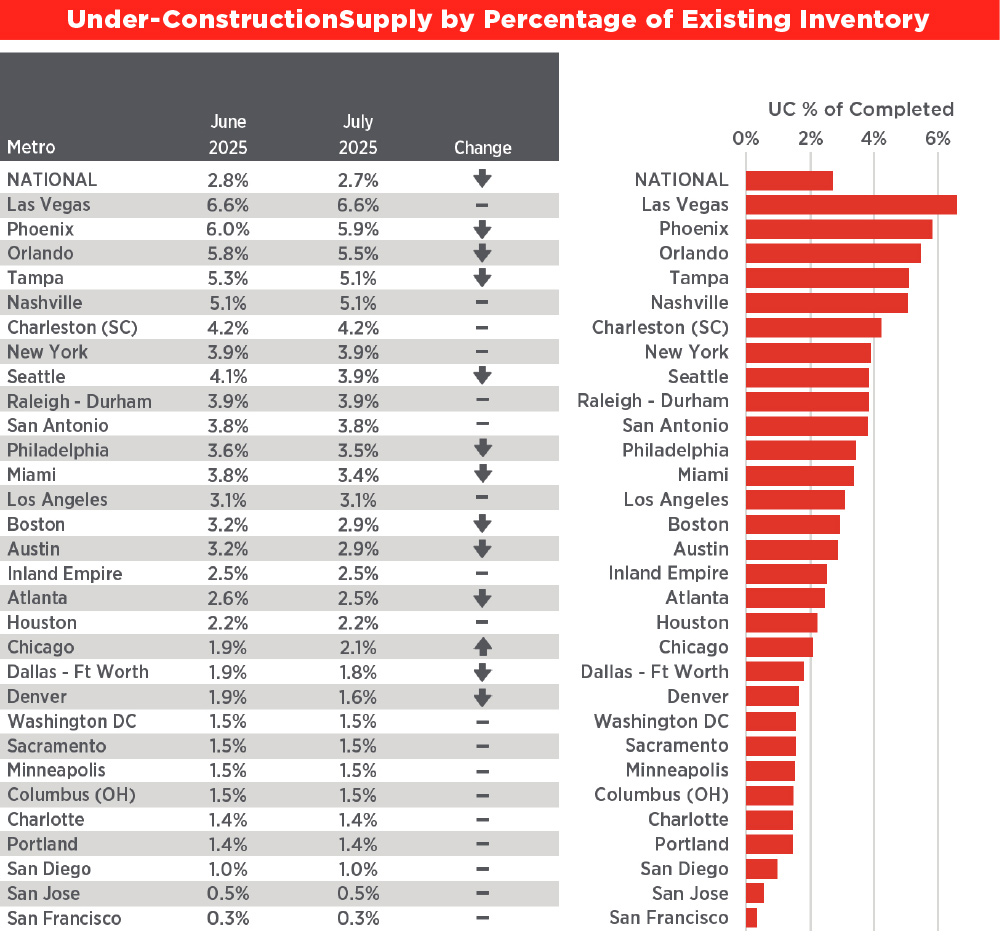
A number of top 30 markets have a higher level of supply under construction than trailing 12-month deliveries, which will be a headwind for rent growth over the next 12 to 24 months. Las Vegas saw a break in supply over the past year but has seen the biggest increase in supply under construction recently, followed by Nashville, New York, and Seattle. On the other hand, Sacramento and Charlotte have the least amount of supply under construction relative to trailing 12-month supply, which should help recently delivered supply get absorbed.
See Under-Construction Supply by Percentage of Existing Inventory chart and Monthly Rate Recap table.