









How to enjoy our new magazine:
Just scroll!
Click or tap the table of contents icon in the menu bar to find any article.
Read any article by clicking or tapping the read full article button below each article intro.
Jump back to your previous browsing spot from any article using the menu bar or back to issue button.



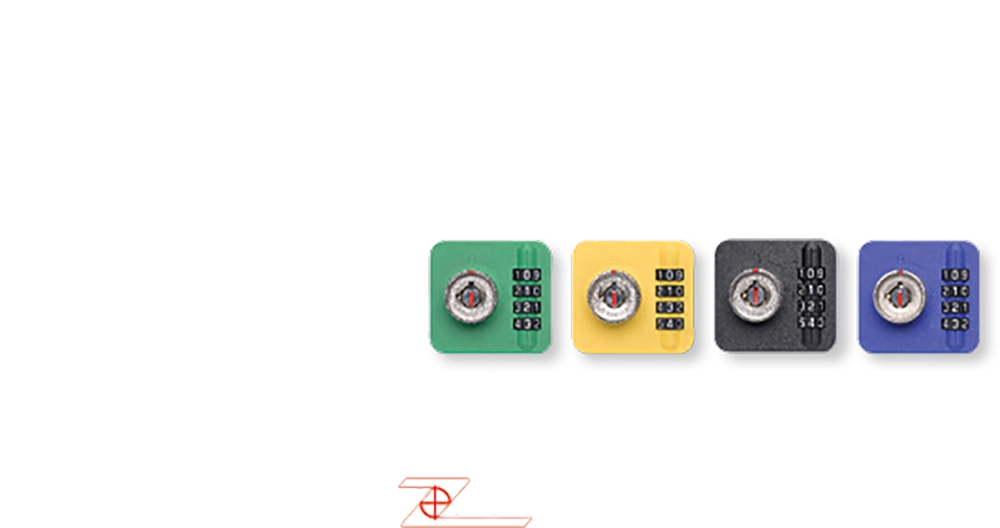
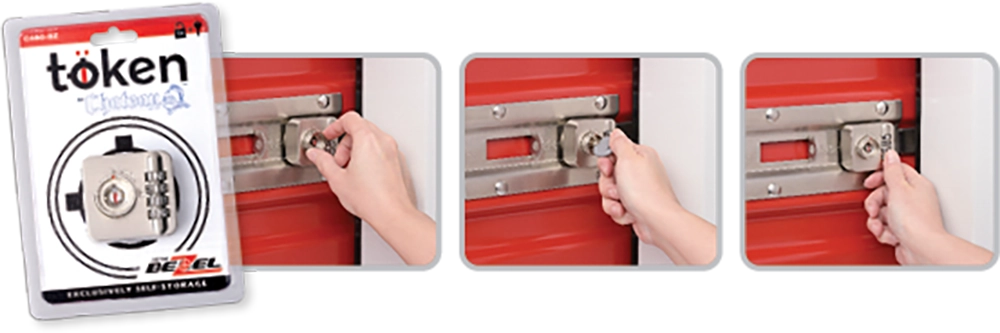
smart lock has arrived
POWER OF BLUETOOTH & NFC









-
Protecting Facilities When Weather Conditions Turn SeverePage 12
-
Choosing Software That ScalesPage 14
-
From Good Old Days To Digital Ways For A Packed PlanetPage 18
-
Catering To The 24-Hour CustomerPage 20
-
Unlocking Efficiency And Innovation For SuccessPage 22
-
Protecting Facilities When Weather Conditions Turn SeverePage 12
-
Choosing Software That ScalesPage 14
-
From Good Old Days To Digital Ways For A Packed PlanetPage 18
-
Catering To The 24-Hour CustomerPage 20
-
Unlocking Efficiency And Innovation For SuccessPage 22




Experience

Local Expertise

Not Just a Builder


-
The Ultimate Self-Storage Construction Financing GuidePage 64
-
New Braunfels Executive Storage in New Braunfels, TexasPage 66

-
Rethinking Legacy Systems In The Age Of AutomationPage 68
-
Five Things Self-Storage Investors Should Be Doing To Maximize BenefitsPage 72
-
Is Inflation A Friend Or Foe?Page 76
- Chief Executive Opinion by Travis Morrow6
- Publisher’s Letter by Poppy Behrens9
- Meet The Team10
- Women In Self-Storage: Renee Tulve by Alejandra Zilak27
- Who’s Who In Self-Storage: Thaddeus Campbell by Brad Hadfield31
- Innovation Spotlight: SecureInventory and SecureSCOPE by Brad Hadfield80
- Self Storage Association Update 83
- The Last Word: Michael Sortwell 84
For the latest industry news, visit our comprehensive website, ModernStorageMedia.com.








CEO of MSM and Storelocal Corporation,
President of National Self Storage
omehow, it’s already May and two national tradeshows are in the books. If you’re an operator or manager reading this and you haven’t locked in your spot for THE Show yet (Nov. 4 to 6, 2026, in Atlanta), here’s the straight talk: Don’t wait any longer.
I get it—November still feels far away, and maybe you missed the early-bird cutoff. But here’s the good news: Register with an affiliate code from one of our partners or sponsors and you’ll still save $100 off the price. That’s real money—get signed up today.
We built this event for you—the people actually running facilities and making the real decisions. You’ll get 60-PLUS HOURS OF CONTENT organized around our four pillars: operations, data, development, and investment. These aren’t recycled talks; they’re actionable insights from top operators and experts you can use immediately back at your properties.
You read that right—60-PLUS HOURS OF CONTENT, more than one person can consume. That’s exactly why we created the Four Pillar Pack, so your whole team can cover it all without missing a beat.
We’re bringing heavy hitters to the main stage too. CNN’s Scott Jennings will break down Washington policy and the economy’s impact on self-storage. Atlanta Braves Hall of Famer Chipper Jones will deliver raw lessons on resilience and perseverance every owner and operator needs. Facility managers get their own dedicated Manager’s Office packed with practical, day-to-day operational training.
The experience is next level. Imagine an underwater welcome reception at the Georgia Aquarium with Wolfgang Puck catering while sharks glide by. Then hit the red carpet for our MSM Awards Gala. The tradeshow floor is completely re-engineered with zoned activations and a central Clubhouse, so networking feels natural instead of forced.
This is the only national self-storage event east of the Mississippi in 2026, drawing 1,000-plus operators ready to learn, connect, and recharge for a strong 2027.
Rooms at the Signia by Hilton—steps from the Georgia World Congress Center—are filling fast. Book now so you’re not scrambling or paying more later.
This is our industry stepping up. I can’t wait to see you in Atlanta! Register today, grab that affiliate code, and let’s make it the best event you’ve ever attended.

-
PUBLISHER
Poppy Behrens
-
Director Of Sales & Marketing
Lauri Longstrom-Henderson
(800) 824-6864 -
Creative Director
Carlos Padilla
(800) 352-4636 -
Editor
Erica Shatzer
-
Lead Writer / Web Manager
Brad Hadfield
-
Storelocal® Media Corporation
Travis M. Morrow, CEO
-
Websites
-
Visit Messenger Online!
Visit our Self-Storage Resource Center online at
www.ModernStorageMedia.com,
where you can browse our paid publications, research archived articles, sign up for a magazine subscription, submit a change of address, and more. 
- All correspondence and inquiries should be addressed to:
MSM
PO Box 608
Wittmann, AZ 85361-9997
Phone: (800) 352-4636
Invest with confidence in a family-owned and operated self-storage brand backed by 40 years of proven experience. Built on trust, stability, and hands-on management, our company has thrived across market cycles while delivering consistent value.
Join a legacy of smart growth and reliable returns in an essential, resilient industry.

210-405-6695
theparhamgroup.com











here’s a moment at every industry event when you can feel the shift. It happens somewhere between the noise of the trade show floor and the quiet of a real conversation, between the quick exchange of business cards and the longer pause where someone leans in and says, “Here’s what’s actually working for us.”
That moment matters.
Because for all the growth, innovation, and attention our industry continues to attract, self-storage is still—at its core—a relationship business. It’s built on experience, shared knowledge, and the willingness to learn from one another in ways that go deeper than surface-level trends.
For more than four decades, Modern Storage Media (MSM) has existed to support that deeper layer. From the earliest days of Mini-Storage Messenger to the platform MSM is today, our mission has remained consistent: to educate, to inform, and to elevate the conversation around this industry we all share.
We’ve never been focused on being the loudest voice in the room. Instead, we’ve focused on being the most useful.
That means delivering data you can trust. It means providing insights that hold up not just in today’s market but over time. And it means creating spaces, both in print and in person, where meaningful conversations can happen.
As the industry evolves, so do the ways we gather, learn, and connect. The pace has accelerated. The options have multiplied. And with that has come a certain level of noise—more information, more solutions, more voices competing for attention.
But what hasn’t changed is the need for clarity.
Operators, developers, and investors are not just looking for what’s new. They’re looking for what works. They’re looking for perspective grounded in experience. They’re looking for connections that lead to better decisions, not just more options.
That’s where MSM continues to stand apart.
Our commitment is to bring forward content and experiences that respect your time and your intelligence, to focus on substance over spectacle, and to ensure that whether you’re reading an article, studying the Almanac, or walking into one of our events, you walk away with something you can apply—something that moves your business forward.
That philosophy is also what led to the creation of THE Show, presented by MSM and Janus International. Designed to be intentionally different, THE Show prioritizes meaningful engagement over mass movement, where the trade show floor is reimagined for visibility and connection, education is elevated, and conversations aren’t rushed. It’s not about how many booths you visit but what you take away from the experience.
As we look ahead, that commitment only deepens. We are investing in more intentional programming, more curated conversations, and more opportunities for the kind of engagement that defines this industry at its best.
Because in the end, it’s not about how many people you meet. It’s about the right conversations—the ones that challenge your thinking, confirm your instincts, and stay with you long after the event ends. Those are the moments that shape businesses and careers. And those are the moments we will continue to create.

Publisher

here’s a moment at every industry event when you can feel the shift. It happens somewhere between the noise of the trade show floor and the quiet of a real conversation, between the quick exchange of business cards and the longer pause where someone leans in and says, “Here’s what’s actually working for us.”
That moment matters.
Because for all the growth, innovation, and attention our industry continues to attract, self-storage is still—at its core—a relationship business. It’s built on experience, shared knowledge, and the willingness to learn from one another in ways that go deeper than surface-level trends.
For more than four decades, Modern Storage Media (MSM) has existed to support that deeper layer. From the earliest days of Mini-Storage Messenger to the platform MSM is today, our mission has remained consistent: to educate, to inform, and to elevate the conversation around this industry we all share.
We’ve never been focused on being the loudest voice in the room. Instead, we’ve focused on being the most useful.
That means delivering data you can trust. It means providing insights that hold up not just in today’s market but over time. And it means creating spaces, both in print and in person, where meaningful conversations can happen.
As the industry evolves, so do the ways we gather, learn, and connect. The pace has accelerated. The options have multiplied. And with that has come a certain level of noise—more information, more solutions, more voices competing for attention.
But what hasn’t changed is the need for clarity.
That’s where MSM continues to stand apart.
Our commitment is to bring forward content and experiences that respect your time and your intelligence, to focus on substance over spectacle, and to ensure that whether you’re reading an article, studying the Almanac, or walking into one of our events, you walk away with something you can apply—something that moves your business forward.
That philosophy is also what led to the creation of THE Show, presented by MSM and Janus International. Designed to be intentionally different, THE Show prioritizes meaningful engagement over mass movement, where the trade show floor is reimagined for visibility and connection, education is elevated, and conversations aren’t rushed. It’s not about how many booths you visit but what you take away from the experience.
As we look ahead, that commitment only deepens. We are investing in more intentional programming, more curated conversations, and more opportunities for the kind of engagement that defines this industry at its best.
Because in the end, it’s not about how many people you meet. It’s about the right conversations—the ones that challenge your thinking, confirm your instincts, and stay with you long after the event ends. Those are the moments that shape businesses and careers. And those are the moments we will continue to create.
Publisher

MSM’s THE Show lands in Atlanta, Ga., on Nov. 4 to 6, 2026, packing the Georgia World Congress Center with more industry speakers and keynotes than ever before, plus special guests, exciting breakout sessions, an acquisitions corner, and a trade show floor designed for engagement and visibility.
After hours, unforgettable events await, with our Deep Blue Welcome Dinner inside the underwater banquet hall of the Georgia Aquarium, catered by Wolfgang Puck, and our Red Carpet Awards Gala, honoring the very best in self-storage.
If you’ve been waiting for something different … Welcome to THE Show.













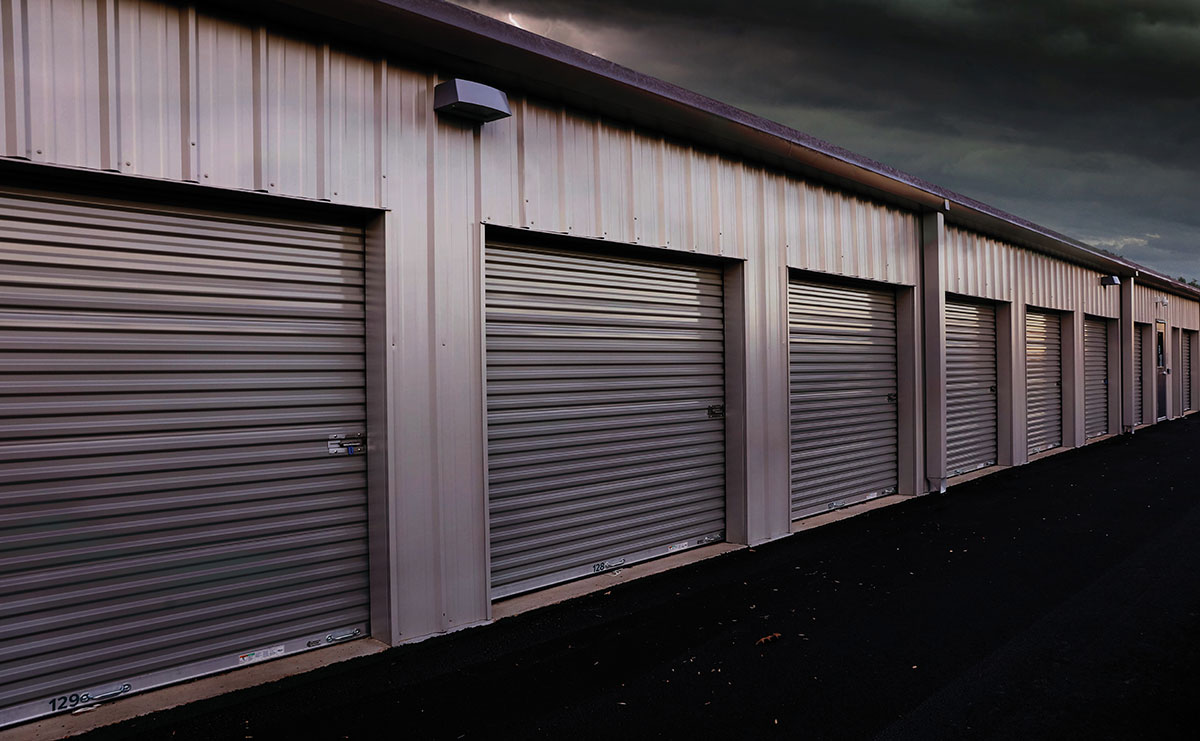
xtreme weather is no longer an occasional stress test for self-storage facilities, it is a recurring operational challenge. Inland hurricane-force winds, hailstorms, and flooding are affecting markets that historically faced little exposure to these risks. As weather patterns become more unpredictable, the ability of a facility to remain operational increasingly depends not just on how it was built but on how well it is maintained.
In many severe weather events, buildings do not fail catastrophically at once. Instead, damage often begins at vulnerable points along the building envelope, allowing wind, water, or debris to enter and amplify the impact. For self-storage operators, roofs and roll-up doors are among the most critical and most exposed components. When one element fails, multiple units can be affected, increasing tenant disruption and recovery costs.
Things to look for include:
- Fastener wear – All metal roof fasteners experience wearing over time, but those facing the elements on a daily basis, as is the case in exposed fastener systems, are especially prone to degradation. Look for wear on washers as well as the screws and replace them before they fail.
- Scratches or wear on paint or coatings – Paints, primers, and coatings, like zinc or aluminum, can help protect the metal underneath and extend its life, but scratches or excessive wearing of those protective coatings can leave the metal underneath vulnerable. Specific scratches can be covered with touch-up paint, and if a significant portion of the roof is showing wear, a full roof coating can be applied to extend the roof’s life.
- Areas of exposure – Look for penetration or gaps in coverage in areas where panels connect or accessory products have been added, like valleys, ridges, edges, around ventilation or skylights, etc. Additional cements, sealants, butyl tape, or closures may be needed to close these penetrations.
Beyond visible components, structural connections deserve close attention. Severe weather damage is frequently traced to failures in fasteners, brackets, and other connecting hardware rather than primary structural members. Corrosion, metal fatigue, or minor loosening can reduce a component’s ability to transfer loads safely into the structure. This is particularly important in regions with high humidity or salt exposure, where corrosion can accelerate deterioration. Routine monitoring of these small but critical parts can significantly reduce the likelihood of unwanted damage.
Here are things to look for during maintenance and inspections:
- Damage to door curtain – Look for individual slats or the seam between slats with creasing. This can be the result of a tenant hitting the door with a vehicle, dolly, or forklift and could impact the long-term performance of the door. Many manufacturers offer replacement door options to consider.
- Rust or corrosion around bottom bar – The bottom bar is an important defense against wind and driving rain, but some non-aluminum versions can be susceptible to issues when water pools at the base of the door or there is significant exposure to humidity, rain, or snow. Look for surface rust (orange or brown discoloration), flaking metal, soft spots, or thinning metal. Replace bottom bars or full door assembly as needed.
- Bent or damaged guides – Look for gaps between curtain edges and the guide, scrape marks, or tracks that are visibly bowed, pinched, or twisted. In high-wind areas, make sure to inspect extra clips for integrity. These issues could lead to premature wear of the curtain or hardware, increase strain on springs, or even result in the door jumping the track. Replace components or full door assembly as needed.
- Worn fasteners – Look for loose bolts or screws, missing hardware, stripped threads, rusty or corroded fasteners, and any wall anchors that are pulling out of masonry or metal walls. Repair or replace components as needed before extreme weather strikes.
As insurers and regulators respond to rising weather-related losses, operators may face increased scrutiny of facility conditions and preparedness. Maintenance records, inspection schedules, and documented repairs are becoming more than operational best practices—they are part of broader risk management strategies.
Ultimately, extreme weather resilience is not achieved through a single upgrade or product choice. It is built through consistent attention to detail, informed inspection practices, and an understanding of how individual components interact under stress. For self-storage operators, maintenance is not just about extending asset life. It is about protecting tenants, preserving operations, and ensuring that facilities remain dependable when conditions are at their worst.

ndustry experts share their secrets to selecting the right self-storage management software. From integrations to product roadmaps to user-friendly systems, discover how to pick a true technology partner.
With so many options, features, and all-in-one promises, finding the facility management software that meets your needs can be daunting. Happily, your software doesn’t need to do everything. Instead of focusing on capacity or cost alone, prioritize the features that matter most to your business and those with whom you do business.
And yet, everything connects to that backbone. Shannon Charbonneau of XPS Solutions, a third-party vendor who works with multiple platforms, mentions the importance of system integrations. “First thing I tell people is to really consider your FMS. Just like an octopus, all the arms need to connect back to the head,” she says. Before you sign a contract, says Charbonneau, be sure your “octopus” plays well with others. “If you change software, it can be a problem to transfer X, Y, and Z.” Consider arrangements with other suppliers, and be sure your new system communicates with theirs. “If it’s the first time you’ve heard of the product,” says Charbonneau, “they likely aren’t integrated with all your systems.”
As well, Sarah Beth DeFazio, vice president of sales and development at Universal Service Group, underscores the importance of investing in a well-rounded system. “Don’t overlook integrations. Your software should talk to your website, call center, gate access, revenue management tools, and online rental platform seamlessly. A system that lives in isolation creates manual work and gaps in the customer experience.”
When vendors get lofty with their promises, Nguyen observes, it may indicate what the software currently lacks. “If you hear, ‘we’re working on that’ more than three or four times,” he says, “that’s a generic answer for what they can’t do now.”
A company that listens to operator feedback and invests in innovation is one worth building a relationship with. “Think long term,” adds DeFazio. “You’re not just buying software for today—you’re choosing a technology partner that will support your growth. Ask where their product roadmap is heading.”
Even so, Donovan Wong, senior marketing manager of Tenant Inc., recommends owners really assess their current state of affairs, as well as any goals for growth. A key question: How does this fit the way your operation actually runs today? “Not how it fits the ideal version of your operation … the real one,” says Wong. “The best software for your business meets you where you are and grows with you, rather than requiring you to reorganize around it.”
While there’s the temptation to buy something off the shelf or focus solely on cost, these tactics usually cost more down the line. “I recommend highly that cost is not the only priority,” says Charbonneau. “There’s a bit of a race to the bottom with that. Cheap and cheerful may be fantastic now, but down the road, you may spend more money transitioning.”
And while Wong points out the importance of gauging your current business needs, it’s also good to look ahead. Shenoy recommends choosing a software partner that embraces growth; as your business evolves, so should your software. “Operators should start by evaluating whether the platform is designed to support their long-term operational strategy, too,” says Shenoy. “Equally important to that strategy is the quality of onboarding, training, and ongoing support provided by the software company. A strong operational partnership with the vendor can often make as much of a difference as the software itself.”
Mixon agrees. “Don’t let a slick sales presentation fool you,” she says. “Ask for what you need, and then say, ‘Show me or tell me what it looks like when so and so happens.’ You want an operational expert, not just a nice visual.”
Wong also stresses choosing a technology partner, not just a provider. Storage operators get the most from their software when they have strong support, dedicated contacts, and ongoing training. “What does the relationship look like after you go live?” he asks. “A great demo is easy. Find out what it’s actually like to call them many months in. The selection process is really a question of fit. Operators should ask the questions that reveal it.”
Mixon recommends speaking with other operators about what they use. Owners need more than payment processing; they also need strong backend auditing and visibility into rent concessions and occupancy data. “Talk to managers who are using it to see if it’s accessible,” she says. “You need input from people besides the sales staff.” Likewise, Nguyen stresses the importance of an easily navigated system for all involved in your business. “You want software that’s built for the people who use it most—your manager, your customer service agents, whoever’s logging into that portal each day. It needs to work for your team. You want software that converts users and builds trust.”


Self-Storage

Self-Storage
Grandpa, tell me about the good old days.” The Judds classic song is about simpler times in the face of a world that is changing so fast. When that song came out in 1986, it hit all the right notes and brought a strong sense of nostalgia. Today it’s becoming clearer by the day that we can’t stay in the past. We must press forward in our ever-changing environment, particularly with regard to technology. Oh, but our self-storage industry held on to the good old days for a long time, didn’t we? Embracing the belief that “this is working just fine” really ended up holding many operators back. Thankfully, some forward-thinking industry operators began opening the door and peeking into the world of technology and automation a few years ago, and now, as we enter the “Agentic AI” era, the options and opportunities have broadened dramatically in all aspects of the industry.
While operators large and small and in many different markets are implementing various levels of technology, there is still a sense of hesitation when using these products and services, particularly when it’s customer facing and in a rural market. Have you heard anyone saying things like “The way I’ve been doing it is fine,” or “The people around here don’t even have cell phones,” or “My customers don’t do (insert unthinkable technology feat here)”? Ultimately, thinking like this will prevent you from being a better operator and giving your tenants important, modern tools of convenience. Everybody likes convenience, right?
When our company acquired a property in a rural market a couple of years ago, we heard all those sentiments from the previous owner and his management team. The site was about 550 units and running about 92 percent occupancy. They did have some basic technology in place—things like an automated gate system coupled to the old stand-alone version of Sitelink and a basic website but without rental or payment capabilities. There wasn’t a lot of competition; in fact, there weren’t any competitors within three to five miles and things just seemed to run smooth as-is, so why change anything? What impact could we, as the new owner/operators, make?
After digging a little deeper, it became clear that there was room for improvement in a number of areas. Previously, the property was staffed by one manager who was also responsible for tasks outside of the self-storage business, setting the stage for inconsistent operational practices and general disorganization and poor documentation, including missing or incomplete paper rental agreements. Additionally, there were little to no revenue management practices in place. Tenants didn’t consistently receive rate increases, dynamic pricing based on demand and supply wasn’t in place, nor had the base street rates been adjusted in a long while. Delinquency was high, with over 60 tenants more than 30 days past due. These deficiencies were largely the result of a manual collections program and infrequent auctions, allowing tenants to become severely past due before action was taken. To top it off, tenants were not offered storage insurance or protection plans, representing both a revenue opportunity loss and an exposure to risk.

Within the first year, there were significant improvements made across virtually all key metrics. Digitized tenant files with updated contact information combined with the automated collections protocol reduced delinquency to 5 percent, with only 14 tenants over 30 days past due at the end of year one. Our review of rate discounts identified an excessive number of complimentary units, prompting corrective actions to minimize revenue leakage. At the same time, professional call center performance drove occupancy to 99 percent, exceeding expectations but pushing occupancy to a less-than-ideal level. This overly high occupancy set the stage for an aggressive rate management approach, including dynamic pricing strategies, consistent rent increases, and effective collections procedures resulting in almost a 20 percent year-over-year increase in income from rent and fees. Following the introduction of a tenant protection program, enrollment reached 74 percent in the first year, generating a new revenue stream while providing customers with a greater peace of mind.
All of the above was accomplished while maintaining tenant trust, as evidenced by a significant increase in positive online reviews, pushing the facility’s overall rating to over four stars, so don’t assume that a rural customer base, which may be perceived as less sophisticated, is not willing to embrace change if it is largely beneficial and presented properly. Our success with the foregoing programs at this location has opened the door to future implementation of other operational enhancements as well, like smart locks/hasps, enhanced gate/access systems, and other products and services that go way beyond the antiquated operational approach utilized by the previous management.
While a small percentage of customers may prefer to do business the traditional way, adopting modern technologies is essential to meeting the evolving expectations of most customers and to driving long-term facility performance improvements and asset value, even in rural markets.
othing good happens after midnight, as the saying goes. But self-storage access may be an exception. While most storage operators with gated facilities offer limited access hours, many companies allow their customers to come and go around the clock. Offering 24-hour access can attract customers with non-traditional schedules, boosting revenue and making a facility more competitive, but operators should think carefully about whether it’s worth the potential headaches.
Melissa Huff, COO and co-owner of consulting firm Lighthouse Storage Solutions, cautions that 24-hour access isn’t always a good idea due to the risk of theft, loitering, and habitation at night. However, if local competitors are offering anytime access, operators should think about following suit, provided they can do so in a secure manner.
“There are perfectly valid reasons for needing extended hours of access,” Huff says. “See if you have the technology and security available to offer it to certain tenants as needed, and that usually should come with some kind of price tag.”
The average customer doesn’t need to visit their storage unit at 3 a.m., but some customers have legitimate access requirements that differ from those of the general population. Common examples include renters with unusual schedules, such as nurses and first responders who work night shifts. Another key category are business storage customers that might need flexible access to their products or equipment, such as contractors, lawn care and snow removal companies, event rental companies, and even DJs that get off work after 10 p.m.
“We see Amazon and Etsy operators that have individual stores online that are occasionally coming in early to manage their inventory and take things out,” says Neil Kadakia, managing principal of Greens Global, whose storage arm Greens Storage operates five facilities in California.
The market for always-accessible storage is deep enough that some major operators, such as Extra Space Storage and Public Storage, advertise that they provide 24-hour access at certain locations. Other brands offer the option more selectively. NSA Storage notes on its website that “in some instances, 24-hour access can be granted for business use, but it is at the discretion of the property manager to maintain a level of security for all tenants.” StorageMart’s website advises interested customers to contact the facility manager.
Extra Space Storage, the largest self-storage operator in the U.S. with over 4,000 stores, offers “some sort of 24-hour access” at over 3,000 properties, according to McKall Morris, the REIT’s director of corporate communications. “We always try to innovate to offer services our customers are looking for, and 24-hour access properties is one example of how we do that. We evaluate properties before having them become 24-hour access locations,” she says. “There are things like municipality restrictions that impact when a property can be open, so that’s one factor that can limit if a property can be open 24 hours. Generally, a property that would be a great 24-hour access facility has high-security systems, is very well lit, and is in a great neighborhood that has demand for the product.”
Even if an operator can afford enhanced security measures, the lowest-risk approach is to limit a facility’s access hours. Break-ins can still happen at night, but closing down the property after 10 or 11 p.m. makes it a harder target for wrongdoers, including sophisticated criminals that might want to case the facility during off hours.
“The middle of the night is prime time for theft,” says Jason Koonin, CEO of Bluebird Self Storage in Canada and Sunbird Storage in the United States. “Since we removed 24-hour access several years ago, we’ve seen dramatically fewer thefts.”
Another concern is homeless individuals coming and going at all hours of the night or sleeping at the site and leaving early in the morning.
“I would say there are relatively few legitimate needs to be in there in the middle of the night,” Koonin adds.
Kadakia says that Greens Storage offers 24-hour access as an option, but only after verifying that a customer, typically a business, has a legitimate reason for needing it, and after conducting a full criminal background check on each employee that will receive an access code. In principle, that could mean checking up on multiple employees, but businesses rarely need more than one or two access codes per property.
Eric Blum, president of self-storage consulting company BMSGRP, notes that some operators have started to offer real-time monitoring via a centralized hub. “That seems to be picking up steam in our industry, which I 100 percent recommend for anyone that’s going to do after-hours access,” he says. “Typically, nobody’s looking at those cameras until somebody says something happened and the manager goes back and looks.”
Greens Storage maintains hundreds of cameras at each property, as well as a license plate reader for cars coming in and going out. “We kind of go a little bit over the top on security, but I think our customers really like it,” Kadakia says.
Proper lighting is a key enabler for secure and convenient overnight access, with many operators preferring motion-activated or phased lighting. Kadakia says that Greens Storage’s properties are fully illuminated between dusk and around 10:00 p.m., after which roughly half the lights turn off, leaving only pole lighting. This cutback is designed to save energy but still provides enough illumination for security cameras to see everything.
Cameras at the properties record continuously. “I don’t agree with a motion-activated camera,” says Kadakia. “I think that’s silly, and that is not commercial grade at all. We’re talking about the cost of a few hard drives and proper wiring.”
All footage is stored to local devices via a network video recorder (NVR) system, Kadakia adds, but the company also has a centralized camera management platform that allows staff to access footage from different locations through the corporate office and via connected phones and tablets. Keeping the footage centralized offers redundancy in the event that a local NVR is disconnected or stolen.
Security measures offered by Extra Space Storage include individually alarmed storage units and security access to the customer’s floor only at some facilities, according to the company’s website. “We have a range of security products to match the store and the store’s specific needs,” says McKall. “But no matter the property and the hours, having a well-lit property is key.”
While robust security protocols can cut down on the incidence of crime, the added risks of allowing people onto a property 24/7 can outweigh the business benefits. The decision largely comes down to the safety of the neighborhood and the degree of customer demand.
“If you’re having break-ins through the night, then you just don’t want to have any kind of 24/7 access,” says Huff.
n an increasingly competitive and digitally driven market, the self-storage industry must evolve to meet the changing demands of customers and stakeholders. From small, family-owned facilities to large corporate chains, and from real estate consultants to investment groups, every segment of the industry stands to benefit from cutting-edge technology. Gemini’s suite of generative AI tools offers powerful solutions, enabling businesses to save time and resources while creating compelling content and driving strategic growth. This guide explores how these tools can be leveraged to transform operations and achieve sustainable success in the self-storage landscape.
Beyond direct customer interaction, everyday productivity is vital. The integration of Gemini in Chrome (https://gemini.google/overview/gemini-in-chrome) provides a boost to a manager’s daily workflow. Its auto-browse feature can automate repetitive online tasks, such as finding and purchasing office supplies and merchandise. Furthermore, the ability to quickly summarize lengthy industry news, municipal code updates, or competitor web pages keeps managers informed and agile, thus saving time. These small time-savers compound, allowing more focus on strategic priorities.
Personally, when I come across a very long article, I simply click on “Ask Gemini” at the top of the Chrome Browser and tell it to please give me the TL; DR (Too Long; Didn’t Read), and it will give me a summary in seconds.
Gemini’s Image Generation/ImageFX/Flow (https://gemini.google/overview/image-generation) tool, with its Nano Banana capabilities, empowers facilities of all sizes to create high-quality, professional visual content with ease. Real estate consultants can generate stunning architectural visualizations of proposed facility designs to attract investors. Marketing departments can create eye-catching social media graphics, website banners, and promotional posters. The unique Nano Banana features, which allow users to circle, draw, or type right onto an image, enable marketing teams to easily edit existing facility photos.
Have you tried creating graphics with other AI platforms and got illegible text and people with more than five fingers? That’s not the case with Nano Banana. I recently had to create a blog header graphic for a wellness clinic. Instead of wasting time looking through dozens of stock images, I went to Nano Banana and I had a perfect image in less than 10 seconds. My client loved it.
See Nano Banana image.

Videos
In an era dominated by video, the Video Generation (https://gemini.google/overview/video-generation) tool, powered by Veo, provides a substantial competitive advantage. Creating sharp, virtual tours of various unit sizes, facility common areas, and detailed overviews of security features can now be done by giving it a descriptive prompt. This allows potential tenants to explore a facility from the comfort of their home, building trust and accelerating the rental process. With its template gallery, marketing professionals can quickly generate engaging social media ads and promotional content that stands out in a crowded digital space. Furthermore, the ability to convert simple facility photos into dynamic, eye-catching videos with rich storytelling enables even smaller facilities to produce compelling content without a huge production budget. It levels the playing field.
Real estate and marketing consultants can deliver comprehensive, data-rich reports with ease. The visual reports feature, which embeds interactive visuals within the research findings, makes it simpler for all stakeholders to understand complex information and align strategic directions. The ability to request citations from specific sources, such as scientific papers or detailed industry reports, ensures that all analysis is grounded in verifiable evidence, a critical requirement for investment decisions. Note: Always double-check the cited sources to avoid outdated or redundant information. In fact, when giving the AI tool a prompt, be specific by providing a time frame.
Central to strategic and operational analysis is the ability to leverage existing data. NotebookLM (https://notebooklm.google.com) allows businesses to upload their own documents, as well as industry reports, into the Gemini ecosystem for deeper analysis. A large multi-facility operator can upload its complete set of operational manuals, standardized lease templates, insurance policies, and local zoning laws. Management can then interact with this knowledge base using natural language, quickly finding answers to specific compliance questions or comparing operational processes across locations. This creates a centralized hub of information, ensuring consistency, enhancing compliance, and streamlining decision-making for complex issues.
Managers can instantly translate rental agreements, facility rules and guidelines, emails, and marketing materials, ensuring clarity and transparency for all customers. If you use Google Workspace/Gmail (https://workspace.google.com), which now includes Gemini, you can translate emails in mere seconds.
community connection, Gemini offers creative tools like Storybook (https://gemini.google/overview/storybook) that can be used by small facility owners to create engaging narrative content about their business, its history, or its unique values. This is a powerful way to build trust and a distinct community presence. Furthermore, Storybook could be used to create engaging “stories” for children of customers who have to visit, turning a mundane trip into a more pleasant experience for everyone. This type of creative, high-touch marketing is invaluable in building a loyal and engaged customer base.
Finally, for unique operational needs, GEMs (https://gemini.google/overview/gems) provides a way to create experimental, mini-apps (AI agents) for specific tasks. While experimental, this feature holds tremendous potential. A facility could build a custom GEM for calculating unit sizing needs, a simple calculator to analyze rental data, or even a basic CRM tool. This empowers self-storage facilities to address very specific pain points without needing a team of developers.
No matter your size or function, the time to leverage the power of Gemini is now. Nevertheless, keep in mind that all these tools are constantly evolving into faster, more in-depth functions. However, remember that they are machines and do not possess wisdom, common sense, or empathy. Moreover, even Gemini admitted that it is AI and it makes mistakes. [Base source: https://gemini.google/gemini-drops]





s soon as you start speaking with Renee Tulve, you immediately feel like you’re having a conversation with a friend. And it only takes a few minutes to understand why she’s being recognized as this month’s “Woman in Self-Storage.” For starters, she’s open to learning new things, even when they take her down unexpected paths. Take, for example, when she used to appear on TV shows, or when she trained to be a police investigator, or when she worked at a math learning center. None of it seems like the kind of job that would lead to the next, yet as she tells you these stories, you can’t help but nod and agree that it all makes so much sense.
For the past 15 years, she has been the marketing manager at Platinum Storage Group, a role in which she has worn as many hats as in the many careers that came before that. And because hindsight is 20/20, looking back, it’s clear to see that her life has turned out exactly as intended.
Her mom, Gloria Ríos, moved heaven and earth to make sure her daughter had everything she needed and everything she wanted. “I’m so appreciative that she found a way to put me through Christian private school. I also played basketball, and she always encouraged me to have fun and to also get good grades.”
“The biggest lesson I’ve learned is that while it’s nice to be ambitious when you’re young, it’s also OK to figure it out later in life. I believe that no matter when you start, taking initiative and problem solving is always valuable and will be rewarded.”
After high school, she didn’t know what she wanted to do, but her mom insisted that she had to go to college. “UC San Diego was the only one I visited, and it was so beautiful, so I went there.” She majored in math because that was her favorite subject in high school. She enjoyed her first two years of college, but the last two were challenging. “We weren’t doing math anymore. It was a lot of letters and abstracts. One of my classes was even called Abstract Math. What is that?” she says and laughs. “But I made it through.”

While working on TV, she met a production assistant named Matt. They reconnected years later and ended up getting married. Eventually, she started thinking about getting more serious about starting a career. “I still loved math because of the problem solving. I loved going through the steps to get to the answer, so I thought doing investigations would be an interesting job to have.” A friend recommended she apply to the sheriff’s department. “He told me that after putting in two years, I could laterally transfer to a detective or investigation division, so I did that.”
She went through the background checks, her family and friends were interviewed, she underwent physical tests, and she got into the police academy. “They treated us like the military. If someone did something wrong, we had to drop down and do pushups. We learned how to disassemble guns and shoot them. It was all very intense.”


Next, she started working as a bookkeeper at a golf course. She also worked as an insurance exam sales rep and as a math tutor at a learning center in Pasadena. “That was very rewarding, working with kids of all ages.”
Then her husband received a job offer in Orange County, and after moving, Tulve was once again lost about what to do. “I decided to look for an admin job, and that’s how I applied to Platinum Storage.” She started working at the company on Halloween Day in 2011. While doing her admin job, she was recruited to help with marketing. “They had acquired a huge portfolio of 60 properties and were in desperate need of help in that department.”
This was back in the days of running ads in the Yellow Pages. “Our website was so basic. I started helping Dane Elefante [son of owner, Skip], who back then worked as the vice president of marketing, and I really flourished working with him doing marketing and advertising; and that’s what I’ve been doing ever since,” she says proudly. “I love it because it’s both creative and analytical. We’re running these ads. What’s the ROI? What’s the cost per lead? I just fell in love with the job and am constantly learning and engaged.”
As she explains it, she’s profoundly grateful that after feeling lost career-wise for so long, she finally found a path that fits her. “The biggest lesson I’ve learned is that while it’s nice to be ambitious when you’re young, it’s also OK to figure it out later in life. I believe that no matter when you start, taking initiative and problem solving is always valuable and will be rewarded. Pay attention to the gaps in your workplace and fill them. Recognize inefficiencies and roadblocks and provide solutions. These are the kinds of things that provide value and ensure you succeed.”
She also loves when industry visionaries pave the way to new technologies. “Shoutout to Tenant, Inc. for all the tech they’re introducing to our industry, like clickwrap and two-step rentals! I appreciate their constant drive to be on the cutting edge.”


n self-storage, putting up a fight usually means navigating zoning boards, chasing down delinquent tenants, or wrangling general contractors. Thaddeus Campbell entered the industry after many different types of battles—and he came armed with a black belt.
“I was an MMA fighter,” he says with a grin, shifting the conversation almost immediately. “That doesn’t mean I was always a winner. My journey to self-storage was actually all about not succeeding at things.”
It’s a line he returns to often—and one that frames a career built less on straight-line success than on a willingness to keep moving after things didn’t work out.
It was his mother who suggested becoming a broadcaster, saying he had a good voice, liked to talk, and didn’t mind the camera. It made sense to Campbell, so he applied and was accepted to Syracuse University in New York, where many famous sportscasters had graduated. “I thought I’d become a sports anchor and be making $100,000 a year by the time I was 26,” says Campbell.
With no plan in place, Campbell moved back home and went to work for his father’s sales company. “I knew it wasn’t right for me, but it was right for the moment,” he says.
Before he knew it, he was taking classes and earned his black belt within two years. Campbell invested in the school and eventually bought it. For more than a decade, Campbell taught classes, trained fighters, and built a business around discipline and repetition. And eventually, like many who spend enough time around the sport, he stepped into the ring himself.
“I started at 28,” says Campbell. “Many of my opponents had been training since childhood.”
Despite this, Campbell held his own, building a strong amateur record and eventually fighting professionally, including bouts in Chuck Norris’ World Combat League. “Yeah, I met Chuck too,” he says casually. “It was pretty cool seeing him sitting front row watching me fight.”
In 2014, that chapter of Campbell’s life came to an abrupt halt. A severe concussion after sparring left him sidelined with agonizing headaches that lasted years. “I couldn’t work,” he says. “I’d poured my life into that business and I had to give it away.”
That was the toughest round he’d had yet.



Campbell partnered up with his contractor neighbor and the duo got to work. They had several early successes, and then they made a mistake that would force Campbell to pivot again. “We thought it’d be a great idea to buy a couple of properties to hold. We figured we’d sink our profit into them, rent them out, and make a lot of money.”
What was supposed to be a long-term play turned into a costly lesson. “I realized too late that we didn’t have anywhere near the money that we thought we had.”
After scrambling to raise $150,000 in high-interest capital just to close, the properties barely broke even. Campbell soon exited the partnership, leaving the assets behind.
Although he chalks it up to another failure, he did gain something from the experience: He learned he loved the mechanics of real estate. “It ticks so many boxes for me: meeting people, building relationships, negotiating, and the structure behind the deals. I was into it.”
Now he just had to find a different route within the same arena.
Campbell was in charge of taking dead lead lists and hammering the phone—and he was good at it. “I closed a few deals very quickly and was making a percentage of the assignment fee.”
In 2021, his partners shuttered the business; they had their eyes set on the booming self-storage industry. They did, however, take Campbell along for the ride. “It was incredible,” says Campbell. “You could pencil a ground-up deal almost anywhere.”
Developers were moving aggressively at the time—locking up land, securing approvals, and flipping parcels for hefty assignment fees. Tasked with sourcing and selling those opportunities, Campbell thrived in the chaos, helping generate millions in deals. “We were finding more parcels than we could build,” he says.
Then the market shifted. Rising interest rates and tighter lending in 2023 brought many of those projects to a halt, with some never breaking ground. What looked like a winning formula quickly unraveled. “You think you’ve got it figured out,” Campbell says, “and then reality hits.”

That’s also when his storage podcast started to take off. For Campbell, podcasting is a bit like returning to his television anchor roots, only on his own terms. “I get to speak with big industry players, smaller operators, and others in the industry. Everyone I talk with inspires me in one way or another.”
By 2024, Campbell says it became challenging to find sites that would pencil for self-storage development. Even when he did find them, there would be pushback from municipalities. When the company decided to focus on acquisitions versus ground-up builds, Campbell knew it was time to move on again. “Building, not acquiring, is what excites me more.”
“He’d mentored me earlier on, and he’d built hundreds of facilities around the country, plus more than 25 small bay flex buildings,” Campbell says. “So, I called him and said, ‘Barry, want to build a $2 billion flex portfolio?’”
Sherman was open to the idea. Campbell joined S3 and June will mark his one-year anniversary with the company. “I’ve never been happier or more fulfilled in my life career-wise,” he says.
Campbell’s work with S3 spans business development, project work, podcasting, and the early stages of a peer-group concept designed to connect people working in the same niche so they can share lessons, compare notes, and sharpen one another.
That’s a lot of hats, but he thrives in each role. And for someone who built a career on starting over, the constant motion suits him. “Self-storage is always evolving and I love that. I also love that everyone supports one another. Even in martial arts, where we were grappling with each other every day, I never saw the level of camaraderie that exists in this industry.”
Each generation, Campbell says, built a little more than the last. “Now it’s my turn to keep building.”
That perspective sharpened after his injury, when his wife stepped up, working six days a week while raising their young family, including a son with autism. Today, with three children and a granddaughter on the way, Campbell says his motivation is simple: “All I have to do is think about where my family came from.”
He also credits his younger brother, Franny, who has Down syndrome, with shaping his outlook.
“If a 44-year-old kid with Down syndrome can wake up with a smile every day, what excuse do I have to be in a bad mood?” he says. “He’s my North Star.”

Data Storage Stats













o gain a precise understanding of the self-storage construction market, our Contractor Survey gathers insights directly from the source: general contractors who specialize in this unique asset class. This data-driven approach allows us to look past high-level trends and capture the nuanced, on-the-ground shifts in sentiment and costs. By focusing on this expert group, we can detect the subtle but significant progressions that define the industry’s outlook.
2025 began with the industry focused on external pressures, primarily the potential for rising steel prices and tariffs to drive up costs. By the third quarter, however, those anxieties had largely subsided. The real story became the market itself, as we observed an increase in competition among subcontractors, who were bidding more aggressively for fewer projects.
It seems the GCs and subcontractors have realized that the projects stalled for the past two years are unlikely to move forward. Many of these projects were bad deals in the first place and were put to bed once and for all when interest rates spiked.
One indicator of the slowdown is that Janus, the 800-lb. gorilla of the door and hallway system manufacturers, just laid off over 100 people.
The cure for low prices is low prices. Headwinds shift to tailwinds, but in order to catch that breeze you need to be out of the dock with your sails raised and ready.
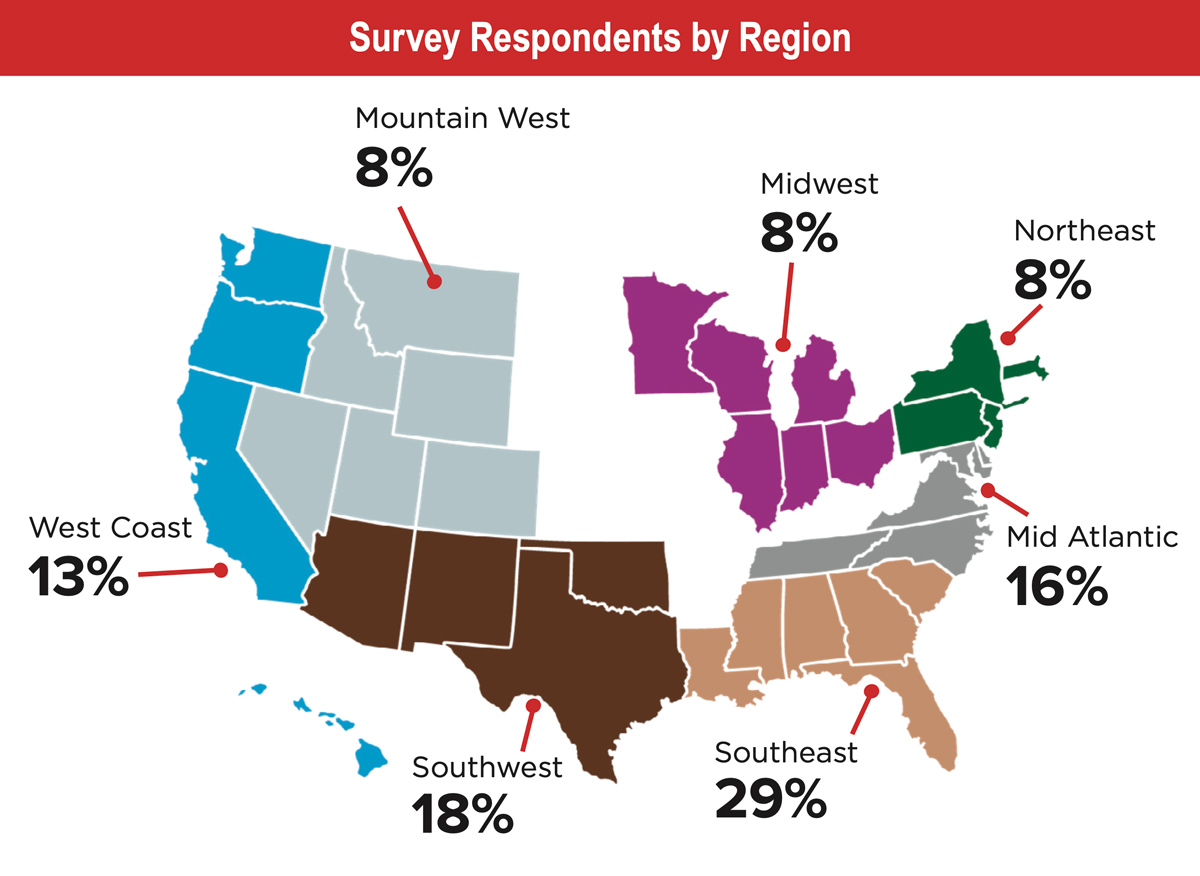
See the Survey Respondents by Region map.
See Tariffs Impact On Hard Construction Costs chart.

By Q3 2025, 22 percent noticed a material impact.
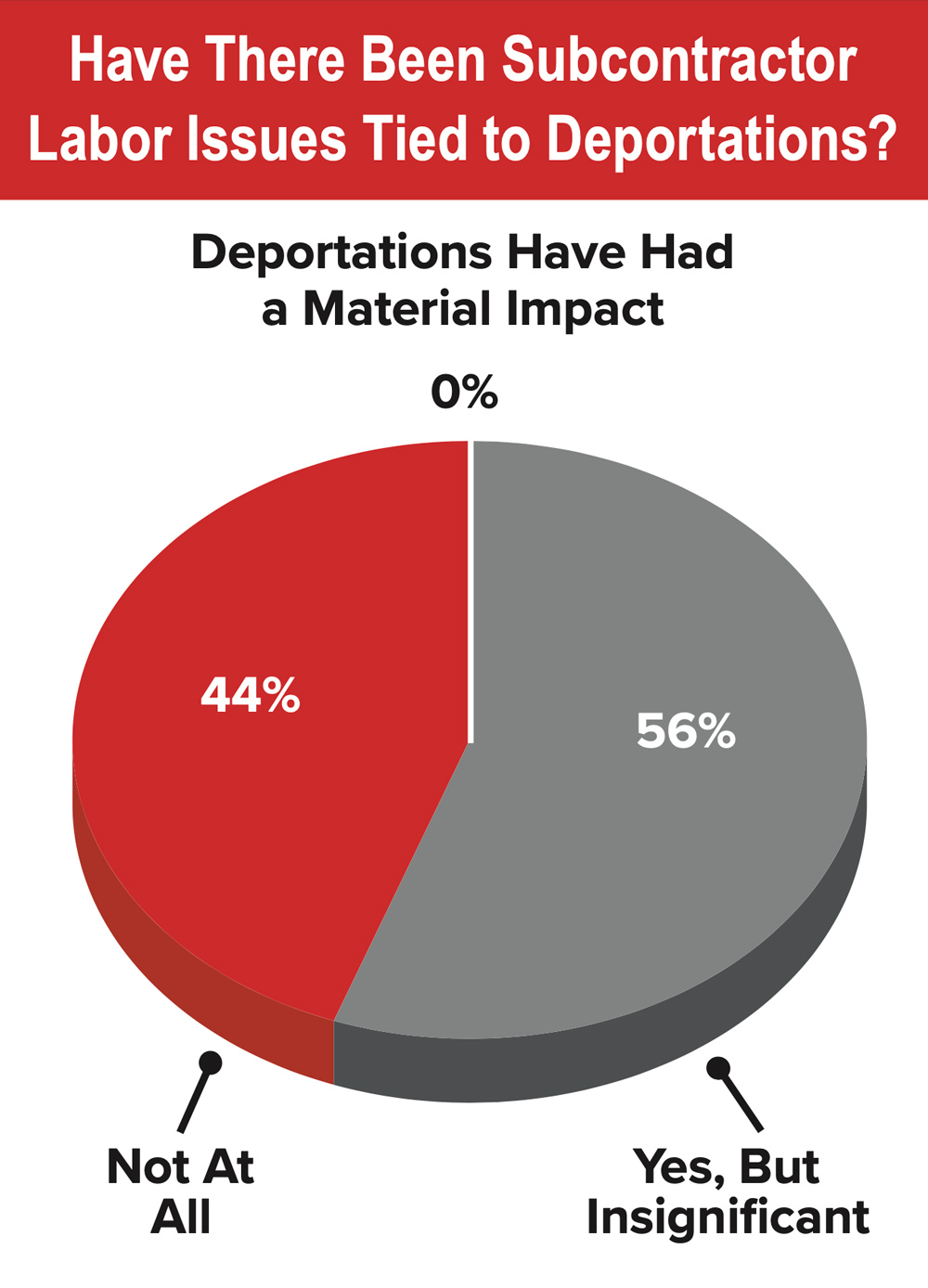
Today, while 44 percent still report no disruption at all, the share reporting some level of impact has more than doubled since Q3 2025.
See Subcontractor Labor Issues Tied To Deportations chart.
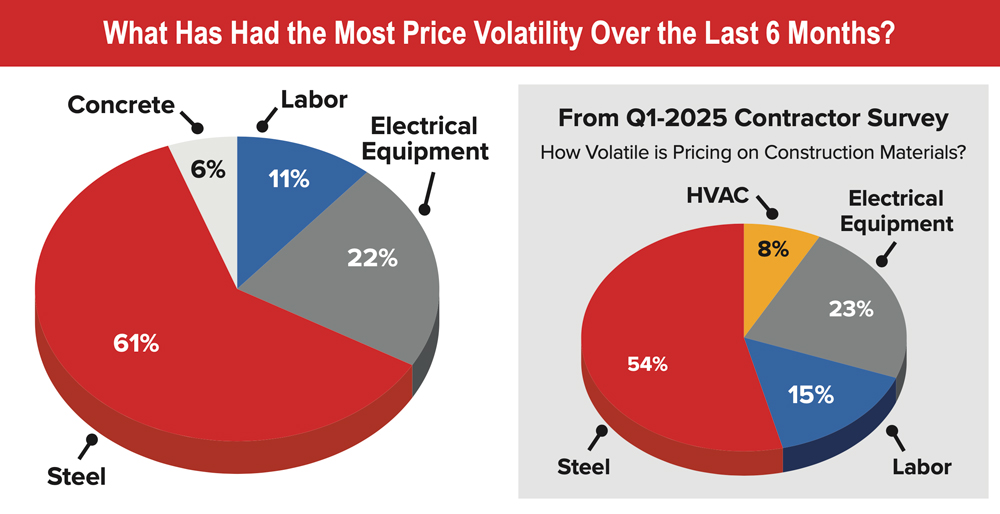
Since Q1 2025, concrete has replaced HVAC in the most volatile construction materials.
Labor and electrical equipment ranked similar to Q1 2025, with steel increasing its majority by 5 percent.
See Price Volatility charts.
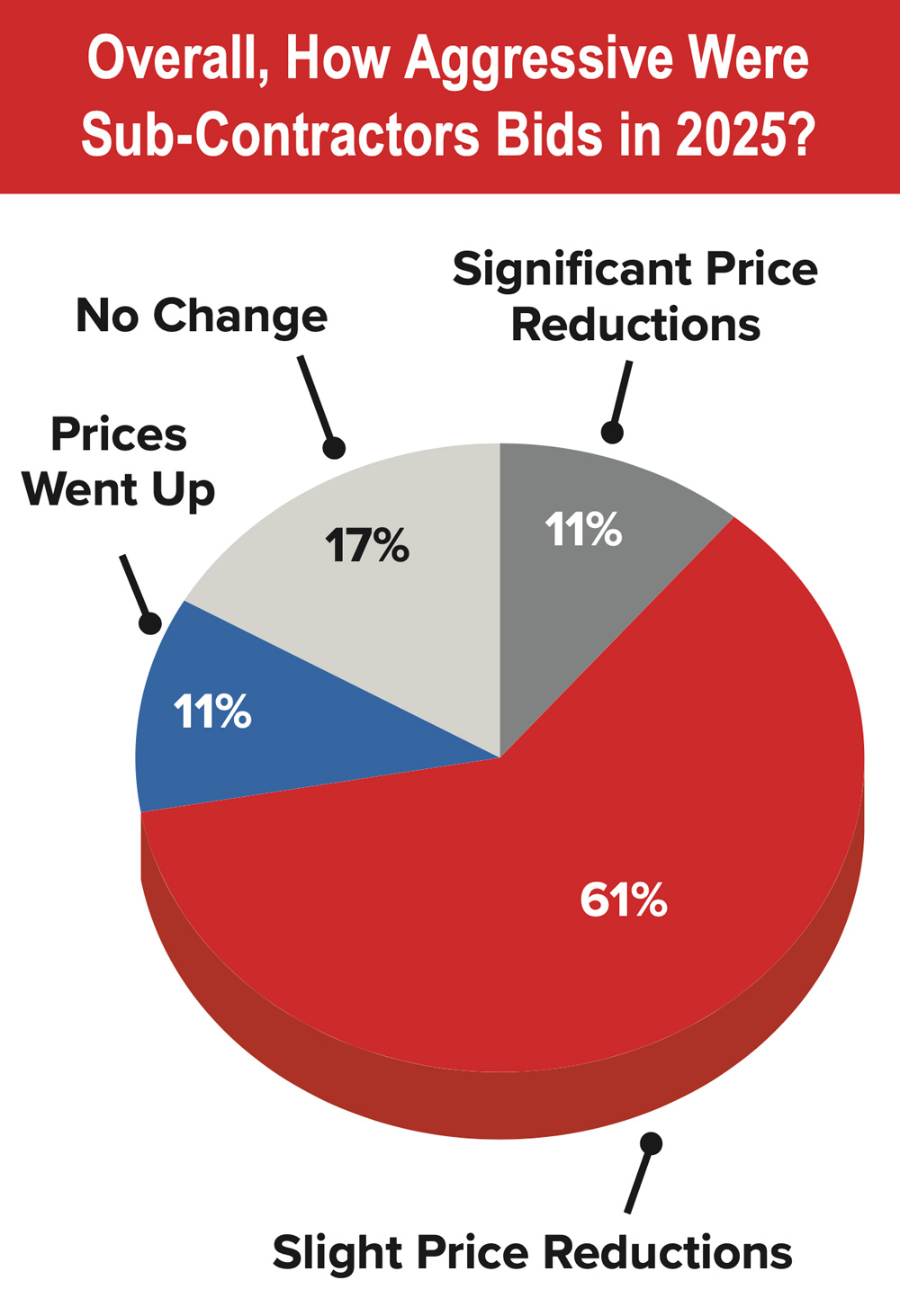
Today, more than 70 percent of contractors have reported that subcontractor prices continue to decline.
See Aggressiveness Of Sub-Contractor Bids chart.
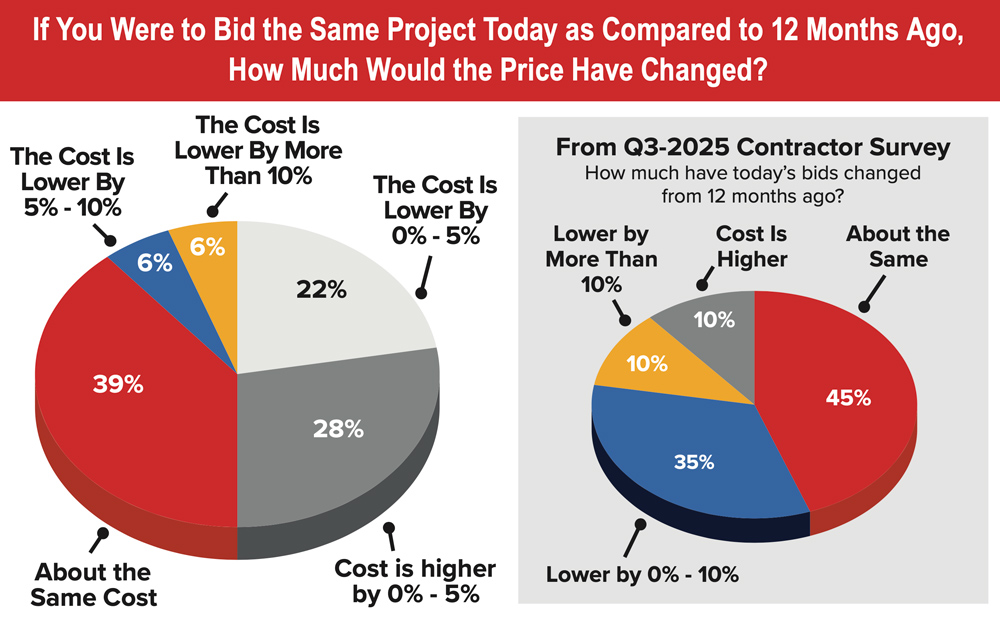
Today, 28 percent of contractors surveyed now say costs are higher than a year ago, roughly double the level seen in the prior survey.
See Year-Over-Year Pricing Change charts.
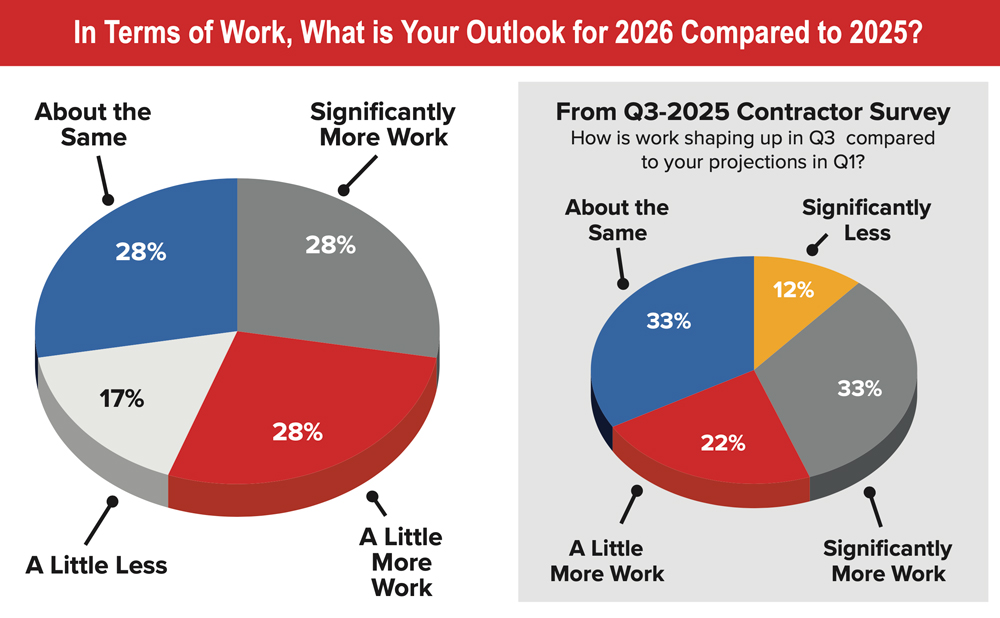
In Q3 2025, more than half of contractors reported more work.
Today, more than half of contractors surveyed expect more work in 2026.
At the same time, those expecting a little less work have increased by about 5 percent, suggesting conditions remain solid but not uniformly strong across all markets.
See Year-Over-Year Outlook and 2025 Projections charts.
With the slowdown in construction on other assets classes like multifamily and industrial, contractors are looking toward self-storage for work, regardless of their experience in the sector.
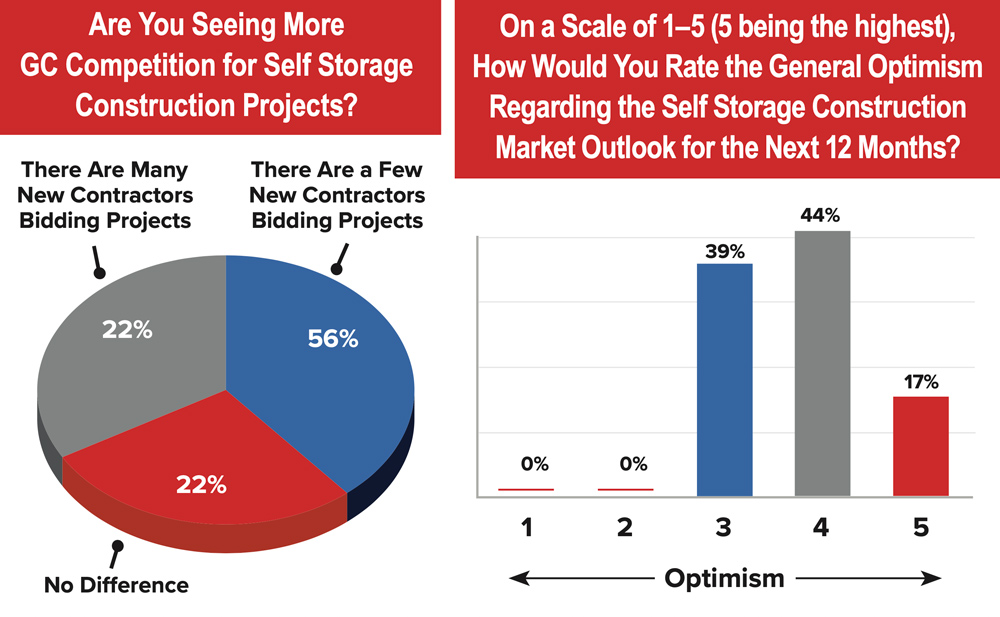
Contractor sentiment remains solid, with 61 percent rating their outlook a four or five and no respondents expressing pessimism. This reinforces the outlook that self-storage construction demand should remain steady throughout the year.
See General Contractor Competition chart and Optimism For The Self-Storage Construction Market bar graph.
The information contained in this 2026 Contractor Survey – Winter (Survey) is provided for informational purposes only and is not comprehensive. The Survey is based on third-party CRE contractor responses to questions posed by DXD Capital (DXD). DXD makes no representations, warranties, or assurances, express or implied, regarding the accuracy, completeness, reliability, or suitability of the information provided in the Survey.
This Survey reflects the responding contractors’ perspectives, estimates, and expectations. It does not constitute DXD Capital’s opinions, commitments, recommendations, or assurances regarding future lending conditions, capital market dynamics, regulatory changes, or self-storage sector performance. Any reliance on the information in this Survey is at the sole risk of the recipient.
DXD expressly disclaims any liability for inaccuracies or incompleteness and for direct, indirect, or consequential losses arising from the use of or reliance on this Survey. The findings should not be construed as financial, legal, or professional advice. Recipients are encouraged to conduct their own due diligence and consult with qualified professionals for specific guidance with respect to any business or investment decisions.

Ivy League Alumni Become Self-Storage Entrepreneurs
Ivy League Alumni Become Self-Storage Entrepreneurs
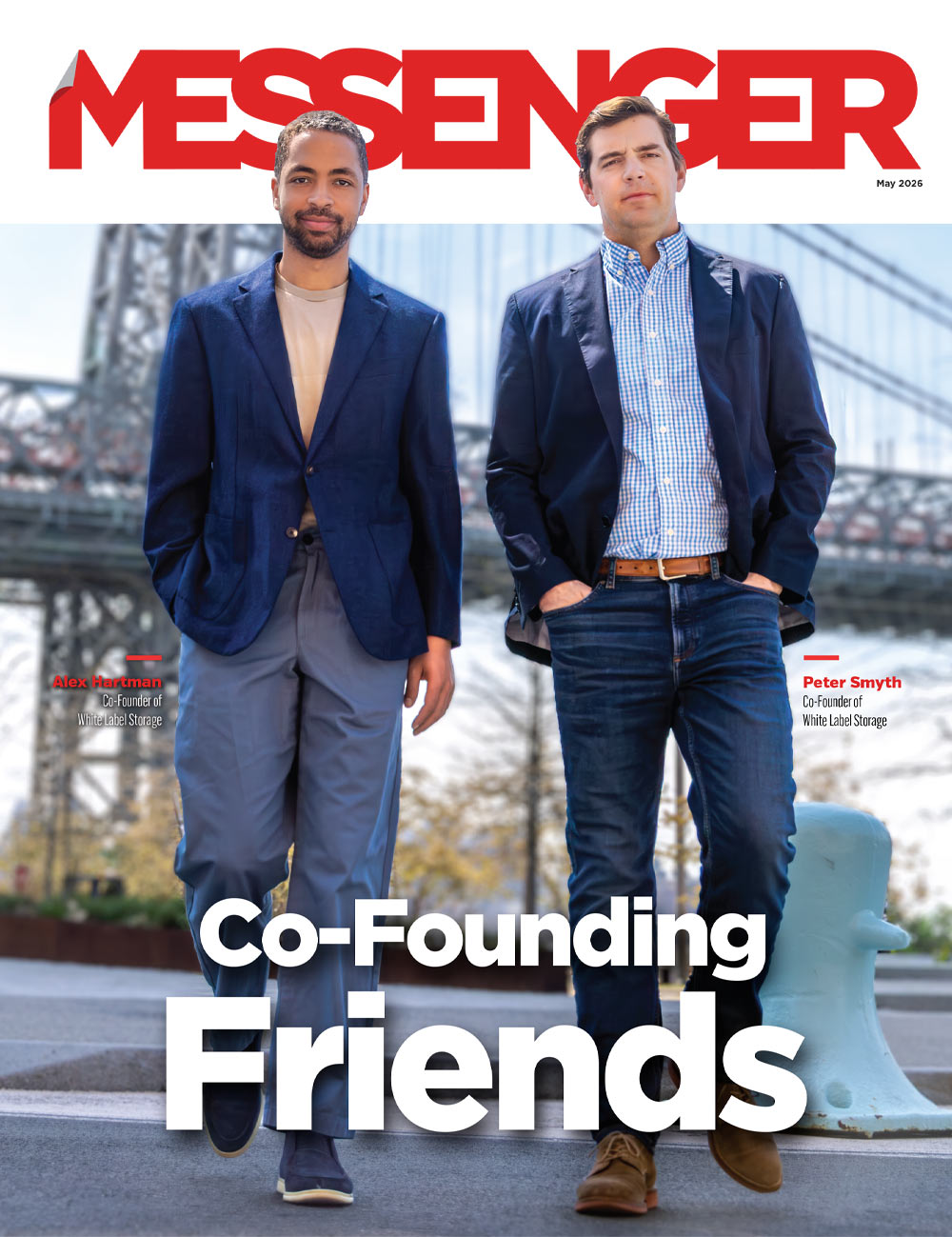
Alex Hartman and Peter Smyth
Ivy League Alumni Become Self-Storage Entrepreneurs
he self-storage industry is full of stories about characters who have stumbled upon this space, like a real estate investor who suddenly discovered the pot of gold or a business loan processor who decided to dabble in the industry after seeing clients flourish in it. They’re all fascinating, and they tend to have a common denominator: people who didn’t set out to work in storage but took the opportunity and their lives are so much better for it.
This month’s cover story features many eye-opening insights. It’s also based on the kind of good-natured friendship everyone needs in their lives. White Label Storage has been around since 2022, but its origins started much earlier.

Alex Hartman and Peter Smyth
“It was just the two of us. We understood it was a risk, and there was an opportunity cost that accompanied it, but we also knew we felt confident we could fall back on a career path.”
Meanwhile, Smyth was born and raised in Baltimore, where he grew up watching his dad be an entrepreneur. “He often talked to my brother and I about the business,” he says. “I admired that he’s always done his own thing.” Having him as a role model served him well in his own desires to develop that entrepreneurial spirit. And just like Hartman, he had some real-world experience right out of college. His first job was in real estate at Hines in D.C. Then he moved to private equity at Federal Capital Partners.
While they both had positions at enviable places, they knew they wanted to do more. And as serendipity would have it, their paths led to Harvard.
The men met and became good friends. Their surrounding environment created fertile ground for both of them to start creating lofty goals. “That was the first place I had been in where everyone was ambitious and wanted to do important things,” says Hartman. “It helped change my mentality about what is and isn’t possible.”
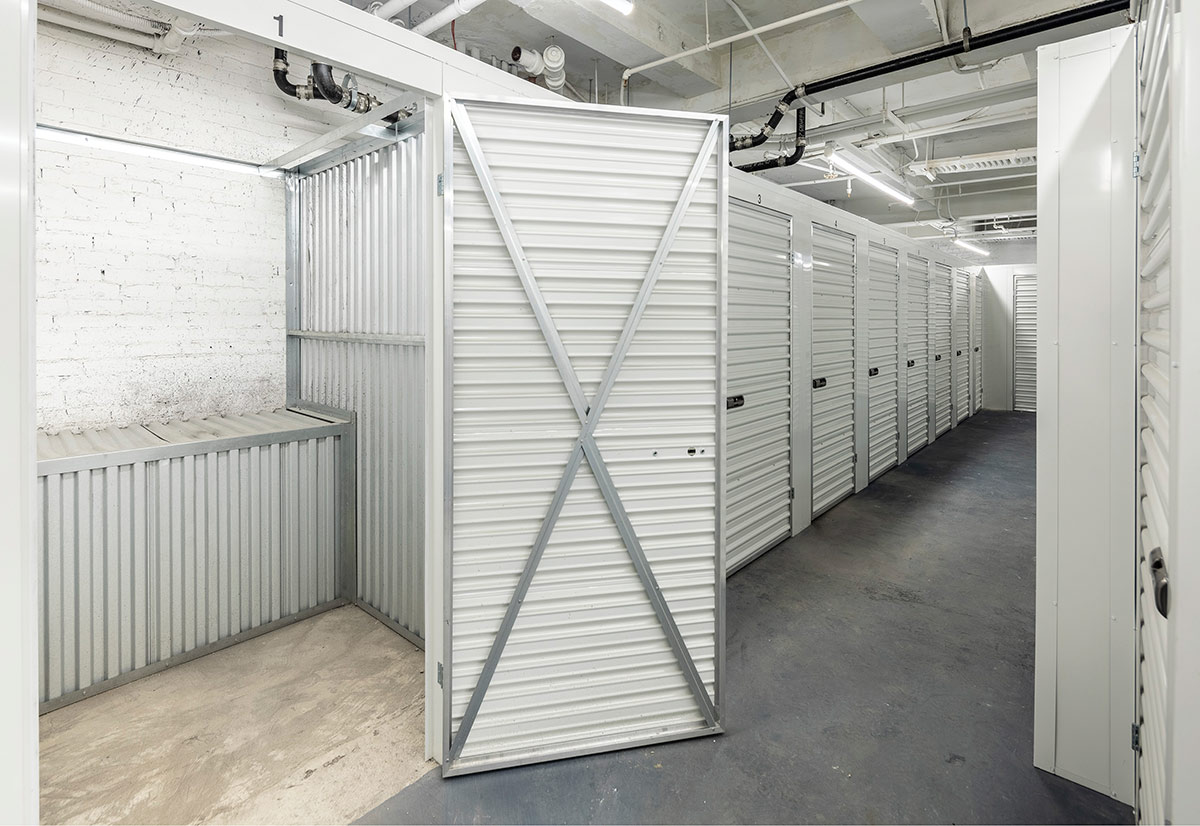
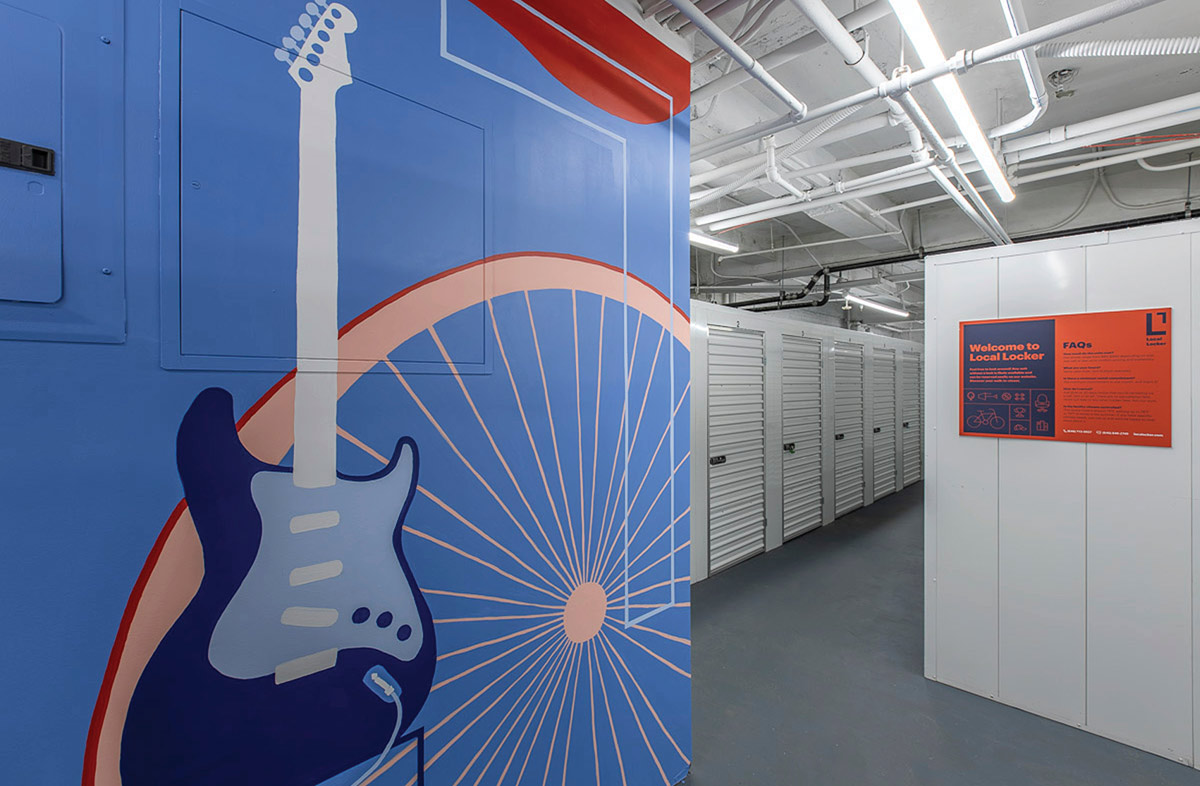
When discussing business ideas, Smyth pitched one: finding unused space in dense cities and turning them into storage units for people living above and around them. “In New York City, people don’t tend to have cars,” Hartman explains, “and we’d give them this convenient option, especially for people living in studio apartments.” This is how their first business venture, Local Locker, was born.
They started with very limited resources. “It was just the two of us,” says Smyth. “We understood it was a risk, and there was an opportunity cost that accompanied it, but we also knew we felt confident we could fall back on a career path.”
The friends got to work, and they worked hard. “The two of us would answer the phones, clean everything, set up the security cameras, and were the only ones working on site,” Smyth says. “We didn’t have the capital to have someone else do it, but it was also important for us to learn the trade. Also, I was way better in customer service than Alex was. I was picking up the phones faster!”
Hartman laughs. “I’m OK with calls going to voicemail,” he says. “Peter has a tick where he has to answer immediately.”
Doing things this way paved the road for them to become aware of the challenges of running storage operations. They recognized the feeling of accomplishment that comes from running a business, but they also understood why operators could grow tired of the day-to-day details. This is how their second business idea started to sprout.
The gears started turning. There clearly was a gap in the market, and Hartman and Smyth thought they could meet it. This time around, they were in a significantly better position to start a new business venture. “We started Local Locker with only one location and grew it to more than 50 of them, mainly in New York City and Washington, D.C.,” says Hartman.
Exterior of Local Locker Storage on Riverside Boulveard in New York, N.Y.
The pair had seen how the minutiae of daily business operations could distract you from focusing on creating real value. In order to benefit White Label and its clients, they understood technology would have to be a major component. “We were thinking about how to do this in a tech-forward way,” says Hartman, “in terms of managing facilities as well as conducting our internal operations.” The pair also recognized their competitive advantage: While there were plenty of legacy providers that have enjoyed longevity in the third-party management market, they tend to have a cost model that does not allow smaller stores to use them.
“We knew that the only way to do things effectively was with good technology,” says Smyth, “so we started thinking how we could serve that smaller market and charge a fee that wouldn’t destroy the facility’s value and would also be profitable for us.”
Since they had cash flow from Local Locker, as well as capital from outside investors, Hartman and Smyth were able to hire engineers. “Something managers struggle with is keeping up with changing rates,” says Smyth. “It’s time-consuming, but if you don’t do it, your facility is always behind and you’ll miss opportunities to increase rates in higher demand months, so we said, ‘Let’s build it’—automate a lot of the work to do it efficiently and deliver a high-quality product for our clients.”
And they’ve continued to build. In fact, they develop most of the technology they use to run facilities. “The most integral piece of the tech stack is the facility management software (FMS). That’s the backend database that houses all the tenant data, processes payroll, and integrates with third-party technology like access control, security cameras, and customer service software. We are not replacing the FMS,” says Smyth. “We build all our tools on top of the FMS: websites, revenue management, dashboards, and AI agents. We are in the process of rolling out a delinquency management tool called StorBill that reaches out to tenants and gets them back on autopay. It’s all about reducing friction and ensuring our managers are no longer tied up in these activities.”
Part of their appeal is integrations of every platform on their tech stack. A lot of these tools exist piecemeal, but they’re each an additional line item that the facility owner bears. They tend to be either too expensive or not customizable. White Label Storage removes these issues. “We build tools to make our team more efficient, while eliminating the additional line items for our clients. That’s our approach,” says Smyth.


That right balance also changes depending on when the new hires come onboard. “As you hit new milestones, you have different priorities,” adds Hartman. “Going from zero to 50 clients presents a different set of challenges than going from 50 to hopefully one day 500.”
Smyth chimes in, saying, “Depending on the role, we try to identify people with a higher growth experience. We often like bringing in people who can take pieces of the playbook from other industries and cultures, then do that here at White Label.”
As examples, Hartman mentions implementing AI in their call centers, but he’s also mindful of maintaining a human element. “We think it’s a really good product, but it can’t answer every type of call right now. The tech is not there. If it does get there, it’s not going to be a self-storage manager or a REIT that figures it out. It’ll be large language model companies. So, it’s unclear where it’s going, but it’s an opportunity for most businesses.”
For his part, Smyth points out that even as technology advances, it’ll always be crucial to maintain human oversight. “There’s a lot of noise about AI and automation, but at the end of the day, the buck still has to stop with someone. A software company that says they will manage your facility has to include that component.” He notes that the typical owner is not going to accept software running their entire store. “From that standpoint, what will change are the tools, but our relationship with the client will remain the same.”
“Our value proposition and our promise to our clients remains the same as it’s always been,” says Hartman. “We don’t sell technology. We sell ‘managing your facility well.’ We’ll always do our best to maximize our clients’ profits, and we’ll do it at a competitive price. The allocation between technology and humans has changed, but it’s not ultimately what we offer our clients. That original promise is what we hold ourselves accountable for.”

Stairwell of a location managed by White Label Storage
Hindsight is 20/20, and having all this experience gives the co-founders good insights about starting any kind of business. “Good opportunities come from some strategic advantage, whether it’s a lead on land or really good data on a specific market,” Smyth says. “We go to so many conferences where they discuss the state of the market, but even when taken within the context of averages, there are always markets that are way overperforming—and on the flip side as well. The people who do well stick to a strategy that’s unique to them.”
Hartman believes that it’s crucial to look into things on a much deeper level. “If you’re taking an SBA loan to purchase a facility that’s at 60 percent occupancy, thinking you’ll get it to 95 percent occupancy, you have to ask, ‘If it didn’t get there before, what’s going to be different now?’ Good management would be helpful, but a lot of people don’t have the details planned out. This has caused many business owners to get burned and leave the market. Self-storage is simple, but there are also non-obvious components to it as well, and you have to thoroughly understand what they are.”
All things considered, several things are evident. Smyth and Hartman have the acumen to identify great opportunities and bring them to life. They have also become industry experts precisely because they rolled up their sleeves and learned the ropes on their way to the top. And their friendship has surely made the journey more enjoyable. “Alex thinks that Josh Allen is better than Lamar Jackson, but Lamar has two MVPs and Josh Allen only has one,” Smyth quips.
“Pete was a division 1 athlete 14 years ago, but he likes to talk about it every day,” Hartman replies without missing a beat. “At least I ran my last marathon 18 months ago. He was a college athlete when George W. Bush was president.”
The banter goes back and forth for a while, and it’s certainly entertaining to listen. It’s also a reminder that individuals thrive when they’re in the right place—and with the right people.
“Without business school, I wouldn’t have been comfortable starting my own business,” says Hartman. “It would’ve been too foreign; but being around others doing it, your mindset changes, and you feel comfortable thinking about it.”
MAXIMIZE REVENUE AND OPERATIONAL EFFICIENCY.
Management
Built for
Performance.




e live in the future now. Everything’s online: Swipe right to find a date, scan a QR code at restaurants to read the menu, and order laundry detergent to get delivered to your front door. To remain competitive, industries across the board need to have a compelling online presence.
Within the self-storage industry, you may be able to get away with a simple website, but when it comes to offering tenants digital leasing contracts, it’s crucial to implement multiple safeguards.
That may sound like common sense, yet it may also be overwhelming to keep track of all the pieces of the puzzle. What should you be looking for to ensure you’re implementing digital leasing effectively? Fortunately, there are plenty of industry veterans willing to offer guidance.*
Ashley Oblinger, partner at Weissman Zucker Euster + Oblinger P.C., stresses the importance of recording IP addresses and timestamps as well. “And there are additional alternatives to verify tenant identity, including email verification links and one-time authorization codes sent via SMS, along with the customer sending a selfie so that the facility has a picture of the tenant without any personal data attached to it. “Some operators also move to software that allows tenants to upload a picture of their government ID, as we have seen in other industries.”
Chuck Gordon, CEO of Storable, advises taking additional action when verifying customers. “In addition to building a step into the digital lease where customers upload a photo of their government-issued ID, staff should also visually compare that ID to the lease information and, where available, to a selfie or in-person visit.”
Gordon offers additional practical advice, such as using a modifiable master lease, then enabling your software to enforce the right version. “Once you have a core lease, also prepare state/province-specific addenda for lien laws, notices, disclosures, surcharging, and consumer protections,” he says. “Then configure your leasing platform so that staff can only send the jurisdiction-appropriate template, with taxes, fees, and required clauses automatically driven by the facility’s location and, where needed, the tenant’s address.”
That said, he cautions that this isn’t a matter of setting it once and going on about your day. “Assign ownership—whether it’s internal or outside counsel—to track tenant, lien, privacy, and surcharging rules by jurisdiction, then update lease language and configuration on a defined schedule. Include staff training into that timeline before a clear go-live date.”
Once that process is in place, Gordon recommends validating it with periodic compliance reviews. “Regularly sample executed digital leases across locations to confirm the right template, addenda, disclosures, and signatures are in use and that retention and access policies support audits, disputes, and litigation.”
Gordon gets even more specific with his recommended types of encryption. “Data that’s at rest should be encrypted using modern standards such as AES-256; and when it’s in transit, all communications should be secured using TLS 1.2 or higher to prevent interception of sensitive information.” In addition, he recommends ensuring that vendors and any third-party security you engage are also meeting the appropriate cybersecurity standards.
Charbonneau keeps bringing up the importance of finding an FMS platform that works well for you. “I sound a little bit like an FMS salesperson, but the answer is once again to ensure that you’re working with a reputable company. Your leases should be going through your software system, and you want to look for an FMS that provides digital protection for the lease information.”
Hall agrees. “We have a new product called SuperLease, which uses one-click signing and cryptographic data capture, including who signed, the signer’s location, and the signature timestamp. It also simplifies the document management process because you can manage the entire lifecycle for that customer within a single document regardless of unit transfers, added spaces, or protection policy adjustments.” He adds that your software should adapt to legislative changes. Take SB709, the California rent disclosure law that passed in January 2026. “We’ve enabled a state-compliant module that verifies each lease, has the disclosures required by law, and automatically adds the required information into each individual rental agreement. How many software solutions on the market have solved this problem?”
Moreover, Oblinger recommends including crucial information on your site. “The operator’s website should contain a privacy policy that discloses data collection and usage, and tenants should also be allowed to access their executed rental agreement through a tenant portal.”
She points out that while the FMS will send the leases, it is up to the operator to require and follow up for signed leases for all tenants. It is up to the owner to ensure that all information is documented correctly: names, addresses, ID information, and any forms submitted by the tenant, such as auto pay or address changes.
As for Oblinger, he warns that all tenant-related documents should be easily available for authorized personnel to access and produce. “This includes rental agreements, addendums, rent increases, ledgers, file notes, lien notices, etc. Operators should also have all vendor contracts readily accessible.”
She also emphasizes that there are people and companies that provide consulting services to operators on these and many other topics. “If you genuinely don’t know the answer to business-critical items, reach out and hire someone for a short time to ensure you’re getting proper information. Whatever you post on a Facebook group can just as likely get you sued. Save your time and hire someone for an hour to discuss your exact need and get a real, knowledgeable, and accurate assessment.”




urals have been part of the urban landscape for years, decorating buildings of all shapes and sizes. Initially, the artform was embraced for practical reasons, mainly to cover eyesores or deter graffiti (Muralist Dave Gordon has noted that murals are “rarely the target of taggers.”).
For many artists, however, murals were never just about covering something up or preventing something else. Diego Rivera, one of the most influential muralists of the 20th century, believed public art carried a greater responsibility. “The highest form of art is that which is accessible to all,” he said, and that idea feels especially relevant today.
While murals remain effective deterrents for taggers, they have increasingly become tools for branding, expression, and storytelling. That evolution is especially apparent in self-storage, where facilities usually occupy large, highly visible spaces. These properties offer the perfect canvas for large-scale artwork, and when done right, murals can reflect local identity and make a facility feel more connected to the community.
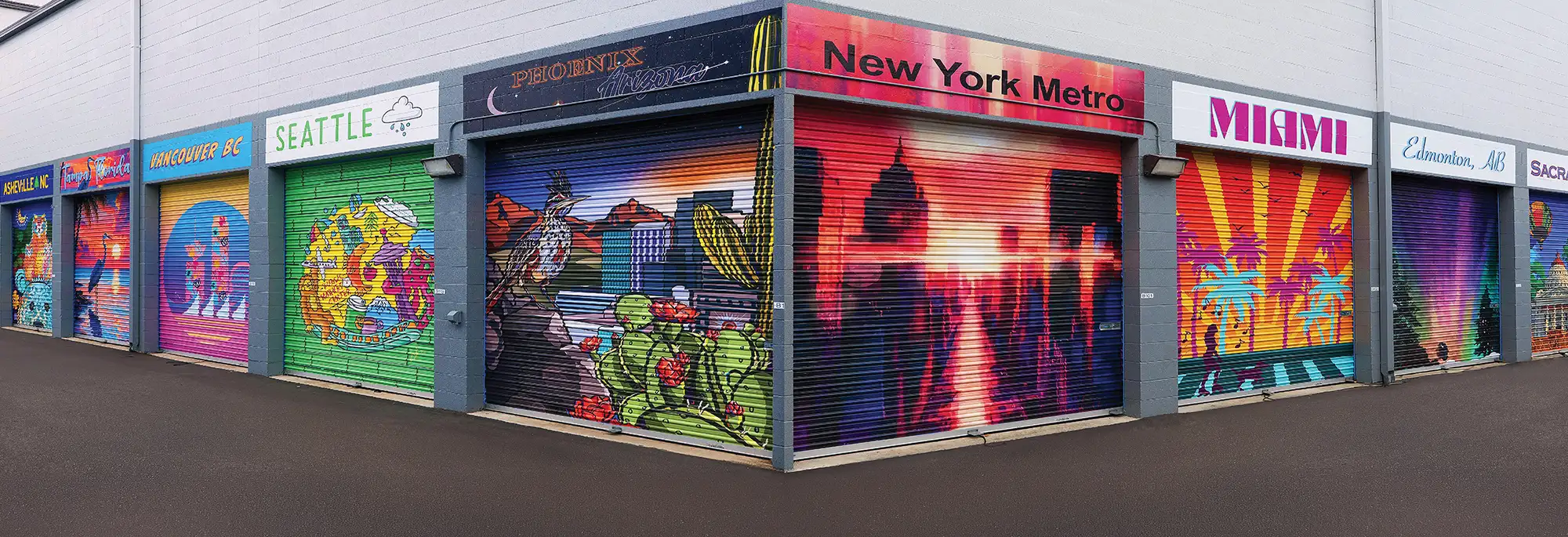
One company taking a distinctive approach is SmartStop Self Storage REIT, Inc. Rather than commissioning a single artist, SmartStop turned its mural initiative into an international art contest, inviting artists across North America to submit city- or region-inspired designs representing one of the company’s major markets. Eleven winning entries were selected and transformed into full-size door wraps on drive-up units at SmartStop’s Ladera Ranch, Calif., facility.
“At SmartStop, we are always looking for innovative ways to connect with the communities we serve,” says H. Michael Schwartz, chairman and CEO. “This contest was a fun and creative way to celebrate the unique character of markets across North America while supporting talented artists and bringing vibrant designs to our facility.”
Today, the property functions as an outdoor gallery, with each winning artist receiving a $1,000 prize. The featured markets include Southern California; Toronto; Phoenix; Asheville, N.C.; Sacramento; Miami; Edmonton; Seattle; Tampa/St. Pete; the New York metro area; and Vancouver.
“This contest was about more than just decorating a door—it was about giving artists across the U.S. and Canada a canvas to inspire,” Schwartz added.
View a video of SmartStop’s door wrap murals here:
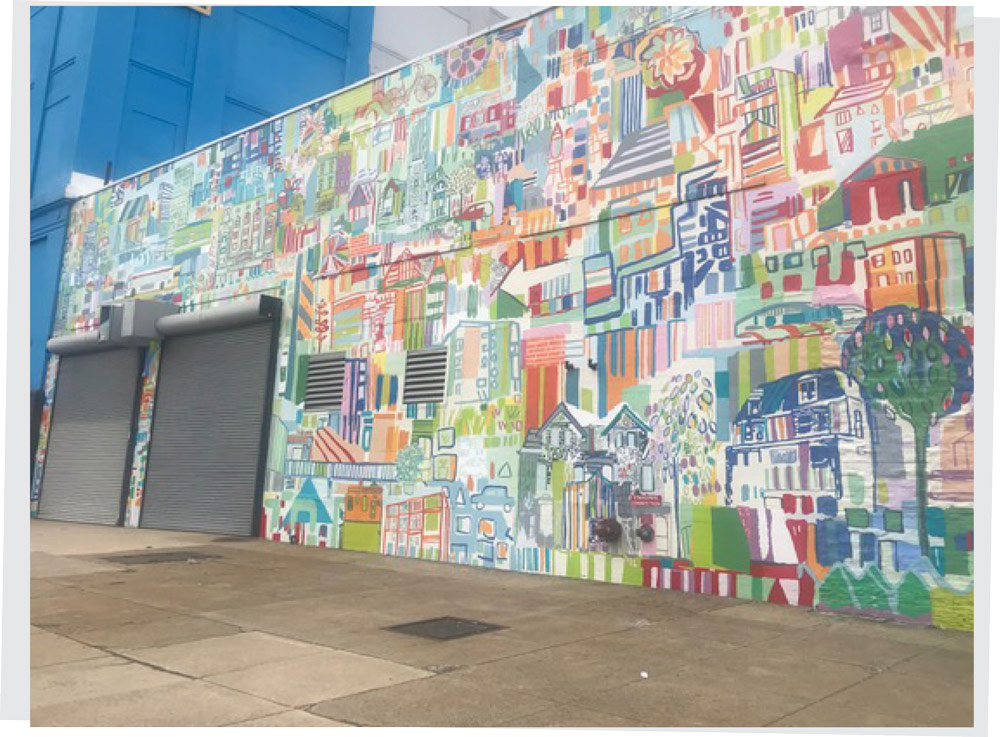
Created in partnership with Mural Arts Philadelphia, this mural was designed with a specific audience in mind: residents of a senior center located across the street. “We wanted to provide a more engaging and pleasant view for them,” says Katie Fete, director of marketing and PR. The project took several months to complete and has earned an overwhelmingly positive response from the surrounding community–and the residents across the street!

Extra Space Storage marked its arrival in Hawaii by adding a vibrant Hawaiian-themed mural to this five-story location, designed to pay homage to local culture while giving the property warmth and a visual identity. District Manager Mike Hurst also states that demand from renters, including surfers seeking space for boards, highlights how the mural helps tie the facility to its island setting and culture.
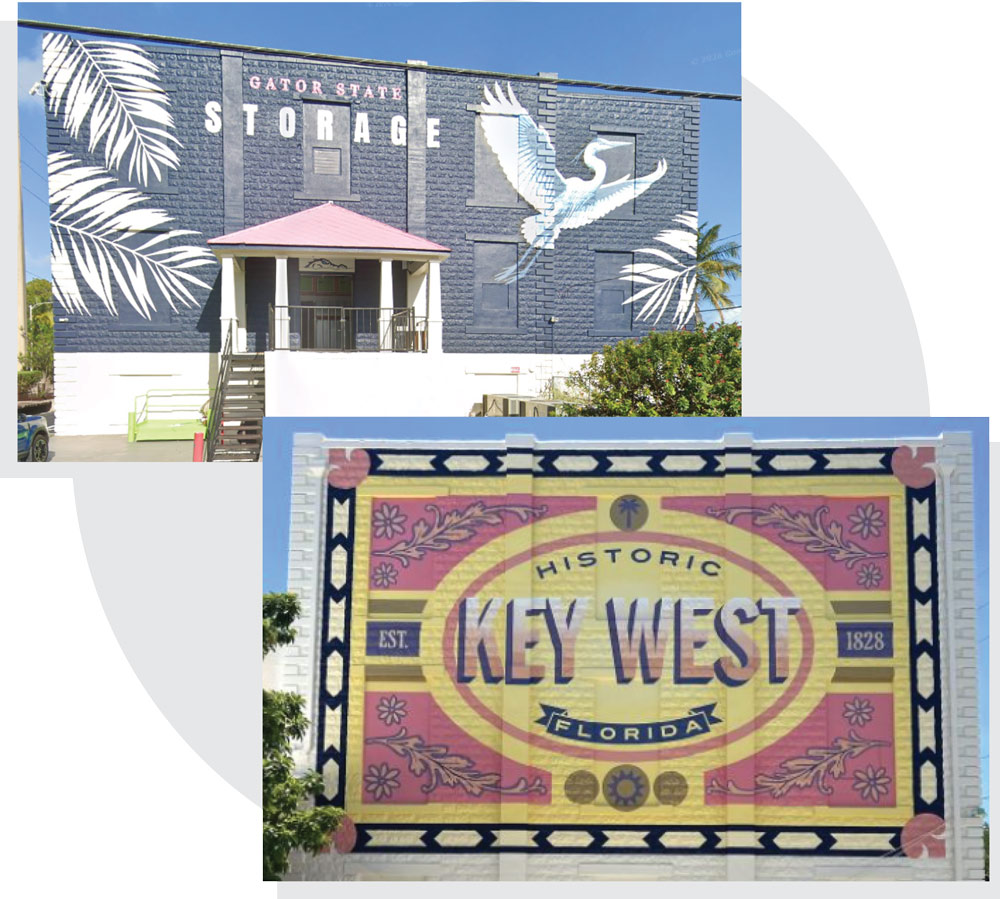
Murals at this Key West facility turn the building itself into a piece of public art. One side is styled like a cigar box label, referencing the structure’s former life as a cigar manufacturing facility. The opposite wall features a soaring heron framed by stylized palm fronds. Together, the murals balance history and place, transforming Gator State Storage into a neighborhood landmark.

Created by artist Millo and curated by Street Art for Mankind in late 2024, this mural draws attention to the fragility of urban ecosystems and the urgency of climate change. “We believe in the power of art to inspire and unite people around critical issues,” said Sarah Little, senior vice president of marketing, underscoring the company’s long-standing commitment to public-facing art with a message.



This mural, designed by local Mexican-American muralist Ms. Yellow, is bright, bold, and beautiful, making the facility–an attractive structure in its own right–the star of the strip. More than 32,000 vehicles drive by it each day, and standing five stories tall, it can be seen from miles away. For Ms. Yellow, who often explores themes of unity, diversity, education, social justice, and mental health in her work, the scale of the Go Store It project was part of the appeal. “The size of it really attracted me,” she said. “I loved thinking about the levels and complexity of the entire thing.”
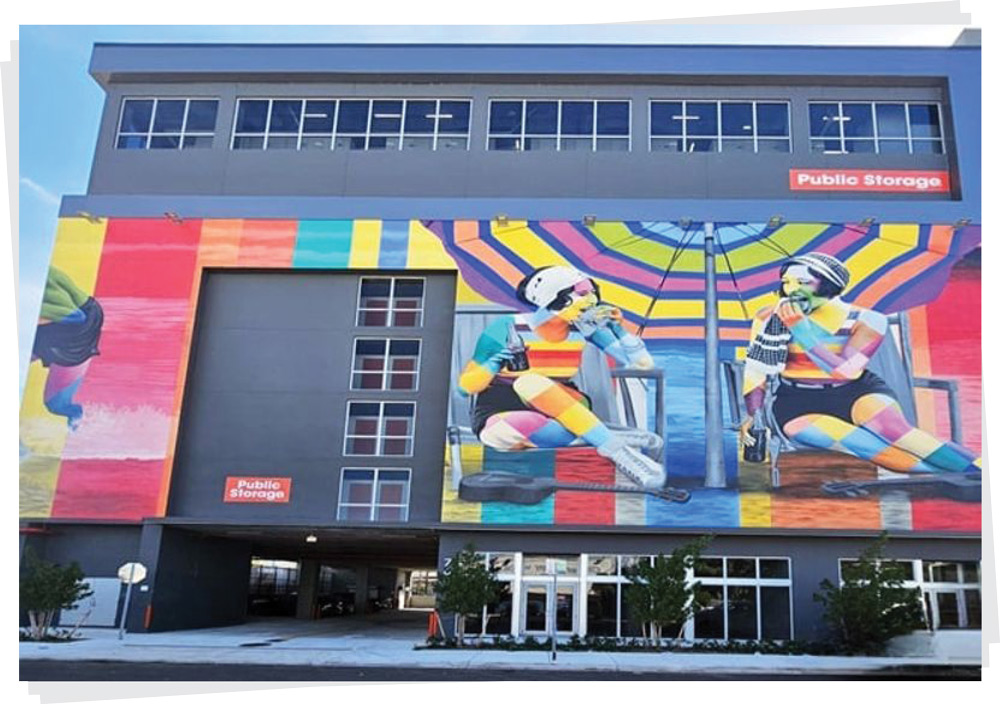
In Miami’s Wynwood Arts District—one of the most mural-dense neighborhoods in the country—Public Storage has embraced large-scale exterior artwork as a way to integrate into a community where murals are not an exception but the expectation. The vibrant, street-art-style mural allows the facility to participate in the area’s creative identity rather than stand apart from it. In a district defined by color, expression, and public art, the mural helps the property feel native to its surroundings.

Created in 2025 by artist Carlos Alberto in partnership with Street Art for Mankind, this mural focuses on education as a pathway to opportunity and inclusion. Designed to spark reflection as much as visual interest, the piece also incorporates an interactive BehindTheWall app experience, allowing viewers to explore the story and message behind the artwork.

The Oakland mural by artist Ruben Rojas delivers a clear environmental message. Featuring the planet alongside the words “Love me before I’m gone,” the piece reflects StorQuest’s emphasis on global citizenship and environmental responsibility. “StorQuest wanted to use art and a powerful message, a love letter from Earth to us,” says Rojas. “It’s our responsibility that we leave this planet better than when we found it.”
720 South Street in Honolulu, Hawaii
In Honolulu, StorQuest unveiled a second large-scale mural created by local artist Kamea Hadar. Noting StorQuest’s use of red in its branding, Hadar chose to incorporate the bright red ʻōhiʻa lehua blossom and the native ʻiʻiwi bird, both iconic to Hawaii. The finished piece celebrates the region’s natural beauty and cultural heritage and cements the facility’s place on the island.

Security Public Storage dedicated its large-scale mural, Manteca Treasures, to the residents of Manteca and the surrounding area in celebration of the region’s heritage. It stretches 330 feet and covers nearly 3,300 square feet. Designed by Jerry Ragg of Mural Decor, the project received a ton of support during its creation. Passersby frequently stopped to watch, wave, and take photos with the artist—an example of how mural projects can become shared experiences as much as finished works. “People have been really appreciative of the murals,” said Penny Haskins, who has managed the storage facility for the past 21 years. “One neighbor said they were thankful for the efforts to beautify the area and reduce the potential for graffiti.”


“In cases where the art installation is within a private property but located in an outdoor setting, a number of requirements by the municipality’s building department would likely be triggered,” says Octavio Robles AIA, Esq. “Art installation agreements typically require extensively written contracts with the property owner, commissioning entity, and municipality, but this is beneficial for avoiding conflicts, allocating liability, and determining short and long-term responsibilities such as for maintenance and repair costs.”
Long story short: Get the paperwork in place, and then get to painting, because as artist Romero Britto says, “Art is too important not to share.”


avigating the world of commercial financing can feel like trying to navigate a maze of hallways without a map. When you are planning a self-storage construction project, the stakes are high. You aren’t just building a warehouse; you are building a high-yielding real estate asset designed for maximum efficiency and security.
You have the vision, perhaps a multistory climate-controlled facility in a growing suburb or a sprawling drive-up site near a major highway. Now, it’s time to lay the financial foundation. This expanded guide will help you gather the specific documents needed for the self-storage industry, stay organized, and move forward with the confidence of a seasoned developer. In the world of self-storage development, preparation isn’t just a virtue; it’s your primary risk-mitigation tool.
Self-storage is a unique asset class. Unlike office or retail, it relies on a high volume of small tenants rather than a few large ones. Lenders look for specific indicators that your project will succeed. Getting organized early demonstrates to the bank that you are a professional operator who understands the industry’s nuances.
1. Business Financials
If you are an existing operator looking to expand, your historical performance is the best predictor of future success. If you are a new entity (an SPE or single-purpose entity) formed specifically for this build, the lender may focus on the performance of other businesses or entities that you own or control. Some things a lender may review include:
- Two years of business tax returns – These should include all schedules and K-1s.
- Interim Financial Statements – A current-year Profit & Loss (P&L) statement and balance sheet.
- Business Debt Schedule – A clear list of all current business debts, including original amounts, current balances, interest rates, and maturity dates.
- Organizational Documents – Your LLC Operating Agreement or Corporate Bylaws and your Certificate of Good Standing.
2. Personal Financials
Self-storage construction loans, particularly those backed by the Small Business Administration (SBA) or conventional banks, almost always require personal guarantees from any owner with a 20 percent or greater stake. To gauge guarantor strength, your lender will collect:
- Two years of personal tax returns – To verify your personal income sources.
- Personal Financial Statement (PFS) – A detailed snapshot of your net worth.
- Liquidity Verification – Recent bank statements showing you have the equity injection required for the loan, which typically ranges from 10 percent to 35 percent of the total project cost.
- Credit Report – A detailed account of current personal debt along with your payment history on those and past obligations.
3. Construction And Development Documents
This is where the “hard” and “soft” costs are defined. In self-storage, net rentable square footage (NRSF) efficiency is king.
- Final Architectural Plans and Site Maps – Lenders need to see the unit mix (for example, the number of 5-by-10 units vs. the number of 10-by-20 units).
- Comprehensive Construction Budget – This should include a line-item breakdown of site work, steel costs, HVAC systems for climate control, and security/access control systems.
- The General Contractor (GC) Package – You’ll need a signed contract, the GC’s license, a resume of past storage projects and references. Lenders prefer GCs who have built storage before, as the specialized steel framing differs from standard residential or commercial framing.
- Civil Engineering and Permits – Documentation regarding zoning, environmental reports, and any necessary entitlements.
4. The Feasibility Study
Unlike a general commercial building, a self-storage loan often hinges on a third-party feasibility study. In my opinion, it is the most crucial piece of a construction loan application. This document demonstrates to the lender that the market can absorb more storage, and specifically the type of storage the developer is considering. It typically includes:
- A saturation analysis,
- Competitor pricing and occupancy levels,
- Traffic counts and visibility scores,
- A recommended unit mix based on market demand, and
- Proforma projections (showing how long it will take to reach the 85 percent to 90 percent “stabilized” occupancy mark).
- Inspections – Before each payment, the bank will send an inspector to the site to verify that the work claimed (e.g., the slab poured or the mezzanine erected) has actually been completed.
- Lien Waivers – You must collect lien waivers from subcontractors to ensure that the bank’s collateral remains clear of legal claims.
- Contingency Funds – Every storage project should have a 5 percent to 10 percent “hard cost contingency” built into the loan to cover the inevitable price fluctuations in steel or unexpected site issues.
- Underestimating Soft Costs – Don’t forget to budget for “soft costs” such as grand-opening marketing, lease-up insurance, and the first year’s property taxes.
- Selecting the Wrong GC – You should find a contractor who has the experience needed to complete the project successfully. Your GC will be an important partner throughout the construction process and selecting the right one is crucial.
- Ignoring Technology – Modern lenders want to see that you’ve budgeted for high-quality security cameras, electronic gates, and property management software (PMS). A facility that can run “unmanned” or with minimal staff is often seen as a lower-risk investment.
- Inadequate Working Capital – It can take 12 to 24 months for a storage facility to reach stabilization. Ensure your loan includes working capital; for example, you can use working capital for a portion of the loan to pay interest during the construction and early lease-up phases, so you don’t have to pay out of pocket while the building is empty.
When you work with a specialized lender, you aren’t just getting a check; you’re gaining an advisor who knows the difference between a roll-up door and a swing door, and why that matters for your bottom line.
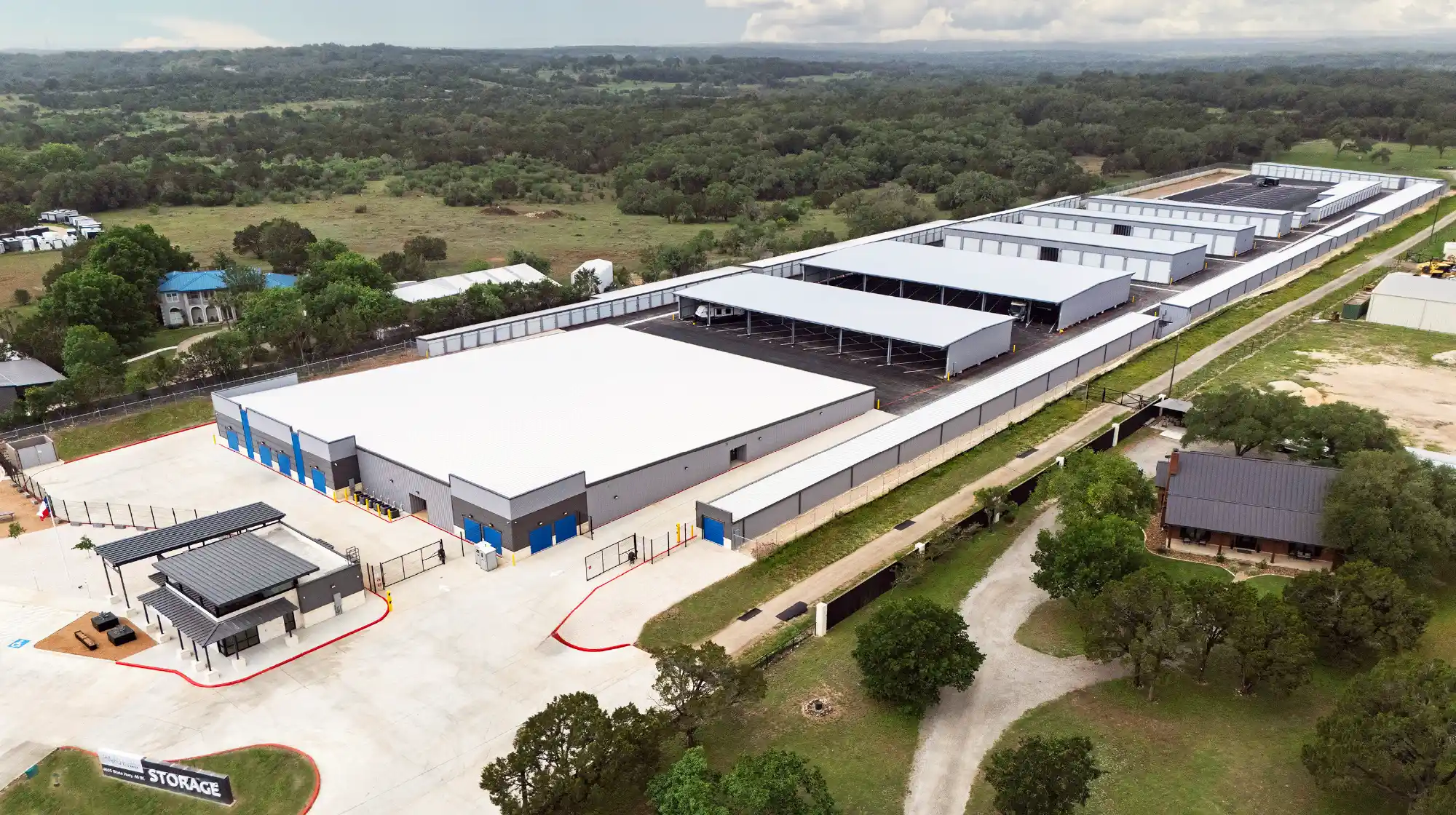
ew Braunfels is the Texas town everyone’s talking about. Nestled between San Antonio and Austin, it’s garnering attention for its rapid growth and is ranked the second most moved-to U.S. ZIP code. Opened in 2025, New Braunfels Executive Storage correctly hedged its bets on this Lone Star State gem.
Developed by entrepreneur Jorden Mahler, the nine-acre facility prioritizes convenience, security, and customer experience. Located along busy Highway 46, the Class-A property spans 122,709 rentable square feet and boasts 575 units plus RV and boat storage. Design was thoughtful, with buildings arranged fortress-style to improve security, minimize fencing, and optimize traffic flow. Amenities include an air station, ice kiosk, food truck zone, and customer lounge with vintage juke box. It all reflects Mahler’s philosophy of “making storage sexy again.” And based on demand, which even required a tenant waitlist, the approach is clearly turning heads.


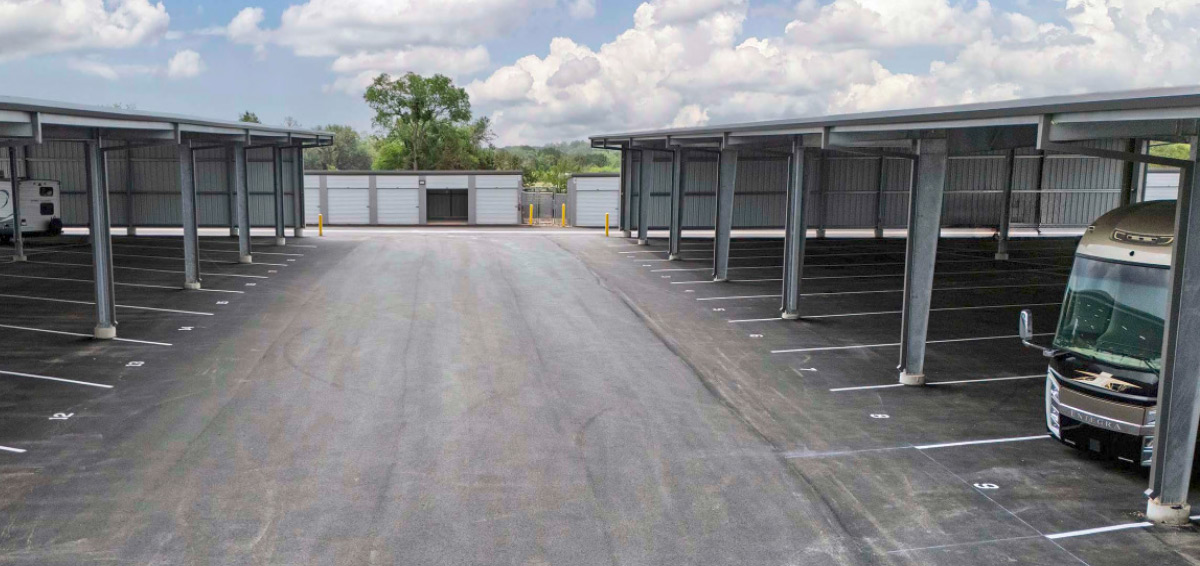
Architect: Open Studio Architecture
Door & Hallways: Janus International/Twin City Hardware
Steel Systems/Office Roofing: Capco Steel/Quick Roofing LLC
Security Systems/Installer: SpiderDoor/Advanced Security
Consultant: Lighthouse Storage Solutions
Software: Cubby
Isn’t Enough

or decades, enterprise technology leaders have been told that modernization is the safest path forward. Refactor legacy systems. Incrementally improve what exists, and avoid the perceived risk of starting over. In theory, this approach minimizes disruption and protects prior investment. In practice, many organizations find themselves investing significant time, capital, and talent into systems that were never designed for today’s security expectations, integration demands, or automation requirements. What starts as a practical approach can gradually evolve into something far less effective. There comes a point where modernization no longer drives progress and instead begins to restrict it.
This is where many modernization efforts begin to falter. Teams attempt to layer new capabilities on top of systems that were never designed to support them. Tools are added, integrations expand, and automation is introduced, but instead of unlocking agility, these efforts expose the limits of the underlying architecture. The result is not transformation but accumulation. Automation, in particular, exposes architectural friction faster than any other requirement. Systems built for human-paced workflows and manual exception handling struggle when processes must run continuously, consistently, and without intervention. What once worked through flexibility and oversight begins to break under the demands of scale and speed, revealing brittle dependencies and structural limitations. Layers of technology build up around a core that remains fundamentally unchanged, increasing complexity without delivering meaningful progress. This becomes especially visible as organizations attempt to introduce AI‑assisted capabilities. Predictive insights, intelligent sourcing, and decision support may be technically achievable but operationally fragile when layered onto platforms that were never designed to expose clean data or support continuous execution. What should simplify operations instead adds another layer of complexity.
Architectural decisions made years ago continue to shape what is possible today. Many legacy platforms were built as monoliths with embedded business logic, rigid data models, and custom integrations. These systems often continue to function reliably, which reinforces the instinct to preserve and extend them. However, reliability alone does not equate to adaptability. As organizations attempt to modernize these systems, they often encounter friction at every layer. Automating workflows requires additional abstraction, which introduces fragility. Scaling demands disproportionate effort because systems were not designed to distribute load dynamically. Integrations become increasingly complex, creating dependencies that are difficult to manage and even harder to unwind. In tightly coupled systems, feedback loops lengthen. The time between change, validation, and correction increases, making experimentation expensive and slowing learning across the organization. Over time, incremental modernization begins to deliver diminishing returns. Each improvement becomes harder to implement and less impactful than the last. Cloud migration is frequently positioned as a turning point, but it rarely resolves these challenges on its own. Moving a legacy system into a cloud environment can improve uptime, resilience, or cost efficiency, but it does not fundamentally change how that system operates. Cloud-hosted is not the same as cloud-native. Without rethinking the architecture itself, organizations often find themselves running yesterday’s systems on today’s infrastructure, with many of the same limitations still intact.
In addition, leaders must consider technical debt. Technical debt is often framed as something that can be managed over time. Something that can be incrementally improved without major disruption. But in many cases, technical debt provides a false sense of control. As systems age, the cost of maintaining them becomes less visible and more distributed. It shows up in slower delivery cycles, increased coordination overhead, and reduced ability to respond quickly to change. These costs rarely appear in a single line item, but they compound across the organization. At a certain threshold, continuing to invest in a constrained system is not the conservative choice. It is simply the familiar one.
risk path. It involves upfront investment, organizational alignment, and a willingness to move away from systems that teams understand and have spent years supporting. But in certain scenarios, it is the most conservative option available. The decision is not about replacing what exists for the sake of novelty. It is about recognizing when the underlying architecture is no longer aligned with the organization’s future needs. Leaders evaluating this decision can look for a few consistent signals, such as:
- Automation requires significant customization or fails under scale,
- Integration efforts consistently introduce fragility,
- Small changes carry outsized operational risk,
- Delivery velocity continues to decline despite ongoing investment, and/or
- Teams rely on workarounds to achieve basic functionality.
When these patterns emerge, they often indicate that the constraint is not at the surface but at the foundation. In practice, successful rebuilds are rarely big‑bang replacements. They are staged, parallel efforts that allow new capabilities to emerge while risk is systematically reduced.
Enterprise technology decisions are rarely made in ideal conditions. They are shaped by timelines, budgets, and the pressure to deliver immediate results. Modernization has long been positioned as the safer path because it appears to reduce disruption and preserve continuity. But safety, in this context, is often defined too narrowly. The rise of AI makes this tension more acute. As organizations look to embed intelligence deeper into workflows, the limitations of legacy architectures become harder to ignore. Platforms that cannot support reliable automation, clean data access, and adaptive behavior will struggle to translate AI investment into real advantage. True risk is not just the possibility of failure during change. It is the gradual loss of flexibility, speed, and competitiveness over time. In an environment where automation, integration, and adaptability are no longer differentiators but requirements, the most conservative decision is not always the least disruptive one. Sometimes, it is the one that rebuilds the foundation entirely.


he tax code rewards commercial real estate investors in meaningful ways. Depreciation, cost segregation, retirement account structures, and strategic income classification all work in favor of those who plan ahead.
After over a decade of investing in and operating self-storage properties, I have found that the investors who build the most durable wealth are those who treat tax planning as a continuous process rather than a seasonal obligation.
The strategies that follow are not novel, but they are underused. The real value lies in closing the gap between knowing and applying them.
Maximize Your Retirement Contributions
For self-storage investors, the self-directed IRA, or SDIRA, permits retirement capital to flow into syndications, private debt, and other alternative vehicles that conventional brokerage accounts will not accommodate. Depending on whether the account is structured as traditional or Roth, returns grow tax-deferred or tax-free.
There is a wrinkle, though. When an SDIRA invests in a leveraged real estate partnership, earnings can trigger unrelated debt-financed income rules, commonly referred to as UDFI, which erode the tax shelter.
One way to manage this is to direct SDIRA capital toward unleveraged deals or private lending, where UDFI exposure drops, and reserve personal cash for leveraged equity positions. Broader, unrelated business taxable income rules can still surface depending on how the lending arrangement is structured, which makes it worth reviewing any private debt commitment with your CPA before putting SDIRA dollars to work.
Employer plan contributions must be made by December 31, but IRA contributions for a given tax year remain open until the filing deadline. If you came up short last year, automate those deposits now and take the decision off the table entirely.
Use Gains And Losses Strategically
Equity investments in syndications generate passive income and losses. Depreciation and cost segregation from one deal can offset taxable distributions from another, reducing your aggregate passive tax liability. Losses you cannot use in a given year carry forward indefinitely, which gives them a compounding quality over a multi-year hold period. Investors with positions in several syndications should model their expected income and loss profiles together rather than evaluating each deal in isolation.
Debt positions follow a separate track. Interest earned from private lending is classified as ordinary income, and passive losses from your equity investments cannot offset it. This distinction catches investors off guard every year, and the resulting tax bill is always unwelcome.
All of this operates within the passive activity loss rules. As a limited partner, your real estate income and losses are classified as passive, meaning they generally cannot offset W-2 wages or portfolio income. The exception is the real estate professional designation, which requires clearing more than 750 hours of material participation in real property trades or businesses during the year, and more than half of your total working hours devoted to those activities.
Few passive investors will satisfy both conditions, but those who work in the industry full time owe it to themselves to explore the designation with their CPA.
Evaluate A Roth IRA Conversion
For purely passive investors, those depreciation losses generally won’t offset the ordinary income a conversion creates. The conversion can still pencil out in years when your other income sources run below their normal baseline, but the savings won’t flow from passive real estate losses alone.
The margin between a smart conversion and an unwelcome tax bill is narrow enough that this warrants a detailed conversation with your CPA before committing any dollars. Once the funds land inside the Roth, they compound free of further tax obligations.
A practical move for those who do find the math favorable is to map your depreciation schedule across your portfolio and identify the years where large cost segregation events are expected. Taking advantage of those windows, particularly when overall taxable income is running lower than usual, can deliver meaningful savings over a 20- or 30-year horizon.
For investors holding real estate inside an SDIRA, the assets must be appraised at fair market value before any conversion. The Internal Revenue Service expects that valuation to withstand examination, so engaging a qualified appraiser is not optional.
Plan Around K-1 Timing And File Extension
Filing a personal return before all K-1s are in hand creates a cascade of amended filings and unnecessary accounting costs. A federal extension to October 15 is available to every taxpayer, carries no additional cost in most cases, and does not elevate audit risk. As a wise accountant once told me, it is better to extend than amend.
With this year’s filing behind you, take an honest inventory of the process. Were K-1 delivery timelines communicated clearly by your operators? Did your CPA have everything needed to file accurately? One proactive conversation with each party now lays the foundation for a far smoother cycle next year.
Reassess Your Investments For Depreciation
Timing matters for deals that closed in early 2025. Property acquired under a binding written contract dated on or before January 19 falls under the prior phase-down schedule, regardless of when it was placed in service, a nuance that could affect the depreciation investors received on their most recent K-1s.
The mechanics work like this: When an operator acquires a facility, a cost segregation study disaggregates the property into components based on useful life. Lighting, paving, cabinetry, and certain site improvements are reclassified from the standard 39-year commercial building schedule onto five- or 15-year recovery periods. With 100 percent bonus depreciation in effect, the full value of those reclassified components can be deducted in year one.
Depending on the property’s age, construction type, and land-to-building ratio, the reclassified portion typically falls within 20 to 40 percent of the depreciable basis, though some assets land above/below that band. Those first-year paper losses flow through to investors and can be applied against passive income from other holdings.
Investors in deals that closed before Jan. 20, 2025, remain subject to the prior phase-down schedule, which capped bonus depreciation at 40 percent for the 2025 tax year. If you filed this spring, confirm with your operator which rules applied to your position.
Going forward, the permanent reinstatement reshapes the economics of new acquisitions. If you are evaluating self-storage opportunities this year, ask whether the operator plans to conduct a cost segregation study and what first-year depreciation allocation they project for investors. That variable will have a direct and measurable effect on your after-tax return.
If this past season went well, build on it. If it revealed shortcomings, you have 12 months to address them before the next filing deadline arrives.
Disclaimer: This article is for educational and informational purposes only and does not constitute tax, legal, or investment advice. Tax laws and IRS guidance are subject to change; information reflects the law as of the date of publication. Tax rules vary by jurisdiction; consult an advisor familiar with the laws of your specific state(s). Nothing in this article should be construed as a recommendation to invest in any specific offering or security. Always consult a qualified CPA, tax attorney, or financial advisor before making any tax, legal, or investment decisions.


any of you have seen the latest reports on increasing inflation in today’s economy. Inflation is the scourge of savers, diminishing the value of nest eggs and retirement accounts. Among other things, inflation is the result of a “cheap money” policy (very low interest rates), and after decades of low interest rates and four years after a $1.9 trillion COVID stimulus bill, inflation is proving to be more stubborn than we all anticipated. Whatever the causes of inflation, the results are devastating for most Americans, and we are starting to see the trickle-down effects in self-storage. The last time the U.S. Men’s hockey team won Olympic gold (1980), inflation was persistently high, interest rates were volatile, and real estate investors were operating in a fundamentally different market than today. With the U.S. Men’s hockey team winning gold earlier this year, are we on the verge of seeing history repeat itself?
But wait a minute; is self-storage inflation proof? Or should we say inflation resistant? Perhaps we are in good shape in our corner of the real estate business. Let’s spend a few minutes exploring self-storage as a hedge against inflation and analyze the positives and negatives to see how self-storage stacks up against other real estate investments.
Controlling expenses is another matter, but self-storage starts off with a great advantage over many other real estate types because the gross margins (say 60 percent) are better, with expenses equaling only roughly one-third of the revenue. As a result, self-storage profits are higher and there are fewer expenses per dollar of revenue. When you look at the nature of self-storage expenses, you’ll find additional advantages. First, energy use is well below the average of most businesses, which has been a high-inflation expense item currently, with single-story properties with limited climate-control outpacing multistory projects built in the last several years. Secondly, real estate tax, typically the largest self-storage expense, only has a very rough correlation to inflation, and thus may not automatically adjust to inflation. In fact, with declining real estate values, you might even see your relative share of the taxes go down. Thirdly, self-storage labor is usually not as highly paid, as many of the workers under union contracts and in highly skilled professions that are closely linked to inflation. Not to mention, technology is improving quickly and will likely allow owners to limit office hours moving forward. While it is hard to precisely quantify these distinctions, they are real and will tend to mitigate the impact of inflation on the self-storage investment market.
After looking at the “cash flow” aspects of inflation, self-storage owners should feel that they are better off than most commercial real estate businesses when it comes to mitigating the impact of inflation. Simply stated, value in self-storage facilities is created by discounting the net operating income (NOI) at the prevailing market cap rate. If an owner can keep the revenues up and control the expenses, they will have protection on the NOI part of the equation, but inflation generally causes the cap rates to increase, which in turn discounts the value. While this is not a good thing from a value standpoint, it is also true that cap rates fluctuate dramatically over a period of years. Thus, if you have kept up with inflation and have some flexibility as to when you sell or refinance your property, you can preserve the value by waiting for a low cap rate or interest rate period. Beware: These real estate cycles always go further and last longer than anyone thinks. But the real advantage is that the loan amount you have to pay back was fixed on the day you took the loan out, so you get all the “benefits” of the value created by growth in the revenue!
What about other real estate as inflation hedges? The results are less dramatic because office buildings, industrial, and retail often have long-term leases that inadequately compensate for inflation. A little inflation that is not compensated for in the lease over a 10- or 15-year period will compound into a healthy diminution in the value of the cash flow and of the inflation-adjusted property. For example, a 5 percent increase in inflation that is uncompensated for in the lease for 10 years will decrease the value of the cash flow and capital value by 40 percent. Hotel revenues would seem to be protected from inflation, but their relatively high expense ratio tends to defeat a lot of the benefit of being able to set the rent every night.
All in all, self-storage, while not perfect at stopping inflation’s ravages, is certainly a lot better than other types of real estate and certainly better than bonds or the volatility in the greater equity markets. Because it isn’t my expertise, I will let you decide on the relative effectiveness of the stock market in beating inflation. We always make this inflation protection argument when we talk to buyers, and we find it is very effective in helping them choose a self-storage investment if they are looking for a stable long-term investment.


- Finding The Right Site
- Site Layout & Unit Mix
- Construction Financing
- Facility Automations
- Doorway & Hallway Systems
- Climate Control Options
- Security For New Builds
- Insuring Your Investment



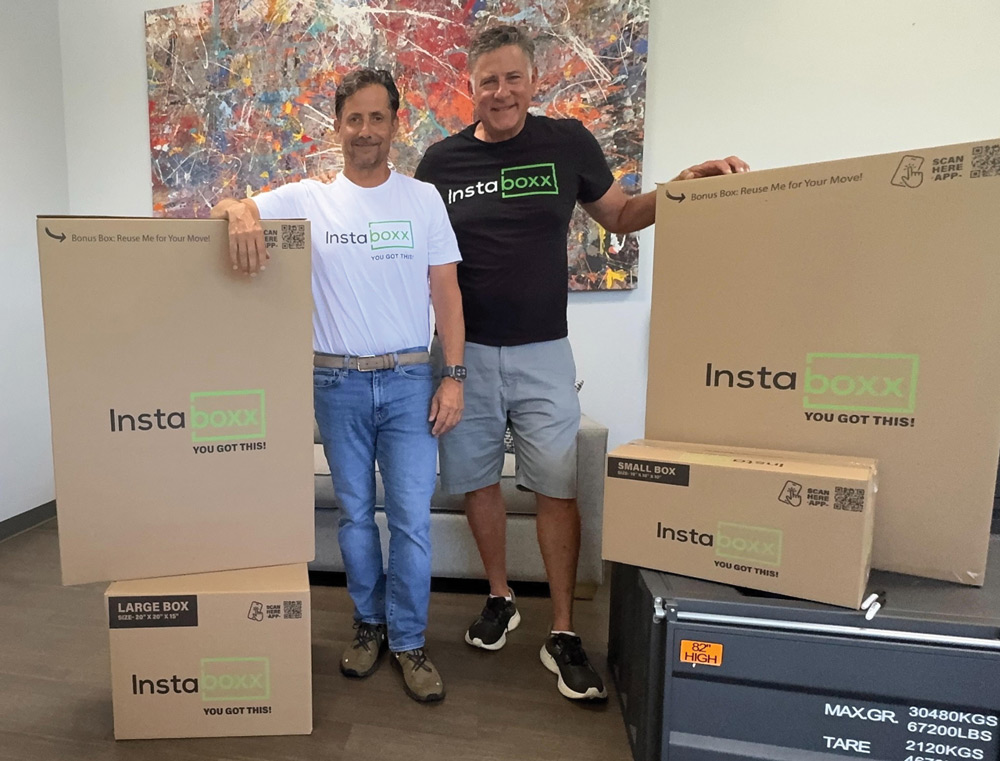

ecureLease, part of the On The Move Insurance platform, is always on the lookout for ways to make life easier for operators and tenants. Like many platforms today, that means integrating AI, but SecureLease is taking a more measured approach, focusing on where it actually fits into the day-to-day operations of a facility.
The company has added two new tools to its toolbox: SecureSCOPE and SecureInventory. One gives operators more visibility into performance. The other gives tenants more visibility into what’s in their units and packed boxes.
Instead of relying on scattered data or gut feel, operators can see what’s working, what isn’t, and where there may be opportunities to improve results across locations. It’s a shift from reactive management to something more informed and, ideally, more predictable. “It will also support healthier revenue performance over time,” adds Maxwell.

Powered by InstaBoxx, the AI-assisted tool allows renters to create a digital inventory of the items they place in storage. But it’s more sophisticated than that. The digital inventory is created simply by taking a photo of the items being placed in a box. The app instantly categorizes those items with photos, descriptions, and estimated values.
Now, instead of guessing what’s in a unit or tearing through boxes months later looking for one specific item, tenants have a live, organized, and searchable record of their belongings. If they remove or add an item from a box or unit, they simply change it on the app, keeping the inventory constantly up to date. The inventory remains accessible throughout the rental period and can be downloaded after move-out, giving renters a level of visibility they typically don’t have.
For operators, it also adds another layer of value to the offering—one that can help differentiate their facility in a competitive market. “It’s a notable shift,” says Maxwell, pointing to a long-standing gap in the storage experience. “Inventory has always been the tenant’s responsibility—or more accurately, their problem. Tools like this provide a solution in a way that benefits both sides.”
That reality, she adds, is what continues to drive the company’s approach. “Operators need solutions that do more than simply check a box,” Maxwell says. “They need tools that help them protect tenants, support staff, improve documentation, and create a more professional, value-driven rental experience, while also reducing expenses and increasing revenue.”
And paired with stronger reporting through platforms like SecureSCOPE, they give operators a clearer understanding of how their programs are performing behind the scenes.
Concludes Maxwell, “These features take time to develop, but they feel obvious once you see them in action.”
At the recent ISS conference in Las Vegas, that reaction was apparent. Operators weren’t asking what the products do—they were asking how quickly they could roll them out.
Unlock the Power of
Innovation & Technology with
Best Tenant Protection…8 years and Running

Why Owner/Operators Choose TPP

Programs That Drive Revenue & Retention
Don’t wait, contact us today to sign up for the best Tenant Property Protection program!



he Self Storage Association is always looking for new ways to connect with, educate, and entertain our members, and that’s why we’re excited to tell you more about our new podcast, “What’s Up, SSA?”
This podcast is designed to give members a behind-the-scenes look at the work we do, the value of SSA membership, and why having a national nonprofit association advocating for the self-storage industry matters. More than anything, we want members to get to know the SSA team and what we do on behalf of you and the industry throughout the year.
Many members interact with us primarily during national events. While those moments are exciting and fulfilling, they’re also busy, fast-paced, and not always the best window into the full scope of our work. Every SSA staff member plays a vital role in executing those events, but our efforts extend far beyond conference week.

Future episodes will spotlight key SSA benefits and updates, including the SSA Foundation, our national events team, legal and legislative insights, conversations with our CEO, and more. Whether it’s advice on how to run your business more effectively or updates on pending legislation, everything we do is to benefit you and your bottom line.
We hope this podcast keeps you informed, connected, and firmly in the self-storage know. Follow the show and watch/listen to “What’s Up, SSA” on Spotify, Apple Podcasts, and YouTube.

alk into most self-storage offices and you’ll see the same thing. A tenant is renting a unit. Another needs to make a payment. Someone is asking about insurance. A new lead just came in online. The phone rings. Staff move between screens to keep up.
None of these tasks are difficult individually, but together they create friction, especially when the software behind them isn’t designed to work as a single system.
That’s where many operators run into trouble.
Over time, self-storage businesses have added technology to solve specific needs: property management, payments, marketing, reporting, and tenant communication. Each tool has value, but too often they operate independently.
The result isn’t efficiency—it’s fragmentation.
Staff toggle between systems. Data lives in multiple places. Processes rely on workarounds instead of workflows. What should be simple becomes time-consuming, and what should be consistent varies depending on who’s working that day.
The issue isn’t a lack of software. It’s how that software is structured.
In many cases, systems have been layered over time rather than built intentionally. What starts as a practical fix becomes a patchwork that’s harder to manage as the business grows.
And the impact extends beyond daily inconvenience.
Fragmented systems slow operations, limit visibility, and create missed opportunities. Add-on services, such as tenant insurance or retail sales, are offered inconsistently. Pricing decisions lack context. Reporting becomes something to question instead of trust.
These aren’t software problems. They’re system problems. The focus needs to shift.
Instead of asking, “Do we have the right tools?” operators should ask, “Do our systems work together in a way that reflects how we actually run the business?”
Because effective self-storage software isn’t defined by features. It’s defined by how well it connects the operation, from the first inquiry to ongoing tenant management.
When rentals, payments, reporting, and customer interactions live within a unified system, the difference is immediate. Tasks take less time. Training becomes simpler. Data becomes actionable. And revenue opportunities are easier to capture because the process supports them.
More importantly, the business becomes easier to manage across locations and over time.
This doesn’t require adding more software. In many cases, it means simplifying—moving toward a more connected, purpose-built approach that aligns with how operators work today.
As competition increases and margins tighten, that alignment matters.
Because the advantage doesn’t come from having more technology—it comes from having software that works the way your business does.
• Fully integrated solutions with in-house baȷa Engineers for faster, easier projects
• Pre-Fabricated Framing Systems with Bolted Connections – No field welding
• Snow Loads from 20psf to 100psf – Wind Speed rated to 170MPH
the road ahead?
Canada’s largest and most trusted self-storage operator.
Sell your property to a partner that values what you’ve built.
We protect your team, your customers, and the business you worked hard to grow.