









How to enjoy our new magazine:
Just scroll!
Click or tap the table of contents icon in the menu bar to find any article.
Read any article by clicking or tapping the read full article button below each article intro.
Jump back to your previous browsing spot from any article using the menu bar or back to issue button.












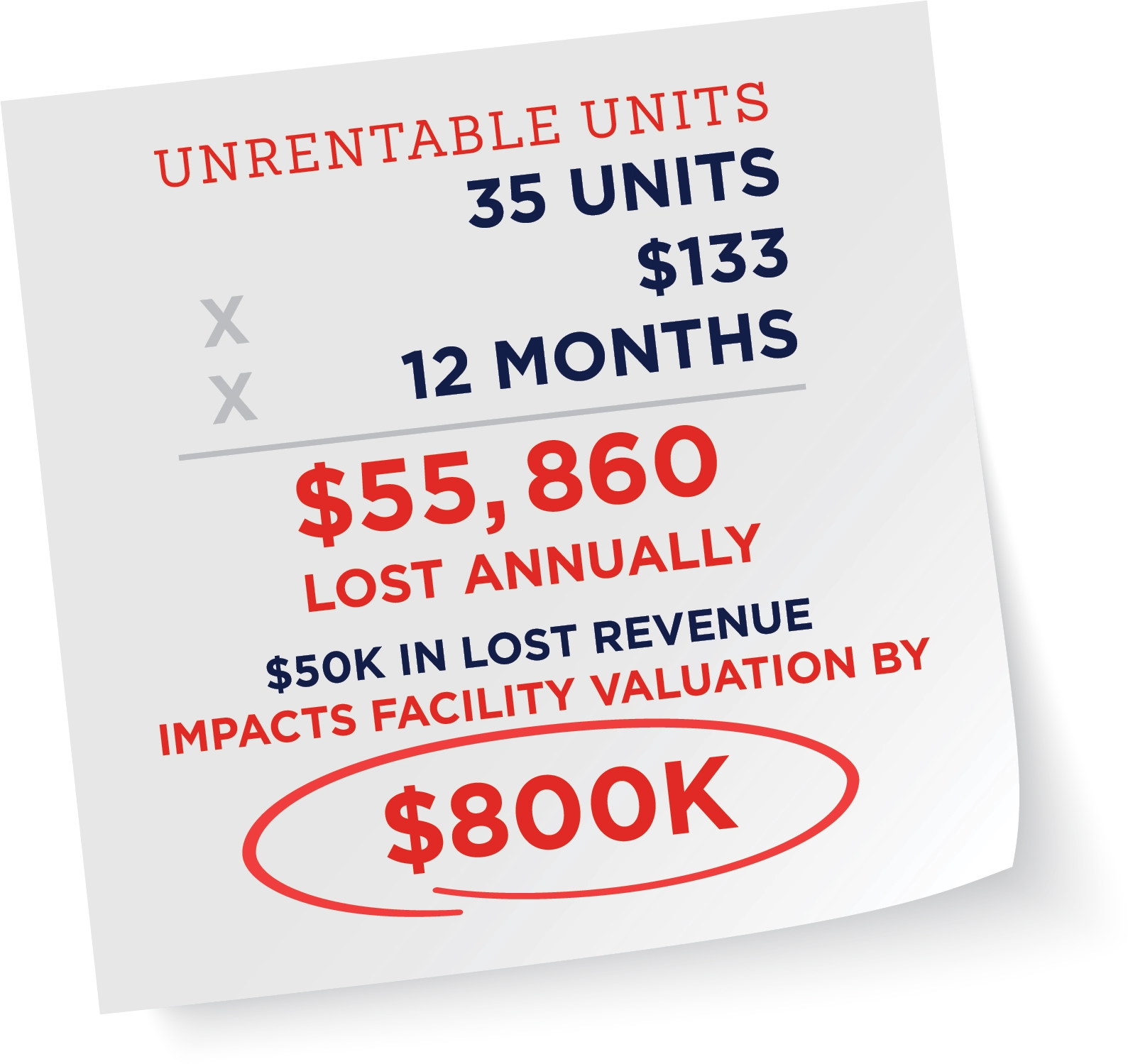
leaking revenue?




-
Profits Grow When You Focus On Female ConsumersPage 12
-
Publish Regularly To Get Cited By AIPage 16
-
Understanding The Alternate Contact On A Rental AgreementPage 20
-
The Missed-Call Revenue LeakPage 24
-
What Moving Companies Want From A Storage PartnerPage 28

-
Page 44
-
Your Market Isn’t The National AveragePage 46
-
The Yardi Matrix Self-Storage National Report For July 2026Page 50
-
How Much Does A Month Of Delay Cost A Self-Storage Development?Page 60




Experience

Local Expertise

Not Just a Builder


-
Early Marketing Can Win Lease-upPage 86
-
Aging Facilities Quietly Erode RevenuePage 88
-
Managing Scope Changes While Protecting Schedules, Profitability, And RelationshipsPage 94
-
Pandora Self Storage in Kirkland, Que.Page 100

-
Part 2 Of The First DPage 102
-
The Hidden Cost Nobody Talks AboutPage 108
-
Ivy-League Insights For Decision-MakersPage 112
-
The Benefits Of A SPF Roof SystemPage 116
-
Building A More Profitable Commercial Tenant MixPage 120
- Chief Executive Opinion by Travis Morrow6
- Publisher’s Letter by Poppy Behrens9
- Meet The Team10
- Women In Self-Storage: Sylver Cook by Alejandra Zilak35
- Who’s Who In Self-Storage: Robert Madsen by Brad Hadfield41
- Innovation Spotlight: PS4.0 by Brad Hadfield124
- Self Storage Association Update127
- The Last Word by Scott Zucker, Esq.128

Why ManagementPlus? Extra Space Storage is the largest third-party management company for a reason. They don’t differentiate between their own facilities and yours. When you partner with Extra Space, you’ll get the same resources that make their properties so successful.
For the latest industry news, visit our comprehensive website, ModernStorageMedia.com.
















CEO of MSM and Storelocal Corporation,
President of National Self Storage
’ll say the nice thing first, because it’s true.
If you’re reading this in Las Vegas, look around. The SSA took over the Sphere this year and put Rob Riggle on the stage. That’s a real investment in you, and every badge in the building gets in the door. Good; this industry deserves events that feel like this.
Some of that is competition, and competition is good for all of us. There are four national shows on the calendar in 2026: one from ISS, two from the SSA, and ours. Nobody gets to coast, everybody brings their best, and you’re the one who benefits.
So, here’s my pitch: THE Show is Nov. 4 to 6 in Atlanta at the Georgia World Congress Center, and it’s the only national self-storage event east of the Mississippi in 2026. It offers: four content pillars (Operations, Data, Development, Investment); a Deal Room powered by TractIQ where acquisitions actually get done; keynotes from outside our bubble, because that’s usually where the best ideas come from; a welcome at the Georgia Aquarium with Wolfgang Puck; and a Red Carpet Awards Gala, because this business is allowed to have some fun.
There’s more self-storage content than one human can consume; it’s built for the entire industry, with something in it for everyone. Bring your teams, bring your VPs and your managers, bring the deal you’ve been sitting on.
Occupancy is tight, rates are turning, and the deals are going to the people who are in the room. That’s been true every cycle I’ve been around for, and November won’t be different.
One piece of housekeeping, and I’d rather tell you now than have you find out later. Registration is $899 through Sept. 30—no membership is required and it’s the same price for everybody. On Oct. 1 it goes up. You’ll be home from Vegas about three weeks before that happens, so handle it while it’s still fresh.
I’m speaking Thursday afternoon in Vegas on revenue leakage in older facilities. Come find me, tell me how the week is treating you, and tell me I’m wrong about something—that’s what this page is for.
Then, I’ll see you in Atlanta.
Register at msmtheshow.com before pricing changes.

-
PUBLISHER
Poppy Behrens
-
Director Of Sales & Marketing
Lauri Longstrom-Henderson
(800) 824-6864 -
Creative Director
Carlos Padilla
(800) 352-4636 -
Editor
Erica Shatzer
-
Lead Writer / Web Manager
Brad Hadfield
-
Storelocal® Media Corporation
Travis M. Morrow, CEO
-
Websites
-
Visit Messenger Online!
Visit our Self-Storage Resource Center online at
www.ModernStorageMedia.com,
where you can browse our paid publications, research archived articles, sign up for a magazine subscription, submit a change of address, and more. 
- All correspondence and inquiries should be addressed to:
MSM
PO Box 608
Wittmann, AZ 85361-9997
Phone: (800) 352-4636

Invest with confidence in a family-owned and operated self-storage brand backed by 40 years of proven experience. Built on trust, stability, and hands-on management, our company has thrived across market cycles while delivering consistent value.
Join a legacy of smart growth and reliable returns in an essential, resilient industry.

210-405-6695
theparhamgroup.com

















he self-storage industry does not need another trade show that looks and feels like every other one. That is why Modern Storage Media created something different with THE Show, taking place Nov. 4 to 6 at the Georgia World Congress Center in Atlanta.
This is more than an exhibit hall surrounded by educational sessions. THE Show was designed as a complete industry experience—bringing together the people, information, connections, and opportunities you need to compete in today’s rapidly changing self-storage market.
The educational program will address the real issues facing owners, operators, and developers. Each presentation will be fresh and exciting, offering new information to add to your wheelhouse. Whether you are trying to finance a project, improve facility performance, understand changing customer behavior, navigate construction challenges, or determine when to buy, sell, or expand, you will find practical information you can take home and put to work.
We have deliberately avoided scheduling educational sessions during exhibit hall hours. You should not have to choose between hearing an important speaker and meeting with the vendors who can help your business. You will have time to explore new products, services, and technology—and to have productive conversations without constantly watching the clock.
We are also working to make attendance more affordable. Through THE Show’s affiliate program, you can receive a registration discount. For more information, contact amaris.solis@storelocal.com before registering. Last but not least, we are offering THE Show attendees an exclusive airline discount through Delta Air Lines to help reduce travel costs.
Attending an industry event requires an investment of time and money, and we understand that companies must choose carefully. But the greatest cost may be the opportunity missed: the idea you did not hear, the relationship you did not build, the solution you did not discover, or the deal you were not in the room to discuss.
THE Show is being built around the way business really happens—in conversations, introductions, shared experiences, and access to people who understand your challenges.
So, why not take advantage of the available registration and airline discounts and join us in Atlanta? I look forward to seeing you there!

Publisher

he self-storage industry does not need another trade show that looks and feels like every other one. That is why Modern Storage Media created something different with THE Show, taking place Nov. 4 to 6 at the Georgia World Congress Center in Atlanta.
This is more than an exhibit hall surrounded by educational sessions. THE Show was designed as a complete industry experience—bringing together the people, information, connections, and opportunities you need to compete in today’s rapidly changing self-storage market.
The educational program will address the real issues facing owners, operators, and developers. Each presentation will be fresh and exciting, offering new information to add to your wheelhouse. Whether you are trying to finance a project, improve facility performance, understand changing customer behavior, navigate construction challenges, or determine when to buy, sell, or expand, you will find practical information you can take home and put to work.
We have deliberately avoided scheduling educational sessions during exhibit hall hours. You should not have to choose between hearing an important speaker and meeting with the vendors who can help your business. You will have time to explore new products, services, and technology—and to have productive conversations without constantly watching the clock.
Attending an industry event requires an investment of time and money, and we understand that companies must choose carefully. But the greatest cost may be the opportunity missed: the idea you did not hear, the relationship you did not build, the solution you did not discover, or the deal you were not in the room to discuss.
THE Show is being built around the way business really happens—in conversations, introductions, shared experiences, and access to people who understand your challenges.
So, why not take advantage of the available registration and airline discounts and join us in Atlanta? I look forward to seeing you there!
Publisher
MSM’s THE Show lands in Atlanta, Ga., on Nov. 4 to 6, 2026, packing the Georgia World Congress Center with more industry speakers and keynotes than ever before, plus special guests, exciting breakout sessions, an acquisitions corner, and a trade show floor designed for engagement and visibility.
After hours, unforgettable events await, with our Deep Blue Welcome Dinner inside the underwater banquet hall of the Georgia Aquarium, catered by Wolfgang Puck, and our Red Carpet Awards Gala, honoring the very best in self-storage.
If you’ve been waiting for something different … Welcome to THE Show.









Unlock the Power of
Innovation & Technology with

Why Owner/Operators Choose TPP





or years, self-storage operators have focused on occupancy rates, rental pricing, and operational efficiency as the primary levers for profitability. Those factors certainly matter, but many facility owners are overlooking one of the most influential drivers of revenue growth: understanding the customer who is often making the storage decision in the first place.
Women frequently play a leading role in household organization, relocation planning, downsizing, remodeling projects, family transitions, and small business operations. Industry discussions increasingly recognize that female consumers are often the researchers, evaluators, and decision-makers behind storage purchases. External industry commentary consistently points to safety, convenience, trust, cleanliness, and ease of use as key factors influencing storage selection.
The facilities that understand these priorities create a more profitable business.
This is where female consumers present a significant opportunity.
Women often evaluate a storage facility through a different lens than simply monthly rent. They may ask:
- Does the facility feel safe?
- Is the property well lit?
- Is someone available to help if needed?
- Can I easily access my unit?
- Does this company appear trustworthy?
- Will my belongings remain protected?
The most successful operators understand security is actually a profit center. Female consumers frequently place an even higher emphasis on feeling secure while visiting a facility alone. Simple investments can produce outsized returns. Some examples include:
- Improved lighting throughout the property,
- Clear sightlines between buildings,
- Modern access controls,
- Visible camera coverage,
- Emergency assistance options, and
- Quickly maintained gates and locks.
Security does not simply reduce risk. It increases perceived value.
For many women, however, the value of a storage unit extends far beyond the dollar value of the items inside.
A storage unit may hold a child’s artwork from elementary school, boxes of family photographs that document generations of memories, holiday decorations that have been passed down through the family, or furniture from a beloved parent or grandparent. It may contain keepsakes from a wedding, baby clothes preserved for future generations, or personal belongings being safeguarded during a difficult life transition. These items are often irreplaceable.
When a woman evaluates a storage facility, she is frequently considering more than whether her belongings will remain dry and secure. She is asking whether the memories, milestones, and family history connected to those belongings will be protected as well.
When customers feel confident that both their possessions and the memories attached to them are being protected, they are often more willing to choose a facility based on trust and peace of mind rather than price alone. In a competitive market, emotional confidence can become a significant differentiator and a driver of long-term customer loyalty.
To a female customer evaluating multiple facilities, a clean property often communicates much more than maintenance standards. It communicates professionalism, reliability, and care.
Peeling paint, poor lighting, cluttered offices, overflowing trash bins, or dirty hallways create doubt. If a facility appears neglected, customers naturally question how well their belongings will be protected.
Conversely, a clean, organized facility creates confidence. It reassures customers that management pays attention to details and takes ownership seriously.
The result is often greater willingness to rent, increased referrals, and stronger online reviews.
Women balancing careers, families, caregiving responsibilities, and personal commitments often place enormous value on time-saving solutions.
The operators winning market share are making every interaction easier. This includes:
- Online rentals,
- Mobile-friendly websites,
- Digital lease signing,
- Automated payment options,
- Contactless move-ins,
- Fast response times, and
- Clear communication.
As storage operators increasingly adopt technology and remote management capabilities, responsiveness becomes even more important. Customers frequently need storage during stressful transitions and often choose the facility that responds first. Internal industry marketing content also highlights responsiveness as a critical conversion factor.
Every point of friction removed from the customer journey increases the likelihood of conversion.
Motion-sensor lighting, climate-controlled spaces, and clean, modern finishes create a more welcoming experience for all customers.
Industry materials increasingly highlight design features that improve usability, navigation, lighting, and overall comfort. These improvements do not simply make facilities look better. They make facilities feel safer and easier to use.
The emotional experience customers have while touring a property can be as influential as the physical product itself.
Women are often influential within family, social, community, and professional networks. A positive storage experience during a move, renovation, business expansion, or life transition can generate referrals for years.
Strong reviews, social recommendations, and word-of-mouth referrals remain some of the highest-return marketing investments available.
Facility owners who intentionally design their operations around the factors female consumers value most—safety, cleanliness, transparency, convenience, trust, and service—create businesses that stand apart from competitors.
The result is not just happier customers. It is stronger conversion rates, higher customer retention, greater pricing power, better online reviews, more referrals, and ultimately greater profitability.







id you know that LinkedIn is one of the top five sources cited by AI answer tools? In the last year, LinkedIn has increasingly been cited as a credible source of information, and the AI Answer Engines mention the people or companies sharing it.
Along with Reddit, YouTube, and Wikipedia, LinkedIn consistently ranks among the top five platforms cited by AI answer tools like ChatGPT, Perplexity, and Google’s Gemini AI Overviews or AI Mode. It’s much easier to use than Reddit, and it’s less time-consuming than creating YouTube videos. It’s where you can become known as an expert in your field or industry, in addition to building credibility and topical authority.
Back in June 2024, I wrote an article for Messenger, “The Two Sides of LinkedIn”, that covered the basics of LinkedIn, so I’ll get into what’s new.
Like everything in the AI world, the self-storage industry is evolving rapidly, and so is the way investors, vendors, and facility owners find information. Whether someone is a large franchise operator looking for new gate access software, an investor seeking off-market deals, or a mom-and-pop owner researching how to increase their profits, they are increasingly turning to artificial intelligence (AI) for answers.
That same study noted that across ChatGPT, Perplexity, and Google AI Mode, an average of 11 percent of AI responses reference LinkedIn. On ChatGPT specifically, that number is 14 percent. This means that more than one in eight AI answers that your potential customers are reading is shaped by a LinkedIn post. If your brand or facility is not consistently publishing on LinkedIn, someone else’s content will fill the gap and shape what AI tells the market about your field.
A post with 10 reactions gets cited at the same rate as a post with 100 reactions; the median cited post actually only has 15 to 25 reactions and a single comment. Even better for small mom-and-pop operators or solo real estate investors is that people with under 500 followers get cited at the same rate—and sometimes more—than creators with massive followings. AI search engines do not reward popularity contests; they reward the most relevant, highly specific answers. This levels the playing field.
Use specific details and names.
Publish long-form LinkedIn articles.
Balance company pages and personal profiles.
Post consistently using the content funnel strategy.
- Top-of-Funnel (TOFU) Growth Content (35 percent) – Broad industry observations are designed to attract new followers. For example, you could write a “newsjacking” post reacting to a recent industry report.
- Middle-of-Funnel (MOFU) Authority Content (35 percent) – Share deep expertise and educational posts that build trust using an infographic.
- Bottom-of-Funnel (BOFU) Conversion Content (20 percent) – These are lead-generating posts. The most effective format here is case studies. For instance, a consultant can detail how an underperforming mom-and-pop facility went from 60 percent occupancy to 95 percent occupancy in six months. Highlight the exact steps taken and provide real numbers as proof.
- Personal Content (10 percent) – Share stories about your journey as a real estate investor or business owner to humanize your brand and deepen connections with your existing network. This helps build trust and credibility.
New: Followers barely move the needle. Follower count is now a vanity metric.
Old: Going broad to go viral.
New: Going niche to get found. Each post should be catered to a niche target market.
Old: Posting two to three times a week.
New: Posting as often as you can—the more posts, the better to feed the AI chatbots.
Old: Short, clipped, one-liner posts.
New: Writing like a human again. Write for your target audience, even if you think they’re not on LinkedIn.
Old: Links buried in the comments.
New: Links in the post. You can even put more than one!
Old: Carousels rule the feed.
New: Infographics rule the feed. Using NotebookLM from Google, you can easily create infographics in minutes.
By the way, ChatGPT now commands 92 percent of AI referral traffic! Don’t you want to increase your chances of being cited? Note: AI tools are evolving so quickly that by the time you read this, there will be changes, new tools, and new tricks. Follow me on LinkedIn to get the latest news and tips: https://www.linkedin.com/in/giselleaguiar.











hat is an alternate contact? The alternate contact is someone we contact if we can’t reach the main contact listed on the rental agreement. This person often knows where the main contact is, or how to reach them, especially in urgent situations like a lien sale. While the primary use of the alternate contact is during a lien sale, we also rely on them if something happens at the property, such as a leak from their unit. If we try to contact the main person and they are unavailable, we reach out to the alternate.
Typically, I say to the alternate, “Hi, we’re trying to get in touch with [Name] regarding their storage unit. Can you assist us with that?” We do send pre-liens and lien notices to these alternate contacts, but keep in mind that not all individuals are aware they are designated as alternates.
If someone tells me they are divorced from the primary contact or requests removal as the alternate, I ask them to provide a confirmation letter to be removed from the list. However, if there’s going to be a lien sale, I will still send documents to that alternate contact, unless I have been provided with a new one.
The alternate contact cannot access the unit, remove property, make account changes, sign documents, or terminate the lease—those actions are not allowed.
We try to have an alternate contact so we can inform the tenant that their belongings will be auctioned. There have been instances when I’ve called the alternate contact because we couldn’t reach the primary tenant. I remember a situation where I had to move items from one storage facility to another. Having alternate contacts proved to be incredibly helpful. I was very grateful for their assistance, as they often had valuable information, like, “Oh yeah, they moved to a different place now.”
I know some managers might say that providing an alternate contact is optional, but I don’t think that should be the case. It’s beneficial to have an alternate contact who isn’t responsible for payments in case we need to reach someone. It’s better to have someone who knows where the tenant might be if they’ve moved or if something has happened to them.
Best practices dictate that we should always ask for an alternate contact. Even if they decline, at least we can say we made the effort to ask.
Some people claim legal authority to access the unit, but I would argue that they must have a court order. Sometimes individuals present a death certificate, claiming, “My parents have passed away. Here is the death certificate.” However, anyone can obtain a death certificate, so that doesn’t suffice. They must go to court and state, “I need permission to access this storage unit, and it is in my father’s name. I am the sole heir.”
Just being an alternate contact does not grant them any legal status to access that unit. They must have a specific document. This policy protects the customer’s property and minimizes your liability.
If the alternate address is missing, I give them a piece of stationery with the facility’s address. Once they obtain that information, they can send it to the facility to be attached to their contract.
Many storage facilities have faced significant consequences, especially during lien sales, for failing to send the proper documentation to the alternate contacts. It is crucial to follow these guidelines to avoid any issues.
For security, it’s important to send them a credit card authorization form, if needed, and have them sign it. This way, they can’t initiate a chargeback, and you won’t be left in a difficult situation.
Additionally, it’s best practice for storage managers to collect complete contact information from all customers.
Sometimes we address these issues, but we don’t always take action. If you hear that someone has split, for instance, it’s important to follow up. Most of the time we’re sitting in front of computer screens, no longer dealing with paper copies, so this is an easy task.
Including an alternate contact in the rental agreement is a critical step that should not be overlooked. This designated person, whether a friend, family member, or another trusted individual, serves as an important communication link in case issues arise, such as missed payments or unexpected challenges. While they don’t have decision-making rights for the account, having an alternate contact can facilitate essential communication, especially when the customer may be unable to respond, such as during hospitalization. This proactive measure helps ensure that important notifications reach someone who can act, if necessary, ultimately safeguarding both the customer’s interests and the integrity of the rental agreement.










ost operators can tell you their occupancy to the decimal. Ask them how many rental inquiries they missed last month and you’ll get a blank stare. That blind spot is the biggest revenue leak in most storage businesses, and almost nobody measures it.
I’ve spent 24 years in self-storage: 13 running facilities and 11 on the systems side. In all that time, I have never audited an operation and found zero missed inquiries. Not once. What I find instead is an operator who’s certain their team answers everything, sitting on a phone report showing 20, 30, sometimes nearly 40 percent of inbound calls going unanswered. One operation I reviewed had 10 people handling inquiries and it was still missing more than a third of its calls. Nobody knew because nobody was counting.
That behavior is why a missed call is not a delayed sale. The prospect who hits your voicemail at 6:40 p.m. does not set a reminder to try you again tomorrow. They hang up and dial the facility down the street. By the time your manager checks messages the next morning, that customer has already booked a unit, and the voicemail they left, if they left one at all, is a record of revenue that went to your competitor.
The same thing happens on every other channel, just quieter: the web form that gets answered the next business day, the text or WhatsApp thread that sits unread over the weekend, and the chat widget that fires an auto-reply message and then goes silent. Each of these is a missed call without the ringtone.
And the worst of it happens after hours. A large share of storage inquiries come in evenings and weekends, exactly when life events force the decision and exactly when most facilities stop answering. The competitor with an online booking flow or a live channel at 9 p.m. is not better at storage. They are just present when the customer shows up.
Pull the missed-call report from your phone system. Every modern phone platform has one. Count the calls that rang out or went to voicemail during business hours and count every call that came in after office hours. Then, do the same exercise for your other channels: web form submissions and their response times, text messages, WhatsApp, and chat. If a channel has no way to report on response time, that tells you something too.
Now do the math. Say you find 40 missed contacts in a month. Not all of those are rental inquiries, so be conservative and call half of them noise: wrong numbers, vendors, existing customers. That leaves 20 genuine prospects. If your team normally converts a third of rental inquiries, that is roughly seven rentals you never had the chance to win. At a $150 monthly rate and a 10 month average stay, each one is worth about $1,500. That single month of missed contacts cost you around $10,000 in lifetime revenue, and the leak repeats every month.
Run your own numbers. They will be different from mine. The point is that once you attach a dollar figure to the leak, it stops being an operational footnote and becomes the most expensive problem in the building. Operators spend real money on paid search and aggregator listings to make the phone ring, then lose the rental at the exact moment the marketing worked.
In most operations, the phone rings at the counter, the web form goes to an inbox, text messages land on a mobile phone in someone’s pocket, and chat belongs to whoever set up the website—four or five channels, four or five places to watch, no single view of what came in and what got handled. Inquiries do not fall through because people ignore them. They fall through because no one can see them all in one place.
Once every inquiry lands in one queue, three things become possible that were impossible before. Nothing can silently disappear, because every contact is a line item until someone closes it. You can set a response-time standard and actually hold to it, because the clock is visible. And you can report on the whole funnel weekly: inquiries in, response times, conversions out, by channel.
What I would not do is buy the automation first. An AI agent bolted onto a fragmented setup just answers one channel faster while the other four keep leaking. Get every channel into one queue, measure for a month, and then decide where a person, a service, or a machine covers the gaps. The measurement usually makes the staffing decision obvious.
Fix the cheapest gaps first. Set your phone system to route unanswered calls to a backup line instead of voicemail. Put an auto-response with a booking link on after-hours channels so a 9 p.m. prospect can reserve a unit instead of calling your competitor at 9 a.m. Assign one named owner to each channel until consolidation happens, so at minimum somebody is accountable for every inbox.
Then, consolidate. Get the channels into one system with one queue, set a response-time target your team can see, and review the missed-inquiry number every week alongside occupancy and delinquency, because it belongs in that company.
You already paid to make the phone ring. Answering it is the cheapest marketing you will ever buy.



Click here for more information.
ost articles about mover partnerships are written from inside the storage office. This one is written from the truck.
I run a company that does both. We move households and commercial sites, and we operate storage. That means I spend part of my week as the kind of operator Messenger writes for, and the rest of it as the person storage facilities are trying to recruit. I get the emails. I get the drop-in visits with the branded pens. I also decide, several times a week, which facility a crew chief recommends when a customer says the words every mover hears eventually: “We’re not going to be ready in time.”
That decision is worth more than most facilities realize, and it is made on criteria that almost nobody pitches to.
What makes movers distinct is timing and certainty. Around 32 percent of self-storage users are in the middle of a household move. A mover is not introducing storage as an idea to someone browsing options. The mover is standing in a half-packed living room at the exact moment the customer discovers their new place will not fit everything or that settlement slipped two weeks. The need is immediate, specific, and already sized. Referral leads generated this way convert at multiples of cold advertising leads, and every operator who has run both channels knows the difference in close rate is not subtle.
The current market makes this channel more valuable than it was three years ago, not less. National occupancy sat at 78.1 percent in the second quarter of 2026, up 1.4 points from the first quarter. On the surface, that reads as healthy. Look at what is underneath it. Average length of stay has stretched to 18.5 months, up 2.4 percent year over year, with 64 percent of customers now staying past 12 months and 46 percent past 24. Occupancy is holding not because move-ins are strong but because move-outs are weak. People are staying put.
That is a stable revenue base and a genuine acquisition problem. When the flow of new tenants thins, the channels that reach people at the precise moment of need become disproportionately important. There are still somewhere between 28 million and 31 million Americans relocating each year, and a large share of them touch a professional mover. That is the pool. The question is who is standing next to the customer when the storage conversation starts.
It is the mover—every time.
A referral that generates a difficult job is worse than no referral at all. We wear the labor overrun, and we wear the customer’s frustration, because we are the ones on site. So, the assessment runs roughly like this.
Access hours against crew schedules – This is the single biggest filter, and the one most facilities get wrong. A residential move commonly finishes between 4 p.m. and 7 p.m. If your gate closes at 6 p.m., or your office closes at 5 p.m. and a new tenant cannot complete a lease after that, you are unusable for a meaningful share of jobs. Facilities with extended or 24-hour access get recommended for reasons that have nothing to do with how nice the office looks.
Drive-up vs. elevator – The difference between backing a truck to a roll-up door and running to a fifth-floor unit through a single elevator can be two to four hours of billable labor on the same volume of goods. If the customer is paying hourly, that difference lands on their invoice. They associate that cost with the mover, not the facility. Drive-up units get recommended first, consistently.
Turning radius and approach – 26-foot trucks and semi-trailers need room. Tight aisles, low canopies, sharp entry angles, and steep driveways get facilities quietly removed from the recommendation list after one bad experience. Most operators have never watched a truck attempt to maneuver their site and do not know they have this problem.
Staging space – Where does a crew put 40 boxes while sorting what goes into the unit? Facilities that allow brief staging near the door make jobs faster. Facilities that enforce a strict no-staging rule make them slower.
Insurance and certificates – A commercial move into a facility that demands a certificate of insurance with specific additional-insured wording, requested with no notice, stalls the job. Publish your requirements. Better still, hand them to your mover partners in advance so they can pre-issue.
Unit sizing accuracy – When a facility tells a customer a 10-by-10 will hold a three-bedroom home and it does not, the crew is standing in the parking lot at 6 p.m. with a third of a truck still loaded. This does more damage to a partnership than any commission dispute. Movers estimate volume for a living. If your sizing guidance is optimistic, we find out on day one and we stop referring.
Who signs and who pays – Can a lease be completed remotely before the truck arrives? Can a customer authorize a mover to collect keys? These sound like administrative details. They determine whether a job finishes at 5:30 p.m. or 8 p.m.
Responsiveness on the day – Something always changes: the unit is smaller than expected, the customer needs a second unit, the gate code does not work. A facility that answers the phone within two minutes on a Saturday afternoon earns referrals indefinitely. One that routes to voicemail loses them permanently.
Notice that none of these are marketing questions. A facility that scores well on this list will get referrals with no commission at all, because the mover benefits directly from a smooth job. A facility that scores badly will not be rescued by paying more.
The informal recommendation – There’s no agreement, no money—just a crew chief who names your facility because jobs there go well. This is the most common arrangement in the industry, yet it is the most undervalued. It costs nothing and it is entirely earned through operational quality. Most self-storage facilities should secure this before attempting anything more formal.
Flat-fee commission – This is a fixed payment per converted referral, commonly benchmarked against the incentives already used in tenant referral programs, where a free month of rent or a payment in the $50 range is standard. It’s simple to administer, easy to explain to crews, and works best when tracking is straightforward.
Percentage revenue share – It’s a share of the first several months of rent. This aligns both parties toward longer stays rather than volume, which matters more now that stay length is the primary driver of facility economics. It requires more administration and a clear end date. Ambiguity about when the share stops is the most common source of partnership disputes.
Reciprocal referral – With a reciprocal referral, no money moves in either direction. You refer storage customers who need a mover and the mover refers customers who need storage. This is frequently the strongest structure available because it removes the commercial friction entirely and both parties have a direct interest in the other performing well. It is also the one storage operators propose least often, usually because they underestimate how much moving demand originates in their own office.
Integrated or white label – Here the mover sells storage as part of a single quoted service and handles the customer relationship end to end. It’s the highest revenue per customer, lowest customer contact for you, and the most operational coordination. This suits facilities with excess capacity and a genuine appetite for a wholesale relationship rather than a referral one.
There is no universally correct choice. There is a correct sequence. Earn the informal recommendation first, because it validates that your site actually works for crews. Formalize it afterward. Facilities that lead with a commission offer before anyone has run a job at their site are asking movers to take a risk on their behalf and pay attention to paperwork at the same time.
Agree on attribution before the first referral, not after a disputed one. A named code, a dedicated phone number, or a simple pre-notification email from the mover all work. What does not work is reconstructing the source of a walk-in three weeks later. Every partnership that has soured in my experience soured over attribution, not over rate.
Put the end conditions in writing. When does a revenue share stop? What happens if the tenant transfers units, moves to a different site in your portfolio, or leaves and returns? These are unremarkable questions when settled in advance but relationship-ending when settled in arrears.
Finally, handle the tax and reporting side properly from the start. Referral payments to a business partner are ordinary commercial payments and need to be documented as such.
Sizing optimism is second. Nobody minds being told a unit is too small. Everybody minds discovering it at dusk.
Third is the absence of a single point of contact. When the crew chief has to explain the arrangement from scratch to whoever is behind the counter, the arrangement effectively does not exist. Name a person. Tell the mover who it is. Tell your own staff too, which is the step that gets missed.
Fourth is damage ambiguity. Goods in transit, goods in a unit, and goods in the corridor between the two sit under different coverage. Establish where responsibility transfers before an incident, because there is no neutral answer available after one occurs.
Time it for the off-season. Approaching a moving company in peak summer is approaching people who are working 14-hour days. Late fall and winter are when operations staff have time to think about next year.
Bring the operational answers, not a brochure. They want to know access hours, whether units are drive-up, truck clearance and turning radius, COI requirements and turnaround, sizing guidance you are confident in, and a direct phone number that a human answers on weekends. A mover can assess a partnership from that page alone and will be quietly impressed that you knew to bring it.
Offer a site visit to let a truck drive the loop. This single step separates facilities that understand the relationship from those that do not.
Then, propose a pilot: 10 referrals, one agreed structure, a defined review point. Make it low commitment, easy to say yes to, and it gives both sides real data instead of assumptions.
Watch length of stay by referral source. Given that stay duration now drives facility economics more than move-in volume, a channel producing 18-month tenants is worth substantially more per referral than one producing five-month tenants, and the difference will not appear in a move-in count.
Review quarterly, together, and ask the question most operators avoid: What went wrong on our site this quarter? You will get an honest answer, because the mover has every incentive for your facility to work better. That conversation is worth more than the referral fee.
Get those right and the referrals arrive whether or not you pay for them. Get them wrong and no commission structure will fix it, because the mover is protecting a customer relationship worth far more than your fee.
The good news for anyone reading this is that most of the items listed herein cost nothing to address. It only costs attention.













ne of the most noteworthy elements of the self-storage industry is that it’s chock full of people who make you feel like you’ve known them forever. They’re down to earth, friendly, and conversations flow easily, with none of the stilted corporate speak of other sectors.
When you first meet Sylver Cook, marketing coordinator at ARCO/Murray, a nationwide leading general contractor specializing in self-storage construction, you immediately feel like you’ve known her for years. And that may be why she’s so successful at what she does. “The main reason I got into marketing is because I love building relationships,” she says. “I enjoy connecting with people and meeting them where they are.”
Her charisma is central to her marketing role; and it’s a character trait the leadership at ARCO/Murrey noticed when she first walked through their doors. It’s also a testament to her happy childhood and the values instilled in her by her parents.
She was raised in the Christian faith by parents who taught her to always treat people with kindness. “Both of them are from Mississippi, and they passed on to us their Southern values: great manners and being polite to everyone. I can’t thank them enough for making me the person I am today,” she says, adding that they also always encouraged her to explore anything of interest. “We didn’t have a lot of money, but they always allowed us to follow what we loved.”
During her teenage years, she nearly lost her life. “When I was 16, I was driving home from church, and I was hit from the back by a drunk driver,” she recalls. “The accident happened right in front of train tracks, and the car hit us at enough speed that we got pushed underneath the crossroads railing arms. We made it to the other side of the railroad just as the train went by.” The incident was frightening, but thankfully her injuries were minor. Plus, the settlement check from the ensuing legal proceedings was enough to fund her first semester of college.
“I started at Texas State University, but I quickly learned that it was very expensive to go to school there, so I came back to Dallas to get my associate’s degree from North Lake College. I then got my bachelor’s degree from Texas Woman’s University.” Getting that college diploma was an important pursuit for her. “Since seventh grade, and through senior year of high school, I was part of a college prep program called AVID (Advancement Via Individual Determination). Now I’m the first-generation college graduate of my family,” she says proudly.
The accomplishment is significant, especially when taking into account that she worked two jobs while attending classes: one at Pappadeaux Seafood Restaurant, where she worked as a bartender and supervisor, and one at the front desk at Hilton Garden Inn. “I had to figure things out and make my own path. I had all the love and support from my family, but I had to handle finances on my own,” says Cook. “But I was very lucky, because after the evening rush at Hilton, it was quiet and I could do schoolwork. It was a lot of late nights, but I made it work.”

After graduating college, she went into health care. “I thought I wanted to do health care administration, but I quickly found out I didn’t want to work in that industry long term.”
This was at the peak of the COVID-19 pandemic. Cook first worked at a pediatrics office, and then at a hospital. “It didn’t feel right to have to make people decide between paying their rent vs. paying for medical expenses.”
She had just lost her brother to COVID, and only six months later, she lost her dad to heart failure. Both traumatic experiences made her even more empathetic towards patients, but she needed to get out of that environment.
Cook started applying for other jobs and was hired at ARCO. “I started as a project coordinator. At first, I enjoyed it because I was learning new things about the real estate and construction industry, but around the second year, I missed connecting with people,” she says. “I was sitting at a computer, reviewing contracts and creating change orders, and I told our vice president, Michael Erceg, that I needed a relationship component—something more aligned with my personality. Being a millennial, I thought change was the right solution, so I thought it was time to look for another job.”
Erceg had a better idea. By then, he was well-acquainted with Cook’s work ethic, and he knew she was an asset to the company. “He said ‘Let us figure out what to do so we can keep you.’”
The sentiment showcased the culture at ARCO/Murray. “Our tagline is work hard, be a pro, and have fun, and they truly promote that we become experts, but that we also enjoy it.”
Erceg connected her with ARCO’s vice president of marketing, Allyson Syperek, and after several meetings and an interview, Cook became the marketing coordinator. “My team specifically focuses on the development of self-storage facilities, with a handful of projects in the marina space, but we have a very healthy pipeline for storage projects, and I’m enjoying them very much. Between the different product types that we offer, self-storage is the most stable and consistent type, with larger contract values. Even though it’s common lore that the industry has stabilized, there are still so many opportunities.”

Those internal pep talks set the stage to her biggest career accomplishments. “I’m proud that I’ve paved the way for myself,” says Cook. “I think I’m the first project coordinator to transition to the marketing team. I had no marketing background, but I learned the skills and I can do them well. ARCO believed in me and trusted me, and I’m so thankful for that.”
These realizations are also why she loves to remind people coming into the industry to be true to themselves. “Tweak what you have to,” she says, “but don’t fake your way through because you’ll lose your real value of who you are as a person. This applies in self-storage, in construction, and in the world in general. Get people to listen to what you have to say.”
She still delights in cooking, specifically good homemade meals. “My boyfriend and I just bought a new home, and I’m in my Martha Stewart era—cooking, baking, and organizing.”
True to her love of fostering good relationships, she savors going out to dinner with friends. “I love one-on-one conversations and checking in on people and family.”
Moreover, she absolutely adores spending time with her nieces and nephews. “I love that they all live about 30 minutes away. I love spending time with all of them,” says Cook. “Life is much sweeter when you’re surrounded by good company.”




in Self-Storage Construction

SBS CONSTRUCTION EAST
Roc Hughes!
at The Show in Atlanta, GA
November 4-6
Booth #345




TEXAS • LOUISIANA • KANSAS • MISSOURI • FLORIDA • ALABAMA • MISSISSIPPI • ARKANSAS • OKLAHOMA • GEORGIA • TENNESSEE • NORTH CAROLINA • SOUTH CAROLINA
17 Scenic Loop Rd.,
Boerne, TX 78006
830-388-7620
SBS East Office:
Atlanta, GA
678-409-1831
TEXAS • LOUISIANA • KANSAS • MISSOURI • FLORIDA • ALABAMA • MISSISSIPPI • ARKANSAS • OKLAHOMA • GEORGIA • TENNESSEE • NORTH CAROLINA • SOUTH CAROLINA
17 Scenic Loop Rd.,
Boerne, TX 78006
830-388-7620
SBS East Office:
Atlanta, GA
678-409-1831

ome of Robert Madsen’s earliest memories involve visiting vacant buildings, warehouses, and industrial spaces. His parents were scoping out properties ripe for self-storage development, but that was lost on the young Canadian. He simply associated these spaces with perks he experienced as a child, such as visiting Florida and California in the early 1980s. The trips were for his parents to attend Self Storage Association events, but Madsen simply remembers running around hotel hallways with other children of self-storage families, some of which he’s still friends with. Other times, because self-storage tends to run in the family, when he meets a second-generation owner about his same vintage, he wonders if perhaps they’d met some 45-plus years ago.
Meeting rookies that would eventually become self-storage hall of famers is also something that sticks with Madsen. He remembers meeting people like John Yellen, a pioneer of self-storage, and shaking hands with the late Don Daniels, a Shurgard founder and one of the first presidents of the SSA.
“You meet these great, knowledgeable people who were blazing a path for the first time in this industry, and you don’t know it then, but you look back like, ‘Wow, these guys were bold enough to forge their own path and hop over all the hurdles, making it possible for all of us today,’” says Madsen.
The industry was in its infancy, so immediately converting the warehouse into a self-storage facility like developers would do today was out of the question. Instead, units were built to order. “We’d get a client, find out what size unit they needed, and then construct it in the warehouse with wood, chicken wire, and whatever other materials we had,” says Madsen. “So, you’d have a 5-by-10 beside a 10-by-10 beside a 10-by-20. It was just an unholy mishmash—not like our well-thought-out unit mixes of today—but at the time, it worked.”
Today, this skid row has become a SoHo of sorts, with ritzy restaurants, chic condos, and flashy cars. While the family no longer owns it, it still stands as a self-storage facility and a source of pride for Madsen. “With those bricks and big old beams, it’s old-school self-storage all the way, and it’s where it all began for us,” he says wistfully.



Although business was doing well, sadly Madsen’s parents’ marriage was not, and the couple split in the early 90s. He stuck around through most of his time in university, but Madsen began to consider avenues other than self-storage. “I wanted to be independent of my parents. After their divorce, it got to be sort of messy being in the middle of both of their storage operations.”
Madsen took a position as an operations manager at Vancouver International Airport, which he found fast-paced, technical, and very exciting. “It also opened my eyes to the importance of having fun and exposed me to some wild and crazy things. [Do] you think weird things happen in self-storage? You should work at an international airport for a few days!”
Madsen still attended the occasional self-storage trade show with his parents. As the son of a storage owner, people would ask him to convince their kids to enter the business. Instead, Madsen would say to let their children find their own path. “If you just put the business in their lap, they may take it for granted, so let them experience other things. If they come to the realization that storage is a pretty great business, they’ll return on their own.”
And that’s how it went for Madsen. After experiencing something completely different, in 2001 he returned to his self-storage roots. “Stepping away for years was the best thing for my progression in the industry,” he says. “It taught me confidence and independence and gave me a newfound respect for the industry, along with skills I could apply to self-storage.”
Today, Madsen has immediate equity and operational involvement in six U-Lock Mini Storage facilities with over 500,000 square feet of rentable space while continuing to help in the management of his mother’s property and one other facility. But he’s not done growing. “We’re actively and aggressively looking for avenues to expand over the next decade.”
Now, as president of the CSSA, Madsen is proud to be able to carry on his dad’s industry legacy. “More than that, however, I just like being in a position to help newcomers to self-storage, advocate for the industry, and educate others about it.”
One of Madsen’s goals is to step up the CSSA’s lobbying and improve issues that matter most to members. “Our priorities are battling overly aggressive taxation, growing communication and knowledge among owners, and improving Canadian industry data.” The association has been involved in a long-standing battle to reclassify the industry as an active business vs. a passive business. “This better reflects the industry while also reducing levels of taxation,” he says. “However, we still find ourselves far from the finish line.”
As an industry leader, Madsen knows there are concerns about the economy and changing market dynamics, so he addresses operators directly: “You need to be agile and prepared. Improve efficiencies and turn unfortunate realities into opportunities. And don’t forget to put a big smile on your face.”

He grew up a self-storage kid, and now he’s a father of four. So, will Madsen’s own kids become third-generation self-storage owners?
“They’re teenagers,” he says, knowing their direction in life could change from day to day. “My wife and I are both in our second marriage, and I think we became better people, partners, and parents because of that. We’ve learned from the scars of our first marriages, and our focus is on raising these kids right—and they are awesome kids.”
Whether or not they get into the business, Madsen does enjoy talking about self-storage with them, and they occasionally attend industry events, just like he did when he was a kid. “I think a couple of them may be taking an interest in the industry,” he says with a smile. “But as I said earlier, people need to find their passion, so I’ll support whatever they choose.”
In the meantime, Madsen, his wife, and kids are just enjoying life. “We travel a lot. We also love to go skiing, hiking, and biking. This part of the country is great for that. And I let the kids know that if they work hard, regardless of what they decide to do, they can play hard like this one day too.”


very quarter, our industry produces a national number, and every quarter operators read it as though it describes their business. Occupancy is up, rates are firming, and tenants are staying longer than they used to. Those headlines are accurate, and they’re the right way to understand where the industry as a whole is heading. They’re also not the numbers an operator should be making next week’s decisions against.
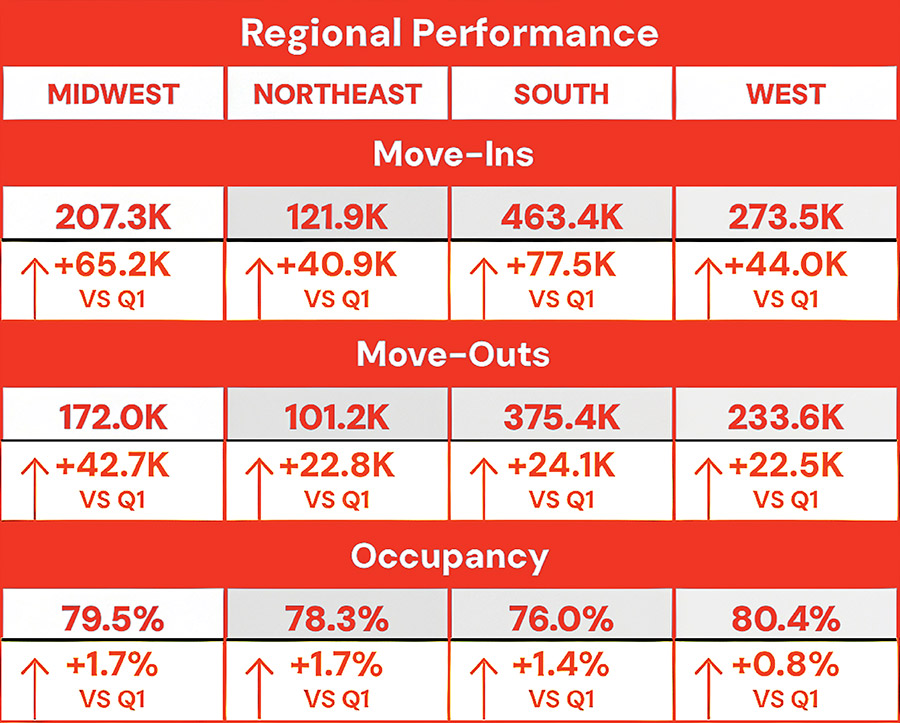
Storable’s Q2 Industry Pulse, drawn from more than 30,000 facilities, shows a sector that looks stable from a distance. National occupancy rose to 78.1 percent, move-in rates climbed nearly 5 percent off a soft first quarter, and length of stay held near where it has been all year. Underneath those numbers, though, the four regions of the country were doing genuinely different things. The Midwest and Northeast posted the quarter’s strongest occupancy gains at 1.7 points each. The South kept running the retention playbook, with move-ins down more than 9 percent year over year and occupancy held together by tenants who stayed put. And the West, still the most occupied region in the country at 80.4 percent, was the only region to lose ground compared to a year ago.
The West stands out here because it inverts what most operators assume about strong markets. The region with the fullest units is the region trending the wrong way, while the regions with lower occupancy are climbing toward it.
See the Year-Over-Year Regional Performance table.
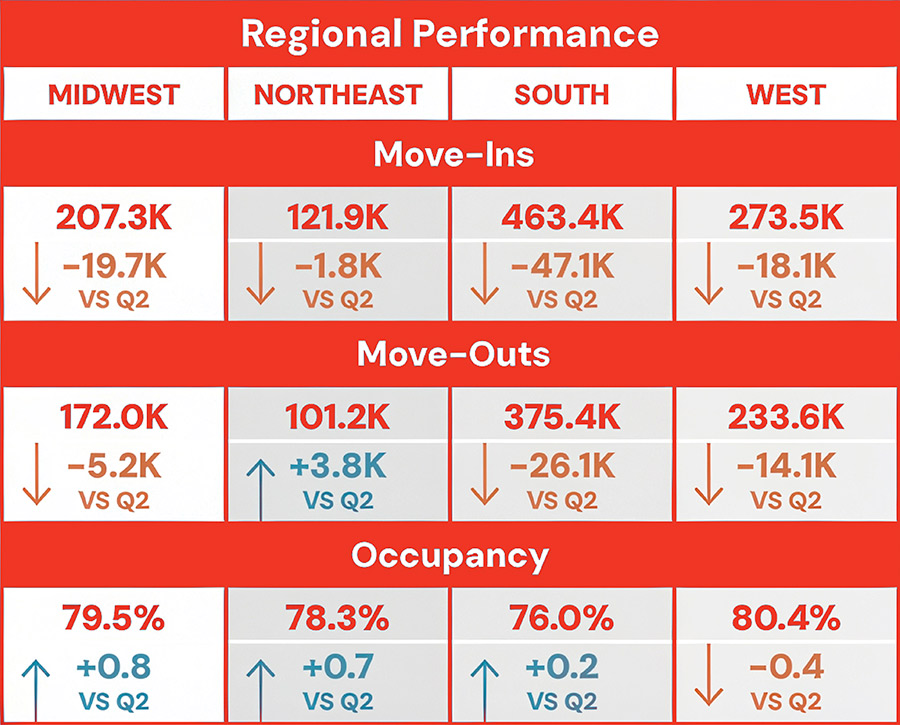
See Q1 2026 Vs. Q2 2026 Regional Performance table.
The first is supply, which arrives on a local schedule. Development concentrated heavily in Sun Belt and western metros between 2021 and 2023, and those deliveries are still working through lease-up. The Northeast and Midwest barely built during that window, so they tightened first without needing demand to improve at all.
Migration is still unwinding from the pandemic reshuffle, as households that left coastal metros for the South continue to reverse course, and every household that leaves a market eventually empties a unit there while filling one somewhere else.
Housing lock-in also bites unevenly, punishing homeowners most where prices ran up the most, which is why western homeowners are more thoroughly stuck than midwestern ones. In markets where the gap between an existing mortgage rate and a new one costs less in absolute dollars, mobility resumes sooner.
And storage demand itself is built from local inputs, following job growth, household formation, military rotations, and university turnover, none of which move in national lockstep. A base realignment or a large employer’s expansion can reshape a single market’s demand for years without registering anywhere in a national figure.
Churn behaving normally again is the second signal. During the freeze, move-outs fell almost everywhere because nobody could move. When move-outs start rising in your market while your occupancy holds, that is mobility returning rather than a retention problem, and it is a signal most operators have been trained by the last three years to misread.
The third is whether pricing holds its ground once the busy season ends. Rates firming in July is ordinary. If a market can hold rates through a slow winter, that says more about local supply than anything a busy summer will tell you.
Most property management systems can already capture why a tenant is leaving, and it costs almost nothing to start asking. Knowing whether someone moved out because they bought a house or because a competitor opened down the street tells you something about your market that no quarterly report can. Very few operators track it consistently, which is part of why the industry keeps waiting on national data to explain what its own front counter already knows.
Our industry has spent three years waiting for a single national moment when the freeze ends and normal returns. The more likely outcome is that it ends in some markets a year before it ends in others, and the operators watching the industry average will be the last ones to find out their own market already turned.




Trained on self-storage so every response is relevant.

From reservations to payments, Alita gets things done.

Enterprise-grade security and 24/7 availability your customers can trust.
Trained on self-storage so every response is relevant.
From reservations to payments, Alita gets things done.
Enterprise-grade security and 24/7 availability your customers can trust.
easonal rate gains build amid uneven supply conditions. Public Storage finalized its $10.5 billion merger with National Storage Affiliates on July 22, marking the second-largest self-storage transaction in history and the sector’s second REIT merger in three years. The deal returns Public Storage (PSA) to its position as the industry’s largest company, with PSA now owning 14 percent of the total square footage tracked by Yardi Matrix. NSA’s portfolio increases PSA’s market share in areas including Portland, Oklahoma City, and Detroit to over 25 percent, while adding 20 new locales to its footprint, many of them secondary and tertiary Sun Belt markets. This transaction punctuates a period of rapid consolidation across the sector. A recent Yardi Matrix analysis found that the market share held by mom-and-pop owners—those with fewer than three stores—fell from 48 percent in 2014 to 31 percent in 2026.
Over the same period, REITs increased their share from 23 percent to 30 percent, while large and midsize private operators with more than 50 stores doubled their share from 11 percent to 22 percent. The rapid expansion of third-party management platforms has further extended REIT influence, particularly as REITs have managed nearly 50 percent of the facilities developed during the past decade—the most active development period in the sector’s history.
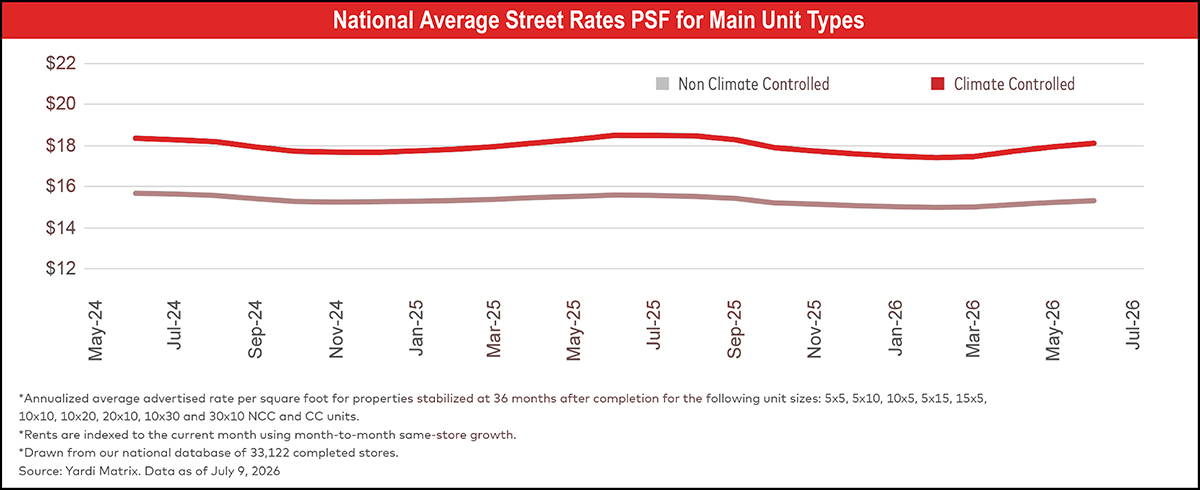
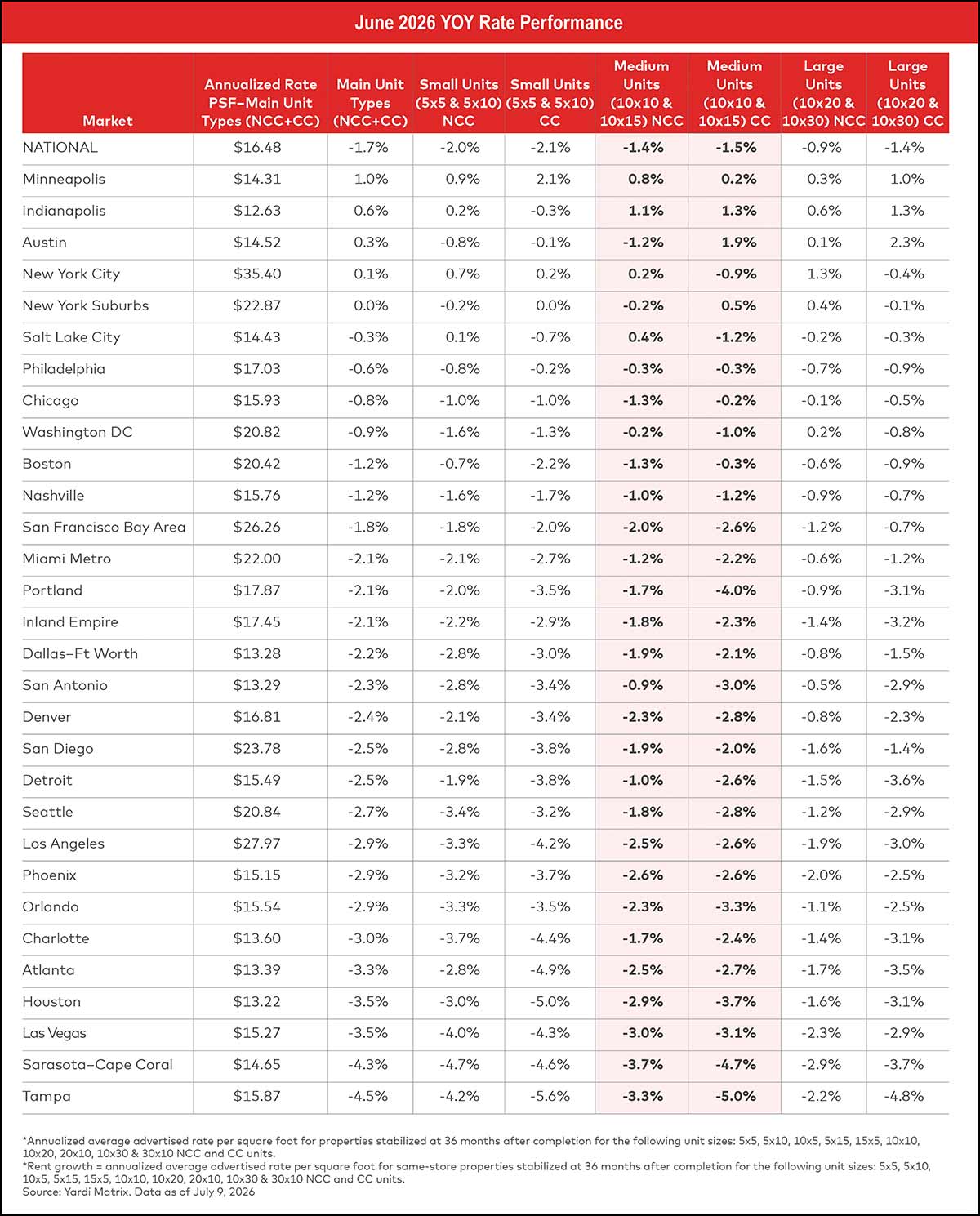
Annual rate declines persist, despite seasonal lift. Advertised rates remain below year-ago levels, but they increased 0.7 percent month over month as the busy leasing season continued. Nationally, advertised rates declined 1.7 percent year over year in June, compared with declines of 1.6 percent in May and 1.9 percent in April. The national average rate for June was $16.48 per square foot across all unit sizes and types.
Eleven of Yardi Matrix’s top 30 metros posted stronger year-over-year rate growth in June than in May, led by San Francisco and Salt Lake City, although nearly all continued to report annual declines. Same-store advertised rates increased year over year in four metros for both non-climate-controlled (NCC) and climate-controlled (CC) units, led by Minneapolis.
Nationally, Yardi Matrix tracks a total of 2,482 self-storage properties in various stages of development, including 608 under construction, 1,579 planned, and 295 prospective properties.
The share of projects (net rentable square feet) under construction nationwide was equivalent to 2.2 percent of existing stock through the end of June, unchanged month over month.
Yardi Matrix also maintains operational profiles for 33,122 completed U.S. self-storage facilities, bringing the total dataset to 35,604.
Self-storage REITs continue to trail private operators on an annual basis, with asking rents down 2.8 percent in June compared with a 1.2 percent decline among non-REIT competitors. However, REITs typically adjust rates more aggressively in line with seasonal leasing patterns, contributing to a stronger 1.3 percent month-over-month increase versus 0.5 percent for non-REIT operators. Although annual REIT rate growth has now lagged private operators for five consecutive months, the recent sequential improvement reflects the seasonal pricing push as the busy leasing period continues.
See June 2026 Year-Over-Year Rent Change for Main Unit Sizes chart.
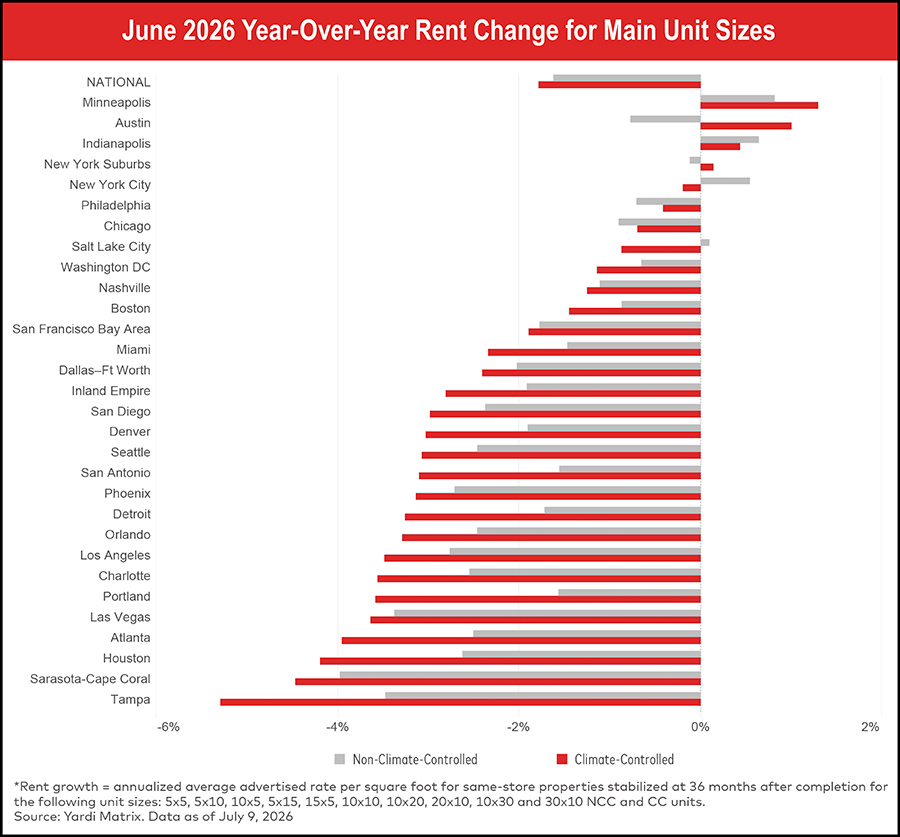
Sequential rate growth was widespread in June, with 29 of the top 30 metros posting month-over-month gains. Sarasota–Cape Coral was the only market without an increase, as advertised rates held flat from May.
Chicago posted the strongest sequential performance in June, with advertised rates rising 1.9 percent month over month. The metro continues to outperform many other markets, supported by lower supply pressure and a seasonal rebound in pricing. Although demand remains uneven nationally, Chicago’s more favorable supply conditions have helped sustain stronger rate momentum.
See National Average Street Rates PSF for Main Unit Types chart and Average Street Rates by Metro table.
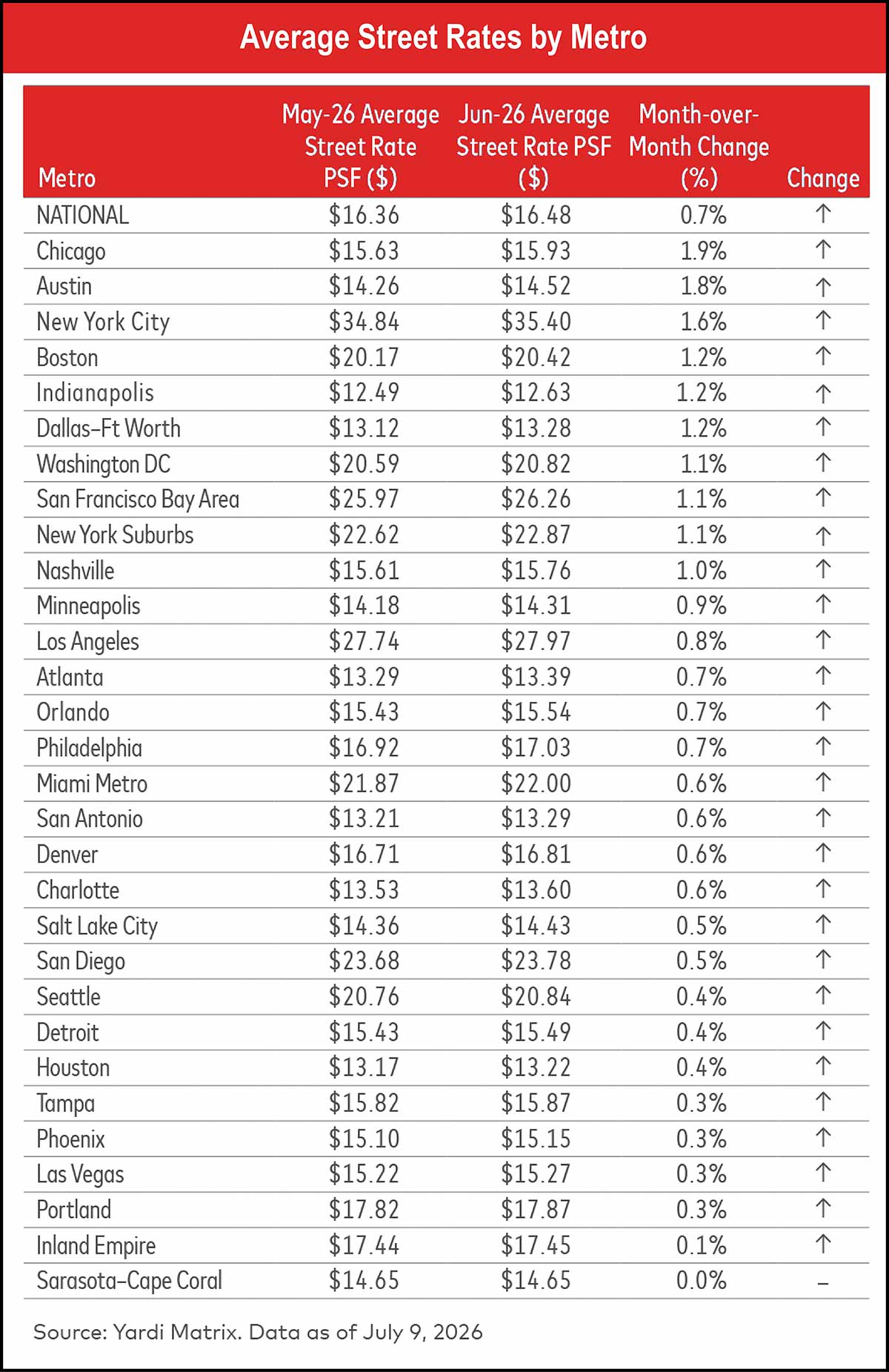
Austin continues to show signs of a potential turnaround. Improving rate growth is supported by strong home sales activity as home prices start to come down, with pending sales up sharply in June. Despite a strengthening demand environment, Austin has also seen a significant turnaround in development activity, both in recent deliveries and supply under construction, which may delay further recovery in rates.
Florida and other Sun Belt markets improved modestly month over month, but advertised rates remain pressured by elevated new supply.
See Self-Storage Major Metro Summary chart.
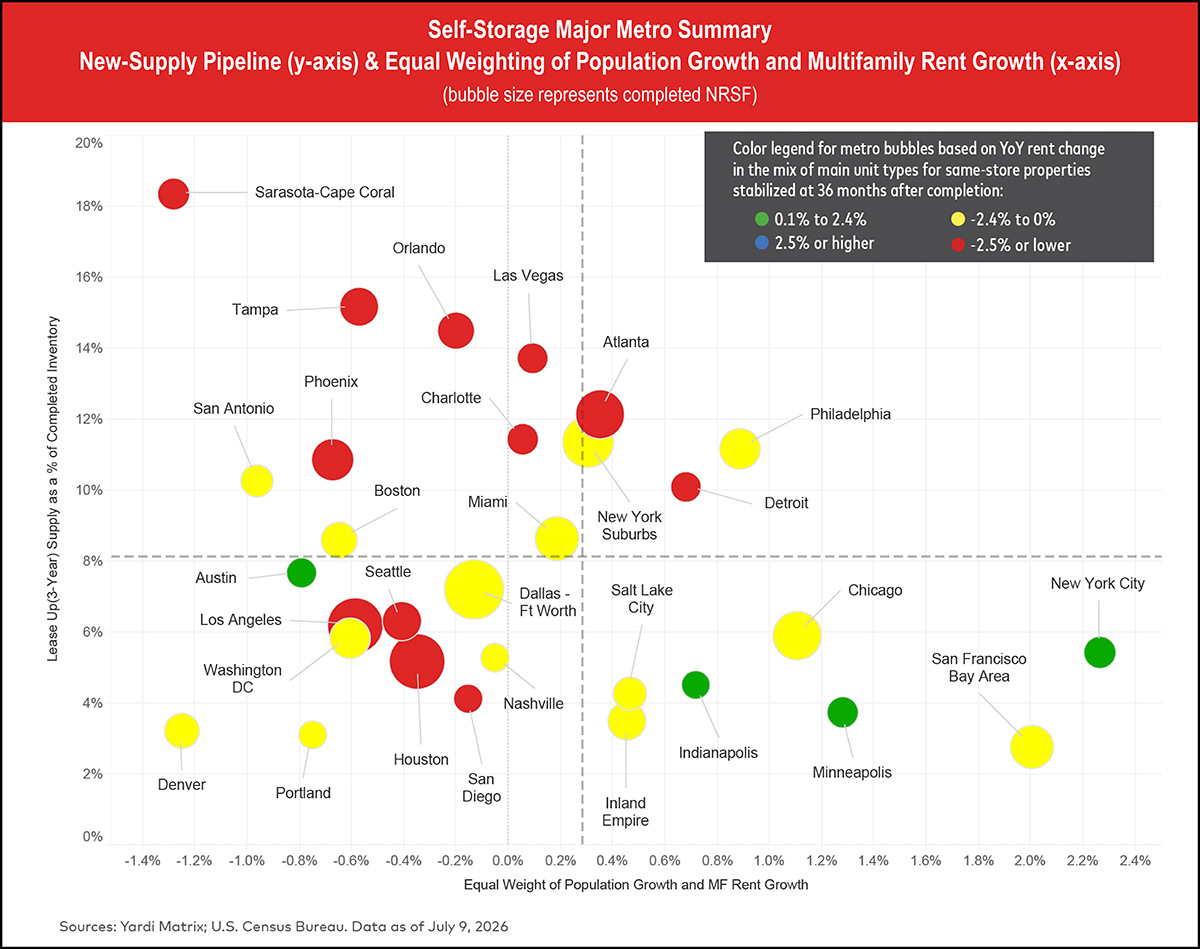
Florida and other Sun Belt markets remain pressured by elevated lease-up supply, even as construction pipelines slow and advertised rates show modest month-over-month improvement. Sarasota–Cape Coral, Tampa, and Orlando recorded the highest trailing three-year delivery levels among the top metros—at 22.5 percent, 17.9 percent, and 17.0 percent of starting inventory, respectively, with Sarasota–Cape Coral and Orlando reaching the highest three-year supply levels in their histories. Although recent rate improvement and slowing construction are encouraging, these markets must still absorb a substantial amount of recently delivered supply, which could keep lease-up competition elevated and make rate recovery gradual over the next several years.
See NRSF Delivered Over the Last 36 and 12 Trailing Months chart and table.
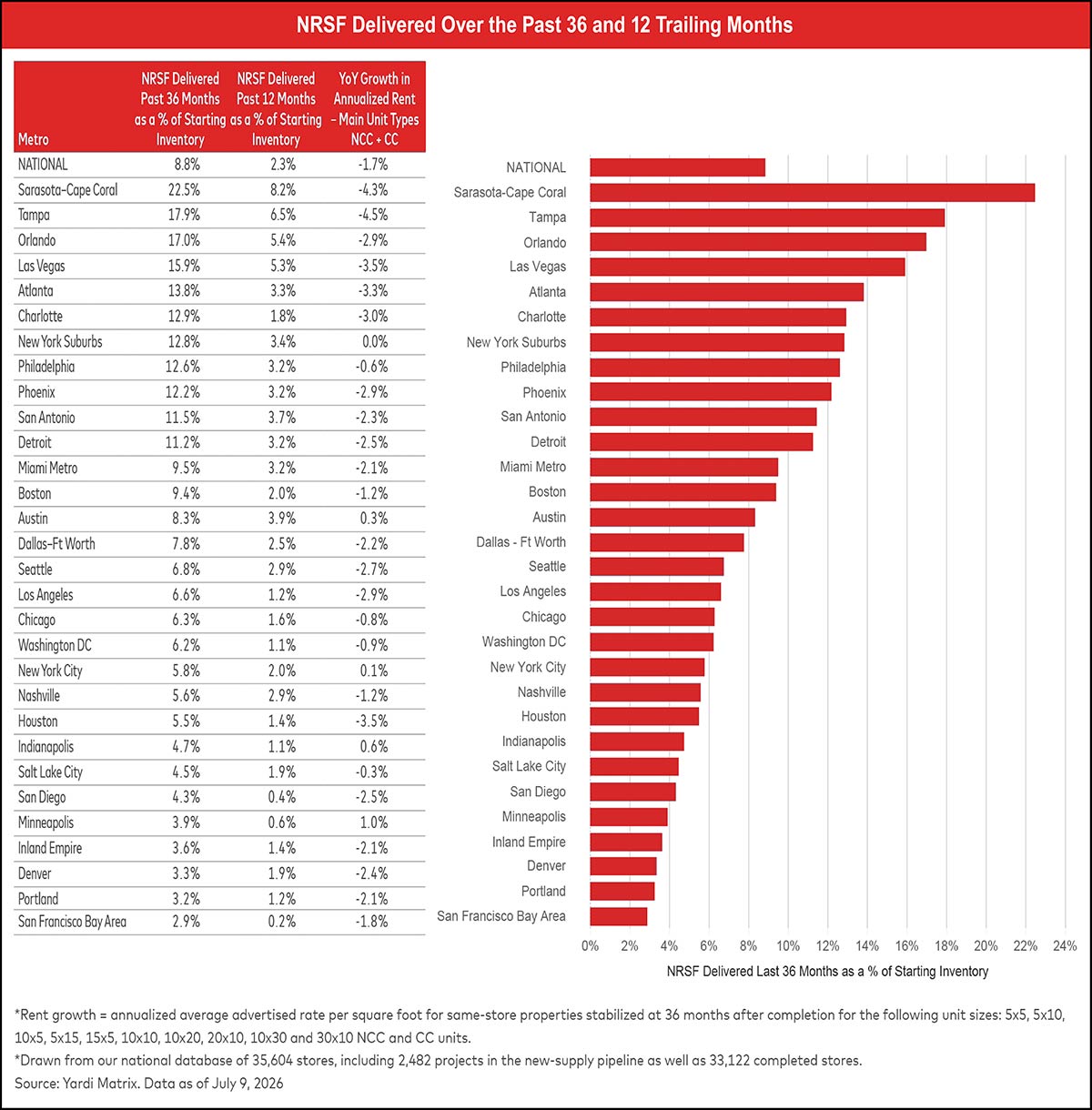
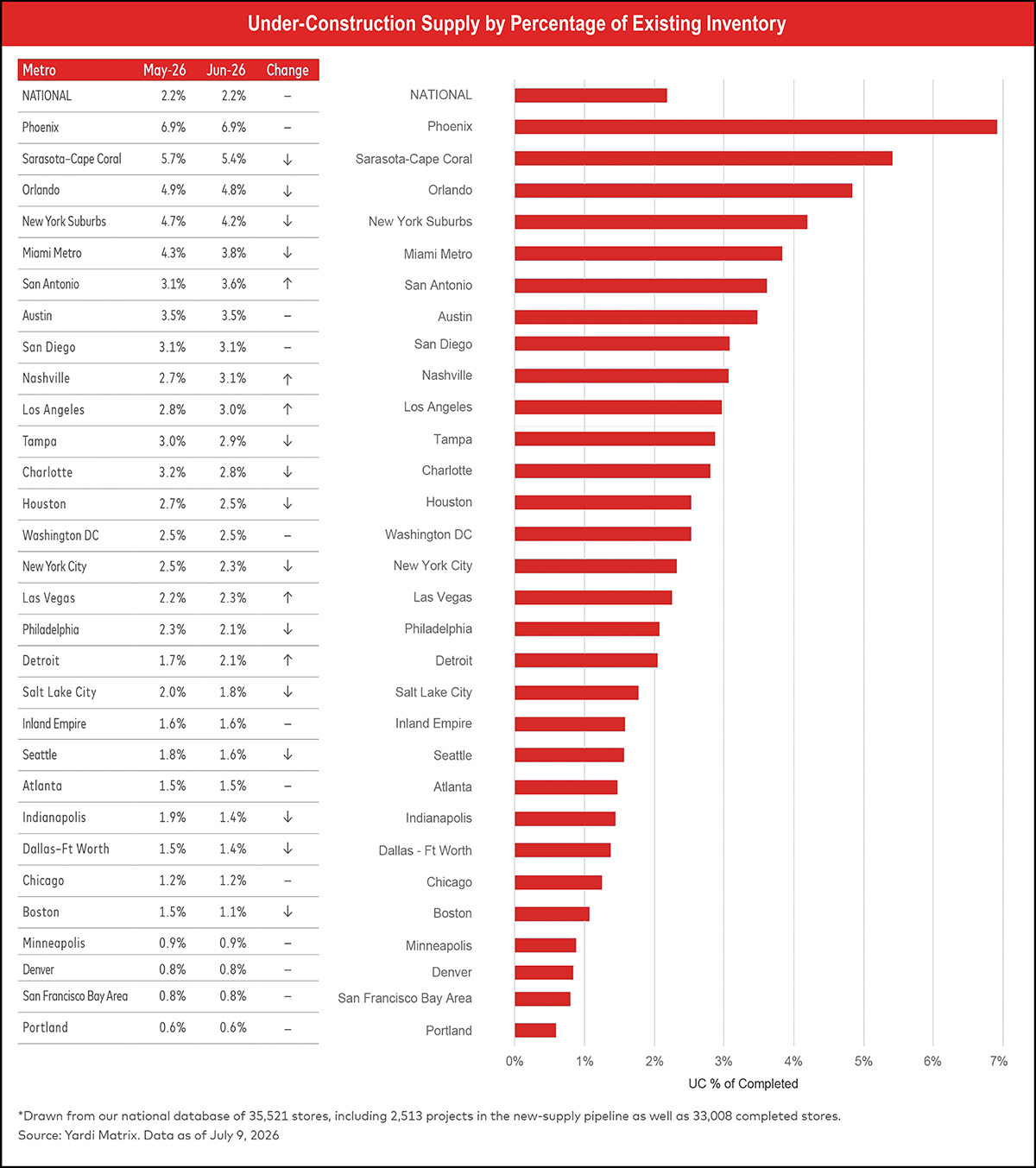
Under-construction activity remains concentrated in select growth metros, led by Phoenix at 6.9 percent of existing inventory—more than three times the national level. Several markets with large pipelines, including Sarasota–Cape Coral, Orlando, the New York suburbs, and the Miami metro, posted modest month-over-month declines. More broadly, construction activity has slowed significantly across much of the Sun Belt over the past year.
San Antonio and Nashville bucked the broader cooling trend, recording the largest month-over-month increases in their construction pipelines in June. These markets may face additional supply-side pressure in the near term. By contrast, Portland, the San Francisco Bay area, Denver, and Minneapolis continue to report limited construction activity, which may help insulate them from supply-driven rate pressure, supporting our forecast for a 19 percent year-over-year decline in new supply nationally in 2026.
See Under-Construction Supply by Percentage of Existing Inventory chart and table.










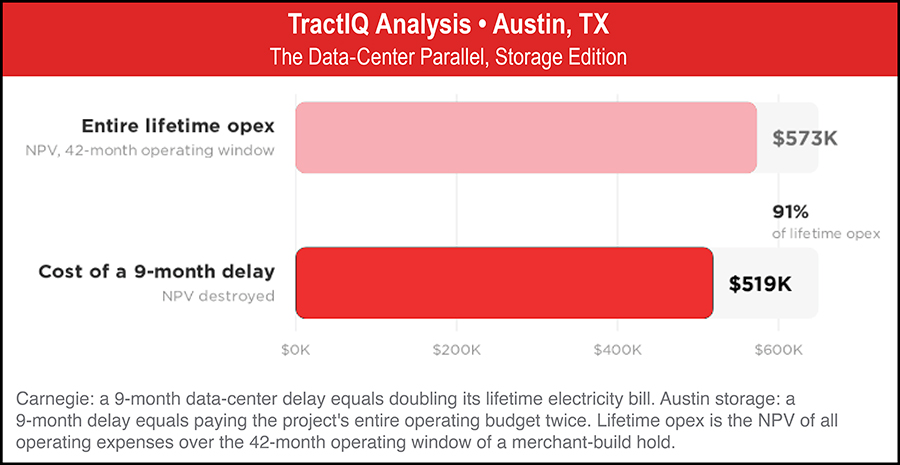
hile my daughter was playing on the floor with a ladybug toy, I was reading an article in “The Economist” about data center development, when something struck me: “A nine-month delay in a data center development worsens the economics of the project as much as doubling its lifetime electricity bill, according to the Carnegie Endowment.”
So, I wanted to look at self-storage projects and try to understand how project delays impact overall returns. And can the same claim be made in self-storage?
I fired up the TractIQ AI Connector in Claude and posed this question to Opus 4.7 and Fable 5 to compare differences in the analysis, then re-ran everything with real street rates in Austin, Texas, where I’m based.
As a quick aside, my aim is not to use AI to write my posts, and to be transparent about when AI is used. It is an incredible time to be in data, technology, and self-storage, and my aim is to explore questions I wouldn’t historically have been able to in one hour and provide interesting takeaways for self-storage investors, developers, brokers, and operators in the process. The results are shown in the AI Model Comparison chart.
See AI Model Comparison chart.
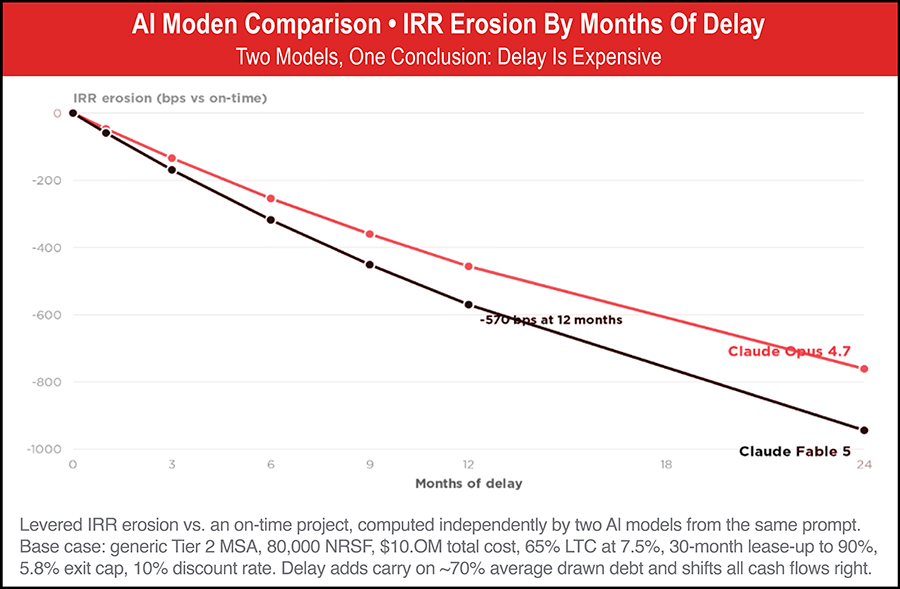
Off the bat, it looks like developers lose approximately 50 basis points off the IRR for every month delayed, and $65,000 of net present value (NPV) from the project.
We all know developers are motivated to expedite the permitting and construction progress, but these findings put that in stark terms.
What’s also interesting is that if you take these claims at face value, it drastically increases the value of a development site that’s already approved vs. one that you’d have to go through a process.
A 12-month head start on a project has an approximate $780,000 value impact on a $10 million project. I’d be curious to hear from developers on how they think about this, and what it means for quantifying land value differences between approved and raw land sites.
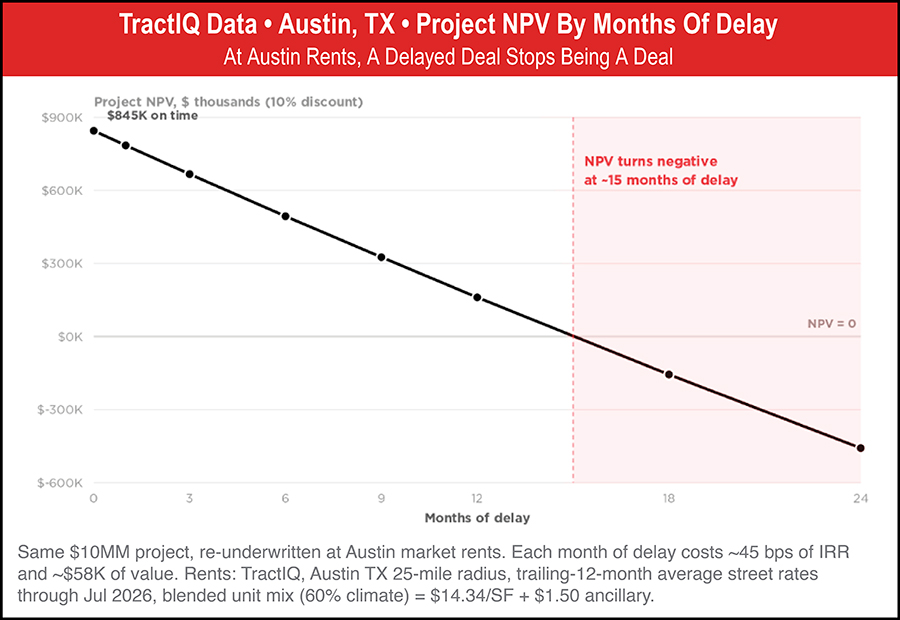
For this round, I anchored the model to real data: TractIQ’s trailing-12-month average street rates across 117-plus Austin facilities per unit type, blended across a typical unit mix. The deal is hypothetical, but the rents are real.
See Austin, Texas, Project NVP by Months of Delay chart.
See the TractIQ Anaylsis – Austin, TX chart.
And one more Austin-specific finding worth sitting with: At current Austin rents, the model says a project has about 15 months of slack before delay alone turns its NPV negative. In a market where entitlement fights routinely run past a year, that is not a rounding error.
Not only will you have higher cost of capital, stress, and risk, but it’s so rare to find a hyperlocal market starved for self-storage in 2026 (although there may be a few listed in TractIQ right now).
So, if you’re a developer, continue to be disciplined and constantly confirm a project is truly worth the effort, since even a one-month delay could have a huge impact on your performance.
Of Self-Storage
cott Jennings should not have been a Republican. Growing up in Dawson Springs, Ky., his grandfather was a Democratic politician, and so was his father, a union factory worker who held local office from time to time. “Yeah, by all accounts, I probably should’ve become a Western Kentucky rural Democrat,” Jennings says with a laugh, his unmistakable Southern cadence coming through immediately. “A lot of folks follow their family’s lead, but I’ve always had a contrarian streak in me.”
Jennings’ political views began forming while watching the Republican Revolution of 1994, when Newt Gingrich and a new class of conservatives was taking the country by storm. He was very impressed with their viewpoints and how they marketed them. He also didn’t care much for Bill Clinton. “I mean, he was a smooth guy, but I didn’t find his personal behavior or his brand of politics very appealing.”
Not even Clinton’s saxophone playing on “The Arsenio Hall Show,” a moment that made many young people first view a politician as “cool,” could persuade Jennings. He chuckles at the memory. “It’s funny; I understand why a candidate would do a stunt like that, but it had no impact on me.”
With that, Jennings registered as a Republican and cast his first vote in 1996. “It came as a big shock to my family,” he says with a wry smile. “That’s probably when that contrarian streak first manifested.”

When asked about a memory of Bush that has stayed with him over the years, he thinks for a moment before settling on the 2006 midterm election. Jennings recalls how many strategists wanted Bush to make major national security decisions to try to influence the outcome of the election—but the president refused. “Bush operated with a strong moral compass and a lot of integrity. He never put politics ahead of what he thought was right, particularly on national security.”
Jennings says some politicians will try anything to salvage a couple of points in the polls, but Bush wouldn’t budge, even under intense pressure. “We need people who are courageous enough to cast politics aside and do the right thing, and he fit that bill.”
After the midterms, when Republicans lost control of Congress, Jennings remembers an impromptu staff meeting. “We’d been shellacked, but the President pulled everyone together and said ‘Yes, we took a thumpin’, but we worked hard and I’m proud of you all.’ It was just an honest, human moment. So, that’s something I remember and something I’ve always admired about him.”
Unfortunately, there can be times when opponents ignore facts or a compelling argument out of emotion or bias. When that happens, Jennings is certain there will still be an audience out there that recognizes who came armed with the facts and made the stronger case. “I think if I were applying this to the setting you described, where a developer is going up against an unreasonable city official, knowing your stuff might make a difference in moving the ball with the other people in the room.”
Holding up a hand, he adds, “But that doesn’t always mean you’ll succeed. I don’t always win either, because sometimes I’m debating people who are extraordinarily smart and prepared themselves, like David Axelrod or Van Jones, so I often have worthy opponents just like people in your industry.”
Beyond industry-specific impacts, Jennings believes there are broader signs of economic improvement. He points to inflation data as evidence that price pressures are easing, which should help everyone.
“Month-over-month inflation data in mid-July showed the biggest one-month drop since April of 2020, so I do think we have seen a calming of the inflation waters. That doesn’t mean there’s no inflation, but we’re not seeing what we did during the Biden administration, so that’s No. 1.”
He goes on to say, “No. 2, depending on your industry, I do think the administration’s policies have led to some incentive for investment. Some industries have put capital into jobs and economic expansion in the United States, and they have directly said, ‘This is because of the President.’”
Jennings also applauds the decision to make Trump’s 2017 tax cuts permanent, calling it a clear, unequivocal success that benefits the economy and working-class Americans. Though he’s certain Democrats could make the argument that the cuts are working against these individuals, he says the proof will be in the midterm results. “That’s sort of the point of an election, right? Both sides make their case, and you see where the chips fall, so we’ll see in November.”


On the regulation front, Jennings also thinks Trump has largely been consistent with what you would expect a conservative to do: reduce government regulations. “The federal government is as small as it’s been since 1966,” he notes. “Every Republican I’ve ever worked for has said they were going to shrink the government—Trump actually did.”
Of course, government regulation remains a thorn in the sides of many self-storage owners as more states crack down on the industry, with January’s California Senate Bill 709 and NYC Local Laws 162 and 171 raising eyebrows and concern.
“Everyone is impacted at the federal level, but some of the most dramatic policy changes are happening at the state level,” says Jennings. “You’re getting wildly different outcomes depending on whether you live in a blue state or a red state. I’m sure your people in self-storage have experienced that.”
Many business owners Jennings has spoken with have been taking note of the radically different business environments across states. “The business environment in, say, Florida or Texas is so much different than a California or a New York. It’s just drastic when you have states that have been run for years by Democrats. The regulatory environment is wild.”
Following the midterms, Jennings expects the experiences of self-storage operators to be different based on location and size. “If you’re a large one, then you’re obviously existing in lots of different locations, so the variability in your policy outcomes is probably vast. If you have one or two facilities, chances are you’re in the same location, so the variability is smaller.”
After spending an hour with Scott Jennings, something becomes clear: Whether challenging his family, deliberating with peers, or making a case for his country, he’s not simply a contrarian—he follows his convictions. And for Jennings, those aren’t up for debate.

Something people often get wrong about you: Folks usually assume I live in Washington or New York. Truth is, I’m in Kentucky. I have a lot of windshield time commuting to those cities, but I’m one of the few TV pundits who doesn’t live there. I think it’s healthy because it informs my commentary. You certainly get a different perspective on the issues of the day when you’re talking to folks out here versus the city.
A hobby of yours that people would not expect: I have over 30 chickens that I take care of—I call these my chicken chores. We have them for eggs, not to eat them; we love them too much. We recently did have a fox incursion and lost a few, but that’s part of the chicken business. The problem with chicken is everyone thinks it’s delicious, from people to foxes to hawks, so you’re constantly defending your chickens from the animal kingdom.
A typical Saturday at the Jennings’ household: The kids and I will usually play some wiffle ball or basketball in the driveway. Then I’ll walk the dog, mow the yard, and do other chores. After I’ve been on the road, it’s just nice to be home taking care of the property. The whole family will often go to a Louisville Bats minor league baseball game, or collect wood for the backyard fire pit and sit around it in the evening.
Favorite place to be outside the U.S.: I haven’t actually logged that much international travel. I’ve been to Europe a couple of times and really enjoyed France, and I took a tour of Japan a few years ago and enjoyed that too. As for where I’d like to go: Italy and Australia. I’m hoping to make that happen very soon.
Last book you read: “Darkest Hour,” about Winston Churchill bringing England back from the brink of defeat, and “Regime Change,” about Trump. But this may surprise you, I also love “Star Wars” books and have a couple of those going at any given time. Lately, I’ve really embraced Audible, but I don’t retain information as well when listening. So—and this is going to sound weird—I sometimes get the book and read along.
Last TV show you binged: “John Adams” with Paul Giamatti. It’d been in my queue because of America’s 250th. It’s so good. When Adams loses the election of 1800 and he’s leaving the White House, there’s a bunch of random people watching. He’s like, “Stop gawking! I’m just an ordinary citizen like you!” He throws his luggage in a horse-drawn carriage and leaves in a huff. It’s just a terrific scene.
A song you’d gladly play on repeat: I’ll answer it this way: I love professional wrestling entrance music, and so, whenever I’m getting ready to do a big debate show on CNN, I almost always put on Hulk Hogan’s “Real American” or The Undertaker’s music to hype myself up. Depending on what mood I’m in, my colleagues either get the Hulkster or the Undertaker.






he roar of the 1920s came to an abrupt halt at the end of the decade when the stock market crashed, plunging the nation into the Great Depression. As factories closed and businesses went bankrupt, millions of Americans lost their jobs, savings, and even their homes. In 1938, as the country continued to struggle through the depression, Atlanta Mission opened its doors as a small soup kitchen and 20-bed shelter.
Today, Atlanta Mission is the city’s largest and longest-running provider of services for those experiencing hunger and homelessness. However, Atlanta Mission’s work now extends far beyond providing food and shelter. Through counseling, addiction recovery, education, career development, and spiritual support, the organization equips people with the tools they need to rebuild independent lives. In 2025 alone, the nonprofit served more than 773,000 meals, provided nearly 260,000 bed nights, conducted approximately 4,200 counseling sessions, and enrolled 695 individuals in addiction recovery services.
“At Atlanta Mission, we believe the future worth building is one centered on human dignity, where efficiency, scale, and systems exist to serve people, not the other way around,” says Tensley Almand, president and CEO of Atlanta Mission. “So, when I think about Atlanta’s future, I don’t just picture new buildings popping up along the skyline—I picture people.”




he roar of the 1920s came to an abrupt halt at the end of the decade when the stock market crashed, plunging the nation into the Great Depression. As factories closed and businesses went bankrupt, millions of Americans lost their jobs, savings, and even their homes. In 1938, as the country continued to struggle through the depression, Atlanta Mission opened its doors as a small soup kitchen and 20-bed shelter.
Today, Atlanta Mission is the city’s largest and longest-running provider of services for those experiencing hunger and homelessness. However, Atlanta Mission’s work now extends far beyond providing food and shelter. Through counseling, addiction recovery, education, career development, and spiritual support, the organization equips people with the tools they need to rebuild independent lives. In 2025 alone, the nonprofit served more than 773,000 meals, provided nearly 260,000 bed nights, conducted approximately 4,200 counseling sessions, and enrolled 695 individuals in addiction recovery services.
“At Atlanta Mission, we believe the future worth building is one centered on human dignity, where efficiency, scale, and systems exist to serve people, not the other way around,” says Tensley Almand, president and CEO of Atlanta Mission. “So, when I think about Atlanta’s future, I don’t just picture new buildings popping up along the skyline—I picture people.”
According to Atlanta Mission, one of the most common misconceptions is that homelessness is a choice. In reality, most people desperately want stable housing but have been derailed by circumstances such as job loss, medical emergencies, domestic violence, or the rising cost of housing.
Addiction and mental illness are often assumed to be the primary causes of homelessness. While both are challenges for some clients, per Atlanta Mission, they are frequently symptoms of deeper issues, including trauma and relational poverty. In Atlanta, fewer than one-third of people experiencing homelessness struggle with substance abuse, and roughly one in three reports living with a serious mental illness.

The face of homelessness is also far more diverse than many people realize. While single men are often the most visible, Atlanta Mission serves families with children, military veterans, women escaping domestic violence, and countless others whose housing insecurity may be largely invisible to the public. Some sleep in their cars, while others move from couch to couch, hidden in plain sight.
“One of our goals is to break the stigmas surrounding homelessness,” says Almand. “We also don’t ever want homelessness to define who someone is. We see it as a circumstance, one that people can overcome with the right support, relationships, and opportunities.”


Next comes “Find Hope,” where relationships begin to form. Social workers sit alongside clients to better understand challenges such as addiction, mental health, employment history, and housing instability. Rather than rushing people through the system, Atlanta Mission focuses on identifying the barriers that have prevented long-term stability.
The most significant step is “Choose Help.” Clients who decide they are ready to pursue lasting change meet with an ambassador, who conducts a comprehensive assessment over multiple one-on-one conversations. Together, they determine whether the individual is ready to enter Atlanta Mission’s long-term residential transformation program known as “Make Progress.”
Those accepted into Atlanta Mission’s residential transformation program begin rebuilding their lives on campus, where housing, childcare, meals, clothing, counseling, and other essential services are provided at no cost. Residents remain there throughout the program, focusing on recovery, personal growth, and preparing for employment.
Atlanta Mission also works to keep families together whenever possible. Because the children of its residents often arrive behind in school, the Mission offers tutoring, counseling, and academic support to help them catch up while their parents rebuild stability.

Launched in 2019, Next Steps prepares Atlanta Mission clients for careers, helps them find work, and then supports them long after they’ve been hired. “Before Next Steps, clients received some vocational training, but there was no official program in place,” says Julie Stokes, director of vocational services. “We knew we needed something better, but none of the external resources we looked into were a good fit until we found Cara Collective.”
Cara Collective is a nationally recognized nonprofit that helps organizations develop career programs for people overcoming homelessness and poverty. After studying more than 30,000 job placements, the organization identified a common pattern: Technical skills may help someone get hired, but soft skills are often what determine whether they stay employed.
Stokes says, “There are five that get people fired: time management, teamwork, conflict management, communication, and professionalism.”
Those five workplace habits form the foundation of Next Steps’ four-week curriculum, which consists of 64 classes designed to help clients recognize and break patterns that have often followed them from job to job. Along with classroom instruction, participants practice real-world scenarios before graduating and being paired with a job search coach who helps refine résumés, prepare for interviews, and identify employment opportunities.
To help overcome that obstacle, every graduate is assigned a retention coach who stays with them for an entire year after they’re hired. Rather than solving problems for clients, coaches help them navigate the everyday challenges that can threaten employment, from workplace conflicts and childcare issues to transportation problems and difficult conversations with supervisors. “Anybody can help you create a résumé. Anybody can help you job search,” says Stokes. “It’s in those moments of conversation, of push and tug and pull, where a client finally says, ‘I haven’t told anybody else this, but …’”
For Stokes, those conversations are what make the program successful. Many clients arrive carrying years of trauma and self-doubt, possibly even criminal records, making trust just as important as résumé writing or interview preparation. “We like to say that what we do in Next Steps is the bridge between a client being stable and a client actually seeing opportunity,” she says. “It’s where they first begin to think, ‘I actually can do this.’”

After seven years, the results have been encouraging. Approximately 71.5 percent of participants who complete the program secure employment and remain on the job for at least a year, a figure Stokes believes reflects the program’s emphasis on long-term success rather than simply finding work. “We find that a good majority of those who finish that first year end it with promotions,” she says. “We’ll get phone calls three or four months in saying someone has been moved into a lead role or taken on additional responsibilities.”
Stokes credits those successes to the workplace habits clients spend weeks developing, from communication and professionalism to conflict resolution and time management. “It’s really about getting clients to think beyond the next paycheck,” she says. “We want them thinking about where they’ll be a year from now, what opportunities they’ll have, and what their future can look like.”
Ultimately, she says, the goal isn’t simply employment. “It’s really about getting clients to believe in themselves.”

“Everybody’s got different trauma and different issues they’re coming in with,” says Stokes. “We’ve had people come in with no job experience, and we’ve had them come in with doctorates. We had a CFO stay with us once. Our clients come from all walks of life.”
That diversity is one reason Next Steps focuses less on teaching technical trades and more on developing workplace habits that apply across virtually every profession. “The soft skills apply in any role that you’re in,” says Stokes.
She recalls preparing a volunteer to conduct mock interviews with two clients on the same day. The first was a young mother in her early 20s applying for a fast-food position, where scheduling around childcare would be a major consideration. The second was a man who had spent two decades working in cybersecurity and information technology before finding himself at Atlanta Mission. “Everybody has a different set of needs,” says Stokes, “and they’re all looking for something different.”

While faith is central to Atlanta Mission’s identity, participation in religious activities is not a condition of receiving services. Faith-based classes, prayer, and chapel services are available, but participation is voluntary, and clients are never denied assistance because of their race, religion, sexual orientation, or personal beliefs. “Nothing is forced,” says Stokes. “If you want to talk about faith, great. If you don’t want to talk about it, that’s OK. The goal is to get you employed.”
Support extends well beyond financial contributions. Atlanta-area residents can donate furniture, clothing, and household goods through the Mission’s thrift stores, with proceeds helping fund its programs. Businesses frequently organize drives to collect hygiene kits, cleaning supplies, and other essentials that help clients transition into permanent housing, while volunteers serve meals, conduct mock interviews, teach classes, and assist with special events throughout the year. “There are all kinds of ways to get involved,” says Stokes. “It really depends on your passion and what you feel comfortable with.”
Whether through financial gifts, donated supplies, or volunteer service, every contribution helps Atlanta Mission continue the work it began nearly 90 years ago, restoring hope and creating pathways to independence for thousands of men, women, and children.

MSM is thrilled to support Atlanta Mission and the amazing work they do by making the organization the official charity of THE Show, coming to Atlanta Nov. 4 to 6. “Atlanta Mission was a perfect fit for us,” says Travis Morrow, CEO of MSM. “Many self-storage operators have had the heartbreaking task of removing homeless individuals and even families from units they’d been living in. Atlanta Mission offers these people an alternative and a chance to rebuild their lives.”
Morrow met with the organization at one of their campuses and was inspired by what he saw. “The facilities are incredible, the staff is wonderful, and I saw a lot of energy surrounding the program. You could tell they were excited about their journey ahead.” In next month’s story, we’ll highlight one Atlanta Mission client who had been staying in a storage unit and is thriving today.
To give back to the local community, THE Show is encouraging its sponsors, exhibitors, and attendees to donate financially and/or bring in-kind items. Donation boxes will be set up throughout the Georgia World Congress Center where the event will be held. Although Atlanta Mission accepts most donations, below are a few items that would have the most meaningful impact for the individuals and families the organization serves:
- Gently worn business and business casual clothing for participants of Atlanta Mission’s job placement program
- Reusable water bottles (for clients during intake)
- New throw blankets
- Mouthwash
- Bus passes or public transportation gift cards
Click the button below for a complete Atlanta Mission donation wish list.
“Every donation, no matter the size, directly supports individuals and families in our community as they work toward stability,” says Cara Adams, the in-kind donation partnership manager. “Thank you for your generosity!”
Catch Tensley Almand at THE Show. His keynote address will be held Thursday, Nov. 5 from 4:30 to 5:30 p.m.

- 24/7 Virtual Doctors
- 5,000+ Free Prescriptions
- Virtual Counseling & Mental Wellness
- No Insurance Required
- No Deductibles or Co-Pays
- Emergency Alert Button
- Live GPS Location Sharing
- Guardian & Family Support Network
- Trip Monitoring & Safety Alerts
- Automatic Place & Geofence Notifications
Your managers invest in your business every day. Invest in them.


Reports
Studies
Services
• Site Plan Reviews • Development Assistance • Office Layout • Vendor Recommendations • Unit Mix Reviews • 3rd Party Management Contract Review • Security Plans • Asset Management
 1-866-279-5673
  info@bmsgrp.com
t began with a handful of consumer complaints and quickly snowballed, as the city’s Department of Consumer and Worker Protection (DCWP) became inundated with grievances against self-storage facilities’ pricing practices. In several cases cited by the city, initial rates around $150 reportedly jumped to $300 or more, forcing tenants to pay higher prices or incur the cost and burden of moving their stored belongings elsewhere; additional complaints followed, citing flooded and vermin-infested units.
The DCWP, under the administration of Mayor Zohran Mamdani, zeroed in on Extra Space Storage, arguably the largest provider of self-storage in the metro area with approximately 60 locations. The city filed a lawsuit seeking approximately $5 million in civil penalties. Despite disagreement with the allegations, Extra Space settled for $1.7 million to “best serve the interests of its customers, team members, and stakeholders.” But the story was far from over.
New York City then proposed a broad range of self-storage regulations, which ignited one of the industry’s biggest regulatory battles in years. City officials claimed the laws are intended to strengthen consumer protections, while many operators argued that they go far beyond what lawmakers intended.
Now, the dust has settled. The DCWP announced its decisions Aug. 25. While the industry now has answers to questions it’s been asking for months, understanding the outcome requires looking back at where the battle began—with a unified industry response that went mostly ignored. And what happened behind the scenes may be nearly as interesting as what comes next.
“[We have] identified numerous provisions that exceed the Department’s statutory authority or impose compliance burdens disproportionate to their intended benefits,” wrote Brett Nelson, senior vice president of general counsel at Extra Space Storage. “The rules will require operators to undertake costly operational challenges. This is particularly true for smaller, independent operators.”
One of the recurring arguments was that the DCWP misunderstood how self-storage works. For example, operators objected to a “simple cancellation mechanism” that essentially compared a storage unit to a streaming service that could be canceled with the click of a button, which would allow them to exit the agreement and leave their belongings behind; there was no need for that, they countered, when leases were already month to month.
Likening self-storage to living space was also a point of contention. “The Department should remove or revise provisions that apply residential housing concepts to self-storage, impose warehousing-style operational standards, require specialized staffing or certifications, or create unclear compliance obligations,” said Stanley Bonilla, senior vice president of asset management and development for Safeguard.
Operators also found the schedule-of-rates requirements vague, while arguing self-storage pricing is always in flux based on inventory, promotions, market demand, and operating costs. “A static public schedule of rates may not accurately reflect what a specific customer will be offered,” wrote Joe Doherty, executive vice president and chief legal officer for the Self Storage Association (SSA). “As a result, public posting may create more confusion, not less.”
Committing to a maximum occupancy fee 12 months into the future was another issue for operators, who said it could result in inflated rent maximums to provide a buffer against unforeseen cost increases; Extra Space further added that transparency among competitors could lead to effects similar to price-fixing agreements.
The extensive electronic recordkeeping requirements being proposed were also deemed problematic. Tanya Oberoi with Storage Plus wrote, “The cumulative burden of these requirements may require significant investments, particularly for independent and mid-sized operators like us.”
Lastly, numerous operators felt the proposed regulations overlapped with or contradicted existing state lien law, in particular giving tenants in default access to “essential goods” such as medications and important documents. Manhattan Mini Storage summed things up by saying its occupancy agreement already prohibited storing these items: “Self-storage units are not safe deposit boxes.”
“Licensing wasn’t an issue—you need a license for everything in New York, even dog walkers,” said Coakley. “Otherwise, these were calls for pricing transparency, 60-day notices for rent increases, and a few other basic things that really weren’t onerous at all. Not that we’re thrilled self-storage is being targeted, but again, [it’s] pretty straightforward stuff.”
Steckler and Coakley then provided a little more context around their issues with the proposed schedule of rates. Their legal argument was that the lease already has that information; if a potential tenant didn’t like it, they didn’t need to sign it. But the DCWP wanted this schedule published before reviewing the lease and hadn’t clearly defined what would be provided. They also elaborated on the idea of comparing self-storage to living space. “Once one rule makes a correlation to livable space, such as applying residential allergen hazard concepts to self-storage, other rules may do the same,” said Steckler. “Then what comes next, rent control? It’s a slippery slope, so we need to make sure self-storage continues to be characterized properly.”
Steckler also questioned how the complaints that sparked the Extra Space lawsuit had been handled. “Much of that lawsuit was based on unvalidated 3-1-1 complaints [non-emergency complaints that, among other things, may include landlord maintenance issues, mold, and pest infestations]. I would say these were not properly investigated, the complaint was extremely vague, and in most cases the operator wasn’t properly notified. From what I saw, they read more like someone had a bad cup of coffee at a diner versus a legitimate complaint.”
Coakley agreed, stating many of the allegations likely could have been rectified with a simple conversation had any type of outreach been done. “We wish they would open a case, contact you, and the operator could resolve it. That’s not what happens, but it would certainly save us all a lot of headache.”
Giving Coakley some cause for optimism was the outcome the NYSSA achieved when previously fighting local laws drafted by the city council. As originally written, they were much more burdensome and potentially damaging to the industry. The NYSSA was able to work with both the council and bill sponsors to reframe and redraft the laws into something much closer to something the industry could live with. In fact, the council even created a separate section in the general obligation law redefining self-storage so that it wasn’t lumped in with storage warehouses and other unsimilar entities. “If we can do that again, we may not have to take this to court,” said Coakley. “Of course, I think the City Council was a little more business friendly. The challenges we have are with the DCWP, which issues and governs the licenses themselves, and our concern lies in the language of those rules.”
Without knowing what the outcome would be, Steckler’s recommendation that NYC operators apply for their business license as soon as possible would prove prescient. “I don’t believe there’s any expectation that if the rules are adopted on August 25th, operators must be in full compliance on the 26th, but it doesn’t hurt to prepare. We’re also recommending they start looking at pricing transparency—how they present things to the customer, how they communicate the deal, and when the deal expires.”
Ultimately, Coakley felt there should be accountability on both sides. “The consumer must be held accountable for entering into an agreement, and the operator must be accountable for the way it was drafted. In this current administration, the balance has shifted, with too much onus falling on the operator side.”
“There’s a contractual relationship with tenants, but it’s month to month,” added Steckler. “The customer can always pack up and leave without a moment’s notice, so there needs to be more education on that, which is a goal of the NYSSA.”
Before signing off the call, Steckler and Coakley made it clear that if things went sideways the NYSSA was prepared to take legal action against the city. “We’ve already sought legal counsel,” said Steckler. “We’re not looking to pick a fight if we don’t have to; a lawsuit is the least desirable action. We’d rather sit at the table, negotiate, and come to an agreement. But if there’s no compromise, we will have to challenge regulations that we believe are simply not appropriate for the industry.”

Maurice Pogoda, president and founder of National Storage Management, zeroed in on the pricing transparency aspect of the rules. He had been very vocal about this in the past and his position hadn’t changed. “I’ve been saying for years that some of the industry’s increasingly aggressive ECRI practices would eventually attract unwanted attention from regulators.”
While Pogoda said he believed dynamic pricing was a legitimate business tool, and New York perhaps an extreme example, there comes a point where customers begin to feel they’re being treated unfairly. “Look, the vast majority of self-storage operators are responsible business owners that provide a valuable service and treat their customers fairly. My hope is that this situation encourages our industry to strike a better balance between maximizing revenue and maintaining transparency, fairness, and customer goodwill.”
John Lindsey, co-founder and president of Lindsey Self Storage Group, said the $1.7 million message Mayor Mamdani and the DCWP sent the industry should be a wake-up call to some operators. “Self-storage has become essential infrastructure for people navigating moves, downsizing, divorce, and disaster recovery,” he said. “That role comes with a level of trust that has to be earned, and this settlement is a reminder that cities are increasingly willing to step in when it isn’t.”
ECRIs have now become a regulatory and reputational liability, Lindsey added, not just a source of customer complaints. He also speculated that, regardless of the NYC outcome, facility and unit maintenance could increasingly transform what was a purely operational issue into a potential source of litigation. “Operators across the country should get ahead of this now. NYC won’t be the last city looking to license this industry.”
U-Haul CEO Joe Shoen, who implemented a one-year rate-lock guarantee in March to separate his business from those he believes engage in deceptive pricing practices, felt the city’s regulatory response up to that point had been proportional to the problem. “We did this to ourselves, and now we’re paying the price because of the REITs’ aggressive pricing strategies,” said Shoen. “This is a customer service business, and we all understood that in the early days of self-storage. But then Wall Street players came in, and now the big guys treat self-storage like a real estate business—a cash cow to be milked.”
Shoen said it was time to deal with the consequences rather than blaming customers or government; he used the recent tainted lettuce outbreak as an analogy. “After hundreds of cases of intestinal illness, the FDA set its sights on Taco Bell. What did Taco Bell do, sue the FDA? No; they issued apologies to the public and implemented new standards of quality control. But when government agencies focus on our largest players, what do they do? They lobby and consider suing the city. I say, clean the lettuce instead!”
Once legislators had taken a bite of the Big Apple, Shoen also predicted other cities would follow suit. “I’m 77 years old and I’m so proud to be part of this industry—I saw it get started. But I can also foresee a time when it’s no longer around if we continue down this path, so I regret not speaking out sooner. These operators who’re digging themselves into a hole: Stop crying about being picked on and put down the shovel.”
A final perspective came from RK Kliebenstein, who told MSM in a March interview that customers complaining about ECRIs could have chosen an operator that was going to give them a one-year price guarantee, but they wanted the discount. “We learn in exit interviews that most people don’t think they’re going to stay very long. When they do and the price goes up, they look for someone to blame. Publicly traded companies are beholden to analysts and shareholders, so they execute accordingly. They’ve been able to convert a good majority of customers into higher-paying tenants with introductory pricing, so the proof is in the pudding.”
In the end, a handful of concerns were addressed and others resulted in compromise. However, several of the industry’s most central objections were rejected outright.
Unsurprisingly, the fundamental licensing and pricing-transparency requirements remained fully intact. This includes giving tenants at least 60 days’ notice prior to a rate hike and prohibiting the collection of fees not included in the schedule of rates without prior notice. These provisions had been established by the underlying laws and were never seriously in dispute.
The department did, however, make 11 changes following the public comment period. A few were clear victories, for example, eliminating the simple cancellation mechanism and removing targeted promotions from the master schedule of rates.
Other concerns resulted in compromise. Rather than broadly allowing delinquent tenants access to retrieve “essential goods,” the final rules were defined and limited to prescription medications and government identification, with facility staff having the ability to retrieve the items rather than providing access to the unit.
Cleanliness requirements were similarly softened but survived. Certifications that had been required weekly must instead be performed monthly, and remediation may be completed by a third party. But the industry’s larger objection to applying residential allergen standards to self-storage went nowhere. “The Department disagrees,” the DCWP stated, reasoning that because household goods travel between storage facilities and residences, the same policy should apply.
Operators didn’t fare much better on pricing. The DCWP clarified the previously vague schedule-of-rates requirement by creating separate consumer and master schedules, but retained the requirement that operators disclose the maximum occupancy fee a tenant could face during the following 12 months. It also rejected concerns that pricing disclosures could have anticompetitive effects, stating that transparency promotes competition and allows consumers to compare operators’ histories of price increases.
Recordkeeping requirements remain extensive, with the caveat that operators no longer must produce records “immediately” upon request. And while the DCWP narrowed the retrieval provision for tenants in default, it rejected arguments that the final rule conflicts with New York’s Lien Law.
Perhaps the biggest blow was the department’s rejection of the industry’s assertion that many of the regulations exceeded the authority granted to it under Laws 162 and 171. The DCWP maintained that the licensing laws gave it broader regulatory authority under the city’s Administrative Code and that existing consumer-protection law provided additional authority to prohibit unfair trade practices.
In short, the industry was able to change how several regulations will work, but it was unable to change what the DCWP intends to regulate.
“Given that DCWP did not take into account the bulk of our concerns, we prefer not to comment further at this point, except to say we are considering our options to ensure we are protecting the best interests of our industry,” Coakley responded via email.
It’s a pivotal moment for self-storage, and operators across the country will be watching closely to see what happens next. From the sounds of it, the dust may not be settled after all.

Attorney Scott Zucker says the self-storage industry has long operated under a straightforward legal principle: Customers rent space to store their own property, retain exclusive control over what goes into their units, and assume responsibility for those belongings. In his view, New York City’s requirements and operational mandates represent a fundamental misunderstanding of that relationship, creating obligations unlike those found in virtually any other jurisdiction. “If local governments begin treating self-storage facilities as custodians of tenant property rather than landlords renting space, the entire legal foundation of the industry could begin to shift.”
Zucker also questions some of the pricing requirements. “While transparency in pricing is an important objective, some of these requirements substantially reduce the flexibility necessary for operators to respond to changing market conditions, fluctuating operating expenses, insurance costs, taxes, labor costs, and utility expenses. Self-storage pricing, like hotel rates or apartment rents, is often influenced by supply and demand.”
While consumer protection is an important objective, Zucker believes the regulations ultimately miss the mark and will inevitably increase operating costs through licensing, inspections, reporting, compliance obligations, and expanded liability exposure. “Those costs do not disappear,” he says. “They are ultimately passed on to consumers through higher rental rates and increased fees, harming the very people the regulations seek to protect.”




t is no secret that competition in lease-up has never been fiercer than it is today. Supply has drastically increased in most markets, with a race to the finish line, and customers are savvier than ever. In that environment, the operators who win lease-up have one habit in common: They treat marketing as a necessary early decision, not a last-minute task.
One of the primary shifts in addressing a strained market, or trying to hit lease-up projections, is that marketing your facility should start the moment you close the deal—whether that is raw land or an existing site under new ownership—not simply waiting until a few days before you open. When your facility does open its doors, the advantages that early marketing creates have either been built or lost. This guide explains why timing matters so much and what your marketing should be doing at each stage of development.
When you wait until opening to begin, you arrive at your most important moment—your lease-up time clock—with no search visibility, no local awareness, no captured leads, and no established position in the market. Competitors who started earlier have already claimed that ground. The work didn’t disappear; it just got compressed into the weeks when you can least afford to be invisible. Additionally, construction and/or onboarding a new facility can be an all-hands-on-deck event, where it pays to have your team involved from the earliest point.
Online visibility takes time to earn.
Local awareness compounds and can benefit the industry.
Positioning is decided early—by you or by the market.
Aesthetics and brand are construction decisions.
Lead capture before there’s a building to show.
housands of self-storage facilities across North America are now entering their third decade of operation. While many continue to perform well, age often brings new challenges that can quietly erode profitability long before they become obvious on a balance sheet.
Owners frequently focus on occupancy as the primary measure of success, but occupancy alone rarely tells the whole story. An outdated unit mix, aging infrastructure, or underutilized property can all limit rental rates, increase operating costs, and reduce asset value—even at facilities that appear healthy.
As competition increases and customer expectations continue to evolve, modernization is becoming less about aesthetics and more about protecting long-term returns. Operators willing to evaluate their properties strategically often discover opportunities to improve same-store revenue.
Start by asking a simple question: Is your facility still designed for today’s customer?
Many self-storage properties were designed 20 or 30 years ago based on customer demand that looked very different from today’s market.
Household sizes have changed. Small businesses use storage differently. Climate-controlled space has expanded dramatically. Customers increasingly expect convenience, technology, and security alongside traditional storage, yet many facilities still operate with the same unit configuration and security tools they opened with decades ago. That can create an expensive mismatch between inventory and demand.
Evaluate whether your unit mix is costing you revenue.
Facilities commonly find themselves with excess inventory in slower-moving unit sizes while consistently selling out of others. Rather than leaving units vacant, operators often resort to discounting rates to move inventory.
Those discounts add up quickly.
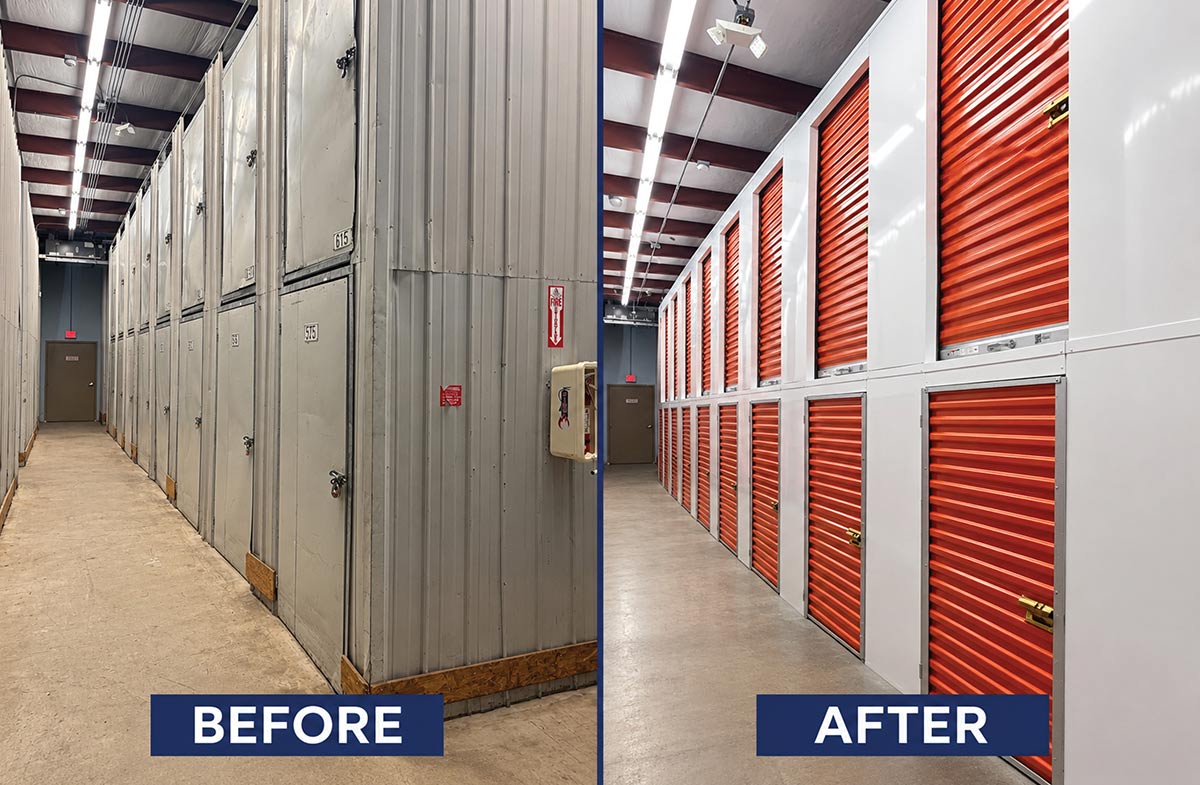
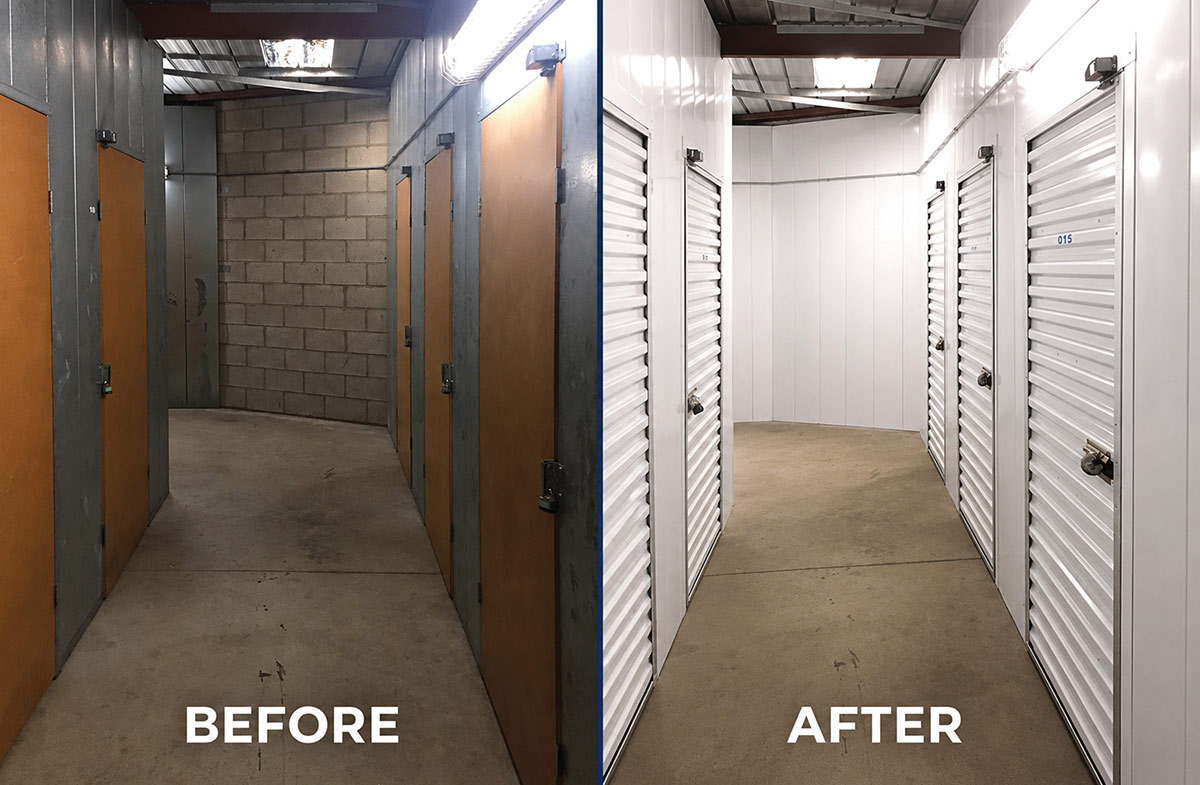
The first step is analysis. Operators review:
- Which unit sizes consistently require discounts,
- Which units remain vacant for extended periods,
- Average length of stay by unit type,
- Waiting lists for popular sizes, and
- Customer inquiries that cannot be fulfilled.
Patterns in this data often reveal opportunities to reconfigure existing space rather than simply accepting lower performance.
In many cases, converting smaller units into larger, higher-demand spaces—or vice versa, depending on the market—can increase both occupancy and rental revenue without expanding the building footprint.
When in doubt, many operators turn to experienced teams of renovation experts that will perform site visits and help with the analysis. From door replacements to unit remixes to office remodels, working with experienced teams often garners superior results with minimal operational disruption.
Aging doors do more than affect appearance. The physical condition of a facility has become increasingly important in competitive markets. Customers shopping online often compare multiple facilities before visiting in person. Once they arrive, the condition of the property strongly influences perceptions of quality, security, and professionalism.
Storage doors play an outsized role in that impression. Since doors represent much of what customers actually see and interact with, deteriorating or damaged doors can create concerns about security and maintenance before a rental conversation even begins.
View infrastructure improvements as revenue investments, not maintenance expenses.
Replacing dated doors with industry leading roll-up doors can improve:
- Tenant experience through smoother operation,
- Unit security and aid in the prevention of common theft attempts,
- Weather resistance,
- Maintenance requirements, and
- Overall curb appeal.
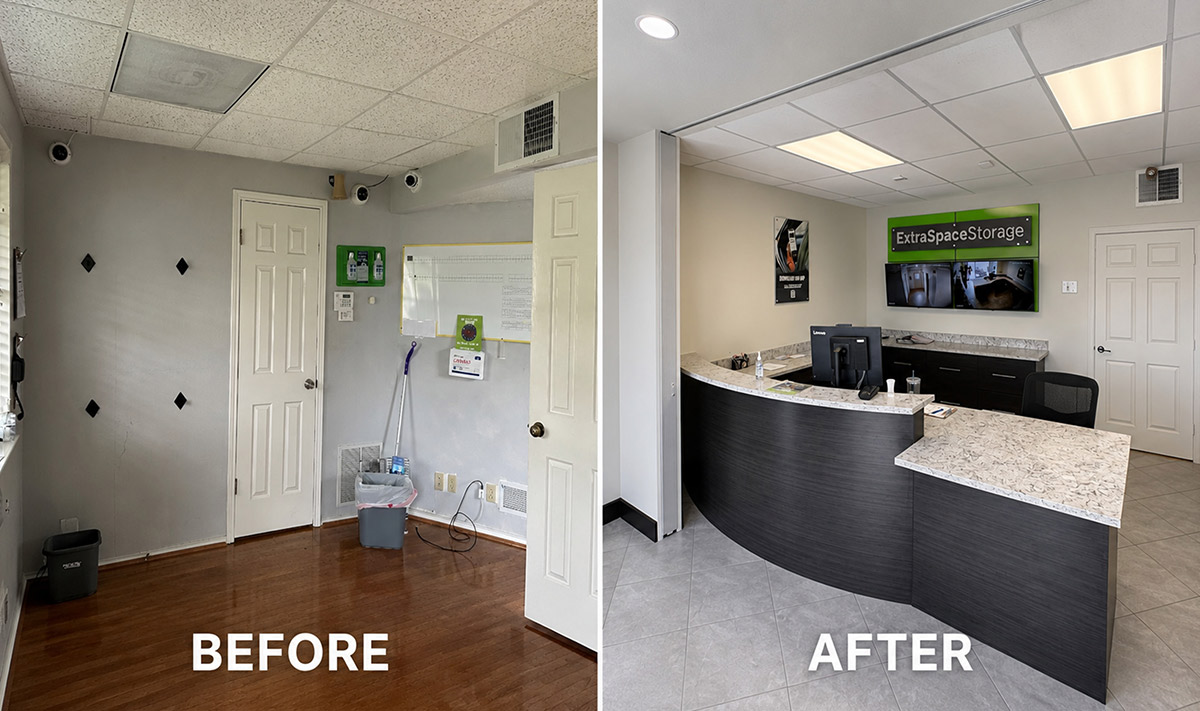
Industry concern about theft continues to rise, with many operators citing break-ins as one of their biggest operational challenges. Criminals frequently target facilities with outdated security or damaged doors that appear easier to breach.
When evaluating existing doors, look for warning signs like:
- Damaged or bent curtain sections,
- Repeated spring failures,
- Doors that are difficult to open,
- Poor tension or inconsistent operation, and
- Doors that regularly come off track.
Ignoring these issues isn’t simply an operational inconvenience—it can become a liability if equipment fails or creates safety hazards for customers or employees.
Modernization also creates opportunities for better security. Many renovation projects now combine physical improvements with technology upgrades. Smart locking systems, LED lighting, enhanced camera systems, and AI-enhanced monitoring tools have become increasingly common components of renovation projects. Beyond improving customer convenience, these technologies can reduce operational complexity while helping deter unauthorized access.
For many operators, modernization isn’t about replacing one product with another—it’s about using renovation projects to improve the overall customer experience while strengthening property security.
- Oversized manager apartments,
- Underused office space,
- Uncovered parking, and
- Vacant land.
Rather than accepting these areas as fixed assets, successful operators increasingly evaluate how each square foot contributes to overall property performance.
Put underutilized property back to work.
- Modern leasing offices,
- Additional rentable units,
- Customer service centers,
- Self-service rental spaces, and
- Hybrid retail or business-use areas.
Similarly, outdoor parking areas may generate relatively modest revenue compared with alternative uses.
Some operators have increased property productivity by converting portions of underperforming outdoor space into additional rentable storage inventory using relocatable storage structures, allowing them to increase revenue while avoiding much of the complexity associated with traditional ground-up construction.
Modern customers expect more than storage space. Facility upgrades increasingly influence more than occupancy.
Customers today evaluate:
- Security,
- Convenience,
- Technology,
- Cleanliness,
- Professional appearance, and
- Ease of access.
A modern office, refreshed signage, updated lighting, improved landscaping, and well-maintained buildings all contribute to customer confidence. These improvements can also support stronger online reviews, better first impressions, and greater pricing power in competitive markets.
One concern many owners share is the fear that renovation projects will interrupt operations or displace existing tenants, but renovation doesn’t have to mean disruption.
While every project differs, experienced planning can often minimize disruption. Successful renovation projects typically begin with a comprehensive facility assessment rather than isolated repairs. Instead of replacing individual components as they fail, operators increasingly evaluate the entire property to determine where investments will generate the greatest return. That approach allows owners to prioritize improvements based on revenue potential rather than urgency alone.

The question isn’t whether owners will spend money on their properties. The question is whether those dollars will simply maintain the status quo—or create measurable improvements in revenue, customer satisfaction, and asset value.
For many operators, modernization represents an opportunity to reposition an aging facility rather than to slowly and quietly leak revenue, which ultimately impacts the property value.
By evaluating unit mix, investing strategically in infrastructure, strengthening security, and identifying underutilized space, owners can often unlock significant value that has been sitting within the existing property for years.
As the self-storage industry continues to evolve, the facilities that remain competitive will be those that regularly reassess how well their physical assets align with today’s customers—not the customers they were originally built to serve.








Management
Done Right.
REVENUE
OPERATIONS
OUR EXPERTISE.

n July 2026, David Barr and I hosted a webinar with Modern Storage Media, and one of the most thought-provoking questions centered on a challenge nearly every contractor, manufacturer, and facility owner faces: How do you remain flexible when the scope of a project changes without creating delays, increasing costs, or frustrating your team? Because we were limited on time, our response was shorter than the topic deserved. Scope changes are too important to address in a soundbite. At Central States, we work with self-storage owners and contractors across the country, and we have seen firsthand how effectively managing change can save significant time and money while strengthening long-term customer relationships. The ability to adapt without losing control of a project is not simply a customer service skill—it is a business discipline that separates successful projects from troubled ones.
One of the realities of the self-storage industry is that no project ever unfolds exactly as it was first envisioned. A facility owner may decide midway through a project that they want a different unit mix. A municipality may require unexpected design revisions. Material availability can create substitutions. Market conditions may shift, causing an owner to rethink expansion plans. Scope changes are not the exception; they are often part of the process itself. The question is not whether changes will occur, but how effectively we manage them when they do.
The foundation for managing scope changes successfully begins long before the first change request ever occurs. It starts during the discovery and planning phase. The more time spent upfront understanding a customer’s objectives, concerns, budget constraints, operational requirements, and future growth plans, the fewer surprises emerge later. Many scope changes happen because important information was never uncovered during initial conversations. By asking detailed questions and investing time in planning, project teams can identify potential issues early and reduce the likelihood of major disruptions later in the project lifecycle. Establishing this foundation demonstrates professionalism and helps customers feel confident that their needs are being heard from day one. At Central States, we have found that many costly project revisions can often be traced back to assumptions made early in the process rather than issues discovered during construction. Spending additional time upfront almost always costs less than making significant adjustments later.
Leaders play a particularly important role in maintaining morale during periods of change. Teams are more likely to embrace adjustments when leadership communicates openly, sets realistic expectations, and acknowledges the additional effort required. Employees need to know that customer satisfaction matters, but they also need to know that leadership values their time and expertise. A healthy culture balances accountability with support. When employees feel respected, informed, and empowered, they are better equipped to deliver excellent customer experiences, even when projects evolve unexpectedly.
When those priorities are aligned, scope changes become less of a disruption and more of an opportunity to demonstrate professionalism, expertise, and commitment. For companies like Central States, we seek to be exceptionally easy to do business with, but flexibility is not about accommodating every request without question. It is about combining industry expertise, proactive communication, and disciplined processes to help customers navigate change successfully. In the self-storage industry, where projects are complex and customer relationships often extend long beyond a single build, that balance is what transforms customer service from a transactional activity into a long-term competitive advantage.


ocated on the western edge of Montreal, Kirkland is one of Quebec’s most desirable communities, with a mix of residential neighborhoods, retail corridors, and corporate campuses. It was the perfect location for Pandora Self Storage, but getting there wasn’t easy due to strict permitting requirements. Persistence paid off, and today the facility is the first-ever self-storage development in Kirkland.
Developed by Robert Vineberg in partnership with Broccolini, one of Canada’s largest privately owned developers, the five-story Class-A property sits along the heavily traveled Trans-Canada Highway, giving Pandora exceptional visibility—although, at 150,000 square feet, it would be hard to miss on its own. The Zero Carbon Design Certified facility boasts 1,000-plus drive-up, dock-level, and interior storage units, as well as a coworking component with 15 offices and three boardrooms.
Working with architects and urban planners, the team created a bespoke design that’s functional, attractive, and future-ready. The result is a facility wrapped in custom-fabricated copper-colored panels and curtain wall glazing, which provides the appearance of a modern commercial building rather than a conventional storage facility.
The property is already more than 25 percent leased by units, ahead of underwritten absorption estimates.
“One advantage of starting from scratch is that our leadership team could take their collective experience of successes and failures and apply them to our platform,” says Vineberg. “There were no legacy systems or procedures we were forced to live with.”
That philosophy extends to both operations and marketing. Pandora emphasizes employee training, professional development, and a collaborative culture, while its marketing strategy combines digital best practices, social media, community involvement, and advertising with a little tongue-in-cheek humor.
With a prominent location, a distinctive design, strong sustainability credentials, and a carefully considered customer experience, Pandora Self-Storage has made an ambitious debut in Kirkland. More than just the company’s flagship, the facility represents a new chapter for self-storage in a market that once refused to allow it at all.



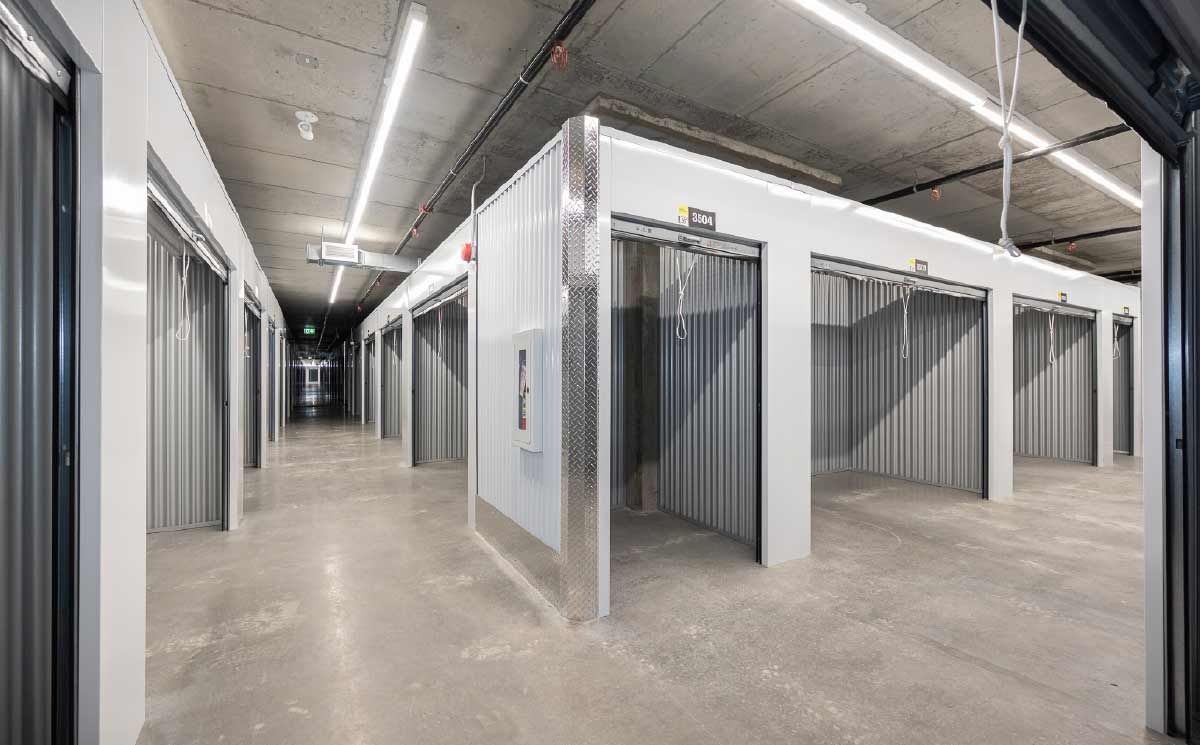
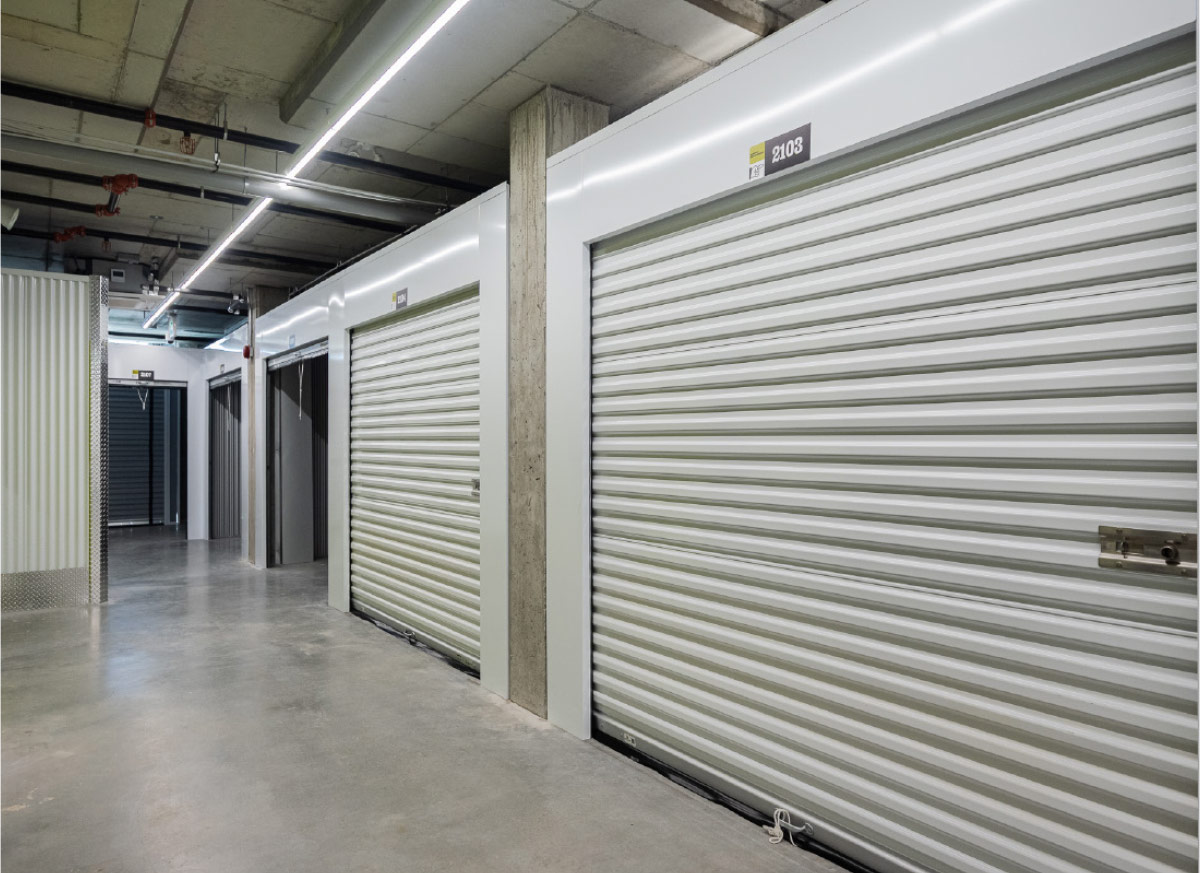


Across The Ds

ast month, we pulled the curtain back on why people use self-storage, revealing that for many tenants, it isn’t just about space but rather preservation of possessions, memory, and identity. It’s the basis for disposition—the natural human instinct to hold onto what is ours—and it’s the D that comes before those we’ve always known: death, divorce, downsizing, and displacement. While those four may create the need for storage, disposition helps explain why our belongings find a home behind a roll-up door instead of earning a spot on Facebook Marketplace, at Goodwill, or in a dumpster. It’s also why tenants may spend thousands of dollars storing things worth a fraction of the rent.
Now, with another assist from Dr. Russell Belk, research professor and author of Possessions and the Extended Self, we’ll look at how disposition applies across each of the four Ds, and how very different circumstances can lead tenants to make the same decision: Put it in storage.
“I can’t get rid of this because it belonged to someone I loved.”
Because of this, parting with those belongings can often feel like a betrayal. “I had to go through my mother’s stuff when she passed, and while some items were meaningful, most had no significance to me other than that they had belonged to her,” Belk told MSM. “Still, since I knew they were important to her, the thought of throwing them out felt disloyal. I definitely had a twinge of guilt when I tossed that stuff in the dumpster.”
“I don’t know what to do with the remnants of our life together.”
Novelist Stephanie Danler (Sweetbitter, Stray) told TIME magazine that when she and her husband separated, they packed up their home and put the boxes into storage. She didn’t think it’d be permanent, but temporary turned into years, and it became clear it was over. “I felt like I had been much younger when I packed them,” she said when finally opening the boxes. “The first box I opened had sweaters in it. His and mine. I remember taping up that box and thinking that we were separating, but we would be unpacking this box before the next snow came … It hurt afresh to see it all again. I still loved him. He still loved me. We wept constantly.”
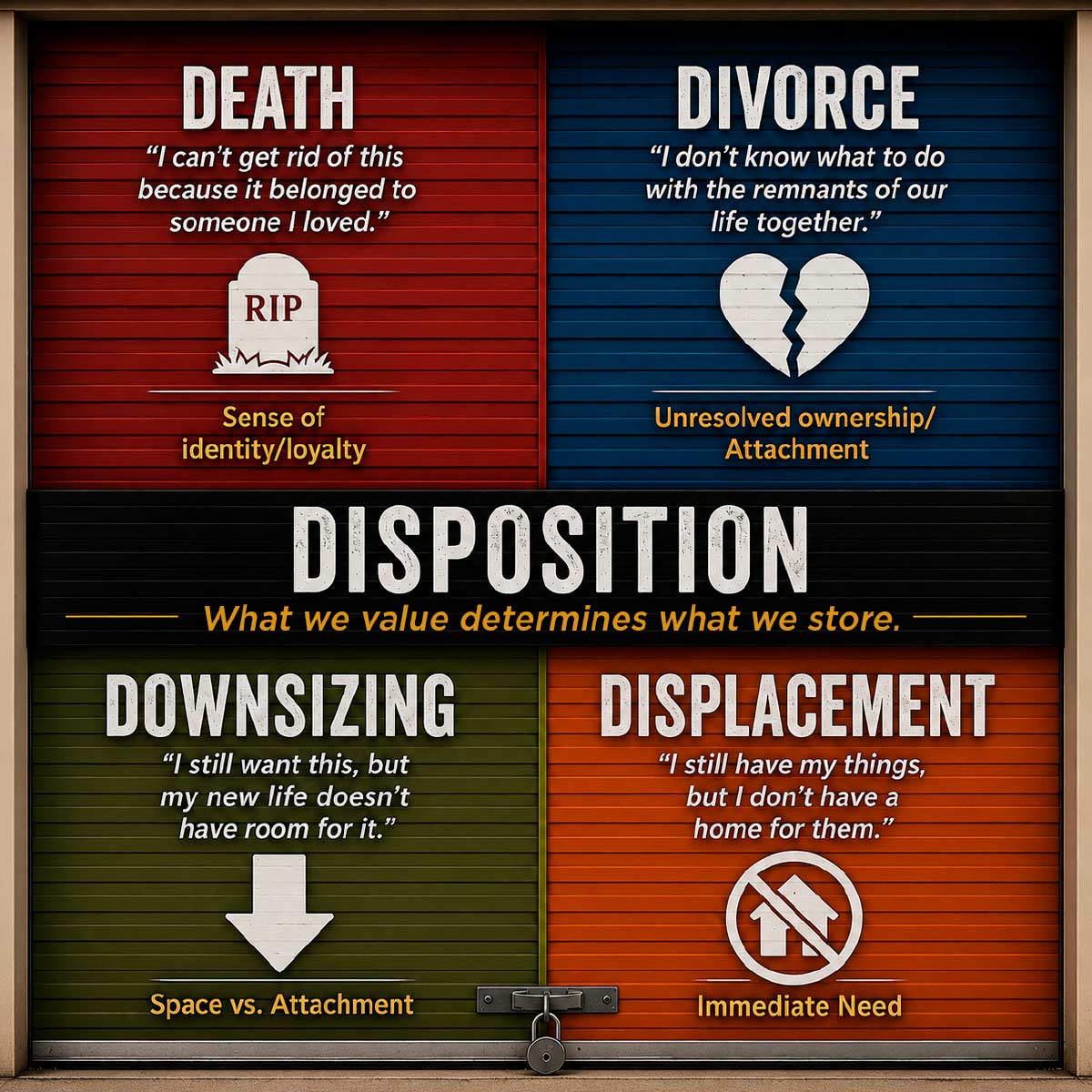
“I still want this, but my new life doesn’t have room for it.”
Amanda Titchenal, the founder of professional organizing company Well Organized, doesn’t necessarily encourage storage but does recommend it when clients refuse to part with certain belongings. However, she has some rules and tells clients their home should only hold things they use regularly. “If you need to get storage, make sure it is for specific purposes and not just a place to dump things,” she says, adding that for the ultra-sentimental it’s OK to relocate special keepsakes to storage if they’re creating too much clutter in the home.
Amber Campbell would likely agree. In a recent Business Insider story, she writes about going from a furnished townhouse to traveling with two suitcases after losing her job. She describes having associated her possessions with security and identity, which made downsizing emotionally difficult. “[It] forced me to question who I was without my stuff,” recalls Campbell. “I was so anxious about letting go that I packed my storage unit like a Tetris puzzle … That’s when it hit me how much of my life I’d spent defining myself by my stuff. They were all evidence that I’d become the person I always wanted to be.”
“I still have my things, but I don’t have a home for them.”
But disaster isn’t the only reason people lose their home permanently or temporarily. Moves often occur due to eviction, foreclosure, military deployment, or job and lifestyle changes, and they almost always create temporary chaos that can strongly activate disposition. During a disruptive move, deciding what to discard may take a back seat to simply getting belongings somewhere safe. What begins as a temporary storage solution can then outlast the displacement that created it.
In a first-person account published by Invisible People, a woman describes realizing she was about to become homeless after the end of a 10-year relationship. Before moving into her vehicle, she packed the possessions she wanted to keep into a storage unit. While living in her vehicle, the unit became the closest thing she had to a home for her belongings. She could retrieve clothes and necessities as she needed them and even use it to rotate seasonal items.
So, while the circumstances may differ, the decision is the same: keep, sell, donate, discard, or store. What makes storage so appealing is that it sells something beyond space: time before a permanent decision must be made. That’s good news for self-storage operators. What’s even better news is that although the world has been slowly digitizing what we used to hold in our hands, many people will still want to keep physical possessions.
“Today, music, movies, photos—they’re all stored digitally. People no longer write letters, but emails,” says Belk. “All of that saves space in the home, but it doesn’t diminish disposition. Those old records and tapes, those faded photos and letters—they’re too good to throw out. And so, storage remains as a place to keep our past in the present.”

In October, we move from the stories surrounding disposition to the data behind it. We’ll look at occupancy statistics, tenant surveys, generational patterns, and other industry metrics to see whether disposition shows up in the numbers.
Have you seen clear examples where disposition drove longer tenancies or strong resistance to selling? Share your stories for possible inclusion in Part 3 or 4 of our series at brad@modernstoragemedia.com.
Brad Hadfield is MSM’s lead writer and web manager.





sk a storage operator what customers care about most and the answers come quickly: price, location, security, access. All of it matters. But after years of running facilities and listening to the people who rent from them, I’ve come to believe a quieter factor shapes most of their decisions, one that almost never appears on a website or a rate sheet. It’s trust, or more often, the absence of it.
Our industry spent decades teaching customers to read every offer with suspicion. Along the way, a lot of operators stopped competing on transparency and started competing on how well they could disguise the real cost of renting a unit. I think of the result as a trust tax. It never shows up as a line item next to rent or insurance or late fees, but tenants pay it constantly in uncertainty, in low-grade frustration, and in the growing attention they pay to which operators make them carry it at all.
The trust tax wasn’t designed. It accumulated, one small decision at a time, repeated across thousands of facilities. A rate advertised online turns into a higher rate after fees. Teaser pricing vanishes a few months in. Increases arrive aggressively after move-in. Cancellation requires a phone call during narrow office hours. Lease terms run long and unclear, with the parts that matter buried in fine print. No single tactic looks like much. Together they’ve built an environment where customers simply assume they aren’t getting the whole story.
That assumption is the problem, and it’s worth being precise about why. Tenants aren’t naive about price increases or policies. Most people accept that a business needs to make money. What they resist is the surprise—the sense that something was kept from them until it was too late to matter.
Because acquiring a customer and keeping one are different problems.
Attractive-looking pricing fills units quickly and is easy to copy. Holding those tenants is the hard part. Every unexpected fee, every surprise increase, every cancellation that feels like a trap leaves a residue, and that residue doesn’t evaporate when the customer vacates. It turns into reviews, word-of-mouth marketing, and the reputation that trails a facility for years.
The operators who win the next decade won’t be the ones who perfected the fine print. They’ll be the ones who made it unnecessary.
The part operators tend to miss is that none of this requires charging less. It requires honesty. Most people would rather hear an uncomfortable truth on day one than discover it in month four.
They notice those patterns instantly, and the backlash against them isn’t confined to storage. Operators aren’t only competing with the facility down the road. They’re competing with every clean, transparent experience their customers have everywhere else—each one raises the bar.
When tenants consistently describe a place as straightforward and honest, that reputation becomes an asset that compounds quietly through referrals and goodwill. The facilities earning trust now are building an advantage that gets harder to copy.
Online rentals let customers see pricing before they ever show up. Digital leases make terms easy to review. Automated messaging keeps communication consistent, and customer portals put information within reach. Done well, technology doesn’t just automate the back office. It makes a facility feel more trustworthy, and that’s an opportunity the industry has barely started to use.
A facility can have strong security, modern amenities, and a great location and still squander some of that advantage if using the place is a chore. The easiest businesses to trust tend to be the easiest businesses to use, and that’s no accident.
The operators who come out ahead won’t necessarily be the cheapest, the newest, or the best funded—they’ll be the ones who understood that trust had become a measurable asset. Customers remember how a business made them feel, whether the pricing felt fair, whether the communication felt honest, and whether the whole experience was easy.
As facilities start to look more and more alike, that memory becomes one of the few things that sets one apart.
The facilities building durable value are also building trust by reducing surprises, simplifying the experience, and respecting a customer’s time and attention. That work rarely shows up on next month’s report. It shows up later in retention, reviews, referrals, and eventually revenue.
The trust tax exists because customers have been trained to expect it—to assume another fee or increase or complication is waiting somewhere under the surface. That’s not their failing. It’s the industry’s, and that makes it something the industry can fix.
Every operator can remove a little more friction, explain pricing a little more plainly, and make the experience feel a little more honest. The ones who do it consistently will earn more than customers. They’ll earn confidence, and in the next decade of self-storage, confidence may be the most valuable thing we sell.
Andrew Bonnis is a self-storage operator, marketer, and writer focused on where operations, technology, and customer experience meet. He manages storage facilities and writes about marketing, automation, and the future of the industry.




Quality Relationships.



he self-storage industry’s high recession resistance and consistent cash flow are attracting the interest of private equity (PE) investors intent on acquiring fragmented, independent facilities. Could PE be the answer to the current economic situation of the self-storage industry?
Most PE firms serve as advisors to the businesses they’ve acquired, helping iron out inefficiencies, develop new leadership teams, launch new services, and find new avenues for the business to grow and profit.
Private equity is an umbrella term that can take many forms, usually depending on the targeted business’ situation. In general, PE encompasses:
- Leveraged Buyouts (LBOs) – Acquiring a controlling stake in a business using a significant amount of borrowed money (debt) and using the acquired operation’s cash flow to pay off that debt.
- Venture Capital – PE provides the funds and the support needed by early-stage, high-growth startups and small businesses that lack access to conventional capital sources.
- Distressed/Turnaround – In these situations, the PE firm buys underperforming or financially troubled businesses with the goal of restructuring their operations and returning them to profitability.
- Growth Equity – Probably the most common approach for a PE firm involves investing in mature businesses that need capital in order to expand, restructure, or enter new markets, usually without taking a full controlling interest in the targeted business.
For many self-storage owners, a PE sale provides an exit strategy and opens the door to thinking about succession planning. Acquisition by a PE firm reduces the operation’s dependence on the owner by bringing in new management. But is the potential for more tenants, increased revenue, or reduced expenses worth it?
Whether a sale occurs or an investment is made by a PE firm is a question that can only be answered with more questions, such as:
- What are the PE firm’s plans for the business?
- Is a sale the right path for the business and the owner’s exit strategy?
- How will the operation’s employees be treated?
- Will the acquired business continue to support the local community?
Valuing the self-storage business requires analyzing what it owns and how much revenue it generates. What is owned is fairly straightforward and includes capital assets, real estate, etc.—all offset by liabilities, of course.
A business is usually worth far more than the sum of its parts. There is, after all, the value of intangibles such as the customer base, the operation’s reputation for quality, customer service, and more that fall under the heading of “goodwill.”
Analyzing the operation’s cash-flow is often an effective valuation alternative. An operation’s revenue stream generally reveals many of those intangible assets such as goodwill. In fact, for most businesses, analyzing the revenue stream will have the greatest impact on its value.
Self-storage businesses typically value between $100 to $150 per rentable square foot or $1,000 to $3,000 per unit. Stabilized facilities trade at 12 times to 18 times EBITDA (earnings before interest, taxes, depreciation, and amortization), which is equivalent to 5.5 percent to 7.0 percent cap rates. Small or un-stabilized properties trade at 4 times to 8 times EBITDA (or five to eight times net operating income).
A cap rate (capitalization rate) is a metric that measures the expected annual return on an investment property. It is calculated by dividing a property’s net operating income (NOI) by its current market value or purchase price.
Another option when valuing a self-storage business involves analyzing recent sales of comparable operations. Although this is an “evidence-based” value analysis, it is usually focused on specific factors and industry trends unrelated to the business. Interest rates and market volatility are often neglected variables.
Every PE transaction involves so-called “cultural aspects.” Negotiations here may often result in the business maintaining its identity and even its unique culture. However, there should always be a clear understanding of the desired goals and what is and isn’t on the negotiating table.
Financing, especially debt financing, plays a key role in every PE transaction. Usually, debt financing is a significant part of the transaction with leverage utilized because of the expectation that the improved performance of the self-storage business will ensure repayment of the debt.
Fortunately, while the acquiring PE firm may influence the decision-making process, day-to-day operations are usually left in the hands of the existing management team in order to maintain the appearance of independence. Collaboration between both the PE firm and management is crucial during the transition period.
PE firms are no different than most buyers in seeking greater depreciation write-offs. This usually means purchasing the operation’s assets rather than the self-storage business itself.
Sellers, on the other hand, usually prefer selling the business, or ownership shares, rather than the operation’s assets in order to reap better tax results. Fortunately, with negotiations, an agreement can be reached that satisfies the tax considerations of all concerned.
Operationally, the owner must consider how involved she is willing to remain. The buyer may offer an earn-out to the current owner for staying on for a period of time to ensure a smooth transition. After all, who’s better equipped to ensure that customers aren’t lost, employees remain, etc., than the current owner?
Obviously, with every sale, there are obstacles that must be overcome, some of which may actually be uncontrollable. A good example is when the seller does not want to continue his or her relationship with the business after the sale. Not only does it have a potential impact on the future success or failure of the business, but it also often affects the percentage of the sale price paid in cash.
Private equity firms frequently implement so-called “dynamic pricing” algorithms (like those used by public REITs). While this can maximize short-term revenue, it often involves jacking up rental rates on existing tenants by 10 percent to 20 percent or more, leading to higher churn and damaging local community trust.
Plus, many PE firms rely on leveraged debt to acquire and upgrade portfolios. In a volatile rate environment, the debt service on these massive acquisitions can quickly cut into net operating income, triggering cash-flow issues.
While the financial benefits are appealing, and the hurdles usually negotiable, is the promise of an improved operation with greater profit potential worth a private equity deal?




lat roofs are a popular, cost-effective choice for storage facilities because they offer lower construction costs, easier maintenance access, and usable space for HVAC units. The flat, stable, and safe surface makes it easier for repair crews to inspect and maintain the roof, reducing labor time and costs.
Flat roofs can accommodate a wide range of roofing materials, from built-up roofing (BUR) to single-ply membranes such as polyvinyl chloride (PVC), as well as metal, concrete, and thermoplastic polyolefin single-ply membrane, for example, and are often designed with a slight slope to facilitate water drainage.
Proper drainage systems can effectively direct rainwater away from the roof, minimizing the risk of leaks and water damage. However, accumulating water finds a weak spot to penetrate into permeable materials or seams that aren’t well-sealed. As water accumulates, it deteriorates most traditional roofing materials: adhesives in single-ply roof systems lose their grip, steel equipment supports are corroded, and oil solvent components of roofing asphalts seep into the water, leaving the remaining membrane brittle, cracked, and leaking as the pond grows, thus accelerating the roof’s aging. Ponding also adds more weight onto the roof and unfortunately remains until the water evaporates.
Fortunately, a spray polyurethane foam (SPF) roofing system builds resilience into the structure. The seamless, fully adhered, insulated membrane combines slope, insulation, and waterproofing in one field-applied system, becoming the evolution of the modern roof.
SPF offers a seamless, monolithic barrier, delivering the highest insulation value per inch of any roofing material (R-6.9 per inch). This system corrects poor drainage by varying application thickness, and self-flashes around roof penetrations. Sprayed as a liquid, SPF expands to create a seamless, self-adhering membrane that completely eliminates joints and seams, the most common sources of roof leaks. It’s easy for professionals to install, it’s affordable (numerous studies have shown that the ROI on spray foam systems can happen in as little as five years or less in energy cost reduction), and it has superior longevity over other roofing systems. But property owners might not know how much protection an SPF roof can provide for their building. For example:
- Durability – One of the best features of spray foam is that it insulates the building, mitigating excessive expansion and contraction due to changing outside temperatures. This characteristic gives it unparalleled durability. Contractors can install spray foam in almost any climate or harsh environment and it will hold up well.
- Seamless Surface – SPF is a continuous system that fills in cracks, holes, corners, and along the roof’s base. Spray foam has no exposed seams, so there is less chance for water to penetrate through to the deck. It is a durable cellular insulation that protects the roof from moisture and air. Building owners never have to worry about cracking or splitting in a single-ply membrane.
- Sustainable – SPF as a roofing system is a low-waste and low-labor assembly, providing an efficient installation method with less disposal and minimal tear-off costs. With proper maintenance, the SPF roof system can be renewed at the end of its service life by re-coating the existing elastomeric coating. SPF features ultra-low global warming chemistry that reduces the carbon footprint in its roofing systems.
- Meets Building Codes – SPF is ideal for meeting all commercial building codes. Coated foamed roof assemblies can meet Class-A and Class-B fire performance, which is especially beneficial in metropolitan areas where building codes are stricter.
- Reduces Heat Absorption – Self-storage flat roofs face severe heat absorption challenges due to their large, unshaded surface areas. However, SPF’s insulation and light-colored roofing surface can reduce the amount of air conditioning needed by reflecting considerably more sunlight—and therefore heat—than conventional, dark-colored roofs.
“It’s essential that our buildings’ roofs are waterproof to protect tenants’ important possessions. Talking with the manufacturer’s experienced sales manager helped me understand the entire process that would occur and got the project back on track,” says Barnard.
Prior to applying the SPF system, the team first used a roof vacuum to remove all of the loose gravel and dust; they then applied a waterborne modified acrylic neoprene asphalt primer to promote better foam adhesion and prevent blistering. Next they applied the SPF, which rapidly expanded into a dense, closed-cell insulation and waterproof barrier. And lastly, an acrylic elastomeric top coat was applied over the cured SPF to protect against UV degradation.
“Because the California sun is relentless on roofs and to meet the state’s rigorous sustainability requirements, I knew that this manufacturer’s SFP and acrylic products would be the ideal choice for this project,” says Barnard.
Barnard has been so pleased working with this manufacturer and the results of this project that he will be using SPF for other building retrofits in the future.

Business
Commercial Tenant Mix

f you’re focused on growing your self-storage facility, filling vacant units is only part of the equation. The bigger opportunity is attracting customers who see your property as an essential part of their business.
From contractors and tradespeople to online retailers and local service providers, commercial customers often rent differently from residential tenants. They’re more likely to stay longer, rely on their unit in their daily operations, and expand their storage needs as their business grows.
Building the right commercial tenant mix can make such a difference to your facility’s long-term success. When you understand what your business customers need and position your property as more than just a place to store, you create healthier occupancy and more predictable revenue year-round.
Business customers tend to think differently. They’re renting space because it helps them run their company more efficiently. Whether they’re storing inventory, tools, equipment, or supplies, that unit becomes part of their everyday workflow.
That’s what makes commercial storage tenants such an attractive audience. When your facility becomes part of someone’s business operations, they’re more likely to view you as a long-term partner instead of a short-term solution, which, in the long run, means longer rental periods, more stable income, and stronger customer loyalty.
E-COMMERCE BUSINESSES
If you’ve noticed more online retailers in your area over the last few years, you’re not imagining it. Thousands of entrepreneurs are running successful businesses from home, but many eventually reach a point where spare bedrooms and garages simply aren’t enough. Boxes take over living spaces, inventory becomes disorganized, and shipping supplies pile up—all of which make it hard to find products quickly.
This is when e-commerce storage solutions can make all the difference. A storage unit gives them room to organize inventory, prepare orders, and manage seasonal stock without committing to a long-term commercial lease. If your facility offers clean units, convenient access, and dependable security, you’re already providing many of the features these businesses value most.
CONTRACTORS AND TRADESPEOPLE
Contractors have different priorities, but they also make excellent long-term customers. Whether they’re electricians, plumbers, roofers, landscapers, painters, or HVAC professionals, they need somewhere safe to store expensive tools and materials when they’re not on the job.
Without dedicated storage space, equipment often ends up taking over garages, filling work trucks, or being left in locations that aren’t ideal for security or organization.
Offering contractor storage solutions gives these businesses a reliable place to store everything they need while freeing up valuable space elsewhere. Features like drive-up units, extended access hours, and convenient locations can make your facility an important part of their daily routine.
In other words, help make someone’s workday easier and they’re more likely to stick around.
SERVICE-BASED BUSINESSES
Not every commercial tenant needs to store pallets of inventory.
Many service businesses simply need extra space to support their day-to-day operations. Cleaning companies, event planners, photographers, marketing agencies, and even real estate professionals all have equipment, promotional materials, seasonal items, and files that take up valuable space. For these businesses, self-storage offers flexibility without the expense of leasing additional commercial property.
It’s also an opportunity for you to market your facility as a practical business resource.
INVENTORY-HEAVY SMALL BUSINESSES
Growing retailers, wholesalers, manufacturers, and specialty shops often find themselves in an awkward position. They’ve outgrown their existing space but aren’t ready to move into a warehouse.
And so, self-storage for businesses becomes an attractive option. Instead of paying for more square footage than they need, they can rent a storage unit that fits their current inventory while keeping overhead under control. As the business grows, it’s easy to move into a larger unit without the complexity of relocating to a new commercial building. That flexibility is one of self-storage’s biggest advantages, especially for businesses that expect their needs to change over time.
INCREASED REVENUE STABILITY
Commercial customers often rent with a long-term purpose in mind. If they’re using your facility to store inventory, tools, or equipment, they won’t move everything to another location lightly. That often translates into more predictable monthly revenue and fewer unexpected move-outs.
HIGHER OCCUPANCY RATES
When you market exclusively to residential customers, you’re limiting your audience. By also targeting local businesses, you create additional opportunities to fill units throughout the year. Contractors, retailers, online sellers, and service companies all have different storage needs, which helps diversify your customer base and strengthen occupancy over time.
LONGER TENANT RETENTION
Once businesses have organized their unit, established routines, and integrated into your facility, switching to another provider becomes less appealing. Providing excellent service, maintaining a clean property, and understanding your customers’ evolving needs all contribute to retention.
REDUCED SEASONAL FLUCTUATION
Residential demand naturally rises and falls throughout the year, especially during peak moving seasons. Commercial demand is often much steadier. While some industries experience seasonal spikes, many businesses need ongoing access to inventory, equipment, and supplies throughout the year. A balanced commercial tenant mix helps smooth out those fluctuations and creates a more resilient business model.
LOCAL BUSINESS OUTREACH
Some of your best commercial customers may already be operating just a few miles away. Take time to connect with local contractors, retailers, landscaping companies, property managers, real estate professionals, and small business owners in your community. Attend chamber of commerce events, sponsor local business groups, or introduce yourself to nearby companies that could benefit from additional space. Building relationships within your local business community can create a steady stream of referrals while helping position your facility as more than just another storage provider.
DIGITAL MARKETING AND LOCAL SEARCH
Business owners usually start their search online. Your website needs to speak directly to them. If your content focuses only on residential storage, you’re missing an opportunity to reach companies seeking flexible business space. Creating dedicated pages that explain your commercial storage solutions and how they support different industries can help your facility appear in relevant searches. It’s also worth publishing educational content that answers common questions and provides practical advice. Take a look at resources like these small-business storage tips for some ideas.
REFERRAL PARTNERSHIPS
Strong partnerships can become one of your most effective marketing channels. Think about the professionals who regularly work with growing businesses. Commercial real estate agents, business consultants, accountants, moving companies, office furniture suppliers, and local networking organizations all interact with business owners who may need storage. Developing referral relationships with these partners can introduce your facility to customers before they begin searching.
TAILORED COMMERCIAL OFFERINGS
Commercial customers aren’t always looking for the exact same experience as residential renters. Some may need multiple units. Others may need room to grow over time or prefer month-to-month flexibility while their business expands. By offering flexible commercial storage options, convenient access hours, online account management, and a range of unit sizes, you’ll make it easier for businesses to find a solution that fits their operations instead of forcing them into a one-size-fits-all approach.
CUSTOMER SERVICE BEST PRACTICES
Business owners appreciate consistency. When they have a question, they want a quick answer. If they need to transfer to a larger unit or update their account, they expect the process to be simple. A knowledgeable team that understands commercial customers can go a long way toward building trust and encouraging long-term loyalty.
FLEXIBLE LEASING OPTIONS
Businesses change all the time. An online retailer might need additional inventory space before the holiday season. A contractor may temporarily require a second unit for a large project. A local retailer might scale back after clearing seasonal stock. Offering business storage solutions that allow customers to increase or decrease their storage as their needs change makes your facility much more attractive than rigid alternatives.
SECURITY AND ACCESSIBILITY
Commercial customers are trusting you with valuable assets. Whether they’re storing inventory, expensive equipment, tools, or business records, they need confidence that everything will be secure and easy to access. Features like gated access, security monitoring, well-lit facilities, and convenient gate hours don’t just improve the customer experience. They can also become important selling points when businesses compare storage providers.
ACCOUNT MANAGEMENT
Every business wants to feel like a valued customer. Simple check-ins, proactive communication, and helping customers adjust their storage as their business evolves can strengthen relationships and improve retention. The goal isn’t simply to rent a unit—it’s to become a storage partner that businesses can rely on for years.
Some useful metrics include:
- The percentage of commercial customers in your facility,
- Average length of stay for business tenants,
- Revenue generated by commercial accounts,
- Retention rates among commercial customers,
- The number of referrals from local business partnerships, and
- Website inquiries related to commercial storage.
Monitoring these trends gives you valuable insights into what’s working and where you can continue to improve your marketing and customer experience.
If you’re looking for more storage strategies for growing businesses or want to explore how commercial storage can support your customers, learn more about StorageKingUSA’s commercial storage solutions.




ome mature companies, upon reaching the top, are content to rest on their laurels. Innovation, they decide, is a younger start-up’s game. It would be easy for Public Storage, which opened its first location in 1972 and is now the largest owner of self-storage facilities in the world, to subscribe to that notion. Of course, 53 isn’t that old in relation to companies in other industries, but in self-storage years, it’s practically primordial. This hasn’t stopped the company from keeping up with the times, and that was made abundantly clear in April when Public Storage moved its headquarters from the Golden State to the Lone Star State (while keeping major presences in both), transitioned then-CFO Tom Boyle into the role of CEO, and introduced PS4.0.
PS4.0, named to reflect the fourth generation of leadership since the company’s founding, is designed to create opportunities for Public Storage to advance into a new era of innovation and growth. Since the launch, Public Storage has already closed on its $10.5 billion acquisition of National Storage Affiliates, a deal that sent shockwaves through the industry; the company has also entered into an agreement to acquire Public Storage Canada for approximately $1.2 billion.
“PS4.0 is all about greater energy and urgency, customer obsession, and a sharper focus on building the capabilities that will drive stronger performance over time,” says Boyle. “Community impact is an important dimension—particularly projects that focus on affordability and clean energy generation. In this new era at Public Storage, every step we are taking is driving towards compounding growth and benefits for our stakeholders.”

Once completed, the projects are expected to generate enough electricity each year to power more than 6,100 households while delivering about $750,000 in annual electricity bill savings for subscribers—that’s more than $36 million over the life of the projects.
Williams further points out that Public Storage maintains the largest solar energy program in the industry and is expected to expand it to 1,300 of its properties by year’s end. She also says supporting the communities the company serves is important to both leadership and employees. “Through this innovative partnership, we’re transforming underutilized rooftop space into community solar projects.”
ComEd President and CEO Gil Quiniones says that with demand for power rising faster than supply, community solar sites offer a clean energy solution that can help close the supply gap while providing the aforementioned savings. Shaun Keegan, CEO of Solar Landscape, parallels Quiniones’ thoughts by stating, “Commercial rooftops represent one of the fastest, most scalable opportunities to expand the electric grid using infrastructure that already exists.”
The expansion of new community solar sites is supported by Illinois’ clean energy policies, including the Climate and Equitable Jobs Act (CEJA) and the Clean and Renewable Grid Affordability (CRGA) Act. “This project represents economic development and investment here in Justice, Ill., and creates economic opportunities for job growth, investment, and sustainability,” Mayor Krzysztof Wasowicz of Justice said in a statement. Estimates suggest that construction is expected to support approximately 300 jobs, while workforce partner programs prepare Illinois residents for careers in the growing clean energy industry. “We’re celebrating the completion of this community solar project,” says Tameka Wilson, executive director of YouthBuild Lake County, which stands to benefit from the energy initiative. “By pairing clean energy development with workforce training, Illinois is helping ensure the benefits of the clean energy economy are shared by the communities that need them most.”
- Lowering greenhouse gas emissions – The company reports a 14 percent reduction in Scope 1 & 2 greenhouse gas emissions’ intensity, with a long-term goal to reduce them 45 percent by 2032.
- LED lighting everywhere – Public Storage says LED lighting, which uses significantly less electricity than traditional lighting, is now the standard for all new construction and existing property upgrades.
- Greener buildings – The company now has 263 green-certified buildings through programs such as LEED, BREEAM, and Arc Performance Certificates.
- Water conservation – Public Storage incorporates drought-tolerant landscaping, efficient irrigation systems, and water-saving plumbing fixtures at viable facilities.
- Recycled moving boxes – Even brown cardboard boxes have gone green, with the company reporting that all corrugated boxes it sells to customers are made from 100 percent recycled fiber.
Boyle concludes that sustainability isn’t a single initiative for the company; rather, it’s about “making thoughtful investments that meaningfully reduce Public Storage’s long-term environmental footprint.”











was asked a question at a recent self-storage conference that I have thought about regularly over the last several years. The question: Are the threats we face as an industry specific to self-storage or more general in nature? The answer is not either/or but both/and.
Our industry has faced threats that are both unique to us and part of broader regulatory trends. Oftentimes, the industry-specific threats are based on misconceptions or a limited understanding of the storage industry. For example, I recently wrote about the moratorium on self-storage development in Atlanta. This is illustrative of threats based on misconceptions that storage is ugly, wasteful, or disruptive to an urban streetscape.
Sometimes, though, the industry commits unforced errors when we leave customers with a lack of clarity regarding key terms such as promotional pricing or which party is responsible when stored property is stolen or damaged. As I have previously written on this page, legislators and regulators can be too quick to put a scarlet letter on the industry because of a few negative customer experiences. However, this does not absolve us from continually examining ways to enhance the customer experience. To that end, I have been heartened recently to hear about improvements to the customer experience adopted by operators large and small.
The industry has also found itself swept into broader regulatory trends, such as regulation of so-called junk fees and algorithmic pricing. The SSA’s efforts in these areas have focused on emphasizing the pro-consumer features of self-storage, for example, different pricing features depending on whether customers’ needs are short term or long term and flexible, month-to-month leases. The danger of overbroad regulation is that the current competitive landscape of the storage industry gets replaced by a one-size-fits-all model that reduces consumer options.
In addition to our direct efforts to respond to these threats, the SSA is taking steps to improve consumers’ and legislators’ understanding of the industry through SSA’s “Storage Is” campaign. We know the important role that you play in your community and want to be more intentional about highlighting your contributions.
I encourage you to share with us how you serve your customers and the work you do in your community. You can reach me at jdoherty@selfstorage.org.

ata analytics and AI have transformed how prices are set, including the use of surveillance pricing, or using personal and behavioral data to tailor prices to individual consumers, among the more controversial practices. While not commonly applied in self-storage, the issue is beginning to draw industry attention.
Unlike traditional pricing models based on supply and demand or broad market segmentation, surveillance pricing uses a wide range of data to estimate a consumer’s price sensitivity: browsing history, location, income, credit profiles, and even inferred preferences. Storage operators could potentially use sophisticated software to analyze market conditions, historical leasing data, occupancy, demographic trends, and tenant characteristics like payment history or length of stay to recommend rent and renewal rates.
Some systems can operate across entire portfolios, while others can recommend rents for individual units based on market conditions and tenant demand. For example, if data suggests that a particular renter has limited storage alternatives or is searching in a high-demand area with low unit inventory, the algorithm may recommend a higher rent. Conversely, if a unit has been listed for a long period, the system may suggest lowering the price to attract tenants.
From a business perspective, surveillance pricing offers clear advantages. It enables property owners to maximize revenue, aligning rent levels with market demand and reducing reliance on manual pricing decisions that can be inconsistent or influenced by subjective judgment. Automation can also improve operational efficiency; by continuously adjusting prices in real time, these systems can help maintain occupancy while increasing revenue.
Despite these advantages, surveillance pricing has sparked pushback because it operates behind the scenes. This lack of visibility can erode trust and make it difficult for tenants to understand or challenge pricing decisions. It also requires collecting and analyzing personal data, sometimes from sources tenants haven’t consented to.
Policymakers at all levels are beginning to examine whether existing laws adequately address these practices, and some jurisdictions have proposed or enacted measures to curb perceived abuses. In New York, the Governor has required rental agreements to state: “THIS PRICE WAS SET BY AN ALGORITHM USING YOUR PERSONAL DATA.” While the requirement is not specific to self-storage, any operators using surveillance pricing in New York should consider including a similar disclosure on their websites and rental agreements.
Surveillance pricing sits at the intersection of innovation and regulation. It reflects a broader trend toward data-driven decision-making that can improve efficiency and market responsiveness, yet it raises fundamental questions about privacy, fairness, and the appropriate limits of technology.


Learn how and request a quote at bajacarports.com/carport-experts.
Proven platform yielding results for owners since 1998, driving revenue and maximizing NOI.
- 265+ stores across Canada – a household name in Storage with scale.
- Highly trained and motivated team delivering results for your store.
- Resources and an infrastructure that respond immediately with boots on the ground.
- A Canadian company that understands the Canadian market and deliver results for you!
fore you
Party Management Company
Proven platform yielding results for owners since 1998, driving revenue and maximizing NOI.
- 265+ stores across Canada – a household name in Storage with scale.
- Highly trained and motivated team delivering results for your store.
- Resources and an infrastructure that respond immediately with boots on the ground.
- A Canadian company that understands the Canadian market and deliver results for you!


