


Data icon
Stats With Starr
Stats With Starr
How Much Does A Month Of Delay Cost A Self-Storage Development?
By Noah Starr
A Construction Crane Working On A Multi-Story Building Frame Against A Blue Sky.
Stats With Starr
How Much Does A Month Of Delay Cost A Self-Storage Development?
By Noah Starr
W

hile my daughter was playing on the floor with a ladybug toy, I was reading an article in “The Economist” about data center development, when something struck me: “A nine-month delay in a data center development worsens the economics of the project as much as doubling its lifetime electricity bill, according to the Carnegie Endowment.”

So, I wanted to look at self-storage projects and try to understand how project delays impact overall returns. And can the same claim be made in self-storage?

I fired up the TractIQ AI Connector in Claude and posed this question to Opus 4.7 and Fable 5 to compare differences in the analysis, then re-ran everything with real street rates in Austin, Texas, where I’m based.

As a quick aside, my aim is not to use AI to write my posts, and to be transparent about when AI is used. It is an incredible time to be in data, technology, and self-storage, and my aim is to explore questions I wouldn’t historically have been able to in one hour and provide interesting takeaways for self-storage investors, developers, brokers, and operators in the process. The results are shown in the AI Model Comparison chart.

See AI Model Comparison chart.
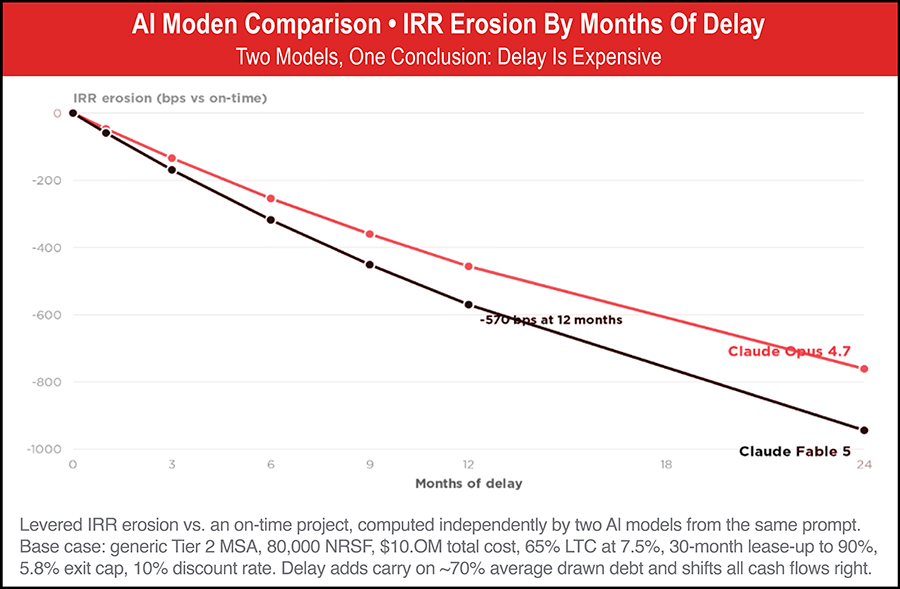
Graph of AI Moden Comparison
What Does A Delay Cost Developers?
Check out the assumptions in the footnote of the AI Model Comparison chart for this sample $10 million project; the results are interesting—both from what it means for developers and each AI model.

Off the bat, it looks like developers lose approximately 50 basis points off the IRR for every month delayed, and $65,000 of net present value (NPV) from the project.

We all know developers are motivated to expedite the permitting and construction progress, but these findings put that in stark terms.

What’s also interesting is that if you take these claims at face value, it drastically increases the value of a development site that’s already approved vs. one that you’d have to go through a process.

A 12-month head start on a project has an approximate $780,000 value impact on a $10 million project. I’d be curious to hear from developers on how they think about this, and what it means for quantifying land value differences between approved and raw land sites.

Why Did The Two AI Models Disagree?
I find it interesting that Fable had starker findings than Opus 4.7. So, I asked it why, and the response is shown, verbatim, in the Straight From The Model sidebar. I find it to be fascinating that Fable took the prompt and added in a decision-point that I never specified but could make sense for many developers depending on the terms of the construction loan. This highlights the need to be extremely clear in your prompting and to recognize that each new AI model continues to evolve in ways that may be unexpected.
STRAIGHT FROM THE MODEL
Fable 5 explains the gap.
1
Why they differ: The models did the same math on a different deal. The prompt left one thing open—what to do with the perm loan—and Fable assumed a cash-out refi at stabilization while Opus left the equity in until sale. Fable’s version has a higher return, and higher-return deals lose more IRR per month of delay. On everything the prompt pinned down, the models agreed within approximately 5 percent.
2
What it means for analysts: When two models disagree, it’s now for the same reason two analysts disagree: an open assumption, not bad math. The question isn’t “which model is right”—it’s “did I specify the deal tightly enough.”
What Is A Delay Worth In Rents?
Now, to the second part of the overall question: How do we compare these findings to a decline in rents?

For this round, I anchored the model to real data: TractIQ’s trailing-12-month average street rates across 117-plus Austin facilities per unit type, blended across a typical unit mix. The deal is hypothetical, but the rents are real.

See Austin, Texas, Project NVP by Months of Delay chart.
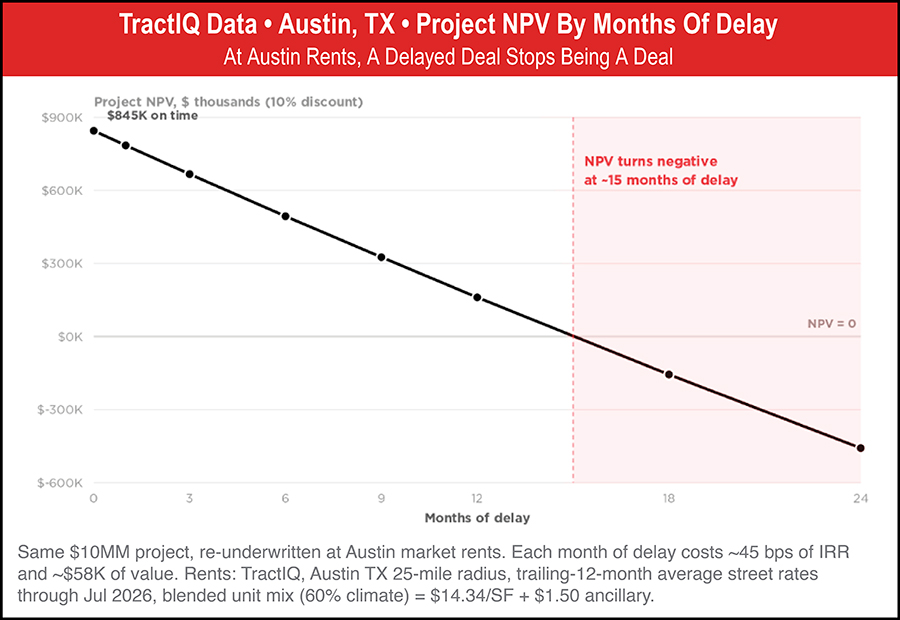
Graph of TractIQ Data
Per the above analysis in Austin using Fable 5, a one-month delay is equivalent to cutting rents 0.8 percent on the entire building, forever. Stretch it to nine months, and the delay costs 91 percent of the project’s lifetime operating expenses. Read that again.

See the TractIQ Anaylsis – Austin, TX chart.
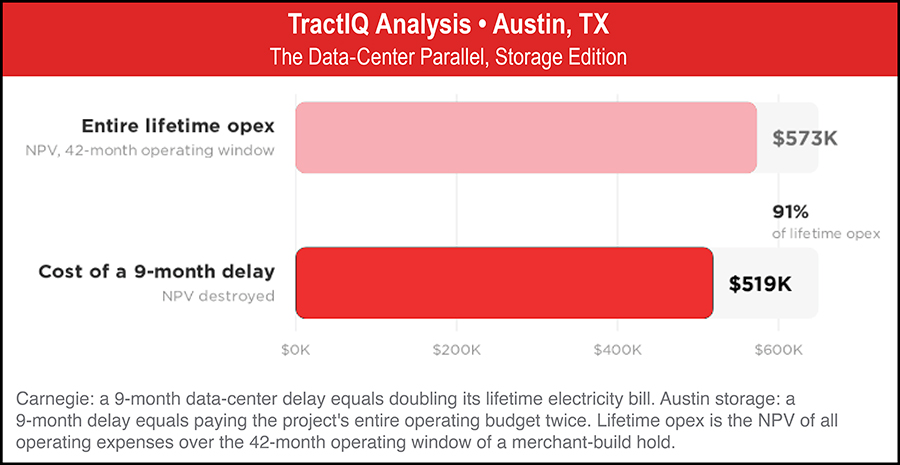
Chart of TractIQ Analysis
This finding doesn’t just support the Carnegie Endowment’s data-center analysis. It’s arguably more striking in storage because the storage operating budget is tiny relative to the capital at risk. In a data center, delay competes with the electricity bill. In storage, delay competes with everything.

And one more Austin-specific finding worth sitting with: At current Austin rents, the model says a project has about 15 months of slack before delay alone turns its NPV negative. In a market where entitlement fights routinely run past a year, that is not a rounding error.

Discipline Is The Whole Game
Before TractIQ and publicly committing to exit the self-storage investment business, I developed 120,000 NRSF of self-storage across four projects. There are so many challenges that come with every project, which I can get into in later articles. But in this case, it demonstrates that the development yield on cost must be significantly larger than outright acquisitions.

Not only will you have higher cost of capital, stress, and risk, but it’s so rare to find a hyperlocal market starved for self-storage in 2026 (although there may be a few listed in TractIQ right now).

So, if you’re a developer, continue to be disciplined and constantly confirm a project is truly worth the effort, since even a one-month delay could have a huge impact on your performance.

Noah Starr is the CEO of TractIQ.