








How to enjoy our new magazine:
Just scroll!
Click or tap the table of contents icon in the menu bar to find any article.
Read any article by clicking or tapping the read full article button below each article intro.
Jump back to your previous browsing spot from any article using the menu bar or back to issue button.








-
Key Tips To Improve OperationsPage 16
-
Leveraging A Forward-Resolve Approach For Better Customer ServicePage 20
-
How To Ensure New Ideas Get Real ConsiderationPage 22
-
Three Free Ways To Market Your FacilityPage 24
-
The Four Seasons Of Facility MaintenancePage 28

-
Choosing Engineers For Your DevelopmentPage 72
-
A Presale Checklist For Smooth TransactionsPage 76
-
A Car Wash Case StudyPage 80
-
Trojan Storage in Camarillo, Calif.Page 84
-
Seven Steps To Starting Your Self-Storage InvestmentPage 86
-
Making Sense Of The UncertaintyPage 88
- Chief Executive Opinion by Travis Morrow6
- Publisher’s Letter by Poppy Behrens9
- Meet The Team10
- Women In Self-Storage: Teresa Sedmak by Erica Shatzer33
- Who’s Who In Self-Storage: David Dodge by Erica Shatzer37
- StorageGives93
- Self Storage Association Update95
- The Last Word: Adam Pogoda96
For the latest industry news, visit our new website, ModernStorageMedia.com.







theparhamgroup.com


ou wouldn’t want to open a hotel today and call it “Mom & Pop’s Hotel;” you need to choose a brand. The same will be true in our industry as well.

He’s also the president of National Self Storage.

-
PUBLISHER
Poppy Behrens
-
Creative Director
Jim Nissen
-
Director Of Sales & Marketing
Lauri Longstrom-Henderson
(800) 824-6864 -
Circulation & Marketing Coordinator
Carlos “Los” Padilla
(800) 352-4636 -
Editor
Erica Shatzer
-
Web Manager / News Writer
Brad Hadfield
-
Storelocal® Media Corporation
Travis M. Morrow, CEO
-
MODERN STORAGE MEDIA
Jeffry Pettingill, Creative Director
-
Websites
-
Visit Messenger Online!
Visit our Self-Storage Resource Center online at
www.ModernStorageMedia.com
where you can research archived articles, sign up for a subscription, submit a change of address. 
- All correspondence and inquiries should be addressed to:
Modern Storage Media
PO Box 608
Wittmann, AZ 85361-9997
Phone: (800) 352-4636

n April 26, 2024, The New York Times published an article titled “Square Feet: Americans Went All-In on Self-Storage, That Demand Is Suddenly Cooling.” As staunch advocates of promoting the truth in the self-storage industry, this article definitely caught our attention!
While the article is well-written and contains a number of truths, many of the statements are misleading. That’s why we sent a letter to the Times, along with a copy of the 2024 Almanac. Our response to the Times, “Why We’re Sending The New York Times A Copy Of Our Self-Storage Almanac,” written by Brad Hadfield, MSM’s web manager and news writer, can be found on page 12.
Unfortunately, many news outlets continue to publish articles without doing their homework to ensure the facts are right. Not only is this an injustice to their readers, but it is also unfair to the vendors and suppliers in our industry who do business daily in good faith with the REAL facts. Above all, it is misleading for investors, developers, builders, and others in our industry.
We have respectfully requested that the Times publish Hadfield’s article as a rebuttal or an update to their story. This collaborative approach will ensure that people have access to the real truth. Furthermore, should the Times consider any future articles on our industry, we would greatly appreciate it if they would consider sourcing the Almanac for data.
When we rebranded our company in September of 2023, we made a commitment to report the truth— the whole truth—about the state of self-storge. We will continue to do so. And if the media gets it wrong, we will definitely reach out and advocate for the real story!

Publisher

n April 26, 2024, The New York Times published an article titled “Square Feet: Americans Went All-In on Self-Storage, That Demand Is Suddenly Cooling.” As staunch advocates of promoting the truth in the self-storage industry, this article definitely caught our attention!
While the article is well-written and contains a number of truths, many of the statements are misleading. That’s why we sent a letter to the Times, along with a copy of the 2024 Almanac. Our response to the Times, “Why We’re Sending The New York Times A Copy Of Our Self-Storage Almanac,” written by Brad Hadfield, MSM’s web manager and news writer, can be found on page 12.
Unfortunately, many news outlets continue to publish articles without doing their homework to ensure the facts are right. Not only is this an injustice to their readers, but it is also unfair to the vendors and suppliers in our industry who do business daily in good faith with the REAL facts. Above all, it is misleading for investors, developers, builders, and others in our industry.
We have respectfully requested that the Times publish Hadfield’s article as a rebuttal or an update to their story. This collaborative approach will ensure that people have access to the real truth. Furthermore, should the Times consider any future articles on our industry, we would greatly appreciate it if they would consider sourcing the Almanac for data.
When we rebranded our company in September of 2023, we made a commitment to report the truth— the whole truth—about the state of self-storge. We will continue to do so. And if the media gets it wrong, we will definitely reach out and advocate for the real story!
Publisher

We have put every issue through 2022 on our website, giving you free access to this wealth of knowledge.
- Year or Topic
- Person or Facility
- Market or Company
This free archive is a powerful tool you can use to see how far the industry has come and to discover how the past helped shape our future.





Modern Storage Media



Messenger



ast week, The New York Times published a story titled, “Americans Went All-In on Self-Storage. That Demand Is Suddenly Cooling.” The piece argues that many developers, spurred by the pandemic to invest money in new self-storage facilities, have been caught short by this drop in demand. While the story does contain many truths, it does not consider certain industry nuances-many of which could be found by picking up a copy of our 2024 Self-Storage Almanac (which is why we’re sending them a copy!).
However, the outlet continues to drive home underperforming occupancy with this quote from Michael Elliott, an equity analyst at the investment research firm CFRA: “We’re probably closer to what would be a quote-unquote bottom with occupancy and rental rates,” he writes.
Additionally, while occupancy is down from the highs of COVID, the NYT doesn’t note that it has simply rebalanced; it is now back to where it was pre-pandemic, as evidenced by Table 7.1.

Based on this perspective, the most recent data places self-storage occupancy right in the sweet spot.
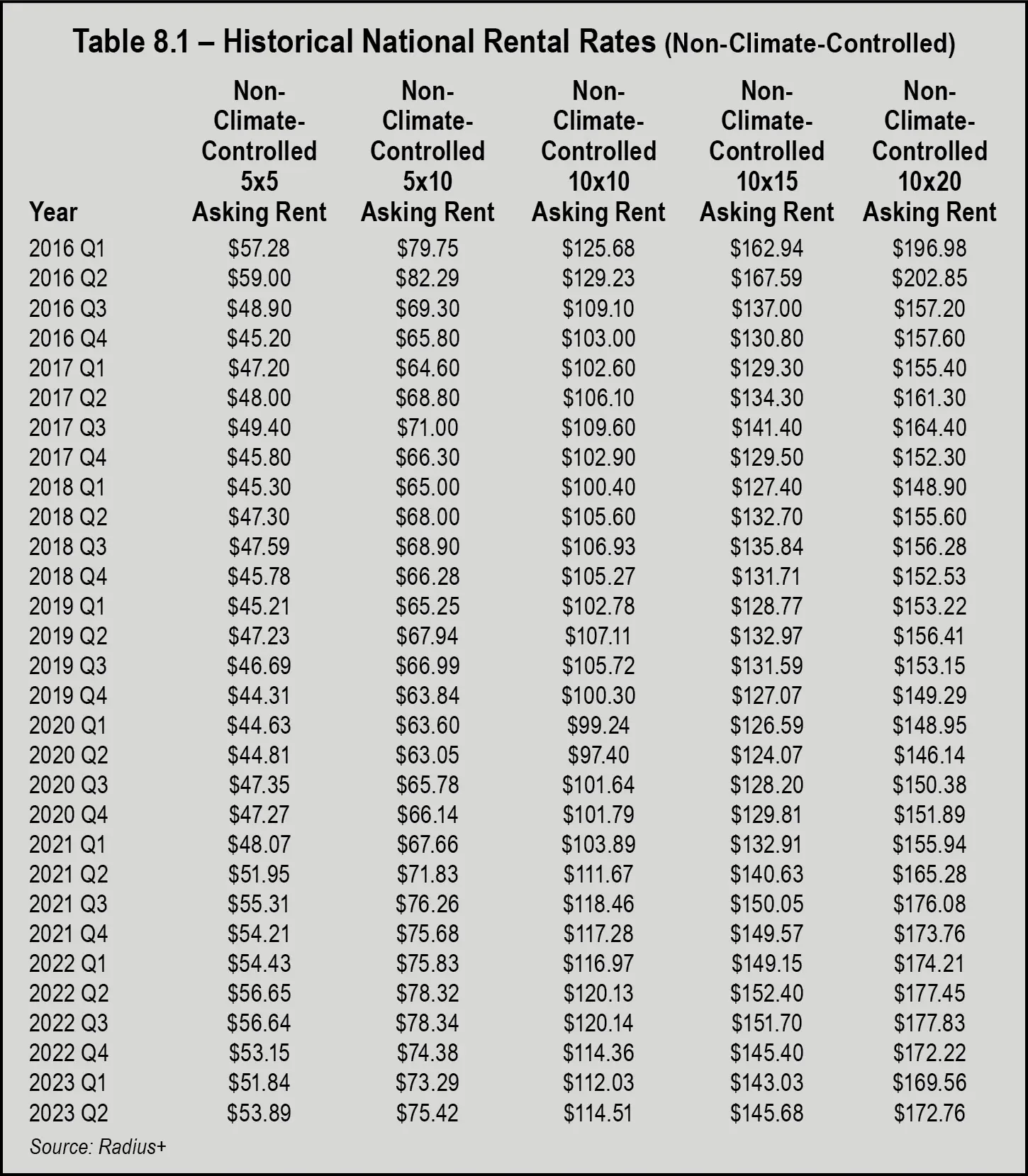
Again, this can be viewed as a bit of a course correction. Looking at national rental rates for climate-controlled units in Table 8.1, for example, we see that rates increased during the pandemic, as did demand. The post-pandemic cool off, naturally, would result in rates balancing out. However, they remain higher than pre-pandemic rates and even some of the rates during the pandemic.
More commentary on rates follo, with the outlet stating, “Storage companies have been making up for lower rates — usually offered as promotional prices — by raising rates on existing customers. The rate increases are happening at a much faster pace, too.” The NYT further quotes Kristin Millington, the director of the self-storage and manufactured housing groups at Crow Holdings Capital, a real estate and investment firm, saying, “Previously, the increases would happen after customers had been renting for around a yea…Now, that’s hitting in month two or three — the move-in rates now are almost like a promotional rate.”
While some large operators have been implementing extreme rate hikes a few months after a tenant moves in, and MSM has addressed this in a series of articles and in the Almanac, it’s not necessarily because they’re performing poorly. Rather, they understand that most tenants tend to stay in a facility for 10 months or longer; so even if they miss out on some revenue in the first couple of months, they make up for it on the back end once the rate hikes have been implemented.
While we believe there should be more transparency about these rate increases with tenants, it’s also never been uncommon for REITs and other large operators to offer low entry pricing (Public Storage was famous for $1 move-in pricing for years). Additionally, REITs and large operators only represent a fraction of the self-storage industry. “They’re not the majority,” says R. Christian Sonne, executive vice president and specialty practice co-leader–Self Storage at Newmark Valuation & Advisory. “There are plenty of independents that don’t play pricing games. They look for other ways to supplement income.”
While this is true, the story fails to acknowledge that the drop in demand is correcting a previous imbalance. “There was a staggering amount of new self- storage development across the country from 2016 to 2019 that diminished demand in some of the major metropolitan statistical areas (MSAs) and secondary markets within the United States into 2020,” reports the Self-Storage Almanac. It further states that post-COVID, supply chain issues, material shortages, and a lack of labor due to the pandemic caused new development to come to a temporary halt. “That brief hiatus, coupled with unprecedented pandemic-related demand for storage space and drawn-out approval processes for development, helped correct the imbalance,” concludes the Almanac.
That said, development is by no means dead. “Many professional, well-capitalized developers continue to find locations in major MSAs as well as secondary and tertiary markets for successful projects,” says Travis Morrow, chairman/CEO of Store Local Corporation and the president of National Self Storage, though he adds that as with any development, a professional study should always be conducted before moving forward.
The NYT story seems to purport otherwise, however. “Higher interest rates make it harder for developers of storage facilities to finance construction,” the article concludes. This is in contrast to a new Self Storage Association (SSA) report that was released on April 30th. In the report titled “Building Momentum,” the SSA states that “Despite the higher cost of construction and capital, new self- storage supply is on the upswing and builders remain busy.”
The SSA also writes that contractors say business is brisk, and speaks with a number of industry experts from Baja Construction, Elevate Structures, MakoRabco, Morton Buildings, Steel & Metal Systems, and Trachte Building Systems. All six vendors are optimistic.
“Despite higher building costs in the industry, we are still seeing strong interest from clients wanting to build new self-storage facilities and existing owners looking to expand their operations,” says Matt Milby, general manager of commercial business at Morton Buildings.
Kelly Crawford, executive director of operations at Steel & Metal Systems, concurs. “Construction in the storage market is thriving. Demand seems to remain constant and possibly growing.”
“Ultimately what we’re looking at is a reversion to mean, or a return to normal,” says Sonne. “Stock prices may be down, but the Times is forgetting that they were up 80 percent a few years ago. If you invested back then, you’re still doing great. Through boom and bust cycles, and even the great financial crisis, self-storage performs better than any other real estate asset class.”
The NYT selected this quote from Public Storage President and Chief Executive Joe Russell: “The new customer environment remains challenging.” However, it didn’t include this follow-up statement from the same call: “We are well positioned in 2024 with our operating model transformation enhancing the industry’s highest margins, our high growth non-same store pool comprising nearly 30 percent of the portfolio, and our balance sheet positioned to fund significant external growth.”
The outlet also uses this quote from Joe Margolis, chief executive of Extra Space Storage: “The industry as a whole will likely face headwinds from lower new customer rates in the near term.” It fails to acknowledge, however, that immediately succeeding that statement, Margolis added, “We are confident in the durability of self-storage, our highly diversified portfolio, and our platform’s ability to capture customer volume when sector demand accelerates.”
Further, the article leaves out Christopher Marr, president and CEO of CubeSmart, who said, “Looking to 2024, [CubeSmart is] well-positioned to execute our growth strategy in any macroeconomic climate,” as well as David Cramer, president and CEO of National Storage Affiliates Trust, who stated, “[NSA] is in an attractive position to take advantage of external growth opportunities as they arise.”
The REITs have scheduled their Q1 2024 financial statement calls, which MSM will be sure to follow up on.
Angie Guerin, executive vice president with MakoRabco, even sees another benefit to the rebalancing. “I think a normalized market adds some runway for ideas to take root and innovation to thrive,” she told the SSA. “I think we’ll see some other great things developed by our industry in the near future.”
“Although trade area specifics can vary dynamically, I would say supply/demand overall is at equilibrium to under-supplied,” concludes Sonne. “Predictions for self-storage remain bullish, and our practice group appraised over 300 properties this past quarter. Things may be a little slower at the moment, but the powder is ready to be lit again.”

ou can elevate your self-storage business to new heights with a comprehensive approach to sales, marketing, and systems optimization. If you want to be an elite self-storage operator, you need to deploy systems in platforms in your daily operations. Create a smooth customer experience by personalizing every interaction. This is made possible through a strong customer relationship management (CRM) system that empowers your sales team.
Invest in employee training that not only imparts product knowledge but also hones effective communication and customer service skills. Don’t forget a first-class marketing strategy that enhances your online presence through SEO and social media and also captivates your audience with insightful content and local partnerships.
Think about automated systems reforming operations, from appointment scheduling to secure access control, ensuring a hassle-free experience for your customers.
By embracing these strategies and staying data-informed, your self-storage facility is poised for exponential growth, over the top customer satisfaction, and lasting success in a competitive market. Here are some strategies and tips for each area.
A robust CRM system is crucial for effective self-storage sales. It allows you to track customer interactions, manage leads, and streamline communication. By utilizing CRM data, you can gain valuable insights into customer preferences and behaviors. This knowledge enables your sales team to tailor their approach, offering personalized solutions that resonate with potential clients.
Employee Training
Invest in comprehensive training for your sales team. Equip them with not only product knowledge but also effective communication and customer service skills. A well-trained team following a well-designed system can confidently address customer inquiries, showcase the benefits of your storage solutions, and handle the sales process with finesse. Ongoing training ensures that your staff stays updated on industry trends and maintains a high level of professionalism.
Promotions and Discounts
This can be something as simple as a free lock or $30 off the first month’s rent. Consider implementing referral programs and encouraging existing customers to refer new clients in exchange for a credit or other rewards. Word-of-mouth marketing remains a powerful tool in the self-storage industry. It is OK if you are brand new to have a honeymoon discount to offer the community, but don’t build your business off discounts; it’s a race to the bottom when it comes to revenue.
Optimize your online presence to enhance visibility and reach a broader audience. Invest in search engine optimization (SEO) strategies to improve your website’s ranking in search engine results. Leverage social media platforms for targeted advertising, engaging with your community and sharing relevant content. A strong online presence not only attracts new customers but also establishes credibility and trust.
Content Marketing
If you do not have a marketing calendar to follow, make this your No. 1 priority to initate today. Create valuable and informative content that resonates with your target audience.
staying data-informed, your self-storage facility is poised for exponential growth, over the top customer satisfaction, and lasting success in a competitive market.
Local Partnerships
Forge partnerships with local businesses or real estate agents to expand your reach. Cross-promotions with complementary businesses can benefit both parties and attract a wider customer base. Consider sponsoring community events to increase brand awareness and demonstrate your commitment to the local community. Have a “welcome to the community,” 8-by-11, branded envelope filled with discounts from all your fellow business partners. Building strong local connections can lead to valuable referrals and long-term customer relationships.
Implement automation tools to streamline routine tasks and enhance operational efficiency. From appointment scheduling to billing and reminders, automation reduces manual workload and ensures a smoother customer experience. Embrace online tools and self-service kiosks to simplify the rental process, providing customers with convenient options for managing their storage needs. The more automation you have, the more time managers have for in-person customers and marketing the facility.
Security And Access Control
Investing in robust security systems is paramount in gaining customer trust. High-tech surveillance, access control measures, and secure entry points contribute to a safe and secure storage environment. Additionally, providing customers with convenient and secure access options, such as digital keypads or mobile access, enhances their overall experience and satisfaction. You need to have a hands-free access option where your customers have an app on their phone and either proximity and geo-fence or tap the app like a garage door opener and it opens the gate for them.
Utilize data analytics to gain valuable insights into customer behavior, preferences, and market trends. Analyzing this data allows you to make informed decisions regarding pricing strategies, marketing efforts, and operational improvements. Stay ahead of the competition by adapting your business strategies based on data-driven insights, ensuring that your self-storage facility remains competitive and meets evolving customer needs.
In conclusion, optimizing self-storage sales, marketing, and systems is a multifaceted approach. By focusing on customer relationships, embracing innovative marketing strategies, and implementing efficient systems, you can position your self-storage business for sustained growth and increased profitability. Regularly assess performance metrics, gather customer feedback, and stay attuned to industry trends to continuously refine and improve your operations.


hile a fix-it-the-first-time approach may be the gold standard of customer service, addressing potential issues before they materialize is the true mark of an exemplary user experience. Consider the pace of our modern world; customers today want instant solutions, and any hurdle might be a reason for them to jump ship to competitors. By ensuring their path is clear from potential obstructions before your customers encounter them, you can retain customers and create advocates for your brand. Let’s look at a few examples of forward-resolving in action.
Scenario: A customer signs up for a new broadband connection.
Forward-Resolving: The service provider sends an email with tips for optimal modem placement, a list of helpline numbers, and information on how to upgrade or modify the plan in the future.
Scenario: A customer books several rooms for a group event at a hotel.
Forward-Resolving: The reservation agent proactively reaches out to the customer, offering services tailored for groups, such as distributing welcome gift bags, arranging group transportation, setting up a special check-in desk, or organizing group tours.
Scenario: A user signs up for a new software application or a technical platform.
Forward-Resolving: The company sends tutorial videos and starter guides to ensure users can efficiently use and navigate the software from the start.
As those examples illustrate, strong forward-resolving skills differentiate great from good providers. Organizations that get this right realize multiple benefits:
- A Better User Experience – Whether it’s high-functioning internet, a great event, or software with a condensed learning curve, organizations that forward-resolve deliver a better experience than those that don’t.
- Enhanced Customer Trust – Organizations that deliver smooth experiences build trust with those who use their services.
- Positive Reputation – People who experience great service tell others. Over time, those experiences form a reputation.
- Operational Efficiency – When problems or challenges don’t have a chance to materialize, call volumes decrease, freeing customer service providers to focus on other tasks.
Impact: A questioning mind is more likely to spot potential challenges or areas of improvement.
Impact: An empathetic approach allows one to predict customer pain points and address them preemptively.
Impact: Imagining possible future situations helps teams prepare for them, fostering an anticipatory approach.
Impact: Empowered employees feel a stronger sense of ownership, pushing them to think ahead and act proactively.
Impact: A well-informed team can better anticipate potential questions or customer issues.
Impact: Recognizing patterns can help anticipate recurrent issues or predict future customer needs.
Impact: Collective knowledge makes teams more alert to potential problems or needs.
Impact: Understanding the broader market helps fend off obsolescence.
Impact: Positive reinforcement encourages more forward-thinking behavior among the team.
Impact: Continuous learning refines the anticipatory mindset, making it more accurate over time.
Forward-resolving is not a static process. It requires constant innovation. The methods and strategies used today might become obsolete tomorrow. Organizations should integrate it into every department, not just customer service, to cultivate a forward-resolving culture. Product development, marketing, and sales—every team should have an anticipatory mindset. When the entire organization operates with this proactive approach, it becomes a seamless, efficient machine geared toward optimal customer satisfaction.
Forward-resolving is not just a strategy; it’s a philosophy. It’s a commitment to ensuring a customer’s smooth, enjoyable, and hassle-free journey. In the long run, businesses that adopt and perfect this approach are the ones that stand out, thrive, and lead in their respective industries.


Secrets Of
Visionary
Thinkers

hen you think of famous visionary leaders, you often think that they have something, know something, or do something that the rest of us don’t have, don’t know, or can’t do. The truth is, they don’t. The only thing they have is an intuitive understanding of how to open their minds and consider new ideas.
When you’re thinking about new ideas, you’re often thinking of the divergent phase of the brainstorming process, where you generate many new ideas.
However, the convergent (deciding) phase is equally important to ensure that those new, fresh, and interesting ideas thought of during the divergent phase actually get considered. Due to some basic neuroscience principles, it’s all too easy to instantly reject any truly new ideas. The very human tendency is to decide to select the ideas that make you feel the least uncomfortable. In other words, even if you managed to generate some really unique and innovative ideas, you’re actually fairly unlikely to decide to use them, unless you do some overt things to help overcome instinctive fears of anything new.
There’s an old adage that people are resistant to change. There’s some truth in that; most people are a bit resistant to change in most circumstances.
However, there are many instances where change is embraced with open arms. Events like marriage, the birth of a child, a career change, or moving to a new city are all dramatic life changes that are typically welcome. Most people are happy and excited to embark on these new journeys.
So, what is it about other types of changes that make the “people don’t like change” adage true? The difference is, with a few exceptions like the above, change is typically assumed to be negative.
To better understand this, think about this hypothetical situation. You’re at your desk, doing your work as usual, when your boss walks over and says, “Things are going to change around here.” If you’re like most people, your instant assumption is not that things are going to get better. You probably assume it’s going to be worse and that you will experience some loss of something you currently benefit from. Even if you can acknowledge that the change might be good for the department or the company, your go-to assumption is that things will be somehow worse for you personally.
This expectation that change equals loss is, surprisingly, grounded in neuroscience. All humans have a set of cognitive biases. Cognitive biases are mental shortcuts that you use for problem-solving and decision-making. There are a few things to understand about cognitive biases before you dive into why they’re problematic.
- Cognitive biases are not the same kind of bias related to diversity and inclusion initiatives. That’s a completely different concept. Cognitive biases are a neuroscience concept; they have to do with how our brains operate.
- Cognitive biases are not individual. All humans share the same cognitive biases. It is not as if you have one cognitive bias and somebody else has a different one. All humans share these same mental shortcuts.
- Cognitive biases operate subconsciously. You are not aware you’re relying on these shortcuts when you are.
When it comes to the convergent phase of creative thinking (when you’re voting and deciding from a large list of ideas) the cliché that people don’t like change tends to hold true. You tend to shy away from the truly new ideas and only vote for the “safest” ideas.
This tendency is due to a specific cognitive bias called the status quo bias.
The status quo bias is the phenomenon just described: You instantly and subconsciously presume change to mean loss (specifically, loss to you personally and individually). You assume that the current state of affairs is the best, and anything other than that will be negative.
So, when you are looking for new ideas and have generated a list of possibilities, and it is time to choose among them, you tend to choose only the safest, most incremental, and least disruptive ideas. In other words, you lean toward the least amount of change possible.
But suppose the situation is something that actually needs real change. In that case, you need to ensure that the team making the decisions doesn’t let the status quo bias get in the way of considering a more radical idea, which may be the one that really solves the problem.
Here are two tips to help you get around the status quo bias:
- Overtly include in your list of criteria that you want ideas that are disruptive, new, and will make a significant impact. Clearly stating that as a criteria will make a difference and will remind people that they need to explicitly consider some of the more interesting, unique, and potentially harder-to-implement ideas.
- Another way you can approach getting around this status quo bias is to require the group to list the potential downsides of changing nothing. Changing nothing is a decision. And unfortunately, it is often the decision that is made by default. You can all too easily “decide to decide later,” once you have more information. Then, during the next meeting, you decide again to decide later, once you have even more information. You continue that cycle until you miss the window entirely, and it’s too late. So, when a group decides not to decide, they need to consider the true consequences of that decision. Given that they thought there was a need to get together and develop new ideas, there’s likely a definitive reason to create change by selecting a more impactful idea.
In order to become a more visionary and creative leader, you need to personally ensure that new, interesting, and more challenging ideas get real consideration. You also need to give your team some assistance so that they can do the same. These tips for getting around the status quo bias will help your team truly consider the potentially more disruptive ideas you may need to fundamentally solve the challenge at hand.

ndeavoring to market your local self-storage business organically (non-paid) is fairly simple when you take advantage of these three free tools: Google Business Profile, Facebook, and Instagram. Google, social media, and your website work together to help your potential customers find you when they need your services and/or products.
SEO (search engine optimization) is optimizing your online assets (website, social media, and your Google Business Profile) so you come up in the top 10 to 20 spots of Google search results.
(See Image 1)

- GBP is directly connected to Google Maps.
- You can highlight all your services, amenities, and products, as well as post your hours.
- Customers can leave reviews.
- Potential customers can ask questions like, “Can I store my car?”
- You can post tips, blog posts, and even promote events like auctions.
- You can upload your logo and lots of images.
- People are going to search for either “self-storage near me” or “self-storage in your town or city.” Let’s look at both prospects.
Potential Customer Searching “Near Me”
This is the person who needs storage for a multitude of reasons and lives or works in your neighborhood. Of course, you don’t need to put the words “near me” on your profile or website. Google will know based on the searcher’s GPS location and pull up all the facilities matching the criteria.
Your exact address needs to be correct everywhere. If you’re new, your location will have to be verified local. Google will send you a postcard, by postal mail to your location, with a PIN. When you get the card, go to your account, find where it says “verify,” and enter the PIN. If you have more than one location, you need a GBP for each one.
A Potential Relocating Customer
For the latter instance, say I’m relocating for work to Prescott, Ariz.; my new home won’t be ready for a while, yet I must be there to start the job. More than likely, I can find a temporary place to live, but I need to store my furniture somewhere. In this case, I need some specific information:
- How close is the facility to my work and new home?
- What are your hours, and can I access it 24/7?
- Is the facility air conditioned or just “climate-controlled?”
I’ll also read reviews and visit your website.
(See Images 2, 3, and 4)


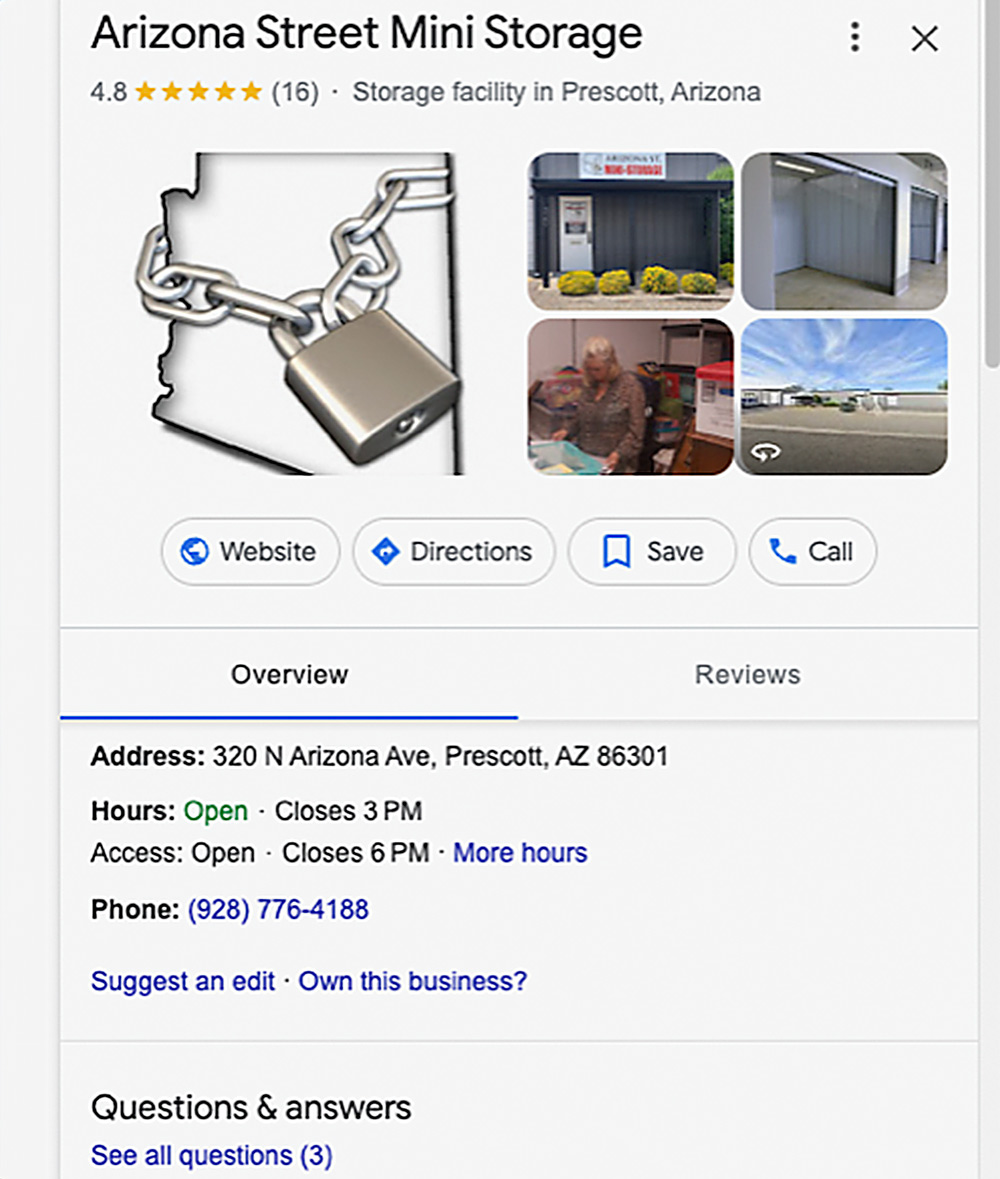
If they know your name, that matters also. Just looking at the several self-storage facilities that came up in Prescott, this one caught my eye because they have a logo. When I searched for their exact name, Arizona Street Mini Storage, I could get more info from their website. Notice in this screenshot, that their Facebook page came up in the search. That’s your next free tool!
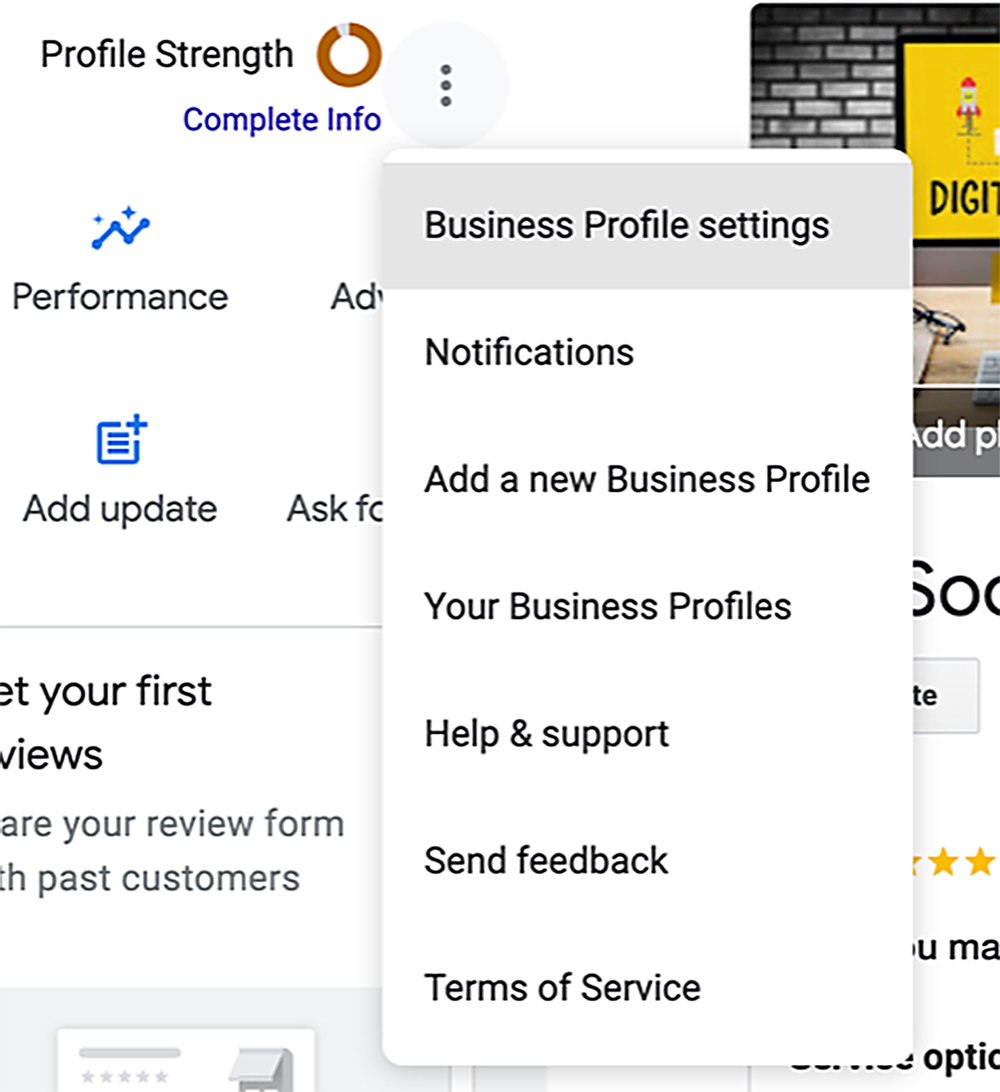
But first, let’s go over what your GBP should look like. Go to https://business.google.com/ and log into your Google account. If you have a Google Business Profile, it will come up. If you don’t, then follow the steps and it will guide you in setting up your profile.
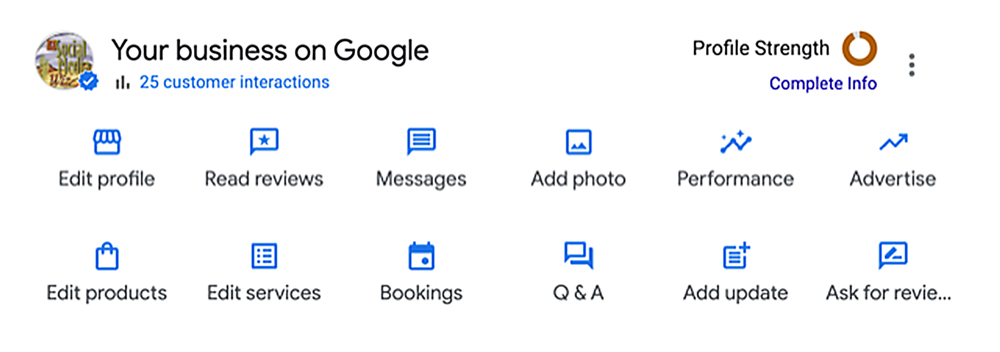
(See Images 6 and 7)
- Business Profile Settings — This is where you can add other managers. I recommend at least two people have access to your profile.
- Notifications
- Add a New Business Profile — This will apply if you have multiple locations.
- Help & Support, etc.
Go through each of these and make sure that everything is filled out and optimized with keywords.
Is the information you provided correct?
- Are your hours correct? Do you have holiday hours? Believe it or not, this is important.
- Are your blog articles posted?
How do you know if your profile was suspended?
- Your GBP listing is no longer visible on Google and Google Maps.
- You’ve lost control of your listing. This may happen when there’s a change in management or ownership, or an employee leaves and takes all your passwords with them.
- Your business is “unverified.”
You may have received a notification like: “Your access has been suspended (or disabled) because this profile doesn’t follow the guidelines.” They should provide a button for you to be able to edit your profile.
They also send you an email saying, “Your business profile has been suspended. Violation type: Content that violates our policies on deceptive content and behavior isn’t allowed. Deceptive content intentionally misleads or deceives others.”
You’ll see an “Appeal” button to appeal this discussion. Most times, they won’t tell you the offense. It’s up to you to determine what it was and avoid doing it again. You must fix what’s wrong before you submit your appeal.
It’s possible that you’ve been overzealous in your posting and Google thinks you’re spam. Maybe something you posted offended someone with a lot of clout. Don’t be surprised if a competitor is behind bad reviews or reporting your facility.
There are two types of suspensions: a hard or soft suspension. A hard suspension is when your business profile doesn’t appear when you Google your business name and city. This is bad. Google may have suspended you if it thinks your business is closed or you’re using spammy tactics. A soft suspension is when your profile comes up and you have access to your dashboard, but it looks like it’s never been verified as a local business and you can’t manage or update your listing. Here’s how to avoid being suspended by Google:
- No keyword stuffing (that’s overusing your keywords or your business name.)
- Don’t make a lot of changes or edits to your profile in one sitting.
- Listing your business hours as 24/7. If you have 24-hour access for your customers, that should be in your description and/or your services. State your office hours clearly. If you have a live-in manager, state the after-hours contact info clearly. Google may suspend you if your information is confusing in any way.
- You accidentally created more than one listing for the same location. In this case, disable the one that’s less complete. By no means should you create a new listing if your current one was suspended!
- Make sure any managers of your listing(s) are in good standing with Google.
Don’t violate any of Google’s terms of service (https://support.google.com/business/answer/7667250).
(See Image 7)
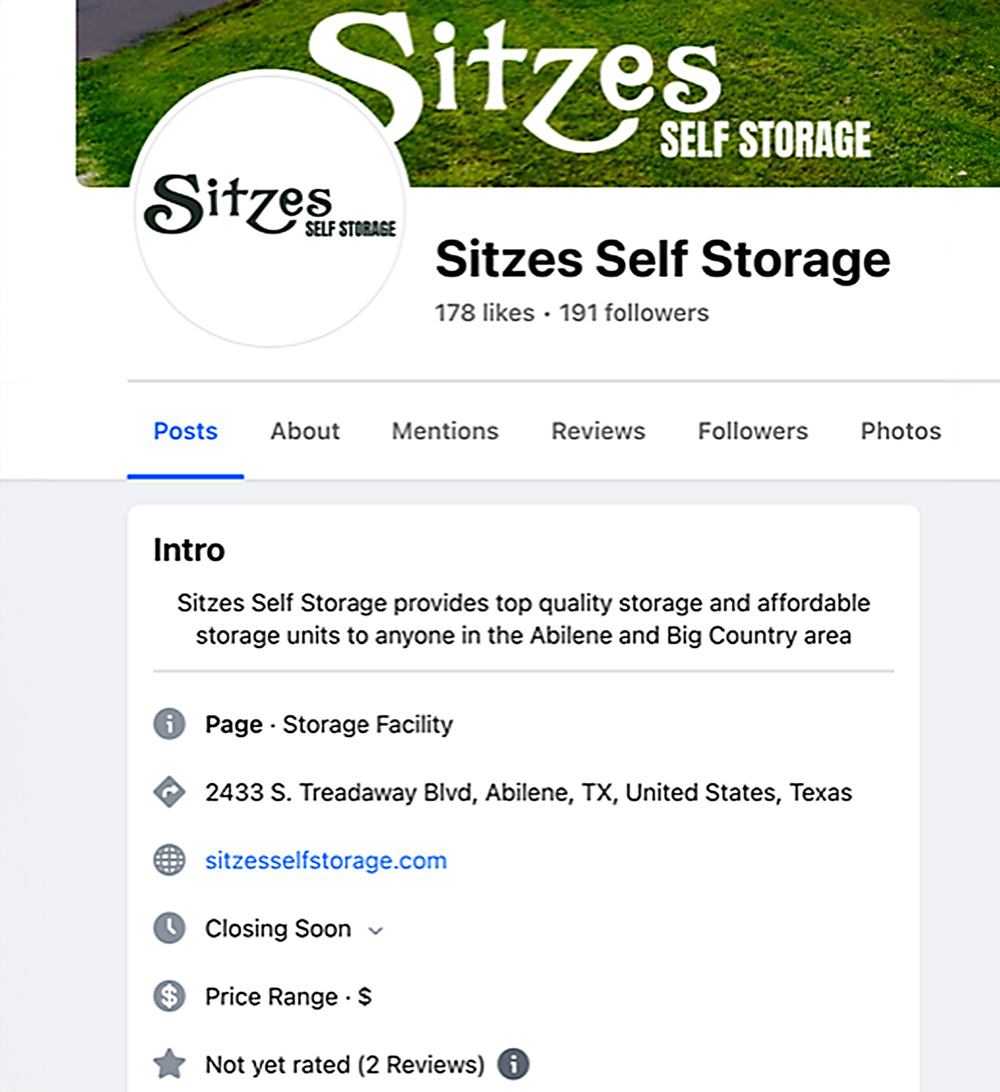
On Facebook, I did a search for “self-storage;” after the big corporate companies, the first independent self-storage facility that came up was Sitzes Self Storage in Abilene, Texas. This is a fairly nice Facebook page. It could be improved by adding more information in the About section, like services, however, I was impressed by the video they posted and the fact that they’re posting regularly.
Given that the self-storage business is not as glamorous as a restaurant, you’re not going to get many folks “checking in” at your location or taking pictures of themselves in their storage units. Nevertheless, you need to ask your happy customers for reviews, not just on Facebook but on Google, too.
This is easy to do if you email receipts to your customers. Just add a link to both and they can choose their preferred platform.
One more important, helpful thing: Every time you upload a video or picture, tag your location. If you have more than one location, you need a Facebook page for each one.
- Make sure your address is on your profile.
- Tag your location on every video or picture you upload.
- If you get an interesting customer, like someone storing a classic car, ask if you can take a picture of them in front of their car nestled safely in the storage unit with their phone. They, in turn, can upload it to their account and tag your business and location.
- Post stories (images or a short vertical video) at least once or twice a week. Tag your location, add your website, and any promotional information. Share them on Facebook, too.
A few points to remember:
- Links work in Facebook posts (in the text area) but not in Instagram posts.
- Links work in Instagram stories but not in Facebook stories. Yes, I know it’s confusing.
- You have less space in your Instagram bio than on Facebook, so use it wisely.
All in all, if these profiles are set up and optimized, and you post regularly, your search results, and ultimately your conversions (AKA sales), should improve.

aintenance is a structured process that can easily be altered from external sources. As the seasons shift and climates evolve, so too must the approach to facility maintenance. Just as nature experiences its ebb and flow, so does the rhythm of maintenance. This experience varies around the world, making it unique to every region.
Alternatively, every facility and its maintenance requires collaboration among various stakeholders, including facility managers, maintenance personnel, architects, engineers, and environmental experts. By fostering interdisciplinary cooperation and harnessing collective expertise, facilities can develop holistic maintenance strategies that address diverse challenges posed by changing seasons and climates.
Crafting a meticulous maintenance schedule entails understanding the nuanced protocols inherent to each season, adapting strategies to meet the challenges presented by changing weather conditions, and ensuring that facilities remain efficient, safe, and welcoming year-round by collaborating transparently with the correct individuals involved.
One should not wait for turmoil to ensue. Taking early preventative measures for the harsh weather conditions works greatly in any facility’s favor. Winter conditions to take into account are heavy rain, low temperatures, snow, ice, sleet, high winds, and even blizzards. These conditions can change a maintenance schedule monumentally, but hopefully will not have a strong impact upon a facility with the right measures in place.
Various types of materials are prone to deterioration during extreme seasons. Metal buildings can be corroded by extreme rain and storms, ropes necessary for opening doors or sustaining heavy materials can freeze and fray, and paint in a myriad of places is prone to chipping. All of this can be either prevented, or treated, with reactionary measures. Refurbishing metal with the necessary product and buying new rope, springs, or whatever materials necessary should be considered in reaction to extreme weather. There are some things that cannot be prevented, and in return will be responded to accordingly.
In regions where snow is a common occurrence, rock salt or ice melt is thrown onto common walking grounds to avoid slipping. Adam Pogoda, president of Farmington Hills, Mich.-based Pogoda Companies, says that while this is a solution for civilian safety, “it may cause corrosion to asphalt and surrounding materials.”
Teresa Sedmak, president of Rancho Cordova, Calif.-based Everbrite, Inc., noted that they also throw down salt for the winter, depending on the region of the country, and further mentions that Everbrite’s product, “ensures metal is maintained by a clear coating that is salt resistant, and is further rinsed and cleaned with fresh water.”
In certain areas of North America, there is the issue of paved surfaces becoming precariously prone to potholes. The extreme fluctuations in temperature, combined with normal deterioration, can cause a seasonal occurrence of potholes, providing all the more reason for maintenance teams to keep a close eye on their facility and the neighboring roads.
Sarah Beth Johnson with Universal Storage Group noted that, “having your site in tip-top shape is even more crucial in attracting potential tenants to your site over others.” Making sure external aspects of any building are presentable, updated, and safe is an essential aspect to a facility’s maintenance. She also suggests “having a friend secret shop your site. Others tend to see what we don’t. Just like at your house, you might not notice the mantle is dusty, but if you have company, they are sure to find that hidden dirt and deferred maintenance.”
Many companies care about upkeeping the appearance of their facility. For example, bollards, which play a critical role in protecting buildings and directing traffic, can be inspected, painted, and repaired to ensure their effectiveness and visual appeal. These, and many other facets of a facility’s external appearance, should be painted and checked for chips during the spring and fall.
A small, but imperative, example of preparation that should be taken during these seasons is assuring the main points of entry into the facility are functional and up to date. Neglecting to address issues with entry points like electric access points or manual locks could result in inconvenience or even safety concerns for tenants or facility workers, especially during extreme temperatures. When facility managers take precautionary measures prior to extreme weather, they will rarely be bothered with dealing with external problems such as points-of-entry issues during the winter and summer.
In regard to presentation, there is landscaping to consider, as spring will elicit a profound amount of vegetation and growth. Similarly, fall brings its own set of challenges, particularly with the accumulation of fallen leaves that must be cleared to maintain safe and accessible entryways. These two seasons are ideal as they provide the perfect temperature to upkeep laborious maintenance of any landscape.
There are a myriad of tedious actions to take when assessing a building’s astuteness. One must think in regards to comfortability for the tenants, workers, and overall structure of the facility. It is good to be mindful of cracks and open spaces in the building that can be filled during these seasons, as this will contribute to better insolation of building temperatures in extreme heat and cold. Johnson recommends checking spaces throughout the facility. “The restrooms must be clean, working, and stocked,” she says. “The hallways must also be checked and cleaned multiple times a day.”
Collaboration with energy specialists and HVAC engineers during this season is essential for optimizing indoor comfort and energy efficiency. By conducting energy audits, implementing energy-saving measures such as insulation upgrades and window tinting, and leveraging renewable energy sources, facilities can reduce reliance on fossil fuels, lower utility costs, and mitigate environmental impact.
Any tenant searching for a storage facility is going to prioritize their own comfortability and safety. It is paramount that any facility is safe for the sake of the staff, customers, and overall integrity of the institution. It is crucial to sustain optimal conditions for any facility, as it will contribute to attracting more tenants while keeping the staff comfortable and the facility in working order.
It can also be helpful to collaborate and implement interdisciplinary approaches to achieve effective facility maintenance across the four seasons. By harnessing collective expertise, sharing best practices, and fostering partnerships with diverse stakeholders, facilities can develop resilient, sustainable maintenance strategies that prioritize occupant safety, environmental stewardship, and operational efficiency throughout the year.
Ultimately, regardless of the season, the primary goal of facility maintenance remains unchanged: to provide a safe, functional, and welcoming environment for occupants while preserving the integrity and longevity of the building. The maintenance of facilities throughout the four seasons demands a multifaceted approach that considers the unique challenges and opportunities presented by each season. By implementing proactive measures, addressing maintenance needs promptly, and leveraging innovative solutions, facility managers can ensure that their properties remain safe, functional, and attractive year-round. Whether braving the winter chill, embracing the renewal of spring, savoring the warmth of summer, or preparing for the transition to fall, strategic maintenance practices are essential for the sustained success and resilience of any facility.


ack in the 1960s, an inventor formulated a liquid coating for the U.S. government. When applied to metals, the coating formed a protective barrier that prevented sunlight and saltwater from causing rust and corrosion. While protecting the metals, the coating also improved the appearance of faded metal.
After the coating’s inventor passed away, Teresa Sedmak, president of Everbrite, Inc., and her husband, Steve, purchased the rights to the formula. Working as contractors within the mobile home industry, the couple started using the protective coating to restore the aluminum siding of mobile homes in 1990. Business was going well, and all their customers were pleased with the restorative results of the coating. Then, in 1996, Everbrite discovered a new opportunity. They easily and quickly added another vertical market to their business when one of their clients, an owner of a self-storage facility, inquired about applying the coating on roll-up doors.
“He said, ‘My brown doors are old, faded, and ugly; they’re 20 years old and I want to make them look better,’” recalls Sedmak. “So, we restored his property in Roseville, Calif., and made the doors look brand new and thought ‘Wow! This is great!’”
“Our first exhibit was in Chicago in 2000, and people were lined up around our table.”
“The first trade show we went to was in 1999 in Philadelphia to check it out. We have grown the business through the self-storage trade shows,” says Sedmak. “After we saw the potential of the trade shows and met some people in the self-storage industry, we decided to get involved. Our first exhibit was in Chicago in 2000, and people were lined up around our table. They were so excited to learn about something that could finally be done about these old, faded doors.”
Although chemicals were not permitted on the trade show floors, thus eliminating live demonstrations, Everbrite’s booth presented proof of the product’s effectiveness via impressive before-and-after photographs. “We had one of those trade show booths that was a pop up with carpet on it with pictures applied with Velcro,” she says. “We had lots of pictures; of course, the self-storage doors show so well because the before and afters are so in incredibly great.”
The pictures were definitely worth a thousand words, but the Sedmaks were always available to discuss Everbrite’s protective coating with interested individuals at trade shows. “They lined up and we got in touch with them,” she says, adding that Everbrite, Inc. became a vendor member of several self-storage associations after receiving such a warm reception at the company’s first trade show. “We are members of the SSA, and have been since I think 2000, and we are members of California and several of the states. We have been members of Texas [TSSA] because they have a really great show.”


In addition to Google Ads and YouTube videos, Sedmak says Everbrite’s website, which was launched in the late 1990s, enabled the company to start selling its products online. She also astutely incorporated trending keywords into the website each time a new industry contacted her about Everbrite’s products to take full advantage of organic SEO.
“As somebody in the jewelry industry would talk to us, then we would sell more to the other jewelry people,” she says about her keyword strategy. “If somebody with aluminum siding or copper roofs or other things started to need us, they tell their peers, we put it up online, and we get other people who use it … the internet really made us grow.”
Sedmak and Everbrite also focused on curating content, specifically how-to videos for their YouTube channel. “So, if somebody wanted to try it for their own storage, they could buy a kit, watch a video to show them how it’s done, try it on one or two doors, and then they can either do it themselves or we can get them a certified contractor in most areas of the country.”
Sedmak and the Everbrite team also wanted to expand the company’s product line to help owner-operators protect other surfaces within their facilities. “We needed something that was stronger for door handles and sinks and other areas that get a lot of use, elevators and that type of thing, so we invented ProtectaClear, which is a harder coating,” she says. “Since then, we have come up with a few variations, but our basic product line has stayed the same.”
Besides the Everbrite and ProtectaClear lines, the company also offers CrobialCoat, which includes Microban technologies to reduce the growth of bacteria and microbes, as well as cleaners and polishes for the various coatings. “All our coatings are made with no carcinogens; they are solvent based, so you don’t want to drink them, but we are very proud that there are no carcinogens in them. That is very important to us.”
Everbrite was reaching more customers than ever before thanks to its expanded product line, but COVID-19 shook up the company’s structure approximately a decade later. Because nonessential employees were not allowed to leave their homes during the lockdowns, Sedmak and the Everbrite team of contractors discontinued the application side of the business. Instead of applying the coatings themselves, the company elected to start a network of certified contractors to do it.
“We transitioned out of ourselves doing it because my husband [who ran Everbrite’s contracting division] was ready to retire and we didn’t have other people to take over that division,” says Sedmak, who mentions that it was a blessing in disguise as it eliminated the need to hire people to apply Everbrite’s coatings, which was becoming increasingly difficult, particularly in California. “So, in the meantime, we have trained other contractors. They come out to the company’s Rancho Cordova, Calif.-based office for training. We train them exactly how to do it; once they are certified contractors, then we refer them to other customers in the self-storage industry.”
The training course, which was designed by Sedmak’s daughter, Jackie Belau, teaches them about Everbrite’s products and how to use them. “It’s not just classroom training or internet training,” she says. “They come in, they put it on metal, and then they take it off; then they learn how to put it onto other surfaces like stainless steel, and they take it off. Then they go out to a self-storage facility here locally and they actually restore some doors, learn how to do the work so that they can see what it’s like to do the doors the proper way. So, they get complete hands-on training.”
Currently, Everbrite’s contractor network has approximately 30 contractors who apply the protective coatings across the nation, thus enabling Sedmak and the other nine Everbrite employees to direct more attention on manufacturing and selling the products to more industries in more countries. Beyond self-storage applications, Everbrite’s products are used to protect historical and high-rise buildings, including the Empire State Building; metal art; automotives, including Tesla’s Cybertruck; boats; patio furniture; water treatment plants; and “any metal that needs protection from sun, salt, air, and corrosion.”
According to Sedmak, the company’s goal is to keep its industry list “very diversified” to ensure its success no matter what’s going on with the economy. “We sell in so many areas and so many industries, and there are so many different uses for it that if one thing turns down because of the economy, the other ones stand up.”
She goes on to say, “We have distributors in New Zealand, Australia, England, and South Africa. And we sell all over the world out of here [the Rancho Cordova, Calif.-based headquarters].” However, Sedmak notes that most the company’s self-storage customers are in the U.S., while a few have been from Canada and Mexico.
“We ship all our products out of our offices here, package, pack and ship; we do all the customer service and technical support as well,” says Sedmak. “We are a small company, but we like it that way. We can give individual help to all our customers. We’re not so large that we lose that friendly, helpful staff, but we’re well enough established, where even large companies can rely on us. We’re not going anywhere.”
In 2019, to further solidify Everbrite’s place within the self-storage industry, the company created a “Top Operators Program” that enables participants, like StoragePRO Management, the program’s first member, to learn how to apply the coatings but with ongoing support from the Everbrite team. Having an in-house facilities team trained in the Everbrite Restoration System process decreases maintenance expenses while increasing curb appeal.
There’s even a possibility that Everbrite will someday be passed on to Sedmak’s young grandson when he’s older. Until then, she’s more than content with her role within the company. “I will always keep my fingers in it … I love the advertising and the marketing and talking to our self-storage friends.”
And so long as Everbrite’s receiving positive feedback, her steadfast dedication to the company she built alongside her husband is all worthwhile. “We’ve had a lot of people who write and tell us thank you for making their property look great or thank you for helping them solve a problem with their buildings or that type of thing,” says Sedmak. “I think our awards are happy customers.”
Erica Shatzer is the editor of Modern Storage Media.

s self-storage still a local business? While many developers have long adhered to the real estate principle that the three most important factors of site selection are “location, location, location,” David Dodge, president of Little Rock, Ark.-based Paramount Metal Systems, believes the internet has somewhat “taken away” the local aspect of self-storage.
Though most renters still prefer to store their belongings near their homes or workplaces, with 69.2 percent traveling 19 minutes or less to their storage units, according to the SSA’s 2023 Self Storage Demand Study, nearly 30 percent are 20 minutes or farther away from the self-storage facility where they rent units. The ability to search online for “self-storage near me” likely provides prospective customers with more options than they were aware of, but Dodge, who entered the metal building industry in 1982, joined Paramount in 2004, and has contributed to more than $500 million in revenue over a 41 year span, was more so referring to the internet’s impact on the pre-development and development aspects of the business than the end user.
Their inability to “qualify information” prompts them to attend self-storage trade shows and speak with the various vendors to obtain professional guidance. However, Dodge states that they may not leave the trade show floor with a better understanding because there have been so many new entrants into the industry in the last few years.

“In the old days, we used to go through every detail of the job,” Dodge says, adding that thoroughness yields a more accurate estimate and can prevent change orders down the line. “The least expensive road isn’t always best.”
Alternatively, when it comes to providing ballpark figures, Dodge says it’s hard to hit the mark. “When you buy groceries, the cost depends on what you put into the cart,” yet one thing should be obvious: The more units, square footage, features, amenities, and high-end finishes included in a project, the more it will cost to develop.

Unfortunately, doing the latter oftentimes means cutting corners. “We’ve adapted as creative, out-of-the-box thinkers,” he says, “to encompass a broader stroke to offset these costs.”
As for increasing rates to offset inflation, Dodge says, “We don’t want to pass those along,” but volatility in the world markets has caused volatility in pricing. “We have no control over that.”
“Everyone wants the Cadillac for the Chevrolet price,” he says. “It doesn’t work that way. You get what you pay for. If the difference brings you pause, maybe you shouldn’t proceed.”
Dodge goes on to say that self-storage development is “not $50 per square foot like it was 20 years ago. The overwhelming explosion of new facilities built has moved that cost to a minimum of 30 percent or higher.”

For example, Dodge points out that there are five or six new self-storage facilities coming on line in the greater Little Rock metro. They are all within three to five miles of each other, with some even closer, which doesn’t bode well in a stagnant growth market. “The city hasn’t grown enough for that amount of new supply,” he says, adding that feasibility studies conducted by an unbiased third party are essential—not optional—for the continued success of the entire industry.
Due diligence and feasibility studies aren’t just prerequisites for new developers either; the most astute self-storage developers realize that each project is unique and there’s knowledge to be gained from each one. As such, Dodge likens self-storage development to deer hunting: The first time you go out into the woods, even though you’re prepared, you may not get to pull the trigger. When you finally shoot one, you may think you know everything about hunting, so you go looking for another buck. If you don’t bag another and find yourself stuck in a rut, it may be necessary to learn some new tips.
“In the beginning, building a facility starts with an idea (Phase 1),” he says. “You’re not sure how to go about that idea because you have so many choices to choose from, but in the end, you decide and jump in (Phase 2). After you have built your first facility and reap the benefits from it, now you have become an expert rather than a novice and earned the right to call yourself a developer (Phase 3). Success in doing it again sometimes requires reverting back to Phase 1.”
On the topic of construction costs, Dodge mentions that it now takes longer for self-storage developers to see a return on investment (ROI). Unlike vendors, suppliers, and builders that can pass cost increases on to the developer, the owner-operator cannot offset the additional expense as easily. To remain competitive with local competition, rental rates should not exceed what tenants in the market are willing to pay. “They can’t pass all the costs on to tenants,” he says. If they did, they would likely have a very difficult time leasing up.



ow do you measure your marketing successes (or failures)? How do you know if your marketing efforts worked? What’s nice about today’s digital marketing is that we have access to a lot of free data. You must track your marketing efforts and review your data at least monthly. Don’t get nervous. You don’t need a degree in calculus or statistics to understand analytics and insights. I’ll explain everything step by step.
ROI is easier to measure if you do paid digital advertising, which is old-fashioned advertising but online. You can lead a potential customer to a sale by tracking how many clicks the ad received and how many visits to the website it produced. The advertising platform will give you a “key” (a strip of code) to add to your website that will track people from the ad.
According to Megadigital.ai*, the average conversion rate through Google Ads for industrial and commercial businesses is 7.91 percent.
Conversely, if you don’t do paid advertising, that is, market organically, you must work with your own goals and metrics; those are KPIs (key performance indicators). KPIs are any measurement that matters to you and your business. KPIs include:
- Sales (obviously)
- Unique visitors – How many people visited your site, not counting multiple or subsequent visits?
- New visitors vs. returning visitors – New folks are great, but returning visitors are better.
- Conversions – Downloading a freebie in return for leaving their name and email address is an example. If you had 100 visitors and 10 downloaded the offer, you have a 10 percent click-through rate. Average click-through rates are 1 to 3 percent. That means you need to attract a lot of traffic and have a great offer of interest to your target audience.
- Page views – How many pages did each visitor view while they were on your site? Likewise, how many visitors did you have to specific pages? For instance, if you’re doing a specific promotion, either paid or organic (non-paid), you want to see how many people visited the page.
- Time spent – How long did they stay on the site? The longer people stay, the better the chances of them doing something.
- Click-through rate (CTR) – This measures how many people clicked on a link. If you had 100 visitors and 10 clicked on a link, you have a 10 percent click-through rate.
Does social media help? Believe it or not, social media helps drive traffic to your website, as well as with SEO. How do you know which network is performing better for you? Or, for that matter, which posts did better than others?
Then, when they got to the website, did they convert? Conversion could mean downloading your special offer, contacting you, or becoming a customer. If not, where did they go? Do they get lost in your website without a clear path to what you want them to do?
- Set up Google Analytics* (GA) – GA is a powerful tool that can give you very deep analytics when set up properly. But it needs to be set up and the code must be added to each page of your website.
If you have a WordPress site, there are free plugins like SEO by Yoast and Google’s Site Kit.
On other platforms, there should be a place in the backend where you can add the GA code in the setup.
GA won’t track anything if the code is not on your pages. In other words, it must be connected to your website.
- Tracking codes (measuring with UTM links) – Google offers a free tool* to track the origin of a visitor. It requires Google Analytics. Use this consistently in your promotional posts on social media and your email marketing campaigns.
- Call to Action (CTA) – Capture leads and grow your email list with intriguing CTAs. The job of good, quality, helpful content is to attract visitors. The job of a good CTA is to convert the visitor into a lead. And these leads are warm, if not hot. They’re interested.
- First, your intake form should get a little more information than just their name and email address (company and phone number may be optional). You can ask them two or three questions to segment your list. For instance, if you offer a coupon with a discount, you can ask if they need the storage unit temporarily or long term. Other pertinent questions could be what type of storage they need and when they need the unit.
- Once you have them on your list, if you haven’t heard from them in a day or two, based on their answers to the questions, send them an email with a video or a link to a pertinent blog article on your site. If they watch the video or go to the link, they’ll receive another email in a day with a different offer. If they don’t click on anything, send them a different email with another video or relevant article. This is marketing automation; all this is set up and tracked by the email program you use, like MailChimp or Constant Contact.
- Follower demographics and statistics – Once you have 100 followers, the networks will provide user stats like age, gender, likes, geographic area, etc. The demographics of your followers must match your target market. Because you’re a local business, serving a local area, if only 7 percent of your 1,000 followers are local, that’s not enough. Sure, it will help with SEO and brand recognition, but is someone in London (unless they’re relocating) going to use your facility regularly?
- Reach – This can mean different things on different networks, and it can be known as impressions. Basically, it’s how many people viewed your post. That means they were logged in and your post (or ad) passed before their eyes in their newsfeed. Good reach helps with brand recognition.
- Engagement – This is what’s important. The more an audience engages with your posts, the more visibility the networks will give you. Did they:
- Like or react,
- Share or repost,
- Comment,
- Click on a link, and/or
- Watch the video (the whole thing or just a few seconds)?
What do you do with all this information? Don’t get caught up in all the data. It’s people first. You’re doing all this to build relationships that build trust and credibility. Furthermore, the data will tell you what’s working and not working.
First, set goals with what you want to accomplish in the next 30 days. Go one month at a time. It’s easier to digest. Moreover, it helps you to be flexible and pivot quickly depending on economic and industry trends. For instance, every business that had their 2020 marketing plan all set in December 2019 had to stop and pivot everything (even their businesses) in March 2020.
- How many people visited your website? If you didn’t have Google Analytics set up before, you don’t have anything to compare it to, and that’s true for a brand-new website. Is the number substantial? Are you happy with it? If not, then you need to blog more and post more. Make sure all your pages are optimized.
- How long did they stay and how many pages did they view? Obviously, as you put more content on your site, visitors will stay longer.
- How did the UTM codes do? Which promotions garnered the most clicks? Repeat the ones that worked.
- How many shares did your posts get? This gives you social amplification or increases your reach. A follower has to like your post enough to share it with their friends and followers.
- What types of posts did better? Videos, links, or graphics?
- How many new followers did you get? Obviously, not everyone who starts following you is going to follow you forever. This applies to your email list as well. If they don’t need your services any longer, they’ll unfollow and unsubscribe.
- Which social networks drove the most traffic to your site? In your analytics, under acquisitions, the search engines are usually first. If you’re new to blogging, it may take a while for Google to notice you, so keep publishing articles several times a week. Next in line will be the social networks. Focus your time and efforts on the ones that brought you the most traffic.
- Which were your most popular blog articles? Write more of those.
- You then take all this information and adjust your strategic and tactical marketing plans for the next month. Repeat monthly.
- Finally, don’t freak out if one metric is down! It’s just one metric. You must look at all your marketing efforts, especially your website traffic and conversion rates. What’s more, don’t forget to take into consideration the seasons.
- No traffic to your website – If not enough people went to your website, it could be that your message is wrong or it’s reaching the wrong audience. In other words, you don’t know your target market. Consequently, you’re not showing them how you can help them with their problems or pain points.
- No Conversions – You are getting people to your website, but they are not converting. The problem could be that:
- The call to action isn’t clear, enticing enough, or obvious to the visitor. What do you want the visitors to do when they land on your website?
- Your website content isn’t selling your facility. What is your top objective?
- You’re not attracting the right target for your business or there’s no interest.
- Your website is ugly and confusing.
Ultimately, your marketing efforts should yield you:
- increased traffic to the website,
- better search engine results page (SERP) rankings,
- increased sales,
- increased following,
- brand awareness, and
- your business goal or objective.
The top 10 reasons why your social media isn’t working are:
- You didn’t set SMART goals. Goals should be specific, measurable, attainable, relevant, and timely. That way, you’ll know when you’ve achieved them.
- You don’t have a strategic marketing plan. Or, if you did write up a plan, it was written years ago and is probably irrelevant now. A strategic plan is a living, breathing document that changes each month.
- You didn’t create a tactical plan outlining how you’re going to implement the strategic plan. This is like a to-do list of what you’re going to do when and for how long.
- You are trying to reach a target market that’s too broad. Defining a target market niche is crucial, and you can have more than one target audience. You talk to men differently than you talk to women. The same thing applies to baby boomers or millennials.
- You didn’t do your research. If your target market is on LinkedIn, why are you spending so much time on Facebook? Maybe it’s the other way around. You must know your target to know where they’re hanging out online.
- All you are posting are sales pitches. It’s not all about you! Follow the 10-4-1 rule. Out of every 15 posts in any given network, 10 are other people’s content of interest to your target, four are your original blog posts or tips, and one (only one) is a direct sales post. Share; don’t sell!
- You’re not blogging enough. Ideally, you should blog two to three times a week. The more often you blog, the more traffic you’ll drive to your site if you’re sharing it on social media properly. Your blog should also be set up properly as part of your commercial website.
- You’re not checking your analytics and insights. These tell you invaluable information about your followers and the types of posts they like and engage with. They will also tell you if you’re reaching the right target. This is especially critical for local businesses.
- You are not planning. Each month is different. Besides seasons and holidays, you have observance and awareness days that will be trending on social media. Search for the word “trending” on this site to see what will be trending in the current or coming month. I publish an article on my website on the monthly trends toward the end of each month for the next month.
- You’re not devoting enough time to it. If you’re starting from scratch with little or no following, it takes 90 minutes a day of work over all the networks besides blogging three times a week for 30 days to grow a following. Once a following is built, then you can manage your social media in 30 minutes a day with the free online tools. Yes, it takes some sweat equity, patience, and perseverance, but depending on your business, you should start seeing results in one to three months.
Don’t forget your email marketing reports. If you send out a regular newsletter (at least monthly), you should track the open rate and the click-through rate and look at which links were clicked on the most. You also want to see how many people on your list are actively opening and reading your emails. If you’re sending out the same old emails, you’re probably not going to be very effective.
In conclusion, successful marketing involves creativity as well as research to know your target, your industry’s market, and how best to reach the target(s). If you try and fail, you must analyze where you went wrong.
If it’s working, keep at it! It’s a marathon, not a sprint! If you stop marketing, people will think you fell off the face of the earth!
Either way, when you’re armed with analytics and insights, you can adjust your strategic and tactical marketing plans accordingly for the next month and reach your goals.


ince its birth in the United States more than 60 years ago, the self-storage sector has evolved to a $58.26 billion industry. Once a temporary way to earn income on land investments until something more permanent was viable, the hastily erected metal warehouse buildings are seemingly now out of fashion, being replaced by architecturally rich, multistory facilities with features such as controlled climates, video surveillance, multi-purpose lobbies, and more.
Today, the self-storage industry is on the brink of another epic shift. The industry is seeing a dizzyingly rapid consolidation of ownership as developers and investors rush to be a part of this asset class. This means that many small, mom-and-pop business entities that have historically owned the lion’s share of self-storage properties are being edged out, replaced by institutional investors (REITs) and other large investment groups.
Spurred by a combination of population growth and post-pandemic demand, the number of households renting self-storage units was at an all-time high of nearly 14.5 million in 2022, or 11.13 percent penetration, according to the 2023 edition of the Self Storage Demand Study published by the Self Storage Association. This was to the benefit of the approximately 70 percent of self-storage facilities owned by private entities with fewer than five assets in their portfolio.
There’s no doubt that self-storage is a healthy industry that continues to grow; however, this time, expansion will be driven not by independent operators but by institutional investors and other larger entities. In just a few years, fewer than half of all self-storage businesses will be harnessed by small, private operators.
It’s a typical small business environment full of pride of ownership. Mom-and-pops ensure the facilities are well maintained, even if they aren’t fancy. Most are single-story structures with exterior, drive-up access and roll-up doors—not many frills, but they serve their purpose. While on-site staff is typically not “9 to 5,” these owners know their customers and personally respond to their requests.
With little stress and minimal tenant turnover, owning a self-storage facility emerged as a good side hustle or a post-retirement income stream for many rural landowners.
The recent pandemic also carried self-storage into the investment spotlight. While residential construction and the housing market screeched to a halt, self-storage prospered. Room was needed at home for temporary classrooms or workspace. That meant home furnishings and belongings needed space away from home. Count that as another boost for self-storage.
And when demand peaks, it’s easier for this asset class to capitalize. Rents can be quickly adjusted up to push revenue. The month-to-month lease structure of self-storage allows owners to quickly increase rates to capitalize on demand or downshift to be more competitive when demand softens. It’s a practice similar to hotel room pricing, but unlike the hospitality world, self-storage requires far less management than hotels.
Further stabilizing this sector, unlike multifamily housing, where the eviction of nonpaying clients is a lengthy and arduous process, removing non-paying storage tenants is relatively easy, allowing non-performing units to quickly return to inventory.
And many times, self-storage facilities fit where other products can’t or won’t. Geographically undesirable lots on a market’s periphery, where building costs are often significantly less, are well-suited for self-storage, an asset class that collects similar rents per square foot as residential, retail, or office properties.
With these fundamentals and lucrative characteristics, it’s easy to see why institutional investors have taken notice of self-storage since the turn of the century. According to Forbes, throughout 2001 to 2023 the average return on self-storage was 20.87 percent.
Investing in self-storage also offers owners the opportunity to invest in a targeted segment of a market. Typically, self-storage facilities target residents within three to five miles, minimizing the cannibalization of other properties or a hyper-focus of capital placement.
While the mom-and-pop owners often stuck with their own tried-and-true ways of managing their properties, newer investors deploy all the tools at their disposal (technology, in-house marketing complete with creative and digital teams, and more) to infuse the product with the proverbial bells and whistles.
And that’s a good thing, as millennials and Gen Z, the newest class of renters, follow the bells and whistles. They seek accessibility via digital platforms and are quite accustomed to gathering input and managing all aspects of their lives via mobile devices and the internet. These customers want to search for the closest facility on Google and explore property features, pricing plans, size options, and other elements on a website. Why worry about the personal touch that so many independent operators deliver when an app unlocks seamless access to a storage unit?
Not only are emerging technologies creating a better user experience for today’s largest renter segment, but they are also establishing efficiencies for the institutional operators. Automation and digital platforms require less manpower and on-site staffing. Today, cameras, improved lighting, fencing, and code-accessible gates and entry points address the top priority of security and keep the facility secure. Even when questions and other situations arise where only an actual human will do, operators utilize call centers or on-call staffers to address challenges rather than full-time, on-site employees.
Self-storage buildings are also looking a bit different than those of the past. Attractive façades, sleek lobbies, and climate-controlled interiors have elevated the self-storage experience while easing these facilities into communities where zoning commissions previously rejected the product. Some multilevel facilities even offer ground-floor retail space, expanding the amenities these properties bring to the community.
However, traditional mom-and-pop operators have been hesitant to jump on the facelift and high-tech bandwagons. Why fix what isn’t broken? And who can argue with them when they have facilities that are 100 percent rented? Obviously, their hands-on approach has worked for decades, so an investment in new technology seems pointless.
Even for those operators who adopt the shiny new features to compete with newer facilities owned by deep-pocketed investment firms, they are often two or three steps behind. After all, many owner-operators adopted this business due to its aversion to shifting trends, so sticking to the status quo seems logical. It works in some markets.
Following years of hyper-activity and transition, a slowdown is at our doorstep. As with all sectors, interest rates are impacting buying and selling within the industry, not to mention the housing market as well. Sustained high interest rates are lowering property values, making it difficult to find deals that were once quite plentiful. In particular, this is affecting properties in secondary and tertiary markets while those in primary markets have typically maintained their values.
It’s possible that the current economy will deter additional new developers and CRE investors from wanting to hop on the self-storage bandwagon, giving the industry a chance to establish itself in its new normal.
Overall, the predicted softening of interest rates will be favorable for self-storage, even if they don’t decrease as drastically as industry watchers are anticipating. As the rates drop, more properties will be sold, acquired, and/or improved. The economy will also ignite the housing market and boost the residential market with the resumption of new builds and developments. As previously mentioned, an uptick in households on the move drives self-storage rentals.
With consumers having many choices now about where to lock up their precious belongings, storage facilities that are strategic and intentional with how they market to and retain customers will be victorious. Undoubtedly, operators investing in marketing (in particular high-traffic channels such as Google or Facebook, optimized websites, or even grassroots campaigns) will thrive.
Yet, it remains increasingly important to understand the demands and needs of every customer segment. While technology has made it possible to run a storage facility with little on-site staffing, having a call center equipped to troubleshoot is essential, especially one that is accessible in the evenings and on weekends. While there’s been a trend toward the architecturally attractive, multilevel, climate-controlled facilities, some customer segments prefer a more traditional product. Even today, customers seek one-story facilities with larger units and drive-up access.
Dynamic pricing will also play a part in determining which storage companies succeed. In the fight for occupancy, operators that adjust prices in order to remain competitive with other nearby facilities will come out on top. Getting a customer into a unit at a lower price, then adjusting the price later, quickly boosts occupancy rates without too much hit on profits.
The most important lesson for operators to understand is that when investing in self-storage, it is an investment in a business as well as a real estate asset. Keeping a facility well-maintained, equipped with the best technological solutions, and competitive to market influences are all essential to maintain occupancy and profitability.
The bottom line: The consolidation of self-storage ownership will change the landscape of this industry forever. However, the fundamentals of understanding the market as well as the customer will forever drive the success of the self-storage sector for both mom-and-pop owners and large institutional investors.
arch 15, 2020: It was the day that the world began to shut down. The COVID-19 pandemic, which began with a whisper, suddenly hit the United States like a bull in a china shop, and just before St. Patrick’s Day, cities across the country began to implement lockdowns to help prevent spread of the disease.
Of course, a good number of Americans were not going to sit idly by. If they were going to be forced to socially distance themselves, why not do it by hitting the road or taking to the water? And just like that, RV and boat ownership surged to levels never seen before.
One man who was ready to handle this newfound need for freedom was Scott Ramser, managing general partner with Ramser Development Company, a business with an established portfolio of quality RV and boat storage, self-storage, and industrial outdoor storage (IOS) assets. “The demand during COVID was dramatic—unprecedented, even,” says Ramser. “While things have slowed a little since those days, we’re still seeing lots of activity.”
Of course, Ramser didn’t get into the RV and boat business as a result of COVID; he’d been honing this self-storage specialty business for decades.
In 1982, after attending the University of Southern California to study economics, Ramser was looking for real estate opportunities. He found a partner in his own family tree: his grandfather Harold.
Together, the duo formed the Newport Beach, Calif.-based firm Ramser Development Company in 1986. “Our first project was a property in downtown Los Angeles that my grandfather and I helped turn into an industrial building.”
Sadly, Ramser’s grandfather passed away in 1989, but he also passed on his passion for development to Scott. “After handling those first developments with my grandfather, I was hooked. With him as an inspiration, I went on to build more industrial buildings around LA. I did this throughout the early 1990s.”
Today, Ramser Development focuses on acquiring value-add assets and developing facilities in markets experiencing high growth. Since inception, Ramser Development has acquired, developed, or entitled more than 10 million square feet of industrial or self-storage real estate.
“We capitalize our properties on a deal-by-deal basis, and we’re constantly looking for new opportunities,” says Ramser. “In fact, we are looking to deploy $50 million over the next 12 months.”
“Because of HOA rules, I had to relocate my boat to a marina, and it hasn’t been cheap,” says boat owner Mark Eary. “The cost of the slip continues to go up, and I’m required to pay into the country club, a feature I don’t care about. Since I don’t use my boat every week, at this point it seems like storage may be the best bet—if I can access it easily when I need to.”
He’s not alone, and with less than 14 percent of existing HOAs offering storage and/or parking for watercrafts within their communities, Ramser knew this was the direction to take the business.
“We began expanding our RV and boat storage platform in 2003, adding RV Storage Depot Santa Ana to our portfolio that year,” recalls Ramser. “Today, we have over 2,500 RV spaces in Southern California.”
From there, Ramser Development Company continued to grow in the Golden State, with facilities in Orange, Los Angeles, Alameda, Yolo, and Sacramento counties. Today, Ramser’s largest California facility is located in Irvine and consists of over 1,200 outdoor self-park spaces.

While Ramser knew the property was ideal for personal RV and boat storage, he envisioned more for it—and then made it happen, opening the property up to IOS for commercial clients. “I rent a lot of land to fleets and laydown yards,” says Ramser. “Companies like Duke Energy, Ryder, Penske, and Tesla.”
Adds Ramser, “Amazon is another big client. We’ve had up to 1,400 of their vehicles parked at our facilities and have several deals with them in California.”
When asked why a company like Amazon, which one would assume has billions to play with, doesn’t just buy the land, Ramser had the answer. “It doesn’t always work that way, regardless of how much capital you have. Land may not be available or even for sale. Plus, sometimes a big company may not want to buy land. They’re more interested in a shorter-term contract with no permanent location. This way they’re not tied down to any one place.”
Although Ramser enjoys interacting with everyday tenants, he says he also enjoys working with big clients like Amazon. “RV and boat space is always 20 to 40 percent commercial vehicles or vessels,” he says. “Fleets, new car inventory, used car storage, etc. When I got involved in the storage business, I knew I’d want to attract commercial users. It’s a great short-term opportunity for them and they typically pay more than a retail customer.”
Because they pay more, Ramser doesn’t worry about them moving out at some point. “You make more with them, and you set aside that extra money. So, if they do leave, you have money and the ability to lease out to third parties under the normal storage scenario. I like to say B2B and B2C work together; it’s a great combo.”

Continues Ramser, “Each member of our team has a focus, but we still get together weekly, whether we’re covering accounting, investing, operations, or whatnot. On top of that, we have more than 30 employees spanning offices in Southern and Northern California, Maine, and Florida. They’re all held to the highest standard.”
Ramser, who worked with his grandfather when he was just starting out, remains open to working with others, especially investors. His investment strategy focuses on buying properties in markets with strong growth prospects, with the target acquisition prices typically falling between $4 million to $50 million. How does he find others with those deep pockets?
“They approach us,” Ramser says. “If they’re interested in RV and boat storage, they know our name. Other times, past investors reconnect for new ventures. They’ll tell us what a great experience they had before, and that they’d like to do it again. That’s music to my ears.”
Ramser says that he enjoys working with partners. “We have locations that are legacy assets owned by just me and one or two partners, but we also do limited partner investments to raise money for certain projects,” Ramser explains. “We’ve had as many as 30 people or companies invest in a transaction, with a minimum of $250,000. And we hold their hand if they need it, providing investment management support and quarterly reporting. We also handle distributions, tax returns—all the things associated with this type of investment.”

“Some people store valuable items in traditional self-storage, but a lot of the time, you get someone renting a 10-by-10 and tossing in a trash bag of old clothes, never looking back again,” says Ramser. “With RV and boat storage, most of the time you’re storing property for people that has real value. We’re talking $250,000 motorhomes or yachts that might cost more than someone’s home. These aren’t things that are going to be forgotten.”
For this reason, Ramser says that anyone considering developing or expanding to include RV and boat storage understand the importance of keeping their tenants happy. “RVs and boats are mobile. They can be relocated in an instant, unlike traditional self-storage, which can be a hassle to move. So, you tick off a tenant, and they’re apt to just drive away.”
Adds Ramser, “You also need to be mindful of rate increases because, again, these tenants are on wheels. There’s no loyalty; they’ll leave you.”
But where will they go? After all, the 2024 Self-Storage Almanac reports that there is currently an imbalance between supply and demand, with development of RV and boat storage not keeping pace with the increased demand for it.
“It’s true, right now their options may be limited,” he says. “We’ve had people upset with a rate increase move out, only to come back a couple days later because they couldn’t find anywhere else to go. And, at that point, the spot is gone. All we can say is ‘sorry!’”
Ramser says that although RV and boat facility owners may currently have the upper hand in this regard, it’s important to always take care of the customer because bad word of mouth travels fast, and no owner should want a reputation for taking advantage of tenants.

To that point, Ramser says he is always looking for new opportunities in California, Texas, and Florida. On top of that, he has been a member of the board of directors of the California Self Storage Association and Storelocal (a cooperative for independent self-storage owners, which he also founded). Ramser is also a shareholder in the organization’s subsidiary, Tenant, Inc., a SaaS technology firm focused on the self-storage industry.
With all this on his plate, it’s no surprise that he is open to a little help from the next generation. “My daughter Ally Young has worked with me for 12 years and is our chief operating officer, and my daughter Claire Curci has been with us for several years and she is head of business management,” Ramser says proudly. “This gives me and my wife Ann more time together to enjoy the water and our five grandchildren.”
“We have two other children who are working elsewhere right now,” Ramser adds with a wink. “We will see if they join us in the future.”
Unlike some items found in traditional self-storage units, RVs and boats are not cheap. Because of this, Ramser says security is of the utmost importance, and that’s why none of the properties he oversees are 100 percent remote, despite the trend.
“Some tasks can of course be done remotely, like check-in and check-out, making payments, and so on,” says Ramser. “But we still have someone on site during business hours. The value of these vehicles and vessels demand it.”
To keep the facilities secure, Ramser says there is no 24-hour access. “Nothing good happens after midnight,” he states, “so we shut it down. We have someone monitoring cameras though, and since it’s out of commission, if we see movement, we know someone is in there with ill intent.”
What if someone arrives late and needs to park their vehicle or vessel? “Our tenants know the rules. We give them a welcome packet that explains it all. They understand that if they show up after lockdown, they’re not going to get in. They’ll have to park somewhere else until 7a.m. It’s never been a problem, and they appreciate that level of security.”
Ramser is so serious about security that he’s had electrified perimeter fences installed at his properties. “Outside of California, where it’s illegal, our fences are electrified. if you try to climb one, you’re going to get zapped,” says Ramser matter-of-factly.
I ask if anyone has ever been zapped.
“No,” he says, adding wryly, “but you’re welcome to come by and test it out.”


he self-storage industry has drastically evolved over the last several decades beyond its traditional role of offering rental space to individuals and businesses due to the advancement of technology. Currently, many self-storage companies are continuously striving to meet the ever-evolving demands of customers, whether that’s through integrating technology to create a more convenient experience for renters or implementing state-of-the-art security measures to prevent theft and unauthorized access.
So, what’s next for the self-storage industry? The emergence of electric vehicles (EVs) presents a unique opportunity for self-storage companies to capitalize on this growing consumer shift and tap into a very lucrative market.
In light of this major shift, the goal of this article is to highlight the buzz around electric vehicles, the challenges around the availability of EV chargers, and how those who operate in the self-storage industry can leverage their existing infrastructure to tackle this developmental issue.
The current market for electric vehicles continues to increase, as sales in North America in the third quarter of the fiscal year grew 54 percent (O’Donovan, 2023). In 2023, North American EV sales were to be a total of 1.6 million and expected to increase to 1.9 million units in the U.S. and 230,000 in Canada by the end of this year (O’Donovan, 2024).
All of this certainly paints the picture that there is a market for electric vehicles. This is due to the collective push for EVs from the government and policy lawmakers, as well as a shift in consumer behaviors to strive for a more sustainable future.
In Canada, “Environment Minister Steven Guilbeault will effectively end sales of new passenger vehicles powered only by gasoline or diesel in 2035 (Gollom, 2023).” However, data on electric vehicle demand presents significant challenges for the industry to collectively meet the government’s mandate.
A recent study by AutoTrader (AutoTrader.ca, 2023) found that the “purchase intention has declined.” It also stated that “In 2023, only 56 percent of car shoppers who did not own an EV were open to purchasing one for their next vehicle—down from 68 percent the year prior.” In addition, the survey indicated that buyers are avoiding the purchase of an electric vehicle due to the state of the economy, citing the high electric vehicle prices, interest rates, and of course inflation.
To address this concern, it was estimated in an economic article (Young & Fanjoy, 2023) that “vehicle prices would need to come down by about a third to even half of what they are today, in relative purchasing power terms, for electric vehicles to be an affordable mass market.”
In the United States, there seems to be a slowdown as well, despite a record 1.2 million U.S. vehicle buyers choosing to go electric in 2023, according to estimates from Kellean Blue Book, a Cox Automotive company (Hailes, 2024). There has been pushback from dealers who have many unsold electric vehicles in their lots, so much so that more than 3,000 U.S. auto dealers asked the Joe Biden administration to “tap the breaks” (Carlson, 2024). Additionally, Tesla, a leader in the electric vehicle market, has indicated to investors that growth has slowed down in its electric vehicle sales.

Another notable reason for decreased demand is insufficient charging infrastructure, which presents a challenge for owners of electric vehicles. The insufficient number of charging stations can turn car buyers off from purchasing an electric vehicle, as they’ll be likely faced with the difficulty of having accessible chargers available to use (Marx, 2024).
Canada and the United States have been facing a ton of developmental challenges when it comes to electric vehicle charger infrastructure, which is evident as it’s directly impacting demand and buyer support.
The current number of EV charging stations and ports in Canada is extremely low. A CBC news article reported that Canada will need between 442,000 and 469,000 public charging ports by 2035, depending on the number of at-home chargers, according to an estimate by Natural Resources Canada (Mazerolle, 2023). As of Dec. 1, 2023, there are a total of 10,425 charging stations and 25,246 charging ports (Mazerolle, 2023). Ultimately, this suggests that there’s a lot of work to be done to meet the government’s mandate that 100 percent of new vehicles must be electric vehicles by 2035.
In the United States, “there are “170,000 publicly available EV chargers across the country,” as reported by the White House. However, Biden-Harris administration set a goal of 500,000 electric vehicle charging stations in the United States by 2030. Those stations would, the White House said, help push Americans to feel more confident purchasing and driving electric vehicles and in turn help the country cut carbon pollution (The White House, 2024).
Building electric vehicle charging stations is a very lucrative opportunity for businesses. EV Connect reported that “EV owners were willing to pay up to $3 per hour for charging and 12 percent were willing to pay $4 per hour, even if it only costs them $0.75 per hour to charge at home,” according to a survey from E Source. The willingness to pay becomes even higher when it’s convenient and can help reduce drivers’ worries about traveling a far distance and running out of charge while on the road (EV Connect, 2022).
Specifically, the installation of electric vehicle chargers could be an untapped stream of revenue for self-storage businesses. This is because self-storage facilities tend to already have the space and capacity to build charging stations and can reap the benefits of offering them to electric vehicle owners. Therefore, on top of being known for renting storage space to individuals and businesses, your facility can be recognized for providing people the ability to charge their electric vehicles. There are several other perks that self-storage facilities and their customers can gain from having electric vehicle charging stations on site:
- Take A New Position – Installing charging stations at your self-storage facility can show your customers and visitors that your business is forward-thinking and innovative. Offering forward-thinking solutions also highlights to them that you care about the community in which your business operates and its residents.
- Improve Customer Experience – Self-storage companies can also significantly improve the overall experience for their customers. This is because customers can visit their self-storage unit and charge their EV at the same time, which is extremely convenient and timesaving.
- Promote Sustainability Goals – This one is a huge benefit, especially if your self-storage facility is currently promoting environmentally sustainable practices or partakes in being a more environmentally conscious brand. Installing EV charging stations at your facility can help your business shine like a beacon for consumers seeking brands that align with their “green” values.
- Drive More Traffic To Your Site – Offering an additional service, such as charging stations, can drive more foot traffic to your self-storage facility, not only current customers but new customers as well. This is a huge plus, as your facility can increase sales from the additional revenue generated from the use of the charging stations. You can also take this opportunity to have your staff cross-promote other services that your self-storage facility offers, such as rental space, moving trucks, and packing supplies.
- Receive Incentives From The Government – You can likely take advantage of any government funding and rebates when you install electric vehicle chargers. Although government funding and rebates depend on the country, state, or province that a business resides in, it can be a great perk for self-storage companies to look into and see whether or not it’s worth it to invest in this initiative.

As a leader in the self-storage industry, XYZ Storage saw an incredible opportunity that aligns well with its values regarding operating sustainable and environmentally friendly services while helping to push forward the development of electric vehicle charging stations for Canadians.
At their Toronto Downtown facility (459 Eastern Ave.), which was recognized as Messenger’s 2020 International Facility of the Year Winner, XYZ Storage has taken a step forward in pushing the development and accessibility of electric vehicle charging stations for Canadians by installing charging stations at the facility.
The company’s efforts and commitments don’t stop there, as they continue the development of installing electric charging stations for electric vehicle owners who reside in the Toronto area. XYZ Storage has plans to install chargers at both of their up-and-coming locations on Dundas Street West and Bering Avenue. The self-storage company has partnered with Rick Brown + Associates to proudly design and launch self-storage facilities that not only serve as a second home to members of the community’s belongings but also offer services that promote sustainability.
“We’re honored to play a role in helping push Canada’s electric vehicle development efforts towards creating a more sustainable future. We also very much look forward to continuing making meaningful sustainable contributions along the way,” says Partner and Director of Operations Leslie Kellen.
XYZ Storage is certainly paving the way for other businesses to follow when it comes to ensuring there are enough electric vehicle charging stations available across Canada and the United States.
So, what plans does the government have to increase the availability of chargers? The Government of Canada has a “Zero Emission Vehicle Infrastructure Program” in place to drive this initiative forward across the country. There will be three funding streams available over the next few years, a total of $680 million worth of funding to increase electric vehicle charging availability and hydrogen refueling opportunities. This program has led to Canada investing over $1 billion since 2016 to making chargers more accessible and electric vehicles more affordable (Government of Canada, 2024).
To continue pushing the sales of electric vehicles, the federal government of Canada is offering Canadian vehicle buyers a rebate of $5,000 for fully electric vehicles and $2,500 for hybrids within certain price points (Mazerolle, 2023).
Earlier this year in the United States, the Biden-Harris Administration announced $623 million in grants, which includes at least 500,000 publicly available chargers by 2030 (U.S. Department of Transportation, 2024). According to the U.S. Department of Transportation, this is to help grow the electric vehicle charging network across the U.S.
“On Nov. 15, 2021, President Biden signed the Bipartisan Infrastructure Law, also referred to as the Infrastructure Investment and Jobs Act, which contains $7.5 billion in new funding for EV charging stations, makes EV charging infrastructure eligible for additional Federal funding programs, and provides funding for numerous other EV-related initiatives (U.S. Department of Transportation, 2024).”
With the government offering grants to businesses interested in growing the electric vehicle charging infrastructure, the adoption of EVs can become more appealing to the average consumer. In addition to growing the charging network for EVs, it’s important to note that creating affordable EVs for the masses to increase demand is a huge contributing factor to the success of widespread adoption (Gollom, 2023) and would increase the chance of meeting government mandates for the next decade.
In conclusion, the self-storage industry has the potential to make real and transformative changes in the electric vehicle industry. As the government pushes for the adoption of electric vehicles, the challenge of limited infrastructure presents a barrier to widespread adoption. Consequently, it is even more important that other businesses step in and contribute to overcoming this major challenge.
Self-storage facilities and other businesses can take advantage of grants and government funding as an easier point of entry into the business of providing electric vehicle chargers, while also benefiting themselves. However, it’s critical for businesses to do their research on what is available in their country, state, or province in terms of grants and funding to support this initiative before deciding to join this business venture.


ow can lackluster rows of flat, windowless storage buildings become a benefit to communities? It turns out, they are a perfect medium for public art installations. Security Public Storage (SPS), owned by San Francisco-based Baco Properties, has seized the opportunity in 14 locations, creating vibrant, large-scale murals that commemorate each community’s history and identity.
“The purpose of our murals is to beautify the community through public art displays,” says Sharon Thornburg, director of marketing for Baco Properties, “to give back to the community and to celebrate their contributions.” She says Ben Eisler, the company’s founder, and his son, Michael Eisler, who is president, are dedicated to every community in which they operate. Although SPS properties span from coast to coast, she says they are always a local business.
Although the colorful murals add visibility to these facilities, Thornburg says that’s that not the motivation. “The murals are a big investment, but we are investing in the city and our longevity there,” she says. Of the 53 properties SPS has built or purchased over the past 40 years, none have ever been sold. “When our owners purchase a facility, it’s really forever,” Thornburg says. “When we go into a community, we are there to stay. We become a fixture in the community, and we build relationships.”
SPS typically commissions two murals each year. They’ve completed at least one new mural installation every year since 2016, the largest comprising over 4,000 square feet. Most are installed at existing facilities, but offering this benefit to the community can help SPS get approval for new projects as well.
“When we’re talking to cities about building or converting a property into storage, it can help,” Thornburg says. “With our next one coming up in El Cerrito, public art was part of the plan. We knew the community had an arts council and that they were attracted to public art. We thought it would make our proposal more enticing since we were going to bring in a mural.”
However, in locations where the buildings aren’t that visible, it doesn’t make sense to create a mural where few people will see it. “The owners feel very strongly that the murals are a gift to the city, to help beautify the city,” Thornburg says. Communities have always welcomed the art installations. “We haven’t proposed a mural and had it stricken down by any type of agency or local government.”
Paul Anderson, local marketing manager for SPS, says the murals often get considerable news coverage and local dignitaries attend their dedication events. “The biggest press coverage was our Fruitridge Road and MLK Boulevard location in Sacramento,” he says. “We had huge support from the community. The mayor, city council members, and local business leaders came out.” All four local news channels covered the creation and dedication of the murals.
SPS chooses the themes for each mural through collaboration with the community. “We reach out to city hall, historical organizations, and service clubs,” Anderson says. “We look for various landmarks or what the city is known for. We are a community company even though we’re nationwide.”







The latest mural was created for the Woodland facility in Modesto. Calif., and celebrates the city’s treasured icons and industries. Five individual displays span 2,300 square feet of wall space. The American Graffiti Festival wall highlights Modesto’s connection to the movie “American Graffiti,” which was filmed there. Anderson says that George Lucas, who directed the iconic film, is from Modesto and was inspired by his teenage years there. The other murals commemorate the local baseball team, E&J Gallo Winery, and almond production, showcasing the beauty of local orchards and importance of the almond industry to the region.
Ragg also created “Manteca Treasures” in 2023. The large-scale installation in Manteca, Calif., measures 330 feet long, covering nearly 3,300 square feet. During its creation, hundreds of local residents honked, waved, or stopped by to share their appreciation with the artist. The mural celebrates the area’s colorful heritage, including its designation as the “Gateway to Yosemite.” Other mural panels highlight farming, rafting, a state park, and the 1870 Southern Pacific Railroad.





Security Public Storage chooses themes for the murals based on what’s important to the local community. SPS Sacramento Fruitridge Road, which intersects with MLK Boulevard, highlights social justice with a mural featuring Dr. Martin Luther King Jr., Rosa Parks, Dolores Huerta, and Cesar Chavez. “We worked closely with the Black Chamber of Commerce and the Hispanic Chamber of Commerce to decide who to feature,” Thornburg says. “It was a community effort.”


A second mural was added to the SPS Salinas location in 2019, celebrating the area’s rich history and heritage from John Steinbeck and Mexican settlers to its ideal climate and produce production. The ribbon-cutting caught local attention and was covered by two local TV news stations and front-page coverage in the local paper.
The mural spans the entire south face of the SPS facility, making it the largest in the Salinas area and clearly visible from Highway 101. It depicts the history of the area’s people and industries from the first residents, the Ohlone people, through the arrival of the Spanish in the 1700s, and today’s vibrant Hispanic culture. The mural reflects Salinas during the Depression through the eyes of John Steinbeck’s novels. The unveiling was attended by officials from the City of Salinas, the Steinbeck Center, and several local and regional arts commissions.
The murals the company commissions unite community members and reinforce SPS’s sense of being a local business. Thornburg says more murals are in the works for 2024, and SPS intends to continue its involvement in public art.

ngineers are key players on any design team, for self-storage and other types of buildings. The design team comprises civil, structural, mechanical, electrical, and plumbing (MEP) engineers; an architect; and a landscape architect, says Rachel Parham, president of Noah’s Ark Development and NDS Construction, units along with Learn Self Storage of The Parham Group based in Bulverde, Texas.
Given engineers’ importance to any project, how should owners and developers choose them for their projects? Should they use engineers the builder recommends or hire third-party engineers? That depends largely on the builder’s experience with self-storage, experts say.
Doing this helps with value engineering, which is especially important when costs of materials and labor rise and lead times increase, she says. Investopedia defines value engineering as “a systematic, organized approach to providing necessary functions in a project at the lowest cost. Value engineering promotes the substitution of materials and methods with less expensive alternatives, without sacrificing functionality.”
Parham says, “We don’t need to overdesign a slab or a building.”
Building codes control the process, however. The design team needs to understand those codes well. And they can change depending on the jurisdiction. Using engineers who are local to the project can streamline the process.
A self-storage newcomer looking for a design team should work with a developer who has a self-storage-experienced design team in place, says Parham. Taking the in-house approach can be a nightmare. She has worked as an owner representative for developers who didn’t use NDS Construction but instead used in-house design teams.
“It was a disaster, in all honesty,” Parham says. “We ended up pulling it out of the general contractor’s hands and putting it back with the owner and us so we could design a facility that made sense, that we could value engineer.”
Having someone who knows how to manage design teams as a whole is also important, she says.
Once you’ve committed to a builder, though, using the engineer the builder recommends is “the fastest way” to design a project, says Andy Sullivan, Midwest region business development manager for Elevate Structures, based in Villa Rica, Ga. But that requires trust, and it limits the ability to “get competitive pricing.”
“My preference would obviously be that I want every guy to sign up with and want me helping them design their building,” Sullivan says. “But if I’m standing in the developer’s shoes, I realize that’s not always in their best interest, either. But I will tell you that all of us building guys, we’re not in the drafting business. It’s part of the service we offer, but we don’t make any money off of drafting and engineering. We make the money once we supply and erect the buildings. If I provided a set of engineer’s drawings to a customer and he decided he was going to go shop it out to somebody, that’s a relationship killer from my perspective.”
“We typically act as the general contractor [GC]; if we do hire a general contractor, we oversee them like crazy,” says Nitzberg. “So, we always pick the engineers, and we always hire them, and they’re always independent. We don’t just say, ‘We’re going to hire the GC and we need some engineering reports, so you pick the engineer, and you hire them and send me the bill.’”
However, Nitzberg says that if a smaller operator is building its first, second, or third facility and doesn’t have resources like Devon does (for example, it has a 30-employee construction division), then “you’re not going to have those relationships, and you pretty much have to depend on whoever you select as your general contractor to bring those relationships with them.”
“If you get to our size, we like to pick firms we know, ones we’ve worked with, ones we know what the cost is going to be and what the quality of their work’s going to be, and they understand what we’re trying to accomplish,” Nitzberg says. “And that doesn’t mean we’re trying to build a Taj Mahal for this engineer. We have those relationships over many, many years and in most of the markets we’re in, so we have go-to firms.”
A frequent problem is when engineers with no self-storage experience bring their background in apartments and industrial buildings, for example, to a self-storage project, which requires light-gauge framing.
“A lot of times as an owner’s rep, we come in as a consultant for the owner,” says Parham. “We train those engineers on what we need them to do to design it and not overdesign it.”
Parham says the engineers she has worked with were open to learning how to tailor designs to self-storage needs. “They’re students for life. I believe an educated industry is a smart and successful industry.”
Sullivan agrees that value engineering is among the most important considerations, “not necessarily drawing it as fast as you can or as strong as you can.” Structures must meet building codes, “but you don’t want to overdesign it because it becomes an unviable project if the cost of construction is too high.”
If you hire an engineer who is experienced with self-storage, even for $20,000 to $30,000 more than others might charge, Sullivan says, “he’s going to save you six figures in the design of the building.”
“We build a lot of buildings similar to the way everybody else does,” Sullivan says. “We also have a proprietary system that structurally is equal to anything that’s in the market that allows us to erect it at about two and a half times the pace. We go from about 6,000 square feet a week on average to about 15,000 with our system. So, any opportunity we get to talk with an engineer on the front end, we want to let him know what all his options are.”
The biggest way Sullivan is able to improve projects is by understanding early on how building codes’ nuances affect self-storage. For example, many states still use the 2018 international building code. It requires that if you build more than three floors above grade, then you must fire spray at least part of the building, “which is extremely expensive.” The code also prohibits fire spraying light-gauge metal, instead requiring the more expensive structural steel.
“But if we go to the 2021 code, we’re allowed to go four floors above grade and not have to fire spray an unprotected structure,” Sullivan says. “So, that’s a big difference where I can see a four-story design and advise the client and architect or engineer to ask for a variance to the updated building code. With that, we (can) save the client half a million to $600,000 on a project right off the bat, without compromising safety.”
If you’re hiring a mechanical or structural engineer, Nitzberg says you’ll do well to clearly understand the work’s scope and estimated prices in advance. “Don’t give the engineering firm a blank check and say, ‘Call me when you’re done and send me the bill,’” he says. “Especially on a conversion, you knock down a wall and it turns out to be a load-bearing wall, and you’ve got a whole bunch of problems.”
Nitzberg agrees that understanding formal building codes in every jurisdiction where you work is crucially important. Equally as important is understanding jurisdictions’ “unwritten codes, what they like and don’t like.” He says, “We always try to hire as local as we can or a firm that’s done business in that jurisdiction with permitting.”


hen considering selling your storage site, there are checklists that need to be completed to maximize your sales price and proceeds. Generally, the net operating income (NOI) is evaluated by your self-storage broker for a sales price. This price is based on current closed sales, revenues, economic occupancy, debt, expense categories, location, class type, and physical condition. All these items are evaluated to generate a sales price at a certain cap rate that will be discussed with you by the broker. Helpful hint: Use a professional self-storage broker (not your cousin at the local real estate company) as self-storage is a unique asset needing specialized help. The checklist will help for evaluating multiple areas; this is not a complete list, but it will help to assess the areas that make money. Remember, during the buyer’s due diligence is when consultants look for items to reduce the sale price from deferred maintenance to bad operational procedures. Deferred maintenance is always costly; if ignored, you will pay for it one way or another.
In conclusion, sellers are a big part of the success of a storage sale. Their efforts directly benefit their pocketbooks. Following these checklist tasks and your professional self-storage broker’s additional guidance will make the transaction smoother.




hen you think of self-storage, the next words that come to mind are not usually car wash. Typically, when self-storage developers think of incorporating complementary businesses into their storage facilities (usually to meet local zoning requirements), they tend to look at office space, shipping/Amazon outlets, or sometimes even small retail CRUs.
As strange as it might sound, however, there is a lot to be said about pairing storage with a car wash. Both businesses are driven by very similar metrics. A car wash, like self-storage, works best in high-traffic, high-visibility locations. Even in the age of the internet, a high percentage of storage customers still come from drive-by traffic, thus making visibility and signage very important for a successful storage site. Car wash has always been somewhat of an impulse purchase. Customers are driving by your wash site, see the sign, and come in to clean their car. Thus, when sourcing sites for a car wash, developers seek the same high-traffic, high-visibility locations as storage in order to provide opportunities for as many customers as possible.
Similarly, modern storage benefits from being located in close proximity to rooftops, thus making access more convenient for the residential consumers who make up the majority of self-storage users. Many car wash users also seem to prefer having their facility of choice close to home. This avoids having the decision to wash a vehicle caught up in the stress of the daily work commute and reduces commute time in cities increasingly struggling with gridlock.


Today’s car washes are increasingly focusing on the express exterior or tunnel wash concept. These washes focus on longer tunnels (often 130 feet or longer), where the car is conveyed through the tunnel while being actively washed by various wraps and brushes along the way. In the past, these so-called “friction washes” earned a bad reputation for scratching cars, but the modern equivalents have moved beyond this problem. Utilizing closed cell foam technology, the modern express tunnel is able to provide a first-rate wash with no real risk of damage to the cars, so long as the equipment is maintained. The advantage to this approach is a better wash in a fraction of the time. A modern, 140-foot express wash tunnel is able to process over 100 cars per hour, delivering a quality wash to each one while using one-third the water of a traditional rollover car wash.
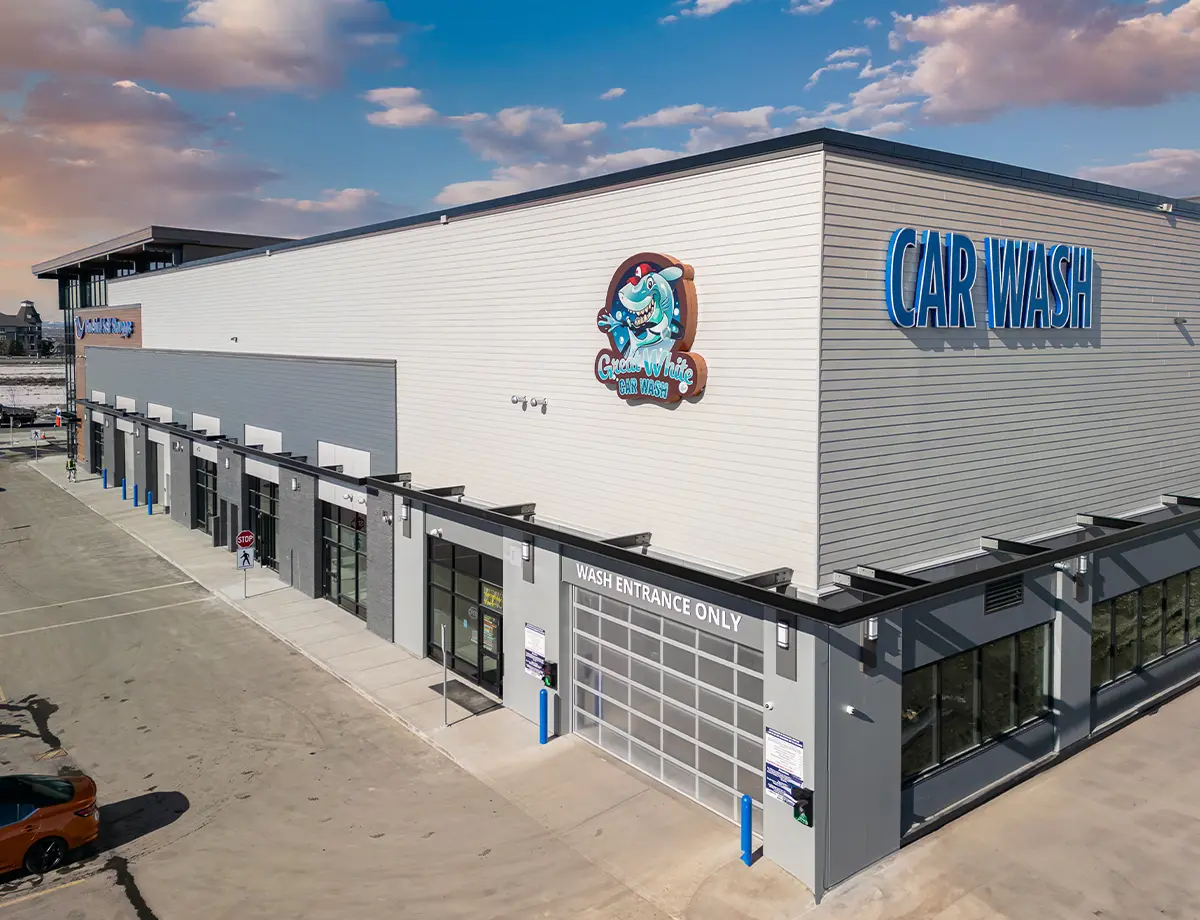
Bluebird was approached in 2020 by the developer to see if a self-storage facility would fit within the community. There were several sensitivities to take into consideration at the time. Mahogany was a higher-end, affluent community with very active and engaged residents. The proposed site in question was located not just near the community but literally right in the center of it. To top it off, the district was designated as a TOD, or transit-oriented development, meaning the city planners (who had to approve the use of storage) were going to be focusing on things like retail presence and street-level activation.
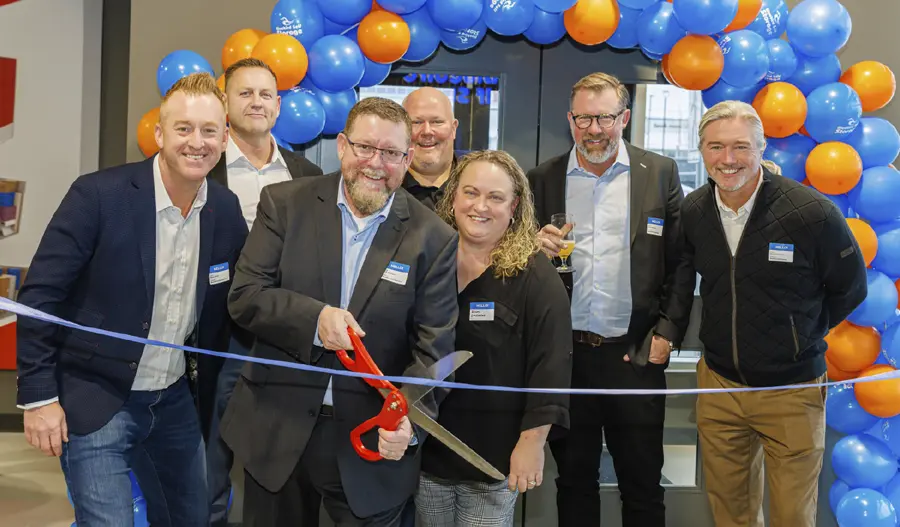


The Bluebird/StoreWest group now has two of these integrated storage/wash facilities within its portfolio (Mahogany and Buffalo Run). Although these two facilities are less than one year old, results for both have been exceptional, suggesting that perhaps storage and car wash are a match made in heaven!

eminiscent of a quaint Hispanic village, with terracotta tile roofs, smooth stucco, and an exquisite mosaic mural, Trojan Storage in Camarillo, Calif., perfects the Spanish Colonial Revival style of architecture. The 114,052-rentable-square-foot facility is nestled within a historical zone and proudly stands as a gateway to the city.
Designed by Jordan Architects, Inc., Trojan Storage of Camarillo opened in August of 2023 after being built by RDS Construction in 18 months. It offers a total of 888 drive-up and climate-controlled units throughout three separate buildings (two single-story and one three-story) as well as 13 uncovered and 28 covered RV/boat parking spaces. A 1,296-square-foot abode above the 1,016-square-foot office accommodates the resident manager. Two other thoughtful amenities include covered loading areas and elevator vestibules.
Besides high-quality aesthetics and an assortment of storage options, Trojan Storage also utilizes cutting-edge technology. The parking canopy is outfitted with solar panels while the facility is secured by Janus International’s Nokē Smart Entry system, security cameras, a slide gate, and a stone wall.
Within seven months, Trojan Storage is more than 53 percent occupied and has earned a five-star reputation. It is owned and managed by Trojan Storage.
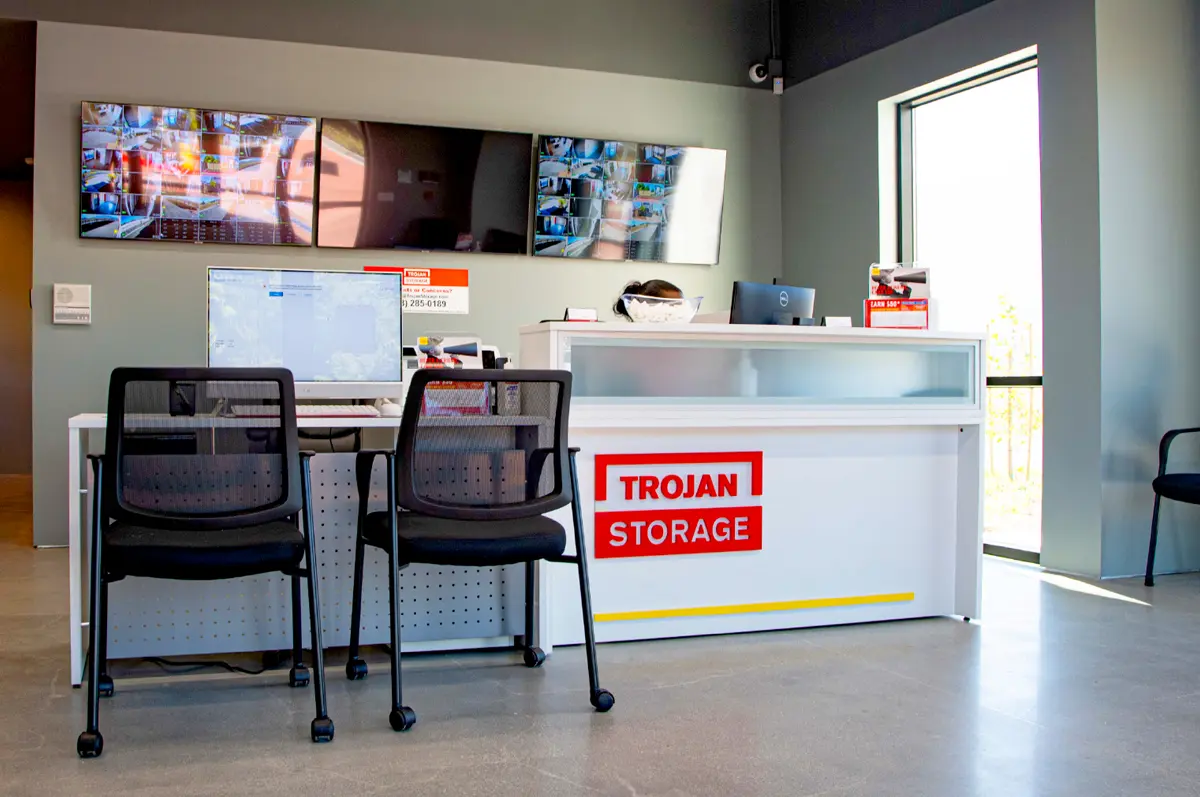






Before You Invest
Seven Steps To Starting Your Self-Storage Investment
By Marc Goodin

Step One:
Step Two:
For example, let’s review three lending options for new construction:
- An SBA $5 million loan at 10 percent down will require you to have a minimum of $500,000 cash to invest.
- For a good-sized project, say 80,000-plus gross square feet with an assumed all-in cost to break even of $10 million. This would require you to have a minimum of $1.5 million cash to invest. (Note: This project could be built in multiple phases, reducing the cash required for phase one.)
- This same $10 million project at a traditional bank may require you to have a minimum of $5 million cash to invest.
- 6-plus usable acres for an 80,000-gross-square-foot, single-story facility consisting of multiple single-story buildings with both non-climate-control and climate-control units. This facility can be built in multiple phases to help with financing and scale.
- 4.5-plus usable acres for an 80,000-gross-square-foot, single-story facility consisting of one single-story large building, predominantly climate control. This facility can be built in multiple phases to help with financing and scale.
- 4.5-plus usable acres for an 80,000-gross-square-foot self-storage with a combination of single and multiple single-story buildings.
- 2-plus usable acres for an 80,000-gross-square-foot, three- story facility single phase, maybe 1.5 acres if no side yards and/or no storm drainage detention is required. You cannot phase multistory facilities, so they cost more initially; this will increase your initial cash investment.
Given the combinations of design parameters and potential landmines, it is important to review every parcel of land in detail with your team, starting with your civil engineer and architect.
The Interest Rate Dilemma
Making Sense Of The Uncertainty
nterest rates are up, it’s harder to get a loan, it’s harder to make loan payments, business is slower than it was during the COVID pandemic, and we don’t know when or how much things will change for the better. That is the interest rate dilemma.
Mind you, most indicators in self-storage are still stronger than before COVID, and stronger than most other commercial real estate (CRE) sectors. However, many in the industry got used to the high-octane performance of street rates, in-place rents, and occupancy of the COVID era. This is especially true for those who entered the industry at that time, with 80/20 loan-to-value (LTV) debt and overly optimistic proformas, anticipating higher street rates and faster lease-up than we are seeing today.
Some seem to have forgotten that self-storage is a cyclical business, the economy itself is cyclical, and despite it all, self storage is still a great cash producing, appreciating asset.
But higher interest rates create a dilemma for business owners because they don’t know what will happen next, or when it will occur. In general, neither the market, nor self-storage owners, like uncertainty.
Business owners want to return to the 4 percent loans they could get until 2022. Jay Powell, chair of the Fed (the Federal Reserve system, the central bank of the U.S.), seems to want them and the entire economy to forget about getting back to those super low interest rates. The Fed uses “forward guidance” to tell us what it is likely to do. The most recent forward guidance on April 16, 2024, indicates that interest rates are likely to stay where they are longer than expected. This corrects the Fed’s March 2024 guidance, suggesting the likelihood of a 75 basis points (bp) drop by the end of 2024, perhaps starting as soon as this summer.
Why? Twelve-month core PCE inflation (which leaves food and energy out of the inflation calculation) did not improve from February to March, and it is actually higher than the prior 3-month and 6-month measures, said Powell. “Right now, given the strength of the labor market and progress on inflation so far, it’s appropriate to allow restrictive policy further time to work and let the data and the evolving outlook guide us. Come what may, we remain committed to returning inflation over time sustainably to 2 percent.” Translation: Interest rates will stay higher longer, and the hoped for 75 bp decline by year end in two or three rate cuts is unlikely. Perhaps there will be one or two smaller rate cuts.
But even if there were a 75 bp drop, interest rates went up 525 basis points since mid-2022. Such a small decline wouldn’t bring CRE loans back down to 4 percent. Business owners long for those good old days but fear that they are in the rearview mirror forever. Or are they?
The Fed has a large quantity of long-term assets (Treasury bills and mortgage-back securities) on its balance sheet. It purchased them as a form of “quantitate easing,” a monetary policy tactic the Fed first used during the Great Recession. Congress’ goal for the Fed’s monetary policy is to promote maximum employment, stable prices, and moderate long-term interest rates. The Fed purchased longer-term assets to help achieve this in the long period of economic growth that followed the Great Recession.
Those longer-term assets are maturing. The Fed can extinguish them, letting them expire and using the principal to decrease its overall debt. But that leaves the government with less money, so it will likely roll the debt over at today’s higher interest rates. As Treasury bills mature and the Fed reissues new debt at today’s higher rate (5.25 percent), the government owes more because interest payments are higher. That means the government has less to spend, and we know how sad that makes the government.
Because of our government’s long-term practice of deficit spending, the Fed will likely have to borrow even more money to cover the deficit. As the government borrows more, it may “crowd out” lending in the private sector because there’s simply less money for businesses and individuals to borrow. All of this has a dampening effect on the economy.
So, interest rates are not just a dilemma for business owners trying to get a loan. The U.S. government is struggling too, as it tries to make the higher debt payments. Business owners have been grappling with the same problem.
Moss is not the only CRE investor drawing this conclusion. Others in the industry agree, thinking interest rates will return to the pre-COVID low and supporting their arguments with page 89 of Ben Bernanke’s book, 21st Century Monetary Policy. Bernanke argues that the economy (and the Fed) leans toward a “neutral rate of interest,” which Bernanke defines as the interest rate “… that prevails when the economy is at full employment with stable inflation.”
Before the COVID pandemic, economists and central bankers thought the neutral rate of interest was about 2 percent, arguing that, “The long-term decline in interest rates, continuing through both recessions and economic expansions, strongly suggests that the neutral interest rate is much lower today than it was a few decades ago.”
Or is it? That’s what Bernanke wrote before the Fed started reacting to higher inflation in the middle of 2022, after it underestimated the inflation threat throughout the prior year. The most recent struggle with inflation leaves the talking heads with a troubling question: Did the COVID pandemic change the economy in a lasting way? In other words, are higher interest rates here to stay?
The Fed certainly wants us to think so. Even in forward guidance about lower interest rates, the Fed is only talking about a small bp drop after a 525 bp increase.
When it uses “forward guidance” (another new monetary policy tool added as we recovered from the Great Recession), the Fed intends to impact the market, the banks, lenders, your decisions to spend and invest, and the economy in general. For the time being, The Fed wants you to think interest rates will stay higher than pre-pandemic levels.

To see how we compare, I surveyed industry colleagues on LinkedIn. They agreed with the primary dealers: 62 percent indicated they expect a decrease of 0.25 percent to 1 percent by the end of 2024. A fifth of survey respondents thought there would be no change at all; one added, “The Fed finally found some fragile balance and I don’t think they will risk disrupting it.” Less than a fifth of respondents thought there would be a decrease exceeding 1 percent.
In spite of “the sky is falling” chatter to the contrary, many in the industry say they are not waiting, watching, and wondering what the Fed will do. “You can’t just wait. Don’t let market conditions provide an excuse to sit on the sidelines. Make the best decision you can and go with it. No risk, no reward,” says Jeff Gorden, president of The Gorden Companies. “The interest rate on a home mortgage was 19 percent in 1981. People still bought houses; they just had to be more creative. They had to hustle.”
What does creativity in financing a deal look like? In a Toy Storage Nation blog, Bishesh Shrestha, senior vice president of self-storage lending at Live Oak Bank, summarized options: seller financing, adjustable-rate mortgages or hybrid loans, government programs, non-traditional lenders, interest rate caps, joint ventures or partnerships, developing in phases instead of the full project, and value-add strategies to attract investors and lenders.
Seller financing has certainly garnered a lot of interest in the investment community. It is when the seller provides some of the financing, standing in second place to the primary debt provided by a lender. For years it was a totally neglected tactic because there was no need. However, when interest rates on home mortgages were 19 percent, it was often the only way to make a deal work. Seller financing, including installment sales, is making deals work today.
One thing to keep in mind if you are a seller being asked to provide seller financing: Do you want to be in second position to another party? If the buyer can’t perform on the loan, and the lender takes back the property, where does that leave you? It’s a risk worth considering.
Clearly, the interest rate dilemma has complicated the capital stack (the combination of capital sources you use to fund your deal or its underlying financial structure). The main components are debt and equity. As interest rates increased, so did equity requirements, leaving the higher than they were a few years ago. LTV ratios fell from 80/20 or 70/30 during COVID to more like 60/40, or even 50/50 today. That means the same deal that required only 20 percent equity now requires 50 percent down. Putting together that much equity is harder and more complicated.
In addition to the equity you put down, banks have added deposit requirements that can be as high as 15 percent or more. In effect, that makes the LTV even less favorable to the borrower.
All of this means you must come up with more money to get your deal off the ground. So, you need to raise more capital than in years past. Current market conditions are making it harder to raise capital because returns are leaner than they were. That is another aspect of the interest rate dilemma.
While there are no immediate, easy solutions, one thing remains true: Self-storage is still a great investment, with strong fundamentals and better performance than many other real estate sectors. If not in self-storage, where will you invest to get comparable returns?



an you believe that a huge part of the human population has suffered from hunger since the world began? Hunger is a condition in which an individual lacks the physical or financial capability to meet their nutritional needs. It leads to malnutrition, wasting, stunted growth, and death. Hunger kills more people than AIDS, malaria, and tuberculosis combined, and it is primarily prevalent in Africa and South America. In 1989, Mission Feeding began with a challenge to feed 5,000 starving children in Mozambique. Since then, Mission Feeding has expanded and became instrumental in helping save the lives of over 18 million children across Africa. Those who suffer most in these times of food crisis are the children. Malnutrition remains one of the leading complications in the deaths of children under the age of five in developing countries around the world. Every year, 3 million children lose their lives due to malnutrition, food insecurity, and starvation.
For more than 30 years, Mission Feeding outreach has been a proven answer to the nutritional needs of starving and malnourished children, saving lives by supplying much-needed food, nutrition, and aid to malnourished and starving children in areas of desperate need. Currently, Mission Feeding feeds more than 350,000 children daily in villages and areas across Africa. A big breakthrough came when a formula for a simple, nutritional porridge was developed. This allowed workers to bag and ship large quantities to villages with the greatest need. Every bowl of food has the vitamins and nutrients needed to stop the cycle of malnutrition and death and rekindle hope in the hearts of children, families, and villages in need.

World Hunger Day is observed every May 28 to raise awareness about the over 820 million people living in chronic hunger and to encourage action to end this. The day aims to increase awareness of global hunger as our world and populations continue to grow. The website for World Hunger Day reveals various statistics on how hunger affects disadvantaged people around the world. The Hunger Project, the organizers of World Hunger Day, also hosts events and promotions to make these statistics public knowledge and garner action. The day hopes to contribute to helping reduce global hunger. It motivates and encourages organizations and individuals to contribute in one way or the other to reducing hunger in their communities. It also calls for action from governments to develop better food security policies. Along with increasing awareness and motivating others to get involved, World Hunger Day promotes global health. Undernourishment, which results from hunger, is a leading cause of death and disability worldwide. By driving efforts to deal with hunger, World Hunger Day invariably contributes to an improvement in global health.
After World War II, the newly formed United Nations began leading the fight against hunger. Following its establishment, the U.N. created FAO, W.F.P., and IFAD to promote food security and agricultural development. In the late 1970s, international organizations such as the I.M.F. and the World Bank began focusing on developing countries as starvation in countries like Ethiopia came into the global limelight. In the 20th century, the prevailing view was that hunger was a problem of demand surpassing supply. However, this view was ended by the research of economist Amartya Sen, who successfully proved that hunger in modern times was a distribution problem or caused by government policies in developed and developing economies. In 1998, Sen won a Nobel Prize for this research.

- Volunteer at your local food bank.
Food banks are charitable organizations that distribute food to those without the finances to buy enough for themselves. Volunteer at a food bank in various roles, including fundraising, social media management, organizing food drives, and awareness campaign management. Check online for a food bank close to you.
- Donate to charity.
If you don’t have the time or resources to volunteer, start donating a weekly or monthly token to a non-profit that focuses on hunger. That could be a food bank, a soup kitchen, or a hunger project. Research for one that fits your ideal, get their account details, and start making donations.
- Raise awareness.
Social media is usually the go-to platform for raising awareness about anything. Use your social media account to draw attention to the plight hungry people suffer around the world. Stress the importance of actions like sustainable eating to reduce food wastage, donating excess food items to soup kitchens or food banks, and tasking governments to do more to end hunger.
ne of the reoccurring issues for self-storage owners is the persistent threat of states and municipalities enacting new taxes or increasing existing taxes on their operations. As part of our advocacy efforts, the SSA attempts to defeat or reduce those tax burdens where possible. The SSA is currently working to resolve issues in Illinois and Nebraska and succeeded in defeating a new tax in Virginia.


s we approach the 2024 rental season, I can’t help but feel cautiously optimistic. Have my rentals started to pick up? Not really. Are my street rates trending upwards after falling for the last 18 months? Nope. Are many ill-advised storage facilities in my markets still being built? Definitely! So, if demand is low, street rates are down, and new supply is up, why am I still cautiously optimistic? That’s just my feeling.
Although my feeling, here’s the evidence informing it. The housing market is the slowest it’s been in the last 40 years, but many people say they plan to buy or rent elsewhere this summer. Their life circumstances have changed, and regardless of what happens with interest rates, they’re ready for a move. It’s likely that this pent-up demand will materialize this summer.
As demand improves, rates will naturally start to rebound. While the REITs have been playing a dangerous game with extremely low web rates and then doubling or tripling customers’ rates after three months, I can’t imagine they’ll continue. It’s not good for their brands or the industry. When demand picks up, their rates should start to reflect in-place/achieved rates and buoy everyone’s street rates up to somewhere between where they are today and the 2021 peak. This is certainly what I hope happens; if not, there could be some serious implications for our industry.
As a family-owned company in it for the long haul, we’re by nature more conservative than most of the active groups in the acquisitions market. We have strict guidelines, yet we’ve still managed to buy 25 properties over the last few years. However, since the second half of 2021, we’ve found it more challenging to be competitive on broker marketed deals. Still, we offer on most deals in our markets. Until the last few months, we have come in 20 to 25 percent below where assets have sold. Fast forward to the first quarter of 2024, and even with our same underwriting guidelines, we have been competitive on almost every deal. For well-located, high-quality assets, and especially those below replacement cost, we are now willing to “stretch” to get to numbers that are maybe a little higher than we want to pay. For quality product, a slight “overpay” is nothing over a 10-year or longer hold. Even if the market doesn’t fully rebound until next year or 2026, we’ll be happy to own these properties because they will eventually perform.
I might look back at this article in a few years and comment, “What was I thinking!” as the world is an unpredictable place. Storage, however, still seems like a pretty good bet, and after a couple of slow years, we’re poised for a rebound.