








How to enjoy our new magazine:
Just scroll!
Click or tap the table of contents icon in the menu bar to find any article.
Read any article by clicking or tapping the read full article button below each article intro.
Jump back to your previous browsing spot from any article using the menu bar or back to issue button.











WHO’S THE FAIREST ONE OF ALL?



-
E-Commerce Businesses Benefit From Self-Storage
-
34 Get ListedSetting Up A Google Business Profile
-
Insights For A Cohesive Wildfire Evacuation Plan
-
Sustaining The Self-Storage Industry In A Competitive Market
-
A Case Study On Relocatable Storage
-
Catering To Empty Nesters
-
Establishing Goals And Bonus Structures
- Publisher’s Note4
- Meet The Team6
- Facility Spotlight: Access Storage by Brad Hadfield15
- Candid Conversations: Steven R. Scott by Brad Hadfield18
- StorageGives by Josh Huff51
- YLG Update54
- Buyer’s Guide58
- News60
- Last Word: Rod Bolls64


elcome to the fall 2024 issue of Self-Storage Canada! As you’ve likely noticed, the entire magazine has been refreshed to rejuvenate interest and better complement the modern designs utilized in MSM’s other publications, including Messenger and Self-Storage Now.
Besides a more contemporary look in print, Self-Storage Canada is now available in a scrolling digital format with numerous enhancement opportunities that elevate the reading experience, such as animated advertisements, video, and audio. We’ve also secured a new website to better support our readers: Self-StorageCanada.ca.
Speaking of our subscribers, Self-Storage Canada has new departments and expanded editorial to provide you with even more meaningful and insightful content. For instance, on page 64, within this inaugural edition of “Last Word,” Boxwell Founder and CEO Rob Bolls discusses the advantages of embracing emerging technologies and resources like this innovative and informative magazine, which also happens to be the only business periodical in Canada dedicated solely to self-storage.
On another note, have you taken our first annual Top Operators Survey for the Canadian self-storage industry? The results of the survey will be presented in the next issue of Self-Storage Canada. Additional details are on the next page.
Finally, as you flip or scroll through this monumental edition of Self-Storage Canada, please feel free to email me at Poppy@ModernStorageMedia.com with your questions, content ideas, and news. We are dedicated to providing you with the most relevant and up-to-date information about the industry through this state-of-the-art publication! Enjoy!






MSM



SSC, SSN, Messenger


-
Web Manager / News Writer
Brad Hadfield
-
Storelocal® Media Corporation
Travis M. Morrow, CEO
-
MSM
Jeffry Pettingill, Creative Director
-
Websites
www.Self-StorageCanada.ca
www.ModernStorageMedia.com
www.SelfStorageNow.com
-
PUBLISHER
Poppy Behrens
-
Creative Director
Jim Nissen
www.commandshiftoption.com -
Director Of Sales & Marketing
Lauri Longstrom-Henderson
(800) 824-6864 -
Circulation & Online Sales Coordinator
Carlos Padilla
(800) 352-4636 -
Editor
Erica Shatzer
- Unsolicited manuscripts, artwork, and photographs must be accompanied by an addressed return envelope and the necessary postage. Publisher assumes no responsibility for the return of materials.
- All correspondence and inquiries should be addressed to:
MSM
PO Box 608
Wittmann, AZ 85361-9997
Phone: (800) 352-4636 - © 2024, Storelocal® Media Corporation. All rights reserved. Reproduction in whole or in part without written permission is prohibited. Printed in the United States.

“Storage has been around since Noah’s Ark,” he said. “It was so simple, but no one really thought of it as a business. Then someone put lockers together and started a new industry that spread all over the world.”
“In the U.S., they’re good at coming together and exchanging ideas, learning from each other,” he explained. Kormos learned a lot from Russell and Victor and became convinced self-storage was a good idea. He returned home intent on rolling out self-storage in Canada.
Even in those early days, Kormos was always impressed by the innovation in self-storage. For instance, one of the first self-storage businesses he saw was on a leased field in Texas. It had Sears & Roebuck metal utility sheds on it. When a customer needed storage, they paid three months in advance, and the owner went to Sears to buy a new shed. He financed the purchases on a charge card. There were no employees and no property taxes on the leased land. “That’s very innovative,” said Kormos.
Without any precedents in Canada, Kormos came up with his own innovative solution: He took a job as a mortgage broker for a couple of years to look for financing for self-storage. Eventually, he found the first institution to lend money for self-storage in Canada—for his project. It took two years!
Then there was the building code. Self-storage buildings in those days were very simple. Canadian building code was quite complex, making it very expensive to build self-storage.
Breaking down that hurdle started when Public Storage came into Ontario in 1979. It turned out to be an effort that took more than a few years, but eventually the National Building Code for Ontario was revised. The process of getting permits and designing self-storage was simplified, and the cost to build self-storage was reduced by 20 to 30 percent.

Shortly before Kormos first learned about self-storage, Russell and Victor helped start the United States’ Self Storage Association in 1975. It had eight districts. A few years later, hetold them that Canada needed an association, so they made Canada District 9, with Kormos as its director.
As the industry grew and bigger businesses like Public Storage moved in, Canada formed its own association.
Kormos’ earliest efforts to create a Canadian association were met with resistance. Most self-storage owners were small businesses. “Membership was $300, and they wouldn’t join if I gave them $300. The timing wasn’t right.”
He didn’t give up. Kormos was actively providing feasibility studies all over Canada. “I learned a lot, but we needed an association,” he said. Kormos talked to three other owners, who caught the vision, and their combined efforts met with success. “Timing was just right, members joined, we became very professional, and we were able to get the law (the National Building Code) changed for the whole country—that was accomplished by the association,” according to Kormos.
“Starting up an association with clout is what I’m most proud of,” said Kormos. “We pulled everything together under one roof. We helped each other. If a small business had a problem, we helped them. If a big one had a problem, we helped them too. It operated very professionally. We achieved a lot through the association.”
Instead of narrow buildings “with a fence and guard dogs,” we have superior security features such as cameras and individual door alarms. “We used to be on the outskirts of town. Now our self-storage is in town, and it looks better than commercial buildings and hotels!”
Over the years, one innovation Kormos is especially pleased with is tenant insurance. “It took me 15 years to find a way to insure everyone. I always wanted tenant insurance, from day one.” He explains that facility owners do as much as they can to keep people’s stored goods safe, and no one wants any customer to suffer a catastrophic loss while using self-storage. “We can only protect tenants so far. They have to do something too, and that’s where tenant insurance comes in. We make it available. This is a good customer service.”
Kormos also talks about the changing nature of what people store, and how the industry has to keep up with that too. “We knew storing fire arms and explosives was a fire risk, and we excluded them in our lease. Now we have learned that lithium batteries are a fire hazard too, and they are also excluded. If someone stores their eBike, they have to take the battery out.”
From its early beginnings as tin sheds, Kormos has watched self-storage evolve to offer comprehensive services to people. “People really caught on to the idea. It takes a lot of courage, and money. They offer a range of services, including moving trucks, closet storage equipment for home, shredding service, even mobile pods and vaults with safe deposit boxes at some facilities.”
Kormos also believes in making it easy for people to do business with you. For instance, “People don’t know exactly when they are moving. Let them move out any time without notice. We also refund any unused rent.”
Another aspect of innovation he sees is in the professionalism of vendors, which has grown over the years. “Now we have more professional vendors—architects, security providers, contractors—upgrading all the time. Everything is evolving in the right direction.”

Self-storage helps businesses as well, such as “people starting up in business and other businesses that only need small amounts of storage.”
He said, “It’s a high-revenue business, so facilities should participate in charitable activities. This is a trend I’m seeing: Our industry getting more and more involved with the public as we grow and evolve.”
With his big tent thinking, he says, “This business is good enough for everyone to walk away smiling.” Anytime you talk to Kormos, you will walk away smiling too. His philosophy is simple, and his perspective is refreshing: “Give really good service. Don’t confuse customers. Make sure people are free to come and go. Give them tenant insurance. Make sure they don’t suffer a catastrophic loss,” and help them. “This is what being human is all about.”
Third-Party Management – He stopped offering third-party management. “To manage properties, you need a substantial infrastructure and a lot of labor, and it doesn’t pay very well. When the big companies started offering it, I stopped. They could bring scale and economies to it.”
The Importance Of Good Staff – “Good staff is very important, and they need support. We need good staff to establish bonding with customers. Empathy for your customers is the main characteristic your staff must possess.”
To explain what he means, he told a story. “About 20 years ago, I dropped into a facility on a Friday at 5 p.m. I always dressed in a suit and tie. Dress like you’re somebody and people pay attention to you,” Kormos explained before continuing with the story. “The manager was so nice. We were having a good conversation, the kind she had with her customers. Then a giant came in. He must have been 6 feet 6 inches tall. He stared at me in my suit and tie. The manager greeted him nicely, he paid his rent, he left, and then he burst back into the office to say, ‘If you fire her, you’ll have to answer to me!’ He thought it was a Friday 5 p.m. firing!” What a display of the value when staff bonds with customers!
Lessons Learned – “On my first project, I didn’t know there was seasonality in the business. We opened on Jan. 2, a terrible time to open. We made a deal with the McDonald’s down the street: If you drove through the property, we gave you a voucher for a Big Mac. McDonald’s did very well, but we didn’t get any rentals. We had an early spring, and by mid-March, the phone started ringing.”
What Being Human is All About – “We had a tenant who was a mechanic with a 10-by-10 full of tools. There must have been $30,000 worth of tools. He always paid on the first of the month, then he disappeared after a few months. I tried to find him but couldn’t. The manager wanted to sell his stuff, and I had to hold him off. Six months later, he came back. He explained that his blow torch blew up on him and he was badly burned over his whole body. He was in the hospital for three months to recover. He had recovered well enough to work, and he needed his tools.”
Kormos forgave all the back rent so he could get a fresh start. “People have hardships, and you have to accommodate that. Why wouldn’t you? This is what being human is all about. It’s one locker. At that site we had 800. How could one locker hurt me?”


ften referred to as “The City Above Toronto,” Vaughan, Ont., located in the Regional Municipality of York, has emerged as a force to be reckoned with in recent years. It is considered a melting pot of cultural diversity and is renowned for its thriving economy, excellent quality of life, and mix of modern architecture and open green spaces. As one of Canada’s fastest-growing cities, Vaughan offers a unique blend of urban luxury and suburban life.
Of course, when a city is growing as fast as Vaughan, there is always a need for self-storage. To meet that demand, Access Storage has come to town, giving residents and businesses alike a safe and secure place to store their belongings. The new self-storage facility, located at 8025 Jane Street, sits on a main artery in the heart of the city and is conveniently situated next to a large IKEA and the sprawling Vaughan Mills Mall, one of Canada’s largest shopping centers with over 200 stores and restaurants. It brings in 13.5 million people per year, so that puts a lot of eyes on Access Storage too.
“We couldn’t just slap our name on the building and call it a day. We had some work to do,” recalls Belik, who says that when Access acquired the building, it still had damage from a recent fire. “The claim hadn’t been settled yet with the insurance company, so the fire-damaged floors became our problem. Thankfully our construction team worked with the restoration company to speed up the completion of the work. We also used the opportunity to create a better unit mix for the market.”
Following restoration and other modifications, Access Storage—a modern-looking facility with mosaics of gray, blue, and white mingling beside matching tinted windows—was open for business. Now, the new, state-of-the-art facility boasts 92,620 net rental square feet, complete with full climate control and three covered loading bays that can accommodate large moving trucks. To make security a priority, the facility features numerous security cameras by Hikvision, 24/7 video monitoring (plus ULC Fire monitoring by Engineering Security), access control entry by PTI Storlogix, and well-lit and easy-to-navigate hallways. Units are secured with Janus International roll-up metal doors, which can facilitate barrel locks.
At six stories tall, it makes an impression in the immediate area, and the greenage surrounding the facility is meticulously maintained by professional landscaping company Sunset NJG Maintenance. “They say it’s what on the inside that matters,” says Belik, “but a good presentation on the outside is equally important.”

“Retail is another nice little revenue stream, so we also offer moving supplies and such,” adds Belik. The store, which is part of the rental office, is fully stocked with moving supplies, including boxes, locks, tapes, mattress covers, and more. New tenants can also rent dollies and carts, use the company parcel receiving services, and rent the Access Storage “Free Move-In Van.”


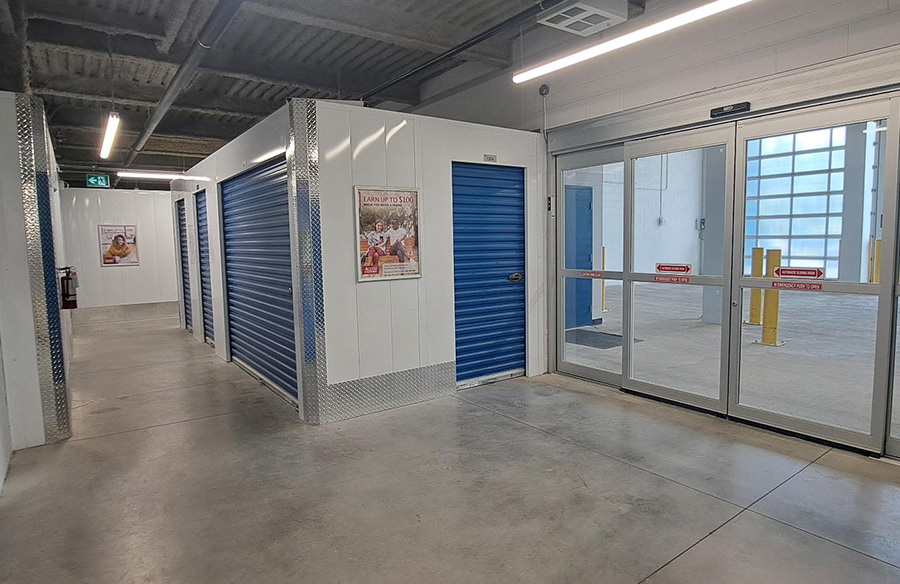
Belik explains that for one, Access only hires the best of the best, even if they’re sometimes difficult to find. “There’s definitely a labor shortage, but we’re not going to compromise when it comes to hiring,” he says. “We look for employees who think like owners, who take pride in the business and what they do. Our employees are responsible for many positive changes at Access Storage. Their input is valuable because they’re on the frontlines engaging with customers every day.”
Belik says that when you hire the best, you’re able to provide the best customer service. “Exceptional customer service is paramount, but our approach is simple,” explains Belik. “We listen to our customers. We want them to feel comfortable coming to us with any questions or needs. It’s important to keep an open line of communication open with them.”
When a customer is pleased, Belik says management always asks for referrals. “Referral marketing can be the bread and butter of any business. It doesn’t cost anything to ask someone to give us a referral, and customers who are referred by friends or family are more likely to stay loyal to a brand for a long time. And they trust referrals because they come from a personal source.”
Although Belik is a big believer in referrals, he does say that the facility’s reviews tend to speak for themselves. “Since the acquisition, we’ve grown our Google reviews, and today we have a 4.8 rating coming from 124 customers. I believe this is because we listen to our customers, and that’s something a lot of businesses forget to do these days.”
Belik also believes in giving back within the community. “People tend to count their blessings, but then they don’t pay them forward,” he says. “It’s important to give back to the community that supports you, and Access Storage actively does that by getting involved with charitable organizations on a local community and national level across Canada. We have over 200 charitable organizations and causes that we work with.”
While there are no plans to slow down, with talks of expansion into Labrador, New Brunswick, Newfoundland, and Prince Edward Island, Belik says the company always carefully considers each new development.
“Nothing is done in haste,” he says. “We always want to be sure a new build or acquisition is a smart move.”
To illustrate his point, Belik says that when Access officially acquired the Vaughan property, it was at 47 percent occupancy. Now it has exceeded 55 percent and should be at more than 60 percent by the end of the month. Talk about your smart moves!

mazon founder Jeff Bezos once said, “The biggest oak starts from an acorn.” He would know; the retail giant started in Bezos’ garage in the mid-90s and has since grown into the worldwide phenomenon we all know today. Around that same time, another acorn was getting its start: Access Storage. The first self-storage facility opened modestly, but its growth trajectory, much like Amazon’s, was rapid. Today, it is the largest provider of self-storage in Ontario, Manitoba, Saskatchewan, and Nova Scotia, with a total of 250 locations across Canada.
One man largely responsible for that growth is Steven R. Scott, who came aboard in 2000 as president and CEO of The Access Group of Companies, focusing on ownership, acquisition, development, and management of self-storage and other residential and commercial real estate in Canada. His list of accomplishments is long—he’s also the chairman and CEO of StorageVault Canada, of which Access owns 40 percent, and the director and treasurer of the Canadian Self Storage Association (CSSA)—but he humbly brushes away my praise. “It’s just what I do, and sometimes it feels like I’ve been doing it for 100 years,” he laughs. “But I wouldn’t have it any other way.”
Scott knows we’re here to talk about self-storage, so he doesn’t waste any time getting to the heart of the interview. “The Access Group is in the real estate space, but I was really attracted to the storage business,” he says. “It’s a high gross margin; there’s low deferred capex, low employee count, so I love the simplicity of the business.”
With such a wealth of experience in the industry, and the ability to help turn an acorn into an oak, Scott and I decide not to focus on any one topic; rather, he’s generous enough with his time to give his thoughts on various issues, many of which weigh heavily on the minds of many in the self-storage business right now.
Scott adds that Canada does have better immigration policies than the U.S., so although housing sales may be down and hurting the self-storage industry, the level of legal immigration to Canada is helping to backfill some of that loss.
Still, when conducting exit interviews with tenants, Scott says that’s when he really sees the recessionary piece of the pie come into play. “A lot of people say they simply can’t afford it anymore, that it’s just too expensive. They’re being a bit more judicious about their spend and their dollars.”
Because of these economic woes, Scott believes both independents and REITs have taken a bit of a beating, and he thinks this cycle could continue for a while. “I don’t know what the catalysts for change are. It could be lower interest rates; Canada lowered their rates by 25 basis points today [July 24, 2024]. So, we wait, and we see.”
Development costs are another topic on Scott’s docket. He says that despite the slowed economy, some developers still will want to build; their rationale is that by the time the project is complete, things will have turned around. Unfortunately, laments Scott, “The cost to build right now is very, very expensive … Finding land available to build upon right now, at the right price, is extremely difficult.”
We segue briefly into politics. “There’s political strife globally. Everywhere you look there’s conflict, and that impacts things too. But just here in North America, we’ve got some big elections coming up, both north and south of the border. Now, we could spend three days on what the hell’s going down in the U.S.,” he laughs, “but we also have an election coming up in Canada in about a year, and maybe that will usher in some change for the better, or not. Again, we wait, and we see.”
Scott says that with rising expenses and wages, it becomes a game of figuring out how much of that can be reasonably passed on to the customer. When residential customers are hard to come by, commercial companies with deeper pockets can often help supplement revenue. “We also have a ton of business customers and business users,” he explains. “A lot of trades use our facilities—electricians, plumbers, roofers, window washers, you name it. Realtors use us for staging equipment; drug companies use us to store materials and products. In fact, a lot of the drug reps will have a stipend for storing their materials and their product with a storage facility. It’s a lot safer for them than keeping them in their branded Pfizer van.”
I ask Scott to elaborate, and he chuckles. “People were breaking into the vans and stealing the Viagra.”

Some of these rate drops can be aggressive, says Scott. “One of our competitors is currently offering a $25 special for a four-month contract. Of course, specials are not uncommon, like Public Storage one-month-free kind of things. But four months at $25 per month? That tells me they are struggling.”
Scott’s not opposed to discounting entirely, at least in the short term. “We’re having to be more aggressive with our specials too, but that’s just one of many tactics,” he explains. “For example, we are spending more money on advertising than in the past to get the phone ringing. It’s more of a strategic plan than going straight to rates.”
When I bring up the aggressive rate hikes happening in the U.S.—operators luring in customers with deeply discounted rates only to jack them up much higher a month or two down the road with little transparency—Scott nods; he’s very much aware of the situation.
“I think the U.S. is using that strategy more than Canada is right now, but we know all about it. Take that facility that offers $25 for four months, for example. I believe the customer knows it’s not going to last, but on month five, when it jumps to $280, and the place they expected to be ready to move into at that point is not, or delayed another four months, they’re not going to be happy.”
Even if the special is made clear to them, Scott says these types of discounts followed by extreme increases could give the industry a bit of a black eye. “People will think the facility is abusing their customers. You’ve got to look at what the public perception of your business is, and that’s where I think people are being a little myopic about it. What works in the short term may tarnish the reputation of the company and ultimately the industry in the long term.”
“Maybe they are, but when you’re living in a small space, you have to keep your stuff somewhere,” says Scott. “There’s a lot of 30-somethings that are going to their storage unit to pick up their mountain bike or golf clubs in the summer, and their hockey and ski equipment in the winter. They’re a new kind of user, and they don’t tend to be as price sensitive until maybe they lose their job or something.”
Scott says they also like to upgrade their belongings. “So, they bought the 100-inch system three years ago, and it’s still perfectly good, but now they want the 120-inch. But they’re not going to throw away the 100-inch, right? And here’s Access Storage, with open arms.”
That’s not the only change millennials have ushered in. They’re also partly responsible for the rise of remotely managed facilities. “They are completely comfortable with the full virtual experience,” he says. “They will rent with us cradle to grave without ever speaking to someone, without ever meeting someone in person.”
Even before realizing remote was a viable option with newer generations, the COVID outbreak had Access Storage testing the waters. “We pre-coded about 20 of our stores to be virtual during the pandemic. No office, no one on site. It worked seamlessly.”
Today, he says about 50 stores follow this model. “I mentioned earlier that there’s a labor shortage, so this has really helped us in that regard. If we had to try to staff those 50 stores in this employment environment, it’d be a big challenge.”
Scott says the model is typically employed in regions where Access Storage has multiple sites. “In one city or town, we may have two or three facilities with offices, and two or three of them without. It works well because someone from a manned facility is only minutes from an unmanned one if they need to be there.”
When I asked if he’s concerned about losing the still viable baby boomer market to the technology, and even aging Gen-Xers, Scott waves his hand. “Let me tell you about my 82-year-old mother,” he laughs. “God love her, but you know, prior to COVID, there was no way that woman wasn’t going to a bank and sitting down with a teller. Now she’s some sort of banking savant; she’s like, ‘Oh Steven, you want me to show you how to transfer money and cash checks on your phone?’ So she and others like her know their way around remote operations.”
He acknowledges that while older generations are now more comfortable with the virtual experience, many still like to have some touch points from a customer service perspective. “We make sure that if someone wants to talk to a person, even at a remotely managed facility, that they can do so. Baby boomers are still our second-biggest customer, so we’re not going fully remote across all our locations. We may never even be 50/50, but it’s an evolution.”
“Look, the average person thinks they’re going to rent a unit for four months when you first talk to them,” he says, “but the average length of stay is closer to 12 months. People expect their divorce proceedings to move quicker, the new house to be ready sooner, the job to last longer. But the reality is most things don’t go as smoothly as planned.”
Continues Scott, “Naturally, most people’s self-storage payments go on a credit card, and not much attention is paid to it until a tenant does the number crunching. That’s when they’ll go, ‘Oh, we’ll just buy new couches so we can throw these old ones in storage out.’ That’s when we part ways, until next time. But it’s that expectation versus reality—how long they think they’ll stay versus how long they do—that is the secret sauce of self-storage.”
And that, it’s noted, is how Scott and his team will continue to grow that oak.

With 25 years in the industry, I know Scott must have a good story about something weird he’s found in self-storage. And he’s very quick to answer: “A dead eight-foot alligator in a 16-foot aquarium.”
I have lots of questions, but Scott holds up his hand. “So, here’s the deal. The owner caught it and kept it in his home as a pet, I suppose. But he got into a fight with his wife and was sent to prison for six months for spousal abuse.”
Continues Scott, “While in prison, he asked a buddy to move the alligator into his storage unit. The guy was supposed to come by and feed it, but as you can imagine with that type of tenant, they weren’t the most responsible folks.”
No suspicions were aroused because the unit continued to be paid for via credit card. Then came the smell.
“It was god awful,” he recalls. “Not something I’ll soon forget.”
But Scott has yet to deliver the kicker, and he leans in for it: “The guy only received six months for going after his wife, but for that gator, he got two and a half years for harboring an illegal species and cruelty to animals. You gotta love the justice system,” sighs Scott.
he self-storage industry has drastically evolved over the last several decades beyond its traditional role of offering rental space to individuals and businesses due to the advancement of technology. Currently, many self-storage companies are continuously striving to meet the ever-evolving demands of customers, whether that’s through integrating technology to create a more convenient experience for renters or implementing state-of-the-art security measures to prevent theft and unauthorized access.
So, what’s next for the self-storage industry? The emergence of electric vehicles (EVs) presents a unique opportunity for self-storage companies to capitalize on this growing consumer shift and tap into a very lucrative market.
In light of this major shift, the goal of this article is to highlight the buzz around electric vehicles, the challenges around the availability of EV chargers, and how those who operate in the self-storage industry can leverage their existing infrastructure to tackle this developmental issue.
The current market for electric vehicles continues to increase, as sales in North America in the third quarter of the fiscal year grew 54 percent (O’Donovan, 2023). In 2023, North American EV sales were to be a total of 1.6 million and expected to increase to 1.9 million units in the U.S. and 230,000 in Canada by the end of this year (O’Donovan, 2024).
All of this certainly paints the picture that there is a market for electric vehicles. This is due to the collective push for EVs from the government and policy lawmakers, as well as a shift in consumer behaviors to strive for a more sustainable future.
In Canada, “Environment Minister Steven Guilbeault will effectively end sales of new passenger vehicles powered only by gasoline or diesel in 2035 (Gollom, 2023).” However, data on electric vehicle demand presents significant challenges for the industry to collectively meet the government’s mandate.
A recent study by AutoTrader (AutoTrader.ca, 2023) found that the “purchase intention has declined.” It also stated that “In 2023, only 56 percent of car shoppers who did not own an EV were open to purchasing one for their next vehicle—down from 68 percent the year prior.” In addition, the survey indicated that buyers are avoiding the purchase of an electric vehicle due to the state of the economy, citing the high electric vehicle prices, interest rates, and of course inflation.
To address this concern, it was estimated in an economic article (Young & Fanjoy, 2023) that “vehicle prices would need to come down by about a third to even half of what they are today, in relative purchasing power terms, for electric vehicles to be an affordable mass market.”
In the United States, there seems to be a slowdown as well, despite a record 1.2 million U.S. vehicle buyers choosing to go electric in 2023, according to estimates from Kellean Blue Book, a Cox Automotive company (Hailes, 2024). There has been pushback from dealers who have many unsold electric vehicles in their lots, so much so that more than 3,000 U.S. auto dealers asked the Joe Biden administration to “tap the breaks” (Carlson, 2024). Additionally, Tesla, a leader in the electric vehicle market, has indicated to investors that growth has slowed down in its electric vehicle sales.

Another notable reason for decreased demand is insufficient charging infrastructure, which presents a challenge for owners of electric vehicles. The insufficient number of charging stations can turn car buyers off from purchasing an electric vehicle, as they’ll be likely faced with the difficulty of having accessible chargers available to use (Marx, 2024).
Canada and the United States have been facing a ton of developmental challenges when it comes to electric vehicle charger infrastructure, which is evident as it’s directly impacting demand and buyer support.
The current number of EV charging stations and ports in Canada is extremely low. A CBC news article reported that Canada will need between 442,000 and 469,000 public charging ports by 2035, depending on the number of at-home chargers, according to an estimate by Natural Resources Canada (Mazerolle, 2023). As of Dec. 1, 2023, there are a total of 10,425 charging stations and 25,246 charging ports (Mazerolle, 2023). Ultimately, this suggests that there’s a lot of work to be done to meet the government’s mandate that 100 percent of new vehicles must be electric vehicles by 2035.
In the United States, “there are “170,000 publicly available EV chargers across the country,” as reported by the White House. However, Biden-Harris administration set a goal of 500,000 electric vehicle charging stations in the United States by 2030. Those stations would, the White House said, help push Americans to feel more confident purchasing and driving electric vehicles and in turn help the country cut carbon pollution (The White House, 2024).
Building electric vehicle charging stations is a very lucrative opportunity for businesses. EV Connect reported that “EV owners were willing to pay up to $3 per hour for charging and 12 percent were willing to pay $4 per hour, even if it only costs them $0.75 per hour to charge at home,” according to a survey from E Source. The willingness to pay becomes even higher when it’s convenient and can help reduce drivers’ worries about traveling a far distance and running out of charge while on the road (EV Connect, 2022).
Specifically, the installation of electric vehicle chargers could be an untapped stream of revenue for self-storage businesses. This is because self-storage facilities tend to already have the space and capacity to build charging stations and can reap the benefits of offering them to electric vehicle owners. Therefore, on top of being known for renting storage space to individuals and businesses, your facility can be recognized for providing people the ability to charge their electric vehicles. There are several other perks that self-storage facilities and their customers can gain from having electric vehicle charging stations on site:
- Take A New Position – Installing charging stations at your self-storage facility can show your customers and visitors that your business is forward-thinking and innovative. Offering forward-thinking solutions also highlights to them that you care about the community in which your business operates and its residents.
- Improve Customer Experience – Self-storage companies can also significantly improve the overall experience for their customers. This is because customers can visit their self-storage unit and charge their EV at the same time, which is extremely convenient and timesaving.
- Promote Sustainability Goals – This one is a huge benefit, especially if your self-storage facility is currently promoting environmentally sustainable practices or partakes in being a more environmentally conscious brand. Installing EV charging stations at your facility can help your business shine like a beacon for consumers seeking brands that align with their “green” values.
- Drive More Traffic To Your Site – Offering an additional service, such as charging stations, can drive more foot traffic to your self-storage facility, not only current customers but new customers as well. This is a huge plus, as your facility can increase sales from the additional revenue generated from the use of the charging stations. You can also take this opportunity to have your staff cross-promote other services that your self-storage facility offers, such as rental space, moving trucks, and packing supplies.
- Receive Incentives From The Government – You can likely take advantage of any government funding and rebates when you install electric vehicle chargers. Although government funding and rebates depend on the country, state, or province that a business resides in, it can be a great perk for self-storage companies to look into and see whether or not it’s worth it to invest in this initiative.

As a leader in the self-storage industry, XYZ Storage saw an incredible opportunity that aligns well with its values regarding operating sustainable and environmentally friendly services while helping to push forward the development of electric vehicle charging stations for Canadians.
At their Toronto Downtown facility (459 Eastern Ave.), which was recognized as Messenger’s 2020 International Facility of the Year Winner, XYZ Storage has taken a step forward in pushing the development and accessibility of electric vehicle charging stations for Canadians by installing charging stations at the facility.
The company’s efforts and commitments don’t stop there, as they continue the development of installing electric charging stations for electric vehicle owners who reside in the Toronto area. XYZ Storage has plans to install chargers at both of their up-and-coming locations on Dundas Street West and Bering Avenue. The self-storage company has partnered with Rick Brown + Associates to proudly design and launch self- storage facilities that not only serve as a second home to members of the community’s belongings but also offer services that promote sustainability.
XYZ Storage is certainly paving the way for other businesses to follow when it comes to ensuring there are enough electric vehicle charging stations available across Canada and the United States.
So, what plan does the government have to increase the availability of chargers? The Government of Canada has a “Zero Emission Vehicle Infrastructure Program” in place to drive this initiative forward across the country. There will be three funding streams available over the next few years, a total of $680 million worth of funding to increase electric vehicle charging availability and hydrogen refueling opportunities. This program has led to Canada investing over $1 billion since 2016 to making chargers more accessible and electric vehicles more affordable (Government of Canada, 2024).
To continue pushing the sales of electric vehicles, the federal government of Canada is offering Canadian vehicle buyers a rebate of $5,000 for fully electric vehicles and $2,500 for hybrids within certain price points (Mazerolle, 2023).
Earlier this year in the United States, the Biden-Harris Administration announced $623 million in grants, which includes at least 500,000 publicly available chargers by 2030 (U.S. Department of Transportation, 2024). According to the U.S. Department of Transportation, this is to help grow the electric vehicle charging network across the U.S.
“On Nov. 15, 2021, President Biden signed the Bipartisan Infrastructure Law, also referred to as the Infrastructure Investment and Jobs Act, which contains $7.5 billion in new funding for EV charging stations, makes EV charging infrastructure eligible for additional Federal funding programs, and provides funding for numerous other EV-related initiatives (U.S. Department of Transportation, 2024).”
With the government offering grants to businesses interested in growing the electric vehicle charging infrastructure, the adoption of EVs can become more appealing to the average consumer. In addition to growing the charging network for EVs, it’s important to note that creating affordable EVs for the masses to increase demand is a huge contributing factor to the success of widespread adoption (Gollom, 2023) and would increase the chance of meeting government mandates for the next decade.
In conclusion, the self-storage industry has the potential to make real and transformative changes in the electric vehicle industry. As the government pushes for the adoption of electric vehicles, the challenge of limited infrastructure presents a barrier to widespread adoption. Consequently, it is even more important that other businesses step in and contribute to overcoming this major challenge.
Self-storage facilities and other businesses can take advantage of grants and government funding as an easier point of entry into the business of providing electric vehicle chargers, while also benefiting themselves. However, it’s critical for businesses to do their research on what is available in their country, state, or province in terms of grants and funding to support this initiative before deciding to join this business venture.
he Canadian Self Storage Association (CSSA) was the brainchild of Sue Margeson. She has been in the storage industry since 1988. During that time, she answered many, many questions from fellow storage associates. The volume of questions that arose, and the fact that the questions being asked were often similar, led her to believe that people in the Canadian self-storage industry needed a “one-stop shop” to find the answers to operational questions, locate needed products and services, and obtain any self-storage resource required to better their businesses. It was obvious to Margeson that an association for the industry was needed. At that time, storage was a relatively small industry, but it has since grown into the multi-billion-dollar industry that it is today.
The Canadian Self Storage Association was founded and begun with a core group: Margeson, Ken Hick, John Madsen, Joe Kormos, and Fraser Kulba. She requested the involvement of these individuals based on the respect that she had for this group of very knowledgeable and driven individuals. Geographically, these original board members represented all the provinces across Canada. This is when the hard work began. Margeson undertook the task of finding the storage operators and getting them on board as the first members of the CSSA.
The membership benefits were plentiful to owners, operators, and managers alike; whether they were just starting out or had been in the business for a while, the information and knowledge they lacked was soon at their fingertips. This community of self-storage is quite unique in that members freely share their knowledge and support their industry colleagues.
The white papers that the association puts out are invaluable. They provide a best practice on most of the big issues, such as auction procedures, contracts, and theft and break-in prevention. Through the association, you are immediately connected to industry leaders and professionals with a wealth of knowledge about our industry and beyond.
The association also has a Young Leaders Group that promotes the growth of the industry by helping to educate and mentor the younger adults in the industry who are the future of self-storage in Canada.
The networking events provide immeasurable information and contacts, and the friendships they foster are truly an asset for these young leaders in self-storage.
The goals of the association are clear and straightforward: The CSSA is a very strong support group for the industry, as well as a strong voice for advocacy, legislative, regulatory, and other issues for all Canadian self-storage owners.
The CSSA Operators Certification Course is offered several times a year; it’s a great way to jump in and learn the basics of self-storage. This is the only self-storage certification course that is offered in Canada, and it is very comprehensive. Some even say that what they learned in the two days of this course would have taken them 10 months to learn while working in a facility. Over the years, we have seen many owners, operators, and staff attend this course many times over. We are proud to let you know today that we have had more than 700 graduates of the Canadian Self Storage Association’s Operators Certification Course so far. This invaluable course will be held again on Oct. 22 and 23, 2024, in Toronto, Ont., at the CSSA’s 19TH Annual Eastern Canadian Conference. Space is limited; if you wish to reserve your spot, please visit www.cssa.ca.
The active/passive tax issue, lien laws, building codes, and property tax issues are a few of the initiatives currently being addressed by the association, with the assistance of the CFIB.
Your CSSA membership provides direct access to all other members and vendor members as well. Our interactive map makes it easy to find colleagues in your area. The CSSA forum provides you with a voice and a resource for information.
Your 2024 CSSA board of directors is as follows:
President – Robert Madsen (representing British Columbia)
Executive Director – Sue Margeson (National)
Treasurer – Steven Scott (National)
Secretary – David Allan (Eastern Canada)
Director – Tami Reilly (British Columbia)
Director – Shannon Conaghan (Alberta)
Director – Alain Gingras (Quebec)
Congratulations to you all! We know that each and every one of these dedicated people are here to assist everyone in the self-storage industry in Canada with whatever they need!
We are all looking forward to meeting you in person at one or all of our upcoming events. This is a terrific opportunity to have a great conversation and get to know these leaders of the Canadian Self Storage Association and your peers in the industry as well. These events are guaranteed to give you a great deal of knowledge of current affairs in our self-storage industry, and many other interesting topics of discussion. The following is the Canadian Self Storage Association’s calendar of events. Please be sure to save the dates of those that you plan to attend. You won’t regret it; we promise! For more information on any of these upcoming events, or to register to attend, please visit www.cssa.ca.
-
October 2024CSSA OPERATORS CERTIFICATION COURSEDate: 10/22 and 10/23
Time: 9 a.m. to 5 p.m.
Location:
The Hotel X Toronto
11 Princes’ Boulevard (Exhibition Grounds)
Toronto, ON M6K 3C3 -
19th ANNUAL CSSA EASTERN CANADIAN CONFERENCE & TRADE SHOWDate: 10/24
Location:
The Beanfield Centre – Exhibition Place
105 Princes’ Boulevard
Toronto, ON M6K 3C3Details: This event includes CSSA Investors Forum, continental breakfast, full hot lunch, and morning and afternoon refreshment breaks.SCHEDULE OF EVENTS8 a.m. to 5 p.m. – CSSA Self-Storage Trade Show in Exhibitors Hall
9 a.m. – Presentations and
discussions begin
5:00 p.m. to 7:30 p.m. – CSSA Networking Cocktail Reception and more -
19th ANNUAL CSSA FACILITY TOURSDate: 10/25
Time: 7:00 a.m. to 2:30 p.m.Details: Your day will begin with a full hot/cold breakfast at the Hotel X, followed by a departure on luxury motor coaches to visit three unique and interesting self-storage facilities in Ontario. -
January 20254th ANNUAL CSSA EXECUTIVE SKI WORKSHOPDate: 1/28 to 1/31
Location: Le Westin Resort and Spa, 100 Chemin de Kandahar, Mont Tremblant, QC J8E 1E2Details: Please plan to join us for this Canadian Ski Workshop that includes receptions, presentations, roundtable discussions, a gala dinner, fabulous skiing and boarding, networking, and so much more. -
May 2025CSSA OPERATORS CERTIFICATION COURSEDate: Mon. 5/12 and Tue. 5/13
Location: The Westin Resort and Spa Whistler, 4090 Whistler Way, Whistler, BC V8E 1J3 -
20th ANNIVERSARY WELCOME RECEPTIONDate: Tues. 5/13
Time: 9 a.m. to 5 p.m.
Location: The Westin Resort and Spa Whistler, 4090 Whistler Way, Whistler, BC V8E 1J3 -
20th ANNUAL CSSA WESTERN CANADIAN CONFERENCE & TRADE SHOWDate: Wed. 5/14
Time: 8 a.m. to 7:30 p.m.
Location: The Westin Resort and Spa Whistler, 4090 Whistler Way, Whistler, BC V8E 1J3Details: This event includes the CSSA 2025 Annual General Meeting, CSSA Investors Forum, continental breakfast, full hot lunch, and morning and afternoon refreshment breaks.SCHEDULE OF EVENTS8 a.m. to 5 p.m. – CSSA Self-Storage Trade Show in Exhibitors Hall
9 a.m. – Presentations and panel discussions begin
5 p.m. to 7:30 p.m. – CSSA Networking Cocktail Reception and more
7:30 p.m. – CSSA Young Leaders Council (for self-storage professionals under the age of 40).
If you are interested in joining this event, please send an email to hello.ylc@cssa.ca. -
SPECIAL EVENTDate: Wed. 5/14Details: To celebrate our 20th year of events, we are hosting a fabulous gala dinner with all of the trimmings! Please plan to join us for the dinner, reception, and live entertainment.
-
20th ANNUAL CSSA FACILITY TOURSDate: 5/15
Time: 7 a.m. to 2:30 p.m.Details: Your day will begin with a full hot/cold breakfast at the Westin Resort and Spa Whistler, followed by a departure on luxury motor coaches to visit three unique and interesting self-storage facilities in British Columbia. -
For more details and to register for any of these upcoming Canadian Self Storage Association events, please visit www.cssa.ca.
Note: When contacting the hotels for your guestroom accommodations, mention you are part of the CSSA group for discounted rates. -
Contact the CSSA
PO Box 43, Rosseau, Ont., Canada P0C 1J0
(888) 898-8538
info@cssa.ca
www.cssa.ca 
ccording to Harvard Business Review, 80 percent of consumers in the U.S. are changing the way they shop post-pandemic based on a survey of the EY Future Consumer Index conducted by thousands of consumers (Gramling et al., 2021). During the pandemic, consumers realized that they could easily access goods online from any geographical location with internet connectivity, and a significant shift in consumer behaviour occurred (Gramling et al., 2021).
As a result, companies have taken note of this shift. And with many businesses solely operating online, it’s an opportunity for self-storage companies to swoop right in. Self-storage companies can target e-commerce businesses that don’t have brick-and-mortar locations and may not have the physical space to operate their business, especially those with fluctuating inventory levels.
The goal of this article is to highlight the growth of businesses in the e-commerce space, the challenges that they face, and how self-storage companies can target these businesses to unlock new opportunities for collaboration.
The e-commerce world didn’t just benefit and provide an alternate channel for major retailers but for smaller entrepreneurs as well. For example, digital marketplaces like Etsy or Facebook Marketplace serve as a hub for buyers and sellers to buy and sell goods and services (Bloomenthal, 2024).
Specifically, the lack of storage space for inventory has become a significant issue businesses face due to the rise of e-commerce (Self Storage, 2023). This makes it imperative for businesses to find solutions to manage their inventory effectively.
Specifically, self-storage companies have an opportunity to be of assistance given the significant challenge e-commerce businesses can face with having a lack of inventory space, especially during peak months. So, what can self-storage facilities do to help? Self-storage facilities can offer tailored solutions to address the unique challenges faced by e-commerce businesses by providing flexible rental options, scalable storage capacity, and additional amenities.
Take note of XYZ Storage, which has actively taken steps to be of service to businesses in the communities where the company operates. This commitment is evident in the company’s storage solutions not only for everyday individuals but businesses as well.
This Canadian storage company offers flexible and cost-effective storage solutions across all five of its facilities, which allows businesses to grow and scale in the future with them. Here are the ways that XYZ Storage caters to e-commerce businesses:
- Providing after-hours access to all registered businesses to allow them to have 24/7 availability to their inventory.
- Creating an after-hours access upon-request policy for individuals who don’t own a business.
- With that after-hour access process, thorough vetting is conducted; limited entry after business hours and top-notch security measures are in place, showcasing that safety is top of mind.
- At some of its self-storage facilities, there are tables with charging stations and convenient workspaces provided for small businesses for short-term needs.
- Self-storage facilities are equipped with drive-up units for added convenience to make transporting heavier belongings easier.
- Truck rental is available on-site for businesses to be able to make deliveries within Toronto and the Greater Toronto Area (GTA).
- Ability to hold keys on files for businesses to make it easier for any business employee to access inventory.
- A package receiving service that allows XYZ Storage personnel to sign for items without having the customer (business) come to the facility for shipments or for them to transport shipments from their home.
- A shredding and secure media disposal service that can be helpful for businesses without access to proper disposal of documentation.
- Self-storage facilities equipped with top-notch security are in place 24/7 to ensure renters’ belongings are secure at all times.
- Free coffee and Wi-Fi are available for renters as well, which is perfect for on-the-go entrepreneurs.
Self-storage companies can benefit from following the lead of XYZ Storage by providing rental services for businesses, specifically ones that solely operate in the digital space. Doing so will allow self-storage companies to tap into a lucrative market that has constantly growing and evolving needs.
In conclusion, self-storage companies that follow suit and align their services with the specific requirements of e-commerce entrepreneurs can establish themselves as invaluable partners in the e-commerce space while unlocking new opportunities for collaboration and growth.
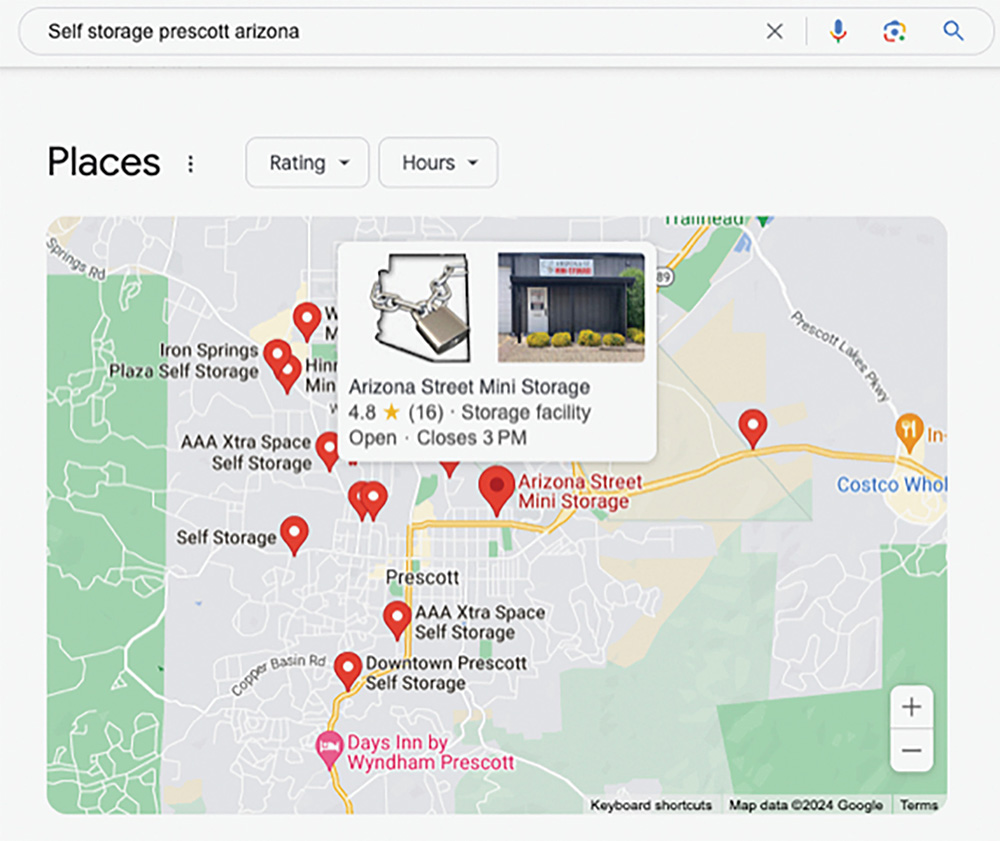
hy is Your Google Business Profile (GBP), formerly known as Google My Business, important? First and foremost, GBP is directly connected to Google Maps (see Image 1).
A potential customer may search for “self-storage near me.” This is the person who needs storage for a multitude of reasons but lives or works in your neighborhood. Of course, you don’t need to put the words “near me” on your profile or website. Google will know based on the searcher’s GPS location, and it will pull up all the facilities matching the criteria based on their Google Business Profile.
People may also search for “self-storage in [your town or city].” This could be someone who’s relocating. At any rate, your exact address needs to be the same everywhere—not just in your GBP.
Additionally, in your GBP, you can highlight all your services, amenities, and products, as well as post your hours. Customers can leave reviews. Potential customers can ask questions like “Can I store my car?” You can post tips, blog posts, and even promote events like auctions.
Furthermore, you can brand your page by uploading your logo and images (see Image 2).
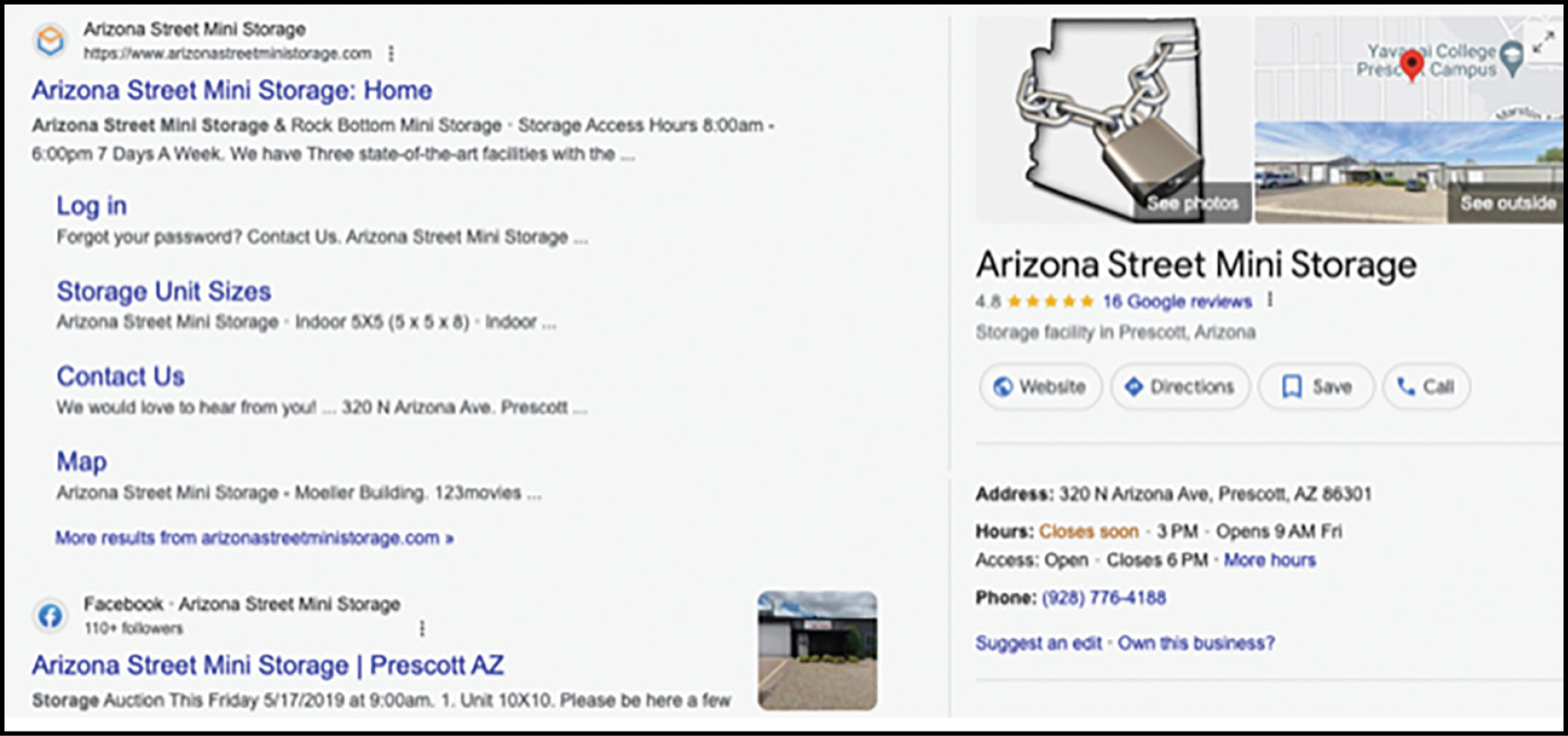

If you’re new to your location, you will have to verify your business. Follow the prompts and instructions to get verified. Once you’re verified, you’ll get a blue checkmark on your logo. By the way, this is what my GBP Dashboard looks like. (See Image 4)
On your profile, when you click on the three dots to the right of “Profile Strength,” you’ll see your business profile settings. (See Image 3) The business profile settings is where you can add other managers to your profile. I recommend having at least two people with access to your profile. Set notifications as needed; you want to be notified when someone asks a question and when someone posts a review—good or bad. As for “add a new business profile,” that would apply if you have multiple locations.

Here’s is where you add the pertinent details of your facility (see image 5). Make sure all your information is current: business name, contact information, regular hours, holiday hours, facility amenities, languages spoken, and services provided. Fill out everything that is relevant to your facility.
Believe it or not, all of this is important. Go through each of these sections and make sure that everything is filled out and optimized with your relevant keywords. For instance, you get 750 characters for your description. Make it keyword-centric, but don’t overdo the keyword stuffing. Write for your potential customer, in natural language, with the search engine in mind.

Another nice feature is “Updates” (see Image 6). You can share blog articles from your website to help with SEO. Add special offers and promote your events, especially your auctions.

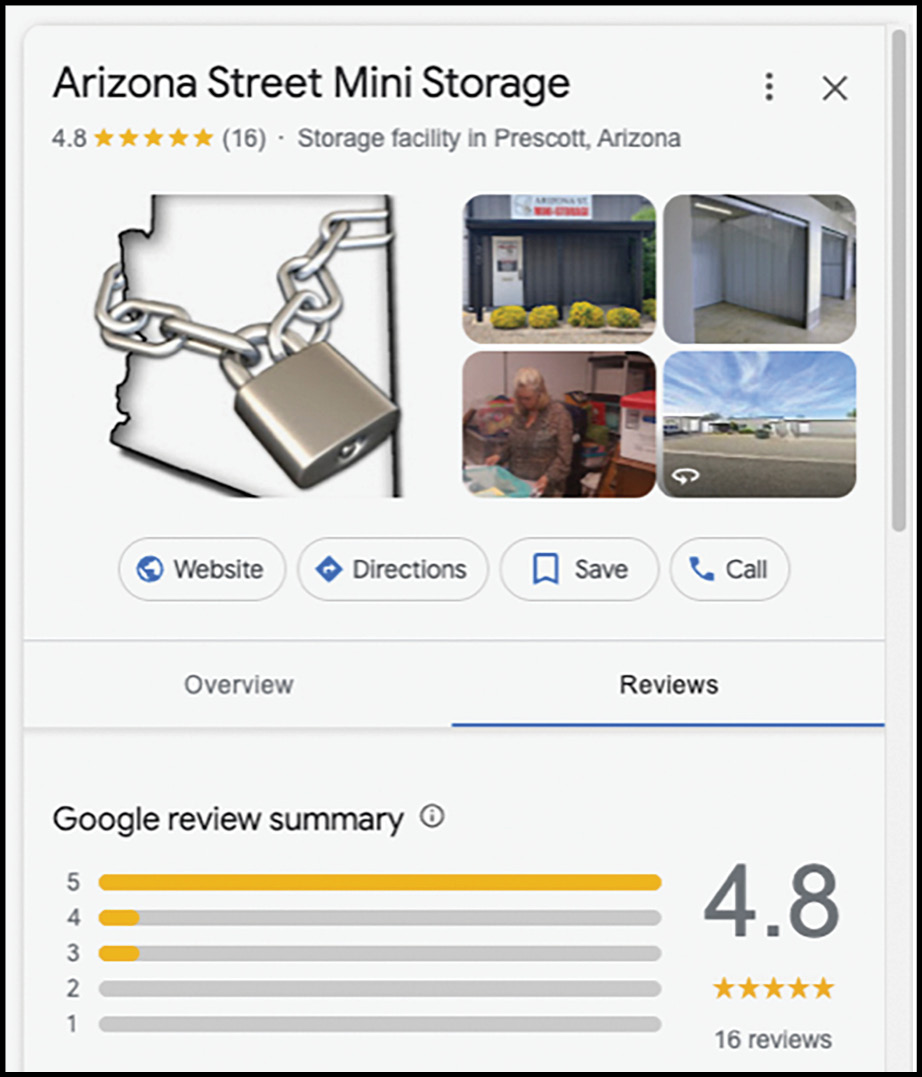
Always check your reviews and respond to them. Thank a happy customer and defuse any unhappy ones (see Image 7).
CHECK YOUR PERFORMANCE
This tracks interactions on your business profile only—not on your website. It will tell you how many people clicked over to your website from the profile. Note: This is not Google Analytics! That’s a different setup. (Refer to my past article on analytics.) If you have your phone number listed, which you should, it will tell you how many calls came from the profile (and messages if you have them turned on).

There are two types of suspensions: hard or soft. A hard suspension is when your business profile doesn’t appear when you Google your business name and city. This is bad. This may happen when there’s a change in management or ownership, or when an employee leaves and takes all your passwords with them. Another possibility is that your business is “unverified.” Google may have suspended you if it thinks your business is closed or you’re using spammy tactics.
A soft suspension is when your profile comes up and you have access to your dashboard but it looks like it’s never been verified as a local business and you can’t manage or update your listing. How do you know if your profile was suspended? More than likely, you received an error message or email saying something like, “Your access has been suspended (or disabled) because this profile doesn’t follow the guidelines …” They should provide a button for you to be able to edit your profile and fix the problem.
It’s possible that you’ve been overzealous in your posting and Google thinks you’re spam. Maybe something you posted offended someone with a lot of clout. Don’t be surprised if a competitor is behind bad reviews or reports your facility.
To avoid suspension, do not practice keyword stuffing (overusing your keywords in your description). Don’t make a lot of changes or edits to your profile in one sitting. Don’t list your business hours as 24/7. If you have 24/7 access for your customers, that should be in your description and/or your services. State your office hours clearly. If you have a live-in manager, state the after-hours contact info clearly. Google may suspend you if your information is confusing in any way.
It’s also possible you accidentally created more than one listing for the same location. In this case, disable the one that’s less complete. By no means should you create a new listing if your current one was suspended! Make sure any managers of your listing(s) are in good standing with Google. Finally, don’t violate any of Google’s terms of service (https://support.google.com/business/answer/9292476?hl=en).
All in all, your Google Business Profile should complement your website. You need both. The GBP is limited in the amount and type of information that you can include, thus your website can provide details.

ildfire season has arrived once again, officially spanning from April 1 to Oct. 31 each year. The concerning trend of increasing wildfire occurrences has become evident over the past few years. While wildfires have always been a part of Canada’s landscape, their intensity and frequency are now reaching unprecedented levels.
This rise can be attributed, in part, to the warmer and drier winters experienced across most of the country, likely influenced by phenomena such as El Niño. Continual shifts in climate patterns suggest that the incidence of wildfires will persist in growing.
Last year marked Canada’s most devastating wildfire season on record, with over 15 million hectares scorched. More than 600 fires have already been recorded this year, significantly surpassing the 10-year average of 430 for this period.
As we gear up for the climax of this fire season, it’s crucial to ask ourselves this question: Are we adequately prepared?
Last year, numerous wildfires spiraled out of control, leading to the evacuations of 48 communities and more than 38,000 individuals in Alberta. These evacuations underscore the critical importance of having a comprehensive plan in place for such emergencies.
Evacuation orders can be issued swiftly and with little notice. Are you prepared to vacate your facility for an unknown duration? Can your operations seamlessly transition to remote functionality?



- Establish clear communication channels with ownership in the event of evacuation.
- Develop an exit plan for leaving offices unmanned, outlining pre-evacuation tasks.
- Create a checklist for essential tasks, ensuring continuity of day-to-day operations remotely.
- Enable key staff to access facility and gate software remotely.
- Provide staff with clear directives for crisis management and customer communication.
- Implement a detailed communication plan with customers, including regular updates and reassurances.
- Utilize social media to provide live updates and reassure customers about the safety of their belongings.
- Define communication timelines and manager responsibilities during evacuation.
- Develop remote work protocols for staff to manage inquiries and payments.
- Ensure remote access to email and software, securely storing passwords.
- Stay informed through local news and emergency services to relay timely updates to customers.
By proactively addressing these points, businesses can better navigate the challenges posed by wildfire evacuations and ensure the safety and confidence of their customers.
Being prepared for wildfires is crucial for effectively managing evacuations if the need arises. If you’re situated in a wildfire-prone area, take advantage of the abundance of resources at your disposal. Start by exploring government websites at both the federal and provincial levels, as they offer valuable information. Additionally, many provinces provide wildfire apps for download, allowing you to stay informed about any fire threats to your facility(s).
In addition to accessing government websites and wildfire apps, there are several other proactive measures you can take to enhance your wildfire preparedness.
- Conduct regular drills. Practice evacuation procedures with your staff to ensure everyone knows their roles and responsibilities in the event of a wildfire.
- Create a wildfire emergency kit. Assemble a kit containing essential items such as water, non-perishable food, flashlights, batteries, first-aid supplies, and important documents. Keep this kit easily accessible in case of evacuation.
- Maintain defensible space. Clear vegetation and debris from around your facility to create a buffer zone that can help slow the spread of wildfires and protect your property.
- Invest in fire-resistant materials. Consider using fire-resistant building materials and landscaping techniques to make your facility more resilient to wildfires.
- Develop relationships with local authorities. Establish connections with local fire departments and emergency services to stay informed about wildfire risks in your area and receive timely updates and alerts.
- Train staff on fire prevention. Educate your staff about wildfire prevention measures, such as proper disposal of cigarette butts, and the importance of reporting any signs of smoke or fire immediately.
By taking these additional steps to enhance your wildfire preparedness, you can better protect your facility and mitigate the risks associated with wildfires.

he resilience and stability of the self-storage industry has caught the attention of real estate developers and investors like never before. Over the past few years, the industry has demonstrated its ability to weather various economic crises, including downturns caused by the pandemic, slowing growth, and persistent inflation. Remarkably, demand for self-storage continues to grow despite these challenges and thanks to some more recent tailwinds, such as the higher cost of housing, increased density, smaller dwellings, and work from home.
This surge in interest has brought many newcomers into the industry, both as operators and renters, altering the way business is conducted. However, if you’ve been observing the self-storage market recently, you might have noticed a troubling trend: a market war that has escalated into a race to the bottom. As the market adjusts, and while demand remains robust—though not as intense as during the pandemic—the fear of rising vacancies and the apprehension caused by an influx of new supply has spurred many self-storage operators into fierce price competition to attract renters and fill vacant units.
In the heat of this pricing war, some companies have resorted to drastic measures, often offering unsustainably low prices to attract renters, only to raise rents significantly a short period later. This tactic, though tempting in the short term, is neither fair nor ethical. It also harms the industry’s reputation by directly damaging the trust of our renters.
While the urge to slash prices to gain renters is understandable, price competition is usually a negative-sum game that erodes long-term profitability and can impact service and quality levels. Implementing price cuts is easy, but reversing their impact will be challenging.
There are several negative consequences to this pricing war. Primarily, the strategy of luring renters with low prices only to increase rents shortly after is a surefire way to alienate them. If renters perceive that they have been deceived, they will likely move out, leaving behind damaging online reviews and decreased lifetime value. Furthermore, this will also pressure competing storage companies to adopt similar practices, leading to a widespread decline in revenues. Simply put, this strategy is not sustainable in the long run. Additionally, it tarnishes the industry’s reputation, making it appear sleazy by relying on fine print to recuperate losses.
The backlash has been strong from industry veterans, with the most frequently repeated complaint being the high customer churn caused by deceptive pricing strategy, as many renters are vacating their newly rented units within six months. In an industry where renters can potentially be lifelong clients, such brief rental periods are considered failure by another name.
At Montreal Mini-Storage, our revenue management philosophy has long been guided by Warren Buffett’s wisdom: “Price is what you pay. Value is what you get.”
We price our services according to the value we offer. Our value is derived from the cleanliness of our facilities, the convenience of our locations, our incredible team, the variety of storage locker sizes, and the numerous amenities we provide, including security and climate control. Above all, our greatest value is the importance we put on the relationships we build with our renters. Our friendly and knowledgeable staff are there to support renters during some of the most challenging times in their lives, and this is what has helped us to retain our clients year upon year.
With this philosophy, we’ve never aimed to be the cheapest self-storage provider on the market, as we know that price is not the only deciding factor for renters. Despite the presence of lower priced self-storage options in Montreal, renters have consistently chosen Montreal Mini-Storage for over 20 years because of our reputation for fairness and excellence as well as the value we provide. This has allowed us to grow into the largest self-storage brand across Quebec and the Maritime provinces. This is not to say that we don’t offer competitive pricing or promotions, but we base these on factors influenced by customer loyalty (like customer’s term). Our renters have stayed with us thanks to the relationships we’ve built and the consistency in our service. Most importantly, they have found a home with us because we have built it for them. We’ve never believed in a one-size-fits-all solution, and price sensitive clients have recognized the value in that. Our inventory has always included a range of options, including lower cost solutions, so no potential customer is priced out of our brand.
Typically, self-storage clients are long-term clients, and a value-based pricing model is truly designed for retention and long-term success. By focusing on providing value rather than competing on price alone, we can ensure the sustainability and integrity of the self-storage industry. As industry players, it is our responsibility to prioritize the long-term health of the market and the trust of our renters over short-term gains.

hen existing facilities seek to optimize their land, relocatable storage units are the clear choice. Owners boost profits by filling gaps around buildings, lining fences, and loading easements. Because of this, relocatables have gained massive popularity in recent years. Facilities worldwide have achieved peak financial productivity by leveraging relocatables in this way.
Adjacent to the tried-and-true infill strategy, however, a new trend is emerging. More and more, entrepreneurs are forgoing traditional structures altogether when designing storage. They’re running numbers, weighing options, and electing to build entire facilities using relocatables.
Upon considering this new approach to storage, several questions begin to emerge. When does it make sense to build using relocatables? Are they comparable in quality and longevity to traditional structures? How will cities and end users perceive this new model?
To answer these questions and more, let’s introduce the focus of this case study. ABC Storage* is a fast-growing storage syndicate based in the Southeast United States. The team is a group of CRE veterans backed by a century of combined industry tenure. Their expertise lies in pinpointing the highest and best use for commercial land.
Today, we will review one of their facilities built exclusively using relocatables. We will review the entire timeline, from city approval to renter move-in. In doing so, we will reveal the decision-making process that led to this approach.
It was, however, a commercial-zoned parcel in a well-trafficked area. Neighboring businesses include a Publix, Target, and a couple dozen restaurants and shops. Site analysis revealed excellent roadside visibility to 50,000 vehicles every day.
Beyond the southern perimeter lies extensive, sprawling suburbs. Data from Sparefoot shows that people tend to rent storage within three miles of home. The mix of steady traffic and nearby dwellings makes this an ideal storage locale.
Cost Analysis
“Compared to a single-story drive-up (NCC) product,” says an ABC Storage team member, “we were saving nearly 50 percent of the cost that we would normally absorb. We were also able to mitigate any risk associated with building material cost increases, shipping aside.”
The impact on cost stretches beyond the initial phase, too.
“Furthermore,” he continues, “our vendor delivered warranties that mirrored traditional construction.” This provided the long-term confidence they needed to proceed.
Satisfied with their findings, the business plan materialized, and the team entered the approval phase.
With that said, the team at ABC discovered the key to permission was education.
“The preparation for this project was not dissimilar from any other traditional building process,” says a team member. “We did, however, work proactively to share product information with the municipality. This ensured there weren’t any hiccups further down the line.”
Their relocatable unit vendor loaded them with site plans, drawings, specs, and photos. The ABC team, in turn, supplied this information during talks with the city. Once the project’s quality and aesthetic were conveyed, approval moved quickly.
Throughout these discussions, the city made a few requests. First, street-facing units needed to have a stone façade. Their relocatable unit vendor obliged by sourcing architectural panels. Next, a foliage minimum had to be met, so their vendor added landscaping into the site plan. Finally, it was decided the units must be fixed to the ground. Their vendor solved this by producing an anchoring system. ABC Storage fulfilled each requirement and city approval was granted.


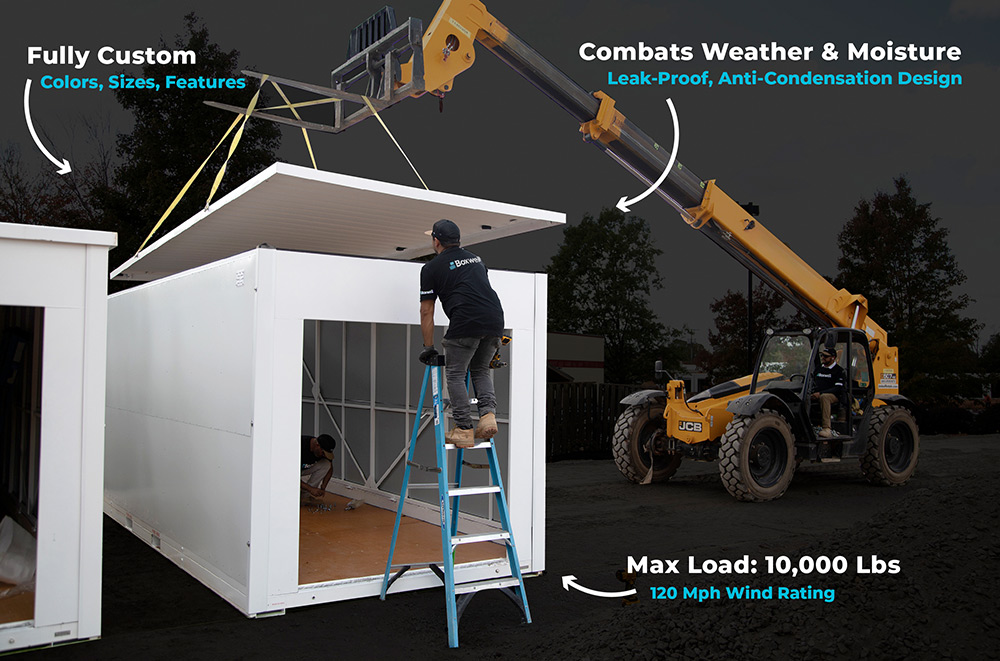
The roll-up door order was placed through the same vendor. Bundling units and doors greatly simplified the logistics surrounding delivery and install.
With the details ironed out and the deposit paid, production began. In three months’ time, their order would be fabricated and transported. Meanwhile, the team at ABC started on the next phase: development.
Site Prep
With the addition of fences, curbs, and other perimeter work, the site prep was largely complete.
Relocatable units ship flat-packed within ocean containers, 12 at a time. This allows 1,920 square feet to fit within a 320-square-foot ocean container. When 50,000 square feet of storage is being transported, it equates to massive savings.
Over the course of two weeks, 26 ocean containers were unloaded, one by one. The flat-packed units and coiled doors hung vertically in skids, ready for assembly.

Once built, relocatable storage units are steadfast, durable, and built to last. The wind rating stands at 120 mph and load capacity maxes out at 10,000 pounds.
The roof is strong enough to hold six feet of snow, although that’s of little concern for this Georgia team. What is of interest to them, though, is the weathertight, condensation-mitigating design. The roof won’t leak, and a moisture-wicking desiccant spray is applied to the ceiling. These measures offer a welcomed peace of mind in a city that averages 50 inches of annual rainfall.
In addition to cost savings, we asked an ABC Storage team member what else stood out about this process. “Speed to market,” was his reply. “We were able to achieve somewhere in the range of four to six months of savings for our construction timelines versus a traditional product,” he says.
During the final stages of building, the ABC Storage team shored up the digital side of the business. They boosted their online presence with a new website and marketing campaign. A third-party management team was chosen to handle the day-to-day operations. Final preparations were made, and the first tenants rolled in.
Their combination of drive-by visibility and digital prospecting has been successful, too. Just four months after opening, 150 units have rented, equating to 28 percent capacity.
The Athens project served as proof of concept for the ABC Storage team. They learned it is possible to build attractive, long-lasting storage using relocatable units. Furthermore, they found the savings in cost and time to be favorable. So favorable, in fact, that they have since repeated the business model several times over. By 2025, the company’s portfolio will include a handful of relocatable-only facilities. Combined, these sites will hold 2,500 rentable units.
Relocatable units have proven their worth, both for infill projects and ground-up builds. Their popularity grows as reputable companies continue to adopt this approach to storage. If you’re a prospective developer, we encourage you to conduct your own side-by-side comparison. You may find yourself bypassing the traditional build process altogether at your next storage facility.
*Company name has been changed.


mpty nesters are parents whose children have moved out of the family home. This life stage marks a significant shift, as empty nesters navigate decisions about their financial and personal lives and figure out the lifestyle they wish to pursue in this next chapter. While these choices primarily affect the empty nesters, their transition also has a notable impact across various industries, especially the housing market. These trends can influence useage and open new opportunities for self-storage businesses to potentially capture the business of empty nesters.
This article aims to explore how empty nesters plan on adjusting to this new stage of life, the implications on the housing market, and how self-storage can transform an empty nester’s experience during this life-changing time.
STAYING PUT
There are many reasons that empty nesters choose to stay in their current home. Empty nesters can experience an emotional attachment to their current home due to the space holding a ton of sentimental value. From raising their children to celebrating important milestones, the emotional attachment to the house can outweigh the practical considerations. Alternatively, empty nesters might have a retirement plan already set and feel confident in their income (Duncan & Zimmerman, 2024). Ultimately, staying put is a smarter financial choice for many empty nesters, especially those without a mortgage.
DOWNSIZING THEIR DWELLING
Downsizing to a smaller home is another viable option for empty nesters, especially if they no longer need the extra space. Moving into a smaller house means reduced maintenance costs and utility expenses. Additionally, it also means that it’s easier to manage daily, given there’s less square footage, and much easier to move around, which becomes more important as empty nesters age. Downsizing can be an amazing opportunity to explore a new neighbourhood or city as empty nesters enter this new phase of life. This can be especially true if the empty nesters are retired or nearing retirement, proving that while this can be a daunting chapter, it can be an exciting one as well.
So which direction do empty nesters favour? Many may assume the majority of empty nesters will decide to sell their house and downsize to a condo or apartment. However, data on U.S. and Canadian demographics suggest otherwise; a good portion of empty nesters are choosing to stay in their current homes.
In fact, according to Redfin News in the U.S., “Empty-nest baby boomers own 28 percent of the nation’s largest homes (Anderson & Bokhari, 2024).” This finding also aligns with a survey conducted by Fannie Mae, where most Americans over the age of 60 don’t ever intend to move and 56 percent stated they would never sell their homes (Duncan & Zimmerman, 2024).
The Canadian market echoes a similar sentiment; the majority of boomer homeowners intend to live in their current homes as long as possible, according to a 2020 Generational Real Estate Trends Report by Mustel Group and Sotheby’s International Realty Canada (White, 2024). A trend that many empty nesters are adopting is renovating their existing homes to fit their new lifestyle, per a Royal Lepage survey (White, 2024).
Self-storage can either serve as a short-term or as a more permanent solution during this phase of life for empty nesters. For instance, if an empty nester is looking to move or relocate, storage can be particularly beneficial for storing their items safely and securely during the move, which they can then retrieve when needed. On the other hand, an empty nester who is looking to declutter and make more space in their home, whether they are moving or not, may want a more permanent storage solution for their belongings, specifically sentimental items, such as family heirlooms and photo albums, or items that belong to their now-grown children.
Additionally, if an empty nester has plans to do renovations, like creating new hobby rooms, self-storage can provide the extra storage space and flexibility for them to commit to those major house changes. Therefore, more time is spent exploring passions and enjoying the current space where empty nesters reside with friends and family (White, 2024).
Renting a storage unit provides empty nesters space to securely store their items regardless of their plans. Depending on the self-storage facility, they’ll have access to various features and amenities, including but not limited to flexible rental terms, various unit sizes, top-notch security, and temperature-controlled units to protect valuable items.
Companies can follow the lead of XYZ Storage, a Canadian-based self-storage business known for its dedication to supporting individuals, families, and businesses as they navigate big life-changing transitions. XYZ Storage has been an expert in the storage industry for almost 30 years and has become the No. 1 reviewed self-storage business in Canada.
The company caters to the needs of empty nesters to provide them with flexible, affordable, and convenient storage solutions across all five of its facilities across Toronto and the Greater Toronto Area (GTA). Here are all the ways that XYZ Storage caters specifically to empty nesters:
- 24/7 Video Surveillance and Monitored Access: Many empty nesters are storing valuables and sentimental belongings that hold a significant emotional value. XYZ Storage is equipped with 24/7 video surveillance in place, which includes limited entry after business hours (only granted upon request) to ensure those belongings are always kept safe and secure. This way, empty nesters will feel confident in leaving them in storage.
- Drive-Up and Drive-Thru Units: Depending on the location, drive-up or drive-thru units are available, which are especially beneficial for empty nesters planning on downsizing. Empty nesters will be able to experience a more seamless and stress-free moving process with convenient access to their units.
- Truck Rentals: To further assist with the moving process, XYZ Storage has a fleet of truck rentals available for new customers to rent, making it easier for empty nesters to move their belongings within Toronto and the Greater Toronto Area (GTA).
- Professional Shredding Services: Professional shredding is a service that XYZ Storage offers to help empty nesters declutter their homes efficiently. The service is created for personal and business usage while ensuring all destroyed papers are 100 percent securely recycled to reduce impacts on our planet and environment. This can be useful for empty nesters who are seeking an eco-friendly way to get rid of old documents, resulting in a more clutter-free home.
- Moving and Packing Supplies: To support the packing efforts of empty nesters, all self-storage locations have moving and packing supplies available for purchase, making it an easy one-stop shop for absolutely everything needed for moving and packing (for example, packing boxes, bubble wrap, furniture coverings, and much more).
Self-storage companies can benefit from customizing their offerings to empty nesters who choose to downsize or even look to create space in their current homes.
In conclusion, self-storage companies can play a pivotal role in supporting empty nesters during this significant life-transition period by offering practical support, specifically flexible storage solutions, whether to help them downsize or declutter their space. Self-storage can be the ultimate solution to help empty nesters navigate this new phase of life with ease and confidence to embrace this new eye-opening life chapter.
hen questioned about the things that satisfy most employees, they will typically list items tied into compensation, such as their salary, bonuses, and access to quality health insurance.
Workable, a job recruiting site, conducted a survey that found the top motivator for employees is compensation. “While factors like fresh challenges and work flexibility matter, compensation remains the top attractor and area for improvement in current jobs, underscoring its importance in employee satisfaction.”
In fact, 63 percent of respondents say compensation, which includes bonuses, is the most important thing that will keep them at their job.
Christina Rita, COO of StoragePRO Management, Inc., in Walnut Creek, Calif., says her company understands the importance of compensation. “We like to do a pay survey to ensure we are where we should be when it comes to compensation,” she says. “We look at both internally and externally.”
USG employees meet once a month on video conference, which allows area managers and training managers to address issues overall. The employees also have an opportunity to talk to one another about issues. Additionally, employees meet once a year for an in-person conference.
If you’re not checking in weekly or monthly, experts agree it should be at least once a quarter. “I think you should follow up with employees at least every three months,” says Carol Mixon, president of SkilCheck Services, Inc., in Tucson, Ariz. “If you don’t, some things will fall through the cracks and become bigger issues if you let them go.”
Mixon talked to one facility employee who hadn’t seen an owner in three years. “No feedback from them, no raises, nothing,” she says. “I know many people are afraid of talking to their employees, giving them feedback as they’re afraid their manager may quit, but if you don’t address things, they will just keep getting worse.”
The first step in reviewing your employees and giving pay raises is ensuring everyone understands your expectations of them. “We set a wide criterion for expectations; everyone needs to know the expectations and that they’re all on the same playing field,” says Jay Catrib, director of business support for Pogoda Management Company in Farmington Hills, Mich. “You can’t base salary on seniority or if you like them. We use best practices.”
Lou Barnholdt, vice president of sales and development for Universal Storage Group, says their annual reviews are conducted at the same time each year. “Our area managers start working on annual reviews in February and March; if there is a pay increase, it takes effect in April,” she says. “We make sure there is clear communication and provide feedback.”
USG’s goals include:
- Meeting or exceeding income expectations for the property
- PMG (Personal Marketing Goals)
- Google Reviews
- Reporting on time and accurately
- Complying with the six company core values
StoragePRO’s raises are goal driven as well. “We previously gave them a rating one to five in their reviews, but we found that really wasn’t efficient in addressing the goals we have,” says Rita. “We now focus on three or four smart goals for each person.”
Natolie Ochi, president of SKS Management LLC in Pleasanton, Calif., says they broach reviews in a more non-conventional manner. “We used to do formal reviews, but that is now seen as out of fashion,” she says. “We prefer to do casual check-ins. We have them write about themselves and what they would like to learn. If we coach it that way, it makes it less stressful.”
It also helps the company learn more about their employees. “Through that process we learned one of our managers was working on an accounting degree; now they are working in our accounting department,” Ochi says, adding that 47 percent of their employees have been with the company more than 16 years.
- Have the employee review themselves prior to the review. This allows them to self-evaluate and help identify improvement measures.
- Meet in person, if possible.
- Document the exchange in writing.
- If there are elements that can be improved, make sure you line those issues out with the employee and they understand the expectations as well as the timeline in which to correct the issue(s).
- End the exchange with clear direction and making note of what they are doing right.
In the early days, USG gave their managers a $10 bonus per lease, but it is now tied into a budget and monthly revenue.
“We give our managers a workbook and they can track their progress for making their bonus throughout the month,” says Johnson. “There is no guessing. You must make it easy to understand. If you don’t, they will just give up.”
Pogoda’s employee bonuses are based on goals set by the company each year. “Our bonuses give our employees a piece of the pie,” says Catrib.
It’s important to make employees feel like they have ownership in the business. “Employees have to feel empowerment in their jobs as well as that they’re appreciated,” says Ochi.
Employees at SKS Management receive quarterly bonuses as well as annual bonuses. “The quarterly bonuses are for immediate gratification; many younger people expect immediate gratification,” says Ochi. “There are some companies even doing bonuses weekly.”
And bonuses don’t necessarily have to be cash. “I will give managers a budget to spend to buy the office pizza if they’re doing a good job,” says Ochi. “We even did those butterfly cakes where butterflies come out of the box. Anything to show we appreciate them.”
- Send an area manager to the property to role play scenarios with the manager.
- Set up special training based on the manager’s preferred method of learning.
- Pair the employee with a mentor. Sometimes managers learn better through networking with a mentor who is on the same level.
- If you are a small company, take advantage of state association programs and their mentoring programs.
Despite utilizing various methods for increasing salaries and giving bonuses, these industry experts agree on two fundamentals: Employees should always be aware of the employment expectations and bonus structures must be easy to understand.

Taking Action

unger is something we think about on a daily basis. While we all have this in common, what is far less common is the ability to satisfy that hunger. Most of us are blessed with easy access to food, whether we choose to make it ourselves or go out to eat. But for many throughout the world, they don’t know when their next meal might be. This stark contrast underscores a significant global issue: malnutrition. Many of us can address our hunger with ease, yet millions worldwide face the daily uncertainty of where their next meal will come from. Thankfully, there are charities working hard for a change.

Mission Feeding was one of the first partners to join StorageGives as a trusted charity. A dedicated non-profit organization for the self-storage industry, StorageGives ensures that 100 percent of all donations reach their intended causes, without any deductions for administrative costs. By focusing on areas critical to global welfare (medicine, veterans, children, and clean water) StorageGives strives for global impact through every donation given.

These common goals led to one of the most significant partnerships Storage-Gives has formed. Recognizing the urgent need to address child malnutrition in Africa, StorageGives has channeled its resources to support Mission Feeding’s essential work. Through the generous contributions of its donors, StorageGives has donated enough to feed 1.8 million children. This remarkable achievement is a beautiful example of the profound effect of collective action and the difference every dollar given can make.
Global hunger statistics paint a stark picture. According to recent data, over 750 million people worldwide suffer from hunger, with children being the most vulnerable. That’s almost one in 10 people who aren’t getting enough food, not knowing when their next meal may come. Child malnutrition remains a critical concern. It is one of the leading causes of death in children under age five. These statistics show the importance of initiatives like Mission Feeding and the vital role they play in alleviating hunger and improving the lives of countless children.
The role of StorageGives in this context cannot be overstated. By partnering with Mission Feeding, StorageGives has amplified the impact of its donations, reaching more children and providing more meals. This collaboration highlights the effectiveness of strategic partnerships in the non-profit sector, where combining resources and expertise can lead to greater achievements.
As we mark Hunger Action Month, it is essential to reflect on the collective effort needed to combat hunger globally. StorageGives offers a unique platform for self-storage professionals to be part of this noble cause. Through financial contributions and active participation, the self-storage community can make a tangible difference in the fight against hunger.
In addition to encouraging donations, StorageGives promotes involvement through upcoming fundraising events like the ones being held at the fall conferences for the Tennessee Self Storage Association and Louisiana Self Storage Association. These events not only provide an opportunity to contribute but also to engage with the community and learn more about the ongoing efforts to combat hunger. By attending these events, self-storage professionals can connect with like-minded individuals, share ideas, and explore further ways to support Mission Feeding and other vital initiatives.
Hunger may not be a crisis you face, but it is being faced by almost 10 percent of the planet. Problems like that can seem overwhelming, but you can make a difference. Even a single meal, to the one receiving it, is a huge blessing. Through the tireless efforts of organizations like Mission Feeding, and with the generous support facilitated by StorageGives, we can make a significant impact in the lives of millions of children worldwide. As self-storage professionals, your involvement can be a powerful force for change, providing the resources necessary to combat hunger and foster hope. Together, we can make a dent in the global hunger crisis, one meal at a time.


Better Together

Self-storage Young Leaders Groups have a diverse range of members covering all aspects of the industry. This diversity allows you to learn how each role integrates with the others. It supports the importance in each job, and how when done well they combine to achieve great results. The members of a Young Leaders Group have diverse backgrounds that range from customer service, call centre, and management to vendors, brokers, development, and acquisition teams. By networking within these groups, you have access to like-minded professionals in every part of the self-storage industry. This allows you to grow a strong network of emerging professionals to help you evolve and get ever proficient and better at your role in the industry.
As time progresses, I often see savvy young professionals progress upward within the industry. If you’re keen, humble, and ever learning, it’s very common you’ll have lots of opportunity to grow in the industry. There are many examples of a high school or university student taking a part-time entry-level job, only now to be a manager, regional manager, director, or executive. With patience and understanding, the industry provides a wide range of learning and challenge to take on. Therefore, corresponding with like-minded peers often provides a great opportunity to learn how everyone’s roles work together. For many smart young professionals, where you start is often only the beginning of a great self-storage journey. Moreover, your skill sets and connections may take you into completely different skills sets within the self-storage industry. Thus, you never know what door you may go down when you’re networking with other like-minded individuals at an event or tradeshow.
A significant benefit of the self-storage Young Leaders Group has been the access to industry experts and veterans in direct-access fireside chats. These informal get-togethers often have great nuggets of information. When a 30-year-plus veteran of the self-storage industry divulges their great key learning over a fireside chat, it’s a real special treat. Moreover, when that is paired with inquisitive minds and innovative young industry brains, I often see ideas that leapfrog the industry on great new paths. The open, unfiltered sharing and innovation that come out of these meetings is priceless.
When I sit down with our Young Leaders Groups and emerging stars of the industry, it gives me great reassurance that the future of our industry is in great hands. Moreover, as we work and share together new possibilities, successes arise that could only be attained through great collaboration. Thus, I encourage you to seize the opportunity to join the CSSA’s Young Leaders Group. On the flipside, if you’re now too old, like me (the age limit is 40), take the opportunity to network and share with our industry youth as you’ll rekindle some of your great stories and imagination in ways that will surprise you.

-
 Advantage Box Co.2080 Van Dyke Place
Richmond, BC V6V 1X9
(604) 276-2000
Email: info@advantagebox.com
Website: www.advantagebox.com -
 Boxwell6672 Gunpark Drive, #100
Boulder, CO 80301, U.S.
(303) 317-5850
Email: ssupport@boxwell.co
Website: www.boxwell.co -
 Chateau Products, Inc.1820 47th Terrace East
Bradenton, FL 34203, U.S.
(800) 833-9296
Email: sales@chateauproducts.com
Website: www.chateauproducts.com -
 G M Packaging Ltd5450 Maingate Drive
Mississauga, ON L4W 1R8
(905) 206-0550; (800) 388-0834
Fax: (905) 206-9917
Email: sales@gmpackaging.com
Website: gmpackaging.com
CEO: Glen McBurnie
Years in business: 24 -
 Great Little Box Company11300 Twigg Place
Richmond, BC V6V 3C1
(604) 301-3700; (800) 661-3377
Fax: (604) 301-3747
Email: info@greatlittlebox.com
Website: www.glbc.com
President & CEO: Robert Meggy
Years in business: 35
Geographic areas served: Western Canada and Washington State -
 iBid4Storage Inc.44 Upjohn Road
Toronto, ON M3B 2W1
(647) 454-4243; (855) 402-4243
Email: info@ibid4storage.com
Website: www.ibid4storage.com
Owner/President: Yehuda Leon Benghiat
Geographic areas served: Nationwide; International -
 Janus International135 Janus International Boulevard
Temple, GA 30179, U.S.
(770) 373-5760; (866) 736-6634
Email: sales@janusintl.com
Website: www.janusintl.com -
 PTI Security Systems9160 E. Bahia Drive, Suite 100
Scottsdale, AZ 85260, U.S.
(800) 523-9504
Email: sales@ptisecurity.com
Website: www.ptisecurity.com -
 Self Storage Manager325 Sentry Parkway, Suite 200
Building 5 West
Blue Bell, PA 19422, U.S.
(800) 469-1740
Email: sales@selfstoragemanager.com
Website: www.selfstoragemanager.com -
 StorageVault100 Canadian Road
Scarborough, ON M1R 4Z5
(877) 622-0205
Email: ir@storagevaultcanada.com
Website: www.storagevaultcanada.com/en -
 Storeganise

-
Prime Group Expands Into CanadaTogether with its affiliates, Prime Group Holdings, LLC, a vertically integrated private equity real estate firm and top operator in the United States, recently expanded into the British Columbia market with the acquisition of a self-storage property in the inner Vancouver suburb of Burnaby. The acquisition was made by the firm’s investment vehicle, Prime Storage Fund III, LP. Located just east of Vancouver, the 1,018-unit facility is comprised of 67,476 rentable square feet and includes 63 parking spaces. It is visible from and easily accessible to the Trans-Canada Highway. Prime Group will manage the facility, which will operate under the Prime Storage brand. This transaction follows Prime Group’s previous acquisition of a facility in Sherwood Park, Alta., which was the firm’s first Canadian self-storage property.
-
Apple Opens London FacilityIn June, Apple Self Storage opened a new facility in London, Ont. The brand-new, modern facility is Apple Self Storage’s 51st location in Canada. Conveniently located at Highbury Avenue North, just north of Trafalgar Street, it is part of the Apple’s adaptive reuse initiative, which seeks to repurpose existing historic buildings for self-storage use, provide a useful service to the community, and minimize the company’s carbon footprint. Formerly Vaughn Hockey Equipment, Apple Self Storage – London has more than 50,000 square feet of storage space and heated indoor units. Its amenities include individual unit alarms, retail merchandise, indoor loading bays, and 24/7 access.
-
U-Haul Helps Displaced Residents In Winnipeg

This spring, due to concerns of collapse resulting from structural problems, a city-issued evacuation order for an apartment building in Winnipeg left many residents with moving trucks full of personal belongings and nowhere to go. In response, U-Haul Company of Central Canada offered 30 days of free self-storage to the 250 tenants of the Birchwood Terrace complex. The 30-day free offer applied to new storage rentals and was based on availability at U-Haul Moving & Storage of Notre Dame. Speaking at a health-care announcement in Carberry on May 10, Canada’s Premier, Wab Kinew, said the province will also be able to help if needed, ensuring medical services are covered, such as prescriptions or missing health cards. “Our government is in there as a supporting capacity right now, and we’ll be there in the long-term.”
According to media sources in the area, residents of the apartment building were notified that their leases were terminated and that they would be receiving compensation of approximately $2,000 per person to cover their damage deposits and May rent. The displaced residents were not able to return to their apartments until repairs were completed.
-
Broccolini Enters Montreal MarketBroccolini, a real estate developer and investor, has entered the Canadian self-storage market with three ground-up projects in Montreal. Totaling nearly 400,000 square feet, the facilities will be branded as Pandora Self Storage and financed through Broccolini Self-Storage Fund LP, which aims to address the growing demand for self-storage in urban centers, especially Quebec and Ontario. The projects include a $39-million, multistory building in Kirkland that will comprise 150,000 square feet in more than 1,100 units and up to 5,000 square feet of coworking space. It’s scheduled for completion in April 2025. Broccolini is also investing nearly $5 million to convert a multistory building in Pointe-Claire; the 115,000-square-foot structure was built two years ago but never occupied. It will offer 900 units after it opens in early 2025. The third is a 120,000-square-foot facility in Brossard; construction on the $35-million project may not be completed until 2026.
-
PTI Releases New ProductsPTI Security Systems has introduced two new products designed to improve facility security and convenience: the ProEdge smart latch and the AP1 keypad. The ProEdge smart latch, which is suitable for new and existing (corrugated or flat) doors, integrates with PTI’s StorLogix Cloud for real-time access data, advanced security monitoring, and overlock capability. Its durable stainless-steel build ensures long battery life and all-weather reliability; its tamper-resistant design has an accelerometer that alerts operators and tenants of interference. Features of the AP1 include a larger OLED display for expanded operator messaging and branding, next-generation Bluetooth with an increased range, increased surge protection capabilities, an optional heated keypad, and raised, backlit buttons. AP1 also integrates directly to StorLogix.
-
Tenant, Inc. Launches Payment LinkTo enhance and streamline the payment processes, Tenant, Inc.has launched a one-time payment link. The functionality allows tenants to complete online payments in as little as four clicks, a greater than 90 percent reduction in steps to pay. The easy, fast, and secure payment process allows businesses to collect more money in less time, while also providing a better customer experience. Per the company’s press release, including payment links in automated delinquency communications enables tenants to complete payment without having to login. There is one click to follow the link from their text or email, a second click to autofill billing address from their browser, a third click to autofill credit card information from their browser, and a fourth click to complete payment. One-time payment links can also be sent on demand in text and emails from the Hummingbird Communication Center. In addition, Tenant, Inc. has released several other new features to help self-storage operators significantly streamline their business processes and gain valuable data insights, including targeted and filtered tabs on landing pages, Google Analytics 4 Advanced Setup and Looker Studio dashboards, unified communications, rent management, tenant warehouse, and promotions management. Details are available at www.tenantinc.com.
-
Janus Unveils Nokē IonJanus International Group, Inc., recently announced the addition of Nokē Ion, an inside-the-door, magnetic, hardwired smart locking system into its award-winning line of Nokē Smart Entry products. In addition to the all-new, hardwired smart locking solution, the Nokē Smart Entry platform also offers a high-tech, battery-powered, external smart lock known as Nokē ONE. These two smart locking technologies, paired with a full suite of smart entry point products and mobile technology, offer a solution for all self-storage smart access applications. Visit www.janusintl.com/noke-ion for more details.
-
MSM Opens ArchivesMSM has unlocked its vault of archives, granting website visitors free access to 43 years’ worth of storage-specific content—the equivalent of 40,000-plus pages. Users can search the archives by keyword (topic, person, facility, company, market, etc.) on MSM’s website and view or download issues as high-resolution PDFs. Since 1979, Messenger (formerly Mini-Storage Messenger) has been providing the self-storage industry with invaluable information about the latest trends, news, advancements, data, and more. To browse the archives for free, visit www.modernstoragemedia.com/msm-magazine-archives.
-
MSM Publishes Legal NewsletterAfter more than 20 years, the Legal Monthly Minute, published by Scott Zucker, a partner in the law firm of Weissmann Zucker Euster + Katz P.C. in Atlanta, Ga., will now be published by MSM. MSM’s partnership with the Legal Monthly Minute will enable Zucker’s pertinent, industry-focused legal information to be disseminated to self-storage owner-operators throughout the United States on a larger scale. Zucker’s Legal Monthly Minute articles have been reprinted in numerous trade association newsletters and magazines, including MSM’s Messenger. They’ve also been used to create his “Legal Topics in Self Storage” books (First and Second Editions). To subscribe, visit www.modernstoragemedia.com/legal-minute.
-
Overlocking SolutionsFor self-storage operators needing to overlock delinquent tenants at their facilities, SpiderDoor now offers comprehensive unit overlocking solutions. SpiderDoor’s overlocking solutions enable tenants to request their lock code via their mobile device at any time. Once a lock has been assigned to a delinquent unit, SpiderDoor promptly sends out a pre-text message. Following full payment of their bill, Spiderdoor dispatches a post-text message and email notification containing the unlock code. Existing SpiderDoor users can take advantage of these delinquency management tools at no extra cost. Non-SpiderDoor users can gain access to all the overlock features for just $10 per location. For more information about Spiderlock’s security and access control products, visit www.spiderdoor.com.
-
Introducing Unit ConnectThe self-storage automation platform swivl has partnered with online self-storage rental system Storagely to introduce Unit Connect. This latest feature is designed to change the way potential tenants find and rent storage units by making the process faster, more efficient, and user friendly. Unit Connect is expected to enhance the rental journey by directly guiding potential tenants to the specific unit they’re interested in, complete with all necessary details pre-populated. This will eliminate the need for customers to navigate through multiple pages, thereby accelerating the rental process by more than four times compared to traditional methods and boosting conversions.
-
Use The Storelocal BrandStorelocal, a membership organization, has launched its Storelocal Storage Brand Licensing Program. Storelocal Storage is a unique business model designed to allow independently owned storage facilities to compete with much larger self-storage conglomerates. Leveraging the “power of more,” Storelocal Storage enables individually owned facilities to rebrand as Storelocal Storage with national brand recognition and SEO domain authority. The program includes everything needed for operations, including a complete brand kit, a dedicated team of SEO specialists, and a tech stack powered by Tenant, Inc. Visit www.storelocal.com for details.
-
Need A Lift?PFlow Industries’ M Series 2-Post Mechanical Material Lifts are ideal for most material lifting applications. The PFlow M Series moves materials faster and more safely than forklifts, with standard travel speed of 25 feet per minute (FPM) and up to 400 FPM available. The M Series can lift up to 10,000 pounds, reach an unlimited number of floor levels, and perform under demanding, continuous-use applications. More information can be found at www.pflow.com.
-
Elevate Offers Doors, HallwaysElevate Structures has expanded its product offerings to include doors and hallways. Elevate’s expanded package will now include primary structure, partition, exterior metal walls, roof, doors, and hallways. The company’s door offering will feature a variety of national manufacturers. Doors and hallway systems are available to customers through a simple inclusion to the contract for the metal building package.
-
Boxwell Expands Product Line


 Boxwell has announced a product line expansion that now includes roll-up doors. Available for standalone orders or paired with Boxwell relocatables, the doors are customizable by size, color, and latch type. The doors can be incorporated into traditional buildings, hallway systems, multilevel facilities, and more. This development underscores their commitment to evolving customer needs, with in-house door manufacturing eliminating the reliance on third-party vendors. Clients enjoy a streamlined ordering process, fewer site deliveries, and consistent customer service.
 -
StorageTreasures Launches AppOpenTech Alliance recently announced the launch of the StorageTreasures online storage auction app, which was created to streamline the online auction experience for storage auction bidders. With a user-friendly interface and tools designed to trigger higher participation rates and final sale prices, the app engages buyers at every stage of the bidding process to help storage operators maximize auction success. It was built with features to improve the auction experience and increase bids, such as effortless bidding, real-time notifications, and enhanced mobile searching. To download the app, visit Google Play or the Apple App Store.
-
Onity Enhances Passport LocksOnity has integrated sensors into its Passport smart locks that can detect temperature, motion, water, rodents, and more. The Passport locking solution’s Long Range Wide Area Network (LoRaWAN®) gateway enables facility owners and managers to collect and transmit information from the sensors to Onity’s Passportal cloud-based management system. The data then triggers early detection and alerts for potential security breaches or environmental abnormalities such as temperature fluctuations, water leaks, or pest infestations. For more information, visit www.onity.com.
-
Apple Self Storage Opens Simcoe Facility
 On Aug. 6, Apple Self Storage joined the community in Simcoe, Ont. Apple Self Storage is managing the facility previously known as Mini Storage 101 at 101 Donly Drive South. It will continue to bring a variety of storage solutions to community under the Apple Self Storage brand through its new remote management model. The Simcoe facility offers drive-up units, vehicle storage options, flexible daily rental rates (billed in four-week cycles), and online payment options; it also provides key-coded access, a fully fenced perimeter, well-lit driveways, and 24-hour surveillance.
 -
Storage Boom Releases PlatformStorage Boom, a new software product, has released its platform worldwide. Designed to support various storage operations, Storage Boom offers tailored solutions to meet the market’s diverse needs. Regardless of size or location, facilities can leverage Storage Boom’s software to optimize their operations and engage more effectively with their customers. Storage Boom’s storage facility software offers a suite of marketing tools that simplify the promotion of storage facilities online, including SEO strategies and social media planning, ensuring facilities can effectively reach their target audience. Additionally, the software enhances customer communication through features like two-way messaging and phone calls, directly contributing to improved customer satisfaction and loyalty.
-
Movables Moves Into Canada
 Movables, a portable storage company that provides deluxe container boxes to residents and businesses, has opened its first site in Canada. Located at 120 Federal Road in Welland, Ont., the company will be storing as many as 300 containers outside its facility, while others can be placed on its renters’ residential or business properties. Movables owner Anthony Continelli, who also owns Abbot Self Storage, a traditional, 400-unit facility in St. Catharines, Ont., created Movables to meet the demand of a growing population facing a shortage of homes. Movables containers, which measure 7.5-by-16, can accommodate up to 10,000 pounds of stored items. With Movables, a container can be delivered directly to a home or business, eliminating the cost and time associated with renting a truck and then loading, driving, and unloading it. Instead, the company’s specially equipped truck transports the containers, some of which may be stored within its climate-controlled facility. While others are placed outside, they still provide additional protection through thermal breaks to minimize condensation. Movables is staffed during regular business hours, but it’s also equipped with 50 high-definition security cameras and a PIN-code access system that is monitored 24 hours a day.


s the self-storage industry expands, staying informed is not just beneficial—it is essential. Knowledge is power, and the competition is fierce. The U.S. market is currently valued at $44.37 billion and is projected to reach $49.88 billion by 2029. Globally, it is expected to grow from $58.26 billion to $72.15 billion over the same period, according to Storeganise. This growth, fueled by urbanization, shrinking living spaces, and rising storage needs, underscores the need for industry professionals to stay ahead of the curve.
Thankfully, we now have a wealth of resources at our disposal. Industry publications have evolved to offer in-depth articles, case studies, and expert insights through engaging formats. Modern magazines, like this one, incorporate dynamic designs and interactive content to emphasize emerging trends and technologies. You may have noticed Boxwell’s trifold ad at the beginning, an example of how publications are enhancing user experiences. Digital editions and online platforms further improve access to valuable information, helping industry professionals stay informed.
Trade shows have also transformed into hubs of innovation, offering immersive experiences that go beyond traditional networking. Today’s booths feature interactive demos and experiential marketing to highlight new products and technologies. These ever-popular events offer learning opportunities through workshops and keynote sessions, addressing the industry’s most pressing challenges and opportunities.
Collaborating with industry experts remains crucial for staying aware of market trends. By maintaining strong partnerships, businesses can better anticipate shifts and uncover growth opportunities. For instance, listening to feedback from partners can lead to product enhancements that address evolving needs in the market, helping companies stay relevant and competitive.
Looking back, the self-storage industry was certainly once much smaller, but the demand for adaptable solutions has always been evident. As the market expands, so does the importance of having the right resources—and most importantly, the right information. Staying informed about trends, customer preferences, and technological advancements is no longer optional; it’s essential for survival and success. Industry publications, trade shows, and strong partnerships all provide access to critical insights, enabling businesses to stay ahead of the curve.
By staying proactive—regularly revisiting strategies, embracing emerging technologies, and seeking collaborative opportunities—businesses can secure a competitive edge. In our competitive industry, the companies that prioritize staying informed will be the ones that lead the market, driving innovation and growth while others scramble to keep up.