



hen existing facilities seek to optimize their land, relocatable storage units are the clear choice. Owners boost profits by filling gaps around buildings, lining fences, and loading easements. Because of this, relocatables have gained massive popularity in recent years. Facilities worldwide have achieved peak financial productivity by leveraging relocatables in this way.
Adjacent to the tried-and-true infill strategy, however, a new trend is emerging. More and more, entrepreneurs are forgoing traditional structures altogether when designing storage. They’re running numbers, weighing options, and electing to build entire facilities using relocatables.
Upon considering this new approach to storage, several questions begin to emerge. When does it make sense to build using relocatables? Are they comparable in quality and longevity to traditional structures? How will cities and end users perceive this new model?
To answer these questions and more, let’s introduce the focus of this case study. ABC Storage* is a fast-growing storage syndicate based in the Southeast United States. The team is a group of CRE veterans backed by a century of combined industry tenure. Their expertise lies in pinpointing the highest and best use for commercial land.
Today, we will review one of their facilities built exclusively using relocatables. We will review the entire timeline, from city approval to renter move-in. In doing so, we will reveal the decision-making process that led to this approach.
It was, however, a commercial-zoned parcel in a well-trafficked area. Neighboring businesses include a Publix, Target, and a couple dozen restaurants and shops. Site analysis revealed excellent roadside visibility to 50,000 vehicles every day.
Beyond the southern perimeter lies extensive, sprawling suburbs. Data from Sparefoot shows that people tend to rent storage within three miles of home. The mix of steady traffic and nearby dwellings makes this an ideal storage locale.
Cost Analysis
“Compared to a single-story drive-up (NCC) product,” says an ABC Storage team member, “we were saving nearly 50 percent of the cost that we would normally absorb. We were also able to mitigate any risk associated with building material cost increases, shipping aside.”
The impact on cost stretches beyond the initial phase, too.
“Furthermore,” he continues, “our vendor delivered warranties that mirrored traditional construction.” This provided the long-term confidence they needed to proceed.
Satisfied with their findings, the business plan materialized, and the team entered the approval phase.
With that said, the team at ABC discovered the key to permission was education.
“The preparation for this project was not dissimilar from any other traditional building process,” says a team member. “We did, however, work proactively to share product information with the municipality. This ensured there weren’t any hiccups further down the line.”
Their relocatable unit vendor loaded them with site plans, drawings, specs, and photos. The ABC team, in turn, supplied this information during talks with the city. Once the project’s quality and aesthetic were conveyed, approval moved quickly.
Throughout these discussions, the city made a few requests. First, street-facing units needed to have a stone façade. Their relocatable unit vendor obliged by sourcing architectural panels. Next, a foliage minimum had to be met, so their vendor added landscaping into the site plan. Finally, it was decided the units must be fixed to the ground. Their vendor solved this by producing an anchoring system. ABC Storage fulfilled each requirement and city approval was granted.

The roll-up door order was placed through the same vendor. Bundling units and doors greatly simplified the logistics surrounding delivery and install.
With the details ironed out and the deposit paid, production began. In three months’ time, their order would be fabricated and transported. Meanwhile, the team at ABC started on the next phase: development.
Site Prep
With the addition of fences, curbs, and other perimeter work, the site prep was largely complete.
Relocatable units ship flat-packed within ocean containers, 12 at a time. This allows 1,920 square feet to fit within a 320-square-foot ocean container. When 50,000 square feet of storage is being transported, it equates to massive savings.
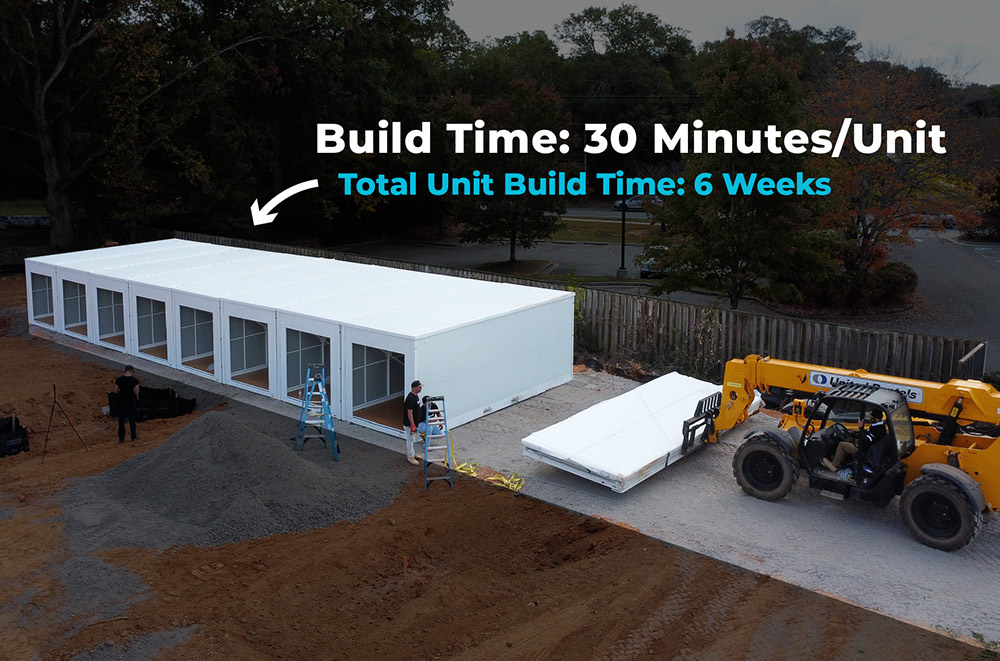
Over the course of two weeks, 26 ocean containers were unloaded, one by one. The flat-packed units and coiled doors hung vertically in skids, ready for assembly.

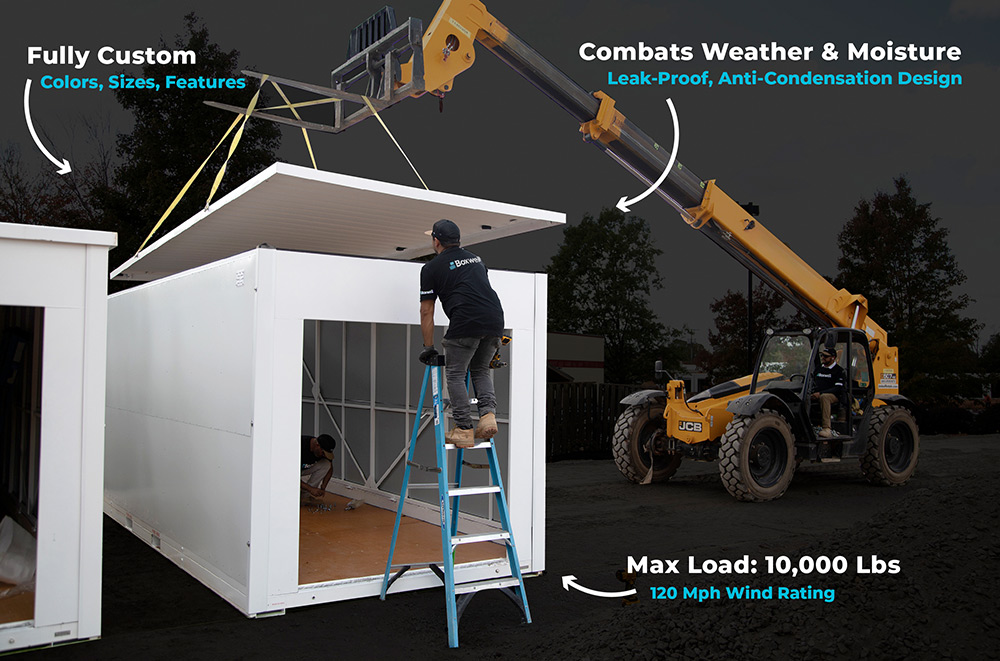
Once built, relocatable storage units are steadfast, durable, and built to last. The wind rating stands at 120 mph and load capacity maxes out at 10,000 pounds.
The roof is strong enough to hold six feet of snow, although that’s of little concern for this Georgia team. What is of interest to them, though, is the weathertight, condensation-mitigating design. The roof won’t leak, and a moisture-wicking desiccant spray is applied to the ceiling. These measures offer a welcomed peace of mind in a city that averages 50 inches of annual rainfall.
In addition to cost savings, we asked an ABC Storage team member what else stood out about this process. “Speed to market,” was his reply. “We were able to achieve somewhere in the range of four to six months of savings for our construction timelines versus a traditional product,” he says.
During the final stages of building, the ABC Storage team shored up the digital side of the business. They boosted their online presence with a new website and marketing campaign. A third-party management team was chosen to handle the day-to-day operations. Final preparations were made, and the first tenants rolled in.
Their combination of drive-by visibility and digital prospecting has been successful, too. Just four months after opening, 150 units have rented, equating to 28 percent capacity.
The Athens project served as proof of concept for the ABC Storage team. They learned it is possible to build attractive, long-lasting storage using relocatable units. Furthermore, they found the savings in cost and time to be favorable. So favorable, in fact, that they have since repeated the business model several times over. By 2025, the company’s portfolio will include a handful of relocatable-only facilities. Combined, these sites will hold 2,500 rentable units.
Relocatable units have proven their worth, both for infill projects and ground-up builds. Their popularity grows as reputable companies continue to adopt this approach to storage. If you’re a prospective developer, we encourage you to conduct your own side-by-side comparison. You may find yourself bypassing the traditional build process altogether at your next storage facility.
*Company name has been changed.