









How to enjoy our new magazine:
Just scroll!
Click or tap the table of contents icon in the menu bar to find any article.
Read any article by clicking or tapping the read full article button below each article intro.
Jump back to your previous browsing spot from any article using the menu bar or back to issue button.


REPLACE WITH


ALL OF THE VALUE.


-
Marie Laffoon, Porterville Storage in Porterville, Calif.Page 44
-
Courtney Cox, Denny’s Storage in Bismarck, N.D.Page 50
-
Daisy González, All-American Self-Storage in Methuen, Mass.Page 54
-
What Lurks Behind The Roll-Up DoorsPage 58

-
Why Flex Spaces Are Here to StayPage 64
-
Financing Expansions And New Development With Bridge LoansPage 68
-
1up Self Storage in Chattanooga, Tenn.Page 72
-
Your Call Center And Website Strategy Might Be Costing You RentalsPage 74
-
What Google’s Social Indexing Means For Local SEOPage 76
-
Elevating Your Marketing With Drone Photography And VideographyPage 78
-
Improving The User Experience And User Interface On Your WebsitePage 82
- Chief Executive Opinion by Travis Morrow6
- Publisher’s Letter by Poppy Behrens9
- Meet The Team10
- Women In Self-Storage: Anna Taylor by Alejandra Zilak21
- Who’s Who In Self-Storage: David Brown by Victória Oliveira25
- Innovation Spotlight: StorageDefender by Brad Hadfield84
- Self Storage Association Update87
- The Last Word: MJ Morris88
For the latest industry news, visit our comprehensive website, ModernStorageMedia.com.


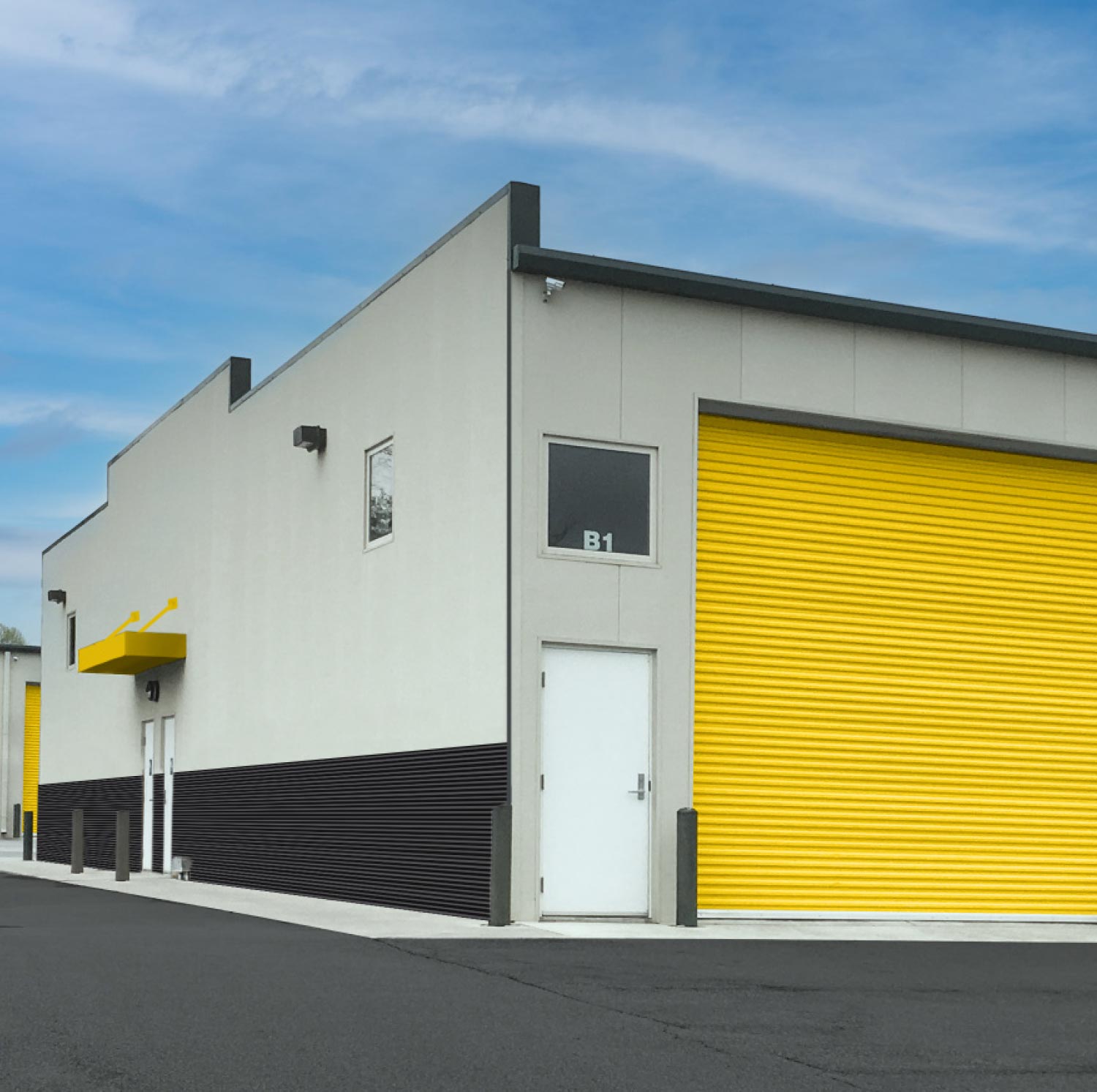
With decades of experience in self-storage construction, BETCO delivers smart layouts, durable steel construction, and full-service support from concept to completion.




f the majority of our tenants are finding our facilities online, wouldn’t you want to put your best face forward? For literally a few hundred dollars you can have professional photos and drone videos taken of your facility and have them live on your website in less than a week! They’ll last all year long and be the best dollar-for-dollar investment you can make in your facility. If you are reading this and use this tip, you just paid for your MSM subscription for two years at least!

He’s also the president of National Self Storage.

-
PUBLISHER
Poppy Behrens
-
Creative Director
Jim Nissen
-
Director Of Sales & Marketing
Lauri Longstrom-Henderson
(800) 824-6864 -
Circulation & Marketing Coordinator
Carlos “Los” Padilla
(800) 352-4636 -
Editor
Erica Shatzer
-
Lead Writer / Web Manager
Brad Hadfield
-
Storelocal® Media Corporation
Travis M. Morrow, CEO
-
Website
-
Visit Messenger Online!
Visit our Self-Storage Resource Center online at
www.ModernStorageMedia.com
where you can research archived articles, sign up for a subscription, submit a change of address, and more. 
- All correspondence and inquiries should be addressed to:
MSM
PO Box 608
Wittmann, AZ 85361-9997
Phone: (800) 352-4636

theparhamgroup.com



or more than three decades, MSM has been recognizing managerial excellence through its annual Manager of the Year contest. Although the objective of the contest itself has remained the same—honoring the best property managers in the self-storage industry—the expectations for managers have shifted and grown in countless ways over the course of 36 years. At the same time, our winners have continuously raised the bar for the prestigious distinction each year, stiffening the competition and making the selection process more challenging as well.
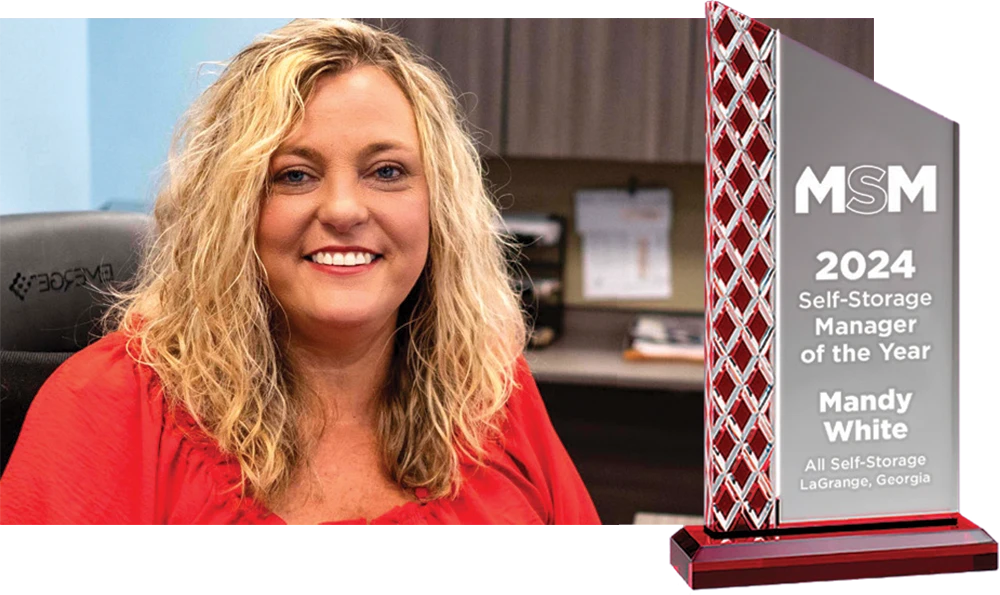
This year’s winner and runners-up are no exception! While each is remarkable in her own way, they all possess outstanding customer service skills and expertise in all areas of operations. Our 2025 Manager of the Year, Marie Laffoon, manager of Porterville Storage in Porterville, Calif., not only turned the facility she manages around in a few short months with no previous self-storage experience, but she also orchestrated the relocation of 600-plus units to a new building with the poise of a long-time professional. The feature story about her fantastic feats starts on page 44.
Formerly employed in the medical field, Courtney Cox of Denny’s Storage in Bismarck, N.D., our first runner-up, has quickly made her mark as a standout self-storage professional. From dialysis technician to general manager, now she even co-owns a facility with her employer. Her story can be found on page 50.
Last but certainly not least is our second runner-up, Daisy González, manager at All-American Self-Storage in Methuen, Mass., which is managed by StoragePRO Management. Her compassionate care for the facility’s tenants transcends expectancy. To read about the admirable story that she calls her “biggest career accomplishment,” see page 54.
Congratulations to these three astonishing self-storage managers! The MSM team wishes you continued success in all your future endeavors!

Publisher

or more than three decades, MSM has been recognizing managerial excellence through its annual Manager of the Year contest. Although the objective of the contest itself has remained the same—honoring the best property managers in the self-storage industry—the expectations for managers have shifted and grown in countless ways over the course of 36 years. At the same time, our winners have continuously raised the bar for the prestigious distinction each year, stiffening the competition and making the selection process more challenging as well.
This year’s winner and runners-up are no exception! While each is remarkable in her own way, they all possess outstanding customer service skills and expertise in all areas of operations. Our 2025 Manager of the Year, Marie Laffoon, manager of Porterville Storage in Porterville, Calif., not only turned the facility she manages around in a few short months with no previous self-storage experience, but she also orchestrated the relocation of 600-plus units to a new building with the poise of a long-time professional. The feature story about her fantastic feats starts on page 44.
Last but certainly not least is our second runner-up, Daisy González, manager at All-American Self-Storage in Methuen, Mass., which is managed by StoragePRO Management. Her compassionate care for the facility’s tenants transcends expectancy. To read about the admirable story that she calls her “biggest career accomplishment,” see page 54.
Congratulations to these three astonishing self-storage managers! The MSM team wishes you continued success in all your future endeavors!
Publisher

Now, our online edition has received a new look for the new year! The guide has been relocated to the MSM website for better security, easier access, improved features, and greater SEO for everyone.
You’ll love the dynamic new search function.
You’ll love the new features:
- A unique link to a dedicated company page
- Ability to include more content, images, video, and social
- Access to dynamic layouts and designs





















fter 25 years in self-storage, I’ve seen this industry grow in ways I never could have imagined. I’ve watched it move from pen-and-paper logs to cloud-based management platforms, from in-person marketing to AI-assisted lead generation, and from reactive property care to predictive analytics. One thing has never changed, though: The best operators—those who consistently run high-performing facilities—aren’t defined by tools or luck. They’re defined by habits, attitude, and skills.
If you’re managing a facility today, you’re not just juggling keys and contracts. You’re the face of a business, the engine of revenue, and the front line of both technology and customer experience. These are the 14 traits that define standout self-storage managers in 2025.
Tech Adaptability And AI Readiness
Being adaptable means staying curious. Subscribe to industry tech updates. Test new platforms. Get comfortable with automation. AI isn’t here to take your job—it’s here to make you better at it. From predictive maintenance alerts to tenant behavior insights, today’s tools can make your job more efficient, your facility more profitable, and your day-to-day operations less reactive.
Confidence That Converts
But confidence isn’t loud or pushy. It’s quiet assurance. It’s knowing your lease terms inside out, being ready to handle objections, and holding your ground when needed. It’s also knowing when to say, “I don’t know, but I’ll find out.” That kind of confident humility builds trust fast.
Sharp Communication Skills
Good writing matters, too. Every email, social media post, and online listing is a representation of your brand. Typos and vague language signal sloppiness. Strong writing and thoughtful replies show professionalism. Consider taking a business writing or digital communication course. And remember: Being clear is always better than being clever.
Mastery Of Modern Revenue Management
Revenue management also includes customer segmentation. Some tenants are price sensitive, while others value convenience or location more. Tailoring offers or using value-based selling techniques can increase close rates and lifetime value. Know how to analyze trends, test offers, and track your results. Pricing is no longer just math—it’s strategy.
Time Management Like A Pro
Positive, Unshakable Attitude
Positive energy fuels better teamwork, smoother tenant interactions, and stronger leadership. It also builds resilience. When you show that you can stay professional and solution-focused in tough moments, your customers and colleagues notice—and they trust you more.
A Constant Learner’s Mindset
They also learn from their data. Every missed rental, customer complaint, or competitor’s success is a lesson. Whether it’s sharpening your digital marketing skills or understanding legal updates in lien laws, continuous learning keeps your skills sharp and your business ahead of the curve.
Trustworthiness and Integrity
Integrity also applies to how you handle money, disputes, and policies. Be fair. Be transparent. Don’t make promises you can’t keep. Word spreads fast, especially with online reviews. Being known as the “honest manager” pays off in loyalty and reputation.
Consistency With Flexibility
Flexibility means knowing when to apply a little human touch. Is a long-term tenant having a hard month? Waive the fee this once. Is a new renter confused about the lease? Take the time to explain it again. The key is to apply policies with fairness and compassion.
Sales Skills That Don’t Feel “Salesy”
Great salespeople also follow up. A missed call gets a call back. An inquiry gets an email. A visit gets a thank you. Every interaction is a chance to build trust—and that trust often leads to rentals, referrals, and reviews.
Real-World People Skills
Good managers know how to read the room. They can sense when someone is in a rush, frustrated, or uncertain—and adjust their approach accordingly. These small gestures build comfort and connection, which lead to long-term tenants.
Crisis Management And Problem Solving
Great managers prepare for the unexpected. They test systems, update emergency contacts, and know who to call. And when a crisis hits, they don’t just fix the problem—they reassure customers and protect the facility’s reputation.
Marketing Mindset
You don’t need a marketing degree. But you do need to understand your customer journey and how to drive leads. Learn the basics of SEO. Track your traffic sources. Test promotions. Marketing today isn’t just flashy ads—it’s smart, consistent visibility.
Remote Operations And Autonomy
Remote tools like cloud access control, mobile apps, virtual assistants, and remote monitoring systems are now part of the daily routine. Can you manage vendors from afar, coordinate maintenance, and resolve disputes through video or chat? Autonomy isn’t just about working alone—it’s about owning results without handholding.









Don’t wait to contact us at: 877-575-7774



Protection with no deductible, no depreciated value, and no premium increases after a claim.

Comprehensive coverage for RVs, boats, trailers, and more, with protection for theft, damage, and accidents.

Coverage for mobile container contents, on-site, in transit, or off-site.

In House Claims: Enjoy 24/7 claims support, ensuring a responsive, personal experience for all.

877-575-7774








f you’ve been around the block long enough to remember Alanis Morissette’s music from the 90s, you know it is a universal truth that life does have a funny way of working things out.
In this month’s installment of “Women In Self-Storage,” we’re taking a look at the life of Anna Taylor, head of self-storage lending at Live Oak Bank in Wilmington, N.C. For the past 19 years, she’s worked in self-storage lending, and all she had to do to land herself in this industry was trust in signs and go with the flow to where life was taking her.
Taylor gravitated towards sports, playing tennis, basketball, and golf with her dad. She continued being a sporty kid until it was time to go to college at the University of North Carolina in Chapel Hill. “I loved being a student there,” says Taylor. “It’s the quintessential college campus with beautiful quads and lots of trees, right in downtown Chapel Hill. It’s a really fun place to go to college. I loved the people, the classes, the sports—all of it! And when I was there, the basketball team won the national championship in 2009, which was a really memorable experience.”

The feeling was mutual, and they offered her a job when she graduated. “It was so exciting,” she says. “I think it should be mandatory that all young people live in a big city when young. I learned to be on my own, to have a budget, and getting out of my comfort zone to meet new people.”
Loose Cubes was ahead of its time, providing coworking spaces and renting out offices and extra desks to freelancers. “They could rent the space for the day, week, or month.” While the concept was novel at the time, it didn’t enjoy long-lasting success. “I got to see the hard times of startups,” says Taylor. “I didn’t realize that a lot of Series A investments were contingent on deliverables, and eventually, we lost our funding. One day, I walked in and realized that in two months, I would no longer have a job.”
Feeling dejected, Taylor called her boyfriend, Kurt, to give him the bad news. What she didn’t know was that at the time Kurt took her call, he was in New York City with his dad, secretly picking out her engagement ring. “His parents were from the city, and they went together to the same store where his dad had picked out the ring for his mom when he proposed.”
Soon after that, the couple went on vacation to Anguilla, a British overseas territory and island in the eastern Caribbean, where he got down on one knee and asked her to marry him. Happy and excited, they decided to move back to their hometown in North Carolina.

That was 13 years ago, and she still loves working there. Ten of those years have been in the self-storage lending division. “We finance all across the country, and I do self-storage loans exclusively. It’s helped me become really good at my job, focusing on one thing.”
But getting good at what she does came with its share of challenges. “In the early days, I was trying to figure out what my style as a lender would be. You have to walk clients through all the financing options, how to structure loans, and prepare sales pitches the first time you meet with someone who’s interested in a loan.” At first, she’d listen to other people and try to mimic them, but she didn’t enjoy doing it that way because she didn’t sound like herself. “I had all this knowledge and I wanted to take this seemingly complicated process and make the path more smooth for customers. I then started taking the approach of explaining information to people instead of selling. That helped me set up relationships with customers.”
Taylor learned her craft thoroughly. When first becoming familiarized with the storage industry, she made a binder with two sections: one about self-storage and one about lending. “I had never heard of cap rates before, so I started learning the jargon.” That was 10 years ago; today she knows the industry like the back of her hand. At some point, she and her husband even bought two self-storage facilities. “That was one of my greatest accomplishments, because it was cool to tell customers that I was also in their shoes.” They’ve since sold those facilities, but she’d eventually like to become an owner-operator again.
As head of self-storage lending, now she has an entire team. Together, they get the word out that even though they have many small business customers, they also do financing for larger firms.

That’s what she loves most about self-storage: the people. “I’ve been in the industry for a decade now, going to the same conferences every year and seeing the same familiar faces. And every single time I’ve had a question, needed recommendations, or I’ve wanted to make a connection, they’re always willing to help. It’s a very ‘I know a guy’ kind of industry.”
When asked what she’d say to women just getting started in self-storage, she mentions the good people again. “I would tell them that there’s so much opportunity here. I love seeing more and more women attending industry events. I’d tell everyone who’s new to not be afraid to reach out to people and learn from them. The industry is full of people willing to help. Ask for best practices, connections, or mentorship. You’ll get them.”
She also loves to read; Pride and Prejudice is one of her all-time favorites. She loves French, Thai, and Mexican foods. She loves spending time with her kids, Marshall and Louise, and playing with their one-year-old golden retriever, Murphy. “He’s a bit of a handful, but he’s so sweet and just wants to be loved.”



he managing director of self-storage development for Wentworth Property Company, David Brown, like many other successful professionals in the self-storage industry, started his career working for a commercial real estate developer, which also marked a big new chapter in his life, as he had to move from Arizona to Pennsylvania.
“I was born and raised in Arizona, and I accepted a job in Philadelphia, which might as well have been a foreign country,” says Brown. “I was lucky to work with a great group. I was taken under the wing by a local real estate developer who was very instrumental in teaching me the business of development.”

It was then that Brown received a gentle push from his father-in-law, Kent Greenwald, a self-storage industry veteran. That nudge led him to decide to give the industry a try, and he achieved success from the start.
“My father-in-law, Kent Greenwald, had been in storage since the RTC days and pushed me to consider self-storage development,” says Brown. “From there, it was finding a local group that wanted to do that, and I was fortunate enough to develop three ground-up self-storage facilities before joining Wentworth Property Company in 2015.”
As someone fortunate enough to find success in his investment early on, Brown has a few tips up his sleeves to share with anyone looking to lay the ground before starting to look for capital to open their first facility.
“It starts with finding the right spot. Development isn’t easy,” he says. “You need to find the right location that allows you to build the right product for the market. Once you find it, you will need to get through the entitlement process, which in some cases can take over a year. Finding funding is something you should do after you are sure you are going to be successful with the entitlements.”

Brown highlights a few key factors to determine if a location is viable for developing a new facility today. “I generally start my evaluations by looking at population density, average household income, existing self-storage square footage per capita, and most importantly rents,” he says. “If the rents aren’t high enough in a market, move on. If the supply is too high, move on. Also, don’t be the person who builds across the street from someone else. It will lead to years of regret for you and your neighbor.”
For anyone looking to de-risk projects before presenting them to investors, Brown suggests waiting to close on the land to avoid headaches. “We don’t close on land until the entitlements have been completed,” he says. “Don’t put yourself in a situation where you can get stuck. Also, be mindful of the permitting process. We do this day in and day out, and we still find municipalities that have extreme review periods, and permitting can take upwards of a year in some cases.”
In his experience, he has seen some first-time developers fall into some common pitfalls. “The most common mistake I see is believing that a site is good when not paying attention to the barriers to entry or trying to build into someone else. Also, developing is not easy or cheap. I often blame my hair loss on the pitfalls of the development process.”
Brown suggests keeping an eye on the recent increase in permit and impact fees to avoid driving up costs during development, which can kill your margins post-launch. “We have also seen a major increase in permit and impact fees throughout the country. We recently had a project that we estimated to have $500,000 in permit and impact fees, and the actual cost was double that. That was a huge hit to the project.”
Like many industry professionals, he has found the self-storage community to be hospitable. “If you are new, I would recommend getting involved in your state storage associations for resources and meeting folks who have a reputable background in developing. One of the best things about the storage community is how open and helpful folks are.”
When it comes to a typical construction timeline for building from the ground up, he mentions his “typical timeline is 12 to 15 months, depending on the project,” but investing in a good general contracting (GC) team is key to accelerating it. “The best way to accelerate the process is to have a competent GC team that is constantly looking for ways to improve the schedule and looking for ways to avoid any issues on inspections,” says Brown. “Elevators are a huge problem for us, and getting ahead of any pitfalls is crucial to opening the doors.”
Innovations that have positively surprised him in construction are currently gaining traction in the industry. “We have built several single-story projects lately, and my friends who own metal building companies can attest that it is the easiest and most cost-effective way to build,” Brown says. “The trouble is that most cities hate it. They want CMU or alternative building materials used with intricate building elements.”












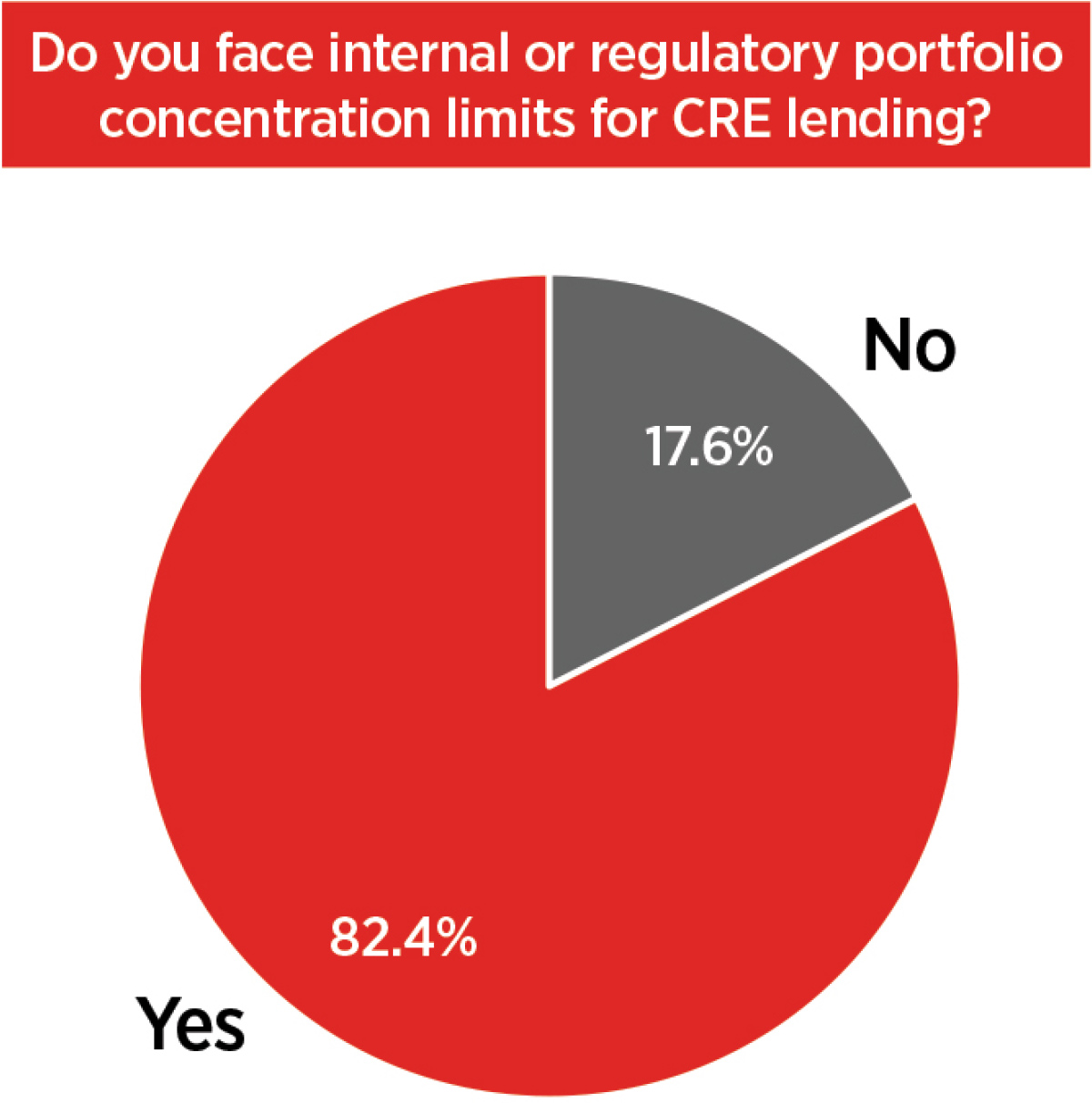
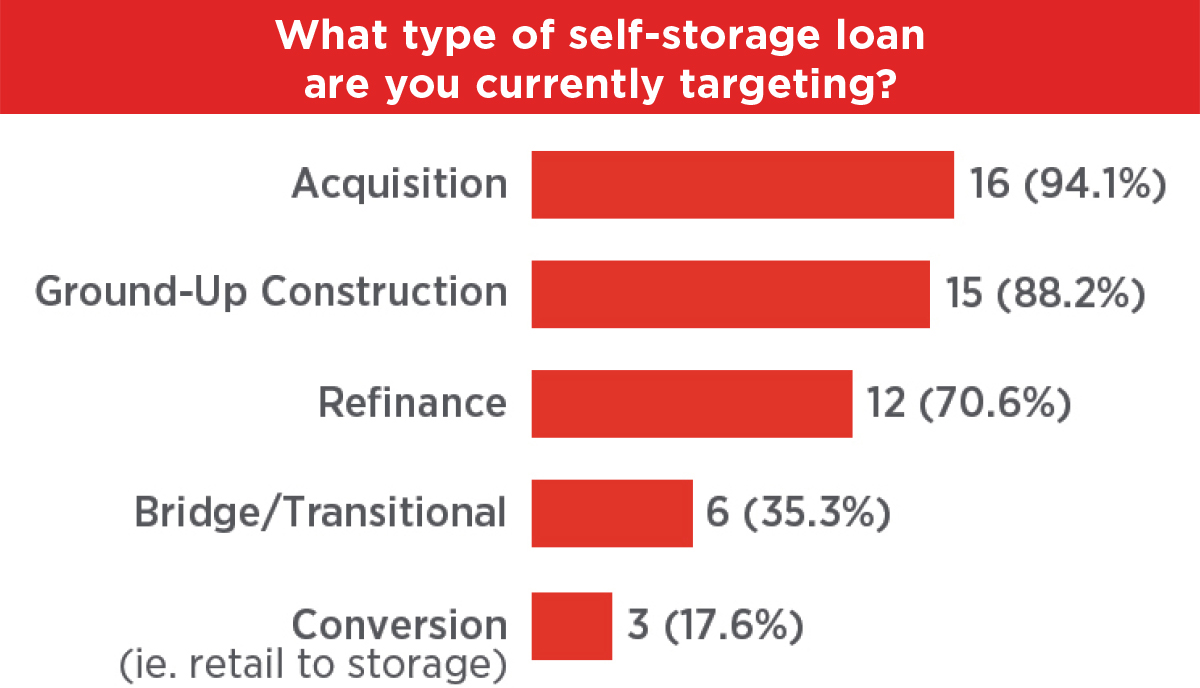
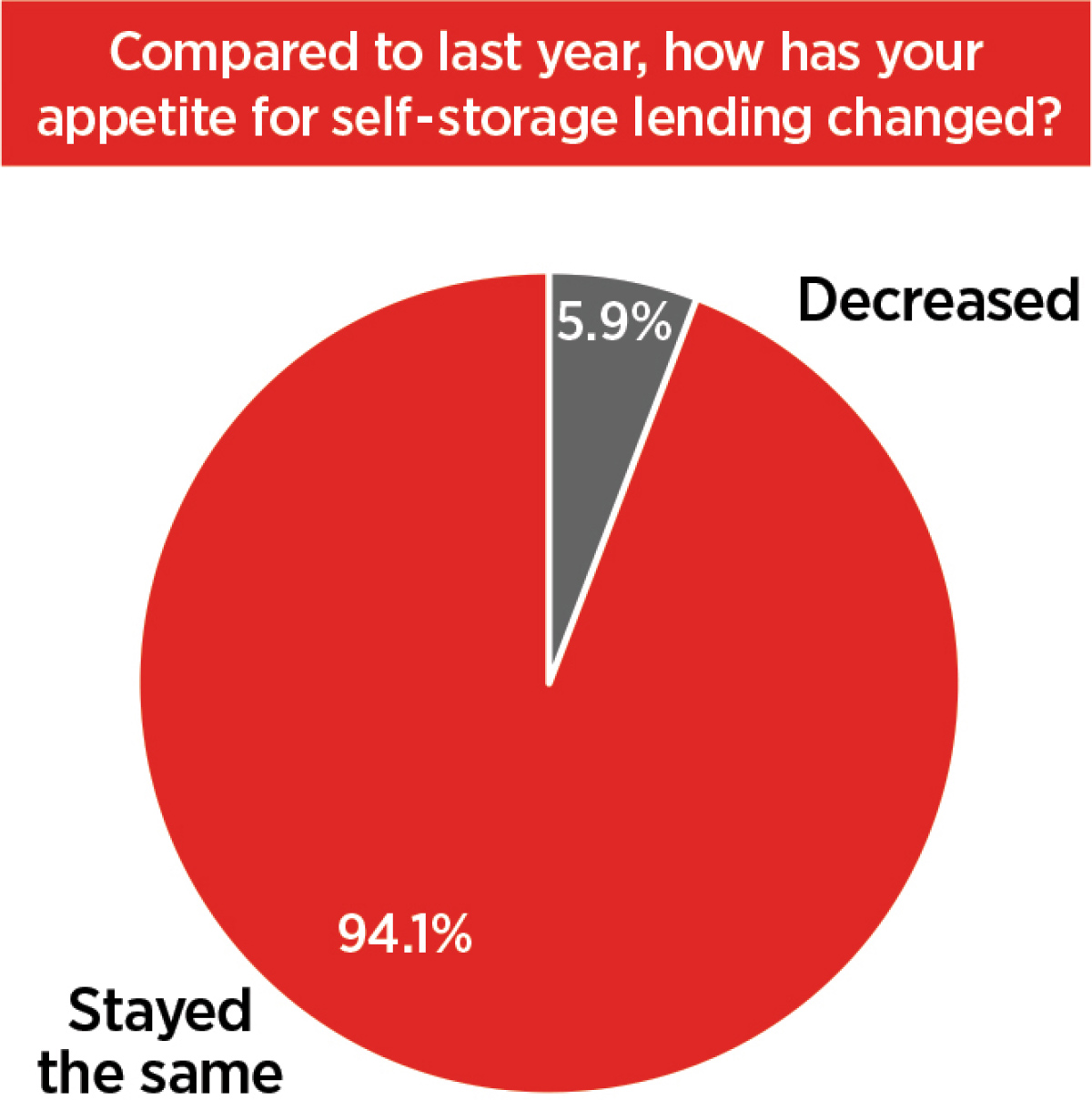
his 2025 Capital Lender Survey offers a snapshot of lending sentiment within the self-storage sector, capturing insights from banks and credit unions actively engaged in commercial real estate finance. The results reflect perspectives from DXD partner institutions across the country, with responses collected from regional and community banks, national institutions, and credit unions. Participants provided their outlooks on lending strategies, portfolio concentration, underwriting criteria, and perceived risks within the current macroeconomic environment.
As the capital markets continue to evolve in response to high interest rates, shifting regulatory landscapes, and broader economic uncertainty, understanding lender behavior is more important than ever. This survey offers visibility into how capital providers are adjusting their self-storage loan strategies and where they may be pulling back or leaning in. What emerges is a picture of cautious consistency: Most lenders report steady appetite for self-storage yet remain sharply focused on managing risk through tighter underwriting and exposure controls.
As a consequence of the generous lending practices that occurred in 2021 and 2022, coupled with significant interest rate hikes leading to asset distress, banks have adopted a conservative lending approach today. This posture is expected to keep construction lending subdued for the next one to two years, thereby mitigating the risk of oversupply across numerous commercial real estate asset classes, particularly self-storage.
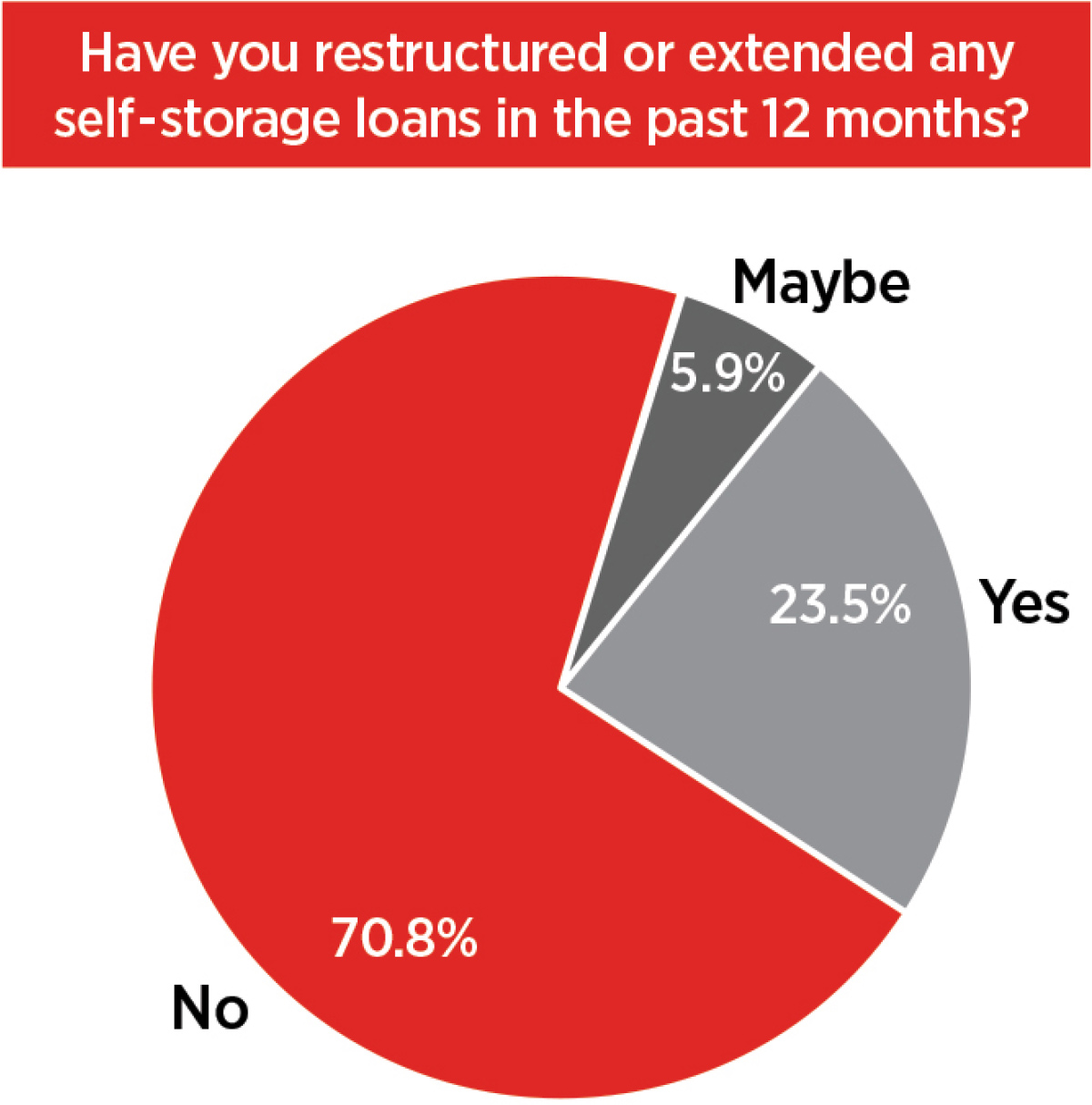
See Type Of Lending Institution chart and Type Of Loans chart.


There is a measured but cautious stance among DXD lenders. Nearly half (47.1 percent) reported that self-storage loan performance was on par with other CRE sectors, while 23.5 percent noted underperformance and an equal share indicated a lack of sufficient data to evaluate. When ranking underwriting concerns, absorption risk during lease-up was the top issue (88.2 percent), followed by oversupply, sponsor capabilities, and construction costs. In terms of broader macroeconomic and regulatory pressures, lenders expressed the greatest concern over interest rates, CRE market softening, and recession risk, with regional bank pullback also registering as a key issue. Together, these insights underscore a lending environment shaped by risk mitigation and selectivity.
See Storage Performance CRE 12 Month chart, Concerned Macroeconomic and Regulatory Issues chart, and Top Three Underwriting Condcerns chart.

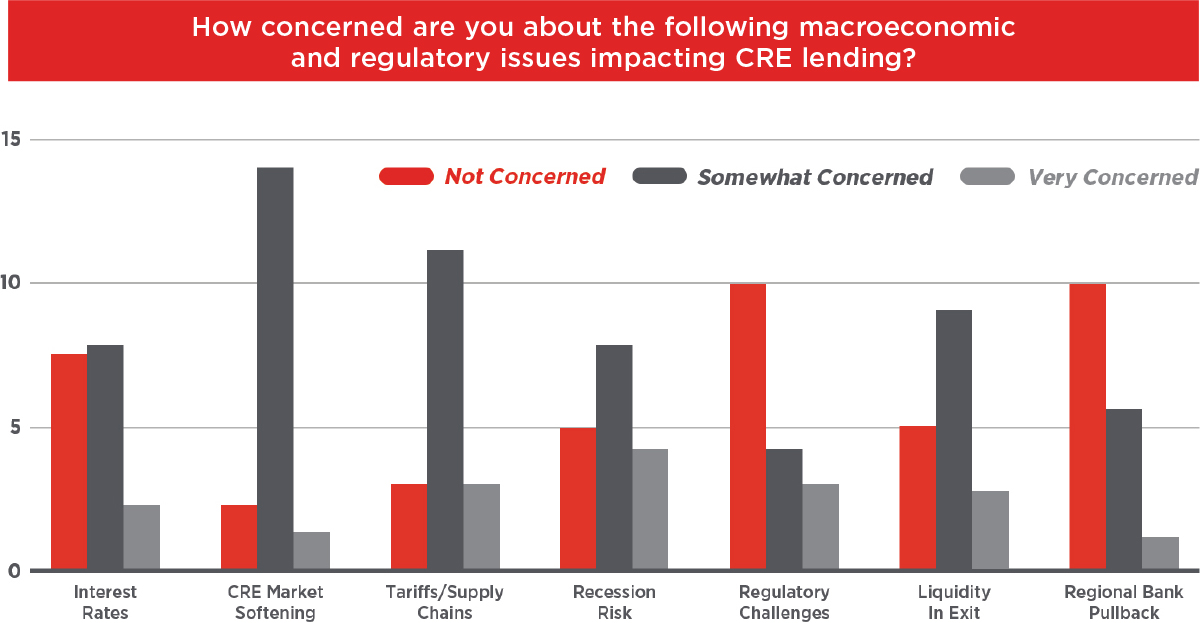

When ranking underwriting concerns, absorption risk during lease-up was the top issue (88.2 percent), followed by oversupply, sponsor capabilities, and construction costs. In terms of broader macroeconomic and regulatory pressures, lenders expressed the greatest concern over interest rates, CRE market softening, and recession risk, with regional bank pullback also registering as a key issue.
Together, these insights underscore a lending environment shaped by risk mitigation and selectivity.
Martin Huff
Managing Director – Investor Relations
(706) 615-2323 – martin@dxd.capital
Andrew Tuthill
Managing Director – Capital Formation
(415) 640-4099 – andrew@dxd.capital
The information contained in this 2025 CRE Lender Survey (Survey) is provided for informational purposes only and is not comprehensive. The Survey is based on third-party CRE lending institution’s responses to questions posed by DXD Capital (DXD). DXD makes no representations, warranties, or assurances, express or implied, regarding the accuracy, completeness, reliability, or suitability of the information provided in the Survey.
This Survey reflects the responding lenders’ perspectives, estimates, and expectations. It does not constitute DXD Capital’s opinions, commitments, recommendations, or assurances regarding future lending conditions, capital market dynamics, regulatory changes, or self-storage sector performance. Any reliance on the information in this Survey is at the sole risk of the recipient.
DXD expressly disclaims any liability for inaccuracies or incompleteness and for direct, indirect, or consequential losses arising from the use of or reliance on this Survey. The findings should not be construed as financial, legal, or professional advice. Readers are encouraged to conduct their own due diligence and consult with qualified professionals for specific guidance with respect to any business or investment decisions.


Before revolutionizing the tenant protection industry, Harry Sleighel was rocking out in bands from Texas to California. His passion for rhythm and performance paved the way for his business style: unconventional, visionary, and always on tempo.

Over the past 35 years, Harry and the Michaels Wilder team have redefined industry standards through vision, grit, and heart.


“It’s been a 35-year ride, and we’ve had some wonderful people with us along the way,” The team we’ve built and the trust we’ve earned, that’s what I’m most proud of.” ~ Harry
Here’s to everyone who’s kept the rhythm with us. The beat goes on, and more to come!






Couple
ailing down Josh and Melissa Huff for an hour-long interview is no easy feat, as this dynamic duo, co-founders of Lighthouse Storage Solutions, spend a lot of time on the road. So that’s where we connect, when they’re somewhere between Vero Beach and Melbourne, Fla. They sign into Zoom on a dash-mounted device that provides a wide-angle view of them with the road stretching out in the rearview. Josh’s hands are on the steering wheel, Melissa’s are hidden behind an open laptop perched on her knees, and both are all smiles.
“I usually do the driving,” says Josh, keeping his eyes on the road but glancing at the camera from time to time. “Not because I’m better at it but because most of my work gets done at the destination, while Melissa can take care of a lot of her tasks in the passenger seat.”
“He grew up navigating Chicago-area traffic, so he’s a good defensive driver,” Melissa says before closing her laptop. “But I do correct him a lot.”
ailing down Josh and Melissa Huff for an hour-long interview is no easy feat, as this dynamic duo, co-founders of Lighthouse Storage Solutions, spend a lot of time on the road. So that’s where we connect, when they’re somewhere between Vero Beach and Melbourne, Fla. They sign into Zoom on a dash-mounted device that provides a wide-angle view of them with the road stretching out in the rearview. Josh’s hands are on the steering wheel, Melissa’s are hidden behind an open laptop perched on her knees, and both are all smiles.
“I usually do the driving,” says Josh, keeping his eyes on the road but glancing at the camera from time to time. “Not because I’m better at it but because most of my work gets done at the destination, while Melissa can take care of a lot of her tasks in the passenger seat.”
“He grew up navigating Chicago-area traffic, so he’s a good defensive driver,” Melissa says before closing her laptop. “But I do correct him a lot.”
“It could’ve gone south very quickly,” Josh told MSM back in 2024. “Fortunately, that’s not what happened. In fact, it was a blessing being so close to one another and our kids during such a turbulent time.”
Being confined to the home also meant working alongside one another every day. Melissa was already active in the self-storage industry, at one time having managed 35 facilities across three states while serving as director of the Tennessee and Louisiana Self Storage Associations (positions she still holds). Meanwhile, Josh had a wealth of knowledge in marketing, with years of experience under his belt. While sharing an office with his new wife during quarantine, however, his interest in self-storage grew. He began doing side projects for her clients, and she began helping him out as well. Eventually, the two decided to put their strengths together and create Lighthouse Storage Solutions.
“A number of facilities that had been doing unprecedented levels of business suddenly found themselves struggling,” recalls Josh, “so we began looking at ways to help them.”
For Josh, that meant marketing, web design, and drone photos and video. For Melissa, that meant consulting, management training, and policy and procedure manuals. By partnering up, they were able to turn Lighthouse into a full-service operation designed to “guide owners on a clear path towards their desired destination.”
Now it’s a whirlwind of work, but the Huffs are loving every minute of it.
As a state association director, Melissa does advocate for self-storage in general–she highlights legislative efforts such as streamlining lien laws and improving the eviction process–but she acknowledges that there is a greater emphasis on independents. “Many of them can use the help, whereas the REITs don’t need any handholding,” she says.
One way the associations support independents is by holding educational and networking events. Because many small operators may not have the budget to attend a big national show, or it might not be feasible for them to shut down their facility and head out to Vegas or Orlando, events like a local “lunch and learn” allow them to connect with others on a smaller scale. “These provide educational opportunities and allow independent owners to sit down with others like them to discuss challenges, brainstorm solutions, and share successes. Everyone learns from one another.”
Melissa stresses that despite a lot of industry restructuring, and a lot of properties changing hands lately, she never sees independents becoming a thing of the past. “Not everyone is selling out to the big boys,” she says. “There are still a lot of small operators who love their business, and they’re stepping up their game in order to compete, whether it’s improving their technology or re-evaluating their rates. And that’s wonderful to see.”

The Huffs looked at the facility and the market and came back to the client with an unexpected recommendation: Keep the property. “There were a lot of tools that the client didn’t even know were available to him that we put into place,” Josh says. “We upgraded the software, designed a new website, implemented a training program, and so on.”
The plan worked. Today, the property is operating successfully and even going toe-to-toe with some heavy hitters in the area. “We love when that happens for our clients,” says Josh. “When they realize it is possible to compete with REITs that are moving onto their turf and still have a valuable and viable business.”
Melissa adds that not every project is an immediate homerun. After setting some clients up for success and giving them a play-by-play on how to keep moving forward, some aren’t ready to cut the cord. This is especially true when there’s new technology involved. “What we often hear is, ‘Can you do this with me?’”
Of course, the good-hearted Huffs are happy to do that, staying on for three or six months more–sometimes longer. “We try to walk alongside them, encourage them. If there are hiccups along the way, they don’t have to handle them alone. We help them navigate those situations.”
“We have people reach out for random things all the time, and our response is always, ‘yeah, we can do that,’” Josh says with a laugh. In the last two months alone, Cubby approached them to produce their podcast and Madison Capital asked them to create video of under construction properties throughout the country. “They send us the audio and video, we produce it and put it out on their platform,” he says about Cubby. “We visit about 15 of their [Madison Capital] properties once a month to capture video that highlights the progress that’s been made.” They also get requests for quick one-off jobs, such as a brochure or billboard design.
Their willingness to say “yes” has also led to highly specialized requests. Beyond marketing materials, operators often turn to Melissa for complex challenges like determining rate increases. “They’ll know they need to increase their rates, but they don’t know which tenants to increase first or how much to raise the rate.”
Collections is something else many small operators struggle with. “They might not be firm enough with delinquent tenants, they may not understand the lien process, or they may just be afraid to implement it,” says Melissa. “So again, we give them a plan so that they know how to handle delinquency and can manage it the same way every single time without exception. That’s empowering for the manager, and after a few of them, it becomes easier.”
Another specialty the Huffs have added to their expanding line of “yeah, we can do that” services is moderating demos between clients and suppliers, including software, security, access control, and call center companies. “We know the questions to ask that they may not,” says Josh. “Being on that call with them gives them peace of mind that they’re making the right decision and that they’re not getting a raw deal or being taken advantage of.”
Does her role as director of two state associations inspire more confidence among clients? “They may feel more secure because of that, but Lighthouse operates independently of the associations,” she says. “The boards can’t get involved with individual properties due to liability. At that level, guidance is generalized: basic information about best practices, marketing, and so on.”
For anything more involved than “How are auctions performed?” or “What does the state’s lien law say?” the associations’ have a go-to guy. “We pick up the phone and call Scott Zucker,” she says. “To help on an individual level, that’s what Lighthouse does.”
Though the company is shining bright, the couple makes it clear that their goal is to also help others shine. “The Lighthouse is a nod to our faith in God,” says Josh. “A lighthouse shows you where you need to go, but it also helps you get there, and that’s how we run our business–guiding others. Of course, we sometimes need guidance ourselves. We’ve joked a lot about God being our business development manager.”
When asked to elaborate on that, he explains that while some of their personal business initiatives have been less than successful, there has also been several unplanned opportunities that just seemed to land in their lap, as if by divine intervention. “We were at the SSA convention in Vegas a few years ago, sitting at a marketing round table, and the leader of the session didn’t show up. Everyone looked around like, ‘Now what?’”
Josh, with his experience in marketing, felt called to step up and volunteer to lead the session. “It was very off-the-cuff, but also very well received,” he says. So, he led another, and then another after that. “Leading these sessions, something I didn’t expect, introduced me to a client that we’ve been doing a lot of work for ever since—drone photography, website redesign, management training, revamping signage, the whole nine yards. But had I not sat at that table, had I not spoken up, it never would’ve happened. We have lots of stories like that, and our faith in God is strengthened as we see Him work time after time.”

“One of our newest gigs is doing event photography for association conferences and events,” says Josh.
“We’ve already done New England and Florida,” adds Melissa. “Georgia, South Carolina, Mississippi, and Alabama are coming up, and Texas is under contract. Who knows where we’ll go from there.”
One place the new gig could land them is Hawaii. “We’ve spoken with Tron [Jordheim, a self-storage consultant and host of the annual Self-Storage Hawai’i UnConference event], but the timing wasn’t right. We have two kids starting high school, one just graduated, and another we’re sending off to college, so we just couldn’t make it work. But there’s always next year.”
So, it looks like the Huffs could be trading vehicle mileage for airline miles in the near future. But even if they’re not behind the wheel, it’s clear that this power couple will continue to steer others toward success.
Wheels: Hyundai Palisade with more than 100,000 miles (three years old) and Hyundai Tucson with 45,000 miles (one year old).
Pilot: Josh 89 percent and Melissa 11 percent. “She’ll take the wheel on long stretches of road from time to time,” says Josh.
Playlist: Morning worship, followed by 70s, 80s, and 90s country classics. Southern rock is also a staple; after all, that’s what Josh’s band plays (That’s right, he also finds time for that!).
Podcasts: Anything self-storage, naturally, plus the news. “We’re current events junkies,” says Josh.
Audio Books: Popular authors like John Grisham and Michael Crichton.
Thirst-Quenchers: Coffee to get going and water to keep hydrated and focused.
Good Eats: Portillo’s in the southeast and In-N-Out in the west make the cut, but the Huffs prefer eating local when they can. “Preferably barbeque … the smoker on the side of the road … we can smell it a mile away,” says Melissa.
Catching Zs: Outside of quick cat naps, the duo doesn’t crash in the car. For a good night’s rest, they choose Hilton (plus they have reward points to earn).
Unexpected Discoveries: “We’ve run into things we didn’t know were there … until we were there,” says Josh. This includes a Blue Angels air show in Pensacola, Fla.; the birthplace of Elvis in Tupelo, Miss.; Superman in Metropolis, Ill.; and the Belmont Stakes thoroughbred race in Elmont, N.Y.
They Brake For: Buc-ee’s. “We can spend a good 15 minutes there,” says Melissa, “and if our feet have a chance to walk on a sandy beach, we are definitely stopping for a stroll.”
ore often than not, professional accolades are bestowed upon people who have decades of industry experience, those who rise through the ranks as they gradually learn the tricks of the trade. But every now and then, someone new comes along who has such a strong work ethic that they shine bright from day one. Such is the case with this year’s Manager of the Year winner, Marie Laffoon, manager at Porterville Storage in Porterville, Calif.
Since joining the facility in 2022, she has transformed it into one of the most successful storage operations in the region. In less than 20 months, she stabilized a 700-plus unit location, which was ahead of the projected lease-up—a milestone that’s rarely achieved in such a short period of time for a property of such size. She hasn’t only attracted tenants, she has been instrumental in keeping them long term, with an impressive 95 percent retention rate.
“When Marie started with us, she had zero self-storage experience,” says Porterville Storage Owner Wayde Elliot. “But what she brought was something you can’t teach: relentless drive, creative problem-solving, and genuine care for every single customer.” He adds that Laffoon treats every single Porterville facility like it’s her own business, and that she always prioritizes the customer experience. “What really gets us is how much she genuinely cares about people. She’s available 24/7 for tenants. We keep telling her to take a break, but she won’t listen. This is just who she is.”
“Marie was very welcoming and guided me throughout the whole process of renting out a storage unit. I appreciated her time. Haven’t had service like that in a while. Thank you, Porterville Storage.”
“Porterville Storage is a great place! Marie was kind, courteous, very professional, and helped us with our U-Haul return! A very clean place to store your items! Thank you, Marie!”
“I love this company! They are very nice and helpful, especially when it comes to the payment, and I had trouble paying it on time. They are there to help you out. And I want to give a shout out to Marie for the help.”
“Gerri and Marie have been beyond nice and helpful, and the new facility is top notch. They’ve made the transfer from the old facility to the new an easy transition. I highly recommend this facility! Thank you for everything.”
“Porterville storage is the best! I could go on about how amazing this place is! The facility is always top tier clean, and staff is so welcoming; I never doubt my belongings are in a safe, secured, clean place. Let’s talk staff though. Staff is where it’s at! Gerri and Marie go above and beyond for everyone! They are always showing their appreciation in every and any way they can and in such fun ways like giveaways. This month was a Blackstone grill, and guess who won! That’s right, me! They truly show that they give their heart and soul to their customers. If you’re looking for a storage unit, you won’t be disappointed. Definitely give Porterville Storage a try. You won’t regret it!”
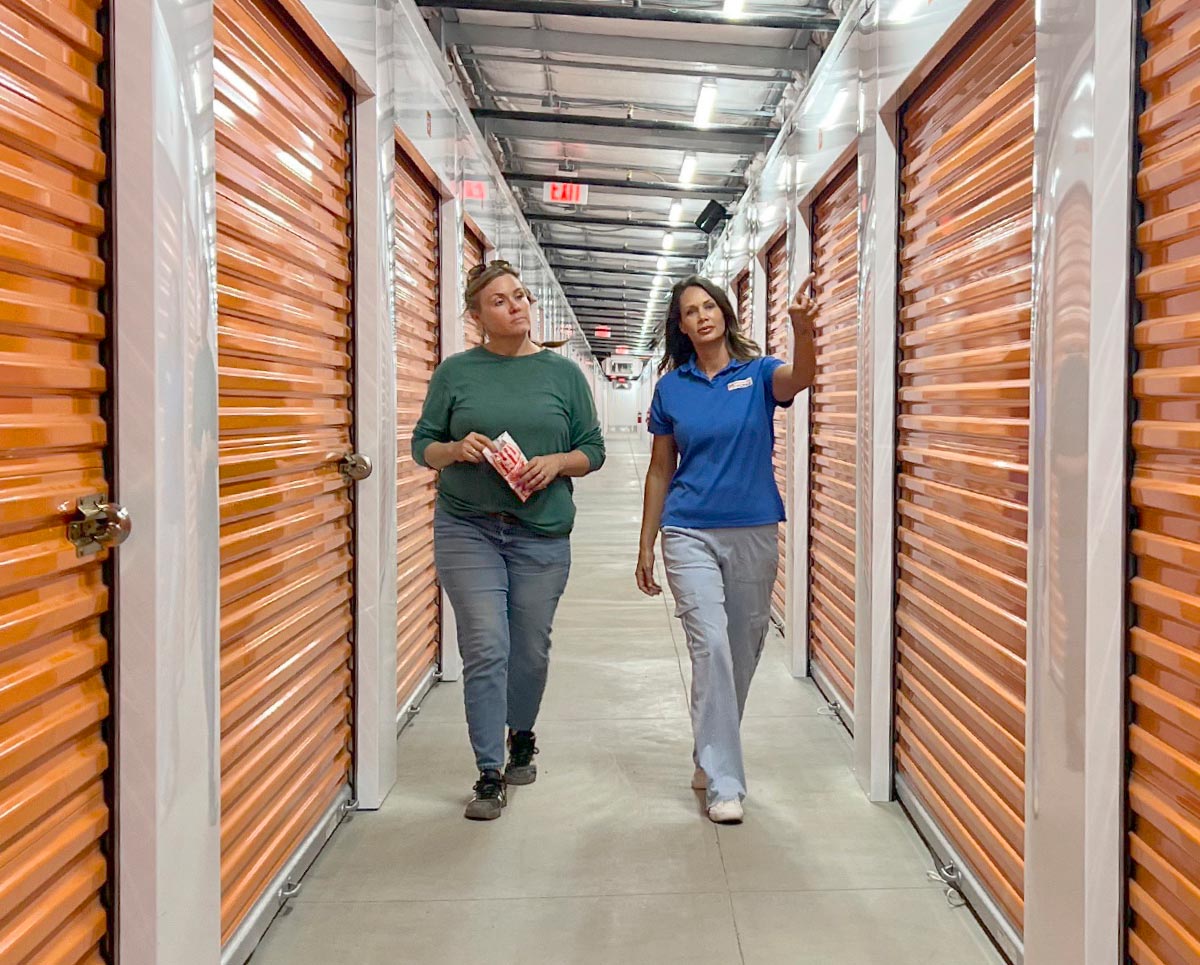

For those of you keeping track, the Porterville Storage owner loves her, customers love her, and here’s yet another testimonial from one of the general contractors who worked on the move to Porterville’s new location: “As a contractor, I regularly work with managers and staff from client organizations, and in this case, Marie truly exceeded my expectations,” says Gary Day. “She played a critical role during job site development, walks, and meetings, offering valuable insight on everything from driveways, spacing, parking lot layout to labeling lanes, and site access. We truly appreciate her input. Things would not have gone nearly as smoothly without her.”
Laffoon’s aware of all these praises, and she’s happy that customers are so satisfied with their experience at Porterville Storage. “I’m very proud of our reviews because customers give them after we’ve already established a relationship,” she says.
Music: “At our old facility, we had to walk a long way to get to the restrooms, and one day, I noticed that the only thing I could hear were the buzzing lights.” Did she just shrug and go about her day? Absolutely not! “Whenever you go shopping, or even to the dentist’s office, there’s always music. And I like that idea. Play something happy and positive and it will make people’s day better. It’s fun.”
Popcorn: This is one of her favorite perks, and she’s happy to offer it. “Most offices have a water fridge, and maybe a snack bar or coffee,” says Laffoon. “I wanted to do something more; and one time I was at a furniture store and noticed a popcorn machine. I thought it was such a great idea! People come in, smell the popcorn, and start snacking on it, instantly relaxed.”

Laffoon makes clear that she’s always seeking ways to create good experiences for everyone, which in turn makes her enjoy her job even more. “You can always tell when people like their job versus when they don’t,” she says. “You usually don’t want to return to a place where people don’t like their job. But here, you’ll see that we love being here, that we love what we do, and that you’re going to feel appreciated.”
Then there are the Blackstone giveaways. “I thought of doing the giveaways for a couple of reasons,” she says. “First, it’s another way to make customers feel appreciated. It’s also a good way to get them to interact with us and have conversations. And I also like that it gives me the opportunity to learn their names. I always like greeting people by name.”
The thought alone would make most managers cower, but not Laffoon. She immediately got to work by acting as project manager for the entirety of the relocation. She coordinated tasks with professional movers and personally contacted every single tenant to fill them in on what was about to come. She guaranteed the safe transfer of their belongings. She also showed up at the facility at 4 a.m. and left well after 6 p.m. for the entire month it took to complete the move, documenting each aspect of the operation to ensure everything was done according to plan. What would have been a logistical nightmare for most people highlighted her commitment to conducting extraordinary work, no matter what comes up. In the end, the relocation strengthened tenant trust in her and Porterville Storage. It’s the kind of professionalism that elevates any brand.

As if that weren’t enough to phone it in the rest of the year, Laffoon raised the bar by coming up with ways to optimize the customer experience once the move was completed. The complimentary RV wash bay being one example, as well as providing free ice for tenants and all the fun elements that make visiting Porterville Storage a memorable experience. These details may appear simple, but they make life easier for tenants when they are already in a time crunch before or after an RV trip.
She also offers excellent advice to anyone who’s new to the industry. “Have patience and compassion, and understand that everyone’s situation is different,” she says. “Mold yourself to what their needs are. Instead of having them meet your objectives, listen to understand what they need and make sure everyone leaves feeling happy and appreciated.”
Overall, Wayde Elliot is eternally grateful to have her on their team. “We often say, only half-jokingly, that we wish we could clone Marie, and we mean it. She truly embodies the gold standard of what it means to be an exceptional facility manager.”
That’s putting it mildly. The way she works inspires trust from both her coworkers and tenants, and she’s clear that it’s the least she can do. After all, self-storage is all about safekeeping people’s memories and prized items, often when they’re going through big life moments. She knows that it’s not always easy to part ways with mementos.
“If a tenant trusts us with their possessions, they deserve the best—every time,” says Laffoon. “My goal is to greet them with a smile and stand up whenever they come in, and they are truly appreciative.”

one told you life was going to be this way. One day Courtney Cox was working as a dialysis technician, frustrated with the profit-oriented mentality of health care, and the next she was being offered a position to be general manager at Denny’s Storage in Bismarck, N.D.
Sam Schilling, the grandson of Denny’s Storage’s owners, Harvey and Diane Schilling, worked part time at the storage location and part time at the same hospital where Cox was employed. During one of their conversations commiserating about the health care system in the country, he asked Cox if she’d want to come work at Denny’s Storage. They had been looking for the right person to fill Diane’s shoes. It was a tall order, since she had dedicated 40 years of her life to making the business run like a well-oiled machine while maintaining good relationships with all tenants.

Cox manages to do all that while establishing trusting relationships with tenants, whom she genuinely cares about. In fact, it’s important to her to make connections. “People really love to tell me what’s going on in their lives, and I really enjoy being that listening ear,” she says, pointing out that getting to know their stories and the experiences they’re navigating enables her to better serve them.
Her desire to make things better for others doesn’t stop with tenants. Cox is a board member of the Larks Community Fund, a nonprofit that promotes children’s participation in sports. “She is very active in helping underprivileged kids get opportunities in sporting events and other community activities,” says Schilling. “She really is a rising star in our community.”
Then there’s the way she handles challenges. In addition to being general manager at Denny’s Storage, she also does third-party management for another facility. “The previous managing company kept paper records of everything, and the man in charge of that management would collect payments for storage units by meeting with tenants at gas stations,” says Cox. “Sam, Kelsey, and I manually entered tenant records for 500 units into software. Half the records didn’t even match, or the tenant had moved out.”
She’s able to laugh about it now, but she admits that it was quite the situation. So far, being able to sort it all out and gain those tenants’ trust again is one of the accomplishments she’s most proud of.
If you thought that being general manager at one facility and third-party managing another was enough to keep her occupied, think again. Cox and Schilling partnered with Prairie Life Storage in Cedar Falls, Iowa, so she’s now part owner and manages the property remotely. “It’s a big learning curve, but it’s really exciting,” she says, noting that she keeps busy but loves all of it.

“I love making sure things are planned and arranged appropriately,” she says, adding that many of the skills she developed as a dialysis technician, as well as managing such a variety of other businesses, have truly come in handy. “Back then, I used to analyze medical charts and I’d train people with no medical backgrounds, leading them and delegating tasks. Here, I’m still a delegator and scheduler, and I like to look at the numbers and see where we can improve to reach financial progress.”
While Cox can certainly cite her stellar key performance indicators, she’s most proud about having good relationships with tenants. “It’s really hard to find good, human interactions in today’s world,” she says. “Everything’s automated and so surface level, and there are so many businesses where everything is so transactional, so I’m glad that we’ve been able to keep that family-owned feeling at Denny’s. I’m glad we’ve kept Diane’s legacy of genuineness and kindness going and that tenants never feel like they’re just a number.”
So, Noah’s proud of his mom and the Schillings are proud of their general manager and friend. “We truly believe Courtney is a generational talent and are excited to see her growth and leadership in the industry,” he says. “Every time I’m asked to describe the perfect self-storage manager, I think of Courtney.”

González
aisy González, manager at All-American Self-Storage in Methuen, Mass., which is managed by StoragePRO Management, loves to bake. Cakes and cookies are her favorite, but her legendary tres leches (three milks) cake is her area of expertise. “I make it for every single family event,” she says proudly. It’s something that makes her so happy because her parents, Maria and Orlando, and her 25-year-old daughter, Mya, are her world; and they certainly enjoy spending time together.
The fact that good relationships are the foundation of her life has certainly shaped the trajectory of her career in self-storage. It also secured her position as this year’s second runner-up for Manager of the Year.
aisy González, manager at All-American Self-Storage in Methuen, Mass., which is managed by StoragePRO Management, loves to bake. Cakes and cookies are her favorite, but her legendary tres leches (three milks) cake is her area of expertise. “I make it for every single family event,” she says proudly. It’s something that makes her so happy because her parents, Maria and Orlando, and her 25-year-old daughter, Mya, are her world; and they certainly enjoy spending time together.
The fact that good relationships are the foundation of her life has certainly shaped the trajectory of her career in self-storage. It also secured her position as this year’s second runner-up for Manager of the Year.
To date, González has managed five different properties across the StoragePRO portfolio. She’s also set up new facilities and provided onboarding and training for new self-storage managers.
And while every business needs a solid team to move forward, González manages to keep everything going, even when she’s short staffed. “Despite losing her assistant manager recently, Daisy has successfully managed her facility under single coverage for several months without missing a beat,” says Conlon. Then, when her facility migrated their online presence to a new platform, she convinced more than 40 percent of her tenants to enroll in autopay. However, there are still customers who prefer to come to the store to pay in person, and González is happy to greet them warmly.
“That’s how I got to know ‘Betty,’” she says before telling a story about a tenant who will forever remain in her memory. (The tenant’s name was changed to Betty to protect her privacy.)

González is very aware of this fact, and the biggest example is how she decided to approach the situation when she noticed that Betty’s payments were past due.
“She had been a tenant for many years,” she recalls. “In fact, she used to come in every month with her son to visit her unit, which looked like a little library, and to pay with a check.” González had become used to those visits, so when she saw that Betty had missed a couple of payments, she was worried.
“I called her phone number several times, and it would ring and ring, and no one would answer,” says González. “I then would call her son, and it would go straight to voicemail.”
Betty’s son was her only living relative. He had lived with her and was her caregiver, so the fact that neither were getting back to her weighed heavily on González’s mind. When she Googled their names, she was shocked to find out that the son had been killed in a fatal car accident.
González’s heart raced, not only because the event itself was devastating but because she knew that Betty relied on her son completely. She reached out to an acquaintance who provides senior services to ask for help with locating Betty. It turned out that Betty had to be hospitalized after the police delivered the bad news; subsequently, she was sent to a nursing home.
Through the senior services organization her friend ran, González arranged for someone to help Betty in everything she needed to do, including claiming her son from the morgue, making all the funeral arrangements, getting her bills paid, saving the photos in the home she shared with her son, and donating everything else.
A few days later, Betty called González. “She told me that she was surprised someone had been asking about her, because after her son passed away, she didn’t have anyone else.” She then asked González if she would come visit her. González did, and Betty hugged her, thanking her profusely for everything. A few days later, Betty passed away.
González reflects on this time, fully aware that the memory will stay with her forever. “I’m glad we were able to help her,” she says with heartfelt concern. “She went peacefully.”
In a world where most businesses would have simply sent the required number of late-payment notices before promptly beginning the lien sale process, González exemplified what having a heart can do for someone who’s going through a truly difficult, life-altering time.
When asked about her biggest accomplishment in her career so far, she doesn’t mention her impressive key performance indicators, nor the success of the portfolios of facilities she manages. She immediately goes back to Betty’s story. “The fact that I was able to help someone that way is something that will always stay with me,” says González. “That has definitely been my biggest career accomplishment.”
Conlon agrees. “Daisy’s career is defined by her operational excellence, her role as a mentor and leader, but also her unwavering commitment to customer care. She has shown that with hard work, adaptability, and compassion, a store manager can have a lasting impact, not just on their property but on the lives of the people they serve; and Daisy’s approach to customer service is deeply rooted in empathy.”
And while González strives to always make her daughter proud, being nominated for Manager of the Year made her take pause and feel proud of herself, too. “When Jen first told me she was nominating me, I thought it was an internal thing. But when she told me I was second runner-up and that this would be a story in Messenger, I was shocked. All these years, I’ve loved my job, but I’ve also been so busy, so I hadn’t really stopped to think about how much I’ve been able to do,” she says.
Nevertheless, she does want to share credit with her coworkers. “Michelle Johnson-Sealy, Sarah Johnson, and Traci Bump have been instrumental in my self-storage career,” says González. “They have helped me on numerous occasions, and the wealth of knowledge I have in this industry is thanks to them. I couldn’t be more grateful to have them on my team.”

Horror Stories
o matter your age or favorite form of entertainment, you’ve likely seen a movie or TV show where someone is engaging in criminal activities at a self-storage facility. It’s happened in Netflix’s “You,” ABC’s “Scandal,” and even Oscar-winning films like “Silence of the Lambs.” And it’s not just fiction. Now and then, news stories broadcast incidents such as the woman accused of locking her boyfriend in a storage unit for days or drug dealers storing their illicit contraband in storage units.
While it’s important to be mindful of these events, it’s also just as essential to know that they shouldn’t define the industry. After all, crime could happen anywhere. Yet, these stories hit closer to home when they happen at the type of facilities we all work with/at on a regular basis. If they happen far away from you, you may still want to discuss them with your peers before looking for ways to heighten the security at your own facilities.
What are some of the scariest stories within our industry? You could go down a rabbit hole by making online searches, but we’ve condensed some of the most interesting ones here, including the criminal variety as well as accidental and the disgusting kind.
Then there was that time when the Washington County Sheriff’s Department in Mississippi got an anonymous tip that there was a casket inside a storage unit at a local facility. The police went to investigate and were shocked to find not one but three corpses. The unit belonged to the former director of a nearby funeral home.
There’s also the story of a Kentwood, Mich., woman who lent her storage unit to a homeless friend. Her intended good deed turned sour when she was charged for involuntary manslaughter when her friend was found dead inside the unit after a fire. The friend had apparently and allegedly died of a meth overdose before the fire—a fact that, while unfortunate, saved the good Samaritan from serving prison time.
And of course, there are countless accounts of break-ins. “If you’ve been in storage, then you know break-ins are unfortunately a normal occurrence,” says Taylor Pierce, vice president of Great Oaks Capital Partners, LLC.
Kellen Anderson, director of sales at Trac-Rite, concurs. “The most common way that thieves break into a storage unit is by grabbing at the bottom center of the [roll-up] door and doing a dead lift, bending the door up.” He recommends owners ensure their doors are reinforced so that can’t be easily accomplished.
These stories may cause some people to believe that self-storage facilities are prone to morbid scenarios, but Scott Zucker, attorney and mediator at Weissman, Zucker, Euster + Katz, says it’s unfortunate that the industry gets a bad rap as a place where crime is rampant. “I’ve seen units being used to store and traffic guns and drugs, and you do hear stories about bodies left in units. However, the same kind of activities also occur in rental houses, hotels, and office buildings.”
Case in point: Local and federal law enforcement have identified many instances of human trafficking and drug operations in hotels and conducted raids to arrest the perpetrators and save the victims. Some of these events have occurred at well-known establishments with the highest caliber of security measures, proving that even when you do everything right, those who want to do harm can still find ways to do it and attempt to hide the evidence.
Zucker points out that the dark side of humanity is present in every corner of society, and that all rental properties are subject to misuse. It’s for this reason that he stresses the importance of investing in strong lighting systems, high perimeter fencing, multiple points of access control, and high-definition security cameras. “Less crime occurs when it’s more likely than not that the crime is being witnessed and recorded,” he says.
Zucker also mentions that there is a wide range of language that should be included in strong self-storage rental agreements. There should be an emphasis on five areas:
- Non-bailment language – This means that the contract includes a provision that explicitly states that the operator is not taking care, custody, or control of the stored property. As such, the tenant is the person who’s exclusively responsible for what they’re storing.
- Waiver of liability – This means the tenant agrees to store their personal items at their sole risk and waives the right to hold the owner or operator liable. Be mindful that each state has its own requirements regarding this type of clause.
- Shift of risk – Explicitly disclaim certain liabilities by requiring the tenant to insure their personal items.
- Strong, clear limitation of value provision – This caps the financial liability at a specific amount. Is a tenant storing a million dollars’ worth of meth without your knowledge? Let’s hope it doesn’t happen, but you shouldn’t be liable if it does.
- No warranty language for safety or security – No warranties, expressed or implied, exist regarding the risk of storing property on site.
Granted, none of these suggestions are intended to be taken as legal advice, nor do they form an attorney/client relationship between you, as a reader, and Scott Zucker. However, it can still serve as guidance you should discuss with your own attorney when drafting the language of your contracts. At the end of the day, the terms in these agreements can go a long way in protecting the facilities, your staff and tenants, and your bottom line. That said, an operator could be held liable for negligence if they ignore the maintenance of the property or fail to comply with state laws governing the industry. So, while consulting with a legal advisor, make sure to become well acquainted with all the responsibilities in your state.
Operators could also face significant financial penalties in cases of gross negligence. “It doesn’t happen often,” says Zucker, “but if they don’t comply with state laws or act intentionally or maliciously, punitive damages could apply.”
It’s good practice to prepare for worst-case scenarios, such as a fire on property, as well. “All stores should sell insurance to make sure customers are covered,” says M. Anne Ballard, former president of Universal Storage Group. “This includes tenant insurance and tenant protection plans. If there’s a disaster, you don’t want to be the operator the morning after a fire telling customers that there’s nothing you can do.”
She proceeds to showcase her preparedness in action. “Years ago, I experienced a fire in one of our facilities, and I was at the parking lot at 4 a.m., handing out to customers the phone numbers to the insurance company because my manager had done a good job and sold insurance to everyone. Had he not done that, they would’ve been at the mercy of charity organizations.”
In addition, it’s good to know how to improvise when needing to call for help if something happens when there’s no cell reception. Alonna Ross, sales executive at Storable, shares her own scary experience. “I was in New York doing a tenant insurance catastrophic loss claim due to water damage. It was a basement unit, and the tenant hadn’t shown up yet.” Once the tenant did show up, he thought someone had broken into his unit to rob it, so he shut the door and locked her inside. “I kept listening to see if there were people on the other side of the door, but also continued adjusting the unit, figuring that he’d eventually be back. I would knock on the walls every now and then to see if anyone could hear me.” She remained levelheaded, knowing that screaming wouldn’t have helped and figuring that at some point someone would notice she was missing. The tenant returned an hour later when he realized who she was.
Then there are instances when the operators find themselves in the thick of the action, like James Eckhart, property manager at Paulding Storage in Hiram, Ga. One of his tenants was clearing his gun before storing it, when he accidentally shot his own leg and one of his fingers. “I called 911, but they couldn’t give me a response time, and the man was beginning to bleed out, so I got him to my car and drove him to the hospital myself.” He concedes that, from a liability perspective, he’s not sure if that was the right thing to do, but he felt morally obligated to help the man. “And I’m happy to report that he survived—and kept his finger.”
All things considered, it’s good to keep in mind that, for the most part, self-storage facilities tend to be safe, especially when the operators prioritize safety. “Generally, it’s a safe environment for consumers and businesses to store their property offsite, with tremendous convenience and security,” says Zucker.
The main takeaway is there’s no need to become paranoid about the safety of self-storage facilities. As with everything else in life, always be vigilant—and maybe get a good bottle of wine and gourmet popcorn to share horror stories with your friends, just to keep things interesting.


he storage industry has long been a sound investment for the simple reason that people have a lot of stuff. You can offer different varieties of extra space, and there will always be people who are moving, downsizing, divorcing, and dying.
Innovation is just as constant as the need for storage. When times get tough, people get creative. They come up with new ideas to make money: starting a business, pursuing their side hustle full-time, or giving up their fancy offices in high rises for more cost-effective workspaces. Enter self-storage flex space.
“Our model redefines what flexible space can be,” says Allira Cooper, head of design and development at FlexEtc. “We do so by blending co-warehousing and coworking into one community-first environment. For us, it’s an evolution beyond storing personal property by creating a workspace ecosystem for brands, entrepreneurs, ecommerce, and small businesses who want to create and scale under one roof.”
Carl Smith, business development manager at self-storage development company BETCO, agrees. “Flex space refers to versatile, multiuse areas that can be adapted to various purposes beyond self-storage units. It offers much more of a purpose for people who can work and play. Think warehouses, conference rooms, office workspace, as well as recreational areas.”


And it’s not just about providing coworking spaces. Cooper is clear that to entice tenants (whom FlexEtc calls members) long term, you should make a concerted effort to provide them exactly what they need. While this may vary from person to person, there are always common denominators. Many will need conference rooms, kitchen space, lounges, and networking with the local community. Personalizations can be addressed in the leasing contracts. “Our memberships start month to month for suites or coworking access, and everyone has access to the shared amenities,” says Cooper. “But because everyone’s situation is different, we offer a lot of flexibility for their small businesses. For example, since some businesses experience ebbs and flows depending on the season, FlexEtc makes it possible to scale up or down as they need. That agility is one of the greatest advantages we offer.”
Smith adds that developers should also be mindful about the different infrastructure tenants will need. “You want flexible floor plans and open layouts that allow for tenant reconfiguration, whether it’s for warehouse space or to put a mezzanine in,” he says. “There have been so many examples of startups initially renting a small unit, then outgrowing it exponentially and needing significantly more space. Enable that to happen. It goes a long way in increasing tenant retention.”
Smith specifically advises to install 14-foot to 24-foot ceilings and durable floors with 2,500 to 3,000 pounds per square inch (PSI) to support heavy loads and machinery. He also cautions that tenants don’t want to be walking in tight spaces and narrow hallways. In addition, he recommends having additional space where tenants can package and ship their products. “I’ve seen companies that have an entire shipping area, so that tenants have a place to drop off their goods, with a shipping manager on site. Everything is shipped accurately and on time.”
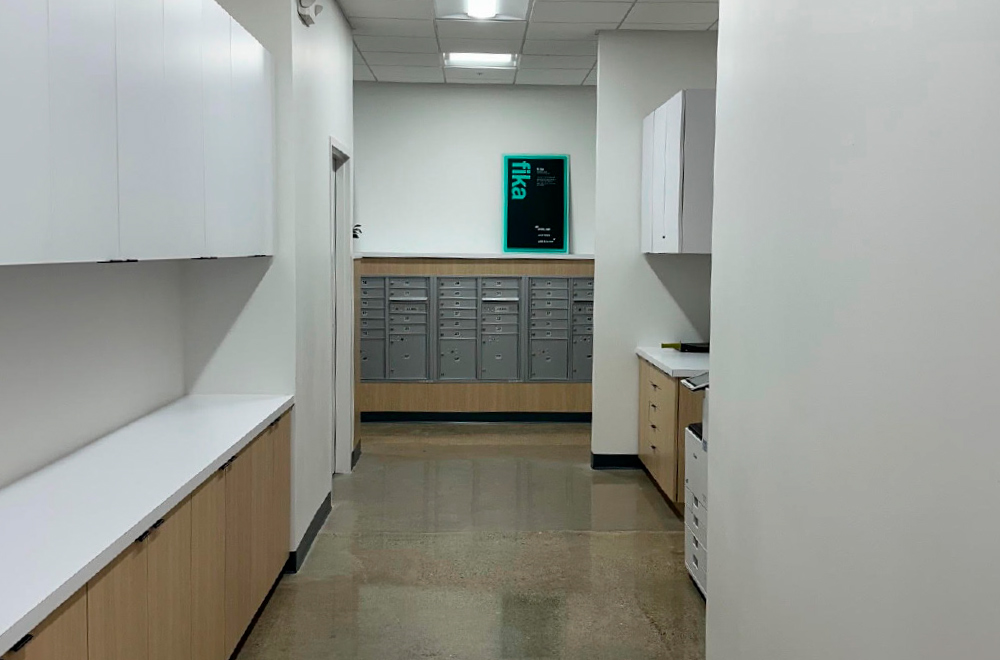
Smith recommends being mindful of having a well-designed welcoming area as well, so that prospects can have that warm, fuzzy feeling when they first visit your facilities.


For his part, Smith shares that he’s seen people bring in furniture, even a bed on mezzanines above the office space. “It’s not for full-time living,” he says, “but more like a man cave space. Ultimately, the tenant has the freedom to do what they want with that unit, and when they move, they can take down the mezzanines, or if the owner wants to keep it, they can work out a deal.”
Since flexibility is the name of the game, having so many versatile uses can bring operators an extra source of revenue, such as providing a mail room with packing supplies or offering ancillary services for people who rent office space. “One company we developed had a photo studio that was used to take professional headshots,” Smith says. “Extra revenue generated out of nowhere.”
Once they learn about the benefits, they tend to be attracted to the concept—and stay long term. “Traditional storage can offer higher rental rates at the beginning, but flex spaces can offer other advantages,” adds Smith. “Faster build times, quicker leasing, and more appealing in certain markets if you strategize well; and since, on average, leases tend to be for several years, you have the security and peace of mind of that durability.”
Indeed, flex storage is more than just renting out facilities. “It’s a launch pad for small businesses and entrepreneurs,” says Cooper. “We exist for those people that don’t fit the traditional office or warehouse mold. We provide infrastructure, the design, and most importantly, the community. We’re building a village.”





Lock Distributors-AUS
02-9880-3844
www.lockdistributors.com.au
sales@lockdistributors.com.au
Funds
Financing Expansions And New Development With Bridge Loans

inancial tools such as bridge loans can help storage businesses reach the next level by providing cash flow to bridge the gap between acquiring a new property and achieving lease-up, reimagining management of an existing facility with a plan to improve rents and occupancy or take advantage of moving into upcoming development phases without waiting for initial phases to show profits.
“In self-storage, the lease-up phase can be a challenging financing hurdle,” says Alex Burnam, senior vice president of real estate acquisitions at StorageMart. “Once a facility has its certificate of occupancy, it often takes 18 to 36 months to reach stabilized occupancy levels that permanent lenders require.”
Bridge financing is designed for that interim period, giving owners the runway to execute their marketing and operational plan before locking into long-term debt.
“Our focus is specifically on properties that are already built and owned but still in lease-up,” says Burnam. “By targeting that window, we can underwrite based on market fundamentals and a credible path to stabilization, rather than construction, expansion, or acquisition risk.”
A trade-off is that bridge loans are shorter term and typically carry higher rates than permanent financing.
“The main benefit is access to capital during a stage when many conventional lenders step back,” says Burnam. “Bridge lenders can be more flexible on occupancy requirements and repayment structures, which helps align financing with the realities of a storage lease-up. In our case, we provide non-recourse terms and build the lease-up plan ourselves, as the management company, which can give owners additional confidence.”
Bridge loans work best as part of a clearly defined stabilization strategy with a thoughtfully planned exit to permanent financing down the road.
“Earlier this year, we closed a deal in the New York City MSA for a facility in the early stages of lease-up, sitting at roughly 25 percent occupancy,” says Burnam. “At the time, it was under third-party REIT management and permanent lenders weren’t willing to underwrite the stabilization risk. We executed a non-recourse bridge loan at 73 percent of stabilized value, which allowed the sponsor to pay off their construction debt, fully fund an interest reserve through lease-up, and even return some capital to themselves.”
This type of scenario is the textbook case for this product line in self-storage.
“Clearly demonstrating that there exists sufficient demand in the market to merit the expansion from a rent and occupancy perspective is a first step,” says Shawn Hill, principal at The BSC Group, LLC. “The borrower should be able to provide the lending community with ample evidence that market occupancy is robust with limited new competition, market rents that justify the economics, and reasonable assumptions on leasing up the expansion.”
Another area to highlight would be the prospective borrower’s qualifications to run a business sufficiently successful to repay the loan.
“The borrower should also be able to convince the lender that they have the financial wherewithal and experience to execute on the proposed business plan,” says Hill. “Demonstrate to the lending community that the sponsor has the management experience necessary to implement the business plan, or supplement with a viable third-party partner that will provide comfort to the lender.”
This could come in the form of bringing on an established outside management company with a positive track record in revamping storage-specific businesses.
“One of the biggest obstacles is the size of a bridge loan, because there’s a lot of work to do for a lender to underwrite projections,” says Steve Libert, founding principal at CCM Commercial Mortgage. “If you’re looking for a small bridge loan, one of the harder things is that your world of potential bridge lenders becomes much, much smaller.”
Generally, lenders will want to see:
- Proforma projections through stabilization,
- Market rent comps and demand analysis,
- A timeline for reaching target occupancy,
- An exit strategy into permanent debt, and
- A detailed outline of the existing capital stack and current cost basis.
“Across the sector, the strongest bridge loan candidates have a clear story to tell on realistic occupancy projections, market data that supports demand, and an operational plan to get there,” says Burnam. “In our case, because we manage the property as part of the process, we generate the proforma, market comps, and lease-up strategy ourselves for clients. That removes guesswork and helps streamline underwriting.
“Red flags would be leasing assumptions that are too aggressive, as well as other unrealistic assumptions surrounding construction costs, market rents, and occupancies,” says Hill. “Finally, if the borrower is not aware of other proposed projects in the market, the lender will likely discover that in due diligence and that will likely impact the final outcome.”
Making a good first impression with a presentation package might be the only impression seekers get. Inadvertently peppering the field of potential lenders with a poor representation can sink your chances.
“You need to put together a very professional loan request package,” says Libert. “As a borrower, if you put together your own loan request package, send it out to 10 lenders, and there is something in it a lender is not going to look at favorably or see as a red flag, you just eliminated 10 options from your potential lender pool. You want to put together a package that’s going to increase your chances of getting the loan dollars and the terms that you’re looking for. If you have your head down doing a great job managing your self-storage facility or facilities—that’s your specialty. To suddenly become a financing expert, put together a loan request package that’s going to answer 90 percent of the questions lenders will ask, and present your loan opportunity as a good one—it’s just not realistic when you don’t live and breathe this world every day.”
To be clear, using a broker is not a requirement or absolute necessity, but there are benefits.
“Many borrowers find value in using a broker because they add a lot of value in making sure the potential pitfalls discussed above are avoided,” says Hill. “A good broker will help provide support to highlight the strengths of the deal and premeditate and mitigate perceived weaknesses. Finally, a competent broker will surely expand the list of eligible capital providers who would be likely suspects for the deal.”
Getting A Market Deal
Brokers Have Unique Underwriting Expertise
Brokers Free Up Your Time
Brokers Diversify Capital Lending Relationships
Brokers Help Solve Problems
“Possessing a specialized skill set per product type is important,” says Williamson. “All we do is self-storage, and we do it east coast to west coast. Everyone we’re talking to is storage-minded and storage-focused. We know all the capital; we know all the players. You wouldn’t hire an office building broker to go find your bridge loan for your self-storage property. Finding someone who is knowledgeable in the asset type is a huge qualifier.”
Opting for a bridge loan offers benefits such as non-recourse loan proceeds, the ability to self-administer the funds and control the process while avoiding the hassle and expense associated with a conventional construction/draw process and extended interest-only amortization.
“Bridge lending in self-storage plays a very specific role,” says Burnam “It is not a replacement for long-term debt but a tool to get from project completion to permanent financing. The key is matching capital with operational capability. When those two align, the bridge period becomes a strategic step rather than a hurdle.”


ighway 58, the main artery running from rural Tennessee into Chattanooga’s urban landscape, may not be as iconic as Route 66, but it’s mentioned in no less than five songs. Now, it’s also featured within the logo of 1up Self Storage, located just off the highway. Although 1up’s nine buildings are single level, owners Bradley Adams and Tom Willumson had a two-story false front installed to make a big first impression from the highway.
The facility houses 428 units and clocks in at 78,628 square feet. With proximity to boating hotspot Harrison Bay, there’s climate-controlled boat and RV storage plus outdoor and covered parking and loading docks for semi-trucks.
The facility was partially converted from a motorcycle dealership; the rest was built ground-up. COVID supply and pricing issues lingered, and the city’s unusual bathroom requirements added complexity. However, Adams says the worst setback was being scammed $50,000 by a gate contractor, so the smart-thinking owners became AutoGate dealers and installed the gates themselves.
1up opened in May 2024, combining REIT quality with local customer care. “Everything is top notch,” says Adams, adding that 1up’s story isn’t complete. “Phase 2 is on the way!”
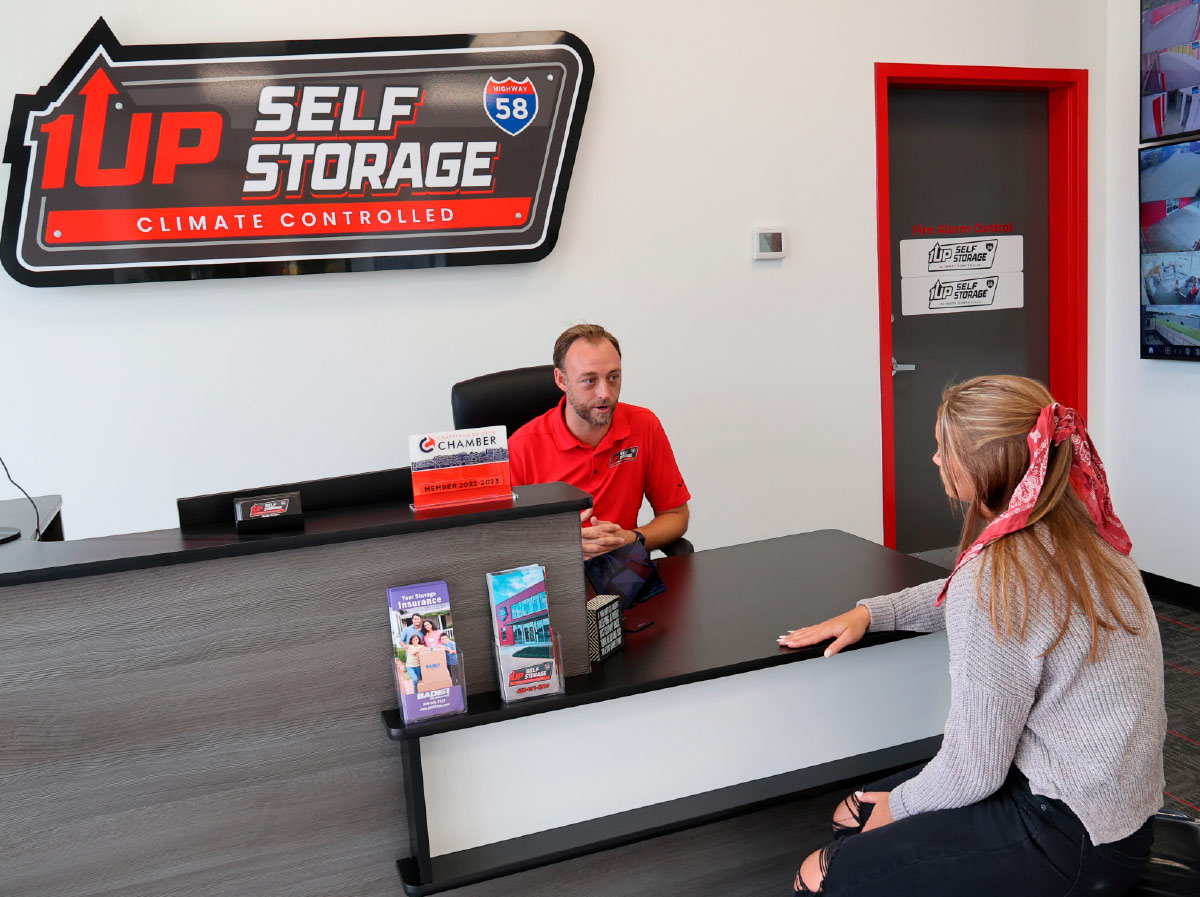




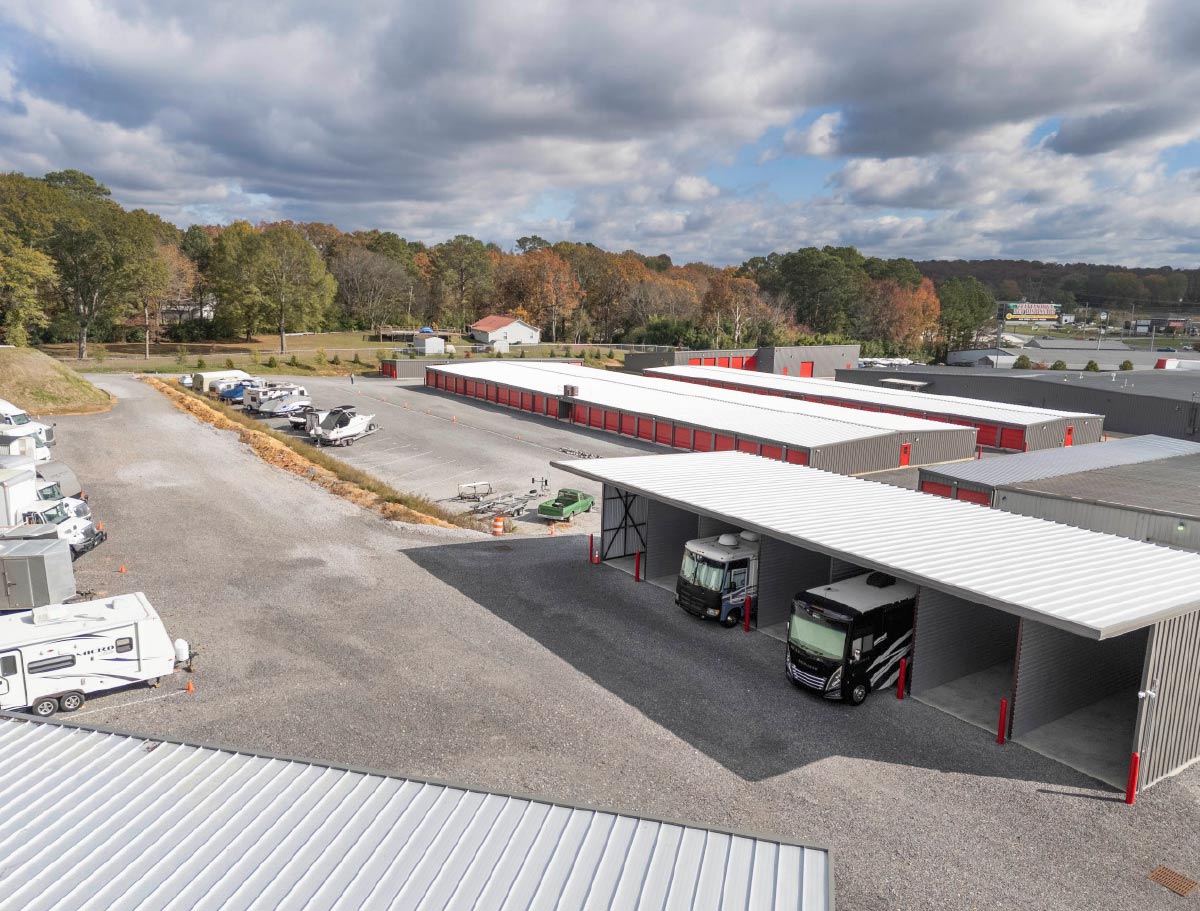

Revenue Engines
Might Be Costing You Rentals

n today’s competitive self-storage market, operators are investing more than ever in marketing strategies designed to drive calls and clicks. But what happens when those calls go unanswered, or when your website fails to convert visitors into renters?
The truth is that your call center and website might be costing you more than just phone bills and hosting fees. They could be costing you rentals.
The phone call is often the first real interaction a potential tenant has with your business. It should feel like a front desk experience, not a phone tree.
- Lower conversion rates – Potential tenants move on to the next facility when their questions aren’t answered quickly or confidently.
- Lost revenue – One missed rental could equal $1,200-plus per year.
- Brand damage – Inconsistent or unhelpful interactions shape how your brand is perceived in the market.
If your marketing budget is doing its job, but your call center isn’t closing the loop, you’re leaking revenue.
- Dedicated sales agents and team segmentation – Assigning specific agents or teams to designated facility groups allows for personalization, stronger rapport with tenants, and a more consistent customer experience. This structure improves lead conversion, enhances follow-up, and ensures that tenant questions are answered with facility-specific context.
- Sales-trained agents – Your call center team should be trained in objection handling, upselling, and urgency creation, not just customer service.
- Full system access – Agents need visibility into unit availability, pricing, and promotions in real time. Without this, they can’t book confidently.
- Lead tracking and follow-up – Every call should be logged, and every missed rental followed up. What gets measured gets improved.
- Script flexibility – The best agents follow a framework, not a rigid script. They should sound human, not robotic.
Here’s where many storage websites fall short:
- No online rentals or reservations – If a customer can’t book immediately, they may not come back.
- Slow load times or poor mobile UX – Frustrated users bounce before they ever see your pricing.
- Lack of clear calls to action – If it’s not obvious where or how to rent, you’re creating friction.
- No integration with live inventory – Showing availability and rates in real time builds trust and drives urgency.
Just like your call center, your website isn’t just a digital brochure—it’s a 24/7 leasing agent.
Operators often focus on SEO and digital ads but forget to evaluate what happens after the click or call.
Ask yourself:
- Can a customer rent or reserve a unit on my site in under 60 seconds?
- Does my site perform well on mobile?
- Is my call center seamlessly integrated into the online journey?
- Am I tracking conversion data and using it to make improvements?
If any of these questions give you pause, now’s the time to take a closer look.
It’s time to stop thinking of these tools as support roles and start treating them like the revenue engines they truly are.

et’s turn back the clock a few years to 2021. The pandemic was in full swing and self-storage operators were realizing that all they had to do was open their doors and people were renting. Did you have an on-site manager, climate-controlled units, drive-up storage, gravel lots? None of that mattered. All you needed was vacant units and a basic website and you were in business. Supply was well short of demand, and everyone needed storage.
Today, things are much closer to life before the pandemic, at least regarding supply and demand. People know they have options when it comes to storage, and they are using all the tools at their disposal to find the right option for their needs. The self-storage space is becoming crowded, with each location telling a different story about what they offer.
These days, the key is figuring out how to tell your self-storage story to your potential customers in a way that is more captivating than your competitors’ stories. Ads and signs can spread the message, but if that message is wrong, indistinct, or boring, you may be wasting your time and money.
So how do you tell an effective story about your facility? How can you elevate your message and your marketing above your competition? Drone photography and video might be your answer.
Drone imagery grabs the viewer’s attention due to its unique vantage point. Since over 65 percent of potential customers see photos of your facility before ever visiting in person, those images need to set you apart and draw tenants in. While ground-level photography remains valuable, drone photography and videography offer advantages both in showcasing your facility and in taking advantage of the precious little time a customer will spend shopping for storage.
Drone footage is especially impactful on mobile devices, allowing customers to quickly understand your facility’s layout and amenities without extensive scrolling or clicking. This user-friendly experience increases engagement and helps customers make informed decisions faster. More customers use mobile than desktop, sometimes at a 2:1 ratio, so make sure to keep this important benefit in mind.


Additionally, it’s important to verify the pilot’s experience with self-storage facilities. Storage is different than other commercial real estate and has unique amenities to highlight. An experienced pilot will know what to film. To make sure you have the right person, request to view their portfolio to evaluate their previous work. Also, make sure to confirm that the pilot’s equipment is professional grade, as high-quality drones are better equipped to handle variable weather conditions and provide clear, stable HD and 4K footage.

- Create a detailed shot list. Clearly outline the features you want to highlight. Your pilot may not know you’ve just completed an addition or recently installed new cameras. Make sure to communicate everything you want to capture. This ensures you don’t miss critical amenities or perspectives.
- Be flexible with the weather. Optimal and legal drone footage typically requires clear, sunny weather. Plan a backup day to accommodate unforeseen conditions and make sure to check the weather as filming day approaches.
- Quality matters. Ensure the footage quality meets your needs without overwhelming your website with excessively large files. HD and 4K are ideal, but editing footage to manageable file sizes is important, especially if you want to post to Google or upload online.
- Edit for impact. Professional editing enhances images and videos by adjusting lighting, removing distractions, and integrating branding or subtle enhancements that direct customer focus to key amenities. It can also reduce file sizes so your videos and photos won’t negatively impact your online performance.
- Website Integration – Utilize drone images as headers or banners on your homepage, offering immediate visual impact. Include videos on prominent pages to enhance user engagement and time spent on your site.
- Google Business Profile – Regularly update your profile with fresh drone images and videos. This significantly boosts visibility and can increase organic search rankings.
- Social Media – Drone footage makes ideal content for platforms like Instagram, Facebook, and YouTube. Short, engaging clips showcasing various amenities or events can significantly boost your facility’s online presence and engagement.
- Grassroots Marketing – Incorporate drone images or short videos in your signage or direct mail campaigns to existing and potential customers, emphasizing security features, facility upgrades, or special promotions.
Another consideration is investing in professional photography at key milestones, such as opening a new facility, showcasing major renovations, or periodically refreshing your online presence. Many capital expenditures are undertaken to increase the value of the property or improve the customer experience. In this way, professional drone footage can provide a substantial return on investment by significantly enhancing your facility’s perceived value. This also helps justify rental increases as the facility improvements are shown to your tenants.
Take advantage of the power of aerial imagery and ensure your facility stands out from the crowd, making a lasting and compelling impression in today’s digital marketplace.

On Conversions
User Interface On Your Website

he main function of a website is to convert a visitor into a lead or a sale. It all centers on the user experience (UX) and the user interface (UI). You might think your website is OK, but until you look at it from your potential customer’s point of view, it may not be.
It’s all about the consumer. They are in control, but you need to control them without them knowing it. Think of it as taking them by the hand and guiding them where you want them to go. They’re thinking, “What’s in it for me?” Consequently, you need to tell them.
The last thing you want is a frustrated potential customer. Just like you would give a potential customer who walked into your facility a guided tour, that’s how your website should be.
I’m sure you’ve had the experience on a website when you’re trying to, say, schedule an appointment, and the system doesn’t work right. You waste a lot of time and become frustrated. That happened to me recently with a medical appointment. It wasn’t like I could go to a competitor. After the third time trying their online form, I ended up calling them and having to wait on hold for a live person to help me.
You don’t want a frustrated customer. Unless you’re the only storage facility in town or for miles, they’ll go to a competitor.
Think of your website as a physical office or store. They could discover you via the search engine listing and go to your home page, or any of your static pages, like “About,” “Products,” or “Services.” However, they could find the link in your social media profiles, posts, other listings, or backlinks. And then there’s your blog articles. Those visitors could come from a search engine, a social media post, or an email. Additionally, there could be a designated landing page or a special sales page from paid advertising.
Follow the links, thinking like a customer. What do you see first? What makes sense? How does a potential customer get from “I think they have what I need” to “How do I book a unit?”
If you’re experiencing any of these, there’s something wrong somewhere along your potential customer’s buying journey. You may think your website looks good, but if you’re getting visitors and no conversions, then it’s not working like it should.
If you’ve followed my tips from past articles and you’re still not getting conversions, leads, or sales, it can very well be your website’s UX and UI.
Put those calls to action in your navigation menu, sidebar, at the bottom of each page and blog post, or in the footer. In addition, you can put it in a pop-up that comes up when the visitor has either scrolled to the bottom of a page or moved their mouse to leave. Don’t have the pop-up appear as soon as someone lands on your site. Consider this: If they just discovered you, let them read the article first before you ask them to join a list or do whatever. Don’t overdo it! Place them in logical areas.
- Put yourself in your target’s shoes. The consumer is in control, so think like one! Know your target market(s)! I have written about this in past Messenger issues.
- Think of your website as your 24/7 salesperson. It’s more than a nice online brochure. Given that, you need to arm it with everything the potential customer needs to know. However, don’t be too wordy. Use bullet points for the important features and amenities.
- Their buying journey must make sense. Look at it objectively step by step, from discovery to sale. Picture different scenarios—the various reasons someone needs to store anything at your facility. Lead them to the call to action.
- Have a visible internal search function. Make it easy for them to search within your site to find more information, what they need, or if they have questions.
- Be absolutely sure it works and looks good on all desktop web browsers and mobile devices. Many times, a site looks great on desktop, but when you look at it on a smartphone, you can’t see the menu or the call to action and the images are immense. Look at your analytics to learn which devices your visitors use the most (desktop or mobile). Test the click-to-call feature on a phone.
- Make sure everything works right. Test, test, test! All forms, booking, checkout, contact form, and calls to action must work smoothly. Subsequently, respond promptly. If it’s automated, ensure that a confirmation email or text message goes out. If they need a human response, get back to them as soon as possible. Your office and facility access hours should be on the footer of your website.
- Provide good, quality, and helpful content. Give them what they want. Educate them. Offer free advice and tips. Proofread everything. Better yet, have someone else proofread it. If you don’t have a second pair of eyes, walk away from it, then come back later and carefully read it out loud to yourself.
- Be human. Remember, you’re talking to humans. Humans have feelings, especially if they’re going through a traumatic experience and they need storage. I was displaced by fire a few years ago. I know what that’s like. Remember, they are thinking, “How can you help me?”
- When using a landing page for a special offer, it should not have any other navigation except the form and the “send” button. OK, maybe one link to the home page. The point is not to have any other distractions except what you want the visitor to do.
By focusing on your website’s user experience and interface, you should see conversions and sales improve.
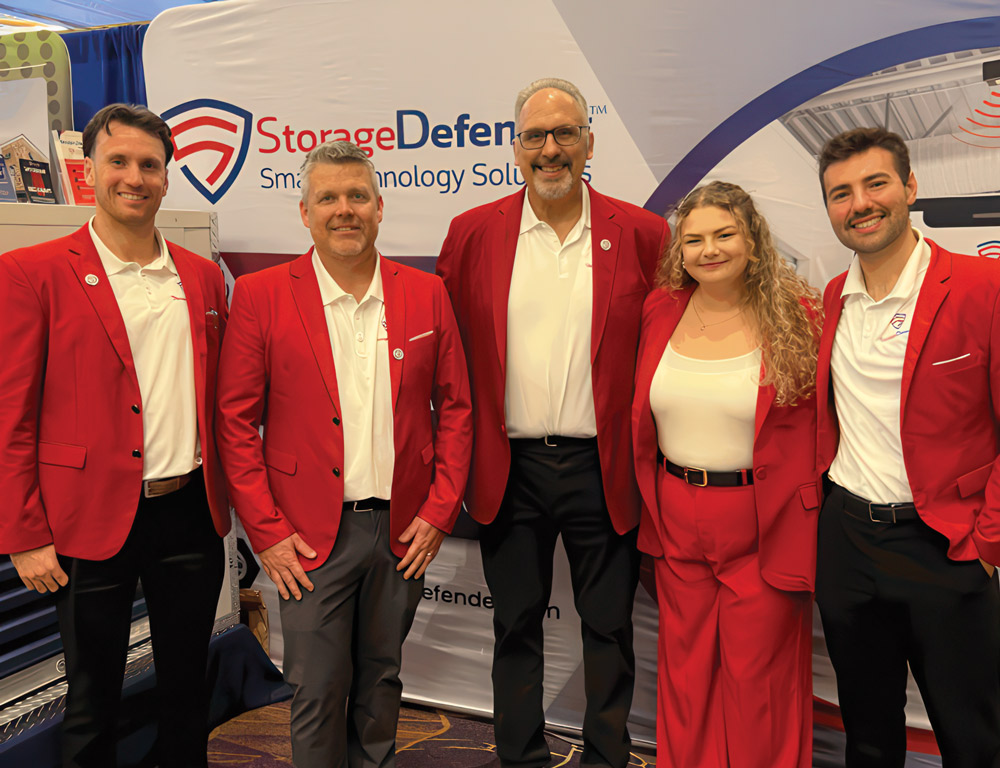
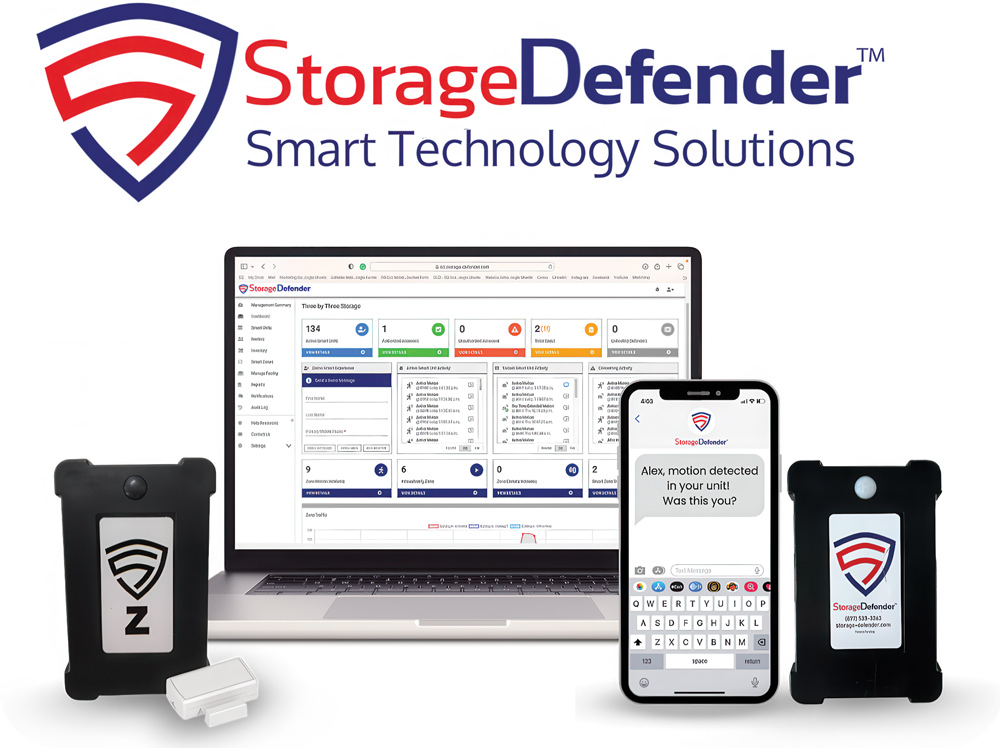
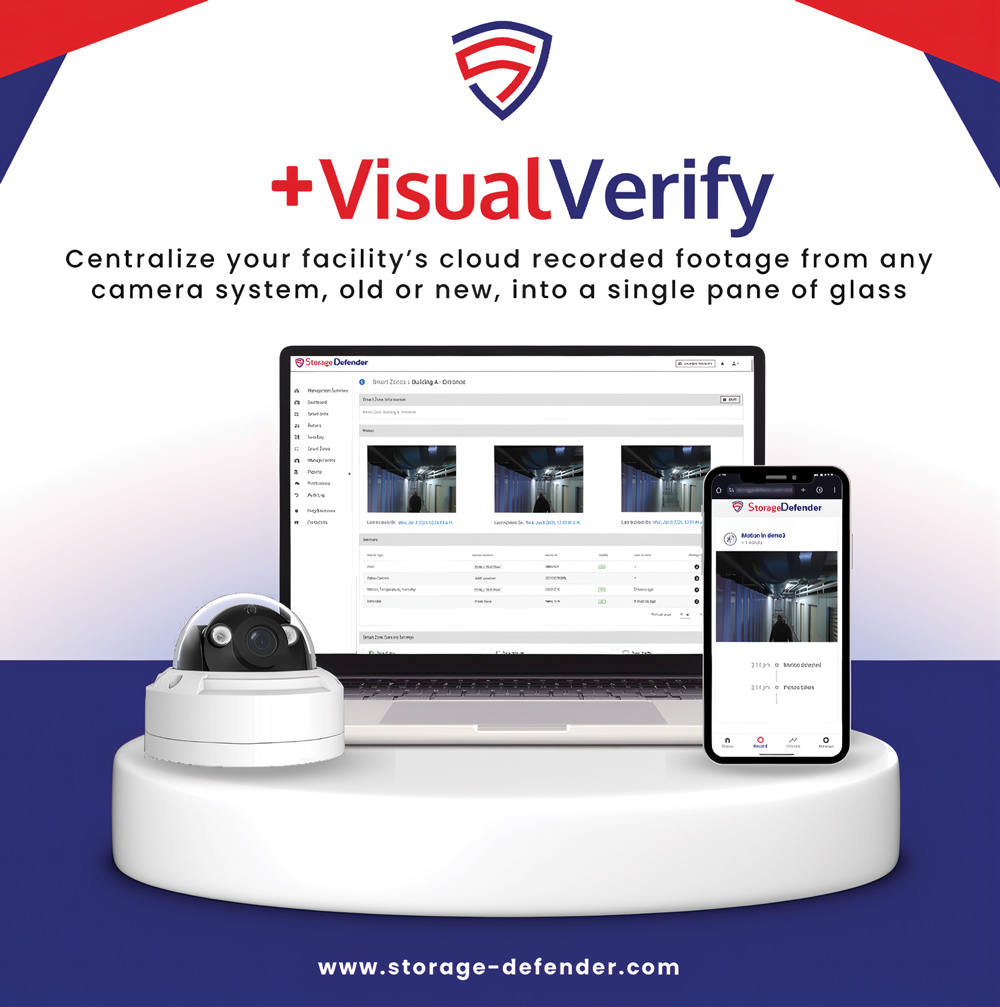
heir signature red coats may draw attention at conventions, but it’s StorageDefender’s smart technology solutions that keep the spotlight on the company year-round. While the six-year-old business is no longer a startup, their quest to innovate with new features like +VisualVerify™ sets them apart.
The foundation of StorageDefender lies in the complementary strengths of its founders, Mark Cieri and Nathan Wright. Cieri had a long career as a global leader at microchip technology companies, even serving as vice president for Philips Hue’s North American smart home lighting division. Wright held roles as a product engineer at Texas Instruments and Schlumberger before founding his own engineering development firm. Both held over a dozen patents when they partnered, and today hold many more together.
“These experiences were certainly valuable, but ultimately what mattered most was taking a swing at starting my own business,” says Cieri. “I didn’t want to leave room for any regrets when I spoke to my future self.”

As they progressed, they saw an opportunity to create an entire hardware-enabled SaaS solution for intelligent monitoring, which became the genesis of their now WMP (Web Management Portal). They conceived applications across numerous industries but were unsure where to start.
“My brother was driving down the highway, noticing one self-storage facility after another,” Cieri recalls. “When he suggested it, that was the aha moment. I made the connection that customers considered storage an extension of their home, such as a remote garage, and my experience with smart homes directly applied. The No. 1 reason people were purchasing smart home products was peace of mind, and they paid a premium for it, too. We realized we could help transform self-storage similarly by introducing individual unit monitoring as a service.”
The duo launched StorageDefender in April 2019, then COVID hit. “Everything went remote,” says Wright. “We were concerned, but self-storage was resilient. This helped us develop deep roots with our early partners as contactless technology became a priority.”
Initially, Cieri and Wright drove around Texas installing the product for clients; fast forward a few years, and StorageDefender is embedded in the self-storage ecosystem with a nationwide installation network. The reception has been extremely positive; some operators pre-outfit units with a smart device, while others offer it as an upgrade or include it in their value-based pricing offerings.
“We’re proud to have pioneered smart-unit-as-a-service for the self-storage industry, and it’s one of the top-rated features tenants will pay for,” Marketing Manager Brook Bland says, citing the SSA’s 2025 Self Storage Demand Study. “Tenants are price-sensitive, so if you just raise rent, they often push back. But when it’s tied to a feature like smart monitoring, the value is clear.” She adds that one recent company case study showed a 72 percent opt-in rate when smart units were offered as an upgrade, which added over $50,000 in annual revenue to a single property.
Cieri and Wright’s latest innovation, +VisualVerify, is a platform that seamlessly integrates with their smart device technology. It also capitalizes on existing camera systems, bringing all property views into one centralized dashboard.
“We saw owners being pushed to buy expensive new AI cameras and multi-property operators struggling to effectively manage multiple camera platforms,” Wright says. “We thought, why not let them work with what they already have?”
With +VisualVerify, most camera systems can be integrated into one dashboard or a “single pane of glass.” When paired with the company’s Smart Units and Smart Zones, it becomes even more powerful, allowing operators to go straight to the exact timestamp of an incident. The platform leverages AI analytics, enabling operators to locate and prioritize incidents autonomously.
“+VisualVerify saves time, money, and provides higher awareness across facilities, especially larger portfolios,” says Bland.
Cieri and Wright haven’t just built a product—they’ve built a company that reflects their complementary strengths. “It’s clear what a natural fit they are,” says Bland. “Mark handles vision, product definition, marketing, and sales, while Nathan orchestrates R&D, product development, and communication infrastructure. They both truly care about our clients, the community, and company culture. I don’t use the term ‘power duo’ lightly, but that’s them.”
That balance of vision and execution has fueled StorageDefender’s growth, and today the team rallies around a core promise: to defend storage and provide peace of mind that profits. “We won’t stop innovating,” says Cieri. “We’re evolving our technology, growing partnerships, and always have new products in development.”
Wright agrees. “Our focus is expanding the solution across the self-storage industry. Stay tuned—there’s more to come.”
From startup to standout, Cieri and Wright will keep building their business and the self-storage industry itself, donning the red coats, naturally!


avigating the self-storage industry can feel scarier than a Halloween night. From dealing with lien sales to managing water damage from tropical storms to facing inexperienced staff, there’s no shortage of terrifying scenarios for owners. But fear not, the Self Storage Association (SSA) is here to help.
As an SSA member, you have access to a treasure trove of resources designed to support you through the scariest storage nightmares. Whether you need legal guidance, emergency preparedness advice, or educational support, SSA has you covered.
Hiring new staff can be daunting, especially when you need to make sure they’re a good fit for the job. SSA’s eTest is a web-based screening tool specifically designed for the storage industry. It’s fast, reliable, and cost-effective, measuring key traits linked to job performance. Better hires lead to lower turnover and higher productivity. Save time and hire smarter with the SSA eTest. Learn more about it at etest.net.
So don’t let the frightful aspects of the industry haunt you. Renew your SSA membership today and get the support you need to make your storage business a success—no tricks, just treats!

f all the variables in play when designing a new facility, final operator considerations must be fought for as the concept begins to take shape. The natural focus of engineers and architects centers around engineering and design problems like life safety travel distances, structural load line tracing, and so on. These are important factors, but the ability to operate the facility efficiently can’t become a casualty in the process. Here are some operational considerations to keep in mind when designing a new facility.
Unit Mix – The right mix of unit types/sizes, placed strategically throughout the building, optimizes revenue potential for a facility based on local demand.
Customer Travel Distances – Where possible, lay out the building floor plans to minimize the number of units with excessive travel distances. Units with long travel distances are often discounted to compensate for this inconvenience.
Site Access Controls – Plan for the right equipment and technology to enable efficient customer access while restricting non-renters from parts of your facility.
Building Access Controls – Elevator keypads programmed to specific floors and specialty stairwell lockset hardware are two easy ways to restrict access within the building.
Site Drainage – Consider drainage patterns for storm runoff, snow, and ice. Site layout can work for or against property managers in terms of site water management.
Loading Area Features – Provide some form of cover from the elements for unloading, whether that’s a simple canopy outboard of your building or a dedicated covered loading bay.
Security Camera Layout – Where controllable, avoid choppiness in your hallway layout to maximize camera visibility and increase oversight throughout the building.
Restroom Placement/Access – This may seem like a small thing, but cities often require an additional restroom based on building code prescription vs. what a low-traffic facility needs, driving up costs.
Dumpster Enclosure Placement – Placing your dumpster somewhere easily accessible by a waste management company will save the property manager time and energy.
Drive-Up Unit Materials – Customers will hit door jambs with vehicles. It’s a fact of self-storage life. Design those jambs to be an easily replaceable material and keep some replacement stock on site.
At the end of the day, you’re designing a revenue-generating asset that’s housed within a physical building. Getting a design team on board early that works backwards from your investment goals will directly impact your ability to optimize that facility’s NOI potential and its value.
• Fully integrated solutions with in-house baȷa Engineers for faster, easier projects
• Pre-Fabricated Framing Systems with Bolted Connections – No field welding
• Snow Loads from 20psf to 100psf – Wind Speed rated to 170MPH

matters most
facilities across Canada




Social SEO
elf-storage operators have long struggled to prove the value of investing in social media marketing for years. The statistics are “fuzzy;” views, likes, clicks—how do you determine your cost per rental with those? We’ve heard for years that more and more users are using social for search, but if you’ve run social media ads, you’ve likely never seen a direct conversion in your analytics. Unless you’re a large brand with deep pockets, investing in social media felt like a “nice to have” instead of being an essential in your digital marketing playbook.
Things dramatically shifted on July 10, 2025, when Google began rapidly indexing more public Facebook and Instagram content, giving rise to the importance of social SEO. You can no longer depend on your website and Google Business Profile (GBP) to be found online. Optimizing your social content so that it surfaces in both social platforms and Google is an essential component of your digital marketing strategy.
Today, search results are blended with social signals. Optimizing your social media profiles and content to improve your visibility in search results is social SEO. Facebook events, Instagram posts, and Reddit threads all show up alongside your website and GBP when searching for “storage units near me.”
Social SEO is a component of your technical and local SEO strategy. It complements your citations, backlinks, and on-page optimization efforts. Consistent messaging across the web and social platforms reinforces your local authority.
Ensure that all your social media accounts are correctly using your facility name, address, and phone number. Write a great description about your facility, use the correct business category, and be sure to add a link to your website. Link your social accounts to your Google Business Profile.
Posting consistently to your social media accounts gives you many opportunities to create hyper-local content. Update your social strategy to include:
Don’t go overboard with keywords when creating your captions. Remember, they should be engaging and easy to read for real people. Using hashtags will allow you to add additional keywords without making your posts look spammy.
Be sure to encourage engagement with your tenants, vendors, referral partners, and other local businesses. Encourage your tenants to post photos and add reviews of your facility. Promote your sponsored community events by publishing them on Facebook and Instagram. Public comments, photos, and reviews are also crawled, and community engagement is another opportunity to increase your search visibility.
One of the biggest shifts we’re already seeing is the rise of AI-driven search experiences. Whether it’s Google’s AI Overviews, Bing’s Copilot, or ChatGPT, the algorithms are drawing heavily on social sources. Verified reviews, user-generated photos, and fresh social posts are increasingly prioritized because they offer the kind of real-time, authentic signals AI looks for when answering questions like “Where’s the best storage unit near me?”
Another key trend is the growth of visual and voice search. Platforms like TikTok and Instagram are training users to discover through images and short-form video. Meanwhile, voice assistants are leaning on structured data, reviews, and social profiles to serve local results. This means that keyword-rich captions, alt text, and even spoken words in videos will directly influence whether your business shows up in search.
To stay visible wherever your potential tenants are searching, social media must be part of your digital marketing playbook. By embracing social SEO now, you not only increase today’s visibility but also future-proof your business against tomorrow’s inevitable search shifts.