









How to enjoy our new magazine:
Just scroll!
Click or tap the table of contents icon in the menu bar to find any article.
Read any article by clicking or tapping the read full article button below each article intro.
Jump back to your previous browsing spot from any article using the menu bar or back to issue button.







IN SECURITY. ZERO.

Zero batteries. Zero hassle.
Zero batteries.
Zero hassle.



-
Human Trafficking In Self-StoragePage 12
-
The Ins And Outs Of On-Site Event PlanningPage 16
-
Can Operators Overcome The Travel-Time Gap?Page 20
-
Human Trafficking In Self-StoragePage 12
-
The Ins And Outs Of On-Site Event PlanningPage 16
-
Can Operators Overcome The Travel-Time Gap?Page 20


They gain reach they can’t build alone.
Through shared brand presence and collective online momentum, the Storelocal community helps independents show up stronger, get found faster, and compete more effectively—while staying fully independent.

-
The Industry’s Real Achilles HeelPage 58
-
Public Storage in Garland, TexasPage 62

-
The Legal Risks Of Automating OperationsPage 64
-
Operational Efficiency As A Capital StrategyPage 66
-
Helping Customers Choose The Correct Unit SizePage 70
- Chief Executive Opinion by Travis Morrow6
- Publisher’s Letter by Poppy Behrens9
- Meet The Team10
- Women In Self-Storage: Margaux Chetrit by Brad Hadfield23
- Who’s Who In Self-Storage: Armand Aghadjanians by Victória Oliveira27
- Innovation Spotlight: Flatbox by Brad Hadfield74
- The Last Word: Chris Berg76
For the latest industry news, visit our comprehensive website, ModernStorageMedia.com.













CEO of MSM and Storelocal Corporation,
President of National Self Storage
endors, let’s talk straight: Self-storage shows have been playing small ball for too long—the same old grid floors with traffic slowing as the day drags on, sessions competing with your booth time, leads that fizzle out. You’ve all felt it during this past budget season. We’re building something different, for you.
THE Show is the big leagues, where pros play at the highest level, as it’s designed vendor-friendly from the ground up. We’re the only national show on the East Coast in 2026, filling that Q4 gap when pipelines stall and giving you a head start into 2027. We’ve planned dedicated trade show hours so there’s no competing content stealing your crowd. There’s a zoned trade show floor with activations to keep 1,000-plus operators circulating, which means steady traffic for every exhibitor—no favorites, just wins.
We’re keeping it simple too: WiFi and scanners included with every booth, plus our affiliate program earning you 10 percent revenue share on registrations you drive. We’re addressing every exhibitor pain point early because exhibitors are our customers too.
We’ve announced keynotes to draw decision-makers: CNN’s Scott Jennings on post-midterm policy and economic impacts and Atlanta Braves Hall of Famer Chipper Jones on resilience and team play. THE Show will also deliver over 45 industry-specific sessions on our four pillars (data, development, investment, and operations), plus an Acquisitions Corner for dealmaking and a manager room for operations and sales training. This is the experience owner-operators want, and we’re delivering it.
Unforgettable nights seal the deal: Wolfgang Puck catering at the Georgia Aquarium and MSM Awards Gala celebrating industry MVPs and Facility of the Year winners. The Signia by Hilton is steps away, facilitating a seamless experience for your team and attendees—no hiking required.
Exhibitors, this is your shot at early exposure to top operators hungry for 2027 solutions. Don’t end up on a wait list—register early. 10-by-10 booths from $4,000; you pick your spot based on sign-up date—no politics.

-
PUBLISHER
Poppy Behrens
-
Director Of Sales & Marketing
Lauri Longstrom-Henderson
(800) 824-6864 -
Creative Director
Carlos Padilla
(800) 352-4636 -
Editor
Erica Shatzer
-
Lead Writer / Web Manager
Brad Hadfield
-
Storelocal® Media Corporation
Travis M. Morrow, CEO
-
Website
-
Visit Messenger Online!
Visit our Self-Storage Resource Center online at
www.ModernStorageMedia.com,
where you can browse our paid publications, research archived articles, sign up for a magazine subscription, submit a change of address, and more. 
- All correspondence and inquiries should be addressed to:
MSM
PO Box 608
Wittmann, AZ 85361-9997
Phone: (800) 352-4636

theparhamgroup.com
Scalability: Benefit from a scalable business model that allows for easy expansion into high-demand areas, maximizing your return on investment.
Steady Income Stream: Enjoy a reliable and consistent income stream with long-term leases and a diverse tenant base, providing stability even in uncertain economic climates.
Location, Location, Location: Our strategic locations are meticulously chosen to cater to growing populations, ensuring optimal visibility and accessibility for potential tenants.
Tech-Driven Management: Embrace the future with state-of-the-art technology that streamlines operations, enhances security, and ensures a seamless experience for both investors and tenants.
Quality: We build facilities with the utmost quality that differentiates our brand from competitors.





 Four Pillars
s a writer, I learned early on to rely on the four pillars of content: structure, style, substance, and strategy. Those principles remain foundational, and they set the stage for everything that follows.
In 2023, MSM introduced a redesigned Messenger magazine that incorporated our own four pillars of content: operations, data, development, and investments. We believe these pillars comprehensively organize every facet of the self-storage industry, ensuring our editorial content is well-rounded and easy to navigate.
Each issue of Messenger is thoughtfully curated within these domains, covering topics from management and marketing to technology, construction, and security. Beyond the magazine, our website, social media channels, and webinars are all aligned with these pillars, delivering consistent and relevant insights across all platforms.
Additionally, even THE Show—our groundbreaking self-storage conference and trade show—is structured around these four pillars. Join us in Atlanta, Ga., Nov. 4 to 6, 2026, at the Georgia World Conference Center for an unforgettable experience. Highlights include the Deep Blue Welcome Dinner at the Georgia Aquarium, catered by Wolfgang Puck, and the red-carpet awards gala celebrating the 2026 Facility and Manager of the Year winners. Expect high-impact presentations from industry leaders and a reimagined trade show floor. For further details, please refer to pages 6, 8, and 10.
We look forward to supporting your continued success in self-storage. And we hope to see you at THE Show in Atlanta!

Publisher
 Four Pillars
s a writer, I learned early on to rely on the four pillars of content: structure, style, substance, and strategy. Those principles remain foundational, and they set the stage for everything that follows.
In 2023, MSM introduced a redesigned Messenger magazine that incorporated our own four pillars of content: operations, data, development, and investments. We believe these pillars comprehensively organize every facet of the self-storage industry, ensuring our editorial content is well-rounded and easy to navigate.
Each issue of Messenger is thoughtfully curated within these domains, covering topics from management and marketing to technology, construction, and security. Beyond the magazine, our website, social media channels, and webinars are all aligned with these pillars, delivering consistent and relevant insights across all platforms.
Additionally, even THE Show—our groundbreaking self-storage conference and trade show—is structured around these four pillars. Join us in Atlanta, Ga., Nov. 4 to 6, 2026, at the Georgia World Conference Center for an unforgettable experience. Highlights include the Deep Blue Welcome Dinner at the Georgia Aquarium, catered by Wolfgang Puck, and the red-carpet awards gala celebrating the 2026 Facility and Manager of the Year winners. Expect high-impact presentations from industry leaders and a reimagined trade show floor. For further details, please refer to pages 6, 8, and 10.
We look forward to supporting your continued success in self-storage. And we hope to see you at THE Show in Atlanta!
Publisher

MSM’s THE Show lands in Atlanta, Ga., on Nov. 4 to 6, 2026, packing the Georgia World Congress Center with more industry speakers and keynotes than ever before, plus special guests, exciting breakout sessions, an acquisitions corner, and a trade show floor designed for engagement and visibility.
After hours, unforgettable events await, with our Deep Blue Welcome Dinner inside the underwater banquet hall of the Georgia Aquarium, catered by Wolfgang Puck, and our Red Carpet Awards Gala, honoring the very best in self-storage.
If you’ve been waiting for something different … Welcome to THE Show.














hen checking in with several storage managers about human trafficking, I discovered that many managers don’t really know how human trafficking can occur in the self-storage business. The managers I spoke with weren’t sure what they should be looking for when doing their daily walk-through.
Keep in mind, the victims aren’t always women. They can be children and even men, whom could be used to transport drugs and complete other illegal activities. Victims can be any age, race, or gender. Estimates show 5 million women and children are victims of sex trafficking. The trafficking business exploits all types of people for sex, labor, and illegal activities.
So, what makes the self-storage business susceptible to human traffickers? First, we have minimal to almost no security at some storage properties, especially at smaller storage operations or remote locations. Obviously, “bad guys” don’t want nosy managers around. This makes remotely operated properties more susceptible to traffickers. The bad guys don’t want to draw attention to their comings and goings at the property or have managers checking the space. They especially avoid any interaction with the storage managers or staff. This makes it more important to be observant and make multiple rounds throughout the storage property throughout the day. If you allow 24-hour access to your property, be careful about which customers you grant it to.
Recent cases in the United States involving self-storage types of trafficking include:
- Milwaukee, Wis. (2024) – Authorities found six children, ranging in age from two months to nine years old, locked in a storage unit without power or water. Two adults were arrested on child neglect charges.
- Cobb County, Ga. (2025) – A man on probation was arrested after he allegedly held a woman captive in a storage unit where he physically and sexually assaulted her.
- Kentwood, Mich. (2025) – A woman was charged with manslaughter after she locked another woman in a storage unit, where a fire later broke out. The victim, who was homeless and had been staying in the unit, could not escape and died in the fire.
Basically, three types of trafficking are found in self-storage. They are people held against their will for sex trafficking, forced labor, and/or domestic servitude.
Human trafficking, a form of modern-day slavery, is a serious violation of human rights that involves the exploitation of people through force, fraud, or coercion for labor or commercial sex. This clandestine crime, which thrives on human vulnerability, is a global issue that affects millions of people.
- Sex trafficking – A commercial sex act is induced by force, fraud, or coercion. If the person performing the act is under 18, it is considered trafficking regardless of whether force, fraud, or coercion is involved.
- Labor trafficking – People are recruited, harbored, or obtained for labor or services through force, fraud, or coercion for involuntary servitude.
The distinction between human trafficking and human smuggling is also essential. Smuggling involves illegally moving a person across a border, but the person is usually cooperative. Trafficking, by contrast, is about the exploitation of a person, which can occur even within their own home or community, with or without transport.
- Children and youth – The average age of entry into sex trafficking is between 12 and 14. Traffickers groom minors through online platforms, social media, and in-person contact.
- Marginalized communities – This includes people experiencing homelessness, those with disabilities, undocumented immigrants, and racial or ethnic minorities.
- Women and girls – They are particularly vulnerable to sex trafficking, making up a significant majority of victims in the commercial sex industry.
- Physical signs – Malnutrition, poor hygiene, untreated illnesses, and signs of physical abuse.
- Behavioral signs – Appearing fearful, anxious, depressed, or submissive. The person may avoid eye contact and seem to be giving scripted answers.
- Lack of freedom – The individual may not be allowed to speak for themselves, have their identification documents controlled by someone else, or live and work in the same location under high-security conditions.
- Dollar signs
- Traffickers’ names
- Gang signs
- Crowns
- Language around loyalty
- Xs
- Tear drops
- Faces with dates above them
- Hearts with dates above them
- Same attire
- Sign of drug or alcohol abuse
- Branding/Tattoos
- Multiple bruises or injuries at various stages of healing
- No ID documentation
- Fearful of authority figures
- Disoriented and confused
- Always accompanied and unable to move independently
- Unusual work conditions (working excessively long and unusual hours for very little or no pay, with restricted breaks)
- Do walk-throughs multiple times during the day.
- Watch for people who are at the storage property “hanging out.
- If you see something, contact the local police to let them handle the situation. Make sure you tell your supervisor/owner so they can guide you in reporting/handling.
- Check the property before you lock the gate/property. I check the entry and exit report from the gate so I know who is still on the property.
- Educate yourself. Learn to recognize the signs of trafficking and understand the vulnerabilities that traffickers exploit.
- Report suspected cases to your local police. If you believe someone is in immediate danger, call 911.
- For tips and resources, you can contact the National Human Trafficking Hotline at 1 (888) 373-7888.
- Make ethical consumer choices. Support businesses with transparent labor practices and choose fair-trade products to avoid inadvertently supporting forced labor.
- Support anti-trafficking organizations. Volunteer your time or donate to local and national organizations that provide survivor services, advocacy, and prevention efforts.
- Advocate for change. Contact your elected officials to encourage stronger anti-trafficking laws and policies.
Human trafficking is a complex and devastating crime that is now using self-storage to promote what they are doing, but it is not an unsolvable one. By increasing awareness in self-storage, having a good relationship with your local law enforcement officers, and reporting suspicious activity, individuals can help combat this horrific exploitation. The road to a future free from human trafficking requires a collective effort, with informed and vigilant communities standing together against exploitation.


At PTI Security Systems, our commitment to quality and passion for innovation drives the development of advanced security solutions to help operators scale with confidence. From smart technology to fully integrated systems, our solutions provide greater security, insights, and control across any facility.

don’t keep up with the competition;
they lead the pack.



MOBILE APP
SMART KEYPAD
SMART LATCH
MOBILE APP
SMART KEYPAD
SMART LATCH

osting events at self-storage facilities gives owners and managers a good way to promote their businesses locally, providing networking for tenants and other local businesses and giving attendees an enjoyable experience.
Industry veterans say creating a successful event requires careful planning, including preparing the event space, providing adequate parking on site or near the facility, getting municipal permits if necessary, having sufficient liability insurance, and promoting the event.
Cox’s Armored Mini Storage Management has 17 facilities in its portfolio, all of which are in Arizona. The company has hosted four types of events: grand openings, customer appreciation days, local business days, and Halloween and Christmas celebrations.
Gibson stresses the need to “spend the time necessary to make (your event) a success” and “put a big focus on marketing.”
“For the manager and staff, it’ll be pretty underwhelming if you don’t take the time to market it well,” says Gibson.
If, for example, the event celebrates a grand opening and the local chamber of commerce is involved, the chamber will promote it.
In addition to the local chamber of commerce, Cox’s Armored Mini Storage Management also promotes its events within its facilities’ buildings to other businesses through on-site signage and traditional advertising means (via physical mailers and email marketing) and online (Facebook, Instagram, and Google My Business) starting two to three months before the event.
The company typically doesn’t budget separately for events, choosing to include them in its annual marketing budget. Gibson, who calls the company “frugal,” says it charges attendees for business day events but doesn’t charge for most of its other events.
Location and marketing are the keys to success, according to Mike Schofield, owner of Phoenix-based Schofield Insurance Group. “These events could be that turning point in letting people know about the facility,” he says.
Promoting the event is just as important as preparing for it, says Sarah Beth DeFazio, vice president of sales and development for Atlanta-based Universal Storage Group. “After all, people can’t attend if they don’t know about it. Use a mix of marketing channels to reach your audience … Think beyond your own efforts, too. Partner with local businesses by asking for raffle donations and cross-promoting each other. Not only does this increase exposure, but it also builds goodwill and a sense of community.”
Promoting your event “isn’t just about filling seats,” says DeFazio; it’s also “about connecting with your community, building relationships, and highlighting your facility as an active, engaged part of the neighborhood.”
Insufficient marketing means “you could have a bomb and just sit there all day with nothing happening,” adds Carol Mixon, owner of SkilCheck Services.
Preparation begins “long before the first guest walks through the door,” says DeFazio. “Ideally, all of your major events for the upcoming year should be planned by October of the year prior. Larger events often require 90 days or more to organize properly, so give yourself plenty of lead time. On the day of the event, your facility should be spotless. This is your chance to showcase your property at its best, so treat it as a stage for first impressions. Pay extra attention to routine cleaning and ensure that every space shines.”
“The bottom-line answer is insurance,” says Scott Zucker, a self-storage lawyer and a partner with the Atlanta-based law firm Weissmann Zucker Euster + Katz P.C.; author of Legal Topics in Self Storage: A Sourcebook for Owners and Managers; and a partner in the Self Storage Legal Network, a subscription-based legal service for storage owners and managers. “If they are doing a special event at the facility, they need to check with their carrier about whether their standard commercial general liability policy will cover injuries and damages. If not, then get a policy specific for coverage for the event.”
Ashley Oblinger, Weissman Zucker’s senior counsel, said that, from a legal perspective, an event is a “big undertaking” because it’s not what a self-storage facility normally does, and it brings non-tenants into the facility. “Every facility’s lease should have a waiver or limitation of liability where the facility doesn’t have liability for damage to property stored,” Oblinger says. “There’s a risk that you could negate that liability [coverage] by bringing in non-tenants for an event. Get insurance to cover guests coming onto the property from personal injury and property damage. And part of that you can get it to cover liability for damage and theft of tenant property.”
Having all attendees sign a release or rider—“some sort of indemnification”—is also an option, says Oblinger, but a release alone “won’t stop people from suing.”
“It might be best to look into hiring someone to put on the event, including permits and insurance,” Oblinger says. “Security for the event, selling tickets—hire it out so you’re not stuck with all the liability.”
Per Gibson, Cox’s Armored Mini Storage Management gets approval from its insurance company for all events other than customer appreciation days. Its regular insurance already covers tenants; the company also requires local businesses that get a booth at the event to sign an insurance waiver.
For nighttime events, such as a carnival with vendors, Schofield suggests getting insurance certificates from vendors with general liability limits that match your coverage against injuries on the property. Ensure proper lighting and consider leasing lighting equipment to increase safety and security.
Ensure that all units’ doors are closed, fill any potholes where attendees will walk, and if it’s wintertime, keep the grounds free of snow and ice on walking areas, adds Schofield. Plus, have security cameras to review any incident that occurs, with or without events.
Parking presents one of the most common challenges for events, according to DeFazio, who recommends preparing a solid plan with the following:
- Traffic control – Consider hiring an off-duty police officer or security expert to direct traffic.
- Overflow options – Ask neighboring businesses about using their parking lots, especially if they’ll be closed during your event.
- Clear communication – Use signage, maps, or attendants to guide guests to parking.
“Being proactive about parking ensures a safer, less stressful experience for attendees and shows that your facility is organized and considerate,” she says.
Schofield adds, “Any lawsuits will look at what you failed to do or did wrong.”
“We’ll be at the entrance and have a takeaway and get their email addresses,” Gibson says. “Sometimes we send them a survey. We always try to gain their information for potential customers and to better plan events. One manager has attendees fill out a little and enter a drawing for a free storage unit for six months.”
DeFazio reminds operators that the event doesn’t end when the last attendee leaves. Treat the event as a learning opportunity. “Always ask attendees for comments and suggestions, either in person, through a short survey, or via follow-up email,” she says. “Their feedback will give you valuable insight into what worked well and where you can improve. With each event, a little effort and adjustment will help your gatherings grow stronger year after year, ensuring they remain memorable, well-attended, and impactful for your community.”
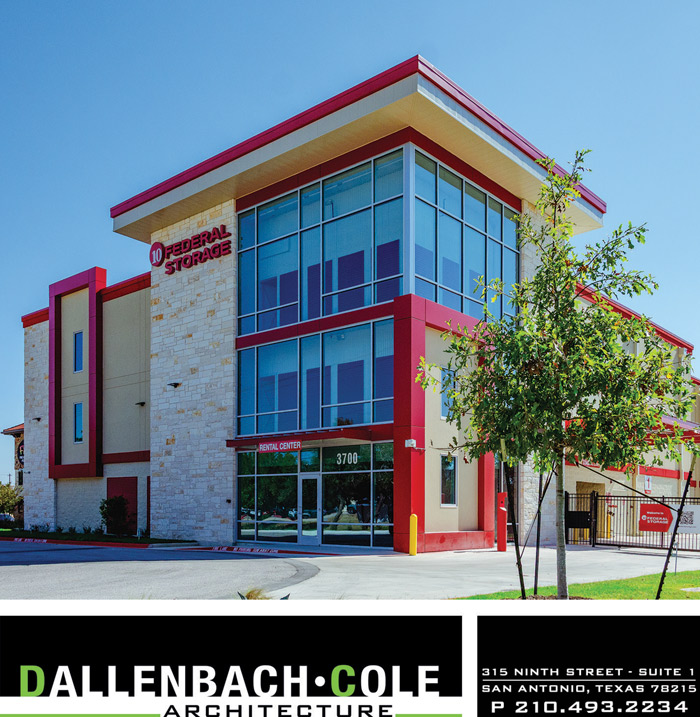


Beyond Location
Can Operators Overcome The Travel-Time Gap?
hen choosing a site for a new self-storage facility, the first focus should be on how many potential customers live within a short travel time. The answer defines your real trade area. While performing this task, drive-time analysis, rather than straight-line distance, you should accurately determine what that area looks like, as even short distances can amount to a significant travel time when considering local traffic and topography. However, in a world where most transitions are done remotely, do you know how much travel distance actually impacts finding new customers?
According to Sue Haviland, owner of Haviland Storage Services, “Travel time [continues to be] one of the biggest factors in both acquisition and retention. Most storage customers prefer something within five to 10 minutes of their home or workplace because storage is often about convenience,” she says. “That said, if a customer drives farther to reach your facility, they typically do so for a specific reason—whether it’s price, amenities, or trust in your brand. Those factors can offset travel time and keep them retained longer. The key is making sure their reason for choosing you remains valuable throughout their rental.”
Part of her day-to-day work involves training managers. She mentions that an integral part of it is encouraging them to speak with customers about why they chose the facility. “We aim to train our team to find out on the initial lead why they chose us. Part of our move-in section tracks how far away they live,” she says. “One of the most common reasons customers give for choosing us is our location and easy access. Many say they drive by, but they will then go online to find out more, and the lead then comes through as a website lead vs. a drive-by.”
In her experience in the industry, Haviland has seen many cases where operators misjudge their market by overestimating how far customers are willing to drive. “One common mistake is building a facility under the assumption that nearby rooftops will be willing to cross a busy freeway or go into an unfamiliar neighborhood,” she says. “When customers feel the drive is inconvenient or uncomfortable, they won’t come, no matter how nice the facility is. The lesson is to never rely on distance alone—always consider drive patterns, psychological barriers, and customer habits.”
She goes on to say, “Proximity to their daily routine is often the first filter; people type ‘storage near me’ or ‘storage in [city].’ But once they’re comparing, price and availability quickly rise to the top. The deciding factor usually depends on their situation. [If they are] moving, short-term users lean toward price and promotions. Long-term household storage renters prioritize security and location; and RV, boat, and business storage users prioritize amenities and access, even if it means a longer drive.”
He believes that as digital-first experiences become more common, convenience is defined not only by location but by how technology simplifies the rental process. While the internet can help a facility overcome limited street visibility, and online renting is a major appeal, the core advantage of location remains. Customers still want a facility that fits well into their routines, but technology can help fill the convenience gap.
From a competitive standpoint, DiNardo mentions that technology gives smaller operators an edge when competing with larger, more conveniently located brands. However, he doesn’t think they can leverage it to the same extent as the major national operators. “On the one hand, the internet and all the tools available today absolutely allow smaller operators to do things that otherwise would be out of reach. On the other hand, they typically can’t take it to the level that the large, national operators can, given they have tons of data and resources, along with teams of people behind the scenes.”
Digital tools are also expanding a facility’s travel radius, helping operators attract and retain customers who might live farther away. “The internet gives you the ability to target customers from wherever you want,” says DiNardo, “but it’s probably very market specific, like everything else with self-storage, and at the end of the day, the customer still needs a reason or motive to rent somewhere farther away than other available options.”
When it comes to operators leveraging digital marketing insights, like geotargeting or customer journey data, the goal should be to better understand where their customers are coming from and how far they’re willing to travel. “I think you see larger operators analyzing every single piece of data that they can because they have the scale to make differences that add up, but I think it’s probably more of an untapped opportunity overall, especially for smaller operators that need to find an edge,” says DiNardo.
From a strategic perspective, he doesn’t foresee digital ease outweighing proximity entirely. “I doubt it, assuming we’re talking about facilities that are comparable, but I do think customers will travel farther for a nicer facility, and I do recognize that nicer facilities typically have digital operating platforms that help to make them nicer, etc.”
An innovation he sees growing in customer experience that could reshape how much travel time matters in choosing a facility is call center video communication. “One thing that seems to be really valuable is video communication with call center reps, especially if the customer can use their own phone as they tour an unmanned property, for example. A lot of people are fine with technology but still like to interact with people.”


If I see an opportunity, I will walk through the door every single time,” says Margaux Chetrit, director of business development at Avenir Properties and senior advisor to Montreal Mini Storage. “I’m a ‘yes person,’ and I think that mindset has defined my career.”
That career is an impressive one, and it’s taken her across the world and fueled her passion in many different ways. Chetrit was born and raised in Montreal, but her journey began after she’d earned several degrees from McGill University. “I worked at Colliers for a bit, but after graduating I decided to earn my graduate degree from the Hebrew University of Jerusalem.” Just like that, Chetrit was off to Israel.
While taking a full graduate course load, she began an internship in Israel’s parliament while working as a journalist for the leading English-language newspaper in the Middle East. Conflict had recently broken out in the region, so many of her stories were about fostering understanding across borders and life during war. “Some of it was written from a pretty naïve perspective at the time,” she says.
She’s being humble, as the articles were good enough to catch the eye of a career diplomat who took her under his wing and helped start her career in foreign affairs back in her hometown of Montreal. After a decade in the diplomatic arena, Chetrit took a break to start a family. “I thought I owed it to my daughter, Elle, to be a stay-at-home mom for a while.”
But Chetrit is not one to sit still for long. “When COVID hit, I thought, maybe the rest of the world could stay home, but I had work to do.” That’s how, in the middle of a global pandemic, she became chief of staff for a Canadian health care chain. “Not only were we dealing with the pandemic, but just months before the shutdown, the company I was working for had made a significant amount of acquisitions, going from small to one of the largest, so we had our work cut out for us.”
But she eventually did say “yes.” What convinced her? “To be honest, the recruiter was my babysitter when I was a kid, so I trusted her,” says Chetrit, “at least enough to give it a chance. At first, I didn’t see the fit. Then I looked closer and realized the sector was a blank canvas for community and brand. I discovered more possibilities than I’d ever imagined, and today I’m all in.”
She was quickly tapped to lead a new co-working project which would evolve into the growing ClickSpace brand. Because the pandemic hadn’t yet eased up and brick-and-mortar commercial tenants were going out of business, the idea was to make ClickSpace an e-commerce service hub. “Private offices, work lofts, a podcast studio, rooftop lounge and terrace, storage, integrated third-party logistics (3PL)—everything physical a modern e-commerce business could need. We called it ClickSpace, and it sold out quickly.”
Despite ClickSpace’s early success, Chetrit noticed there was a gap: Over the course of a few years, roughly 60 businesses cycled through the project and only one was woman-owned (actually co-owned). “We were speaking to a very narrow demographic,” she says. “Women are often the decision-makers at home and in small businesses. I recognized the need to broaden our appeal.”

Demand from the series translated into space needs. With Scotiabank’s support, Chetrit led Phase Two of ClickSpace, a workspace designed specifically for female founders with private offices, amenities, and community baked into the plan. It pre-leased before there was even a blueprint and has remained full ever since.
The next big undertaking was creating a female-focused self-storage facility. While working on Montreal Mini-Storage’s latest property at 500 Sauvé Ouest, Chetrit and her colleagues, Andrea LaFrechoux (director of real estate), Serena Miscione (leasing specialist), Alida Wu (senior financial analyst), and Tonia Assaf (construction project manager), looked around the room and realized they were five women in leadership positions. That’s when the aha moment happened; they decided to design the project to reflect their own needs and those of their peers. The result is Montreal Mini-Storage’s 24th facility and the first storage facility of its kind designed by women, for women.

The grand opening event was a large celebration featuring food, live music, and an art showcase by ArtMarket, a women-led platform that spotlights emerging female artists. Julie Roy, the Ahuntsic-Cartierville city councillor, stood in place for the mayor, who was out sick that day, and led the official ribbon-cutting ceremony, recognizing the project’s contribution to inclusive urban development.
Just one month after the grand opening, the facility is 70 percent built (there is still an existing manufacturing tenant that will be exiting soon) and leased up to 60 percent occupancy (nearly 20,000 square feet are occupied). Plus, the buzz and tenant base continue to grow. “We’re meeting a wider audience where they are on product, tone, and design,” says Chetrit, “and it shows in the data.”

Before moving on, Chetrit says she needs to give one very important shout-out to company CEO Simon Berman. “When the five of us ladies came up with this vision, Simon gave us 100 percent carte blanche. Never peeked into the office to know what was going on or questioned a single thing we were doing. Instead, he gave us full autonomy and cheered us on every step of the way.” She continues, stating that the fact that Berman has placed five women in leadership roles, in the self-storage industry no less, says a lot about the type of man and leader he is.
The value proposition isn’t about space for Montreal Mini-Storage. “We don’t just sell four walls,” says Chetrit. “We make homes for your milestones and memories.”
It looks like, after a series of globe-trotting adventures and careers, Chetrit has found a home in self-storage too.






eople from the most eclectic backgrounds seem to find their way into the self-storage industry, perhaps more than any other non-artist career path. This is the case with Armand Aghadjanians, who majored in art history and went on to have a brilliant career in brokerage, later joining the RHW Capital team in 2019 as director of acquisitions.
Aghadjanians started his career right after graduating from college, working as a broker selling commercial properties. “I focused on office and retail properties, both nationally and in Los Angeles.”
Becoming a director at a traditional company like RHW Capital is no steppingstone in one’s career, which is something he knew from the beginning. As the door of the company began to open in the form of an interview invitation, he did not rest until his values and hard work were noticed by the right people. “I was an art history major with very little to offer on paper in commercial real estate. I started in brokerage, which has a low ceiling to enter but is brutally competitive to make it to the top. When I decided to pivot to acquisitions, I sent out a couple of hundred applications,” he says. “RHW Capital was the only company that offered me an interview. I did not set out to work in storage, and I did not know much about it, but I came prepared and left them with this: You can teach me to underwrite and fill in the gaps, but you cannot teach someone to give a darn. Nobody you interview will outwork me. That was six years ago, and it has been an incredible journey ever since.”
As he reminisces about his experience, he pinpoints his brokerage experience as the foundation for the great work he is able to do today. “I am glad I had experience in other asset classes. Understanding leases and deal structures gave me a foundation. But the most valuable piece was learning the brokerage community. Brokers are the lifeblood of storage deals. Acquisitions professionals have to know how to build those relationships and keep transactions moving smoothly. Real estate is not just numbers. It is a people business. That lesson has served me well.”
As technology begins to integrate acquisitions teams more robustly, he mentions the biggest change has been in the speed at which the process is done. “[Technology] has not changed the fundamentals of evaluation, but it has made the process faster and more convenient. Tools like TractIQ help me gather the data I need to build a narrative for our team and investors. Ten years ago, the process was slower. Today, the pace is much faster, but the core analysis is the same.
In his years of experience, he has noticed that networking and making a good impression are just as important for buyers as they are for brokers. “It sounds simple, but it is true. Do a lot of deals and be easy to work with. If brokers and sellers enjoy working with you, you will see opportunities others do not.”


He highlights pattern recognition as one of the most important things buyers should pay close attention to before closing on a property or land. “The obvious drivers like rates, supply, demand, and capital markets matter, but the less obvious piece is market behavior. It is one thing to design a capital deployment plan; it is another to actually execute it. Pattern recognition is important. Who is selling? Are they sector tourists with a few facilities or long-term operators retiring? Where will opportunities actually show up? In secondary markets, in larger institutional-grade assets, or somewhere in between? Building a thesis that lines up with the reality of the market is harder than it looks, and if you are raising capital, timing and alignment with your investors is everything.”
A common mistake Aghadjanians has noticed happening way too often on the buyer side of the industry is “overestimating potential and underestimating risk.” He says, “Too often, upside gets baked into underwriting as if it is guaranteed, but upside should be something that improves the site without being necessary to hit your proforma. If failing to realize it breaks your numbers, that is not upside—it is risk disguised as opportunity. At the same time, I remind myself not to confuse cynicism with wisdom. Real estate is about probabilities, and every investment is a bet made with incomplete information.”
Once a buyer signs on a new investment, he mentions that the next step should be getting the operational foundation running. “Make sure the phones are up, the website works, advertising is running, bills are paid, tenants are signed onto new leases, and the software is live. Beyond that, the strategy depends on the property. But getting the operational foundation solid is non-negotiable.”
Aghadjanians also shares advice for independent operators who may one day consider selling to a larger player. “First, hire a reputable broker who truly specializes in storage. Second, work with an attorney who does commercial real estate transactions regularly. And third, ask the buyer early for their due diligence checklist. Collecting those items ahead of time saves enormous stress. Most sellers do not realize how much information a buyer will request until the process is already underway.”

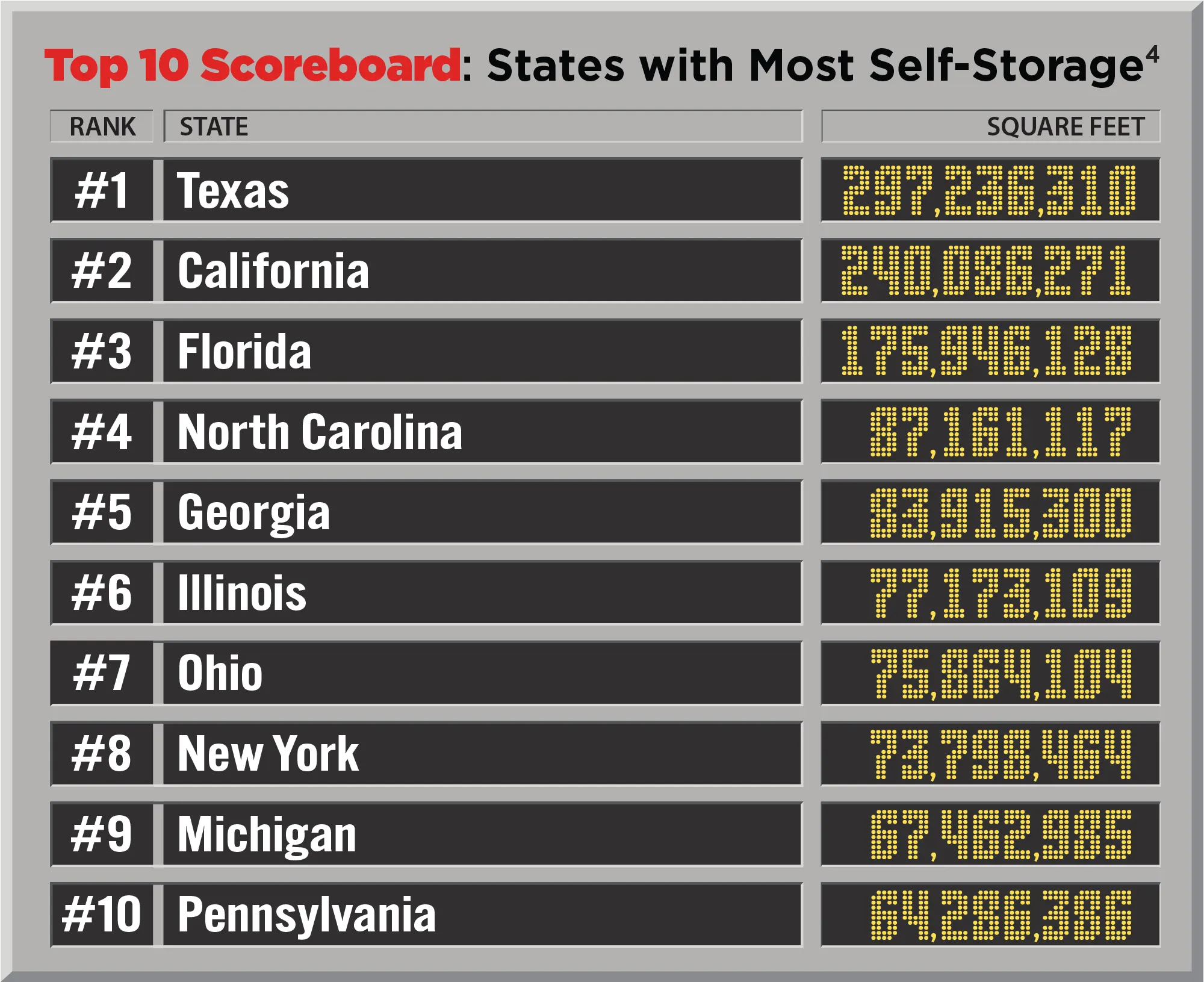
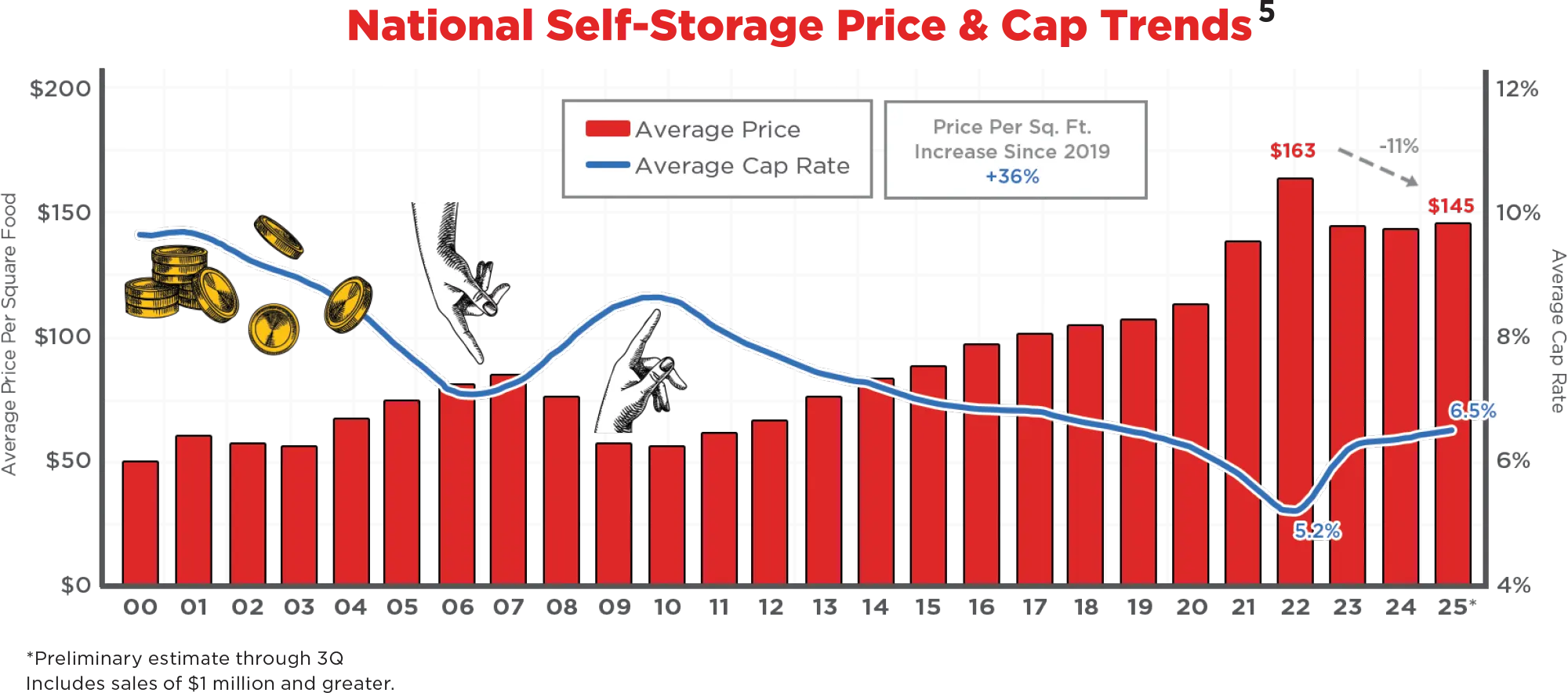
Data Storage Stats


n an article “The end of the web? Goodbye HTML, hello AIDI!” on Search Engine Land, Mario Fischer said, “Disruption is normal, even when we don’t see it coming.” Disruptions are a fact of life. They could be bad disruptions like hurricanes, floods, fires, etc. Those we have no control over, yet we must deal with them.
For me, artificial intelligence (AI) is a major disruption that has upended what I do—both good and bad. On the other hand, the AI is changing how people search. They ask questions and expect answers. They have a pain point, and they want a solution—fast. Additionally, they expect accuracy, authority, credibility, and trustworthiness. In past articles I’ve explained how your content marketing strategies need to be tweaked for the AI answer bots. Furthermore, I’ve shown you where to share your content so the search bots will find you and cite you.
This doesn’t mean that traditional search engine optimization (SEO) is dead. It’s just enhanced. It’s gone from search engines to answer engines. You must re-strategize your content marketing to focus on FAQs (frequently asked questions).
In other words, SEO is going “keywordless.” In the same article that coined that word, “Google’s Old Search Era Is Over – Here’s What 2026 SEO Will Really Look Like” on Search Engine Journal, the author wrote, “SEO isn’t dying; it’s finally maturing.”
For decades, marketers have been convinced that SEO keyword optimization was the only route to take. Enter answer engine optimization (AEO). Forget keywords. Think FAQs. Answer FAQs Given that, you need to get back to the basics.
- Know your target audience. Know their age, pain points, and geographic area. Will it be B2B, B2C, or a combination of both?
- Define why they may need to store something. Are they storing for good or bad reasons? Empathize with them and/or celebrate with them. Put yourself in their shoes. For example, were they just displaced by fire? Or are they selling their home and need to stage it?
- Set SMART goals. Goals should be specific, measurable, attainable, realistic, and time-bound.
- Develop both strategic and tactical marketing plans. The strategy is how you’re going to reach your goals; the tactical plan is how you’re going to implement the strategy.
- Optimize everything for search. That means your Google Business Profile (GBP), your website, and social media profiles. Your branding should be consistent throughout.
- Create and publish content. Decide what you’re going to be able to publish with regularity. Something should go out daily.
- Monitor and measure your efforts. Analyze your data and insights monthly. Then, adjust your goals and strategic and tactical plans accordingly.
It helps to see these tools demonstrated. I recommend Matt Wolfe’s YouTube channel (www.youtube.com/@mreflow). The link is at the end. He’s funny, and he demos and tries all these tools as they come out.
You will find that from all the AI tools to choose from, you’re going to like one over another. Moreover, you’ll discover that one tool is better for writing, while another is better for analyzing.
After watching Matt Wolfe’s demo on Comet, which was so cool, I had to try it. A client of mine, a local brick-and-mortar health and wellness clinic, has struggled to rank in traditional search. She and her husband have been obsessed with keywords. “Make sure all our services are listed!” Yes, that’s important—in your GBP.
Now, with AI search, I had to restrategize everything and tweak her website so the AI answer bots would grab her content and cite their resident experts.
Since we had over 1,000 search terms, I asked Perplexity to condense the top 20 into categories and give me three questions for each topic. I had them in seconds.
These are top search queries for {business name}, a {type of business} in {location}. What are the top questions people in the {greater geo area} are asking regarding these terms? Please give me three questions for each category row.
I chose “thinking” rather than “fast” so I’d get a more thorough answer. I had my list of FAQs in less than a minute.
The Google results varied from the Perplexity ones because Perplexity was using the keywords from the Google Search Console. Using those same keywords, Google presented what people are currently asking in the geographic area. This information is invaluable!
It then asked me, “Would you like me to cluster these into themes?” I was curious, so I said yes.
It organized the topics thoughtfully, as people would ask. It then gave me “insights for campaigns.” There you have your marketing plan for 2026. You can say to it, “Yes, please give me a month-to-month content calendar with blog posts, social media posts, and videos to run on {social media networks}.”
It wants to keep helping you. The trick is to be as specific as possible. It will only do what you tell it to. It’s patient, too!
To stand out, you need to add your own EEAT (experience, expertise, authority, and trustworthiness). Add quotes, examples, testimonials, etc.—anything that AI cannot write because AI does not have wisdom, feelings, or common sense.
What’s the optimal length of a blog post? It depends. A friend asked me that recently. He had asked Claude (https://claude.ai), another AI tool that’s great for writing content, to write an article; it gave him a 2,500-word document.
You need to give it a word count. The rule of thumb is that the article should be as long as it needs to be to explain what you need to explain.
I’ve had the experience where the AI-written article had repeated or redundant sentences and paragraphs. You must proofread it yourself. Additionally, use H2, H3, H4, etc. headers and bullet points.
- Be concise and direct. The answer should be as brief as possible, quickly addressing the question without fluff. Visitors to an FAQ page are typically looking for quick, scannable solutions, and so are the AI search bots.
- Aim for one to three sentences. The answer should be contained within one to three focused sentences. This length is highly scannable and aligns with what Google often uses for AI Overviews (the summaries at the top of search results).
- Use formatting. If the answer requires more detail, use bulleted lists to break up the text and improve readability.
- Avoid complexity. If an answer requires several paragraphs of explanation, it is generally not suitable for an FAQ page. In this case, the best practice is to:
1. Provide the concise, one-sentence or two-sentence answer.
2. Include a link to a separate, in-depth blog post or article where a user can dig deeper.
In short, your goal is to provide a complete answer with the fewest words possible.
All in all, AI tools will save you time and money. See the link below for AI prompts to help you analyze data and plan your marketing for this year.




n self-storage, operators love to talk about occupancy. We talk about being full, having strong demand, and celebrating the moment a property finally hits its stabilization mark. A full facility feels like success, and in many ways, it is. But behind every unit that gets rented is a cost, and behind every customer who chooses your facility over the one down the road is a story you need to understand. That story is called customer acquisition cost (CAC), and it is one of the most important metrics in your entire operation. Many owners believe they have a marketing problem, when, in reality, they have an acquisition cost problem. Marketing is an expense, but acquiring a customer is an investment. If you don’t know how much you’re spending to gain that customer, or whether the customer you gained was worth what you spent, you’re trying to build a profitable business without a financial compass.
One of the most common misconceptions is the belief that walk-in customers cost nothing, but walk-ins are never free. People walk in because they saw your signage, found your facility online, viewed your pictures, read your reviews, or heard about you from someone else. Even referrals, which feel organic and costless, are the result of great service, well-trained managers, on-the-ground marketing, and a property that delivers on its promises. Every “free” lead is actually the outcome of prior investment. Understanding that all leads carry a cost—whether visible or not—is essential for understanding CAC.
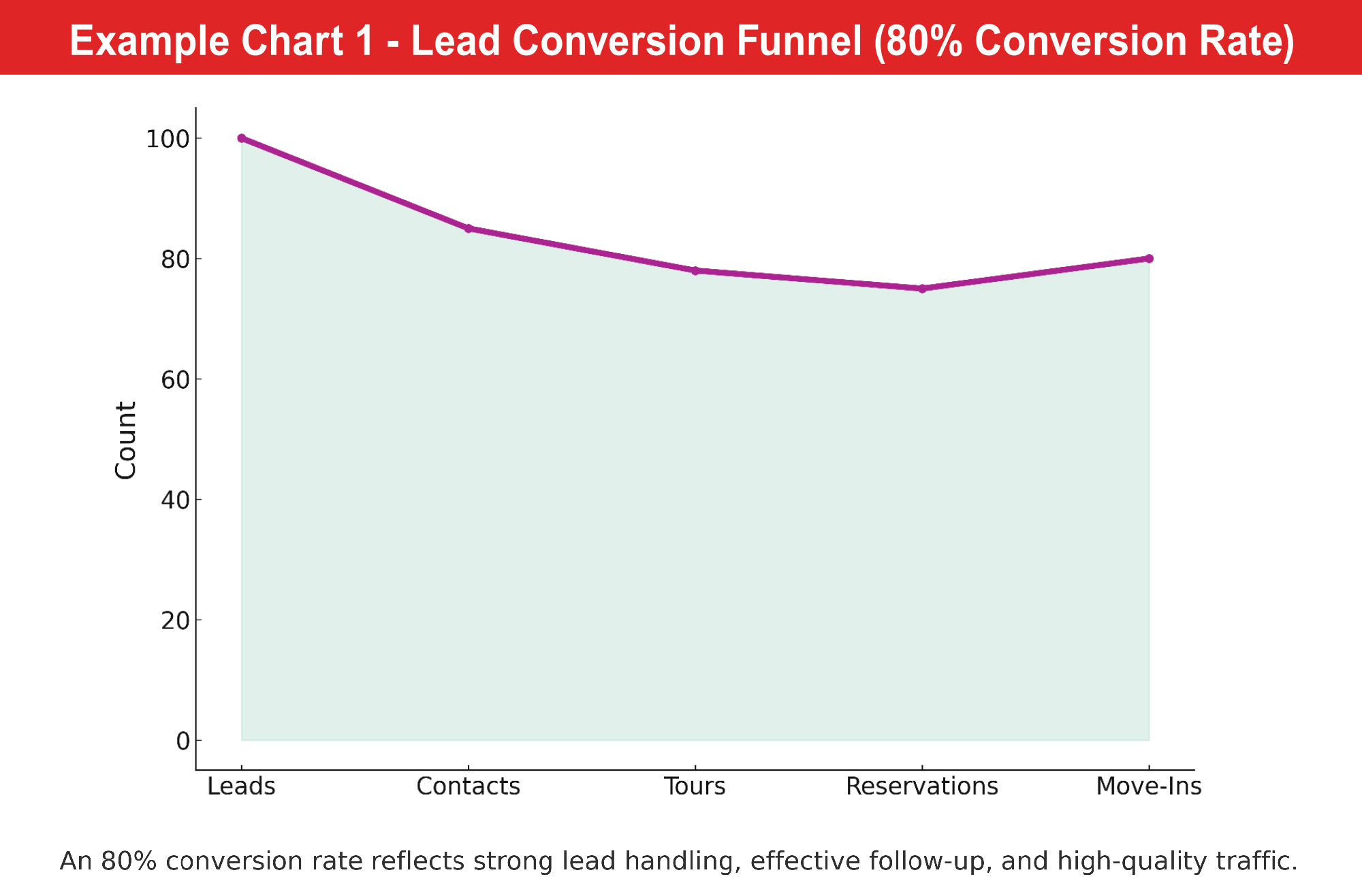
Another key part of improving CAC is making sure owners and managers are aligned on how tracking will happen. Too often, managers are expected to measure results without ever being shown the budget behind the decisions or the goals those dollars are meant to support. When owners share their marketing budgets, priorities, and expectations openly, it creates the space for meaningful conversations about what should be tracked, how it will be tracked, and why it matters. This collaboration not only improves accuracy, but it also empowers managers to take ownership of the results. When the people on the front lines understand the “why” behind the marketing dollars, they become far more invested in capturing the right data and using it to make better decisions.
Another area operators often overlook when evaluating customer acquisition cost is the enormous value of referrals and community-based marketing. At USG, our referral program, which offers a $50 reward to anyone in the community who refers a renter, is consistently one of our lowest costs per lease. Word of mouth, whether it comes from a current tenant, a local business, or simply someone who has had a positive experience with our team, continues to outperform many paid campaigns. This is because “boots-on-the-ground” marketing still matters in self-storage. Being visible, involved, and genuinely connected to your community builds trust long before someone ever needs storage. A tenant referral or positive personal recommendation almost always produces a high-quality renter at a fraction of the cost of digital advertising.
The same is true for Google reviews—one of the most powerful lead generators available. Independent 2025 consumer-behavior studies show that 83 percent of people use Google to check reviews when evaluating local businesses, and 63.6 percent are likely to check Google reviews before ever visiting a business in person (Backlinko, 2025; RedLocalSEO, 2025). These numbers demonstrate that your online reputation is not passive—it is an active driver of lead quality and conversion. When prospective renters see a strong rating and authentic, recent reviews, they gain immediate trust in your operation. In many cases, one great review can produce more qualified leads than an entire paid advertising campaign—and at virtually no cost.
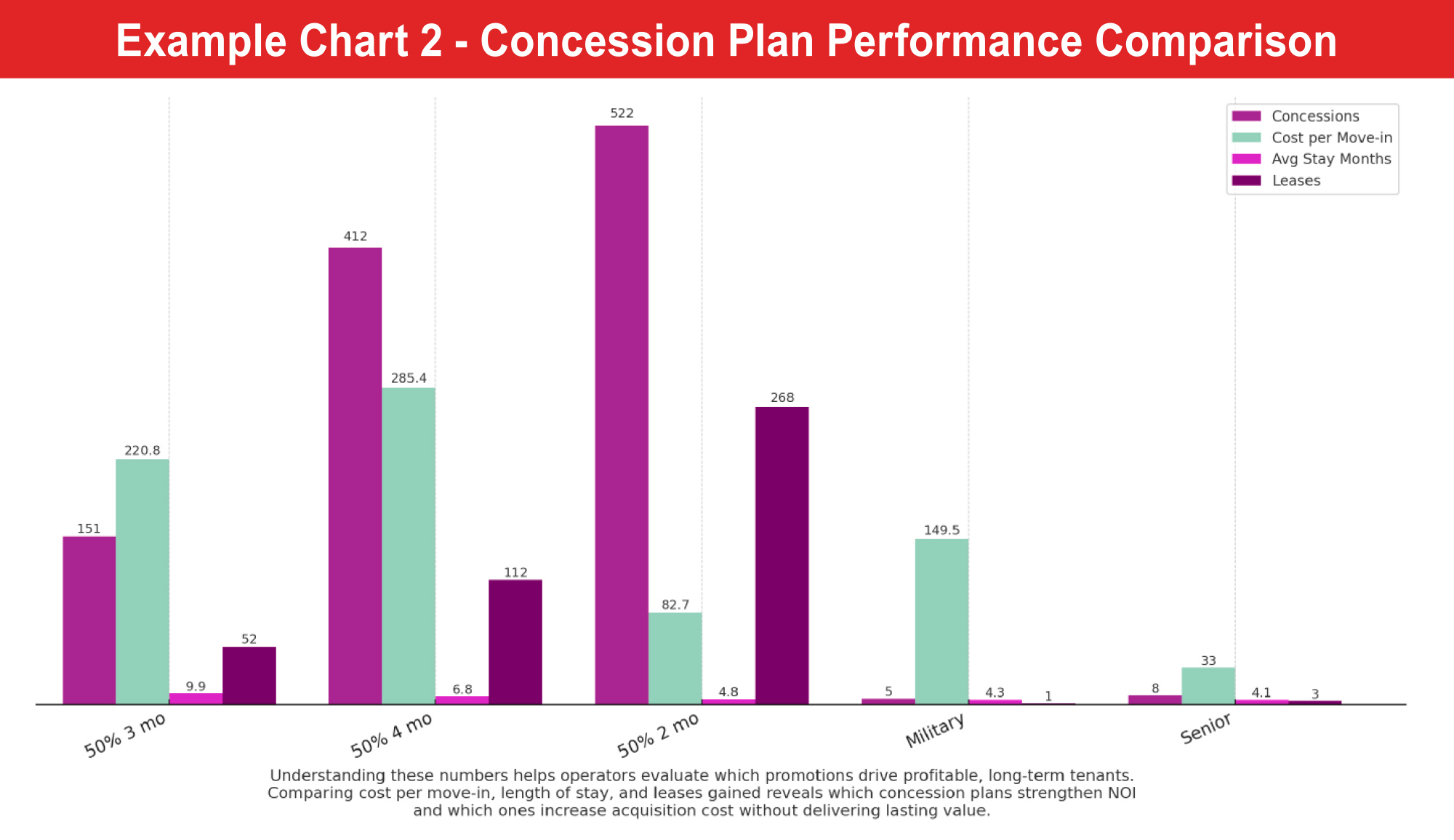
It is completely acceptable—and often necessary—to try new marketing efforts. Self-storage is not a one-size-fits-all industry. What works in Atlanta may not work in rural Tennessee. A strategy that performs well for a climate-controlled facility may flop for a drive-up site in a lake town. The key to testing new marketing is to track it carefully. Run a promotion or campaign, measure how many leads it generates, evaluate how many of those leads convert into rentals, and monitor how long those renters stay. Marketing without measurement is gambling, but marketing with measurement becomes strategic growth.
Understanding CAC is important, but it is only one part of a larger story. Strong operators also monitor lead-to-rental conversion rates, cost per lead, channel-specific performance, missed call rates, cost per appointment set, and the lifetime value (LTV) of each tenant. A $45 lead could be extremely profitable if it converts well and the customer stays long term. Meanwhile, a $10 lead could be a waste of money if it rarely converts or leads to short stays. This is why measuring performance from multiple angles gives a more complete picture of marketing success and operational health.

At Universal Storage Group, we’ve learned that great marketing only works when it is backed by strong training, consistent tracking, and operational excellence. Our most successful stores follow a formula: Track every lead, train managers to convert professionally, test new ideas, and execute consistently based on what the data shows—not what we hope. Marketing alone doesn’t fill a facility. Marketing paired with well-trained people, strategic decision-making, and disciplined follow-up does.
Ultimately, customer acquisition cost is not just a marketing metric—it is a profitability metric, a leadership metric, and a strategic roadmap. Understanding CAC allows owners and managers to grow smarter, not louder. It tells you where your customers come from, how much they cost, which promotions work, which efforts waste money, and which strategies best support your long-term goals. When you understand your CAC, you unlock the ability to make confident, data-driven decisions that strengthen your business month after month.




High Notes
Notes

et’s start at the very beginning; a very good place to start. If you didn’t recognize that opening line, you’re missing out on the best musical of all time. But if you’re a fan of the Von Trapp family, welcome. You’ve come to the right place.
Kelly Gallacher, owner of The Gallacher Development, his wife, and their six children built a beautiful life in Salzburg, Austria. They decided to move there because all their kids played the violin and life presented them with the opportunity to pick a place to live in Europe. Technically, they settled in Mondsee, which means moon lake; the town is home to the church in which Fräulein Maria, the fictional governess from “The Sound of Music,” portrayed by Julie Andrews, walked down the aisle.
But let’s not get ahead of ourselves. Let’s start this story a bit earlier than that.
Eventually, Gallacher’s father went into business with his father-in-law. “They owned commercial laundry facilities, A1 Linen Supply, in Salt Lake City.” The business extended to Farmington, N.M., so that’s where he started school and lived until fifth grade.
The family moved around several times as they opened additional A1 locations. When Gallacher was about to start his senior year of high school, the family moved again. It was hard enough to move at that age, but to add insult to injury, he had to attend the rival school, where he played basketball and baseball.
Baseball earned him a scholarship to attend Ricks College in 1973. In 1975, he paused his studies to go on a mission trip to Mexico as part of the Church of Jesus Christ of Latter-Day Saints. He traveled all over the country, riding horses to the smaller towns. “It was perfect for me, and Spanish came easily to me.”
In 1977, Gallacher returned to the United States and enrolled in Brigham Young University, where he majored in business and financial planning, with a minor in Spanish.
In 1979, he decided to interrupt his studies again to go into the concrete and construction trade. “I figured that if people didn’t want financial planning or investment advice, they’d definitely want to build a home,” he says. “And generally, that requires concrete, so I chose that as my main skill.”

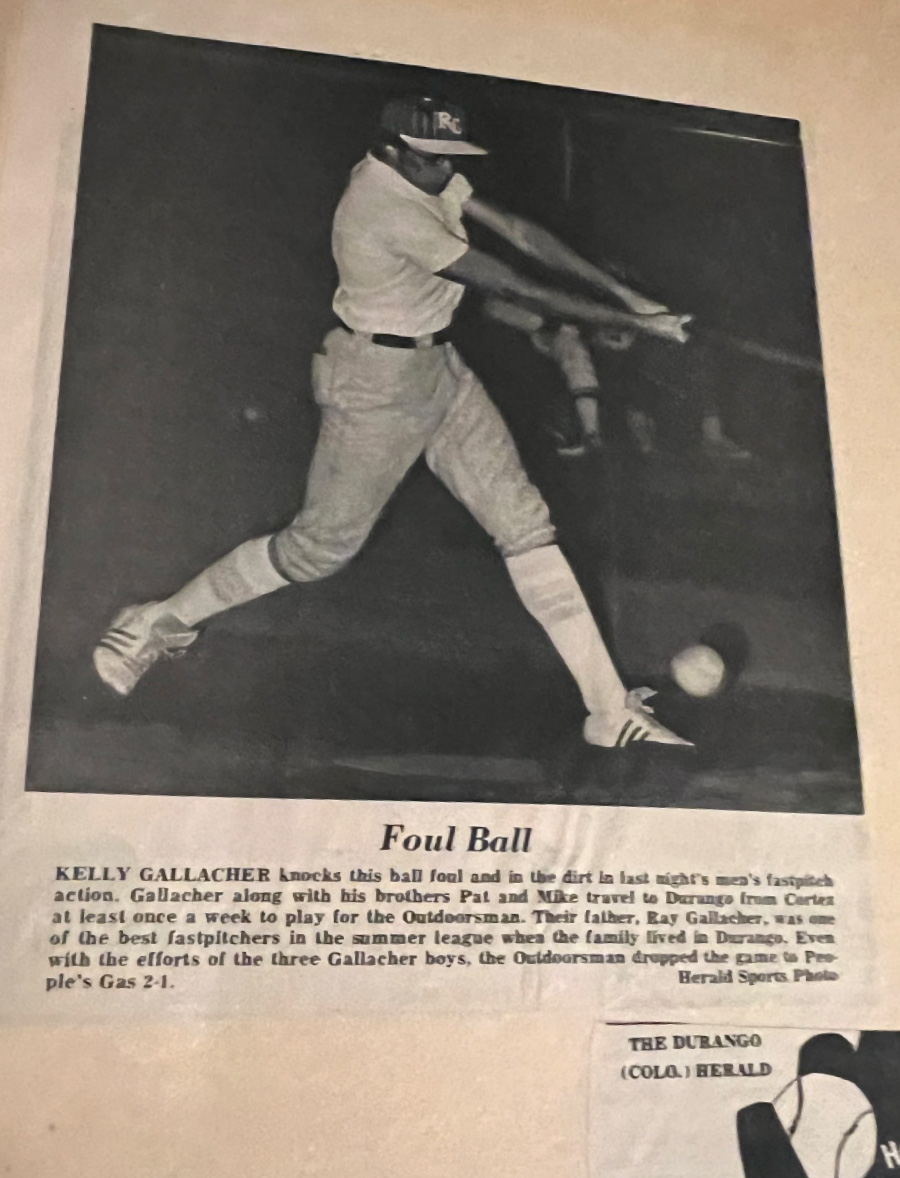

After graduation, he became a property manager at Equitec. Soon enough, he was noticed by the higher-ups. The reason: “The costs of repairs and tenant improvements were about 50 percent lower than they should have been because I was doing it all myself,” says Gallacher. “My boss asked, ‘Who is this kid, and why is everything less expensive?’” After that, he moved up the company fairly quickly.
While working at Equitec, he ran into someone from his BYU days at his church: Marlene Woolf, who had just returned from her mission trip in Germany and became Gallacher’s wife in 1981.
Gallacher started working on a development project for an office building in Chicago in 1987. While that job was relatively short-lived, it gave him a story that he will forever share at dinner parties. “One November, I took the train from O’Hare into downtown at 2 a.m., and I had to walk to my apartment,” he says. About a block away from his home, he heard machine gun fire. “I immediately knelt down by a blue mailbox. The gunfire was nonstop, and at some point, I decided to grab my bag and take off running.” Right when he was about to do so, he heard someone yell, “Cut! That’s a take!” The movie “Untouchables” was being filmed. He sighed with relief. “I was so grateful.”
They opened their offices in Oakland, later moving to Emeryville, Calif., and started doing real estate deals with major players in the industry. One day, Gallacher’s then brother-in-law, Lynn Storey, called him to say he had a deal in Houston that he wanted him to look at. It was a failed retail center in the Woodlands: two buildings, opposite to each other, 20,000 square feet each. It only had four tenants and it was in foreclosure. “Lynn said that we could buy it for really cheap.”

They walked in and asked if they could rent a unit, but the men were informed they were sold out. Then Gallacher decided to find out more about the industry by asking a lot of questions. “If we rented a unit, how much would it cost?” It would be $100 a month. That’s when the wheels started churning in his mind. “$100 a month on a 10-by-10? This could get me the same rent as a suburban office?”
Now Gallacher was interested. “How do you get tenants? What do you do when they move out?” And you could rent out space without having to pay a broker’s commission.
“How often can you raise rents?” he asked. “Whenever I want,” replied the storage owner. And there’s no need for tenant improvements every time there’s a new tenant. Gallacher looked at his brother-in-law and said, “I’m converted. I’m a self-storage guy. Best kept secret in the country.”
When they left, Gallacher called Nitzberg and told him everything he had just learned. “I really think we ought to do this.” At first, Nitzberg was hesitant, but the numbers were good. “We converted those buildings, and it was a massive home run,” Gallacher says proudly.

Gallacher and his partners decided to stay in storage. Once again, they took advantage of a shift in retail spaces. “Big-box retailers like Home Depot and Walmart were abandoning their smaller stores to open bigger ones. Those locations are typically owned by investment companies, and we approached them, offering to buy them.”
The Devon Group then decided to turn those big-box buildings into drive-thru storage facilities. “We were the only ones doing that concept back then, and people loved them,” says Gallacher. “We started doing the same all over the country, and it was well received.”
At some point, a former associate from Equitec went to visit their office in Emeryville. Once he found out what The Devon Group was doing, he was intrigued. But as it happens with all trips, soon it was time to go, and the former co-worker flew back home to the Netherlands. The phone rang a couple of days later. It was the Dutch guy. “I have a building for you,” he said to Gallacher.
Thus, the first self-storage facility in the Netherlands was born. It was only a matter of time before more people from The Devon Group would fly back and forth to work on the project. “It took over a year for people to understand the concept of what self-storage was, but once they got it, they were interested, and the site leased up quickly, Gallacher recalls.
At that time, the self-storage secret was out in the U.S., and all the major bankers in Wall Street wanted a piece of the pie. Goldman Sachs came knocking and bought The Devon Group, and after about three or four years of working together, Goldman became intrigued with the work in Amsterdam. “They were fascinated with the Netherlands’ success, and they decided to expand in Europe, starting in London. They then opened facilities in Utrecht, The Hague, Berlin, Cologne, Marseille, Toulouse, and Lyon. We bought existing buildings and converted them into drive through self-storage,” says Gallacher.
Their kids were 15, 13, 11, 9, 7, and 5, but they didn’t need a governess. Gallacher would fly every week to Amsterdam, where he would stay at an apartment during the week, then come back to his family during weekends. They all ended up learning German.

London was shut down for three days, so Gallacher had to stay in the U.K. while his family remained in Salzburg. “To this day, I appreciate the Brits because they were so kind and supportive.” After three years in Europe, it was time to come home.
In 2013, Gallacher parted ways with Devon and went out on his own, eventually entering a partnership with his brother Kevin. Together, they created Gallacher Development. During this new chapter, he became a member of the board of directors of Janus International, a role he held for over seven years. Since then, he has continued to develop properties in the U.S. and in Brazil.
As he reflects on his professional trajectory, he’s thankful that he’s spent most of it in the self-storage industry. “I love the camaraderie and how we all share helpful information with each other, even among competitors. Even when I do market studies on potential projects, I can go to a competitor, tell them the truth, and they share valuable insights. It’s such a friendly and supportive group.”



While his career has taken him on many adventures around the world, today, the center of his life is his family. His mother, Sally Gallacher, is 94 and has 103 great-grandchildren. He loves to spend time with his now adult kids and his grandkids. “We’ve had 19 grandkids in total,” he says. They all call him Pappa. “But my wife’s name is the best name on the planet: Grandma Bubbles.” She was given that name by their first grandson when he was two years old. Now, all their grandkids call her that.
For Marlene’s 70th birthday, Gallacher planned a big surprise. They were going to fly to London and Salzburg; at the airport, she saw that he had flown in all their kids to join them on their trip. “She had no idea. And then she turned around at the gate and saw everyone. Her face lit up. That’s what I like.”
While he’s still very much involved in Gallacher Development, he reflects on what makes him the happiest. “I’m very, very happy with my life, and my grandchildren are everything. All my needs and wants are taken care of. My joy is being with my family and serving in my faith.”
Self-Storage
With Warehouse Anywhere
arehouse Anywhere is a self-storage concept reminiscent of worldwide recognized brands like Airbnb and Uber; they don’t own any of the asset classes but have brilliantly managed to create a nationwide network of facilities to make life easier for their target market: multilocation enterprises. In fact, that’s part of their elevator pitch. “We’re the easy button for organizations and businesses that need to utilize self-storage while consolidating costs and maintaining the ability to scale quickly,” says Laura Holmes, their chief executive officer. “And we’re that solution, whether it’s in a market, region, or national footprint.”
With core values strategically spelled through the acronym STORAGE (solutions-driven, teamwork, operational excellence, reliability, accountability, game-changing, and ethics), it’s no surprise that the company is serious about being the self-storage solution businesses and organizations come to trust.
Originally, Warehouse Anywhere was formed in late 2015 under Life Storage, operating under that name until they were acquired by Extra Space Storage in 2023. Since that momentous acquisition, Warehouse Anywhere has continued independently as a privately held entity—a risk that has most definitely been worth it, considering that the business is now operational in all 50 states, with more than 14,000 facilities within its network. “Since our inception, we have sourced over 110,000 storage spaces on behalf of our customers,” says Holmes.

Such efforts are combined with digital campaigns that extend far beyond their website: inbound marketing, lead nurturing emails, LinkedIn presence, published content in trade publications, and a full sales team that focuses on outbound calls. It’s the kind of effort that reflects that effective marketing requires a lot more than a single person wearing many hats. Careful strategizing tailored to each specific channel has yielded stellar results.
Clients can also bypass the hassle of additional hiring and training as they scale by simply getting in touch with Warehouse Anywhere. This benefit is summarized clearly by one of their many glowing reviews: “We tried managing storage on our own, but it quickly became clear we’d need at least two full-time people just to handle sourcing and delivery issues. Warehouse anywhere helped us secure 22 facilities across 13 states in just four days, making our latest brand launch a success and proving why we came back.”
These extra details have enabled Warehouse Anywhere to grow, resulting in an impressive retention rate to boot. “Our customer retention rate is 94 percent year after year,” Holmes says proudly. “We have customers who have been in the same space and same location for 10-plus years from across many industries. Once they’re settled in, they stay for a long time.”
Customers also get a dedicated concierge team, eliminating the very common frustration of long wait times and endless menu options that offer everything except a real human answering the phone. This entire approach to doing business enables commercial customers to not only rent storage but also scale into any market quickly, while Warehouse Anywhere handles all the related logistics.
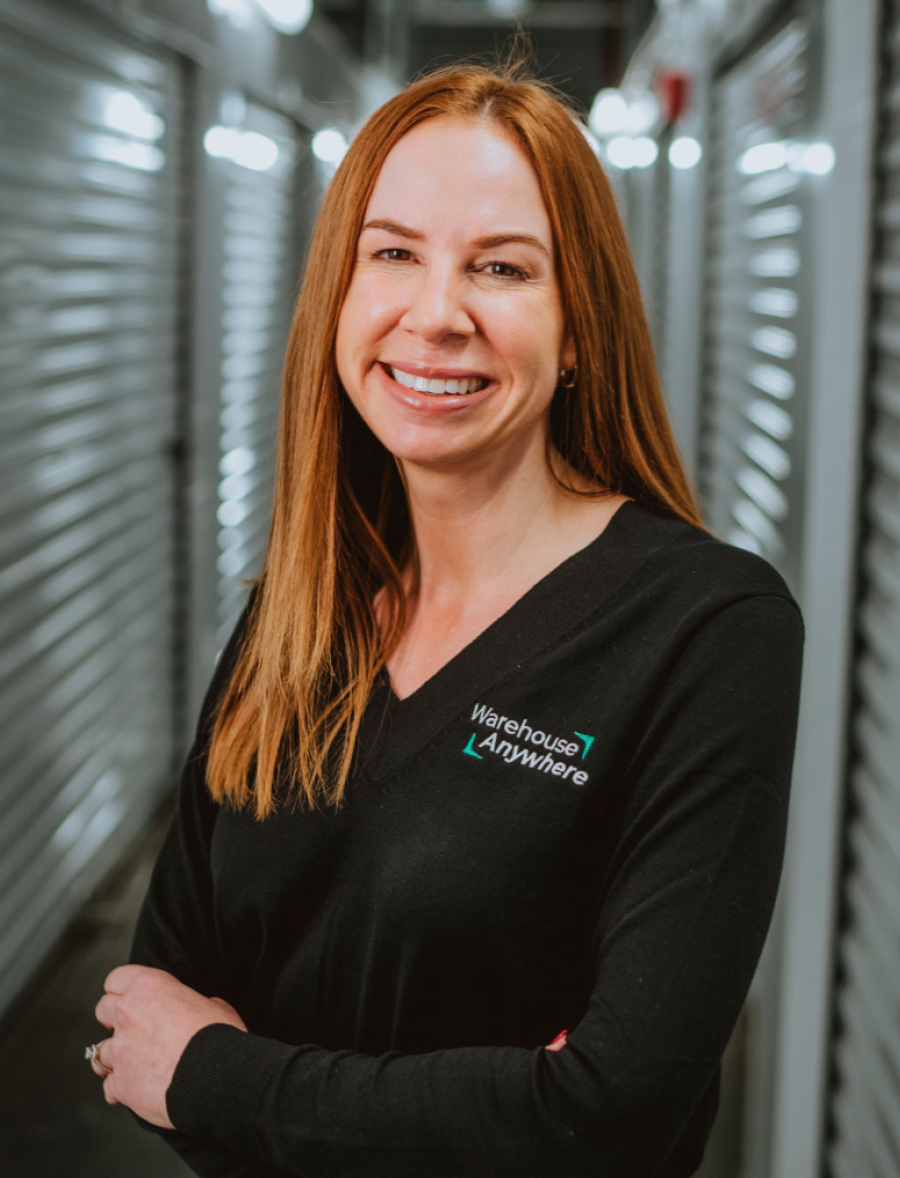
In addition, Warehouse Anywhere finds storage locations that also offer workspaces, breakrooms, and comfortable lounges, ensuring that their clients’ work needs are accommodated. If a client needs it, they’ll work miracles to the best of their abilities to make it happen.
Finally, clients get their invoices streamlined, since multiple charges are consolidated into a single bill. The company’s modus operandi truly elevates the user experience to levels that ensure they remain as clients for years to come.
And of course, customers can access the platform through their mobile devices to make the experience as seamless as possible and practical.

The company’s also provider agnostic when choosing where to send its business. That said, it does have a list of preferred partners; these are facilities with which Warehouse Anywhere has formal agreements. “All we ask for is additional operational support from them,” says Holmes. “If we need to cut a lock or for them to take over management of a new client space, we have their support. Commercial customers aren’t as price sensitive as residential ones, so we tell them they can even charge a premium for that. It’s more money for them and a stickier client. In exchange, we get additional support, as needed.”
Once Warehouse Anywhere has gathered all the customer’s requirements (such as ZIP code availability, 24/7 access, climate controlled, wide drive aisles, package acceptance, drive-up units, flexible leases, etc.), it sources facilities based on the desired amenities. If there are both preferred and non-preferred partners within a mile of each other, Warehouse Anywhere will pick the preferred one. And the partnerships are mutually beneficial on all levels. “One of our value propositions to prospective preferred partners is that once our clients approve a site, we rent it,” says Holmes. “Payment is completed and one of our reps is there within 24 to 48 hours.”
So not only do partners get paid promptly, but they get long-term professional clientele too. As if that weren’t enticing enough, they also get a steady pipeline year-round. This way of doing business has resulted in their partner network having more than 40 preferred partners of all sizes, totaling over 8,000 facilities nationwide. It’s the crème de la crème of self-storage networks, with their partners ranging from large storage providers all the way down to local and regional ones as well.

That said, there’s no need to worry about the company’s enterprise pipeline. “We have a very heavy emphasis on sales and revenue growth,” Holmes adds, “and our close rate in enterprise clients is at 60 percent, so even when it takes six to eight months, we’re still winning their business.”
Another common challenge is when clients are bought through mergers and acquisitions. “When there’s a new owner, we need to draft new contracts, accommodate for new forms of payments, and handle a lot of updates,” says Holmes. However, the team always handles such changes with the same duty of care they approach every single client, ensuring these types of transitions go as smoothly as possible.
“Treating people well is very much part of our culture,” says Holmes. “We have fun doing what we’re doing, and every year, we give awards to celebrate individual accomplishments. We enjoy doing what we do business-wise, but we’re also proud to foster a healthy work environment.”
Even though it’s a remote-first company, an effort is made to get the team together at least twice a year. With a heavy presence in Denver, Buffalo, Chicago, and Atlanta, individual teams from each of these locations get together quarterly. There’s also the option to work at an office, if employees so choose, although nothing is held against anyone who wants to work from home on a full-time basis. “It’s been great for us because it’s opened the talent pool,” says Holmes.
That’s very much a key component to the company’s success. In a world where the phrase “it’s not personal, it’s business” has become ubiquitous when prioritizing organizations over the team’s wellbeing, Warehouse Anywhere’s holistic approach to taking care of customers and staff who make it all possible is a market differentiator worth showcasing and celebrating.

Are Smart Locks In Your Future?
he shift toward automation in self-storage is more than a passing trend—it’s becoming a core operational and cost-saving strategy. Owner-operators are facing mounting pressure to cut costs, scale efficiently, and deliver the seamless experiences customers now expect. Automating operations with integrated smart locks and smart entry technology that are accessible via robust mobile technology addresses all three.
Key operational drivers for smart lock adoption include:
- Labor Costs and Staffing Challenges – Hiring and retaining qualified staff, especially at remote or rural sites, is increasingly difficult and expensive.
- Evolving Consumer Expectations – Today’s customers demand self-service, mobile-first options that let them rent a unit in minutes, so they don’t need to wait for office hours.
- Enhanced Security – Smart lock technology helps to deter break-ins and boost tenant confidence.
Mobile app-based smart locking technology is modernizing and streamlining self-storage operations like never before. With smart entry technology at facility entry points as well as smart locks on individual unit doors, owner-operators are now able to automate once manual tasks like lock removal for new rentals, lock checks, and the end-to-end overlocking process. For self-storage customers, this means that online and after-hours rentals can now be completely automated, mobile move-ins that provide full remote visibility for the owner.
But not every electronic lock on the market is the same in terms of fortifying your facility against theft, elevating convenience for your consumers, and streamlining your operations. By opting for industry-leading smart-locking technology, you can automate many manual processes at your facility, saving you both time and money.
Read on for nine non-negotiable features you’ll want to have in your smart locks and the results facility operators are already experiencing when using cutting-edge smart technology for individual unit security.
Comprehensive Smart Security System
Of course, knowing something happened on your property is good, but deterring criminals is great. And that’s what you can achieve with industry-leading technology that provides unit-level smart locks to deter would-be criminals from breaking into storage units at your facility. By equipping the smart locks with fully integrated in-unit motion sensors, owner-operators can cut break-in claims by 92 percent, according to industry data.
In addition to taking your smart security to a whole new level by deterring theft, you can ensure a seamless experience for your team and your tenants by consolidating access control for entry points and individual units into a single mobile app that’s custom-branded for your facility. As a result, your team is informed and efficient because they can focus on operational priorities instead of time-drains like processing claims. And your tenants are safe and satisfied because of the high level of security and convenience you’re providing through the smart-locking platform.
Fast, Affordable Installation And Support
Another factor is that a smart solution is only as good as its connectivity. If your product isn’t communicating properly, you may not know until it’s too late. Proactive monitoring of your equipment is a necessity to ensure your smart security products are functioning and serving their purpose. When evaluating vendors to partner with, you’ll want to ensure they’re able to proactively identify and diagnose any connectivity issues remotely.
One of the major advantages of working with an industry-leading smart-lock solution is full-service, in-house project management and installation. Other electronic locks on the market today require third-party installation, leading to inconsistencies in setup and support. Smart-lock solutions simplify this by providing expert installation and ongoing support, ensuring the highest level of quality and reliability. With proactive fleet management capabilities, you get dedicated personnel to monitor, diagnose, and correct issues remotely. By providing 24/7 support through these in-house resources seated in the U.S., U.K., and Australia, you can call or chat with a live, dedicated support agent any time of the day or night. All these advantages ensure that your smart-lock solution is installed more quickly and more affordably and any ongoing support is made easy.
Proven Experience In The Industry
- Door Compatibility – A smart-locking solution has to be compatible with the door, but it also has to clear the frame or hallway system when the door is rolled up. Being intimately aware of the door and construction nuances is supremely important when developing a product for the storage industry.
- Environmental Considerations – Exterior, drive-up storage units are installed in the toughest climates imaginable. From the humid heat of south Florida, to the arid, desert heat of Arizona, to the blistering cold of Minnesota, products need to be able to operate flawlessly in all conditions.
- Connectivity Challenges – Connectivity in storage is far more complex than connecting products in the hospitality or consumer sectors. That’s why you may run into problems when trying to use products from other sectors to make your smart-security products operate in low bandwidth, low connectivity facilities. Products need to be able to communicate inside a building filled with steel or outside in the extreme elements on concrete masonry unit (CMU) or metal buildings.
Electronic and non-connected locks on the market are estimated to have less than 10,000 self-storage unit installations each, while the industry-leading smart lock solution has over 450,000 smart locks installed as of August 2025, including facilities of all construction types throughout North America, Europe, and Asia. That’s a big difference, but it shouldn’t be too surprising since this smart-lock solution is designed exclusively for the needs of the self-storage industry.
Intuitive App Performance
When implemented properly, a smartphone app controlling digital access for the facility and the unit can be a positive for your tenant experience and your operations. One of the most common calls a call center receives is a tenant forgetting their gate code. When access is managed digitally through a smartphone app, the tenant has no gate code to remember. Like my earlier example, a tenant losing their physical key to their unit padlock or forgetting their combination to a combination lock can initiate a time-consuming process of approvals and paperwork. This process ultimately ends in using a grinder to remove the padlock from the door, which risks damage to your door and injury to your staff.
By reviewing App Store ratings before making a purchase, you can see what tenants and managers are saying about the best app experiences.
Advanced Features For Enhanced Security And Convenience
Owner-operators using smart locks for individual unit security note that electronic and non-connected solutions lack the range of innovative features like digital key sharing for flexible access management.
In addition to digital key share, the industry-leading smart lock solutions bring you these advanced offerings:
- Motion Sensing – With four-way, security-grade native motion sensing, facilities get the highest level of unit security.
- Seamless Tenant Onboarding – With one-click automated onboarding at rental, you can provide your tenants with the utmost convenience.
- Emergency Override – This ensures reliability in critical situations.
- Automated Auction Processes and Unit Transfers – These allow for seamless facility management.
Hardwired For Maximum Reliability
Other traditional battery-powered locks on the market can require up to eight batteries per device, which means roughly 4,000 batteries to replace for a typical sized facility. With industry-leading smart lock solutions, you get a hardwired system that requires zero batteries to replace for the full lifetime of the product, which saves facility owners thousands in installation costs because it requires zero repeaters.
In addition, the design of the smart-lock solution is proven to provide a four-times stronger mesh signal than previous models, enhanced performance with 80 percent less network traffic and one-second average travel speed. As another bonus, there is no Wi-Fi required for tenant access via the mobile app, which allows these smart-lock solutions to function in airplane mode and maintain connectivity even in challenging environments.
Superior Customer Support And Training
Industry-leading smart lock solutions offer 24/7 live technical support and white-glove onboarding, ensuring your team receives expert guidance from installation to everyday use. And with an app and web portal available in over 10 languages, you’re able to provide a solution for a global market.
Flexible Locking Solutions
Electronic and non-connected solutions typically offer only one type of locking mechanism; however, with industry-leading smart-lock solutions, you get both battery-powered and hardwired smart locks for greater flexibility based on your facility’s needs.
In Stock And Ready To Ship
Owner-operators report that this is another benefit of working with an industry-leading smart lock solution with inventory on hand and ready to ship in North America, Europe, and Australasia.
With the implementation of Nokē smart technology, StoreEase charges tenants a monthly technology fee of $5.99. This fee is transparently explained as covering the added convenience, security, and app-based access provided by smart locks.
At 94 percent occupancy (523 units), this generates over $37,000 in annual recurring revenue—revenue that would be difficult to justify without the value that virtual management and smart access deliver.
The total project cost to implement Nokē smart technology was $115,000. After subtracting the $85,000 saved on fencing and gate installation, the net project cost was just $30,000.
Higher unit-level security and visibility can also mean big insurance and property protection savings. Facilities can save up to 25 percent on commercial insurance and can generate up to $15,000 to 20,000 in additional tenant insurance and protection plan revenue share annually …
Higher unit-level security and visibility can also mean big insurance and property protection savings. Facilities can save up to 25 percent on commercial insurance and can generate up to $15,000 to 20,000 in additional tenant insurance and protection plan revenue share annually because of the enhanced unit level security that industry leading smart locking solutions provide.
With so many ways to drive operational cost savings all while providing an enhanced customer experience, the cost of not seriously considering smart locking and smart entry technology far outweighs the upfront cost to deploy.




well-executed self-storage facility can be steady, resilient, and reliable even when other real estate sectors struggle. For the most part, that’s true. But beneath those strong fundamentals is a structural weakness anyone who’s been in this business long enough knows all too well.
Self-storage is incredibly vulnerable to an oversupply of new construction. When a submarket gets too many new facilities at once, you don’t get a soft landing. You get a knife fight over tenants. Unlike multifamily, retail, or industrial, we don’t have a dozen levers to pull to increase performance. We have one big lever (reduce rental rates) and one small one (increase marketing spend).
And nowhere is that vulnerability more acute than during the 18-month to 30-month lease-up period after a facility opens, when every operator is sprinting toward stabilization while competing head to head with whoever else delivered down the street. It’s the most fragile period in a project’s life. If your timing collides with a wave of new supply, even the best-designed facility with the best manager can find itself stuck in neutral.
To understand why, we need to look at the bigger picture. The broader real estate world is wrestling with high interest rates, frozen capital markets, and rising distress. Multifamily distress has jumped into the teens. Office is above 10 percent. Hotels are near 9 percent. Looking at CRED IQ’s CMBS commercial real estate loan analysis, only 0.1 percent of self-storage loans are currently in distress.
See Overall Distressed Rates by Property Type Chart.

The lease-up phase is where oversupply does the most damage. In a typical cycle, 18 to 30 months of runway is enough for a professionally managed facility to ramp occupancy and grow NOI toward stabilization. But that timeline assumes you’re not fighting a pricing war with a brand-new competitor offering two months free down the street.
Unlike other asset classes, storage operators can’t retreat to a long list of value-add levers.
Take hotels. Hotels can change their brand flag, remodel rooms, replace management, add amenities, upgrade food offerings, promote loyalty programs, and on and on. People do dumb things for loyalty points. They’ll stay in a crappy Marriott because their status gets them a free waffle and microwave egg breakfast. Hotels can differentiate.
Self-storage doesn’t have that much leeway. Operators will disagree with me, but there is not much brand loyalty in self-storage. When potential customers need storage, they pick based on price, proximity, and availability, and it’s usually the first facility they look at.
There lies the vulnerability for self-storage.
Nationally, the sector still looks healthy. REIT occupancy sits in the low 90s. Revenue growth softened, but mostly because operators have been using heavier move-in discounts. Cap rates have drifted up from the unrealistic lows of 2022 but remain attractive. Lenders still like the asset class.
Viewed from 30,000 feet, storage looks bulletproof.
But national averages hide local chaos.
Roughly 3 percent to 4 percent of the nation’s storage inventory is still under construction, which is seemingly modest until you see where it’s landing. The top 10 metros account for more than a quarter of all deliveries. In several markets, Dallas/Fort Worth, Atlanta, Charlotte, and Nashville, the pipeline is stacked on top of already-high per-capita supply.
Dallas has roughly 13 square feet of storage per person, and millions more square feet are coming. Atlanta has more than a million square feet scheduled to deliver in just two years. Charlotte, Phoenix, and parts of Florida are showing similar patterns.
This is where lease-up gets dangerous. A 90,000-square-foot project might model a 24-month lease-up at strong rents. Add one nearby competing facility and stabilization can stretch to 36 months. Add two or three, and then you’re looking at 48 months or longer with heavy discounting and strained cash flow.
Oversupply hits self-storage harder than almost any other asset class because:
- Price is our only meaningful lever. Multifamily can renovate units, add amenities, revitalize the pool area, or target new tenants. Retail landlords can re-tenant. Industrial leases offer long-term insulation. Self-storage has month-to-month leases and interchangeable units. Price is the battleground.
- Storage demand doesn’t expand just because supply does. Multifamily demand grows with new jobs and headwinds to buying a home. Industrial demand grows with e-commerce and manufacturing. Storage is like a funeral home; when you need it, you need it. But when you don’t, no price can convince you to use it.
- Lease-up cash burn is unforgiving. Every extra month in lease-up below proforma eats into returns. When the loan begins amortizing and/or the property doesn’t meet the bank’s debt coverage ratio, the stress compounds.
- Stabilized competitors can undercut you. And they often will. They can slash rates temporarily and stay profitable. A new facility cannot. That imbalance is what makes oversupply so dangerous.
It’s important to clarify: The industry as a whole is not oversupplied, but pockets are. Even in Dallas, where there is an enormous supply in place and planned, there are opportunities for new development.
Many, many markets have healthy demand for new storage. They have strong occupancy and significant barriers to entry, such as strict zoning, limited land availability, or challenging approvals. In these markets, development pencils, and lease-up is more predictable.
And yes, interest rates do matter. Higher rates compress returns, but interest rates don’t kill good new storage deals. Tip: If your underwriting works at a 5.5 percent interest rate and not a 7.5 percent interest rate, you should not be building the project. Well-located self-storage can survive an interest rate above 7 percent. It may not survive three new competitors.
The biggest mistake developers make today is pretending the real estate frenzy of 2021 to 2022 should be the new norm for occupancy, rental rates, and cap rates. The pandemic created the perfect storm of self-storage demand.
That pandemic-related demand has faded. People are moving less. Home sales hit a 30-year low, and new multifamily construction is almost nonexistent. And yet, some developers still underwrite aggressive lease-ups in markets with obvious supply pressure. If you see two or more other developers are planning new construction within your three-mile radius, it doesn’t matter how pretty your REIT comps look. You’re in the danger zone.
So, the outlook is cautiously optimistic, especially when you look at who is using self-storage. Younger generations use it more than older ones. For example, according to the SSA’s Self Storage Demand Survey, only 6 percent of baby boomers had self-storage. That number is 16 percent for millennials and a shocking 16 percent for Gen Z, whose age range is 13 to 28. I don’t know many 18-year-olds, much less 13-year-olds, renting self-storage. That 16 percent is crammed into the 20-year-olds to 28-year-olds. As that generation gets older, the percentage of Gen Z using self-storage could be in the mid-20 percent range.
There’s no existential crisis in self-storage. The industry remains one of the strongest performers in commercial real estate. But the margin for error in development is thinner today than it’s been in years. The threat isn’t macroeconomic collapse. The threat is the facility down the street delivering when you do.
Get your site selection right, understand your competitive set, underwrite conservatively, and avoid submarkets where cranes outnumber moving trucks.
Get it wrong, and you’ll learn quickly that self-storage’s Achilles heel isn’t interest rates—it’s oversupply.


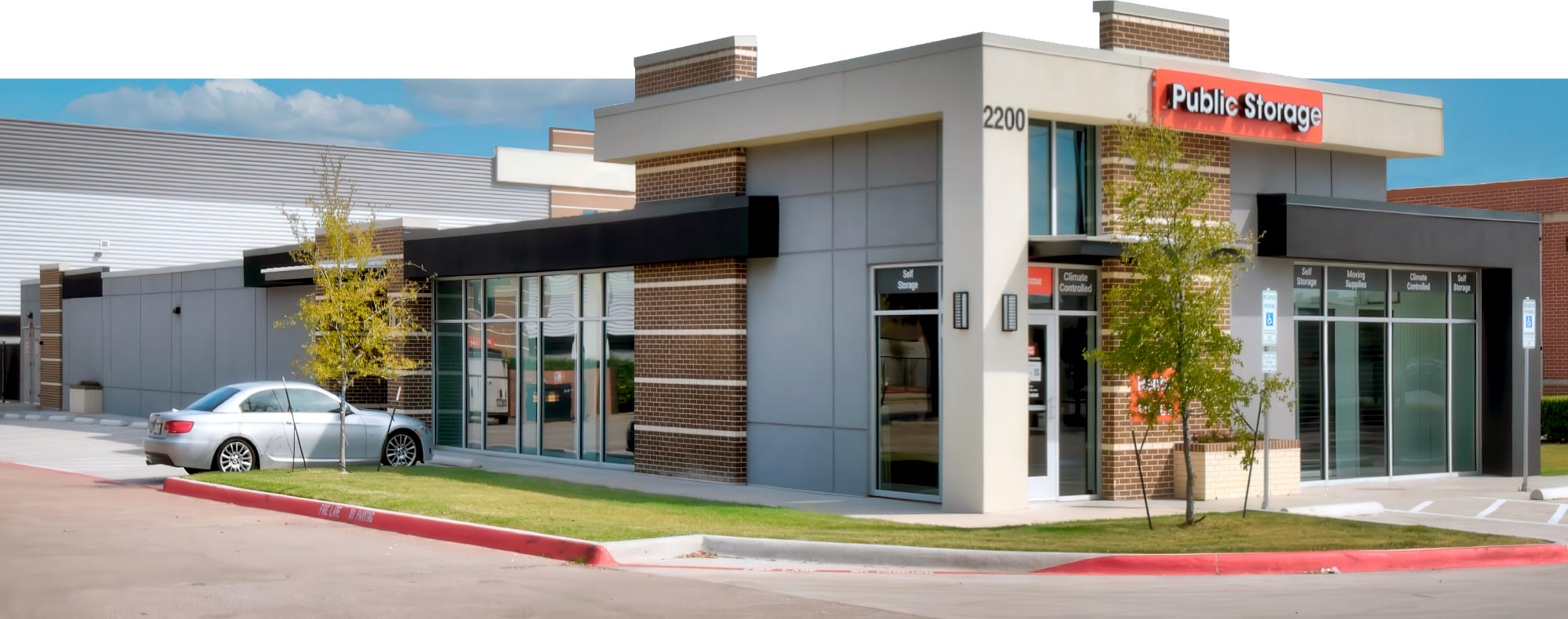
ome to several cowboy hat makers, Garland, Texas, proudly holds the title of the Cowboy Hat Capital of the Lone Star State. Catering to the storage needs of the city’s Western crowd is Public Storage, which opened just over a year ago.
Construction of the facility (owned by developer Hines, designed by DALLENBACH-COLE Architecture, and built by Reliable Construction) was completed in just 12 months following a challenging entitlement process that was needed to gain a special use permit, a city requirement. Today, the facility encompasses 90,650 net rentable square feet, boasting 820 units across two buildings on a “flag lot”—a narrow section of land followed by a larger parcel.
DALLENBACH-COLE Architecture placed the single-story office at the site’s entrance, giving it prominence; a second building behind it holds the bulk of its storage units and serves as a backdrop. The complex entitlements required office design, including a combination of brick, stucco, and metal panel accents, while incorporating canopies, a recessed entryway, large display windows, alcoves, planters, and distinctive lighting. The result reflects both Garland’s heritage and its growing modern identity.



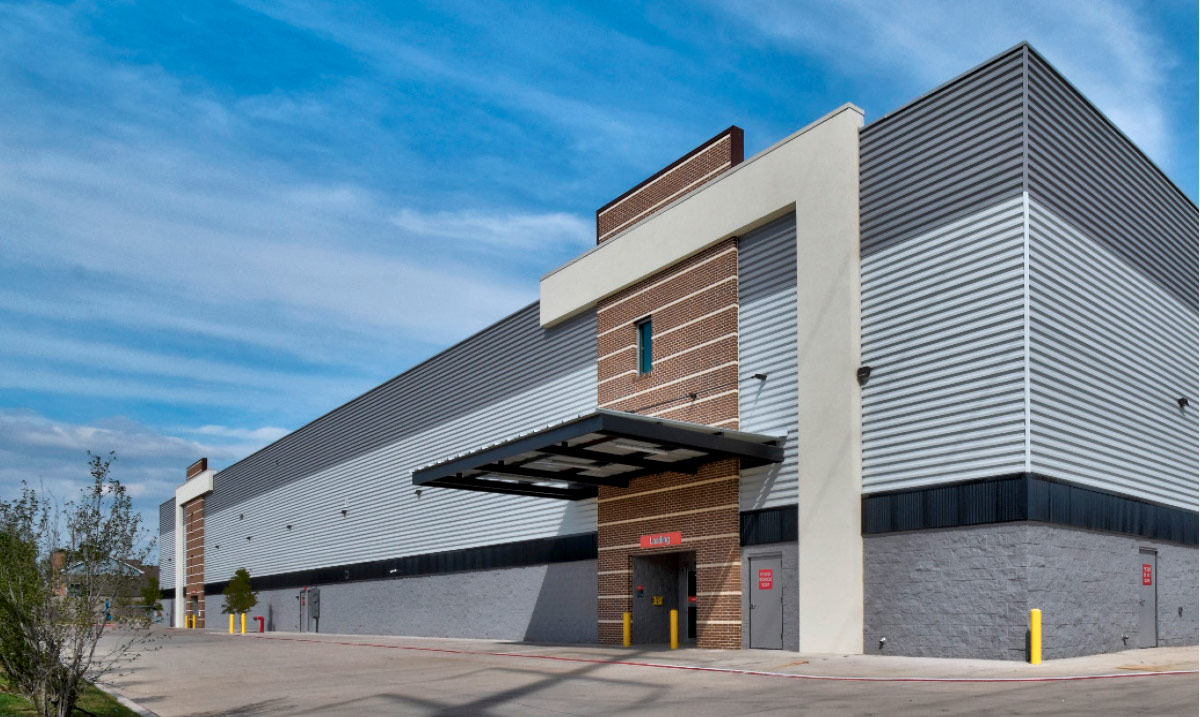



rtificial intelligence (AI) is quickly making its way into industries far beyond Silicon Valley, including the traditionally low-tech world of self-storage. Operators are increasingly drawn to AI tools that promise efficiency and cost savings in areas such as lease execution, payment processing, customer communication, and even default and lien procedures. While the potential benefits are real, the legal risks of relying too heavily on AI in such a compliance-heavy industry should not be overlooked.
- Data Privacy and Security – Payment systems handle sensitive financial information, triggering obligations under state privacy statutes (e.g., California’s CCPA) and payment card industry (PCI) standards. A breach, even if caused by a third-party AI vendor, can lead to liability for the operator.
- Error and Accountability – If an AI misapplies payments, generates duplicate charges, or sends incorrect account notices, the operator—not the AI vendor—bears the legal responsibility.
- Debt Collection Laws – Automated reminders and delinquency notices may trigger compliance issues under the Fair Debt Collection Practices Act (FDCPA) or similar state laws. AI systems that generate aggressive or misleading communications could expose operators to claims of harassment or unfair practices.
Courts have little tolerance for deviations from statutory lien procedures. If AI generates a defective notice, miscalculates a deadline, or fails to provide proper public advertising, the operator could face liability for wrongful sale. Lien enforcement often requires human judgment, such as determining whether a payment was properly credited or whether military service protections apply under the Servicemembers Civil Relief Act. Operators need to work with their vendors to ensure that attention is given to these nuanced factors as part of their default and lien procedures.

hen capital is expensive and valuations are under pressure, every operational decision becomes a financial one. In self-storage, the conversation has long revolved around rental rates, new supply, and absorption. But for a growing number of sophisticated operators and investors, the real gains are being made elsewhere: in the steady, deliberate pursuit of operational efficiency through automation. It’s no longer just a cost-saving tool, it’s a capital strategy.
That reality hasn’t gone unnoticed by institutional buyers. Increasingly, they evaluate a facility’s operational efficiency with the same scrutiny they apply to location or market fundamentals. A well-run property—one that demonstrates predictable income, consistent collections, and scalable operations—commands a premium. Efficiency has become an underwriting criterion in its own right.
For independent operators, this reframes the purpose of automation. It’s not about trimming fat; it’s about signaling the financial stability that lenders and buyers need to see.
With borrowing costs high, and investors more cautious, every inefficiency shows up on the balance sheet. Lenders and buyers are reviewing P&Ls line by line, not just to assess returns but to evaluate risk. They’re asking tougher questions: How predictable are your collections? How easily can you staff or scale? What happens to your margins if occupancy slips five percent?
Operators can’t control interest rates, but they can control the systems and workflows that determine how efficiently their business runs. That’s why many independents are turning inward. In this market, automation is one of the few levers that can lower expenses, improve tenant experience, and strengthen asset value.
When liquidity tightens, efficiency becomes the new growth strategy.
Digital move-ins have replaced paper leases and in-person signings. Smart access systems have eliminated the daily grind of managing keys and gate codes. Automated billing and communication tools have turned collections from a stressful routine into a predictable process. Even missed calls—once an unavoidable cost of doing business—are now captured through automated systems that protect every lead.
For independent operators, these technologies do more than streamline tasks. They provide a portfolio-wide view of performance once reserved for the largest portfolios: live data on occupancy, delinquency, and revenue that enables faster and more informed decisions.
When you take the repetitive, time-consuming tasks off a manager’s plate, you allow them to focus on what people are actually good at. Suddenly, their day isn’t about paperwork and chasing down payments. It’s about providing great customer service, finding creative ways to close a sale, or building a real presence in the local community—things a machine can’t do. And that shift has a huge, often overlooked financial impact, especially with staffing being one of the industry’s toughest challenges.
Your managers stop being caretakers and start acting more like business owners. And it’s not just about morale. We all know that high turnover costs a fortune in recruitment and training. A less stressful job means people stick around longer, which directly cuts down on those hidden expenses. A good manager with great tools is more than just an employee, they’re a revenue generating asset and a huge competitive advantage.
Access to live data helps them make smarter calls on pricing and inventory. Because they aren’t buried in busywork, they have time to walk the grounds, catch maintenance issues early, and actually talk to their tenants. They’re no longer just reacting to problems; they’re actively driving the business forward. That’s exactly what sophisticated buyers want to see—a business that runs on great systems and empowered people, not one that relies on a single person to hold it all together.
There’s also a customer story behind the numbers. When renting and paying are simple, tenants stick around longer. That kind of predictability in both operations and occupancy is what attracts buyers and leads to stronger valuations.
Automation, in other words, translates strong operations into tangible financial performance.
Improving the customer experience almost always pays off. When tenants can rent, pay, and communicate without friction, occupancy follows. The next step is to make sure your systems can keep up with that growth.
Once your daily workflows are running smoothly, start thinking about scale. Add tools that help you manage multiple sites, track performance in real time, and price units more intelligently. Features like smart access, centralized reporting, and dynamic rate adjustments give you a clearer picture of your portfolio and let you run more units with the same staff.
Every improvement builds on the last. Over time, those small gains add up to a more valuable, more resilient business.
At a 6 percent cap rate, that improvement adds $1 million in value. Those gains aren’t theoretical, they’re happening every day for operators who treat operational improvement as seriously as acquisition strategy.
And unlike development or expansion, these returns don’t depend on new land, new entitlements, or new risk. They come from running what you already own, better.
For many owners, the next phase of growth won’t come from building new facilities but from getting more out of the ones they already have. In this market, the smartest operators aren’t thinking bigger. They’re thinking better.

Tenant Inc. was built to use it.

Tenant Inc. was built to use it.

elf-storage customers don’t always understand the amount of space needed to correctly store their items, which is why managers and professionals in the industry must be ready to advise each individual customer on the best unit size. To understand the best methods to help self-storage customers, MSM interviewed three professionals with years of experience in the self-storage industry to share their knowledge: Carol Mixon, owner and president of SkilCheck Services, Inc.; Sarah Beth DeFazio, vice president of sales and development at Universal Storage Group; and Diane M. Gibson, president of Cox’s Armored Mini Storage Management.

If the unit is too small, it could damage stored items as well. “If things aren’t stacked properly because [the customers] are trying to get everything to fit, they could stack things too high, causing the items on the bottom to collapse,” Gibson says. “If a unit is completely packed, if there’s ever a circumstance where you would need something from the back of the unit, things could be damaged by moving them in and out.”
Online calculators can be handy. The tool allows customers to answer a questionnaire with the items they need to store. Based on the answer, the calculator generates the ideal unit size for each individual customer. Carol Mixon agrees that this is a great, helpful tool, but it can have its faults. “I have personally used it, and I have recommended people to use it. But the problem is, a lot of times, [customers] forget stuff from outside the house, from the garage, and they forget to put everything,” says Mixon.
The online calculator is only useful if the customer answers the questionnaire with every single item, or at least with most items, that will be in the unit, so that the tool can give an estimate of the ideal size for the space. However, mistakes can happen, and it’s likely that the client will forget and omit some items from the calculator, which can alter the ideal size of the unit. It’s common for people to miscalculate the unit size. “I can’t tell you how many people get a unit and then a second unit,” adds Mixon.

Comparing the unit size to a one-car garage or a bedroom, for example, can allow customers to understand how many items can fit in the unit. However, the self-storage manager should also guide their clients. The customer must know that the unit should have some free space to easily move or retrieve belongings, if necessary. If seasonal items are in the back, there should be a way to safely move them without damaging the other items or having to remove everything from the unit.
That’s why the manager should always ask clients about the items they plan to store and advise them on the best unit size that will fit everything comfortably. “Always allow extra room for future items or easier access. A unit packed wall to wall may be cheaper but becomes frustrating if you need to retrieve something,” DeFazio says.
Using tape on the floor to mark the size of the unit can be another great tool for helping customers determine their ideal unit size. The only issue is that the tape doesn’t allow clients to visualize vertical space, which is so important. On self-storage units, boxes can be stacked to maximize the space. “The problem with taping the floors is that you don’t understand how high you can go, and how you can stack the boxes,” Mixon adds.
The best method for guiding customers through this process is allowing them to visit the unit (or a demo unit) before finalizing the contract. “I make it mandatory for my people to show the unit,” Mixon says, noting that seeing the unit beforehand enables customers to better understand the space they’re dealing with. It can also be helpful for the manager to give organizational advice to the customer based on their self-storage experience and how to store efficiently.
In addition, Mixon advises people to write the information of what’s inside the boxes on the side, so that it can be read once the boxes are stacked. “If you’re a planner, I think you can really utilize the space correctly,” she says. If there are items that the customer will need to access frequently, they should keep it at the front of the unit.
Tools for determining the ideal unit size for a customer can be helpful. However, nothing will help the clients more than the expertise and guidance of the self-storage manager. It’s important that they can trust the professional to give them the best advice and support throughout this process.


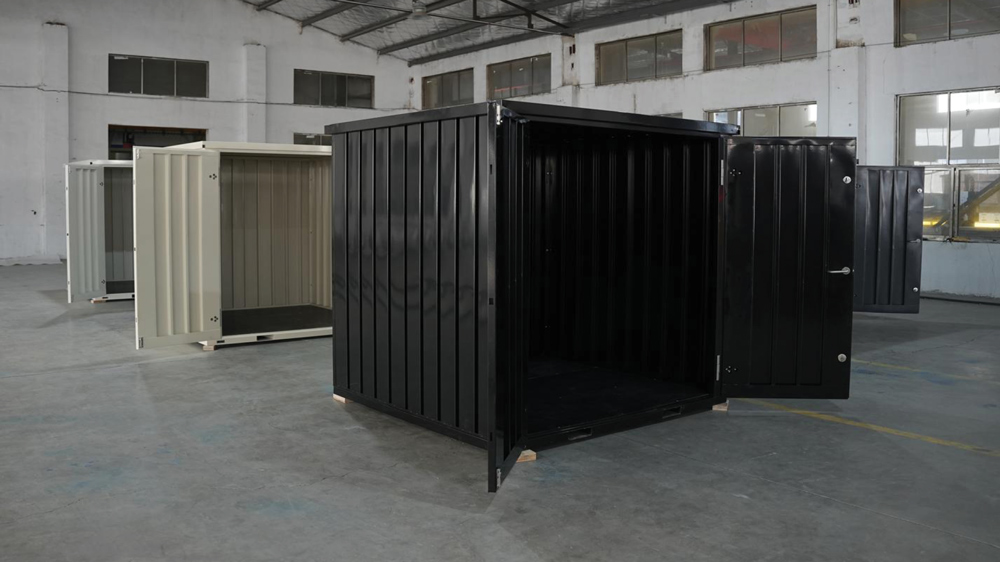
latbox was born out of a desire to be better. CEO Carlos Leal was buying their storage container products from another company for resale, but he was unhappy with them. “I’d find a lot of mistakes or inconsistencies,” recalls Leal. “I became tired of telling them what they needed to fix and how they needed to fix it.” Shortly after, Leal visited the factory and discovered that they weren’t even manufacturing the products—they were purchasing parts from other manufacturers and assembling them. “That’s when I saw the opportunity to do it myself and do it better.”
Leal spoke with his friend in China, and the duo partnered up to create a better Flatbox—one that was their own product. “We started a factory in order to do everything in-house. Then, we just fixed every issue we had with the previous products we were purchasing. We also made the product wider and taller, and painted the interior and exterior using a 20 metal gauge powder coat, whereas others only paint only the exterior with 25 metal gauge.”

That growth has come in many forms, from resellers to individuals needing a backyard shed to businesses that may need extra space for supplies. Now that Leal is making the rounds at self-storage trade shows, Flatbox is making a name for itself in self-storage. “A lot of self-storage facilities have unused space on their property, but they don’t want to build more permanent structures, or they can’t due to permitting issues. Flatbox is an easy way to expand and bring in more revenue,” says Leal.
Of course, permitting may be required for some Flatbox placements, but Leal explains that it’s on a country-by-country or state-by-state basis. “In Florida, for example, if it’s under 220 square feet, you don’t need a permit because it’s considered a shed. But regardless, it’s an easily movable unit that you can place on site one day and then move it later and do something else with it. With some other portables, you’ll need heavy equipment to place it and remove it.”
Many self-storage operators like that Flatbox products can be interlocked. “You can make the spaces wider, longer, and taller,” says Leal. “You aren’t limited to what you can do like you are with other products. Flatbox gives you options!”
Speaking of options, doors can also be placed anywhere on the unit, which is ideal for facilities that may want loading and unloading done on a particular side of the unit based on the space it will occupy. “Everything is customizable,” says Leal. This also includes locks, which can be built into a panel or added later by the operator if they want a specific brand of lock.
Flatbox also offers superior flooring and roofing, says Leal. Floors are made with rubber-wrapped marine board that’s designed to last, while roofs can be styled like a typical container or include gutters to draw water away. Either way, Flatbox puts up a good fight against Mother Nature. “We’re from Puerto Rico, and the weather here is crazy, pouring rain one moment and 100 degrees and sunny the next,” says Leal. “So, if they can power through Puerto Rico weather, they can handle just about anything.”
One last advantage that Leal wants to mention is how efficiently Flatboxes are shipped. The design of them allows for 20 units to be placed inside a 40-foot container. “To my knowledge, that’s more than any other supplier of flat-pack containers. The closest I’ve seen a competitor come is 16, but it’s much less for others.”
With all the customization options, one might think the Flatbox team has their hands full. While that may be true, Leal wouldn’t have it any other way. “It doesn’t matter,” he says matter-of-factly. “We are the factory. We have many options, but we’ll also make whatever the client wants. It’s fully customizable.”
To that end, Leal does say that the company is working to build out its distribution team across the world to handle all the logistics behind the product. This will allow them to continue customizing and creating new products –some of which are already available. Flatbox has already introduced a variety of new products, including kiosks (a Flatbox with a hinged canopy), offices (a literal Flatbox office space with windows), multi-compartment units (a sectioned Flatbox with multiple entry points), and accessories like shelves. “We’re constantly innovating and always improving,” says Leal with a smile.

am bullish on self-storage because of something I noticed at a Class-A facility in Southern California. I saw a 20-something moving out of a shared apartment and a young couple running a side business from their unit. Neither looked like the “classic” self-storage customer, yet they are becoming the backbone of the next demand wave.
That’s when my long-term thesis of self-storage really clicked for me. We’ve spent the last two years talking about supply, and rightly so. The industry built aggressively after the pandemic demand surge. Yardi Matrix estimates roughly 50 million-plus square feet delivered nationally at the peak of this cycle, which slowed rent growth and tested underwriting assumptions. But what matters is who emerges stronger.
Data and real life are telling us: Demand isn’t disappearing—it’s evolving. Gen Z is becoming a dominant user group of self-storage. Surveys from SpareFoot and MSM show Gen-Z renters are adopting storage earlier in life than millennials—often in their early 20s—driven by mobility, smaller living spaces, side hustles, and delayed homeownership. Once a customer uses storage once, lifetime value tends to be significant. Storage isn’t transactional; it’s habitual.
This matters because Gen Z is entering its prime “life transition” years. Moves, job changes, relationships forming and dissolving, business formation—these are the moments that drive storage demand, and they compound. When you acquire a customer at 23 instead of 35, the runway is long.
Now layer that over the housing reality. Homes are getting smaller. Apartments are denser. ADUs are reshaping markets like California, where land scarcity compresses space. The result is simple: People still own the same amount of stuff but lack the room. Storage becomes the external closet, garage, and business backroom.
Yes, rent growth has been uneven. Yes, new supply has tested operators. But national occupancy has remained resilient, hovering around the low 90-percent range, and new construction pipelines are tapering as we look into the future.
This is where experience matters. The 18.6-year real estate cycle teaches us that the best opportunities are rarely obvious. Late-cycle discomfort is where durable platforms are built. For disciplined developers, especially in supply-constrained, infill California markets, self-storage remains one of the most compelling long-term asset classes in commercial real estate—not because of last quarter’s rents but because of the people quietly lining up at the door. And this line makes my long-term thesis bullish on self-storage.
• Fully integrated solutions with in-house baȷa Engineers for faster, easier projects
• Pre-Fabricated Framing Systems with Bolted Connections – No field welding
• Snow Loads from 20psf to 100psf – Wind Speed rated to 170MPH
Time
Party Management
Company
You enjoy your success.
maintaining ownership.
StorageVault is there to buy.