









How to enjoy our new magazine:
Just scroll!
Click or tap the table of contents icon in the menu bar to find any article.
Read any article by clicking or tapping the read full article button below each article intro.
Jump back to your previous browsing spot from any article using the menu bar or back to issue button.








-
Step-By-Step Disaster PrepPage 16
-
Should On-Site Managers Have Dogs On Their Properties?Page 20
-
Easy-To-Implement Ancillary Income IdeasPage 22
-
The Subtleties Of Managing Mixed-Use PropertyPage 24



-
Construction Financing In A Post-Pandemic WorldPage 56
-
Silver Creek Self Storage In San José, Calif.Page 62
-
Younger Customers Prefer Eco-Friendly CompaniesPage 66
-
Storage Box San Antonio, TexasPage 70
- Chief Executive Opinion by Travis Morrow 8
- Publisher’s Letter by Poppy Behrens 11
- Meet The Team 12
- Women In Self-Storage: Ginny Sutton by Erica Shatzer 27
- Who’s Who In Self-Storage: Joe Margolis by Erica Shatzer 31
- StorageGives 85
- The Last Word: Steve Mirabito 88
For the latest industry news, visit our new website, ModernStorageMedia.com.


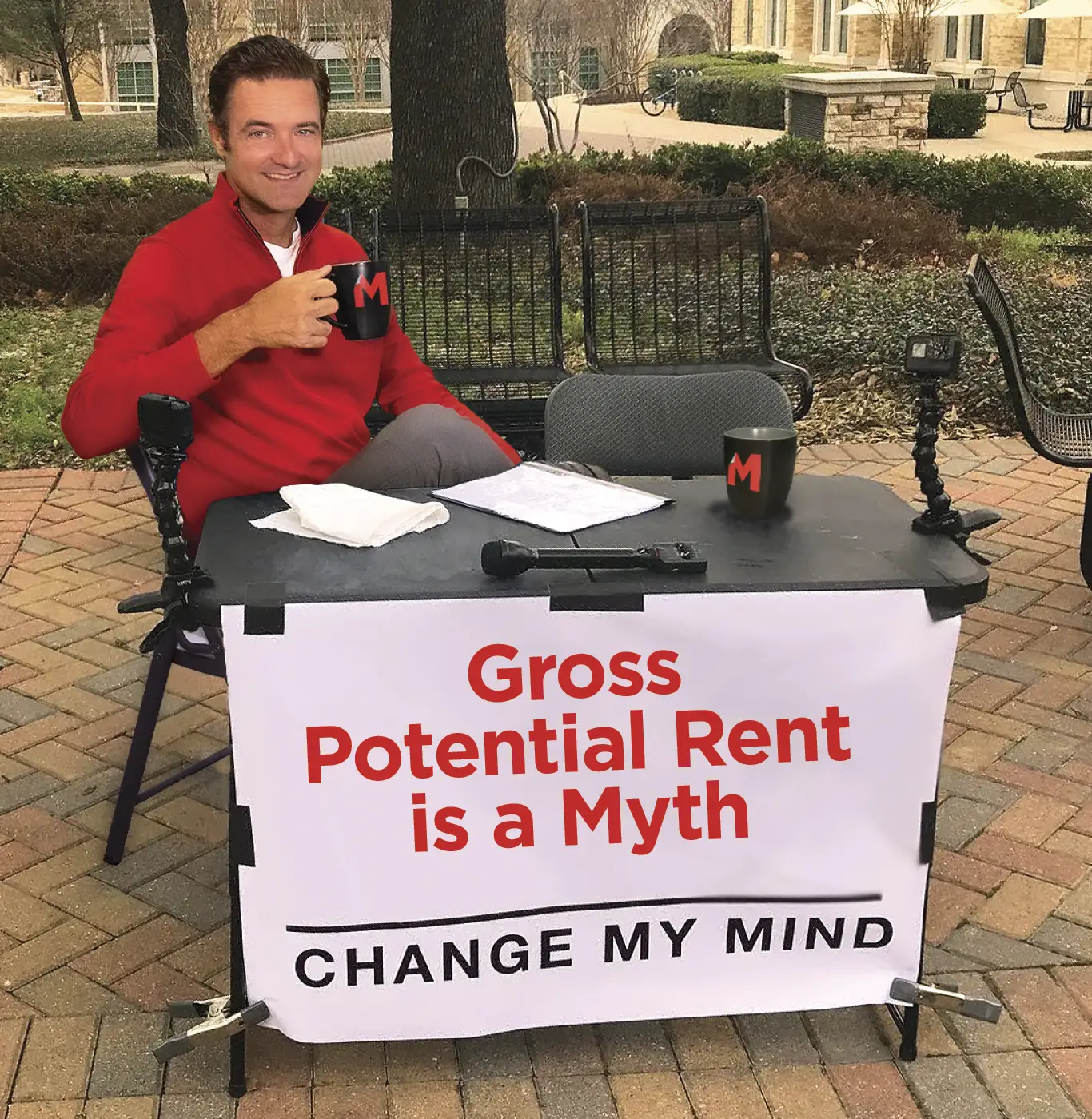
enders ask me all the time about what the gross potential rent of a facility is. I ask them what they want it to be. GPR is a relic carried over from the multifamily world into self-storage. Self-storage leases are more fluid than multifamily, so GPR doesn’t really mean much, just a picture in time.
He’s also the president of National Self Storage.

-
PUBLISHER
Poppy Behrens
-
Creative Director
Jim Nissen
-
Director Of Sales & Marketing
Lauri Longstrom-Henderson
(800) 824-6864 -
Circulation & Marketing Coordinator
Barbie Boyle
(800) 352-4636 -
Editor
Erica Shatzer
-
Web Manager / News Writer
Brad Hadfield
-
Storelocal® Media Corporation
Travis M. Morrow, CEO
-
MODERN STORAGE MEDIA
Jeffry Pettingill, Creative Director
-
Websites
-
Visit Messenger Online!
Visit our Self-Storage Resource Center online at
www.ModernStorageMedia.com
where you can research archived articles, sign up for a subscription, submit a change of address. 
- All correspondence and inquiries should be addressed to:
Modern Storage Media
PO Box 608
Wittmann, AZ 85361-9997
Phone: (800) 352-4636

elcome to the October edition of Messenger, the second issue of our newly redesigned flagship publication. This month, we are proud to feature Pam Domingue, owner of California-based Storage Solution, in our cover story. While Pam accidentally discovered the self-storage industry in 2003, today she will be the first to tell you, “I love the industry. I am blessed to have found it, and I cannot imagine doing anything else! I am also fortunate that so many in this industry have become my good friends!”
Also in this issue, starting on page 40, we feature the 2023 Manager of the Year winners. Please join us in congratulating our overall winner, Jenny Rodrigues, property manager of ‘Ohana Self Storage in Honolulu, and our runners-up Ron Pell of Morningstar Storage in Ladson, S.C., and Kelly Maas of Moove In Self Storage in Finksburg, Md. And a very special thank you to all those managers nominated this year. You and our winners are the epitome of excellent customer service in our industry.
Last but certainly not least, have you seen the digital edition of the September issue of Messenger? If not, scan or click the QR code below to explore all the amazing new digital enhancements that are now included in every issue. No other publication in the industry has access to these
state-of-the-art digital offerings!
So, how do you like us now? We would love your feedback! Please feel free to send me your comments by email at poppy@modernstoragemedia.com.
Remember: We value your input!

Publisher

 Watch for our redesigns of Self-Storage Canada and Self-Storage Now! magazines in Q1 of 2024!
elcome to the October edition of Messenger, the second issue of our newly redesigned flagship publication. This month, we are proud to feature Pam Domingue, owner of California-based Storage Solution, in our cover story. While Pam accidentally discovered the self-storage industry in 2003, today she will be the first to tell you, “I love the industry. I am blessed to have found it, and I cannot imagine doing anything else! I am also fortunate that so many in this industry have become my good friends!”
Also in this issue, starting on page 40, we feature the 2023 Manager of the Year winners. Please join us in congratulating our overall winner, Jenny Rodrigues, property manager of ‘Ohana Self Storage in Honolulu, and our runners-up Ron Pell of Morningstar Storage in Ladson, S.C., and Kelly Maas of Moove In Self Storage in Finksburg, Md. And a very special thank you to all those managers nominated this year. You and our winners are the epitome of excellent customer service in our industry.
Watch for our redesigns of Self-Storage Canada and Self-Storage Now! magazines in Q1 of 2024!
state-of-the-art digital offerings!
So, how do you like us now? We would love your feedback! Please feel free to send me your comments by email at poppy@modernstoragemedia.com.
Remember: We value your input!
Publisher



- Breaking news updated daily
- Real-time sales and acquisitions updates
- A newly redesigned calendar of events
- Enhanced promotional opportunities for advertisers
The website also enables readers to submit news, events, and article ideas. Don’t forget to browse the MSM Store for dozens of exclusive, storage-specific publications, including three of the industry’s most trusted resources: the annual Self-Storage Almanac, The RV & Boat Development Handbook, and the annual Expense Guidebook. New publications are frequently added to its extensive list of offerings!




Modern Storage Media



Messenger






ires, floods, hurricanes, burglaries, and finding hazardous chemicals in storage units are just some of the disasters you may have encountered (or could encounter) running a self-storage facility.
“Unfortunately, I’ve had the misfortune of experiencing about every disaster with our facilities,” says Beau Agnello, former senior vice president at Pogoda Companies in Farmington Hills, Mich. Those disasters have included all those previously mentioned, as well as the 2021 winter freeze that gripped much of the country, including South Texas. According to usclimate.gov, the storm was the costliest winter weather event in U.S. history. Several of their properties were affected with power outages and broken pipes.
Agnello says a comprehensive disaster plan put together before the event, as well as managers who were trained in disaster management, helped the company get through the crisis.
Getting your facility through a disaster can be broken down into two parts: pre-disaster planning and disaster management during and after the event.

Kenneth Nitzberg, chairman and CEO of Devon Self Storage in Emeryville, Calif., says to identify the types of natural disasters most common to your area. For example, California facilities should identify earthquakes and wildfires. “If you’re in the business long enough, you will encounter different disasters, so you need to try to have a contingency for each.” When identifying the types of disasters, our experts say it’s a good idea to also make sure your facility is prepared with supplies such as emergency kits, food and water for managers who live on site, ice melt, and other supplies.

M. Anne Ballard, president of marketing, training, and developmental services for Universal Storage Group in Atlanta, Ga., points to a fire at one of their facilities that destroyed the office, manager’s apartment, and tenant units in one building. “The owner had good property insurance that included replacement value and loss of use,” says Ballard. “All of the tenants had insurance on their belongings and the manager had content insurance on her belongings in the apartment.”

The Emergency Preparedness Manual assembled by the Self Storage Association is a great blueprint for assisting you with building your own disaster plan. “We have what we call the ‘Red Book,’ which started in print but is now in digital form as well,” says Ballard. “The book has everything managers and employees need to know about what to do in the event of a disaster.” Carol Mixon, president of SkilCheck Services in Tucson, Ariz., says these books are very helpful in the event of a disaster. “Most managers don’t even know where all the shutoff valves are for water and utilities,” says Mixon. Ballard adds the books should contain everything you can think of that will assist you or your employees during a disaster, including step-by-step instructions, detailed information about insurance policies and agent contact numbers, utility bill account numbers (including copies of the bills) and contact numbers, as well as usernames and passwords. “Don’t list them as ‘username’ and ‘password;’ label them as something else to help protect the facility, but they should be included and updated as employees change,” says Ballard. “Think of what you would need if you didn’t have access to your office.” Mixon also advises not to forget to include contact numbers that you may not think of, such as poison control, mental health, and domestic crisis lines.
No matter how long you’ve been in the business, you may encounter a new scenario, says Nitzberg. “When you come across something new, make sure to add it to your book so there are instructions in case it happens again.”

Nitzberg says they recently had a fire at one of their facilities and had to call a remediation company. Experts advise building relationships with the companies before disasters strike. If there is a natural disaster, for example, affecting many different people and businesses, if you’ve fostered a relationship with a company, they may be able to help you sooner.

Most long-time facility owners and managers have a story about a vehicle that caught fire in a unit, strange smells that ended up being drug-related chemicals, or even lithium batteries catching fire. Some disasters can be avoided if tenants know and understand the rules about storing hazardous materials and chemicals, vehicles, gasoline, and other items. “Of course, you may not know what every tenant is storing, but regularly inspecting the property can help,” Ballard says. “When they’re moving in, go out and inspect the rest of your property, but be nosy in what they’re storing as you walk by.”
Mixon once detected a strange odor coming from a unit while out walking a property. It ended up being chemicals used to make methamphetamine.
“Identify the disaster, and if it’s a fire, call the fire department,” says Nitzberg. “It may sound silly, but in an emergency sometimes people panic and forget the basics.”
Make sure to prioritize safety of employees and tenants.
Mixon says your employees should be trained in helping tenants exit the building, as well as ensuring all escape routes are practiced and marked prior to any emergency. Safety equipment such as fire extinguishers, which may help people escape, should always be in good working order. Ballard says your employees should understand their safety, as well as that of tenants on the property, comes first. “Don’t be a hero. If they’re being robbed, they should cooperate; if it’s a tornado, they should take cover without regard for computers or records or anything except their safety.”
Place the appropriate calls.
Once emergency services are notified and everyone is safely out of danger, experts say the handbook should outline who should be called first. Most managers who work for owners or management companies typically call their superior, who then coordinates notifying owners, insurance companies, and remediation contractors after emergency services gives the green light for re-entry.
Coordinate communication.
Gary Sugarman, COO of William Warren Group in Santa Monica, Calif., says, “Comprehensive and continuous communication should be established with tenants, employees, and authorities through all means available, such as emails, texts, calls, letters, and social media.” The communications should outline what happened, the plan(s), and what tenants and employees should and shouldn’t do. “These may be many different communications over a long period of time,” he says. As well, experts advise to make sure employees understand who is to communicate with the media. “It’s typically the owner or representative of the company,” says Ballard. Finally, communication also includes documenting for your records and for that of the insurance company anytime you enter or must remove anything from a unit due to safety concerns. Nitzberg says photographic and video documentation is best. Mixon adds, “We require incident reports on every incident, no matter how big or small. We never know when we will need them.”
Set up containers, dumpsters, portable bathrooms, and temporary office space.
The fire that destroyed the office and manager’s apartment of a USG-managed facility had them working from the back of a truck until the city approved other temporary buildings and portable bathrooms. Sugarman says it’s important to coordinate with tenants on when and how they may go through and move their property and to provide dumpsters for them to use as well as containers for items that have been separated from the units. “It’s very important not to just throw everything away, so storing them in containers until they are claimed may be necessary,” he says. “Also communicate clearly to the tenants how long the containers will remain on site before unclaimed property is disposed of.”
Agnello offers one more piece of advice that will help you and your tenants through the disaster: “Don’t take anything the tenants say personally and show a lot of compassion and empathy. Most people have an emotional attachment to their items, so show a lot of patience, which will go a long way in easing tension.”



have to start out by saying that I love dogs! I can’t remember a time in my life that I didn’t have a dog, and I understand the beauty and companionship that dog owners feel about their pets. So, I can understand when facility managers bring their pets to work, either for company during the long days working at a facility where it seems like a ghost town, or for security where tenants or visitors are regularly behaving badly and the manager needs to feel protected.
There is no perfect answer. In a legal world, the value of having pets on the property must be weighed against the risk. Companies address and analyze these cost/benefit issues every day when they run their businesses. For every dog that may be docile every day of the year, there is another that suddenly, and without warning, bites a tenant who may approach it. And certainly, for every person who might otherwise love dogs like I do, there are others who remain fearful and may choose to rent somewhere else because the pet is present at the property. At the same time, the best manager who can be hired may only take the job if they can bring their pet to work.
For those properties that elect to allow their employees to bring their pets to work, there are a few protective steps that should be taken. The first is to notify your insurance company that there is a pet on the premises. Your policy may need to be updated (or a rider may need to be added) to address this factual condition and the “added risk” that comes with it. The cost of the additional coverage might be different if the dog is under a certain weight or is a certain breed. But not having coverage while allowing pets on the property leaves a business exposed to the cost of that risk without insurance coverage if something happens.
Secondly, there should be notice to the tenants and visitors that a pet is present on the property. The notice should be posted on the exterior gate and outside the office door. Although there is always the risk that the tenant may elect to rent elsewhere, the notice is important in case the tenant or visitor might be allergic to the pet or even, most simply, if the tenant or visitor is afraid of dogs and would be surprised or upset if they came into the office and were confronted without notice.
Big thanks to Carol Mixon for asking me about this topic!


any times, when self-storage owners and operators think of ancillary income, they may be thinking about earning a few hundred dollars more per year on selling boxes and packing tape. The truth is, if you’re treating avenues for ancillary income as serious revenue streams, you can make serious extra revenue.
“People tend to overlook it, but overall, ancillary income can add seven to 10 percent of total income to your property,” says Chriss Michalopoulos, director of operations for Pogoda Companies in Farmington Hills, Mich. “Ten percent of $1 million is still $100,000 without a lot of effort.”

“This is a critical piece of revenue,” says Michalopoulos. “It’s a one-time fee we charge for the time and processing of a new customer.” If you decide to charge these fees, it’s also important to note what competitors are charging, review it at least annually, and increase if warranted. Pogoda just increased their fees from $15 to $25, which is still competitive in the market but below the administrative fees the REITs are charging. The amount of revenue administrative fees can generate each year is based on the size of property and turnover, but a typical 500- to 600-unit facility could generate $6,000 to $8,000 per year.

Another large revenue producer are late fees added to tenants who haven’t paid their rent by the 6th of the month. Michalopoulos says in Michigan, where many of their properties are located, they are allowed to charge the greater of $20 or 20 percent. These combined fees can add up to a whopping $50,000 to $60,000 each year, based on a $1.2 million property. If tenants fail to pay and their delinquency advances to the lien stage, they are charged $100 for lock cutting (recently raised from $75). Auction income, which typically amounts to 25 to 30 percent of the bad debt, can add another $15,000 of revenue.

Based on the nature of your storage facility and location, you could provide more retail inventory, but the basics of boxes, packing tape, bubble wrap, locks, and other supplies should be offered. Michalopoulos says this income is typically “on the lighter side of your ancillary income streams,” but it can still average $9,000 to $12,000 per year.

As many self-storage facilities require their tenants to now carry insurance on their stored items, it only seems logical for the facility to partner with an insurance carrier while getting a commission on the policies. Michalopoulos says 90 to 95 percent of their customers take the insurance offered at their facilities, and while $3 per policy may not seem like it would add up, it can bring in up to $4,500 a year in extra income.

Some facilities have their own trucks they lend to new tenants. However, if you offer truck rentals, Michalopoulos says you can make an additional $5,000 to $16,000 per year. “It all depends on the location; it really helps if you’re by a college town,” he says. “We partner with U-Haul, Penske, and Budget.”
When managers are showing a unit to a prospective tenant, they will pull a lock from the retail store; when they make the sale at the unit, they go ahead and secure the unit with the lock.
Michalopoulos says it’s like leaving money on the table if your managers aren’t trained to sell your ancillary products. Since late fees are a high revenue source, managers should also be trained in collecting fees and only occasionally waiving fees for tenants.
Depending on your property and where it’s located, vending machines may be a good option, especially for tenants in hot climates looking for cold drinks or RV and boat tenants looking to take a few snacks on their road or fishing trip.
Also depending on where your facility is located, you could partner with companies on revenue sharing for EV charging services. This is a very new idea in the United States, but it is already being implemented in other countries. As well as possibly producing another small revenue stream, it could also attract people to your property that you can convert into self-storage customers.
Shelving for units
Especially if you have many commercial tenants who need to store files or pharmaceuticals, offering shelving units for a monthly rental could add to your ancillary income.
Partnerships with moving companies
This may seem like a no-brainer given the symbiotic relationship between moving and self-storage, but it is an idea that hasn’t been pursued as often as it should. Like truck rental partnerships, these can produce a handsome revenue stream while also endearing you to stressed tenants who need help.
Cell towers
While not a new idea, it is often an overlooked one. Many cell companies will approach you if you have land that is ideal for a new tower. However, you can also investigate options with cell companies that service your area.
Specialty and vault storage
Many specialty storage options, such as wine storage, require a significant investment, but some do well in areas with many collectors. Another specialty storage option is vault storage, which may allow tenants to store guns, art, or other expensive items.


ver my 46-year property management career, I have managed everything from apartments to large, 400,000-square-foot warehouses and lots of self-storage properties. Some of those storage properties included ancillary real estate/businesses such as small retail spaces, self-service car washes, business incubator spaces, contractor large bay flex space, indoor and under-the-stars RV/boat storage, mailbox rentals, and cell towers/billboard land leases. Even the largest rental truck dealer in Boston, Mass., was our tenant.
The non-storage parts of these properties operate in a completely different manner than traditional self-storage. We’re all familiar with the standard month-to-month storage rental agreement (also known as lease or occupancy agreement), however these commercial tenant spaces are leased using commercial leases with terms that are often far different. Commercial leases are often for five to 10 years, while land leases for billboard signs and cell towers can be for terms of 25 to 40 years. Often the initial 25-year land lease is for five years with (4) five-year guaranteed renewal options. All have built-in rent escalations at a predetermined rate, typically about three percent. Three percent is not a great increase, but when the annual rent might be $45,000 or better, it’s not so bad.
A short or brief commercial lease could be 10 to 12 pages, but I have seen some that are 25 pages or more, including a cell tower lease from Sprint that was 47 pages. I highly recommend you work with an experienced commercial real estate attorney when drafting and negotiating these leases, as you are likely to have to live with that agreement for a long time. That experience will pay off in ensuring your interests are protected. Grabbing a free or $50 lease off the internet may come back to haunt you over and over if something was accidentally omitted or not clearly written. Remember, the lease is the document governing the relationship between both parties. Saving a few thousand legal dollars up front could be very costly should you end up in litigation that ends very poorly for you.
Managing mixed-use property is not difficult if you understand the nuances between self-storage and the commercial space. Commercial tenants tend to stay far longer, pay better, and most accept rent increases without the emotions we are sometimes subject to from the residential storage tenant.
I see more frequent mixed-use properties for sale than ever before. Maybe one is in your future.


id you know that only 35 percent of organizations have a formalized succession planning process for critical roles? ATD Research disclosed that shocking statistic in its “Succession Planning: Ensuring Continued Excellence” report in 2018.
Not planning for succession can leave businesses at risk for lapses in leadership that could prevent them from achieving their objectives or carrying out their missions. Conversely, being ready for an eventual passing of the torch allows for a smoother transition with minimal disruption.
Luckily for members of the Texas Self Storage Association (TSSA), Ginny Sutton has been preparing for her retirement for nearly four years. And after serving as TSSA’s executive director for 26 years, Sutton’s replacement, Kristy Spurr, whom Sutton hired in February of 2020 as the deputy executive director, has a Texas-sized pair of shoes to fill.
She was hired as the executive director of the Texas Mini Storage Association (now known as the Texas Self Storage Association) in 1997. At the time, 11 years after the association was founded, Sutton was one of only three employees, and they were responsible for helping its 900 members succeed.
“You go into the association business to fill a need and help people,” she says. “That’s what non-profit trade associations are all about.”
“When I was hired, the board of directors met every single month and were highly engaged, but they also had their own businesses to run and grow. It was a tough transition from board and volunteer-based to staff-based,” recalls Sutton. “The role of board members on a not-for-profit board isn’t to run the organization day to day. That’s what the paid staff does. The board’s role is to govern and provide leadership and vision about the industry. As things have become more sophisticated, we attract more visionary leaders who don’t want to dictate the day-to-day operations, which is really a positive thing.”
With board approval, Sutton began developing the association’s team, hiring additional staff, adding membership, communications, and education staff along the way. Eventually, she promoted Holly Barr from administrative assistant to a membership role, pushing her “from day one to be the best she can be. Like all the staff, I held her to a high standard. She had all the qualities needed to take on a leadership role and is now our director of membership and business development.”
But Barr wasn’t the only one to reap the benefits of Sutton’s critical feedback. She’s been coaching and challenging TSSA employees to do their best throughout her entire tenure, including Spurr, who’s readily absorbing all the institutional knowledge that Sutton has to share. Undoubtedly, Sutton’s extensive experiences have provided invaluable lessons for her to learn. “I remember what a leap of faith it was to hire our first-ever director of communications position many years ago,” she says. “Some of the board members thought it wasn’t a necessary position, but part of leadership is determining when you need to grow your staff so you can take on new endeavors, like expanding from a simple four-page newsletter to an actual magazine and also growing a dynamic website. One person can’t carry the whole load, especially as the number of members grows so significantly.”
Sutton goes on to say, “There’s a long learning curve when it comes to understanding what the members want and need from us, so we always look for staff members who are inspired to be servant leaders. From there, you watch for the talent certain staff members have, even when they themselves don’t always recognize those talents. Two more of our administrative staff in addition to Holly have been promoted to positions with increasing responsibility as their talents were capitalized upon. Each new position added—and staff member hired as we expanded—brought something that would benefit the members and allow us to provide more to them.”
It has been time, money, and energy well spent. The Texas Self Storage Association now has nine employees to execute its mission. “Members deserve the best we can give them,” Sutton says.
As she was expanding its staff, Sutton, who describes herself as a “recovering workaholic” striving for excellence, was also accelerating the association’s membership efforts. By working long hours—typically 60 hours each week for 20 years—and attending all the national self-storage conferences and trade shows to recruit new members, she managed to more than triple the TSSA’s membership base and earn it the title of the largest self-storage association in the country. She also recently advocated for a publicly traded company (REIT) membership within the association to combat the loss of members due to consolidation. Presently, there are approximately 3,000 company members and roughly 5,000 facilities affiliated with the association; three REITs are currently members. “I pushed so hard to grow the base in those early years,” she says, adding humbly that she “stood on the shoulders of giants. They [the TSSA’s founders] did a lot of great work, providing resources people couldn’t get anywhere else.”

She was instrumental in overhauling the TSSA Goldbook©, a 300-page legal reference guide that includes legal articles, step-by-step procedures for foreclosure and eviction, and now FAQs and more practical information to help members. Sutton recalls the painstaking effort required to revise the editions of that reference book year after year, but proudly reports that it has become an irreplaceable staple for many self-storage operators throughout Texas. Since its first printing in 1992, the Goldbook is updated every two years following the state’s legislative sessions, of which Sutton and the TSSA lobbied for changes to the self-storage statute beginning in 2011. Sutton has also assisted with the creation of numerous other print and digital resources for the TSSA, including more than 80 legal forms (some with Spanish translations), an online Resource Library, the Ask the Experts Legal Q&A Database, Self-Storage News magazine, and of course the well-known TSSA lease (offered in both a regular self-storage and boat/trailer/RV version).
Speaking of the lease, Sutton has facilitated countless revisions to keep it current and easily accessible for TSSA members with all sorts of self-storage properties. Updates are made to the lease, which she calls “an insurance policy of sorts,” for when issues arise at members’ facilities. “Kristy has picked up the gauntlet I’ve thrown down to keep everything up to date, and she has done an amazing job of it.”
“There’s always something new that pops up for members,” she adds. For instance, a recent mercury spill occurred at a member’s facility when an antique item, perhaps a thermometer, broke inside a unit, causing contamination and thousands of dollars in environmental remediation. A similar scenario involved the costly removal of medical waste that was being stored inside a unit at another facility. TSSA members resolved these unexpected situations, and many others, with the TSSA’s assistance and the resources the association provides.
“I love helping people find solutions,” she says. “I find great joy and a sense of satisfaction from that. Virtually any scenario that comes up, we have a solution for it!”
Sutton was also responsible for establishing the association’s electronic leases that were initially generated via a software program called Blue Moon. Though Sutton acknowledges that the first version of the electronic lease was “a bit clunky,” “had limitations,” and took two years to launch, it was a step in the right direction. “It evolved,” she says, adding that the program was originally installed by disk and then by flash drive. Now the e-lease is installed by TSSA staff directly into more than 15 property management software programs.
More recently, her staff is working to facilitate more e-signature services. “We rely on industry partners to make that happen and are limited by what they can do,” says Sutton, who enjoys watching owner-operators embrace technology. “But we truly want to keep our members happy.”
Sutton also streamlined the TSSA’s operations through its association management software (IMIS) by convincing board members many years ago that it was worth what seemed like an exorbitant cost. After she was hired in 1997, one of the first things she did was convince the board that the association needed to pay back licensing fees for five years to employ its many unused features to create a billing system and expand the data about members. Eventually, she and other staff created an integrated website that would enable members to pay their dues online, among other things. The most recent addition to the website includes an automatic renewal of annual dues, something Barr and Spurr have spearheaded, and the launch of an online community, called Engage, where members can ask and answer questions for one another using their own experiences.
Last but certainly not least, Sutton has been a driving force behind the TSSA’s annual conference and trade show, as well as its other educational programs, luncheons, and networking opportunities. As an emissary for the association, she’s spent her time at conferences wisely, using every minute to recruit new members, along with exhibitors and speakers for future TSSA programs.
“When you love the people in the industry you serve, it is really hard to say goodbye. So, I’ll just say ‘so long and ‘til we meet again,’ since I feel like I might make an appearance again at a future industry event. But I think it’s important, at least for now, to step aside and let the staff that succeeds me do things their way and forge their own paths.”
After her final curtain call at the conference, she’ll be tying up loose ends before handing Spurr the reigns at the end of the year.
“I’ve done my part,” she says about leaving the TSSA. “I’ve laid as strong of a foundation as I could. Now it’s up to them to take it to the next level.”
Even so, Sutton may not walk too far away from the association after she retires. “I may keep writing for the magazine if they need me,” she says, noting that the TSSA produces six issues of Self-Storage News each year.
There’s one other aspect of the association that she’s not ready to abandon: fundraising for the Shriners Children’s—Texas Hospital. The Texas Self Storage Association has been supporting the specialty pediatric hospital for more than 20 years, raising more than $2 million to-date. And to say it holds a special place in her heart would be an understatement.
“I love children, and having toured the hospital many times, I am always beyond touched at how they change these kids’ lives, whether by treating their serious burn injuries or addressing their orthopedic needs. This is a perfect example of feeling like the money you’ve raised or donated does something almost impossibly important. I’m also continually fascinated by the research they do and how they keep improving rather than resting on their laurels. People after my own heart,” she laughs. “And I’ve been inspired by the generosity of Doug Hunt and his family as they’ve led the way to raise funds year after year. He is incredibly dedicated to this cause.”
While her retirement plans remain undecided, Sutton has a long list of possibilities. Whether she’s traveling, exercising, quilting, organizing, tackling home renovations, volunteering, starting another book club, finding part-time employment as a consultant or real estate agent, or a combination of all the above, Sutton definitely won’t be resting on her laurels!


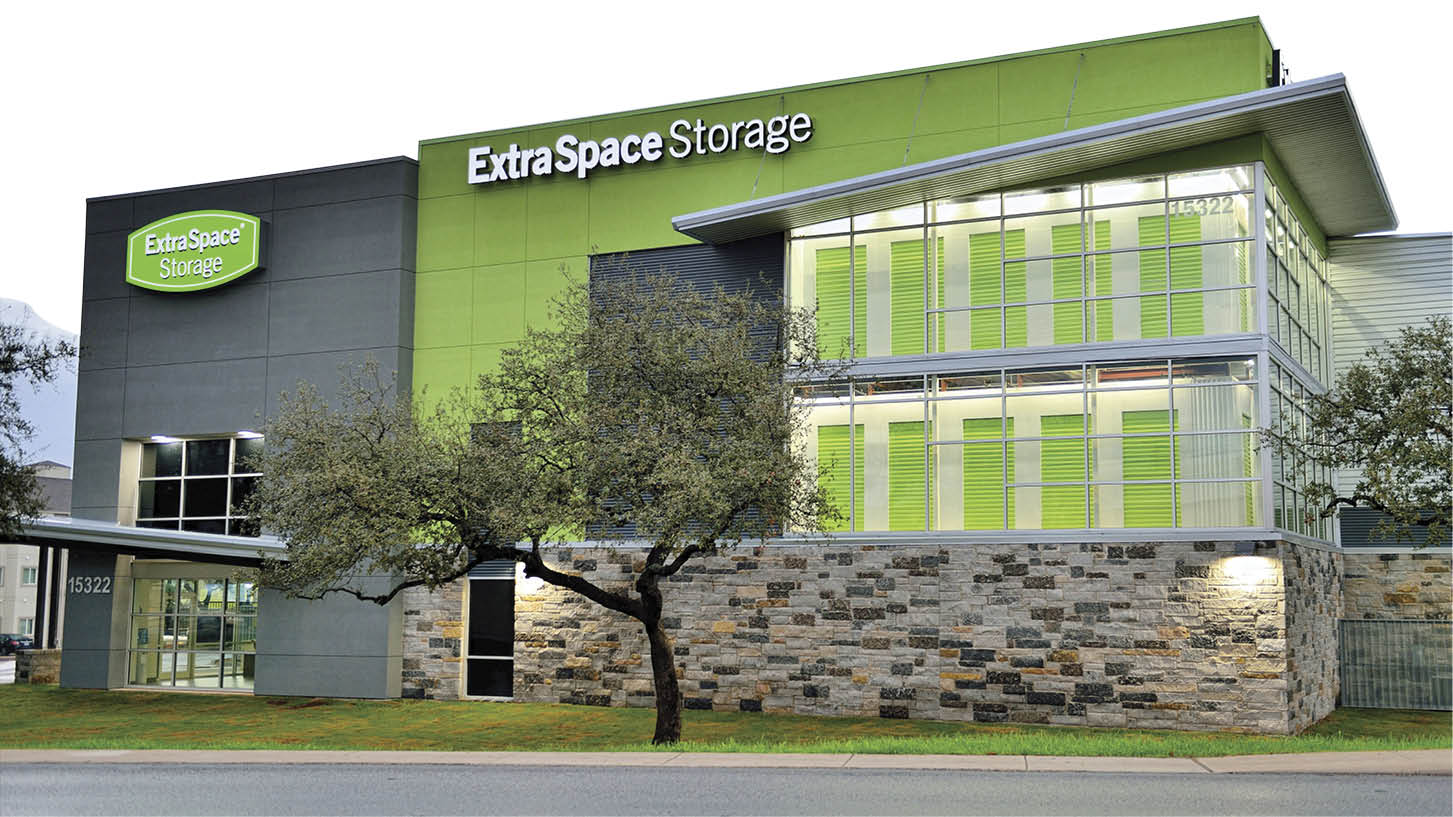
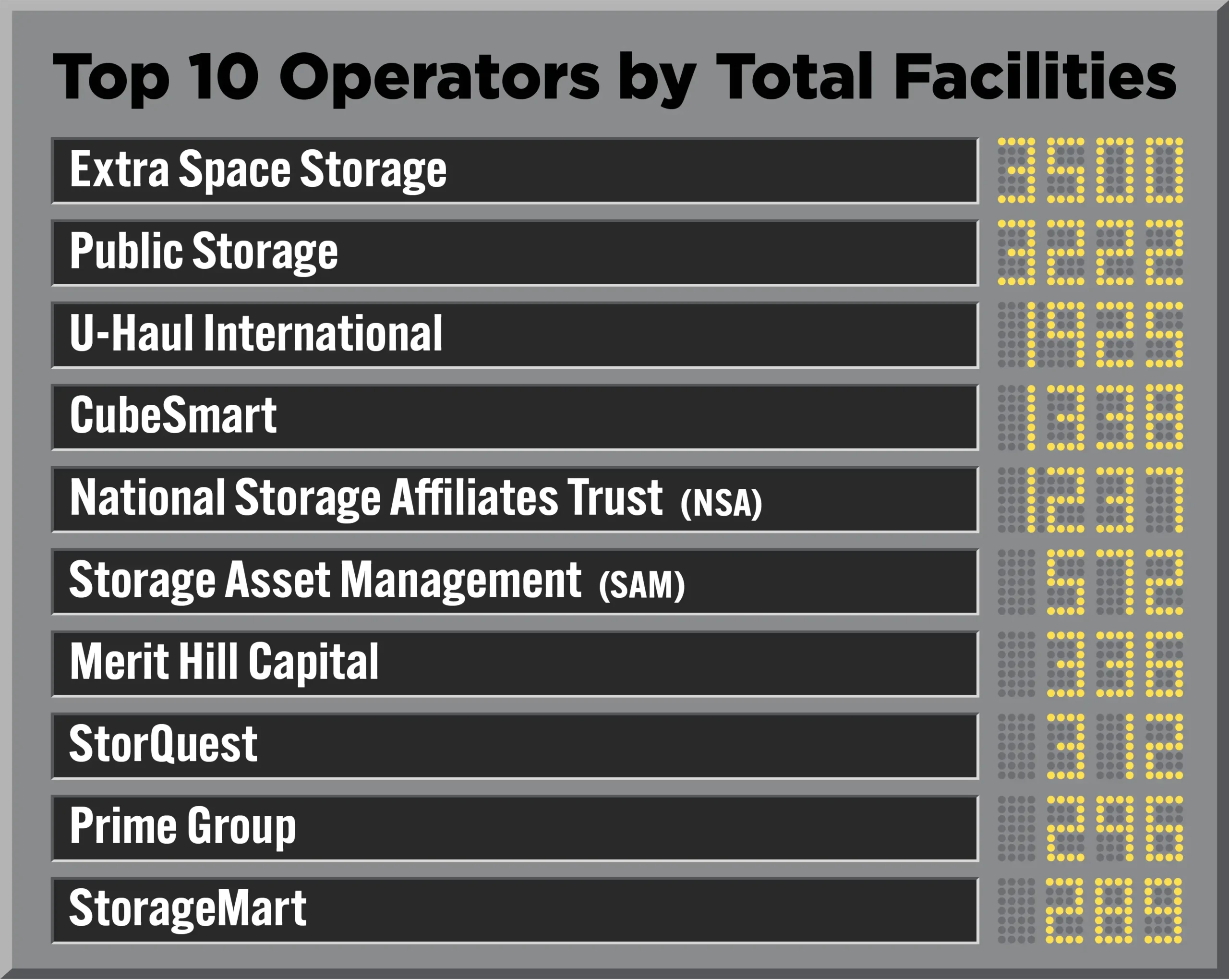
ith the approval of both companies’ shareholders, Extra Space Storage and Life Storage completed their previously announced merger on July 20, 2023. Together the REITs have become the largest self-storage operator in the United States (based on total number of facilities) with more than 3,500 locations across 43 states, approximately 270 million rentable square feet of storage space, over two million customers, and an enterprise value of approximately $46 billion.
Though the two REITs had a market overlap of 80 percent, the addition of Life Storage’s portfolio has increased Extra Space Storage’s presence in Texas, Florida, and the Southeast. What’s more, Extra Space had no locations in Arkansas, Iowa, or Buffalo, N.Y., prior to the merger.
Since many self-storage professionals were mulling over the specifics of this record-breaking deal, Messenger sat down with Extra Space Storage’s CEO Joe Margolis to shed some light on the matter.
Margolis mentions that the merger will enable Extra Space to improve its balance sheet, lower its cost of capital, increase its buying power, expand its third-party management and bridge landing platforms, and form better industry relationships. On the corporate level, the REIT has already achieved some G&A expense savings by eliminating duplicate, higher level functions. For instance, there will be one board instead of two (although the Extra Space board has expanded from 10 to 13 directors with the addition of Mark G. Barberio, Joseph V. Saffire, and Susan Harnett), one executive team of C-level positions, and fewer administrative roles.
Alternatively, he says that there are “almost no redundancies” at the store level. “We need those employees to run the stores.”

As for facility operations, Margolis states that all of Life Storage’s stores are being moved up to Extra Space’s platform of proprietary and integrated systems. At the same time, the company will be analyzing Life Storage’s systems in search of possible improvements that could be incorporated into Extra Space’s platform to optimize operations.
Despite the substantial savings, it was digital marketing that motivated their decision to operate under two brands. Margolis explains that having both Extra Space and Life Storage pop up in “storage near me” search results doubles the REIT’s digital real estate, which can meaningfully impact its overall performance.
When Extra Space Storage and Life Storage merged in July, the real estate investment trust also obtained Life Storage’s Warehouse Anywhere subsidiary in the deal. However, it wasn’t a business model that Extra Space wanted to pursue. According to Joe Margolis, CEO of Extra Space Storage, third-party logistics for warehousing isn’t their area of expertise. After assessing its potential, the REIT didn’t like the profit profile of the business or its scalability. “It’s not storage,” he said.
For those reasons, Extra Space Storage sold the Warehouse Anywhere division to a group of former Life Storage employees. Terms of the deal were undisclosed. Now a standalone business, Warehouse Anywhere, which was launched in February of 2021 and is based in Williamsville, N.Y., has a workforce of 40 employees and may hire another five to 10 employees—all of which will have an ownership stake in the company. Anthony Habib, an owner and CEO, has led the division since early last year. His partners include Eddie Killeen, former Life Storage COO, and Steven Ciemcioch, former Life Storage president and head of business development. Ansir Junaid, chairman and CEO of the SupplySide Group based in Cleveland, Ohio, is an investor.
Warehouse Anywhere is a tech-enabled third-party logistics business that provides supply chain solutions for primarily small businesses and facilitates last-mile delivery of goods to homes and other businesses. It also delivers real-time data for inventory management and handling distribution. Instead of owning real estate, the company rents storage space—about 12,000 storage units nationwide—from various self-storage operators, including Extra Space Storage.
“… regardless of brand, the stores will be operated in similar manner, focused on providing a clean and safe storage facility and excellent customer service driven by our strong technology platforms,” adds Margolis.
While operating under multiple brands may be an uncommon strategy within the self-storage industry, Margolis says that “it’s nothing new,” pointing to the hotel industry as an example. “Marriot has many brands.” To be exact, Marriot has 31 brands, all of which offer different features at varying price points to accommodate any prospective customer.
When it comes to further expansion of the portfolio, though, Margolis clarifies that new stores will most likely be brought on as Extra Space Storage. However, that decision will be made on a case-by-case basis as some markets may be better suited for the Life Storage brand, such as those where it already has an established presence.
“We are laser-focused on integrating the Life Storage portfolio and people onto the Extra Space platform, extracting the synergies we have identified, and preserving our culture and values that have led to our consistent performance,” he says. “After smoothly integrating the Life Storage portfolio, people, and systems, we will turn to the external growth opportunities we believe will be available through this merger.”
Eventually, the merged REIT will resume external growth through acquisitions and ground-up development.
Why will consolidation continue? The answer comes down to scale, the importance of which cannot be overstated. With technology at the forefront of self-storage operations, and customers seeking elevated storage experiences, it’s becoming increasingly more difficult—and costly—for independent owner-operators to compete with larger regional operators and REITs. Many mom-and-pops have begun acknowledging this growing reality. In the first half of 2023, more than 100 self-storage owner-operators hired Extra Space for its third-party management services; its third-party management platform is the largest in the industry.
“Big operators have advantages,” he says, pointing to data, pricing, and technologies as a handful of operational components that economies of scale can make more affordable and effective. “It’s difficult for smaller operators to compete.”
He goes on to say that “NOI and occupancies won’t likely be as good” for independently operated facilities that share a market area with REITs and other larger operators.
For independent owner-operators to better compete and enjoy similar economies of scale, it may be necessary to employ a third-party management company or join a storage cooperative. Margolis says that most facilities “do better” with third-party management, but he adds that owner-operators should “only do it if you truly want them to manage it. Don’t hand over the keys and then ask to drive.”






Sharing is Caring!
Ten Reasons To Share Your Data
By Brad Hadfield
1
More Transparency Helps Everyone
“Keeping our data in silos means that only the largest operators have enough operational and market data to make informed decisions. It’s in all of our best interest to safely and anonymously provide our data.”
– Don Clauson, CEO of Strat Property Management
“In today’s data-driven world, the power of knowledge lies in collaboration. Embracing data sharing not only fuels innovation but also accelerates progress. All major research supports data sharing because it’s the cornerstone of collective advancement.”
– Andrew Capranos, President of 10 Federal Storage
“Sharing data ultimately makes the end-user experience better, allowing owners to use the information to better understand the needs of customers and tenants.”
– Adam Wagner, President of Superior Storage
– Mike Burnham, CEO of StorageMart
“People don’t want to give up what they believe to be confidential information. What they don’t realize is that a lot of this information is already out there.”
– Chris Sonne, Executive Vice President, Newmark Valuation & Advisory Group
“Operators fear that by sharing their data they are providing their direct competitors with their ‘secret sauce.’ However, prices and unit sizes are mostly available online.”
– Travis Morrow, President of National Self Storage
– Chris Sonne
“A common argument I hear is, ‘If the REITs have independent owners’ data, they’ll use it against us.’ They’re going to do that anyhow … Publicly traded companies are great at getting intel because they have more resources at their disposal. But, if mom-and-pops can join together to share data with one another, we can compete more effectively.”
– Adam Wagner
– Mike Burnham
“Sure, you could search for ‘10 facilities near me,’ but you can’t identify a specific property. Aggregated data offers the anonymity that’s so important to owners.”
– Chris Sonne
– Chris Sonne
– Mike Burnham
“REITs have to release some data, such as occupancy every quarter by each market they play in. But ultimately, they only have to give as much detail as they choose to provide which can lead to inaccurate assumptions about the industry as a whole.”
– Jeff Adler, Vice President of Yardi Matrix
– Mike Burnham
“Sure, you could search for ‘10 facilities near me,’ but you can’t identify a specific property. Aggregated data offers the anonymity that’s so important to owners.”
– Chris Sonne
– Chris Sonne
– Mike Burnham
“REITs have to release some data, such as occupancy every quarter by each market they play in. But ultimately, they only have to give as much detail as they choose to provide which can lead to inaccurate assumptions about the industry as a whole.”
– Jeff Adler, Vice President of Yardi Matrix
– Gartner Research
“Businesses that harness the power of a large, communal pool of data can expect to provide more customer value because users of the data more fully understand their customers’ needs, and in turn to foster a more loyal and satisfied customer base.”
– Forbes
“A combination of information from different environments and businesses can lead to the creation of a range of information that could not otherwise be derived from a single specific data set.”
– Harvard Business Review
– Mark Poole, Director of Operations, Liberty Investment Properties
“Benchmarking, when you’re working with accurate data, has enormous benefits. Owners can see how their operating expenses compare to the market. They can see what concessions others are offering. And they can decide whether they can sharpen their pencil on rents a little.”
– Chris Sonne
– Mike Burnham
“The proliferation of property management software, which has moved data to the cloud, makes the sharing of data easier. It’s as simple as turning on a ‘switch’ for the operator.”
– Travis Morrow

2023 Manager Of The Year
Jenny Rodrigues
of ‘Ohana Self Storage
By Erica Shatzer

or those living on the mainland, family is typically defined as blood relatives. On the Hawaiian Islands, however, family, or ‘ohana, has a much deeper meaning. To embrace ‘ohana means to develop a sense of familial care and devotion to all members of the human family so that everyone has what they need to survive and live joyous lives. In addition to their biological relatives and members of their extended families, Hawaiians often include friends and neighbors in their ‘ohana.
Our 2023 Manager of the Year, Jenny Rodrigues, property manager of ‘Ohana Self Storage in Honolulu, embodies the essence of ‘ohana and treats every customer like a relative. Since taking the helm at the beginning of 2022, she’s also managed to transform the formerly neglected property into a safe and inviting space for its entire self-storage family.
An Incredible Undertaking
“I knew right away of only a handful of people in the storage industry who could handle this turnaround and investigation of so many unknowns,” says Mixon. “Jenny Rodrigues was definitely my first choice to help this kind, unsuspecting owner turn this property back into a profitable business entity.”
Mixon had worked with Rodrigues about 20 years prior to that audit and was well aware of her many strengths and abilities. She was partially responsible for opening and managing Waikele Self Storage in Oahu in 2003, and Rodrigues’ adaptability was revealed when she rented her first unit from the trunk of her vehicle before the facility’s office was in place. Mixon also knew that Rodrigues had the necessary customer service skills to tackle ‘Ohana Self Storage’s unresolved units, having completed a whopping 374 rentals over the phone in one month when she was employed at the StorQuest call center.
While intrigued by the challenge of turning around the approximately 2,500-unit facility, Rodrigues wanted to see the site before agreeing to take on the massive mission. “I was blown away,” she says about the facility’s laundry list of issues. Her findings left her “speechless,” but she was willing to roll up her sleeves and restore order.
Rodrigues felt the best approach would be treat ‘Ohana Self Storage as if it was a brand-new facility and “start from scratch.” This mindset enabled her to effectively prioritize the countless duties she would have to complete to get the property back on track.
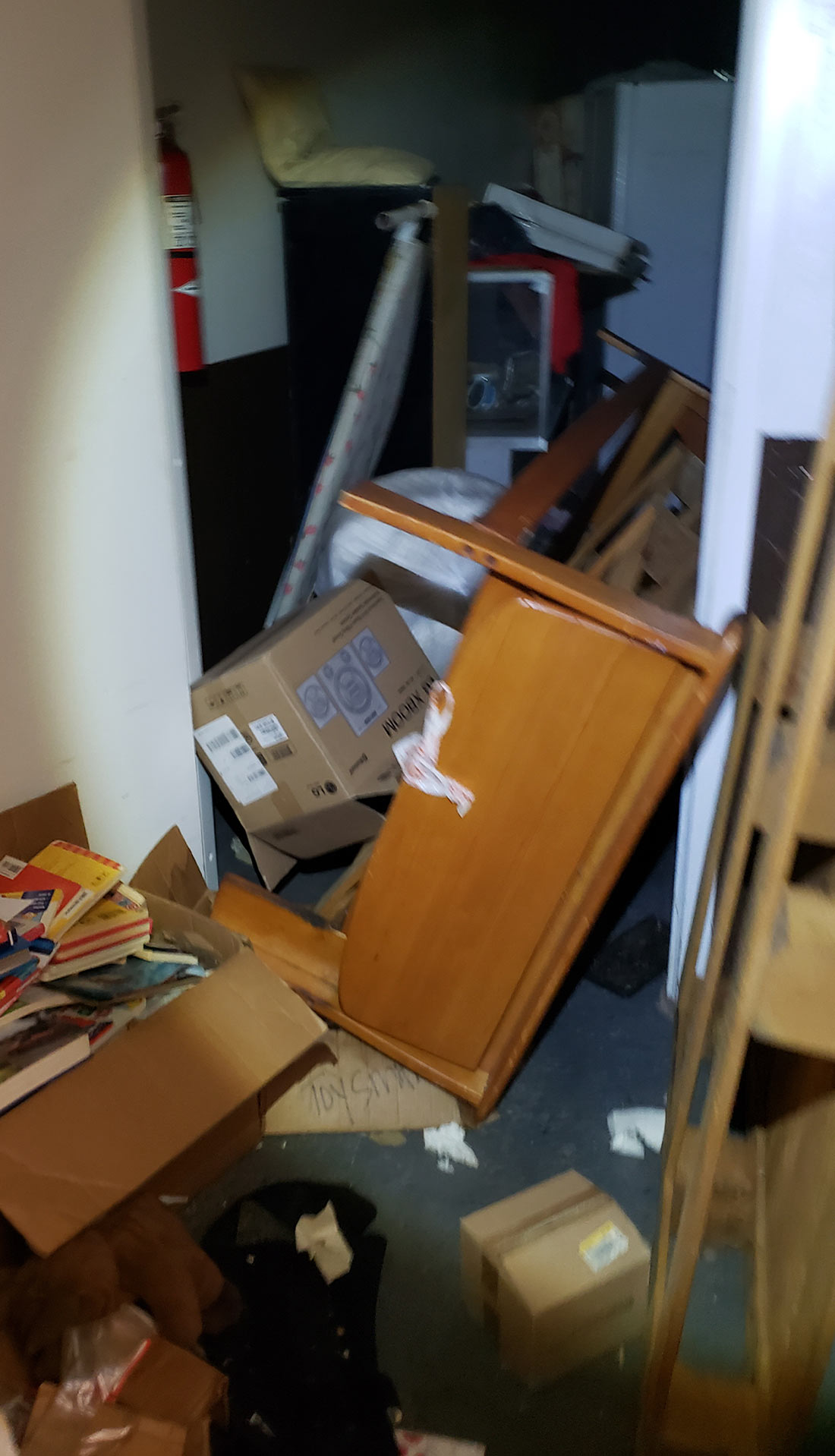
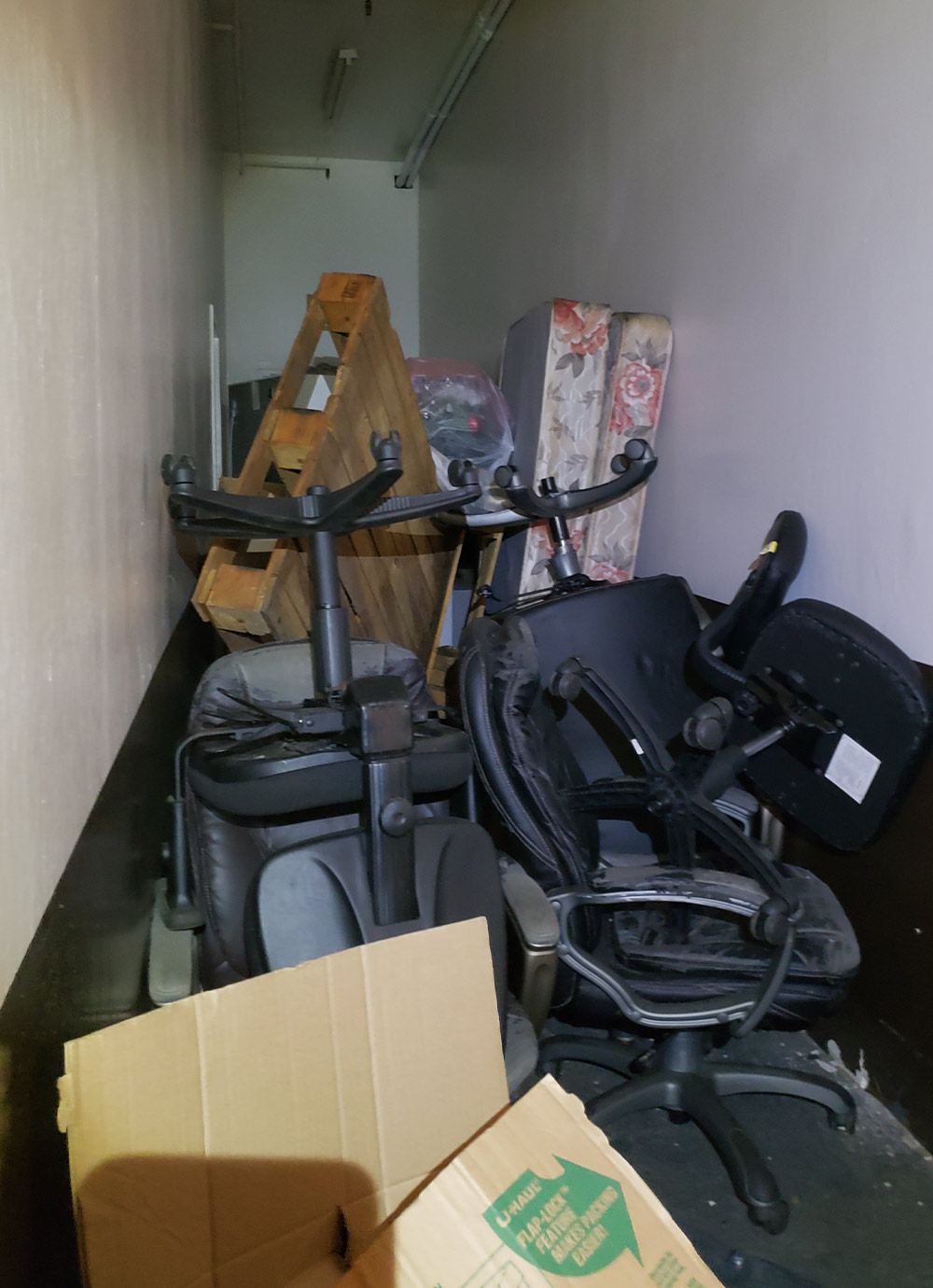
Other safety issues at ‘Ohana Self Storage included rats, lighting, garbage, inaccessible emergency exits, a nonexistent site map, and overall uncleanliness. Rodrigues uncovered and recorded these problematic matters during her initial walk through of the property. She then came up with a logical sequence for dealing with those potential hazards.
The trash would need to be removed before the other items on the to-do list could be addressed; it took four 40-foot containers to clear the garbage that had accumulated throughout and around the two-story building. She recalls that trash was “overflowing at the emergency exits,” leaving those doors completely impassable.
With the garbage gone, Rodrigues was able to start thoroughly cleaning the entire property. Walls and doors were wiped down. The aisles and empty units were swept and mopped. Things were beginning to look brighter and better when an existing customer requested that she mop a spot on the floor within his unit that had been present since he moved in. After mopping the stubborn spot several times, she requested assistance from the maintenance man. Scraping off the spot released an unsettling odor, proving that it was fecal matter—a shock that left Rodrigues wondering if squatters or homeless people had been occupying the facility.
After the deep cleaning, Rodrigues focused on the rat infestation that was plaguing the property. Although they had pest control, tenants relayed to the new management that their stored belongings had been damage from rodents, so she ordered dozens of bait stations. She then set up two bait stations per aisle, one near each fire extinguisher, for a total of 30 bait stations. Rodrigues later learned that the closest wall of the neighboring property (a prison) belongs to its mess hall, which may explain why ‘Ohana Self Storage was infested. She says it took approximately a month and a half to eradicate that problem, but thankfully there haven’t been any sightings since, nor any new reports of rodent damage, and only a handful of carcasses had to be discarded.
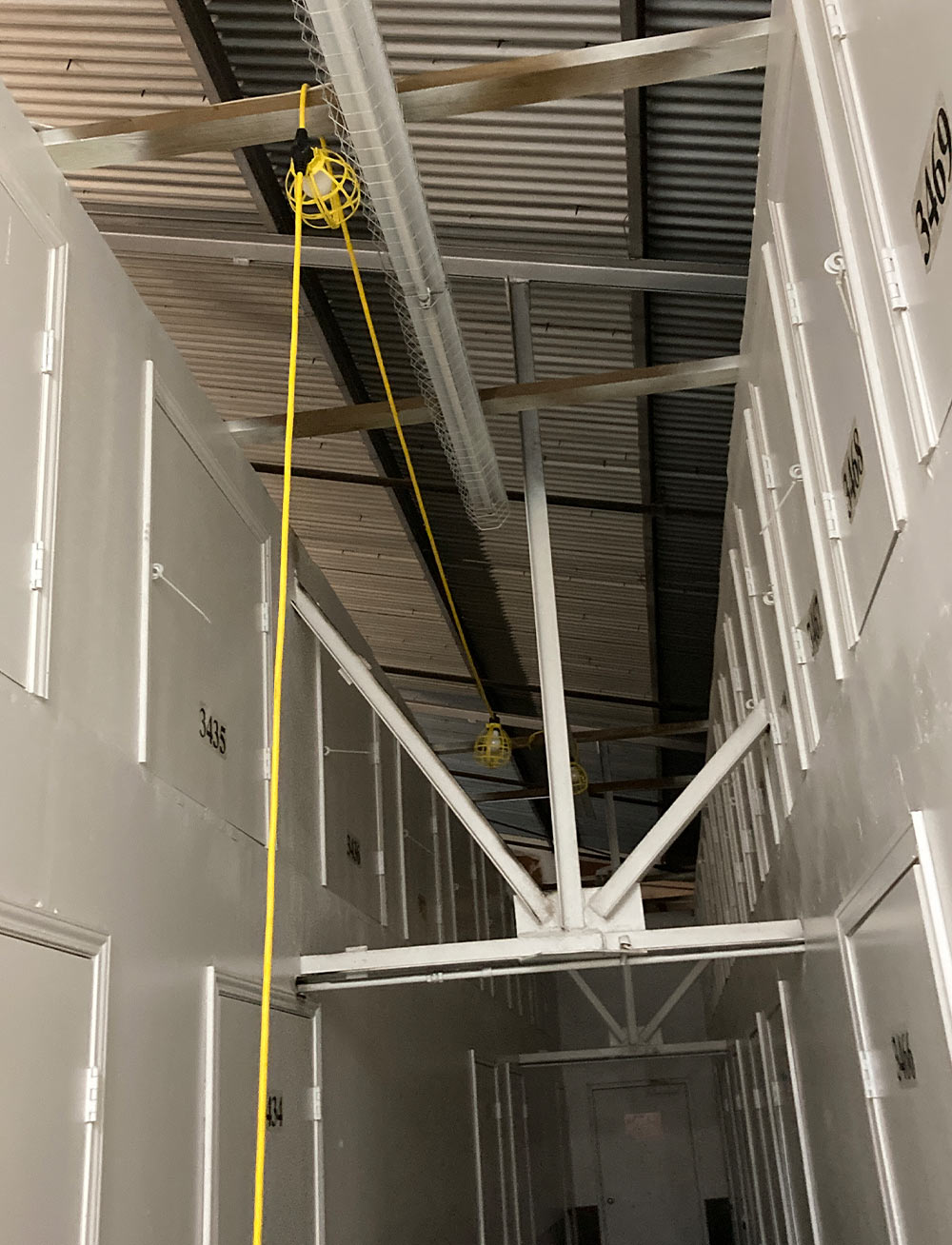
Originally, the next task was expected to be a hefty expense. None of the hallway lights at ‘Ohana Self Storage were operating, and numerous droplights powered by extension cords snaked throughout the 20-year-old, wooden facility—a hazard she feared would cause the property to go up in flames. They assumed an electrician would need to be hired to replace all the ballasts and/or fixtures, but Rodrigues, with her unwavering optimism, had the maintenance man remove the fluorescent tubes and insert new lightbulbs. To everyone’s astonishment, all the old bulbs were merely burned out and never replaced. The potentially dangerous droplights and extension cords were unplugged and taken down.
“Tenants had been using flashlights and cell phones to get to their units,” Rodrigues says, adding that she’s had to remind some tenants that the hallway lights are in working order because they were accustomed to navigating the property in the dark.
Around this time in the rehab, someone broke the store front glass. Rodrigues arranged for it to be replaced and then began changing the latches on the storage units to make the wooden swing doors more secure. She’s also been reminding customers of the importance of high-quality locks after finding units without locks, as well as doors secured with zip ties and twist ties.
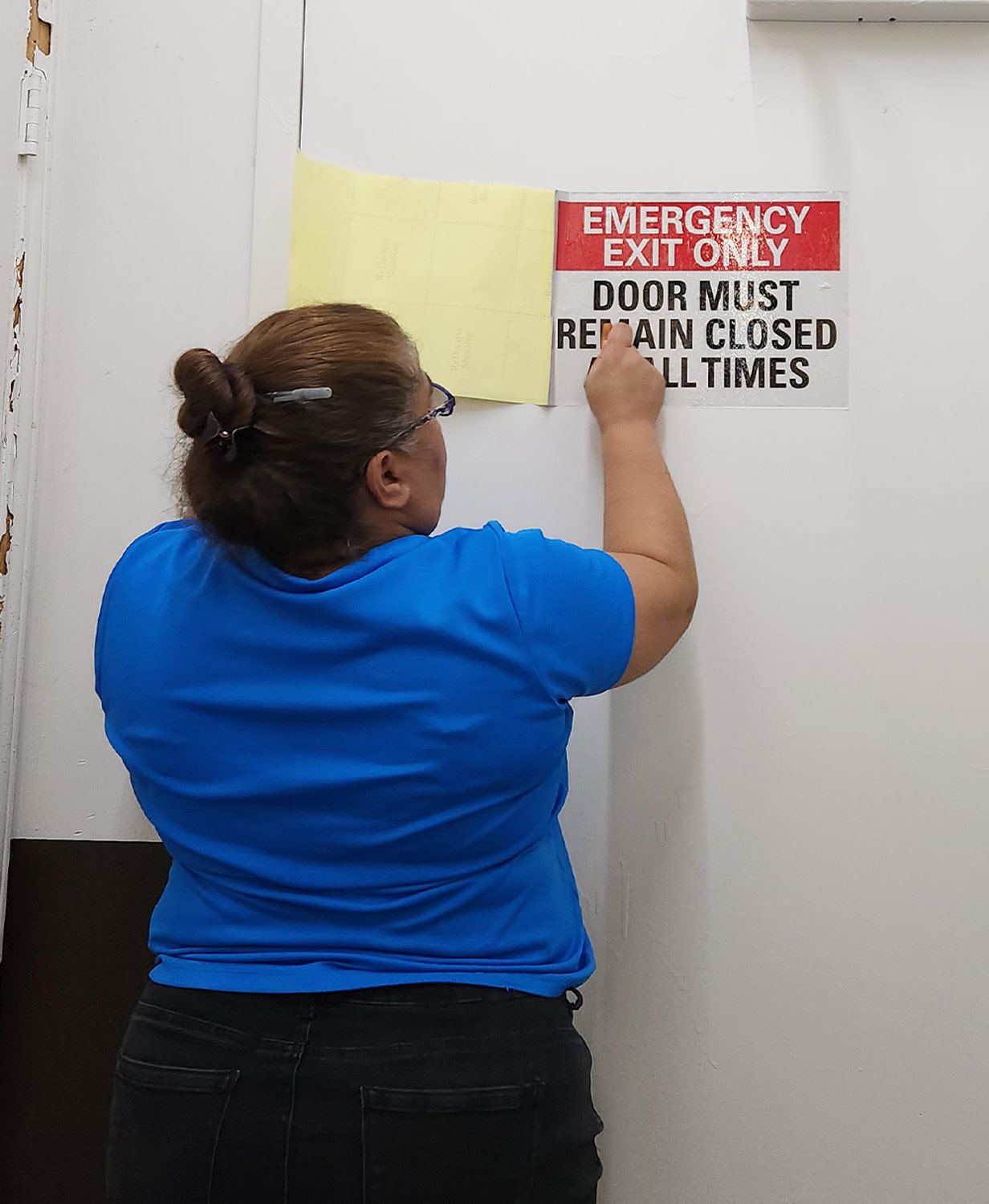


“I want to get that space cleaned up and get racks to offer kayak and board storage in that area,” she says. “We would need to modify the space to block off the emergency exit from the board storage, but it is very possible.”
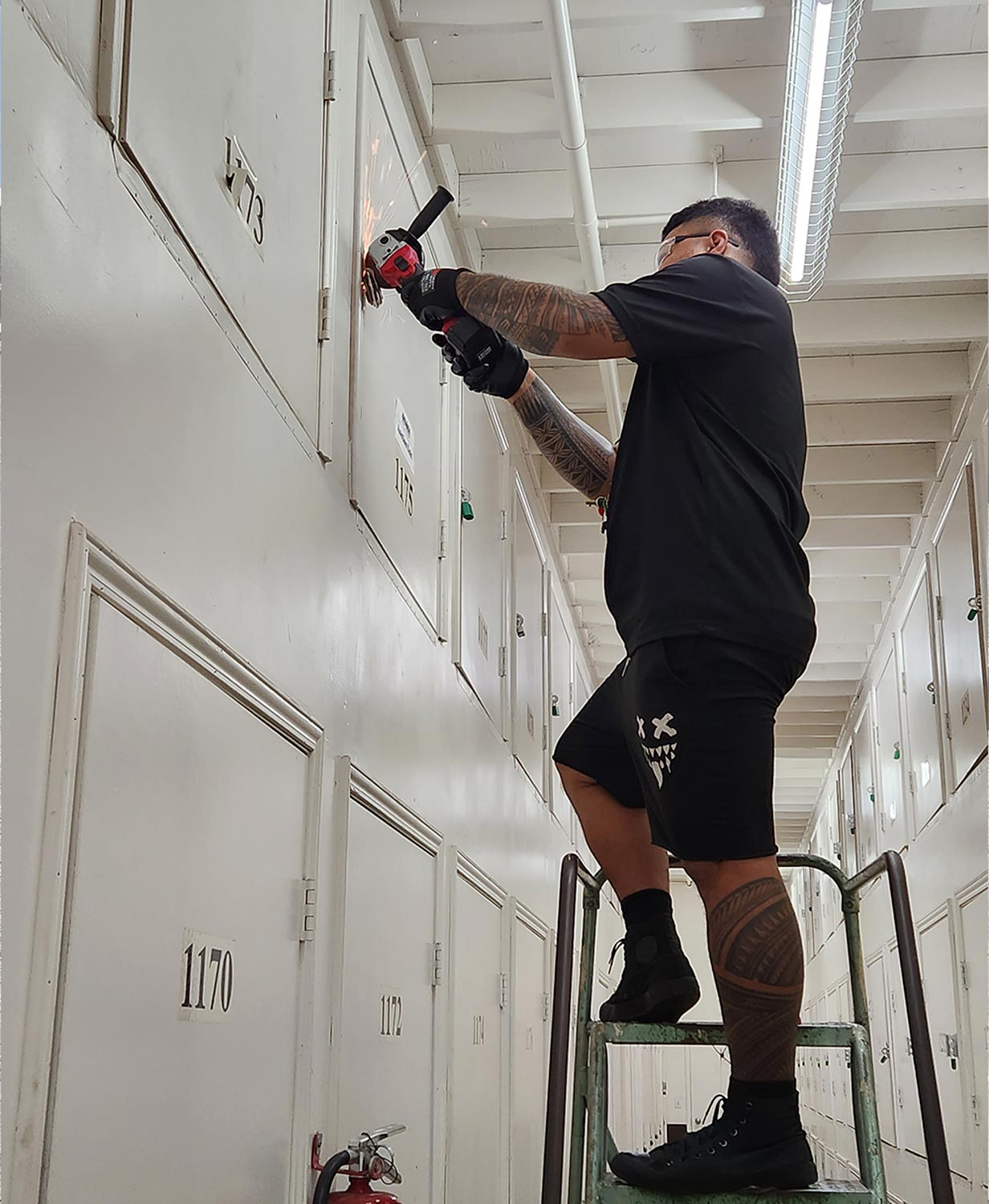
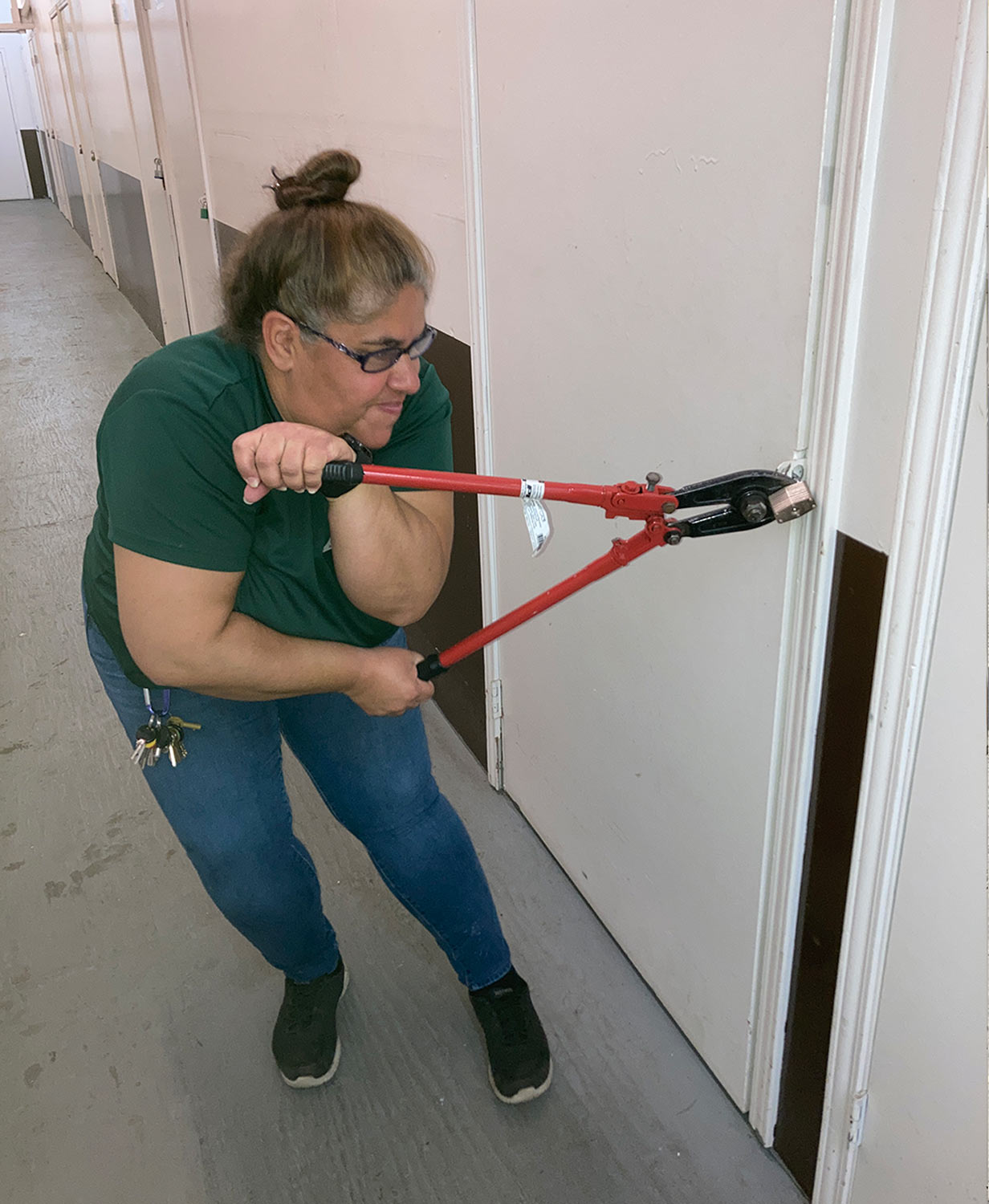
“With this we were able to solve a lot of them,” she says. It took her seven months to shrink the number of unknown units to approximately 300. “We are currently down to less than 200 of these units.”
Rodrigues goes on to say that many of the unit doors were secured with green locks, making it impossible to identify the vacant units by the lock color alone. Therefore, she had to cut locks off the units that weren’t in the property management software to determine whether they were indeed empty. While some were vacant, a few exposed another alarming mess she had to clean up: huge piles of old mail that should have been sorted and delivered to the rental mailboxes at the facility.
“As of February 2023, we started auctioning these unclaimed units to clear them out and free them up for paying tenants,” she says. “We have sold 138 unclaimed units so far and have 133 more to auction. Of those unclaimed units, 25 went unsold and we have made $9,812.22 from the remaining 113 that were sold.” Rodrigues has held nine separate auctions since taking over as the property manager.
Last but not least, she also corrected the inaccurate data within the property management software. Some tenants had been paying rent for a 4-by-4 locker when they were really renting 10-by-10s. According to Rodrigues, they do offer lockers in that size, but they obviously cost significantly less per month. The lockers, which account for nearly half of the facility’s unit mix, are located above the “walk-in” units. She purchased two new rolling stairs for tenants to safely access the lockers and intends to buy four more as she continues to rent them at a promotional rate of $20 per locker.
“She treats everyone like she knows them,” says Mixon, who describes her personality as welcoming. “She knows their stories. She’s friendly, good with customers, and wants to help them and make people comfortable. She makes them feel like family.”
Rodrigues also goes above and beyond for customers and finds way to make renting at ‘Ohana Self Storage a better experience. For instance, she had the facility’s website updated so customers can reserve units, make payments, and update their contact information online. Additionally, on top of keeping a log for packages, she started texting tenants to notify them of their deliveries.

“… we have been averaging 20-plus rentals per month, so we are slowly climbing back up to where we want to be.”
Late fees can be another source of contention, so Rodrigues has implemented several procedures to assist with delinquency control. They now email invoices for free and charge $1 per paper invoice that is mailed. Payment reminders are made via telephone, email, and text before a late fee is applied. As for additional sources of revenue, she’s initiated a rental insurance requirement in which they earn 50 percent of all the premiums collected, a $15 administrative fee on new rentals, and a retail display for selling packing and moving supplies at a 50 percent markup.
Calm After The Storm
Although turning the facility around has been a whirlwind of an experience, Rodrigues has taken it all in stride and aims to make even more waves as a positive force for her property, community, state, and the self-storage industry. In addition to the aforementioned tasks, she managed to host a food drive for the Hawaii Foodbank, attend several industry conferences, and collect donations for victims of the devastating Maui wildfires. Now she’s planning to secure funding for a local school’s senior party and luau.
Clearly, whatever storm may come down the line, ‘Ohana Self Storage is guaranteed to have smooth sailing with Rodrigues steering the ship!

ithin four years, Ron Pell has become a pillar of his community through his position as a property manager at a Morningstar Storage facility in Ladson, S.C. Now his exemplary customer service skills and innate ability to generate support for local charities and small businesses have earned him the title of first runner-up in Messenger’s 2023 Manager of the Year competition.
Although Pell doesn’t consider himself to be an “outside salesperson,” nor the kind of person who would excel at making cold calls or unsolicited visits, his inviting and informative approach to sales has enabled Morningstar Storage’s 3772 Ladson Road location to experience year-over-year occupancy growth, from approximately 78 percent when he started to around 95 percent today. Being modest about his success, he says his method for securing new rentals is easy yet effective: “I just have conversations with people.” However, it’s much more than small talk. During those exchanges he listens carefully to customers’ stories to determine their needs, relays information about the facility and its rental process, gains their trust, and offers storage solutions—all of which require focus, feeling, and finesse.
“As a customer service professional, Ron has consistently displayed extraordinary commitment to serving his customers with utmost dedication and care,” says Michelle Odom, district manager at Morningstar Properties, LLC. “Countless customers have raved about the wonderful experience they have had while working with him, highlighting his ability to create a stress-free storage process by getting to know them as individuals and providing tailored support.”



He first learned about Hearts for Summerville, a newer nonprofit organization that serves the youth within the community, when they provided notice of their intention to move out of their rental unit. Respecting their mission and philanthropy, he provided them with a complimentary unit to hold items from their food, clothing, and toy drives. Pell also allows them to use the facility’s moving truck for free to make deliveries and hosts yard sales that enable the charity to raise awareness and collect donations.

What’s more, Pell garners support for all of the nonprofits present at the facility by promoting their events, displaying their promotional flyers, and directing donations to their doors. “Tenants donate items they no longer want,” he says. “I connect them to the nonprofits.”
Odom adds, “By fostering collaboration and synergy among these charities, Ron has amplified their impact on the community.”
She was particularly impressed with his holiday display that included five artificial Christmas trees and signage stating that Morningstar Storage proudly supports the charities that trimmed them. Pell wasn’t named the winner of that annual, company-wide holiday decorating contest, but it was a win for the five nonprofit organizations represented in the display.
“During the holiday season, Ron’s creativity and compassion shone through when he involved all the supported charities in a heartwarming office decoration contest,” says Odom. “By inviting them to decorate trees that showcased their exceptional work, he brought attention to the great initiatives the organizations are undertaking, creating an even stronger sense of community and goodwill.”
Commercial tenants at Morningstar Storage on Ladson Road are promoted in a similar fashion. Pell mentions the small businesses that rent units at the facility during tours and touts their products. For example, two of his tenants are candlemakers and their handmade creations keep the facility smelling sweet. After informing customers about the source of the fragrance, he points out their units and encourages them to shop local. Pell has plans to further promote the small businesses by creating office displays and hosting vendor event such as pop-up shops.
Pell also provides the same extraordinary level of care to the facility and the company.
“Ron’s commitment to finding innovative solutions and saving money is commendable,” says Odom. “His impressive efforts in negotiating a deal with a new elevator vendor for his and sister sites resulted in annual savings of $1,800, with additional long-term savings of $15,000 every five years. Furthermore, his hands-on approach to maintenance and repair tasks, such as building a new garden area on the property, exemplifies his dedication to maximizing efficiency and cost-effectiveness.”
And in response to these praises, Pell replied that he was pleasantly surprised by the win as well as the nomination, especially since Morningstar has 107 stores. “I like everything about my job and Morningstar Storage,” Pell says, adding that he didn’t realize he was doing anything worthy of recognition—he was just doing his job. But when you do what you love, love shines through all that you do!
or a decade, Kelly Maas has been exceeding everyone’s expectations at York, Pa.-based Investment Real Estate, LLC (IRE), as the property manager of Moove In Self Storage in Finksburg, Md. Throughout that time, she’s received a promotion to senior property manager and earned about a dozen company-wide awards, including three in 2022. This year she adds second runner-up of Messenger’s 2023 Manager of the Year contest to her long list of honors and achievements!
“The property struggled for several years to reach its milestones until Kelly provided her magic touch,” says Shaun Levy, IRE’s vice president of operations. “She shines and so does the property.”

“During the construction, she also served as a ‘pseudo’ project manager as she was able to give input and insight daily to the construction team to enhance the expansion project itself,” Levy says.
Thanks to her waiting list, those new temperature-controlled units were filled the moment they became available. The facility consistently remains more than 90 percent occupied because of her passionate management style.
Although Maas humbly states that the facility’s in-demand features (the only temperature-controlled units in the area) and prime location (right off the highway in a high-traffic area of Finksburg) enable the units to practically rent themselves, her five-star Google reviews and numerous repeat customers speak volumes about her personality and proficiency as a property manager. Her tenants most often describe her as awesome, helpful, friendly, and knowledgeable, and she’s known to go above and beyond for each customer.
“Kelly has found a way to expertly hold the needs of the business and the pleasantries of customer service in the same regard and has found a happy medium on many occasions. She represents all of our fundaments,” adds Levy, who calls Maas dedicated, diligent, and thorough. “She really is a pleasure to work with.”
All her colleagues agree with Levy, so they regularly contact Maas when they need assistance with the property management system, advice on customer service challenges, or guidance during special circumstances. She’s also a “trusted trainer” within their organization. Maas has trained around a half dozen new hires and provided input that was instrumental in improving the company’s training program.
Since mentoring is her preferred activity, and she loves watching managers grow, learn, understand procedures, and reach goals, she makes herself available to anyone at any time. In fact, Maas is so willing to offer guidance and “share the why” that she actually purchased a wireless, hands-free Bluetooth earpiece in order to help other managers no matter what duties need to be done at her facility. She’s often on a call while pulling weeds, picking up trash, or cleaning the property.
“She continues to be a mentor for both new and seasoned managers, along with voluntarily coordinating group training sessions on topics that can, and do, benefit managers across our portfolio,” Levy says, adding that Maas has also helped transition new acquisitions into the Moove In Self Storage portfolio.

As for the management side of self-storage, she has that down pat, which is why IRE named her the company’s most valuable property manager in 2022. “We award this moniker to the person who averages ranking the highest in our eight company-wide recognition categories,” says Levy. “Those include highest autopay, highest insurance, highest average unit occupancy, most net rentals, highest unsold unit percentage, earned five-star Google reviews, and the culture award … Kelly not only averaged ranking the highest, but there was also no other manager even close to her average score, making her the landslide winner of this esteemed award.”
Maas was honored with two other company-wide awards last year for having the lowest delinquency rate and best representing the company’s culture. The lowest delinquency award was earned for retaining the lowest delinquency rate in the company for the entire year. She managed to keep the Finksburg location’s rate below one percent by making collection calls, informing delinquent tenants of the payment options, signing tenants up for autopay, and working with past-due tenants to settle their debts.
The culture award was given to Maas because she “lives by and demonstrates” IRE’s fundamentals every day. “Kelly earned this award for being the person who received the most kudos from her colleagues and supervisors,” Levy says, “along with being the person who had the most engagement herself with the app in which she provided kudos to those deserving of it.”
Of this recognition, Maas simply expresses her fondness for the company, its “do-the-right-thing” culture, and self-storage. “It’s such an honor to be ‘part of the herd!’”

For articles about previous Manager of the Year winners, visit ModernStorageMedia.com and click on the Topics tab.
deas are like seeds. When planted in the mind of a determined woman, and cultivated with sensibility and persistence, they take root and flourish. Sometimes the hardiest of ideas propagate others or produce a thriving business. That’s precisely what happened when Pam Domingue, owner of Storage Solution, was presented with a self-storage seed back in 2007.

deas are like seeds. When planted in the mind of a determined woman, and cultivated with sensibility and persistence, they take root and flourish. Sometimes the hardiest of ideas propagate others or produce a thriving business. That’s precisely what happened when Pam Domingue, owner of Storage Solution, was presented with a self-storage seed back in 2007.
However, they discovered that self-storage was “more of a hands-on business” than they initially thought. So, they began by doing what everyone was doing at the time: finding a retired couple, a family in this case, and having them run the business.
“The store did all right, but we quickly learned there was a lot more to it,” says Pam. “We had to modernize the facility. They were running it with stock cards, and no one paid late fees. No advertising, no customer service. We realized that our management couple was not up to the task, and they opted to leave. We had to hire a manager who could focus on sales and handle the technology.”
Pam goes on to say, “It’s not a passive business, it’s an active business,” admitting that she had to backpedal and promptly learn as much as possible about self-storage to give their new venture a chance to prosper.
Pam attended national and state trade shows to learn everything she could about how to run a self-storage facility. She networked with other owners and met some of the industry veterans, many of whom she is proud to call her friends today.
“Some of the early advice I received came from industry icons such as Don Temple and Barry Hoeven,” says Pam. “Don advised me at the first tradeshow I attended to ‘listen, learn, and talk to other women.’ There were not a lot of women there at the time, and he knew that was changing. Barry taught me to put myself out there and to give back. When you receive help from someone, try to pay it forward.”
With newly acquired knowledge, past experiences to reference, and unfaltering fortitude, Pam managed to push the defunct property to new heights within six months. “It was a mess,” she recalls. To get the facility up to par, she set up a computer system to replace the old-fashioned ledger cards. Security cameras and an access gate system were installed as well. “Having the systems in place increased our revenue by 20 percent in the first year and raised occupancy by six percent in the first six months.”




While organic growth in business is defined as an internal increase in sales, Pam describes the ways in which they acquired facilities as organic. For instance, it was the seller of the second facility in their portfolio who contacted the couple. The owner was selling his facility, which was near their Yucca Valley location, so the Domingues sold their second home and purchased the 29 Palms facility. The same seller also reached out to them a few years later to offer his Fontana facility when his partners wanted to sell.
They came to own other facilities within their portfolio in a similar fashion. Sellers in areas near their facilities would contact her about acquiring their value-add properties. “We slowly grew over time,” says Pam. “We grew organically.”
Currently, there are eight facilities within their portfolio and one under construction in Lancaster, Calif. Seven of those established locations are within driving distance (approximately two hours) of their home in California. The other property, Waikele Self Storage, is in Waipahu, Hawaii, on the island of O’ahu.
Pam, whose mother was born in Hawaii, wanted to take a tour of Waikele Self Storage while on vacation. At the time, Carol Mixon, owner of SkilCheck Services, Inc., was a co-owner of the facility. When she learned that Mixon’s partners wanted to sell the property, a handshake deal was done on the way to the Honolulu airport. In 2016, she purchased the impressive property, which includes 33 World War II ammunition bunkers that Mixon and her co-owners had converted into unique storage units. They are painted battleship gray and named after naval ships to assist with wayfinding; each bunker also features historical signage about the ship of its namesake. The facility offers 690 storage units of standard sizes as well as 280 parking spaces.
Although she bought the business in 2016, Pam didn’t take over management of the property until 2017. Then, in 2018, she was able to purchase the land under the facility. Previously, the land been leased.
“Most property in Hawaii is on land leases, so commercial property ownership is rare on the island,” she says. “A local developer purchased the property from Hunt Corporation, who received the land from the Navy in exchange for building the infrastructure. The developer saw the use as warehousing. Carol Mixon’s partners took it one step further and realized it would make a great storage facility. They brought in Carol and her former husband to help them build out the units and start the business. The developer sold off the individual bunkers as warehouses and yard space.”
Owning this property enables Pam to visit her Hawaiian relatives on a regular basis. She checks on the store every four to six weeks. “It doesn’t seem like a long flight now,” she jests.
As for the ground-up development project in Lancaster, Calif., that was the dream of Pam’s husband. He wanted to build a new facility and got the ball rolling before he became ill. After a two-year-long entitlement process, they are getting ready to break ground. Development wasn’t Pam’s idea, nor passion, but she’s carrying the load for her husband with help from some of the industry leaders in construction.
“I’m willing to try anything once,” she says about making decisions for the project and overseeing its development, “but I may not do it again!”
The two-story, 80,00-square-foot, climate-controlled facility is expected to be completed within 18 months. It will feature smart locks and covered RV parking.
“I’m big on education,” she says, noting that she sends her staff to industry events and recommends online training courses to enhance their skills. “We have a training program and do as much on-the-job training as we can. I also encourage them to attend Zoom events offered by our state association and usually take a few employees to Las Vegas for the Inside Self Storage Expo. It’s important to me that they stay up on the current trends and hopefully have some well-deserved fun while they are there. I help them grow, which helps me grow. I can learn as much from them as they can learn from me.”
Her employees aren’t the only ones benefitting from these educational experiences. “I learn something new at every show I attend,” says Pam, who doesn’t hesitate to put newly acquired knowledge to good use. “I’m always trying to figure out the best way to do stuff. I love seeing the new tech at the trade shows and I’m always ready to try something new.”
She’s used some of that information to create processes that streamline, simplify, and improve operations at her facilities. “It’s so much easier when bringing on other facilities,” Pam says about having defined policies and procedures in place. “We have a routine and a checklist now, which helps keep things in order. It’s a lot different than when we purchased our first and second facility; we had no idea what we were doing at the time.”
Staffing is another aspect of operations that Pam has been fine-tuning over the years. For example, she has moved away from hiring retired couples. “We hire the individual who is right for the job(s),” she says. “Too often with a couple, one is great and the other is not. One ends up doing all the work and this can be an issue. We would rather have two co-workers who are not related. We’re also getting away from resident managers at many of our facilities. With the technology advancements in cameras and gates, we no longer need that 24-hour, on-property security.” Residential managers present other issues as well, such as the additional expenses of housing, overtime pay for work done after hours, and potential eviction situations should they need to be terminated.
Instead of those previously preferred types of managers, Pam seeks employees who excel in sales and possess an inner drive to deliver exceptional customer service. “We must remember we are a sales business,” she says. “We are selling our facilities, our staff, and our services. We value all our customers and strive to offer the best experience we can.”
She currently employees 13 full-time and two part-time employees, but Pam has been “exploring” hybrid management options for her facilities because it can be “hard to keep and find good employees.”
“Small stores especially do not warrant the cost for a full-time employee,” she says. “While I do not see us embracing the remote management concept entirely, we have two satellite facilities that have staff at a nearby facility. This works well for us; our customers appreciate someone in the office helping them and answering questions. Technology can assist, but I don’t see it taking the place of our staff.”
Pam is tech savvy and personally favors conducting business online, but she realizes some storage customers enjoy having face-to-face conversations with managers. What’s more, she states that most of their referrals come from walk-in customers, which backs up her belief that “the person behind the desk creates loyalty.”
On-site managers can glean valuable insights as well. Pam values feedback from her employees and uses their input to make store-level adjustments. “They know their markets,” she says. “Each is different, and cultural differences are important.”
We have a wide range of customers, from millennials to retirees and businesses. They do not all want to be treated the same. I try to teach my staff to slow down and treat the person how they want to be treated. If they want to talk, let them tell you what is going on in their lives. If they are in a hurry, don’t over talk; try to help them on their timeline. Listening to what the customer wants is important.”
She goes on to say that a personalized approach is especially important at her Hawaiian facility because of the unique island culture. “With the cultural differences, you cannot just treat a customer the same as you do on the mainland,” says Pam. “They expect you to be part of their ‘ohana [family]. We have customers cooking for us, bringing us malasadas. You must understand their culture and be able to relate to them. They are often distrustful of mainlanders and like to deal with the locals. My family connections helped smooth things over when we took over the facility. It was managed by a mainland company; we have more of a family approach. While it’s difficult to hire in Hawaii, more difficult than California, I will say when you do find a good employee, they can be the best, very hardworking and loyal. I am lucky; when I am gone, I have a great team there.”

But the notion to rebrand their entire portfolio didn’t come into play until the Domingues began drawing up plans for their new build in Lancaster. Truth be told, Pam had no intention of replacing the brand name she had created in 2013 after buying their third property. She assumed the project would bear the Storage Solution name just like the others, but her husband had a different idea.

However, because they were already using Storelocal products at their facilities, Pam decided to take a “harder look at it,” acknowledging the SEO benefit of Storelocal branding. “It’s a good name, and the online benefits made sense.”
About letting go of the name she produced and lovingly cultivated for a decade, Pam says, “It was a big decision, and it’s a little scary. I love the business. I’m not tied to just the name, but it’s an ego thing. It can be hard to let go.”
Nevertheless, letting go of the Storage Solution branding has proven to be a shrewd choice, as taking on the Storelocal name has only sweetened her business thanks to improved SEO.
Collaboration and cooperation—the foundations of both Storelocal and the self-storage industry—are notions Pam whole-heartedly supports. In fact, it was the good will of other owner-operators that amazed her from the beginning and continues to uplift her.
“The car business was cutthroat,” she says. “Self-storage was such a change! Call anyone with a question and they’d help.”
She closes with a stellar example of the spirit of self-storage: When a car crashed into one of her facilities in Delano, Calif., Pam and Jack were stuck several hours away in one of the worst rainstorms southern California had seen in a long time. They contacted a nearby competitor, whom they had only met recently. He immediately contacted his contractor and instructed him to take a break from his project to fix her boarded up building. He even helped with having their contractor prioritize the rebuilding of their office, an act of altruism that kindled camaraderie. The Domingues now consider Josh Miller and his mother Tanya Miller of Storeland Self storage two of their “closest friends.”
“That’s literally the epitome of what the industry’s about—great people helping each other,” says Pam. “When we help each other, we all do better. To quote Storelocal, ‘We are stronger together.’”
nce Pam was established as a successful owner-operator, she started investing in the self-storage industry in various ways. She’s been on the board of the California Self Storage Association (CSSA) for 10 years—nine of which were spent as an officer (a year as secretary, seven years as treasurer, and a final year as secretary again).
“Everyone should get involved in their state association,” says Pam. “Everyone should give back to their association. The state and national associations do so much for so many operators and contribute to our success as business owners. We are grateful for their advocacy and the education opportunities they provide.”
She also invests in Westport Properties and serves on the board of Kure It, the nonprofit founded by the late Barry Hoeven. Pam joined the Kure It board in 2016 after Hoeven’s passing.
Although she is “rolling off” the CSSA as board secretary this year, Pam plans to “stay active with Kure It” and remain on some of the CSSA’s committees to lend a hand however she is able. And the reason she continues to contribute to the greater good is simple: “I love the industry,” Pam says. “I am blessed to have found it, and I cannot imagine doing anything else! I am also fortunate that so many in this industry have become my good friends!”


hile it has become somewhat more difficult to obtain financing for new self-storage construction in today’s post-pandemic world, there is still plenty of capital for strong new development projects backed by experienced, strong sponsors.
As the world has mostly returned to “normal” after the eye of the pandemic storm has passed, self-storage operational and financial performance is also beginning to normalize. Rent growth is slowing, and occupancies are declining from record highs but have remained relatively strong. While street rents have begun to move downward, existing customer rate increases (ECRI) continue to remain strong as we approach the end of 2023. By most commercial real estate performance metrics, self-storage is still performing extremely well.
The dramatic speed and extent of interest rate increases in a little over a year is likely the single greatest self-storage financing challenge we have seen since the Great Recession of 2007 to 2009. However, the major difference between then and now is that the Great Recession brought financing to a complete halt, while today there is still plenty of financing available, albeit at much higher rates than we have experienced over the last 10 to 15 years. Interest rates for self-storage construction loans have quickly ballooned from the 3 percent to 4 percent range that we enjoyed over the past several years to rates that today can often exceed 8 percent or 9 percent. Interest rates for permanent financing for stabilized self-storage facilities have also more than doubled in a very short period of time, often exceeding 7 percent going into the fourth quarter of 2023.
Who’s Providing Construction Financing?
The most active construction lenders for new self-storage projects include:
- Banks
- Credit Unions
- Small Business Administration (SBA) Lenders
- Private Lenders/Debt Funds
Community banks and credit unions continue to be excellent sources of construction financing, but borrowers will likely have to solicit more lenders than in the past with their construction loan request to find reasonable construction loan terms. As mortgage brokers working for our self-storage developer clients, we have typically had to present our loan request packages to 10 or 15 targeted lenders to obtain favorable loan terms from many of them. Today, we often reach out to as many as 40 or 50 lenders to obtain a handful of attractive construction loan term sheets. In the recent past, most banks and credit unions would lend up to 75 percent or 80 percent of the total cost of a new self-storage construction project. However, today the same group of lenders will typically provide no more than 65 percent loan-to-cost, requiring the borrower to provide equity for the remaining 35 percent.
While some banks would waive personal guarantees for lower leverage projects in the past, today virtually all require borrower personal guarantees for project completion, monthly mortgage payments, and full repayment of the loan at maturity. Some lenders will reduce or eliminate (“burn-off”) these guarantees once the project is fully leased/stabilized and the net operating income (NOI) is more than sufficient to cover the mortgage payments.
- Project feasibility
- The total construction budget
- The operating proforma and projected net operating income (NOI)
- The borrower’s financial strength and experience
Even if the market supply/demand factors and rental rates support a new self-storage facility, the total cost of a new development as it relates to the stabilized cash flow of the self-storage facility will be the ultimate test of project feasibility.
Projects that may have been feasible/profitable before the pandemic oftentimes may not “pencil out” today due primarily to increased cost of construction and increased interest rates. Pandemic supply chain issues have mostly eased, but the severe increases in the cost of materials like structural steel, finished steel, concrete, and many other building components remain. Labor costs have also increased in most parts of the country, as unemployment rates have remained low.
For a time, these increased project costs could often be absorbed with help from 3 percent to 4 percent interest rates and increasing self-storage market street rental rates. Today, interest rates have more than doubled and rental rate growth has slowed or reversed in many markets, not only providing little help for the increase in construction costs but rather creating further feasibility challenges.
Despite rising interest rates and construction cost headwinds, there are still many new self-storage construction projects that can be very profitable, albeit fewer in number than before these challenges came into play.
Projected stabilized NOI is calculated by subtracting projected operating expenses from projected rental and ancillary income. There are many factors that go into both the revenue and expense sides of the equation, and construction lenders have become somewhat more conservative in their analysis. When analyzing projected rents, most lenders will no longer underwrite upwardly trending rents from rental rates at the time of underwriting to when the facility is to open for business. In an environment where rent growth is slowing, or when street rents are decreasing, lenders will utilize current market street rents for the first year of operations and may only conservatively trend rents in subsequent operating years. The lender’s stabilized occupancy assumptions may also be more conservative than the feasibility study or the borrower’s projections.
On the expense side of the equation, lenders are much more focused on certain expense items such as real estate taxes and property casualty insurance than in the past. Throughout the country, real estate taxes for commercial properties have doubled or tripled in a short period of time, and lenders will look for a thorough analysis (usually from the appraiser) to underwrite real estate taxes at project completion and stabilization. Property insurance is another expense that has increased significantly over the past few years. Insurance companies have experienced record claims in many of the coastal areas of the country, and it is not uncommon for insurance premiums to have doubled or tripled for properties located in coastal cities. Substantial premium increases are also not unusual from properties located in landlocked areas of the country, such as the Midwest, as insurers look to spread the risk and increase their premium revenues across their entire customer base.
While it has become more difficult to obtain financing for new self-storage construction in today’s post-pandemic world, there is still plenty of capital for strong new development projects. A strong project is one that has a compelling projected return on investment after taking into account today’s higher interest rates, increased costs of construction, and the general slowdown in rental rate growth and occupancy in most markets. Borrowers with financial strength and self-storage development experience will have an advantage over those with less capital and/or experience in the self-storage industry.
Experienced developers with strong self-storage development projects and financial backing will always be able to find construction financing; they will just have to work a little bit harder to find it as we move transition from 2023 and into 2024.

ocated approximately 0.5 miles from the offramp fed by the highly traveled 101 freeway, this site is located on the main thoroughfare of Silver Creek Valley Road, which is the main feeder to the vastly developed Silver Creek and Evergreen communities. With over 165 feet of topographic fall, the site struggled to find a use that could mitigate this issue and make it pencil from a financial standpoint. Enter the chameleon of industrial/commercial uses: self-storage.
A San José-based developer, Toenisketter was perfectly set up to carry this project through to completion with their construction arm. Fortunately, they had numerous connections in the area and to the subcontractor market in order to capitalize on this opportunity during a tough time. However, this would be far from a straightforward project and would face its share of hurdles.
Numerous developers and design teams passed on this site due to its extreme topography and odd shape. However, Jordan Architects was up to the challenge. With some 165-plus feet of fall, the task of designing a user-friendly facility was not for the faint of heart. There was a great deal of difficulty and hundreds of hours of coordination between the civil engineer and architect to figure out a solution to the topography.
Anyone who has worked with the City of San José can tell you that it’s no cake walk. Couple that with the height of a pandemic and you have a recipe for delays and extended entitlement timelines. While the design team was able to address any concerns issued by the city, the timeline was still severely impacted by the COVID pandemic and an overwhelmed staff at the City of San José.
Ultimately, the design team was able to work out a feasible ramp system to access the critical loading areas and fire apparatus lanes. The unique layout allowed for drive-up units on upper floors that are accessed via a ramp. However, this proved to be a laborious task in order to accommodate the maximum acceptable fire apparatus grades as well as ADA access to the two buildings.
The exterior of the project is clad with a mix of flat and corrugated metal panel broken up by vertical and lateral building articulation. Further adding to the facility’s presence are the large banks of both spandrel and vision glass. Travelers along Silver Creek Valley Road will be presented with faux units behind vision glass at the southeastern corner of the larger building. The height of the building reaches some 43-plus feet above finished floor, standing out from its surroundings with warm colors and capped off with a dark green exaggerated cornice element.



n August, a group of young environmental activists celebrated a trailblazing legal victory when a Montana judge ruled in their favor, saying that state agencies were violating their constitutional right to a clean and healthful environment by permitting fossil fuel development. It was the first time a U.S. court had ruled against a government for violating a constitutional right based on climate change. District Court Judge Kathy Seeley found the policy the state uses in evaluating requests for fossil fuel permits, which disallows agencies to look at greenhouse gas emissions, to be unconstitutional.
The 16 “climate plaintiffs,” who had sued Montana officials three years ago for failing to protect residents from global warming, argued that not meeting these constitutional obligations endangers their health and livelihoods and threatens future generations. Although state officials are determined to overturn the decision on appeal, the ruling could set an important legal precedent if it stands.
But even if the ruling is rejected, younger generations will likely remain passionate about protecting the environment by inciting meaningful change. According to data from Verywellmind, of all the generations in the U.S., Gen Z (38 percent of the population) is most worried about global warming. Both Gen Z and millennials are concerned about negatively impacting the world’s future (32 percent and 29 percent, respectively). Furthermore, Deloitte notes that Gen Z is adopting more sustainable behaviors than any other group; 50 percent reduced how much they buy, and 45 percent stopped purchasing certain brands because of sustainability or ethics concerns. This could mean that “zoomers” are looking for eco-friendly features when searching for self-storage near them.
Go paperless.
Switching from paper to digital has never been easier. Cloud-based storage, digital apps, email, and e-signature software can enable self-storage facilities to reduce paper waste and streamline operations.
Update your website and operations.
By allowing customers to take virtual tours of your facility and make online reservations, you are reducing the number of vehicles on the road and greenhouse gas emissions. The same principle applies to remote management; permitting employees to work from home even one day a week improves your carbon footprint.
Add solar panels.
Rooftop solar panels are a win-win for owner-operators; the energy they generate reduces your carbon footprint and utility bill. Plus, there may be rebates and/or state and federal tax breaks available to offset the installation costs.
“A lot of the sustainability efforts we have done to date have been easy decisions for us because they are at the intersection of what’s good for the environment, what’s good for the community, and what’s good for our shareholders,” Extra Space Storage CEO Joe Margolis said about the REIT completing solar installations at more than 400 of its facilities over the past five years. “Solar has been a great thing to reduce our electricity use while producing a great return for our shareholders.”
Replace energy hogs.
Appliances with an Energy Star rating contribute to sustainability by using less electricity. Energy Star appliances (printers, copiers, refrigerators, etc.) can save you 10 to 50 percent on energy bills. You should also ensure that your facility’s HVAC system is the correct size for the building; a HVAC system that isn’t large enough for the space will be running more frequently. To reduce water waste, consider opting for dual-flush toilets and low-flow faucets in your bathrooms.
Switch your bulbs.
Energy Star LED-certified light bulbs use anywhere from 70 to 90 percent less electricity than incandescent bulbs. Motion-sensing lighting is another popular option that self-storage owner-operators have been utilizing at their facilities to keep them well-lit without wasting energy.
Dig into landscaping alternatives.
When it comes to landscaping, choosing native plants and/or drought resistant plants is a practical way to reduce water usage. Water catchment systems or timers for irrigation systems can lower water bills as well. Stōr Self Storage, which has several facilities throughout Texas, uses water catchment systems to collect and store more than 66,000 gallons of rainwater; it’s used for irrigation. Per the company’s website, “Implementing rainwater harvesting is beneficial because it reduces the demand on existing water supply and reduces the runoff, erosion, and contamination of surface water.”
Another option is to incorporate sustainable landscaping into your site design, such as a retention pond to help manage stormwater.
Help your customers recycle.
Besides having recycling bins for paper, plastics, glass, and aluminum, you could consider converting a hard-to-rent unit into a recycling center of sorts for your tenants and community. Plastic bins could be installed for a variety of items that can be difficult for people to properly discard, including light bulbs, batteries, tires, electronics, paints, household cleaners, prescription medications, ink cartridges, various metals, and more. There are even companies willing to haul the items away from the facility at no charge.
In addition, many customers appreciate being able to donate their unwanted belongings without having to lug them to another location. Local charities that resell these items or distribute them to people in need would likely pick up the donations from your facility. Alternatively, charity auctions are easily implemented through nonprofit organizations like Charity Storage.
Support green initiatives.
Some self-storage operators form partnerships with green organizations that make a difference in the world. For instance, StorQuest Self Storage donates $1 from every new unit rental to One Tree Planted, a nonprofit that plants trees to restore ecosystems that have been degraded and deforested.
Offer recycled products.
Even the retail items you sell can be green. For example, there are recycled and biodegradable options for packing peanuts and carboard boxes. You could also create a box sharing program similar to U-Haul’s “Take A Box, Leave A Box,” where customers can drop off their moving boxes for other customers to reuse for free.
Additionally, owner-operators can recycle their own waste after completing facility upgrades. When replacing roll-up doors, the old metal doors can be taken to scrap metal yards or donated to local fire departments and/or police departments, where they can be reused for training purposes.
Swap your swag.
Freebies or giveaway items imprinted with a facility’s name and logo have become a staple in self-storage marketing, but you may want to order some greener promotional items, such as reusable water bottles, tumbler cups, or travel mugs; reusable straws; reusable tote bags; hand-crank flashlight keychains; or anything made from recycled products (notebooks, pens, pencils, etc.) Whichever items you choose, don’t forget to have your facility’s name and logo printed on them.
Build green from the beginning.
By using recycled and/or eco-friendly building materials and obtaining LEED certification, self-storage developers can reduce construction-related pollution and build more sustainably. A few options include foam-panel walls to conserve energy, eco-friendly fiberglass siding, and thermal-plastic roofing. A thermal-plastic roof reduces heat, requires less long-term maintenance, and can be recycled. Owner-operators who aren’t ready to replace their roof could simply paint it white to keep the building cooler.
What’s more, conversions are a greener alternative to ground-up development. By repurposing existing structures developers reduce the impact of building, eliminating millions of pounds of waste and between 50 and 80 percent of greenhouse gases that would be produced building from the ground up.




ituated on an L-shaped lot in San Antonio, Texas, Storage Box offers three stories of modern storage space. The contemporary, 123,000-square-foot facility was designed by Dallenbach • Cole Architecture and constructed by Capco General Contracting in approximately nine months. After selling an adjacent lot, the owner was required to incorporate a sizeable landscape buffer into the site plan to separate the building and parking lot from the residential neighborhood. The proximity of the retaining wall to the property line proved to be a challenge, but the result was a striking site. Metal panels above masonry block bring texture and visual appeal to the façade, while a stripe of bright blue separates those perfectly contrasting materials. The same blue is used to make the exterior roll-up doors and awnings pop and draw attention to the metal geometrical tower at the corner of the building that houses the rental office—a design element that resembles stacked boxes. Neon green roll-up doors on display behind large panes of glass illuminate the floor above the office. Within the office area, behind a long countertop, digital signage is affixed to an exquisite diamond tile wall. The facility utilizes security features from PTI Security Systems and a hallway system from Janus International.

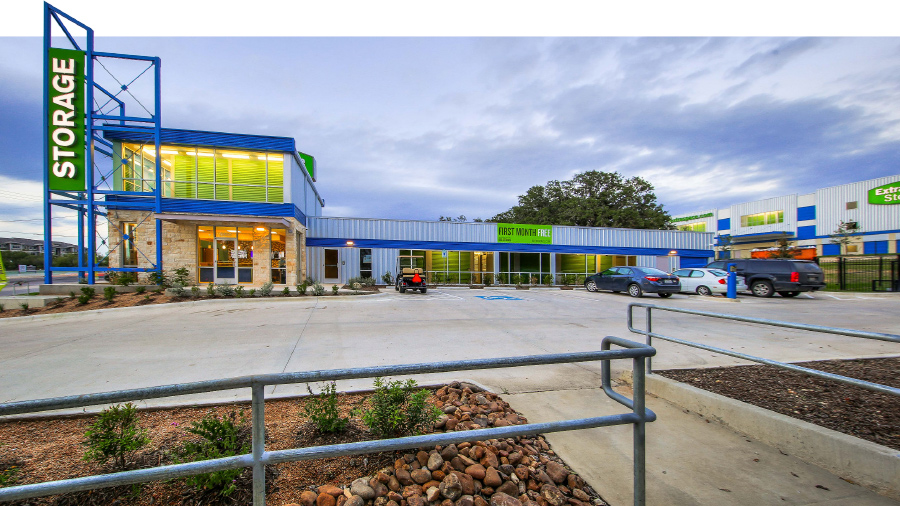


he economic measures taken by the federal government during the pandemic have had sweeping consequences, and commercial real estate has been particularly hard hit by the fallout. The favorable self-storage lending climate enjoyed by buyers and developers just a few years ago is experiencing turbulence, with the cost of capital reaching its highest in over two decades. Current owners and would-be buyers who are caught in the fray may have to choose between some less-than-ideal options.
“The economy got overheated after COVID,” Neil Gussis, principal of Skokie, Ill.-based CCM Commercial Mortgage, says. “There was a lot of money pushed into the system and people wanted to spend it.” The robust spending led to inflation, and historically, the way to battle inflation is to raise interest rates to cool down the economy. The Federal Reserve began adjusting the federal funds target rate range steadily in 2022, raising the fed funds rate by more than five percentage points in just 16 months.
“Consequently,” Gussis says, “we’re at a historic high point in interest rates for the past 22 years, and we got there in a short amount of time.” Although viable deals are still out there due to the overall stability of self-storage as an investment type, the higher cost of capital is demanding that both buyers and sellers revise their expectations.
“To illustrate, consider 10-year CMBS loans executed in 2013 or 2014, which carried an average rate of 4 percent,” Snyder says. “Presently, newly available 10-year fixed-rate loans are priced within the range of 6.5 percent to 7 percent. The looming challenge stems from more than $200 billion in fixed-rate CMBS debt set to mature over the next 18 months, potentially complicating property owners’ refinancing efforts without substantial paydown requirements.”
Synder says this issue is compounded by the rapid escalation of short-term rates, with a base SOFR (Secured Overnight Financing Rate) surging from nearly 0 percent to over 5 percent within an unprecedented timeframe. “Consequently, a bridge loan established with a bank just 18 months ago at an interest rate around 3 percent could conceivably exceed 8 percent today,” he says.
R. Christian Sonne, executive vice president of self-storage for Irvine, Calif.-based Newmark, says small operators caught in the wrong position in this path have been hit particularly hard. “Even if your self-storage facility is doing great, if you had a 5 percent loan and now you have to refinance because it’s been 10 years and it’s due, it’s now 7.5 percent,” he says. “You were making $100,000 a year, and now you’re making $60,000. Your cash flow just gets crushed.”
Sonne says that mom-and-pop operators in that situation may be forced to sell. “There’s total sticker shock for people,” he says. “Banks get really tough on their underwriting, and they might tell you that you need to put another $100,000 into it. A small operator doesn’t have that laying around.”
Gussis says timing determines the position operators are in now. “The owners who opened up at the beginning of COVID won the lottery,” he says. “They leased up in 12 months when they thought they were going to lease up in 36 months.” However, for the same developer who started a project 18 months later, the economics are a totally different story.
Gussis notes that those who were caught during construction are most vulnerable. “If you have a variable rate construction loan where you were paying 4 percent, and now you’re paying 9.5 percent, that’s going to have a dramatic effect,” he says. Owners in this predicament will either have to put in more cash or sell.
“You put three or four years of your life into finding and getting the land, getting it permitted, getting all of the entitlements, and then doing it, and oftentimes, there is a psychological attachment to that deal,” Gussis says. “So, those owners have to decide how much time they want to give a project. Do you want to cut your losses now and limit your gains, or do you want to play the long game?”
“If you’re in the middle of development, each of those deals have to be reassessed both at the ownership level and the bank level, because they aren’t what they were penciled out to be,” Gussis says.
He says the transaction volume for the first six months this year was down about 70 percent from the same period last year. “The valuations went down when the interest rates went up, so the seller has these expectations from last year and the buyer can’t afford to pay that price,” Sonne says. “But people are adjusting and getting more realistic about their asking price.”
Shawn Hill, principal at Chicago-based The BSC Group, LLC, says that ample liquidity still exists in the market despite high interest rates and a general tightening in the banking community. “Capital is still flowing from banks, credit unions, life companies, CMBS, debt funds, and the SBA,” he says. However, lenders remain leery due to ambiguous language from the Fed regarding future rate hikes.
Hill says banks presently account for approximately 40 percent of all outstanding commercial real estate debt. “They are facing increasing regulatory pressure and have seen many of their existing loans not being paid off due to the lack of refinance opportunities,” he says. This has ballooned their balance sheets and has curtailed the capital they have available for new loans.
CMBS lenders are active, however, Snyder says owners are hesitant to commit to fixed-rate loans at rates exceeding 6 percent for 10 years. Consequently, although CMBS debt is accessible, it may not be the most attractive option in today’s climate. He says credit unions and insurance are other potential sources of capital, although they are more selective lenders.
“Life company allocations are getting full as we approach year end,” Hill says, “but self-storage remains attractive to many on larger, trophy-type deals in core markets.” He says there is still capital in the market for construction, bridge, and permanent executions. “We are definitely in a market where borrowers need to talk to a lot of lenders to ensure they are getting the best rates and terms possible, and we are definitely in a market where mortgage brokers can add a lot of value through their relationships and experience in structuring deals.”
According to Snyder, alternative lenders, such as debt funds, investment firms, and private money entities, are gearing up by expanding their workforces and preparing to fund substantial capital to address the gaps left by banks, insurance companies, and CMBS lenders. “However, they are capitalizing on the current market dynamics, offering interest rates at 8.5 percent and above,” he says. “While these rates may deter many, those in need of capital with projects capable of absorbing these rates—even if only for a brief duration—will find ample funding opportunities.”
Although Sonne says larger operators can have lines of credit up to as much as $100 million, he notes that when the cost of credit goes up, what they can afford to pay for a facility is less. “So, everybody’s unhappy,” he says. “You’re getting less money only because of the cost of interest rates and because banks are kind of sitting on their hands. The banks aren’t sure what’s going to happen in the economy, so they’re making it very difficult on people.”
For buyers, Gussis says new construction that’s 30 percent leased can be attractive. “They’ve already saved themselves three years of buying the land, getting it titled, and building it, so the question becomes, what’s the money value of time and what would it cost me to build it today?” If the buyer believes in the market, he says they’ll be willing to pay.
“Some owners are in so deep they can’t see the light of day,” Gussis says. “That portion of our sector is going to play out over the next six to 18 months. They have the toughest choices to make. I think we’re going to see more lease-up deals come to market.”
An upside for owners, he says, is that with new builds way down, they won’t be vulnerable to much new supply in 2025 and 2026.
“We haven’t seen anything like this since the late 70s, early 80s,” Sonne says, “but it was much, much worse then.” For context, the prime rate in mid-1984 was 13 percent, compared to 8.5 percent in mid-2023. We’re much better off now than 40 years ago. However, in March of 2020, it fell to 3.25 percent. “We were a little spoiled for a while,” Sonne says. “People got used to these 4 percent and 5 percent interest rates, but that was just abnormal. We’re really in an adjustment period now.”
Hill doesn’t believe we will go back to the extremely low rate environment we were in any time soon, if ever. “I think rates in the fives and sixes will persist for the next decade once things settle down,” he says.
As for operations, consumer demand hasn’t shifted much, according to Gussis, although it’s uneven across markets. “If you look at the Almanac, no matter what cycle we’re in, national levels of occupancy have never varied more than 5 percent year-to-year,” he says. “Operations are still going great.”
Sonne believes it’s a great time to buy self-storage as long as you recognize that you won’t get the same return as in recent years. “There’s more capital that wants to invest in self-storage than there is storage available because of the stability of the industry,” he says. “It continues to perform well, even in uncertain times like we have now.”

nvesting in self-storage facilities can be a lucrative venture. However, it is also important to pay attention to the challenges and costs that come with managing staff, customer service, bookkeeping, and marketing. The good news is there is another option: remote self-storage management.
Remote management is revolutionizing the self-storage industry, offering a hassle-free solution that is both time and cost-effective. Let’s explore the game-changing benefits of remote self-storage management and why it’s an attractive option for those looking to increase the return on their investment and save time.
There was a storage facility recently purchased in Tennessee for $1.375 million. Copper Storage Management was their remote management team, and the investment was appraised for $4.2 million in less than 18 months after Copper Storage Management implemented changes. Copper Storage Management was able to achieve this substantial value add by cutting payroll costs, raising rates, and cutting collections.
In Holt, Mich., a 31,200-square-foot property was built for $1.8 million. After just 11 months, the property was at 74 percent occupancy, with $21,000 expected in monthly income. The current asset is valued at $2.8 million, but we expect the value to continue to grow to $3.8 million once the property is 90 percent occupied. Copper Storage Management was able to facilitate a quick lease-up by providing a fast and easy rental process for customers. Tenants can rent 24/7 on their own via the website or rent with a person 12 hours a day, 7 days a week, via their phone.
Investing in a self-storage facility does require thoughtfulness, intentionality, and preparation. However, the long-term investment can outweigh the upfront time and energy if you invest wisely. Using a self-storage management company like Copper Storage Management will provide peace of mind while simultaneously saving you money.



he overall capitalization rate or “cap rate” is used to convert income to value. One of the easiest ways to think of the relationship of a cap rate to value is the acronym IRV: Income divided by Rate = Value or I/R = V. As the cap rate goes down, the value goes up. Officially, the direct capitalization is defined by The Appraisal Institute in the Dictionary of Real Estate as follows (page 65):
“A method used to convert an estimate of a single year’s income expectancy into an indication of value in one direct step, either by dividing the net income estimate by an appropriate capitalization rate or by multiplying the income estimate by an appropriate factor. Direct capitalization employs capitalization rates and multipliers extracted or developed from market data. Only one year’s income is used. Yield and value changes are implied, but not explicitly identified.”
To complicate matters, a cap rate can be calculated on last year’s net operating income (often called trailing), a forecast of next year’s expectations of net operating income (forecast). Moreover, the “true” cap rate is often a perspective, not a fact. For example, the seller may believe the cap rate was a 5.5 percent, implying a higher value, while the buyer may believe the cap rate was a 6.0 percent, implying a higher return. And, the broker involved in the deal may report a 5.75 percent cap rate. While all three perspectives are important to understand, it doesn’t exactly determine the cap rate.
For comparison purposes, it is best to understand the forecast or stabilized cap rate (for example, this is the cap rate used in an appraisal) and the trailing cap rate to understand expectations of buyers and sellers in the transaction. It is also important to understand if expenses were adjusted to market, particularly real estate taxes, in the forecast or stabilized cap rate. For the purposes of this article, the stabilized or forecast (sometimes called Year 1) cap rate will be addressed because it is typically the most consistent cap rate considered for comparison purposes (for example, it is the basis of Investor Survey’s on cap rates).
Direct Cap Comparables – Deriving comparables from similar properties that have sold is generally the preferred technique when sufficient information is available. For example, what cap rate is reported? The trailing or the stabilized? Comparable cap rates are summarized in Table 1.
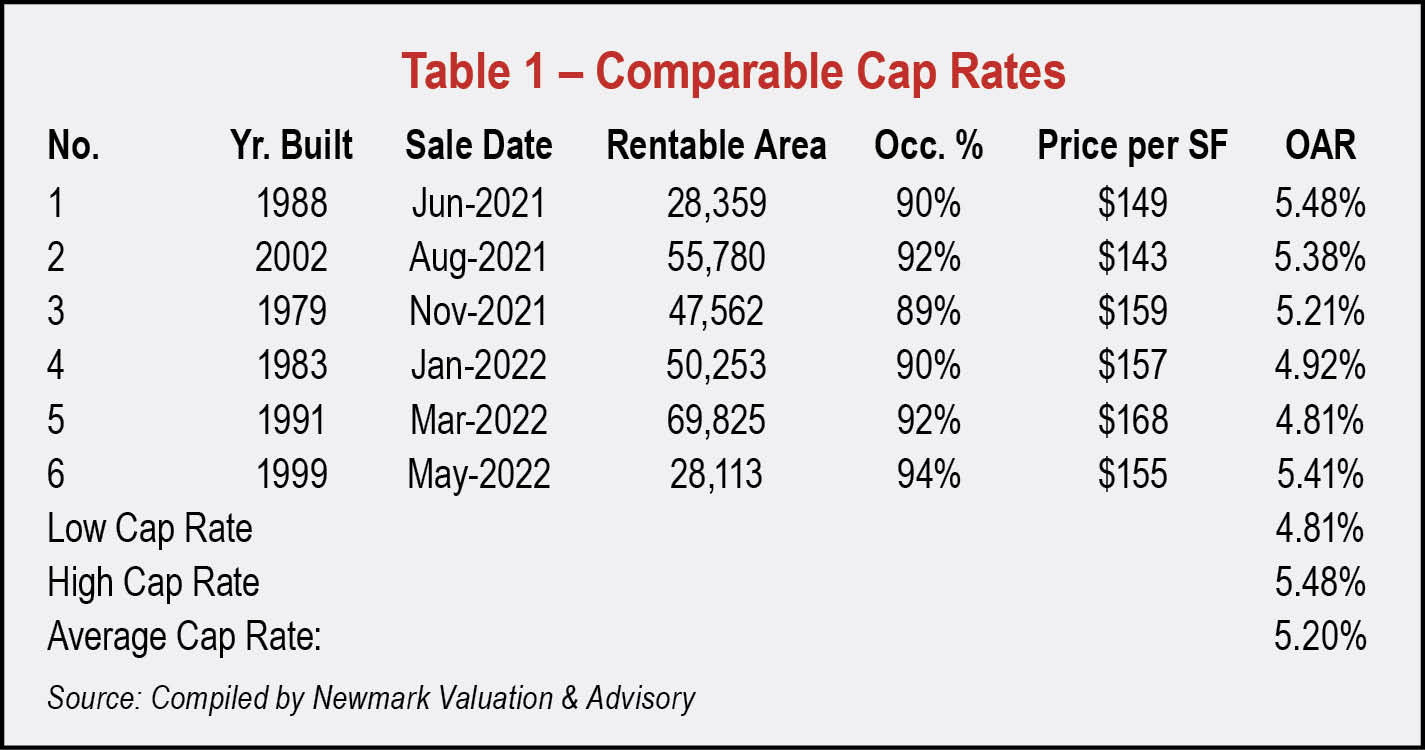
Investor Surveys – Survey research is based on periodic publications of the current thinking of investors, compared to historical performance data of comparable sales. Surveys are generally used as support and should not be relied upon as a primary source. They are very useful to understand real-time market dynamics. Surveys can vary in scope of research, so it is worthwhile to review a wide variety of publications. The results of the most recent self-storage investor surveys are summarized in Table 2.
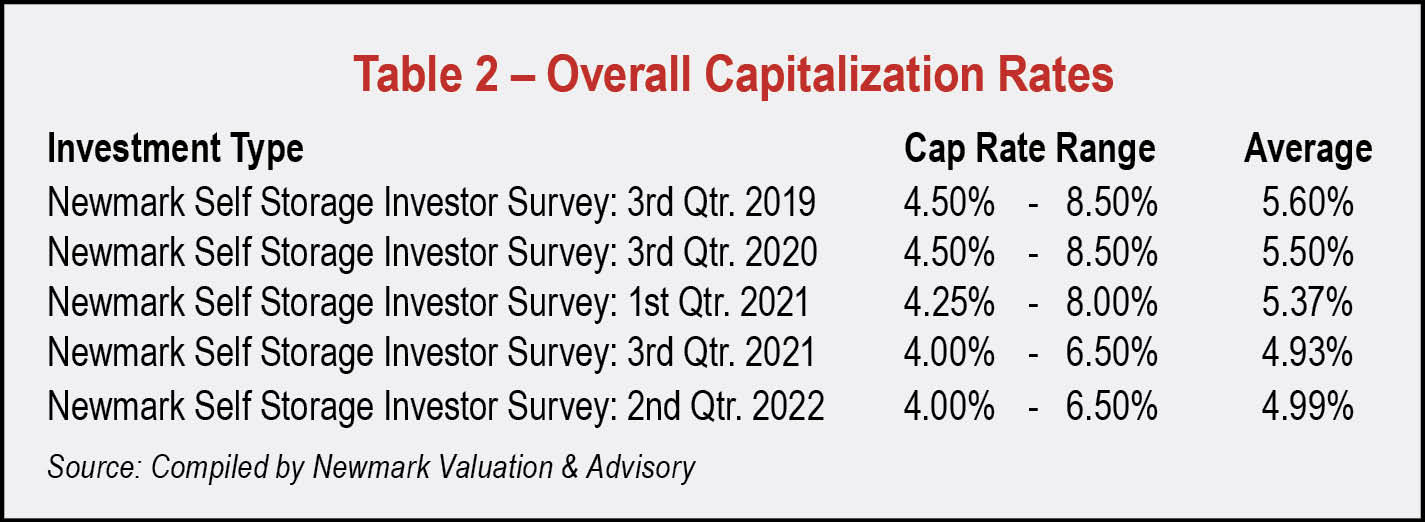
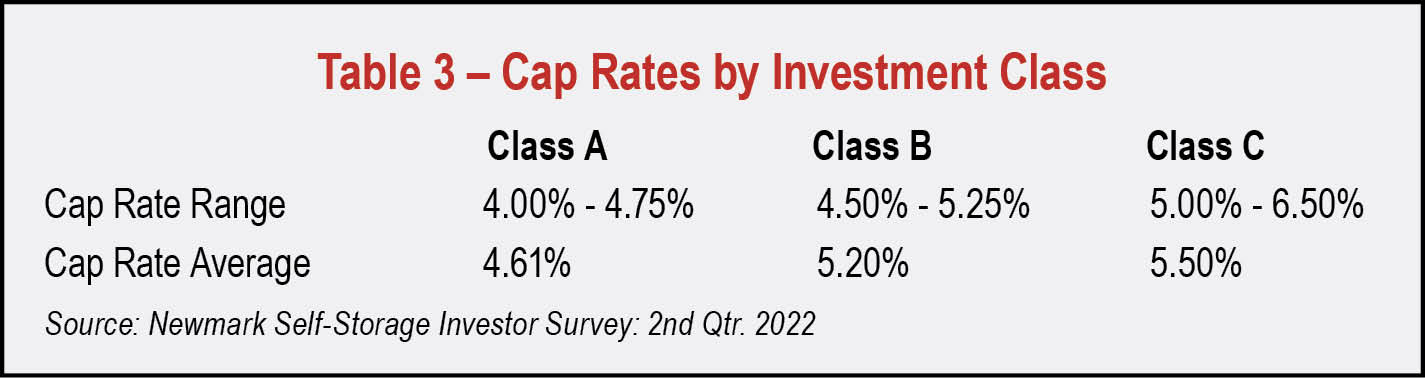
Band of Investment – This technique is based on returns to debt and equity, sometimes called a built-up model. It accounts for market-based financing with a market-based return to equity. The return to equity for a single asset is typically higher than a comparable self-storage annual return to investor or dividend from a self-storage REIT or stock (does not account for appreciation of the asset). Another way to look at the equity dividend or cash on cash, is the annual return on every dollar of equity. Since most properties are purchased with a combination of debt and equity, the technique has relevance in the market. A Band of Investment Analysis example is summarized in Table 4.
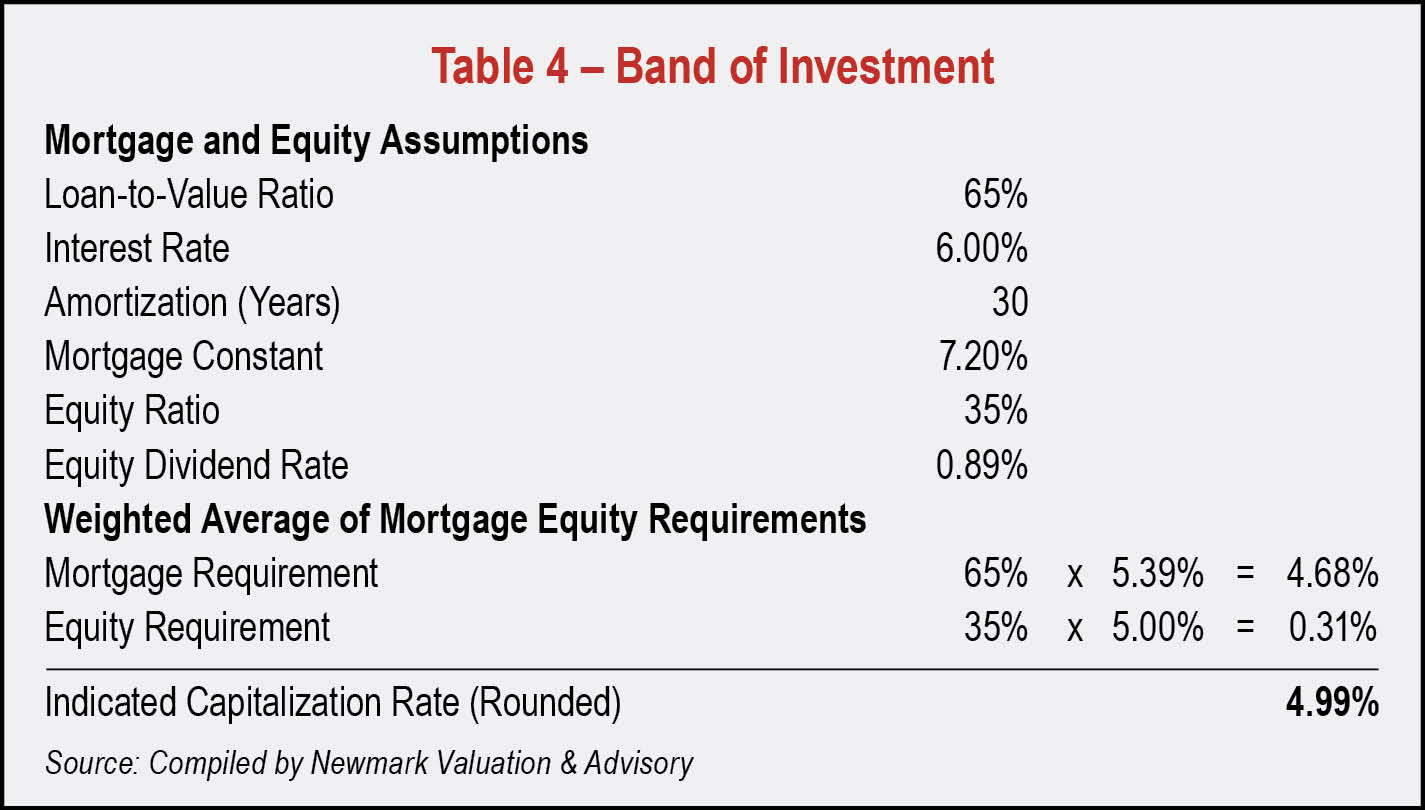
Over the past year, the return to equity has become significantly lower due to higher interest rates. Some investors are willing to underwrite a negative return in the initial year to make a deal pencil, but that means significant upside is expected in rents. Common to industrial and apartment sectors, this is new for self-storage. It is another indicator that institutional investors have confidence in the self-storage asset class in bull and bear markets.
Mortgage Equity Analysis – This analysis derives from the idea that real property investments are a combination of two components: debt and equity. It differs from the Band of Investment because it accounts for total yield: equity dividend and appreciation over time. It is a useful tool because it solves for a levered equity yield (that includes both cash flow or equity dividend and appreciation over time). Self-storage as an asset class has demonstrated superior returns for many years. For example, comparing total return of self-storage REITs over the last 25 years, self-storage has provided a 17.50 percent return on average and is superior to other core sectors such as office, industrial, retail, or apartments (based on NAREIT data or publicly traded companies only). As a result, institutional investors have been storing capital in the sector. The Mortgage Equity Analysis solves for equity yield, a common metric of the comparison of returns among investments for the institutional market. The equity yield rate estimated is lower for a single asset (in this case estimated at 9.25 percent) than publicly traded REIT data because REITs offer greater liquidity. The mortgage equity example, with the same mortgage requirements as the Band of Investment example for consistency, is presented in Table 5 and Table 6.


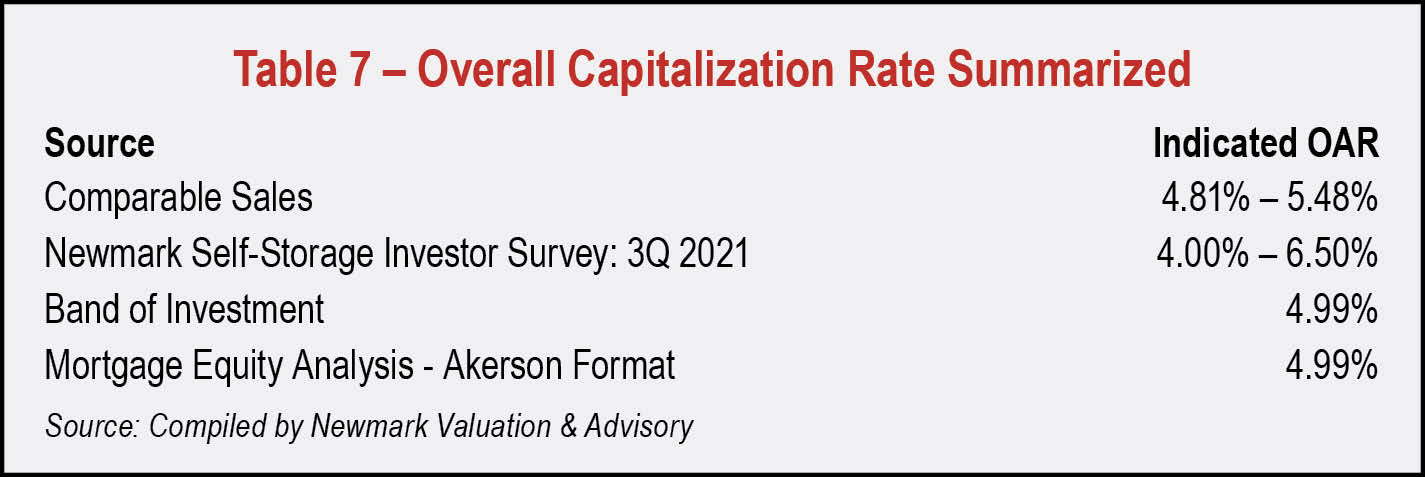



ost everyone knows someone whose life has been impacted by cancer, but they never expect it to happen to them. Breast cancer knows no age, gender, or race. As the most common cancer in women worldwide, it remains a fact of life. Approximately 2.3 million women around the globe were diagnosed in 2021, and incidence rates are on the rise.
That’s because breast cancer has no boundaries. It is the leading cause of cancer death in the world’s poorest countries and the second leading cause of cancer death in American women. The developing world is experiencing higher mortality rates than ever before due to a lack of screening and access to treatment, and we are seeing disparities right here at home as social and economic factors create barriers to proper diagnosis and care. Many of those deaths result from metastatic breast cancer. In November of 2012, Donna Morgan-Esquibel was faced with a phone call that no one ever wants to receive.
For Morgan-Esquibel, November 2012 is a time she will never forget. A call came in that would change things forever. After having a routine mammogram, she was asked by her doctor to come in to have more detailed imaging of her breasts. “After a few days had passed I was informed that I would need to have a biopsy of my right breast as something on my images appeared to show some indications of crystallization on the X-rays,” she said. A biopsy removes cells or tissue from a suspicious area in the breast. The cells or tissue are then studied under a microscope to see if cancer is present.
Morgan-Esquibel describes the time she spent waiting for the results as “torturous.” After several days that seemed to pass more slowly than normal, she received the news that she was in the early stages of breast cancer. “I was devastated. We were in the process of moving from Phoenix, Ariz., back to Athens, Ga., and then my world just stopped,” she said. She was relieved when her trusted doctor in Arizona told her that they could provide her the care she needed prior to when she had planned her move to Georgia. She was hopeful and quickly proceeded with the necessary surgery to remove the tumor, then she began radiation treatments.

One short year later, during another routine mammogram, she was shocked to hear the news that another cancerous spot was found in her left breast. “I couldn’t believe it! I had my biopsy, and my cancer was back, just in the other breast, and it was even more aggressive,” she said. Breast cancer survivors have an increased risk of getting a new breast cancer compared to people who have never had the cancer. A new breast cancer is called second primary breast cancer. Unlike a recurrence, which is a return of the first breast cancer, a second primary tumor is a new cancer unrelated to the first.
Morgan-Esquibel vividly remembers the words her surgeon then said to her: “You need to look at this as life or death, and I won’t do a single mastectomy, only a double mastectomy.” She was paralyzed with fear, and the only thing that was moving on her body were the tears coming from her eyes. “To say I was devastated was an understatement,” she said. She decided to take heed to the advice of her surgeon and proceed with the double mastectomy.
Her next step was to call her boss, Lonnie Bickford, and let him know what was going on. She still remembers his exact words to her, “I was afraid it was back, but do whatever it takes to get well and let me know what you need.”

As Morgan-Esquibel’s surgery date came closer, she was understandably afraid and did not know what to expect. After six long hours in surgery, the surgeons were pleased with how it went, and she was finally in a room and working towards recovery. “I remember when they took off my bandage and I heard my husband for the first time say, ‘It doesn’t look that bad,’” she said. “If you haven’t seen anyone with a double mastectomy before they started reconstruction it will make you feel like there is a big lump in your stomach, and it is devastating just to see it along with tubes hanging out of both sides for drainage.”
Although the surgery was complete, the recovery was just the beginning. “I went through months and months of recovery from having 50 ccs of saline injected into the metal spacers in my breasts each week,” she said. In retrospect, Morgan-Esquibel admits that she may not have had the reconstructive surgery if she had known what she knows now. “I don’t think I really knew how painful this process would be, because I might have thought twice about reconstruction,” she said.
Thankfully, Morgan-Esquibel now continues to remain completely cancer-free and continues to see her doctors on a regular basis. She is proud to be a part of StorageGives and feels honored that Breast Cancer Research Foundation benefits from the donations made through this organization. As Bickford states on the organization’s website, StorageGives.org, “We are facilitating a platform to connect the storage industry to worthy causes to make an impact in lives all over the world.”


hat time of the year is upon us when you either want to renew or start your membership with the Self Storage Association. The industry is soaring, and you want to be a part of it. SSA connects you and your business with valuable benefits designed to help you run your business that you won’t find anywhere else.
How do you weigh whether you can afford to your SSA membership? Here are a few reasons:
One of the best benefits that SSA offers its members is one that you’re probably not aware of. Each year, the SSA Foundation offers scholarships to deserving members and their families toward post-secondary education tuition and fees. The program has awarded over one million dollars in scholarships to eligible applicants. The 2023 to 2024 Foundation Scholarship application is now available. Visit selfstorage.org for more information or to apply.
This is just the tip of the iceberg. After seeing all the benefits you’ll miss out on by not being a member, can you really afford not to renew? Visit selfstorage.org/membership for more details.

fear our industry faces a potentially existential public relations and business threat caused by some legal, but tone-deaf, revenue management and customer service practices that may result in our industry’s inability to remain independent of governmental scrutiny. Unflattering news reports have surfaced regarding “exorbitant” rent-rate management practices. The common themes: large operators not being transparent about rental rates and failure to acknowledge and escalate customer concerns to upper management. These concerns were echoed by owners and operators I spoke with during the SSA Fall Convention.
Municipal governments are contributing to this problem by implementing restrictions on the development of storage facilities in many of the same metropolitan markets experiencing higher rental rates. For example, when new customers were being charged almost $100 less for the same unit size, a customer in California asked his store manager for an explanation regarding his 67 percent rent increase notice. Unsatisfied with the manager’s response, he asked to speak with a supervisor. After no response, he contacted his city councilmember, who acknowledged that most storage rentals are for personal use and said, “If we can cap residential rent rates, we may as well cap storage rent increases too.” Shortly thereafter, with no success in reaching the storage operator, city staff was preparing a rent control ordinance! Do we want the government to tell us what we can charge? If these egregious practices continue, that day will come.
In The San Francisco Chronicle’s article “Self-Storage Prices Are Soaring to Unexpected Highs – Even for the Bay Area,” a homeless person complained that her storage rental was too expensive. A Baltimore journalist reported on a fed-up customer who vacated her unit after a 40 percent increase raised her monthly rent to nearly $1,000. She was unsuccessful in contacting the operator.
In each of those situations, neither the operators nor a trade association responded to requests for comment. Avoiding frank conversations with the media perpetuates a one-sided narrative. As chairperson of the California Self Storage Association’s Legal & Legislative committee, I can attest that disgruntled consumer complaints regarding excess rent increases trump all other consumer inquiries. We have a duty to prevent unnecessary regulatory creep by providing customers with transparent pricing policies and a process for customers to be heard by upper management. If the manager cannot ameliorate the situation to the customer’s satisfaction, someone else from the organization needs to step in. It would be unfortunate for the decisions of a few to impact everyone. Prevent the bad press, governmental scrutiny, and regulation. Be proactive and act now!