


Self-Storage.ai

any in the self-storage industry get into the business through family ties or a happy accident. Nylan Raufaste entered the business out of necessity. The Martinique-born French entrepreneur came to Canada in 2018 to study at HEC Montreal. As part of the curriculum, he was required to complete an exchange in another country.
“I had never been to Asia, so I chose to go to Singapore,” says Raufaste. “It’s modern and English is widely spoken, so it felt like a good place to spend a year.”
Knowing he would return to Montreal, as he loves Canada and Quebec, Raufaste didn’t want to take all his belongings, but he also didn’t want to be paying rent in two cities on opposite sides of the globe either. Naturally, he began looking for self-storage solutions online.
“I was having a hard time finding pricing, and I didn’t feel like calling around,” says Raufaste. “This was before COVID forced everyone to go contactless, and a lot of operators hadn’t yet posted their prices online—a lot of them weren’t even online at all.”
Raufaste gave up searching and stored his belongings in a friend’s garage. The problem had been solved, but his brush with the storage industry had just begun.
Raufaste and several tech-minded classmates began meeting weekly to toss around ideas. Then it became more serious. “Over time, it became clear to many of us that we wanted to be entrepreneurs,” he says, acknowledging that there were some nerves on display despite their ambition. “It’s super risky to be an entrepreneur because the reality is that only one out of 100 startups in tech will actually become successful.”
They didn’t let that statistic stop them. “We’re young, and that’s the best time to take risks,” says Raufaste. “Twenty years from now, you may have a family, kids, a mortgage. It’s a lot scarier to take a risk then when you have big expenses and people counting on you, so that’s why we decided to do it now. And I think that was a very good decision for us.”
“Me and [co-founder] Ange Blecon had the idea to create an Airbnb-style platform for self-storage where people with unused space at home could rent it to neighbors or friends so they could store boxes and other belongings,” he says. “Instead of going to a facility that might be far away, you could find someone in your neighborhood and store your things in their unused garage. They make money, and you pay less than you would at a facility, with the proximity benefit.”
Raufaste was aware of similar marketplaces in the United States, such as Neighbor, but the concept was new to Canada. The startup quickly ran into challenges. “There was a lot of hesitation about storing items from someone you don’t know. You never know what they may have packed in a box.”
Despite the platform being intended for peer-to-peer use, one operator decided to create a listing on the marketplace: Montreal Mini Storage. Raufaste was surprised and intrigued, so he decided to give them a call. “They were simply wanting to promote their storage units, regardless of platform,” he says.
That gave Raufaste and Blecon another idea: a marketplace comparing storage unit prices. He and his partner shuttered the peer-to-peer platform and created a new one where people could review units, compare prices, and rent online.
“We were basically generating leads for self-storage operators,” says Raufaste. “In terms of security, it was also better than working with the peer-to-peer model.”
Unfortunately, growth proved slower than anticipated. “In general, a marketplace is difficult because you have to spend money and energy acquiring both the supply and demand sides,” he says. “You only get paid when you make a connection between those two.”
To improve marketplace conversion, Raufaste realized they needed a tool to help users identify the right unit size. “We were able to identify this as a main challenge for people because many Canadians had never used self-storage before. They knew what type of items they wanted to store, but they didn’t necessarily know the number of square feet they needed.”
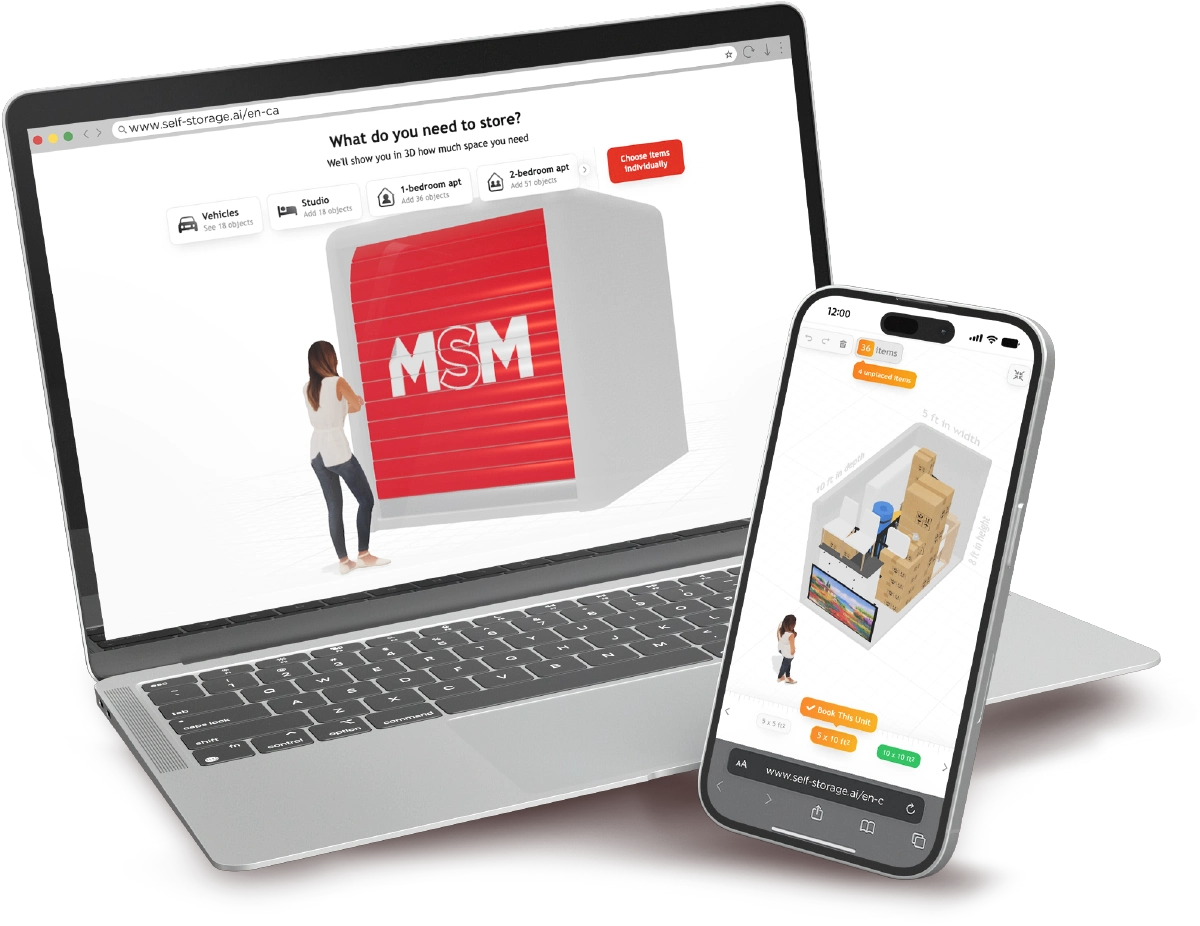
The new direction made more sense. “Instead of trying to connect people with storage facilities, we had a product that could generate recurring revenue, with operators paying a monthly or annual subscription to access it.”
Was Raufaste concerned about taking clients in an industry he had never directly worked in? He shakes his head. “Even though none of us has ever worked at a facility or managed one, we’ve talked with a lot of operators over the years. When we had the pricing marketplace, we spoke with single-facility operators, mid-size operators, and large operators. We collected a lot of insight on how operators think and work depending on their size and their concerns.”
What concerned him and Blecon more was how they would bootstrap the new business. “There aren’t that many venture capitalists, investors, or family offices in Canada like there are in the United States and elsewhere,” says Raufaste. “It’s much more common to finance your company through grants.”
Self-Storage.ai found support from the Ministry of Economy, Innovation, and Energy in Quebec and has received substantial funding since 2021. “These grants are not debt, and you don’t have to give away equity in the company to receive them,” says Raufaste.
Of course, reporting requirements follow. “You have to keep reporting back to the government about how the funds are being used and how the company is progressing, but it’s non-dilutive funding, so the reporting requirements are a fair tradeoff.”
Ultimately, the government hopes those investments pay off. “They want you to build a company, create jobs, and help Quebec—and Canada in general—shine worldwide.”

Most, however, either leave the site or call the facility for help. “Both outcomes create friction in the booking process and increase the risk of losing the rental. The real question is simple: Is losing conversions from many worth a couple of oversized rentals? Our clients and I say no.”
SpaceStacker improves the booking process by allowing users to select their belongings and visualize how they would fit inside different unit sizes using a 3D planner. “The user experience is better, website engagement and SEO are improved, and clients see more conversions and fewer dropouts,” says Raufaste.
Fewer phone calls also free up managers and agents for other tasks. If someone does call, staff can use SpaceStacker themselves to provide quick recommendations. To further demonstrate value, Self-Storage.ai tracks 3D planner engagement data and conversion rates for every client. As usage grows, the team continues refining the tool and introducing new features designed to make the process even more intuitive.
SpaceStacker is gaining traction across the industry and now serves clients across four countries, including Montreal Mini Storage with 24 facilities (coming full circle after having been the first facility to list on the original pricing marketplace).
With fewer tech start-ups focusing on the sector, he believes the opportunity for innovation remains strong. “There’s still a lot that can be done.”
When asked what’s next for the industry, Raufaste quickly points to customer experience. “There can be a lack of trust in the industry, especially among people who aren’t familiar with it,” he says. “Some of the recent pricing practices haven’t done the industry any favors either. Someone sees a price online, rents the unit, and then the rate skyrockets.”
He believes a shift toward more customer-friendly practices is inevitable. “In many ways, we’re solving the same problem I faced years ago in Montreal: helping people figure out exactly how much space they really need,” he says. “Even though our clients are operators and we’re helping them improve conversions, the end users of our solutions are tenants or potential tenants. They love using the product because it makes it easier to find what they need online and book online. We’re gamifying the experience a bit, so it’s a win-win for operators and their customers.”
It’s also a win for Raufaste, who, after a series of starts and stops, appears to have found his place as an innovator in the self-storage industry.

On their first day out, they split up to cover more ground. As time passed, Raufaste realized he hadn’t heard from Blecon in a while. Calls and texts went unanswered. “I actually started to get concerned,” he says.
Eventually Blecon called back, and they met up again. As Raufaste began asking where he had been, saying he was nearly ready to file a missing persons report, Blecon simply grinned.
“We have our first listing,” he said, holding up his iPad.
As it turned out, Blecon had knocked on the door of an elderly woman who agreed to create a listing with one condition: He had to fix her WiFi first. He obliged. Then she asked him to set up her printer. Next came troubleshooting her computer.
A few cups of tea and two hours of free tech support later, Blecon finally convinced her to create the listing. Unfortunately, it didn’t last long.
That same evening, the woman called Blecon back furious, convinced he had installed a virus on her computer. “Obviously he hadn’t; she was just having more trouble with it, but that didn’t matter,” says Raufaste. “She pulled her listing down anyway.”
And that’s how, in the span of just four hours, the duo got a taste of both the highs and lows of start-up life.