


nstitutional investors are transforming the self-storage market by acquiring properties traditionally owned by independent operators. These buyers (REITs, private equity funds, and sovereign wealth funds) bring advanced tools and strategies to improve efficiency and maximize returns. As of 2025, independent owners still managed roughly 70 percent of U.S. facilities, but their share is shrinking by 1 percent to 2 percent annually, and institutional ownership has nearly tripled over the past decade.
Key takeaways:
- Higher Revenue Potential – Institutional operators generate 10 percent to 20 percent more revenue per square foot than independent owners through AI-driven pricing, centralized management, and marketing resources.
- Generational Shifts – Many independent owners are aging out, with substantial numbers of facilities transitioning to institutional ownership annually.
- Acquisition Strategies – Institutions favor portfolio acquisitions, joint ventures, and platform investments to scale quickly.
- Market Dynamics – Limited new supply, rising construction costs, and zoning restrictions have tightened the market, driving up competition and prices.
- Asset Preferences – Climate-controlled and premium facilities are in high demand, commanding a 25 percent to 40 percent rent premium over standard units.
For smaller owners, improving financial reporting, adopting dynamic pricing, and addressing inefficiencies can boost valuations and attract institutional buyers. With $5 billion to $8 billion in private equity targeting the sector, the next 12 to 24 months present a strong opportunity for sellers in this consolidating market.
The acquisition was underwritten at a mid-5 percent initial cap rate, with a plan to integrate NSA’s assets into Public Storage’s proprietary “PS Next” platform—closing a substantial NOI margin gap, lifting occupancy to 90 percent, and generating $110 million to $130 million in annual run-rate synergies.
The mindset is clear: Institutions aren’t just buying existing cash flow, they’re buying the value they can create through operations and technology. Over 90 percent of institutional facilities already use automated pricing systems, versus only 15 percent to 20 percent of independent operators—a technological edge that explains why they see so much untapped potential in these acquisitions.
PORTFOLIO ACQUISITIONS
Bulk purchases are the fastest way to scale. Acquiring a portfolio in a single transaction lets institutional buyers expand quickly while spreading fixed costs (technology, marketing, vendor contracts, centralized management) across numerous locations. Public Storage’s $10.5 billion NSA acquisition is the prime example, adding over 1,000 properties with $110 million to $130 million in expected annual synergies.
“The bigger story is the value-creation opportunity from moving the assets onto Public Storage’s operating platform,” said Boyle.
The impact shows in the numbers: Institutional ownership of U.S. self-storage has climbed to 39 percent by 2026, up from just 13 percent in 2016.
Not every institution wants to shoulder large acquisitions alone. Joint ventures share risk, tap local expertise, and ease entry into new markets. Public Storage, for example, structured a $3.3 billion joint venture for part of the NSA portfolio, sharing financial risk while maintaining management control.
PLATFORM INVESTMENTS
This strategy focuses on building or acquiring the operational systems (technology, branding, management tools) that make large-scale operations efficient. Public Storage’s “PS Next” platform, with centralized call centers and AI-driven pricing, has increased revenue by 10 percent to 20 percent per square foot. That efficiency makes underperforming facilities attractive targets, because the improvement potential is both measurable and repeatable.

LIMITED NEW SUPPLY IN KEY MARKETS
Rising construction costs and nearly 600 days of planning have significantly slowed new supply, and a 25 percent tariff on imported steel in 2025 drove domestic steel prices up 18 percent, adding roughly 5 percent to construction budgets. Over 50 cities have enacted stricter zoning rules or outright bans on new storage development. As a result, new supply is projected to drop to just 2.4 percent of total stock in 2026, down from 3.0 percent in 2025 and well below the 4.2 percent long-term average, with 2027 deliveries expected to decline another 25 percent to 30 percent. The impact is severe in high-barrier markets: Boston has only 0.7 square feet of storage per capita, driving rent growth of 11 percent to 15 percent year over year. When supply is restricted, existing facilities gain pricing power—something institutional buyers capitalize on quickly.
GROWING DEMAND FOR CLIMATE-CONTROLLED AND PREMIUM ASSETS
Climate-controlled units generate $18 to $28 per square foot, versus $10 to $16 for standard drive-up units—a 25 percent to 40 percent rent premium institutions can push further with AI-driven pricing. Currently, 40 percent of new customers actively prefer climate-controlled options, and 50 percent to 60 percent of new builds are now climate-controlled, up from about 30 percent a decade ago. These facilities are costlier to build and harder to replace, making them especially appealing acquisition targets.
TENANT RETENTION AND LONG-TERM DEMAND TRENDS
The average self-storage tenant now stays 18 to 19 months, up from nine to 14 months in 2017, providing more predictable cash flow that aligns with institutional underwriting. Demand has also diversified beyond moving and downsizing—renovations, remote work setups, and lifestyle changes are now consistent drivers. In 2023, 12.6 percent of U.S. households used self-storage, versus less than 10 percent before the pandemic, creating a more stable occupancy floor. With an estimated $5 billion to $8 billion in private equity earmarked for self-storage, shrinking supply, scarce premium assets, and longer tenant retention have created a fiercely competitive buyer market.
HOW INSTITUTIONAL BUYERS UNDERWRITE STORAGE ASSETS
Institutions evaluate both current cash flow and future performance potential, taking a more analytical, data-driven approach than most private sellers. Here are the metrics and benchmarks they use.
OCCUPANCY RATES AND RENT GROWTH TRENDS
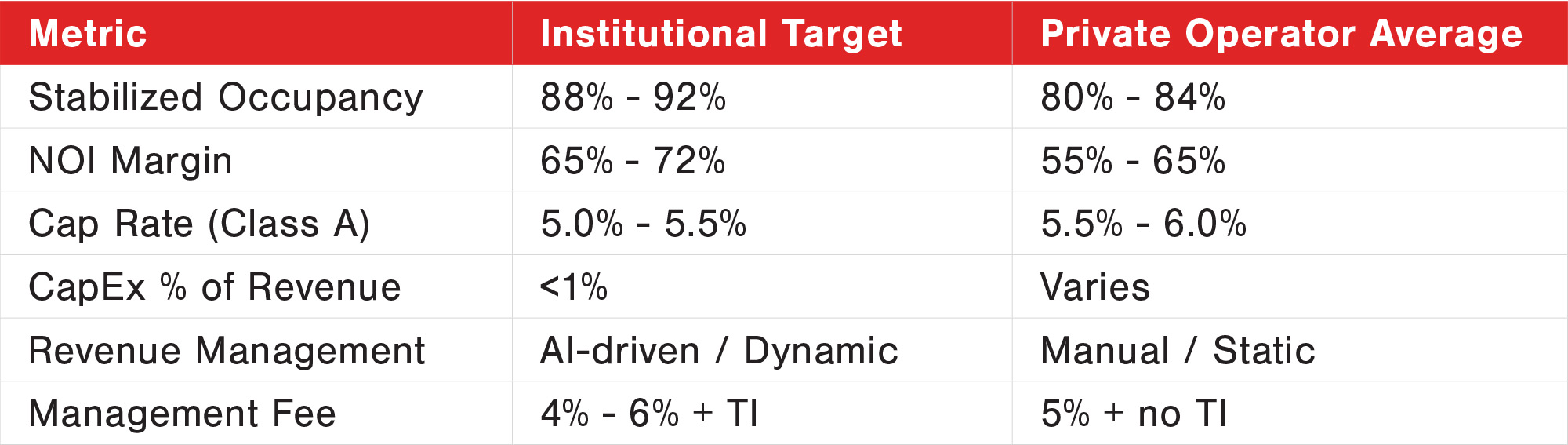
Institutional buyers target stabilized occupancy of 88 percent to 92 percent, penalizing facilities below 85 percent occupancy with a cap rate penalty of 50 to 150 basis points. They watch the gap between street rates and actual rents received: A gap exceeding 15 percent signals potential annual rent growth of 8 percent to 12 percent from long-term tenants. Rent growth projections are stress-tested against modest national increases of roughly 0.3 percent year over year, and institutions often leverage AI tools targeting revenue gains of 5 percent to 10 percent.
LOCAL MARKET CONDITIONS AND SUPPLY RISK
Underwriters evaluate the development pipeline within a 3-mile to 5-mile radius. Markets where new supply exceeds 10 percent of existing inventory are generally avoided, since lease-up can stretch to 24 to 36 months. There’s a clear divide between supply-constrained coastal areas and oversupplied Sun Belt markets: Boston represents the high-barrier profile institutions prefer, while high-construction cities like Phoenix and Austin require more cautious absorption assumptions.
OPERATIONAL EFFICIENCY AND ASSET CONDITION
Top-tier assets are expected to achieve NOI margins of 65 percent to 72 percent, versus 55 percent to 65 percent for smaller private operators. Underwriting includes expense normalization, adjusting for underestimated property taxes, insurance, and management fees. REIT-operated assets typically incur management fees of 4 percent to 6 percent, plus tenant insurance, whereas independent owners often pay below-market rates and keep 100 percent of tenant insurance. Physical condition matters too: Phase I Environmental Site Assessments run alongside inspections of roofs, parking lots, and HVAC, and deferred maintenance can drive price reductions of $100,000 to $500,000.
IMPROVE FINANCIAL REPORTING
Institutional buyers won’t take your word for performance. During diligence, underwriters will match rent rolls to bank deposits and scrutinize aging reports to verify income. Inconsistent records raise red flags and give buyers room to renegotiate. The solution is standardized reporting: accurate monthly rent rolls, lead conversion tracking, and documented occupancy trends. Clean records meet buyer expectations and speed up the transaction.
TIGHTEN OPERATIONS AND REDUCE INEFFICIENCIES
The performance gap is striking: Top REITs generate $20 to $28 in annual revenue per available square foot (RevPAF), while many independent facilities fall between $12 to $16. To close the gap, implement dynamic pricing—used by over 90 percent of institutional facilities and worth 5 percent to 10 percent in revenue—and invest in smart access systems, which can reduce on-site labor costs by 30 percent to 50 percent. One multigenerational owner improved RevPAF by 32 percent in 18 months through dynamic pricing software, security upgrades, and a professional website, adding over $280,000 in NOI across a three-facility portfolio.
POSITION ASSETS TO ATTRACT INSTITUTIONAL BUYERS
Deferred maintenance can be a deal breaker, with roof, paving, or HVAC issues triggering price reductions of $100,000 to $500,000—address them upfront. Boost ancillary revenues like tenant insurance and in-facility retail, which flow directly to NOI and sale price. If feasible, add climate-controlled units, which command a 25 percent to 40 percent rent premium and are favored by institutional buyers. If a full modernization isn’t realistic before selling, third-party professional management typically improves NOI by 10 percent to 25 percent within 12 to 24 months, elevating your position on the cap rate spectrum at closing.
The performance gap between institutional and independent operators is significant but not insurmountable—institutions run occupancy in the low 90s while many independents sit in the low 80s, a difference that directly impacts valuations. Dynamic pricing, smart access systems, and consistent rent increases can close that gap. Whether you plan to sell or hold, the approach is the same: Tighten operations, modernize where it matters, and maintain clean financial records. Owners who treat these as ongoing priorities—not last-minute preparations—will negotiate from strength and exit on their own terms.

How do institutional buyers pick which facilities to buy?
They zero in on facilities with clear operational upside in markets where demand is high, supply is tight, and barriers to new competition are significant—favoring prime locations, newer builds, and climate-controlled product. They also prize clean financial records and documented operating history, weighing cash flow stability, execution risk, and how easily the property scales within their portfolio.
What should I fix before selling my storage facility?
Start 12 to 24 months ahead. Get at least three years of clean, consistent financial records in order, and address deferred maintenance like roof leaks or broken doors. Focus on increasing NOI through automation, dynamic pricing, and reduced delinquency, and work with brokers and tax advisors early to clarify goals and navigate diligence smoothly.
Will climate-controlled units raise my sale price?
Yes. Climate-controlled units typically generate 25 percent to 40 percent higher rents than standard storage. Since a facility’s value is tied closely to NOI, those higher rents directly enhance valuation and make the property more attractive to buyers prioritizing modern amenities and revenue growth.