


elf-storage operations have come a long way over the years, with technology playing an increasingly important role. Today, it’s helping operators manage everything from customer service and revenue management to security and delinquency. At White Label Storage, much of that evolution has happened in-house.
The Brooklyn-based third-party management company develops much of the technology supporting its operations. Its latest tool, the ECRI Hub, is designed to simplify one of the more complicated and time-consuming aspects of revenue management: existing customer rate increases (ECRIs).
Hartman and Smyth started with very limited resources. “It was just the two of us—answering the phones, cleaning everything, setting up the security cameras—but we knew we were building something bigger than ourselves,” says Smyth.
As they grew the business from one location to more than 50, they saw firsthand the unique challenges involved in self-storage operations, including how easily day-to-day tasks could distract operators from seeing the bigger picture. That’s when the entrepreneurial wheels started spinning again and White Label Storage was born.

PRODUCT STRATEGY: Madeleine Paulson
Another key has been continual innovation. In fact, the company develops most of the technology it uses to run facilities. “The most integral piece of the tech stack is the facility management software (FMS). That’s the backend database that houses all the tenant data, processes payroll, and integrates with third-party technology like access control, security cameras, and customer service software. We are not replacing the FMS,” says Smyth. “We build all our tools on top of the FMS: websites, revenue management, dashboards, AI agents, and a delinquency management tool.”
Operators may be divided on the use of certain ECRI tactics, but managing them has become increasingly complicated. White Label Storage’s ECRI Hub, proprietary software designed to optimize and de-risk the process, aims to simplify the job. “Rate increases for existing tenants are essential to keeping self-storage facilities competitive and profitable, but the process is resource-intensive,” says Smyth. “I’d say it’s one of the most time-consuming tasks in self-storage management.”
Managing ECRIs requires teams to track which tenants are eligible, calculate appropriate increases, confirm notice periods, and keep records straight across separate systems, all while avoiding increases that would spark customer churn. In cities and states where they’re being scrutinized or new legislation surrounding them is being enforced, managing them also means maintaining compliance.
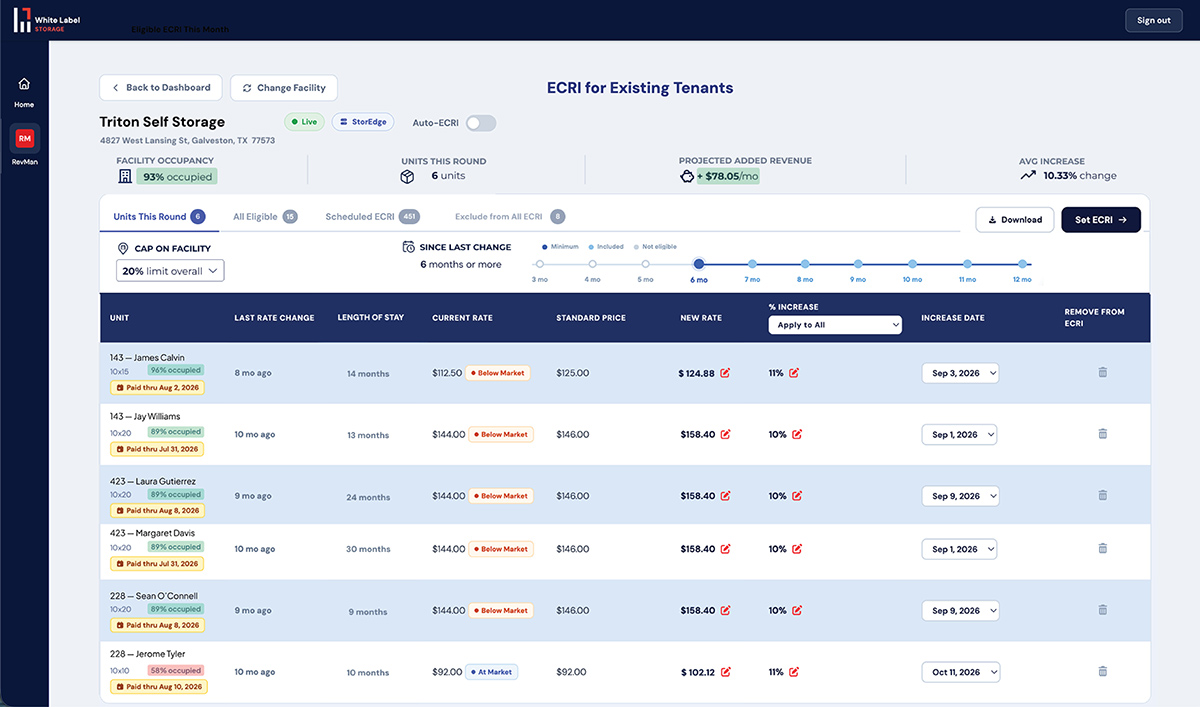
White Label wasted little time putting the ECRI Hub to work. “Actually, it’s already being used across White Label’s operations teams,” says Madeleine Paulsen, product strategy and design manager. “The Hub enables our managers to be more strategic by consolidating tenant data and actions to take for ECRI. In one view, we can review eligibility, pricing gap of in-place versus street rate, and other tenure data. The ECRI Hub helps improve revenue generation quickly and consistently, which delivers more value to owners and operators without the extra overhead of legacy third-party tools. Now, revenue managers have a streamlined interface to review and execute rate increases, ultimately maximizing owner returns.”
Like much of White Label’s technology, the ECRI Hub was built in-house, an approach that was important to the company. “Off-the-shelf solutions usually mean working around software bottlenecks,” says Paulsen. “By building our own tool, we directly reflect our operational core and value of WLS management. In addition, because we built this ourselves, we can quickly adapt the tool as the compliance landscape evolves.”
As it stands, the ECRI Hub will function as an internal tool that White Label Storage uses to improve revenue management across its portfolio.
- Dynamic with the compliance landscape – The hub features built-in guardrails and automated effective-date logic, meaning that rate increases are far less likely to run afoul of notice requirements. It’s also noteworthy that the team is able to efficiently implement changes as compliance evolves with time. “We can adapt quickly to requirements as they continue to roll out,” she says.
- More consistent revenue capture – The hub allows operations teams to easily see which tenants are eligible for an ECRI, and the expected revenue per round for increases. “This lets them notice and act on pricing opportunities they might otherwise have missed or postponed,” she adds.
- Focus on strategy – By replacing manual, cross-system tracking with one streamlined tool, the ECRI Hub cuts down the administrative time operators spend managing rate reviews. “That’s time that can then be focused on strategy and not hunting down all kinds of data points that inform it,” says Paulsen.
Hartman adds, “Of course, it’s not going to stop there. We’ll continue to build new in-house technologies. We won’t be satisfied until White Label Storage is a fully comprehensive platform that helps self-storage owners do less and earn more.”
For Hartman and Smyth, this idea goes back to something they set out to do early on: build something bigger than themselves.