



hen a facility’s name, phone number, address, or schedule changes, the dangerous period is not always before the correction. It is the interval when the old fact and the new fact are both circulating.
The website shows the new office hours. The map profile still shows the old schedule. A call-routing vendor has accepted the new number, but the rental page has not. The internal directory now uses the new facility name while an employee searches for the familiar one and opens the wrong record. Each surface can look reasonable in isolation. Together, they create a split customer experience.
Self-storage operators often approach this as a list of edits. That is necessary, but it is not enough. A material facility fact change should be run as a short, controlled cutover: one authorized change set, one effective window, a deliberate sequence, explicit stop conditions, and a final reconciliation.
The goal is not to make every system update at the same millisecond. Most platforms do not work that way. The goal is to know which version is authoritative, which destinations are still carrying the prior version, and what a customer or employee should do while the systems converge.
That difference should determine the cutover order.
Google’s current Business Profile guidelines call for a business to be represented as it is recognized in the real world, with an accurate address and no duplicate profile for the same business. The same guidance says storage facilities should use office hours as their primary hours, or front-gate hours otherwise. Google Search Central separately describes how names, addresses, telephone numbers, and hours can be represented in LocalBusiness structured data. Those are platform rules and web vocabularies, not proof that a fact is correct. They do show why a source change can affect both what people read and what machines process.
- When does the new value become effective for customers and staff?
- Which system must change first so the next action remains safe and intelligible?
- Which old value must remain temporarily available for continuity?
- What result would require the team to stop or roll back?
- What evidence will close the change?
This distinction matters during a rebrand, phone migration, hours change, website move, temporary closure, address normalization, or management transition. Some changes are reversible. Others are only partly reversible because directories, caches, and customer communications can outlive the original edit.
A stable internal facility key helps the team keep the property correlated while its public name or other fields change. RFC 9562 defines UUIDs as 128-bit identifiers intended to provide uniqueness across space and time. An operator does not need to expose such an identifier publicly, and a UUID does not prove ownership or authority. The useful principle is simpler: The durable key should not change merely because a display value changes.
- Facility key – The stable internal identifier for the exact location;
- Authorized before and after – Only the fields approved to change, shown side by side;
- Effective instant – Date, time, offset, and named time zone;
- Customer-critical paths – Phone, website, rental, office/access-hours display and arrival instructions affected by the change;
- Release sequence – The order in which systems and profiles will be updated;
- Stop and rollback conditions – The failures that pause the cutover and the prior state that can be restored; and
- Closure evidence – The independent readbacks required before the change is considered reconciled.
The brief is deliberately narrower than a master facility record. It governs one change window. It should not become an excuse to republish private contacts, security information, alarm details, credentials, or unsupported legal relationships.
The effective instant deserves more care than a date alone. RFC 9557 extends internet timestamps with additional information, including a named time zone, and explains how offset and time-zone data can become inconsistent. Operators do not need to adopt that technical format everywhere, but they should record enough context to distinguish, for example, 8 a.m. Eastern from 8 a.m. Mountain during a multi-state release.
First, admit the change into the authoritative operating source. The team should be able to identify who approved it, what evidence supports it, and when it becomes effective. A submitted platform edit is not the source of truth simply because it was submitted.
Second, prepare continuity and rollback. If a phone number is changing, confirm what happens to calls made to the old number. If a page URL is changing, prepare the redirect and retain the prior route. If hours are changing, prepare the temporary message that explains the transition. Rollback should be executable, not a note that says, “restore if needed.”
Third, update direct customer pathways. The owned facility page, rental flow, customer-service script, call routing, and operational directory usually deserve priority because they shape the customer’s immediate next step. Structured data should reflect the same approved visible facts; it should not become a separate place where a different answer survives.
Fourth, update discovery and directory surfaces. Map profiles, business listings, and industry directories may review changes on their own schedules. Record submitted, accepted, applied, and publicly observed as separate states. A confirmation screen does not prove that the public value changed.
Fifth, reconcile every affected destination. Test the live page, call the public number through an approved test, inspect the exact profile, check both desktop and mobile displays (where relevant), and record unresolved discrepancies. Search indexing and ranking are downstream outcomes; they are not closure evidence for the operational change.
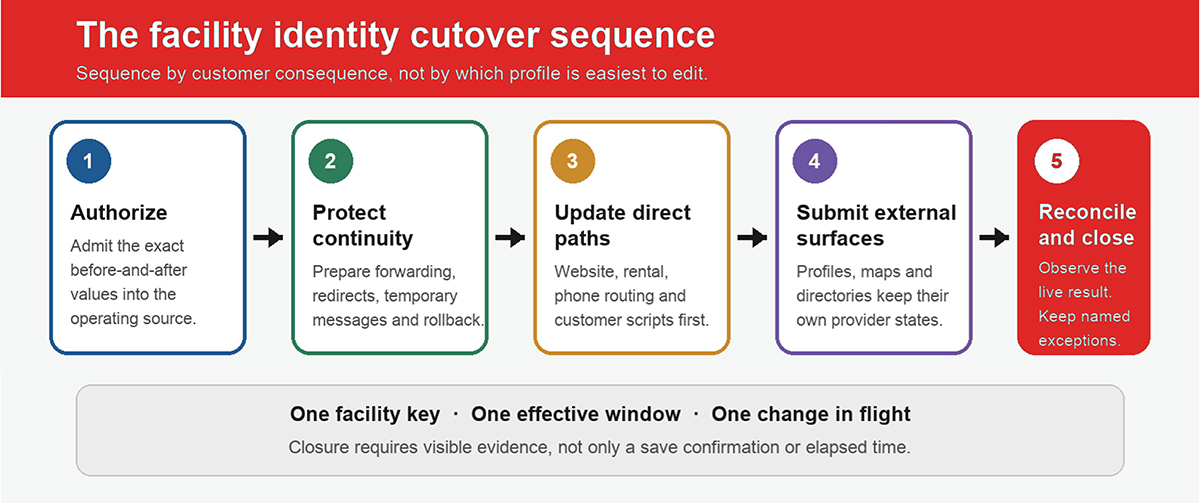
Without that rule, a team can lose causality. A name change and a phone migration happen together. A directory rejects one field but accepts another. A manager then cannot tell which change produced the visible result or which prior value should be restored.
The W3C PROV-O Recommendation provides general concepts for linking entities, activities, agents, sources, revisions, and times across systems. A self-storage operator does not need to implement an ontology to benefit from the idea. Each visible result should be traceable to the change activity, source, and responsible actor that produced it.
NIST SP 800-53 is a security and privacy control catalog rather than a self-storage operating manual, but its configuration-management family reflects a broadly useful discipline: Changes, inventories, and system states should be controlled as part of an organization-wide risk process. The analogy should stay bounded. It supports disciplined change management; it does not turn a facility profile into a regulated information system.
The team assigns one stable facility key and freezes the exact before-and-after values. The old phone number will forward for 30 days. The customer-service script and facility page are prepared in advance but remain unpublished. The map-profile edit cannot be scheduled and may require provider review.
At 10 a.m., the authorized source changes. Call routing activates, then an independent test confirms that both new and old numbers reach the intended queue. The owned facility page and rental contact route publish next. The team checks the visible page and its machine-readable data. Only then does it submit the map-profile change and update lower-consequence directories.
At 10:35 a.m., the website, rental flow, and phones show the new state. The map profile still shows the prior closing time and has not yet applied the new number. The cutover is not failed, but it is not closed. The team records a visible exception, keeps the old number forwarding, and gives customer-facing staff the temporary discrepancy note.
At 11:42 a.m., the map profile shows the new number and hours. A second reviewer confirms the public result from a separate session. The cutover closes with one remaining task: Recheck the forwarding dependency before its retirement date.
Nothing in this fictional example proves a recommended timeline, platform approval speed, customer result, or performance improvement. Its value is the sequence: authorize, protect continuity, update direct pathways, submit downstream changes, and close on observed evidence.
- Every customer-critical path shows the authorized value or has an approved temporary exception;
- The prior value is either retired or intentionally preserved for continuity;
- Every submission, provider decision, and public readback is recorded separately;
- The team can name the unresolved destinations and their owners;
- Rollback dependencies remain usable for the stated period; and
- A reviewer other than the person who made the change has checked the consequential results.
Schema.org includes a SelfStorage type and inherited LocalBusiness properties that can represent approved facility information on the web. That vocabulary can help systems describe a location consistently. It does not verify a business profile, prove legal control, guarantee a search result, or replace the independent readback.
The discipline is the same whether the change affects two surfaces or 20. Make the transition explicit. Keep the customer path intact. Separate provider receipts from visible results. Do not let an old value disappear until the new path is proven—or until the team has deliberately accepted the exception.
Facility identity is not only a record to maintain. During change, it is a release to govern.