









How to enjoy our new magazine:
Just scroll!
Click or tap the table of contents icon in the menu bar to find any article.
Read any article by clicking or tapping the read full article button below each article intro.
Jump back to your previous browsing spot from any article using the menu bar or back to issue button.







to see what R3 can do for you.



-
Where AI Delivers In Self-Storage MarketingPage 12
-
Driving Visibility, Trust, And Rentals Through ReviewsPage 16
-
Conquering Google’s “Ask Maps” AI FeaturePage 20
-
The Impact Of Existing Tenants On PerformancePage 24




Experience
Local Expertise

Not Just a Builder


-
Page 36
-
Q2 2026 Investor SurveyPage 38
-
The Turnaround Of An Underperforming PropertyPage 40

-
Inside The Self-Storage Development SlowdownPage 64
-
Developing Self-Storage In The Sunshine StatePage 68
-
Building In Markets Overlooked By National OperatorsPage 72
-
San Gabriel Self Storage in San Gabriel, Calif.Page 74

-
How AI Is Leveling The Playing FieldPage 76
-
Avoiding Temperature Stratification With FansPage 80
-
Ultimate Guide To Selling Self-Storage And RV PropertiesPage 82
-
Where The REIT Model Breaks DownPage 84
- Chief Executive Opinion by Travis Morrow6
- Publisher’s Letter by Poppy Behrens9
- Meet The Team10
- Women In Self-Storage: Michelle Otto by Alejandra Zilak29
- Who’s Who In Self-Storage: Ryan Chapman by Brad Hadfield33
- The Last Word by Niki Bossonis88
For the latest industry news, visit our comprehensive website, ModernStorageMedia.com.
















CEO of MSM and Storelocal Corporation,
President of National Self Storage
’ll give it to you straight, because that’s the only way I know how.
You’ve had this one circled. You told yourself you’d “see how the quarter shakes out,” “run it by the partners,” “maybe next year.” I get it. But it’s August. THE Show is Nov. 4 to 6 in Atlanta, and the clock on the good pricing is running out. It’s time to pull the trigger.
Hear me on this: It’s not another regional show; this is a full-on national event with many things you’ve never seen before. We built THE Show to be the big leagues of self-storage. It’s the only national self-storage event east of the Mississippi in 2026, at the Georgia World Congress Center. With four content pillars (Operations, Data, Development, and Investment), you’ll leave with a playbook, not a tote bag. Other highlights include a Deal Room powered by TractIQ, where acquisitions actually get done; keynotes that pull from outside our bubble, because that’s usually where the best ideas come from; and nights that remind this industry it’s allowed to have some fun, with a welcome at the Georgia Aquarium with Wolfgang Puck and a Red Carpet Awards Gala.
We built this show for our entire industry; there’s something for everyone and more self-storage content than a single human can consume, so bring your teams. It will be an experience you’ll talk about for years—the industry already is.
The operators who win this next cycle won’t be the ones who waited to see what everybody else did. Occupancy is tightening, rates are turning, and the deals are moving to the people who are in the room. That’s the whole game, and you should be in it.
You’ve been on the fence long enough. The fence doesn’t rent units or make you more money.
Register at msmtheshow.com before early pricing closes. Bring your VPs, bring your managers, bring your questions, and bring the deal you’ve been sitting on.
Don’t be the one hearing about it in December.
I’ll see you in Atlanta.

-
PUBLISHER
Poppy Behrens
-
Director Of Sales & Marketing
Lauri Longstrom-Henderson
(800) 824-6864 -
Creative Director
Carlos Padilla
(800) 352-4636 -
Editor
Erica Shatzer
-
Lead Writer / Web Manager
Brad Hadfield
-
Storelocal® Media Corporation
Travis M. Morrow, CEO
-
Websites
-
Visit Messenger Online!
Visit our Self-Storage Resource Center online at
www.ModernStorageMedia.com,
where you can browse our paid publications, research archived articles, sign up for a magazine subscription, submit a change of address, and more. 
- All correspondence and inquiries should be addressed to:
MSM
PO Box 608
Wittmann, AZ 85361-9997
Phone: (800) 352-4636

Invest with confidence in a family-owned and operated self-storage brand backed by 40 years of proven experience. Built on trust, stability, and hands-on management, our company has thrived across market cycles while delivering consistent value.
Join a legacy of smart growth and reliable returns in an essential, resilient industry.

210-405-6695
theparhamgroup.com















ne of the greatest privileges of publishing Messenger is having the opportunity to recognize the people and companies that continue to raise the bar for our industry. Every year, I am inspired by the innovation, dedication, and professionalism demonstrated by self-storage owners, operators, managers, and developers across the country.
This November, we’re taking that recognition to an entirely new level.
For the first time in the history of both the annual Facility of the Year and Manager of the Year competitions, the winners will be announced live during an elegant Awards Gala at THE Show in Atlanta. Instead of announcing the winners before-hand, we’ll share the excitement together as the envelopes are opened live before an audience of industry leaders.
Think of it as the self-storage industry’s version of the Oscars, where you can show up in your business casual attire or dress to the nines—black tie is clearly optional.
It’s a fitting way to celebrate the individuals and facilities that define excellence in our business. Whether it’s a beautifully designed facility, an operation that consistently exceeds customer expectations, or a manager whose leadership inspires an entire team, these awards recognize the very best our industry has to offer.
If you’ve never entered one of our competitions, I encourage you to consider doing so this year. The Facility of the Year competition honors excellence in design, operations, innovation, marketing, technology, customer service, and overall performance. Likewise, the Manager of the Year competition recognizes the professionals whose leadership and dedication are often the driving force behind a facility’s success.
Being named a finalist is an achievement worth celebrating. Being announced as the winner before your peers at a black-tie gala is an experience you’ll never forget.
THE Show has been designed to bring together the brightest minds in self-storage for education, networking, and business opportunities. The Awards Gala will serve as the perfect finale—a celebration of excellence and the people who make this industry so remarkable.
I hope you’ll take a few minutes to submit an entry or nominate an outstanding manager. You may be surprised at just how deserving your team really is.
Complete competition details, eligibility requirements, submission guidelines, and entry forms are available at www.modernstoragemedia.com/msm-awards.
As always, if you have any questions, please don’t hesitate to reach out to me directly at poppy@modernstoragemedia.com.
I look forward to celebrating with all of you this November in Atlanta—and perhaps congratulating you as you walk across the stage.

Publisher

ne of the greatest privileges of publishing Messenger is having the opportunity to recognize the people and companies that continue to raise the bar for our industry. Every year, I am inspired by the innovation, dedication, and professionalism demonstrated by self-storage owners, operators, managers, and developers across the country.
This November, we’re taking that recognition to an entirely new level.
For the first time in the history of both the annual Facility of the Year and Manager of the Year competitions, the winners will be announced live during an elegant Awards Gala at THE Show in Atlanta. Instead of announcing the winners before-hand, we’ll share the excitement together as the envelopes are opened live before an audience of industry leaders.
Think of it as the self-storage industry’s version of the Oscars, where you can show up in your business casual attire or dress to the nines—black tie is clearly optional.
It’s a fitting way to celebrate the individuals and facilities that define excellence in our business. Whether it’s a beautifully designed facility, an operation that consistently exceeds customer expectations, or a manager whose leadership inspires an entire team, these awards recognize the very best our industry has to offer.
Being named a finalist is an achievement worth celebrating. Being announced as the winner before your peers at a black-tie gala is an experience you’ll never forget.
THE Show has been designed to bring together the brightest minds in self-storage for education, networking, and business opportunities. The Awards Gala will serve as the perfect finale—a celebration of excellence and the people who make this industry so remarkable.
I hope you’ll take a few minutes to submit an entry or nominate an outstanding manager. You may be surprised at just how deserving your team really is.
Complete competition details, eligibility requirements, submission guidelines, and entry forms are available at www.modernstoragemedia.com/msm-awards.
As always, if you have any questions, please don’t hesitate to reach out to me directly at poppy@modernstoragemedia.com.
I look forward to celebrating with all of you this November in Atlanta—and perhaps congratulating you as you walk across the stage.
Publisher

MSM’s THE Show lands in Atlanta, Ga., on Nov. 4 to 6, 2026, packing the Georgia World Congress Center with more industry speakers and keynotes than ever before, plus special guests, exciting breakout sessions, an acquisitions corner, and a trade show floor designed for engagement and visibility.
After hours, unforgettable events await, with our Deep Blue Welcome Dinner inside the underwater banquet hall of the Georgia Aquarium, catered by Wolfgang Puck, and our Red Carpet Awards Gala, honoring the very best in self-storage.
If you’ve been waiting for something different … Welcome to THE Show.










Unlock the Power of
Innovation & Technology with


Why Owner/Operators Choose TPP




rtificial intelligence is no longer a trend the self-storage industry is preparing for; it is already shaping how operators compete. From automated leasing to remote facility management, technology is redefining operations, and marketing is evolving just as quickly.
For many operators, the question is no longer whether to use AI but how to use it effectively. Where does it create real value? Where does it fall short?
The answer is not about replacing marketing teams. It is about making them more efficient, more informed, and ultimately more effective. The operators who understand this distinction are the ones gaining ground.
AI fits naturally into that environment because it excels at execution. It can create content faster, analyze data more thoroughly, and respond to inquiries instantly. What it cannot do is replicate experience, judgment, or creative instinct.
The most successful marketing teams are using AI to handle repetitive and time-consuming work, freeing up human effort for decisions that require nuance and insight.
Self-storage marketing demands constant updates: location pages, promotional campaigns, seasonal messaging, FAQs, email outreach, and more. For multi-site operators, that workload multiplies quickly.
AI allows teams to generate first drafts of these materials in minutes instead of hours. A new facility opening, a rate adjustment, or a local promotion can all be translated into usable marketing copy almost instantly. Instead of building each piece from the ground up, marketers can focus on refining and tailoring messaging, so it feels consistent and intentional.
This is particularly valuable when managing a portfolio of properties. Maintaining a cohesive brand across multiple locations has always been a challenge, but AI helps standardize messaging while still allowing for local customization.
AI makes it easier to interpret that information. Instead of relying solely on experience or assumptions, operators can use AI to surface patterns and trends that influence marketing decisions.
This might mean identifying which types of customers convert fastest, understanding when demand is likely to spike, or recognizing which campaigns are delivering the strongest return. With these insights, marketing becomes less reactive and more strategic. In a competitive market, that shift matters. It allows operators to allocate resources more effectively and adjust campaigns before results plateau.
One word of caution: Limit the uploading of any customer or company data to a closed, premium, paid AI service like the enterprise version of Microsoft Copilot so company or customer data doesn’t end up in the public sphere and accessible by the AI agent outside of your business.
Storage customers rarely plan weeks in advance. They search when the need arises, often comparing several facilities at once. A delayed response can mean a lost rental.
AI-powered chat and automated response tools ensure that inquiries are addressed immediately, regardless of time of day. They can provide basic information, guide prospects through options, and capture leads for follow-up.
This capability is especially important as the industry continues its shift toward remote and hybrid facility management. With fewer staff on site, operators still need consistent and responsive customer experience. AI fills that gap, extending service hours without increasing headcount.
The result is not just convenience; it can be conversion.
AI helps operators improve performance by accelerating the feedback loop. Instead of waiting for monthly reports, marketing teams can evaluate results in near real time, identifying what is working and what is not.
This allows for quicker adjustments, refining messaging, reallocating spend, or testing new approaches without prolonged delays. Over time, this leads to more efficient campaigns and better use of marketing budgets.
In an industry where demand can shift quickly based on housing trends or economic conditions, that level of agility is a clear advantage.
AI is increasingly being used to strengthen that visibility. It can help optimize website content, improve readability, and adapt messaging to align with search behavior. For operators with multiple locations, this reduces the burden of manually optimizing each site while still maintaining strong local presence.
However, ranking well is only part of the equation. Once a customer lands on your site, the experience still determines whether they convert.
Brand identity is one of them. In a crowded market, differentiation is critical, even when facilities offer similar products. AI can produce content, but it does not define what your brand stands for or how it should sound. That requires deliberate direction.
Strategy is another area where human input is essential. Deciding how to position a facility, where to invest marketing dollars, and how to respond to competition are not tasks that can be automated. AI can inform these decisions, but it cannot make them.
Customer experience also remains a human responsibility. While AI can assist with communication, it takes a deeper understanding of customer behavior to design a seamless, trustworthy journey from search to move-in. Small details, clarity in pricing, tone of messaging, and ease of navigation often determine whether a customer chooses one facility over another.
Trust itself is perhaps the most critical factor. Customers are placing personal belongings in your care, often during stressful transitions. Marketing must reinforce reliability and transparency at every touchpoint. AI can support that effort, but it must be carefully managed to avoid errors or impersonal interactions that erode confidence.
Finally, there is creativity. AI can generate variations of ideas, but it does not originate them in the same way humans do. The campaigns that stand out—those that connect with customers on a practical or emotional level—are still driven by human insight.
AI works best when it handles the tasks that benefit from speed and scale, like content production, data analysis, and immediate response. Human teams deliver value through strategy, creativity, and decision-making.
When those roles are clearly defined, marketing becomes both more efficient and more effective.
The industry is moving toward greater automation in nearly every aspect of operations. Marketing will continue to evolve alongside it. But while the tools may change, the fundamentals do not. Customers still expect clarity, responsiveness, and trust.
AI can help you deliver on those expectations, but it cannot replace the people responsible for getting it right.


At PTI Security Systems, our commitment to quality and passion for innovation drives the development of advanced security solutions to help operators scale with confidence. From smart technology to fully integrated systems, our solutions provide greater security, insights, and control across any facility.

don’t keep up with the competition;
they lead the pack.



MOBILE APP
SMART KEYPAD
SMART LATCH
MOBILE APP
SMART KEYPAD
SMART LATCH


nline reviews have become one of the most influential factors in how consumers choose businesses, and self-storage is no exception. Before a prospective tenant visits a facility website, calls the office, or sets foot on a property, there is a strong chance they have already searched online and read reviews. In fact, according to a BrightLocal’s 2026 Local Consumer Review Survey, 97 percent of consumers read reviews of local businesses. For many operators, those reviews are now the first impression of their business.
What was once considered a “nice-to-have” marketing element has evolved into a core business driver. Reviews influence customer trust, local search visibility, occupancy rates, and even long-term brand reputation. In an increasingly competitive storage landscape, operators who actively manage their online reputation position themselves to attract more tenants and build stronger customer relationships.
For self-storage operators, this shift is especially important, because storage is often tied to major life events. Customers may be moving, downsizing, going through a divorce, managing an estate, or relocating for work. During these stressful transitions, people naturally seek confidence and trust before making a decision.
A facility with hundreds of positive reviews immediately communicates credibility. It signals that customers feel secure storing their belongings there and that the business delivers a quality experience. On the other hand, a facility with very few reviews or a low rating may create hesitation, even if the property itself is excellent.
Consumers often compare multiple facilities before making a decision. In many cases, the operator with the stronger online reputation wins the rental before a customer ever picks up the phone or visits the website.
Search engines such as Google evaluate several review-related factors, including:
- Quantity of reviews,
- Overall star rating,
- Frequency of new reviews,
- Review recency,
- Owner responses to reviews, and
- Keywords mentioned in reviews.
Facilities with a steady stream of recent positive reviews are more likely to appear prominently in local search results and map listings. This increased visibility creates more website traffic, phone calls, and ultimately more rentals.
For operators investing heavily in advertising, reputation management can also improve marketing efficiency. If two facilities run similar advertising campaigns, the business with stronger reviews will often achieve better conversion rates because customers already trust the brand before engaging further.
Beyond the rating itself, the content of reviews matters. Prospective tenants often look for comments about:
- Cleanliness,
- Security,
- Customer service,
- Ease of rental process,
- Staff professionalism,
- Billing transparency, and
- Facility accessibility.
These reviews provide insight that marketing materials alone cannot replicate. Customers trust authentic experiences from other tenants more than traditional advertising messages. Positive reviews help reduce uncertainty and reinforce confidence. They also create emotional reassurance during what is often a stressful time for renters.
Consumers understand that no business is perfect. In fact, a profile with only flawless five-star reviews can sometimes appear unrealistic. What prospective tenants truly evaluate is whether a company listens, communicates professionally, and attempts to resolve concerns. A thoughtful response to a negative review demonstrates accountability and customer care. It shows future customers that management is engaged and willing to address issues proactively.
When responding to negative reviews, operators should:
- Respond promptly,
- Remain calm and professional,
- Avoid defensive language,
- Acknowledge the customer’s concern,
- Offer to continue the conversation privately when appropriate, and
- Focus on resolution rather than argument.
Poor responses can damage trust quickly, while professional responses can strengthen credibility. Negative feedback also provides valuable operational insight. Recurring comments about cleanliness, gate access, communication, or billing may highlight areas that need improvement internally.
Building a steady review generation process helps create ongoing credibility. This does not require aggressive or complicated tactics. Often, the most successful operators simply make review requests part of their normal customer experience.
Common touchpoints for requesting reviews include:
- After move-in,
- Following positive customer interactions,
- During move-out,
- After resolving a customer issue, and
- Through follow-up email or text communication.
The key is making the process easy and natural for customers. Importantly, operators should avoid practices that violate review platform policies, such as offering incentives in exchange for positive reviews or selectively requesting reviews only from happy customers. Authenticity is critical. Genuine feedback creates stronger long-term trust than artificially inflated ratings.
- Customer acquisition,
- Retention,
- Brand perception,
- Employee morale,
- Competitive positioning, and
- Revenue growth.
For multi-store operators, reviews can also reveal trends across locations. One facility may consistently outperform others in customer satisfaction, offering insights into staffing, processes, or management practices that can be replicated elsewhere. In some cases, reviews may even impact hiring. Prospective employees increasingly evaluate company reputations before applying for jobs, particularly in customer-facing industries.
Responses do not need to be lengthy or overly formal. What matters most is authenticity and consistency. For positive reviews:
- Thank the customer,
- Personalize the response (if possible), and
- Reinforce appreciation for their business.
For negative reviews:
- Acknowledge the issue respectfully,
- Show willingness to help while trying to take the issue offline, and
- Maintain professionalism.
Review responses also contribute additional content to business listings, which may further support local search visibility. Most importantly, responses help humanize the business. In an industry where customers are trusting operators with valuable personal belongings, that human connection matters.
Operators who invest in reputation management today are building a long-term competitive advantage. Those who ignore reviews risk losing visibility, trust, and potential rentals to competitors who prioritize the customer experience.
The facilities that stand out in the coming years will not necessarily be the largest or newest. They will be the businesses that consistently earn trust and demonstrate it publicly through customer feedback.
A strong reputation is not created overnight, nor is it built solely through marketing campaigns. It is the result of consistently delivering positive customer experiences and actively engaging with customer feedback.
For self-storage operators, reputation management should be viewed not as a reactive task but as an ongoing business strategy. In an industry built on trust, reviews have become one of the clearest reflections of that trust available to prospective customers.

or years, the playbook for local self-storage marketing was straightforward: Claim your Google Business Profile (GBP), upload a few high-resolution photos of clean hallways and bright-colored roll-up doors, add your office hours, and let it ride. It was a “set it and forget it” asset that brought in steady local leads.
But local search has fundamentally changed. With the rollout of Google’s Ask Maps AI feature, search is shifting from a static directory of business listings to an interactive, AI-driven conversational assistant.
According to insights compiled by Search Engine Journal, Google’s AI mode doesn’t just look for keywords in your business description anymore. Instead, it scours your entire digital footprint, including your GBP attributes, customer reviews, website content, social media posts, and blog articles, to answer highly specific, multi-variable customer questions.
If your storage facility’s online presence is gathering dust like an abandoned unit, you risk becoming invisible to modern renters. Here is your definitive guide to optimizing your local storage facility for the Ask Maps AI era.
However, with Ask Maps, a user can type or speak a complex, highly specific request. Here’s an example: “I need a secure, climate-controlled 10-by-10 storage unit in north Phoenix that has 24-hour gate access, an elevator, and is open for move-ins right now.”
This is a multi-variable query. To recommend your facility, Google’s AI must instantly verify multiple independent layers of data:
- Do you have 10-by-10 units available?
- Are they climate controlled?
- Do you offer 24-hour access?
- Is there an elevator?
- Are you open for business at this exact moment?
If your profile or website fails to explicitly confirm even one of these details, the AI will likely skip your facility and recommend a competitor who made that data clear.
There are five things you need to do to get cited by Ask Maps.
- Access Types – Clearly differentiate between drive-up, indoor, and elevator access.
- Security Features – Explicitly check boxes for on-site security, 24-hour surveillance cameras, and electronic gate access if applicable.
- Climate Control – Ensure your listing specifically indicates climate- or temperature-controlled options and the differences.
- Operating Vs. Access Hours – This is critical. If your office closes at 5 p.m. but renters can access their units until 10 p.m., ensure your access hours are meticulously updated in GBP.
- Stop Keyword Stuffing – Stuffing keywords into your business description or business name (e.g., “Best Affordable Cheap Storage Units Austin”) no longer carries any weight for AI search. Focus instead on providing clean, authentic, and detailed data.
- Real-Time Inventory Updates – “Our 5-by-10 climate-controlled units are running low for summer! Book online today to lock in your rate.”
- Security Spotlights – Share a photo of your newly upgraded digital keypad access or well-lit corridors with the text “Your peace of mind is our priority. 24/7 digital surveillance is always active.”
- Sizing Guides – Post visual breakdowns of what fits in a 10-by-10 unit (e.g., “Can I fit a one-bedroom apartment’s worth of furniture?”). This helps Google connect conversational search intents (“storage for a one-bedroom apartment”) to your facility.
How often should you post? Aim for at least two to three times per week. If you’re in a highly competitive area, post more often. Consistency matters more than volume. Treat your GBP feed like a mini billboard dedicated exclusively to high-intent local buyers. Additionally, don’t post the same thing over and over again. If you use a scheduler, repeat posts no more than every other week. Don’t forget to post any events, like auctions. Note, too, that GBP is not a social media network. Stick to business-related posts only.
- How to Safely Store Antique Wooden Furniture in [City Name] (Targets “climate control” and “antique storage” queries).
- The Ultimate Guide to Packing a Moving Truck to Maximize Space.
- Vehicle, Boat, and RV Storage Rules in [City Name]: What You Need to Know.
- Decluttering Your Garage: A Four-Step Weekend Checklist.
By writing localized, helpful content, you build context. When the AI scans the web for the best facility for “boat storage,” your deeply detailed blog post proves to Google that you are a highly relevant match.
Monthly, your Google Analytics and Search Console reports will provide data to help you decide what to post the next month.
- GBP Offers – Use the dedicated “offer” post type on your GBP. This creates a distinct tag with an expiration date that Google can easily parse for value-seeking searchers.
- Website Schema – Ensure your webmaster uses structured data (schema markup) on your pricing pages so Google can instantly read promos like “First Month Free” or “$1 Move-In Special.”
Multi-Channel Social Posts
Don’t just post randomly on Facebook and Instagram. Craft posts that mirror real-world problems and questions. Share customer testimonials, moving tips, and community events you sponsor. If a local business or group tags your facility on Facebook for helping with a charity drive or a crisis, Google’s AI notes that localized relevance.
If you do any B2B business, you must be on LinkedIn. Besides that, don’t post the same thing at the same time on all the networks. Understand your target audience, how they use each social channel, and strategically share substance-filled posts.
Weaponize Your Reviews and Replies
Reviews are the ultimate validation signal. The Ask Maps AI frequently extracts sentences from reviews to justify its recommendations (e.g., “highly recommended because users say it has great elevator access”).
- Prompt Your Customers for Specifics – When asking satisfied tenants for a review, don’t just ask for five stars. Guide them gently by saying something like, “If you enjoyed our clean facility, secure gate access, or helpful staff, please mention that in your review!”
- Respond to Every Review – When replying, naturally weave in facility features and location. If a reviewer mentions great service, reply with something like, “Thanks, Sarah! We take pride in keeping our climate-controlled building clean and easy to navigate.” Even if they don’t mention what features they used, you can add them: “Thanks, Sarah, for taking advantage of our …”
To stay competitive and to ensure your facility remains on top when Google Maps or an AI search tool is asked to find local storage, treat your digital presence as a living, breathing asset.
Keep your attributes flawless, update your inventory and specials weekly, and consistently publish authoritative content that answers the exact questions your future tenants are asking.
Download my free Define Your Target Market Workbook from my website (https://azsocialmediawiz.com) to jumpstart your content marketing.



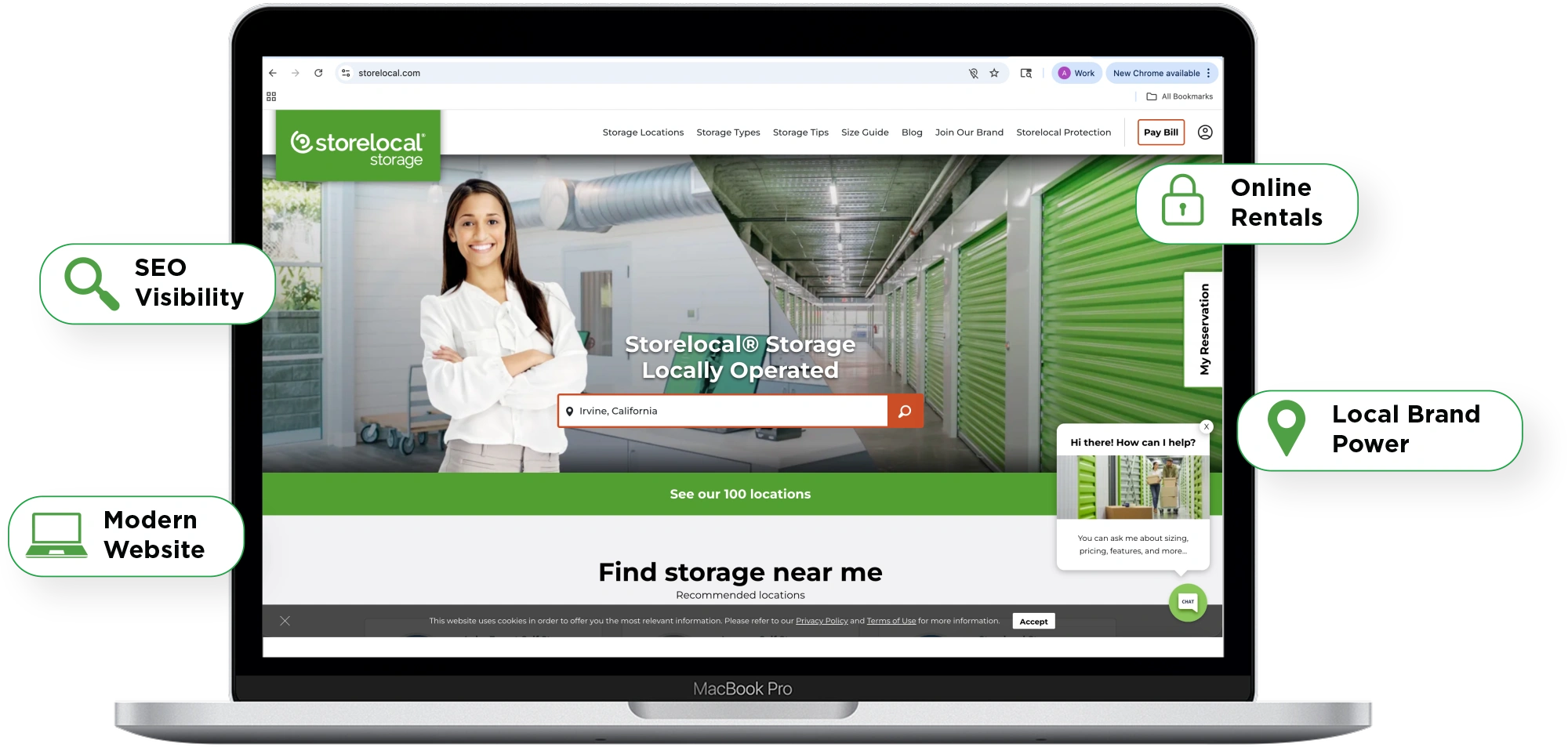

or most of the self-storage industry’s history, the playbook has centered around customer acquisition. We find the customer, win the move-in, optimize the funnel, and price competitively enough to fill units while accepting whatever churn the market hands us. Marketing budgets, software roadmaps, REIT investor decks, and broker pitches have all been built around the assumption that growth comes from getting more people through the door. That playbook is showing its age.
Storable’s Q1 2026 Industry Pulse, drawn from data across more than 30,000 facilities, lays it out clearly. Average length of stay climbed to 19.3 months, while national move-outs dropped roughly 4.6 percent year over year. Occupancy held steady at 76.9 percent, even as move-ins softened across most regions. Operators are protecting performance by keeping the customers they already have, and they’re pulling back on move-in pricing because they must compete harder for every new one. Retention is now contributing more to performance than acquisition in many markets.
This is a structural shift that’s been building for some time. Mortgage rate lock-in has kept more homeowners in place than expected, job mobility has slowed, and the life events that historically drove storage demand are happening on longer timelines. Storage demand is still there, just shaped differently, and growth increasingly depends on the customers operators already have, not just the next move-in they win.
The operators who pull ahead over the next few years will be the ones who recognize what’s happening and adapt deliberately around it.
Acquisition KPIs were good enough when most customers stayed about a year, but at 19.3 months they leave too much out. A customer who stays 19 months at a slightly lower monthly rate can be more profitable than a customer who stays 11 months at a premium rate, especially once turnover costs are factored in. Every time you must move someone out, clean the unit, market it, and lease it again, you’re spending money to replace revenue you already had.
In a retention cycle, the numbers that matter shift to how long different kinds of customers stay, why they leave when they do, and what the relationship is worth across its lifetime. Most operators don’t track these consistently, and the ones that do are pulling ahead.
That doesn’t mean leaning harder on existing tenants when move-ins get softer. The same friction that keeps a long-tenure tenant in place can also be what finally pushes them out, and a tenant lost in year three is far more expensive than a few dollars gained on a rate increase. The operators handling this well are pricing for the long-term value of the relationship rather than for the next quarter. Doing that against tenure, unit type, market, and replacement cost is difficult work, and it requires a level of data discipline the industry hasn’t always practiced. Each operator’s approach to that analysis will look different depending on their portfolio, their systems, and their own read of local market dynamics.
From there, pricing has to distinguish between move-in customers and existing tenants, because they’re not responding to the same signals. Investments need to flow toward what keeps long-tenure customers in place, which often isn’t what makes a facility competitive on a marketplace search. And the marketing has to evolve as the customer profile shifts, because more of these renters are people whose lives have outgrown their homes even though they can’t move.
The retention cycle doesn’t generate the headlines that a record-setting move-in quarter or an acquisition spree does, and none of the work behind it is especially glamorous, but the operators who understand the math, build the data infrastructure to back it up, and run their facilities accordingly will outperform the ones still waiting for the housing market to thaw.
The housing market will thaw eventually. When it does, the operators who used this period to get better at retention will come out the other side with a stronger and more resilient business.





- 24/7 Virtual Doctors
- 5,000+ Free Prescriptions
- Virtual Counseling & Mental Wellness
- No Insurance Required
- No Deductibles or Co-Pays
- Emergency Alert Button
- Live GPS Location Sharing
- Guardian & Family Support Network
- Trip Monitoring & Safety Alerts
- Automatic Place & Geofence Notifications
Your managers invest in your business every day. Invest in them.


ichelle Otto is the owner and president of 6Storage Software Solutions, an industry-leading provider of self-storage management software and cloud-based security systems. These titles are undeniably impressive and tech-forward, but the road that led her to where she is today started in a much different field. Her story fits perfectly in the mosaic of professional backgrounds that comprise the self-storage industry. It also shows how sometimes the right path appears gradually as you move forward and go with the flow.
Backtracking a bit, Otto enrolled in a 10-month secretary program at Hickey College in St. Louis following high school. “I always knew I wanted to be a secretary, and I wanted to start working as soon as possible,” she says, “so attending a university was not for me.”
This new purchase was significantly bigger, with 328 units. It was also a hefty project, as it was a distressed property that needed a lot of attention; they were dealing with leaky storage units, property encroachments, and city requirements to get the property to pass code. For that reason, Otto quit her corporate job. Their new mission became to invest in additional storage facilities.

She also found it difficult to find self-storage management software that met her needs. “I have used many products; and for a long time, I was not happy with how companies treated operators, particularly smaller ones. In 2019, I was determined to find a better option, and I found 6Storage.”
That would be another serendipitous event in her life. Not one to miss an opportunity to make things better, she decided to become vocal about what could be improved—and to offer to be a consultant. “I saw they were on the right track but needed help, so I offered to be a consultant.” Just as she went from owning one facility to an entire portfolio, she eventually bought 6Storage, proving self-storage to be a lifelong passion.
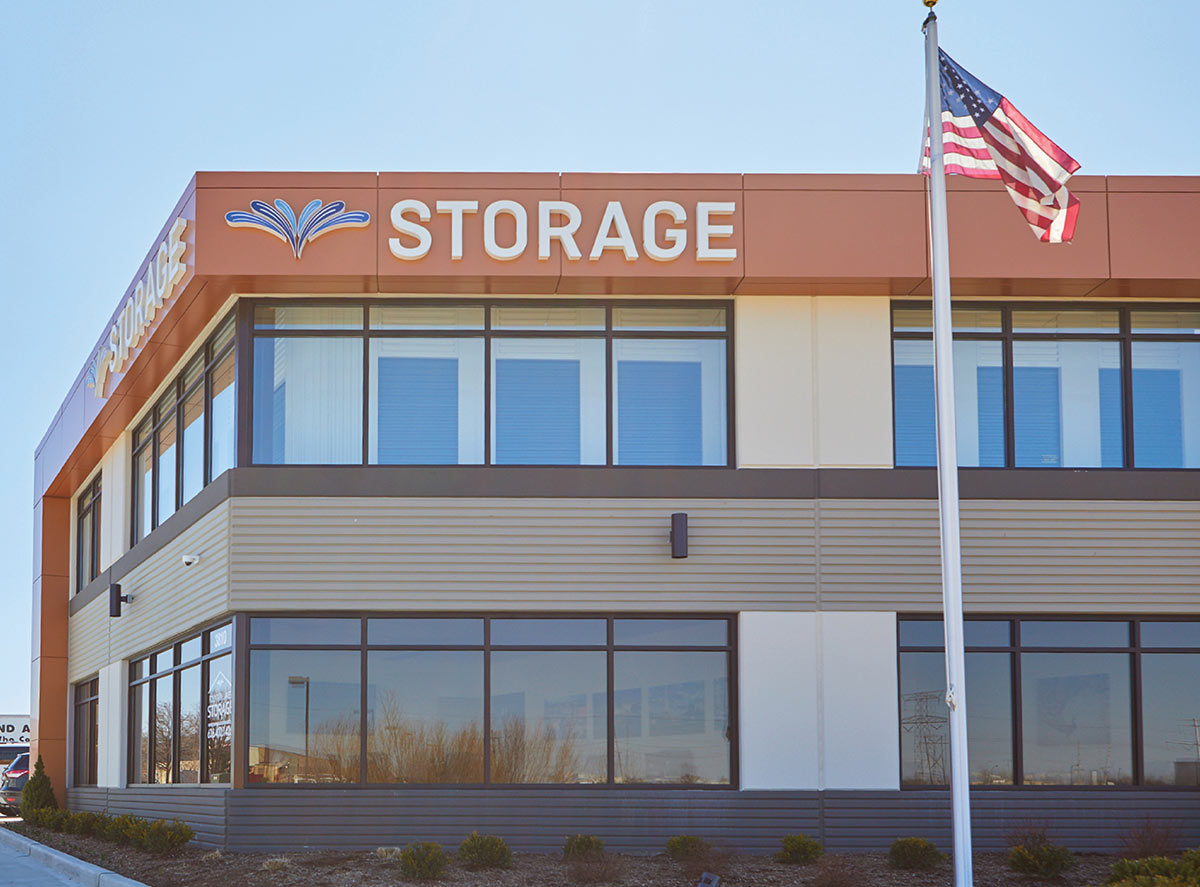

And they have been filling them for years. “We offer an all-in-one automated system: management software, a website with online rentals, and an access control system. We also offer a Tenant Protection Plan, an AI chatbot, and search engine optimization (SEO) services. I believe in offering all these solutions, but I also believe we must do a great job at each product that we offer. We want to be the best in the industry.”
She also highlights their ethos of providing great customer service and of having a good work culture. “I have the best team of employees, and they all love what they do. Everyone takes ownership of their piece of the business,” she says with pride.
Otto enjoys providing educational material to her customers and prospects via webinars. “I like to showcase our software, offer sneak peeks of features, and to encourage participants to attend more detailed demos.”
She chose this type of engagement as both a form of education and marketing. “Operators appreciate that they’re free and eliminate the need for travel, which can be time-consuming and costly. Webinars also allow them to stay focused on their facilities without stepping away from daily operations, making it a convenient way to learn and stay engaged with the industry.”
Most recently, Otto hosted a Storage Redefined Masterclass in Denver. “I presented at the Toy Storage Redefined Masterclass. I see it as an opportunity to focus on a niche of the self-storage industry. It’s an emerging segment with its own set of challenges and opportunities, so being able to share insights and connect with operators who specialize in this space is incredibly valuable.”
Teaching family has been just as important as educating customers. Her daughter Jessika serves as the product owner at 6Storage. “She has real experience as an operator as well and has been in self-storage most of her life.” Although she once swore she would never work in the family business, 10 years later Jessika Selsor has become both an industry and software expert.
She’s also aware of the highly valuable viewpoint of women in the industry. “We think differently from men in many ways, and we are very much needed in this industry. We see things from a different perspective and create a necessary balance.”
And of course, Otto enjoys the people in this space. “I love the people in storage. I love that we are a smaller industry, and I love watching it change and grow.”
Otto relishes spending time in the kitchen, especially baking and preparing family meals. She loves to travel, too. “I have several favorite travel destinations, but Aruba is my favorite. However, this year I had the opportunity to go to Egypt and take a cruise on the River Nile—yes, the Egyptians call it the River Nile, not the Nile River. It was such a great trip.” Despite greater Cairo having a population exceeding 22 million, Otto mentions that the city has fewer than 50 self-storage facilities, underscoring a major opportunity for growth. However, it could take time for it to gain acceptance because the concept is mostly unfamiliar to Egyptians
in Self-Storage Construction

SBS CONSTRUCTION EAST
Roc Hughes!
at The Show in Atlanta, GA
November 4-6
Booth #345




TEXAS • LOUISIANA • KANSAS • MISSOURI • FLORIDA • ALABAMA • MISSISSIPPI • ARKANSAS • OKLAHOMA • GEORGIA • TENNESSEE • NORTH CAROLINA • SOUTH CAROLINA
17 Scenic Loop Rd.,
Boerne, TX 78006
830-388-7620
SBS East Office:
Atlanta, GA
678-409-1831
TEXAS • LOUISIANA • KANSAS • MISSOURI • FLORIDA • ALABAMA • MISSISSIPPI • ARKANSAS • OKLAHOMA • GEORGIA • TENNESSEE • NORTH CAROLINA • SOUTH CAROLINA
17 Scenic Loop Rd.,
Boerne, TX 78006
830-388-7620
SBS East Office:
Atlanta, GA
678-409-1831

nnovation often begins with curiosity. Long before Ryan Chapman was building artificial intelligence for the self-storage industry, he was just a California kid who loved figuring things out, whether it was solving a Rubik’s Cube or mastering ping pong. It didn’t hurt having a best friend like Clay Jones, who matched this instinct every step of the way. “We met at preschool orientation, so we’ve known each other forever,” says Chapman. “We were always challenging one another.”
As they grew, they began taking on bigger challenges, including surfing, skateboarding, and snowboarding. From there, though they remained friends, their paths diverged—each went to a rival university and then competing companies. But the ties of childhood aren’t easily undone, and eventually they teamed up to take on their biggest challenge: artificial intelligence.
Despite that, he never viewed technology as a likely career path. He had doctors in the family, so when it was time to choose a major at the University of California, Berkeley, he selected bioengineering to keep medical school an option (Jones, naturally, went to Stanford).
Surrounded by Silicon Valley, Chapman quickly discovered that many of his classmates were pursuing computer science. Then came the moment that changed everything. One afternoon, Chapman found himself helping his roommates complete an assignment for a computer science class he wasn’t even taking. “I remember helping them with their project and thinking, ‘Man, this is super fun,’” he recalls. “I loved the problem solving.”
With that, Chapman changed his major and began taking his own computer science classes. It was exactly what he’d been seeking. “It brought me back full circle to when I was a kid figuring things out,” says Chapman. “I didn’t really know where it would lead, I just knew I loved studying it. It didn’t feel like work.”
That attitude became something of a personal compass. Chapman wasn’t thinking of future salaries or titles; instead, he was noticing how time could disappear. “I would always lose track of time while I was programming,” he says. “I think that’s a good measure of finding something you naturally do well. If you stop looking at the clock, you’ve probably found something you really enjoy.”
Berkeley also introduced Chapman to entrepreneurship. Working alongside classmates, he helped develop a mobile application called Touch Freight, designed to help freight truck drivers. The project won a university competition before advancing to the Mobile World Congress in Spain, where it captured another top honor. The experience gave Chapman his first taste of building something from the ground up and seeing an idea evolve into a viable business.

“It was a great experience,” he says. “But I’d always wanted to start a company, and I wanted to do that with Clay.”
Jones, meanwhile, had landed at Amazon, where he worked on machine learning systems. As voice agents became capable of handling more complex customer interactions, Chapman and Jones began looking for industries with high call volume, complicated workflows, and fragmented technology. Real estate quickly emerged as an area where the technology could have a meaningful operational impact.
Rather than trying to build another broad AI platform, the duo believed the greatest opportunity lay in mastering a single industry. Chapman compares the strategy to Waymo’s approach to autonomous driving. “Waymo picked one city and went really deep. They mastered that environment first. I believe the AI agents developed with that same level of focus will ultimately deliver the most value. I wanted to find our own city.”
That city turned out to be the self-storage industry. “I spoke with Clay and we talked about real estate as an opportunity,” says Chapman. “That led to a conversation with our friend Taylor, who now leads sales at Lumio and had worked in acquisitions at Red Dot Storage. That was the lightbulb moment.”
Chapman and Jones began talking with operators, learning about their daily challenges, and looking for customer-facing and operational work that artificial intelligence could realistically improve. Those conversations became the foundation for Lumio.


Lumio turns each operator’s policies, workflows, training materials, escalation rules, frequently asked questions, and facility-specific knowledge into skills the agents can follow.
“Our AI agents work from the same operating playbook as the human team,” says Chapman. “They sound and work like your team, down to each facility. When the AI cannot resolve something, it hands the issue to your team with the full context and learns from how they resolve it, helping the agents improve over time.”
The company’s goal is to give existing teams more capacity by removing unnecessary tasks that consume valuable time. “With less time spent on this repetitive work, your team can actually spend more time on sales or cover more properties,” he says. “We see larger operators continuing to expand, and Lumio gives their existing teams the capacity to support that growth while continuing to deliver the best possible customer experience.”
Chapman knows that many self-storage operators spend much of their day balancing customer service, sales, collections, and facility operations. He feels AI can relieve many of those routine demands, allowing staff to focus on the interactions where people make the greatest difference. “Every missed phone call represents a potential rental, while every routine customer inquiry pulls employees away from other responsibilities,” he says. “That’s where Lumio can help. The platform handles many of those routine interactions while allowing on-site teams to focus on higher-value work. Our customers want to make sure they never miss a lead. If someone calls and reaches voicemail, there’s a good chance they’ll simply call another facility. Capturing those opportunities is incredibly important.”
In an industry where tenants are often going through a hard time due to death, divorce, displacement, or downsizing, Chapman has found a way to make the struggle a little easier. And it may have all started with a Rubik’s Cube.

As childhood friends, Ryan Chapman and Clay Jones have been experiencing life together. They served as best men in each other’s weddings, they’re building Lumio together, and they’ve even competed in a half Ironman together.
More recently, both entered another new chapter. Just months after launching Lumio, Chapman welcomed his first daughter. Shortly after, Jones also became a father.
Looking back, Chapman believes those shared experiences have shaped not only the company they are building but the way they approach life. “Whether it’s building a company or building a family, I think the most rewarding parts of life come from doing challenging things with people you love,” he says.
Data Storage Stats


tability and resiliency in the self-storage asset class, particularly in a current environment of unstable investment market conditions, indicate minor increases in investment rates in the Q2 2026 Cushman & Wakefield Self Storage Investor Survey. In the past 16 quarters, self-storage average cap rates have varied less than 100 bps, while 10-year Treasuries have increased over 200 basis points.
The current survey shows an increase in investment rates with an average overall capitalization rate of 5.75 percent, an increase of 9 bps over Q1, following a 14 bp increase last quarter. This indicates a total increase of 23 basis points to the average, overall capitalization rate in the first half of 2026. Terminal cap rates increased 11 bps to an average of 6.18 percent in Q2. Discount rates (IRR) increased an average of 16 bps to 7.90 percent this quarter. Cap rates for Class A have not changed significantly, while Class-B and -C rates show a wide trend above Class A, suggesting a flight to quality in the sector.
The self-storage valuation team at Cushman & Wakefield Advisory surveyed over 50 market participants about a wide variety of data points, including the usual cap rate, terminal cap rate, and yield rates. Key performance indicators are shown in the following table:

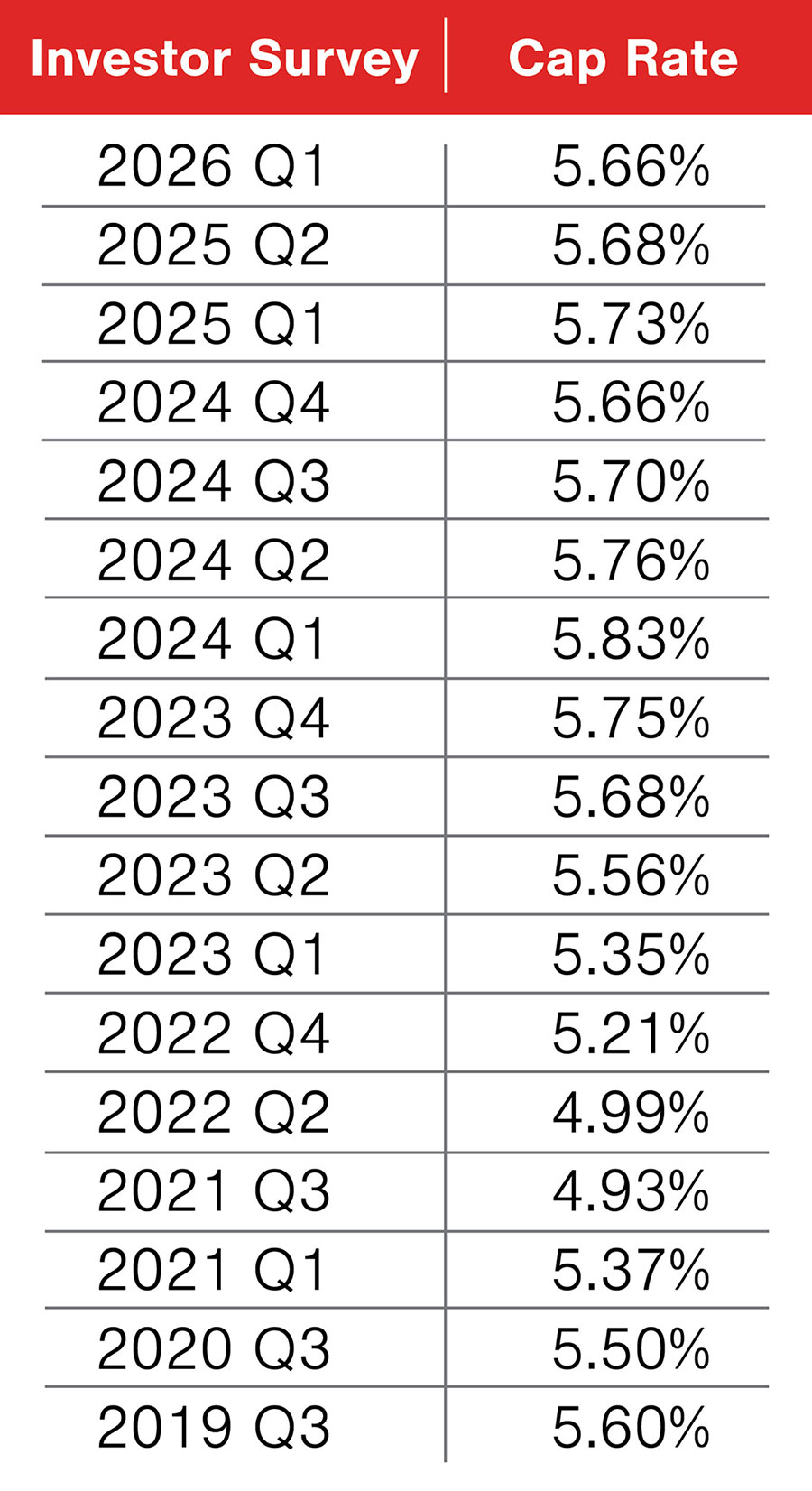
It underscores market confidence in the sector, and a fundamental underwriting shift from an emphasis on cash flow to appreciation, from equity dividend to equity yield. In inflationary markets this is typical. But in low to moderate inflationary environments, it has not occurred before in this asset class. Self-storage has always been about cash flow, and that has now changed.
Self-storage is just fine. Slow growth in dynamic market conditions demonstrates confidence in self-storage over the long run.
n self-storage, operators tend to fixate on occupancy. And understandably so—it’s the most visible indicator of a facility’s health. But occupancy alone can be deceiving. A property can run at 88 percent and still be leaving tens of thousands of dollars on the table every single month.
That was the situation we inherited when we took over management of an established self-storage facility in northern Washington. On the surface, the numbers looked reasonable. After digging a little deeper, a different picture emerged: below-market rents, almost no insurance penetration, a weak digital presence, and operational inconsistencies that were quietly eroding both revenue and reputation.
What followed was a 10-month turnaround that increased monthly revenue by 27 percent—without a major expansion, without adding units, and without sacrificing occupancy. This is the story of how it happened.
But a deeper operational review told a more complicated story. Rental rates had never been adjusted to reflect market conditions. The facility’s online presence was minimal, meaning prospective customers were finding competitors first. Insurance enrollment sat at just 9 percent—a fraction of what a well-run facility should expect. Staffing was inconsistent, leading to service gaps and missed leads. And years of deferred maintenance had left the property with security vulnerabilities and curb appeal issues that were silently undermining tenant confidence.
The facility wasn’t failing. It was underperforming, which in some ways is a harder problem to see and an easier one to ignore.
“High occupancy gives a lot of owners a false sense of security,” says John Eisenbarth, COO of West Coast Self-Storage. “When we walk a property at 88 percent and start asking questions about rate history, insurance penetration, and search visibility, we almost always find the same thing—significant revenue that’s been sitting there unclaimed, sometimes for years. This facility was a clear example of that.”
THE CHALLENGES: A MULTI-FRONT PROBLEM
Turnaround work rarely comes down to a single fix. In this case, the challenges spanned pricing, marketing, operations, physical infrastructure, and ancillary revenue—each one manageable on its own but compounding together into a significant gap between what the facility was earning and what it could be earning.
BELOW-MARKET RENTAL RATES
Despite strong occupancy, rents had not kept pace with the market. The facility was essentially subsidizing its tenants, providing storage at rates that no longer reflected current demand. This is a common pattern at properties that haven’t had active management attention: Rates get set, and then they stay set, while the market moves on without them.
POOR ONLINE VISIBILITY
The facility ranked poorly for high-intent local search terms like “storage near me” and “storage units [city].” In an era where the vast majority of self-storage customers begin their search online, an invisible facility is a facility that’s losing business before the phone even rings. Without strong search rankings and a well-optimized Google Business Profile, the property was effectively hidden from its own market.
LOW INSURANCE PENETRATION
Tenant insurance is one of the most consistently underutilized revenue streams in self-storage. At just 9 percent enrollment, this facility was leaving a substantial recurring revenue source almost entirely untapped, while also carrying more risk exposure than necessary. Insurance penetration at well-managed facilities typically runs 70 percent or higher.
OPERATIONAL INSTABILITY
Staffing had been inconsistent, which created a cascade of downstream problems: uneven customer service, missed rental leads, and a general lack of accountability in day-to-day operations. Strong facility performance depends on having the right people in place, executing consistently, every day.
DEFERRED MAINTENANCE AND SECURITY GAPS
Years of deferred maintenance had accumulated into a list of issues that affected both tenant experience and property security. Camera coverage had gaps. The gate and keypad systems had functional problems. Roof and HVAC issues were left unaddressed. Landscaping had been neglected. These aren’t just aesthetic concerns—they signal to tenants (and prospective tenants) that the facility isn’t well cared for.
STAFFING RESET AND SERVICE OVERHAUL
We began with the foundation: the team. The existing staff was replaced and the staffing structure rebuilt from the ground up, with a strong emphasis on professionalism, service consistency, and lead conversion. Our on-site team was backed by our Customer Success Call Center, ensuring that inquiries were captured and converted even outside of standard office hours. The impact on lead management and day-to-day operations was immediate.
SECURITY SYSTEM UPGRADE
We closed the surveillance gaps by expanding camera coverage across the property and implementing live overnight video monitoring. The effect was twofold: unauthorized activity dropped significantly and tenants (both existing and new) got a clear signal that the facility was being actively managed and secured. Confidence in the property’s safety is not a soft benefit; it directly affects retention and referrals.
CAPITAL IMPROVEMENTS AND CURB APPEAL
We worked through the deferred maintenance backlog methodically: roof repairs, pest control, gate and keypad replacement, HVAC system upgrades, and an ongoing landscaping initiative to improve the facility’s visibility from the road and its overall street presence. These improvements served both functional and marketing purposes—a well-maintained facility is easier to rent and easier to keep full.
STRATEGIC PRICING ADJUSTMENTS
We implemented a dynamic pricing strategy calibrated to current market conditions. The results were significant: Scheduled rent per square foot increased by 30 percent and actual rent per square foot increased by 21 percent. Critically, this was accomplished while occupancy continued to climb—a clear indicator that the previous rates had been set well below what the market would bear.
WEBSITE REBUILD AND SEO OPTIMIZATION
The facility’s digital presence was rebuilt from the ground up. A complete website redesign incorporated high-volume local keywords, and a domain migration was executed to consolidate authority and improve search performance. The result was a significantly stronger local SEO footprint that made the facility visible to customers who were actively searching for storage in the area.
LOCAL VISIBILITY CAMPAIGN
Beyond the website, we executed a comprehensive local visibility effort: Google Business Profile optimization, local citation building across key directories, and consistent social media publishing. Search rankings across key storage terms improved by an average of 72 percent, with many keywords moving from page three or beyond into the top five Google results—a shift that translates directly into more calls, more walk-ins, and more rentals.
- Occupancy climbed from 88 percent to 95 percent—a 7-point gain that, in a competitive market, represents meaningful relative performance.
- Monthly revenue rose from $62,000 to $79,000—a 27 percent increase driven by a combination of higher rates, stronger occupancy, and new ancillary income streams.
- Insurance penetration jumped from 9 percent to 80 percent—a 789 percent increase. This single metric, often dismissed as a secondary concern, became a meaningful revenue contributor and reduced the facility’s risk exposure at the same time.
- Search rankings improved by an average of 72 percent, with numerous high-value terms moving from obscurity into the top positions where customers actually click.
Taken together, these results represent a facility that, in under a year, went from quietly underperforming to operating at a level commensurate with its market and its potential.
For Eisenbarth, the human side of those numbers matters as much as the metrics themselves. “The owner had been trying to move the needle on this property for years without much success, so there was understandable skepticism when we came in with a plan,” he says. “We don’t take that lightly; we know we have to earn that trust through results, not promises. Watching the revenue numbers change month over month, and seeing the owner’s confidence in the process grow alongside them, is exactly why we do this work.”

OCCUPANCY IS A LAGGING INDICATOR
A high occupancy rate tells you what has happened, not what is happening. A facility can be full of underpriced tenants, invisible online, and operationally inconsistent—and still show 88 percent occupancy. Use occupancy as one data point among many, not as a proxy for overall health.
PRICING, OPERATIONS, AND MARKETING MUST WORK TOGETHER
The 27 percent revenue increase in this case study did not come from any single lever. It came from dynamic pricing, operational stability, and digital visibility working in concert. Operators who address only one of these areas will see limited results. The compounding effect of all three, aligned and executed simultaneously, is where meaningful transformation happens.
INSURANCE PENETRATION IS AN UNDERUTILIZED REVENUE STREAM
Moving from 9 percent to 80 percent insurance adoption required intentional focus, staff training, and consistent enrollment practices, but the revenue impact was immediate and ongoing. If your facility’s insurance penetration is in single or low double digits, there is recurring revenue being left on the table every month.
DIGITAL VISIBILITY IS PHYSICAL BUSINESS PERFORMANCE
In self-storage, the customer journey almost always begins online. A facility that doesn’t rank for relevant local search terms, or that has an under-optimized Google Business Profile, is losing prospective tenants to competitors before the first contact is ever made. Digital investment is not a marketing expense—it’s a revenue strategy.
The gap between what a facility is earning and what it could be earning is often invisible until someone goes looking for it. In this case, a structured management approach that combined pricing strategy, operational discipline, capital investment, and digital marketing revealed and closed that gap within a single year.
For storage owners and investors evaluating their own portfolios, the question worth asking isn’t just “Are we full?” but “Are we performing at our potential?” Those are two very different questions, and they don’t always have the same answer.















he age of artificial intelligence poses a persistent question: Can you believe what you see or hear online?
Whatever good already comes from AI and may promise to come, the risks of being fooled by it are growing. The technology, while often detectable in videos and audio, is getting better at tricking the eye and the ear.
Of course, fakery itself is nothing new. It certainly showed up in the analog world. Touched-up photos, embellished descriptions, and misleading offers are among the misdeeds, says Cris Burnam, CEO of StorageMart, a privately owned self-storage company with facilities in the U.S., Canada, and the United Kingdom. It’s based in Columbia, Mo., owns 375 self-storage facilities, and has about $600 million in annual revenue.
“The human mind is infinitely resourceful, and sometimes devious, so I suppose it could happen [in self-storage],” Burnam says. “It’s such early times, though, that I think operators are still trying to figure out how to even show up in AEO [answer engine optimization]. So, that’s where I think the majority of the focus is, versus figuring out how to cheat.”
Marketing, analytics, and customer-experience optimization company CXL (cxl.com/about) defines AEO as “the practice of optimizing your content so that search platforms can directly provide answers to user queries, rather than just listing links. It focuses on making your content the answer that engines deliver to users, whether through featured snippets, voice assistant responses, or AI-powered chat results. While traditional SEO aims to improve website ranking and visibility on search engine results pages, AEO goes a step further by positioning content as the definitive answer to specific questions.”
Burnam gives this example of the need to learn how to use AEO to your business’ advantage: When you do an internet search for self-storage, there used to be “maps” that would show up prominently in Google. Now they’re pushed down in the search results and being replaced higher up, with an AI answer often as the top result.
“Businesses of all flavors, not just self-storage, are figuring out what to do about that,” says Burnam. “Maps listings used to be free. They’re still largely free, but not showing up as much, so you’re seeing your search volume really diminish from those traditional SEO sources.”
Having to pay more to Google for search results is happening more as well. Something related to the question of whether online trust in self-storage is eroding Burnam said is: “Would somebody use AI to make their facility look better online than it really does?” Before AI, maybe a facility photo was taken on a cloudy day, for example.
But he gives another example: Someone in the hotel business takes an exterior photo of a property and wants it to look like the Four Seasons, even though it looks more like a Ramanda Inn. The person uses AI to spiff it up Four Seasons-style. “I think that’s probably dishonest,” says Burnam. “And I can see where it could happen.”
The self-storage industry has historically policed itself well as “a group of hardworking entrepreneurs who have subscribed to ethical business practices,” Burnam says, “but it’s a brave new world,” and these kinds of dishonest practices could be happening.
Self-storage has been a “simple business in terms of the social contract between you give me some money and I give you a decent place to put your storage,” Burnam adds. “And because it’s used for storage, it’s a little different than, ‘Wow, I checked into my hotel room and I’m right next to the dumpster and you didn’t tell me about it.’ Or you use a wide-angle lens to take a picture of my kitchen in the apartment I’m going to rent. And in fact, I get there and it’s a lot smaller than it looked on the photo. Those are the kinds of things that I think you see in storage-adjacent real estate businesses [adjacent by type, including apartments, moving services, and anything rented for a short term].”
“No, you really can’t do that, because everybody has sophisticated revenue-management programs now,” Burnam says. “And they figure that the guy who just pops in the door and shows up is willing to pay a little more than the person who’s online and shopping really hard.”
StorageMart stores use AI for as much as 30 percent of their customer call volume, per Burnam, “so using a non-human to answer these calls is much more efficient than using call center staff or on-site staff, especially at large busy stores.”
It’s “the easiest payback on AI that we have seen,” Burnam says. It includes basic calls, such as when rent is due, the office hours, and forgotten gate codes. These calls can be handled using AI agents and large language models (LLMs). This creates better service.
AI is also used in revenue management to decide when and how much to increase rents, and it’s being used to make better advertising decisions. These two topics are as much business intelligence (BI) as AI.
“The lines begin to merge and get fuzzy as one is essential to the other,” says Burnam.

Driving by the facility and seeing it that way firsthand before seeking it online “would in fact make the deepfake, AI-generated, or misleading advertisements more difficult to carry off,” he says. Roughly 2 percent to 10 percent of StorageMart’s customers, depending on the facility, come from long distance without having seen the facility, but the majority are from the local markets the company serves.
“A really lousy location” at the back of an industrial park, for example, that people wouldn’t drive by, could be “a fabulous physical property” with “all the bells and whistles, but it never does as well as the one that’s located out at First and Main,” Burnam says. “I’ve been in this business since 1987; the one thing that has always been true is that if you have a great location, you’re going to do well. And that’s whether it was back in the Yellow Pages days, in the early days of the internet, and now here we are in the dawning era of artificial intelligence.”
Charbonneau feels that any erosion of trust has more to do with aggressive rent increases that customers don’t understand than AI, but trust could be damaged if companies use AI systems for customer service and don’t tell customers up front that it’s AI.
Charbonneau stressed that having a live person back up AI customer interactions “is paramount, because while AI is absolutely fabulous, and I can’t stress that enough, for the day to day, you know, we take millions of calls, and we know how many of those are going to be—I need to check my balance, I want to know why it’s $5 more this month than it was last month, I need my gate code—all of those kinds of questions that AI is so well suited for, but the moment they need something that the AI can’t handle, I want them to be able to have a live person who can think and act and make decisions accordingly,” she says. “So, I think that’s where the trust factor comes in is that they’re getting what they need and they’re getting it quickly.”
AleX gives quotes, but it then transfers callers to a live agent to create a lease, which the company considers a lead, according to Charbonneau. Some AI companies use only AI from start to finish. “We have 26 years of call data to draw from to teach our system how to act,” she says.
The company created and maintains its AI system in-house to keep all its tenants’ information private by not sharing it with a third party. Clients can listen to calls and see transcripts of their AI conversations. This can help customers understand AI’s value to them.
People working in self-storage have been going to trade shows, reading articles, and attending webinars for the past several years telling them why AI is so valuable for serving their customers, says Charbonneau, but their tenants haven’t. Therefore, service providers must “do the absolute level best you can with the service that’s out there” to demonstrate the value to their customers.
According to Charbonneau, some customers have said they were surprised at how much the company’s AI system knew about them and thought it was “a little weird,” but as long as the AI system is being fed and then uses accurate information and a live agent is standing by to confirm it, customers will be satisfied with the service. She thinks the need for a live agent as backup will decrease as AI becomes the norm.
Scott Levy, president and CIO of Highline Storage Partners, a retail owner-operator of about 60 self-storage assets in the Southeast, based in Birmingham, Ala., has seen no erosion of trust caused by AI. He thinks a majority of Highline’s customers aren’t using AI to find its stores—yet.
Highline uses live agents for direct, incoming sales calls. It uses AI for rollover and first-level service calls “to help us help the customer self-serve their problem.” For example, if a customer can’t find his gate code, or wants to pay his rent, they’ll talk to an AI agent instead of a live agent.
Despite this doubt about what you see or hear, “it has nothing to do with self-storage,” Watkins says. “In fact, self-storage is isolated substantially from the AI revolution because the industry is so slow to adapt and so not tech-forward that they’re going to be the last to the table. Now, does that really matter? Because if you don’t believe anything you hear or see, does it matter whether it’s AI or not? Is AI building mistrust in other areas?”
AI could improve trust in customer service, says Watkins. For example, he recently called to make a reservation at a restaurant he knew well. He encountered an AI agent. Because he’s building and investing in AI—Tenant uses an in-house AI system for some of its customer service—he tried to “break” the restaurant’s AI agent by asking questions it couldn’t answer or making reservation changes it couldn’t handle. He was unsuccessful.
To him, this experience illustrates that now “is the most fascinating time that business has ever seen in the history of business with the tools and functions that AI is bringing to market.”
Watkins goes on to say, “And what it can do today has nothing to do with what it can do tomorrow. And I do mean tomorrow; I don’t mean next week, next month, next year. The evolution of this product is moving so fast. And in many ways, it’s moving in ways that will wind up great for the storage industry because we have a very simple business. People pick an empty room to put stuff in. Maybe they visit it; maybe they don’t. They come through a gate. They make some payments … It’s dirt simple.”
He pointed to five “pillars of running a storage facility.” They are gate-access control, taking payments, revenue management, moving tenants in and out, and doing leases.
“That is not AI,” says Watkins. “AI agents serving your customers are adapting by the second, on their own.”
Ultimately, AI can erode or strengthen trust, depending on how it’s used.
“Use AI appropriately and you will build trust,” he says. “You’ll take away the friction in customer service.”






Trained on self-storage so every response is relevant.

From reservations to payments, Alita gets things done.

Enterprise-grade security and 24/7 availability your customers can trust.


e’ve been thinking about self-storage all wrong. The industry has long been aware of the four Ds that draw people to a unit: death, divorce, downsizing, and displacement. But there’s a first D that sets them all in motion, and once you recognize it, you may never look at your business, or tenant behavior, the same way again.
This paradox has always been explained by way of the four Ds. These life events create an immediate need for space, and they continue to drive millions of rentals every year. But there’s a lingering question: Why keep the stuff? Why not sell, donate, or throw out unnecessary items?
Before death, divorce, downsizing, or dislocation ever send someone to a storage unit, a more basic human tendency decides whether they keep their belongings in the first place. It is disposition.
Call it the first D of self-storage. The other four Ds explain the moment of need. This first D explains the attachment that turns a moment into years.
Dr. Russell Belk, a research professor at York University in Ontario whose work explores possessions, collecting, gift-giving, sharing, and materialism, has spent decades studying why people become attached to things. His landmark 1988 paper “Possessions and the Extended Self” argues that “we are what we have,” an idea that continues to influence consumer behavior research today. In the paper, Belk reinforces this idea by observing how many people experience a diminished sense of self when their possessions were unintentionally lost or stolen.
He still discusses the topic today, having recently returned from engagements in France, India, and Brazil. MSM spoke with Belk to further discuss how his research applies to self-storage. Although the industry’s impact on keeping possessions wasn’t part of the initial study formulation—it was still a relatively nascent industry in the 80s after all—he says the ideas carry over. “The four Ds certainly can necessitate or at least urge us to use storage,” he says. “The decision to pay for it becomes less about economics and more about maintaining identity.”

Belk explains that this personal nostalgia can be very powerful. “It’s not necessarily about wanting to go back to a particular period of time or stage of your life; these items represent a piece of you. Although they may no longer be a key part of your identity, at one point they were and they may have shaped the person you are today.”
When people anthropomorphize things, or treat objects like real beings, attachment can become even stronger. Think of children who name their stuffed animals; if you take the toy away from them, they may be distressed for weeks. “As adults, we also become attached to possessions like cars, bikes, and other belongings. Once we name them, it’s no longer just a functional relationship; it’s attachment, and that makes them harder to part with.”
Some people have such a hard time parting with their possessions that they hire personal organizers to help them declutter. Belk has done some work with these professionals to witness how people would respond to having to unburden themselves of their stuff. During the study, the organizer would ask a question such as “Does this spark joy?” If not, the recommendation would be to get rid of it. “People would comply, but there’d often be recidivism. After a year or so, they’re back to the clutter that caused them to call an organizer in the first place.”
Again, this is where self-storage comes into the picture. Operators often think they’re renting square footage, when they’re really renting something much more valuable: space to hold on to identity and avoid the emotional discomfort that comes with letting go.
One of the most famous experiments that demonstrates this phenomenon was conducted by behavioral scientists Daniel Kahneman, Jack Knetsch, and Richard Thaler in 1990. Researchers gave half the participants a coffee mug (the “owners”) and the other half nothing (the “buyers”). Next, owners were asked how much they would need to sell the mug, while buyers were asked how much they would pay to get one. Owners valued the mug at roughly $7, while buyers were only willing to pay around $3 for the exact same mug.
That tendency appears everywhere, such as homeowners who value their house’s worth much higher than nearby comparable sales suggest. Other examples come to mind: Sellers on eBay routinely inflate the price of used items that could be purchased new for less; on “Antiques Roadshow,” people refuse to sell items when they learn they can’t get the price at which they thought an item would be appraised.
Self-storage operators see the same thing every day. A sofa worth $300 at a resale shop may occupy a climate-controlled unit for years. Boxes labeled “college,” “Christmas,” or “baby clothes” remain untouched through multiple rent increases. Even when replacement would be cheaper than continued storage, many tenants choose to keep paying. Viewed through a financial lens, the decision appears irrational. But through the lens of behavioral psychology, it makes more sense.
A storage auction, on the other hand, demonstrates the endowment effect in reverse. To the former tenant, the unit may have represented years of memories and thousands of dollars in perceived value. To the winning bidder, it’s simply a collection of objects with a resale price. The contents didn’t change; the owner did.
While the endowment effect explains why people value their possessions more once they own them, another psychological principle explains why letting them go feels so uncomfortable. Behavioral economists call it loss aversion, a theory developed by Daniel Kahneman and Amos Tversky. The concept is simple: People typically experience the pain of losing something more intensely than the pleasure of gaining something of equal value. For example, finding a $100 bill feels good, while losing a $100 bill feels considerably worse.
For operators, this is where the first D stops being about psychology and becomes economics. The same instinct that makes a tenant overvalue what is in the unit also makes them tolerate the rent going up. When a modest monthly increase sits next to the imagined cost of losing something irreplaceable, loss aversion quietly does the math in the operator’s favor. It is a large part of why existing customer rate increases—when not overly aggressive—are met with little resistance, and why a unit rented in a moment of crisis so often outlives the crisis by years. The first D does not just fill units; it keeps them full.
In self-storage, the “resource” isn’t the storage unit itself. It’s the emotional value of possessions. Returning to the first D, the theory may look like this:
- A “hawk” tenant fiercely protects their possessions. When faced with a life event such as downsizing or divorce, this person refuses to part with meaningful belongings. Rather than selling or donating them, they rent a storage unit because the emotional cost of letting go outweighs the financial cost of storing them. In other words: “I’ll pay $250 a month before I throw away Dad’s workbench.” The storage unit becomes a way to “win” the conflict with loss.
- A “dove” tenant is less attached to their possessions. When confronted with the same life event, they’re more willing to sell, donate, or discard items. They experience less emotional conflict over parting with objects. They’re more likely to think, “I don’t need this anymore. Someone else can use it.” So, they may never rent storage at all, or they may rent only for a brief period.
Operators who understand who their hawks and doves are can make more informed decisions about when to raise rates and by how much, depending on the tenants themselves.
That may sound surprisingly familiar. Humans routinely place greater value on possessions simply because they’re already ours. We negotiate harder when selling our own home than when buying someone else’s. We defend family heirlooms with an intensity that outsiders sometimes struggle to understand. Even children instinctively cry “Mine!” to hang onto something that belongs to them.
In other words, the instinct to hold onto possessions isn’t merely cultural but deeply biological and self-storage remains a perfect solution to this ancient conflict. Instead of choosing between throwing something away or sacrificing valuable living space, customers purchase a third option: a storage unit. They get to preserve ownership without cluttering their home or garage, they don’t have to go through the emotional discomfort of letting go, and the facility offers security, insurance, and climate-controlled units that keep the items safe (i.e., physically defended).
This is why when there’s a burglary or fire, you often see reporters interview tenants who lost all their belongings. They’re often incredibly distressed, and many will say they lost “invaluable” possessions, even if those items didn’t have much monetary value. This was just demonstrated in a recent story MSM reported on about a self-storage burglary in Issaquah, Wash. Kelsey Johnston, one of the victims of the break-ins, told reporters, “We open up the door, and everything’s scattered to the ground. Things are ripped open. It’s just violating. These are memories. These are not just things that you can sell.”

The life events associated with the four Ds remain among the industry’s most reliable demand drivers, and they likely always will. But the story really begins with the first D—disposition—not when people need storage, but why they keep it.
Understanding that distinction can help self-storage operators by providing deeper knowledge of customer behavior, tenant retention, and the emotional decisions that influence occupancy every day. In part two of this series, we’ll look at how disposition turns the four Ds into self-storage revenue, and why life transitions that might seem temporary often become long-term storage relationships.
Do you have a story to share? If you’ve encountered a tenant whose belongings told an incredible story, or you’ve witnessed firsthand how difficult it can be for customers to part with their possessions, we’d love to hear from you. Your experiences may be featured in an upcoming installment of The Four Ds series. Email Brad@ModernStorageMedia.com to share your story.








elf-storage properties have historically proven to be one of the most durable investments within the world of commercial real estate. Occupancy rates, minimal operating costs, and consistent cash flow have made them a highly attractive asset class for new entrants and seasoned investors alike. Despite their many positive attributes, any individual looking to buy, develop, expand, or refinance a self-storage facility must confront a significant challenge that is often overlooked: financing.
Whereas location and the mix of units are both crucial considerations in self-storage development, there is no question that financing plays a role on par with those factors. Choose wisely and the results can pay dividends for decades to come; get it wrong and the financial ramifications could prove devastating.
This guide breaks down the primary financing pathways available to self-storage owners and developers today, the criteria lenders use to evaluate deals, and the steps that give your application the best chance of success.
The asset is also operationally simple. There is no plumbing inside units, no tenant buildout, and in many modern facilities, no on-site staff at all. Expenses are predictable and controllable, which makes underwriting more straightforward for lenders assessing risk.
Self-storage has also demonstrated exceptional resilience during economic downturns. When people downsize, relocate, or go through life transitions such as divorce, job changes, or estate settlement, they need storage. That counter-cyclical demand profile gives lenders confidence that the asset will continue generating income even in uncertain economic conditions. All of this translates into more self-storage financing options, more competitive rates, and more flexible structures than many other property types.
Conventional loans from banks and credit unions remain the most common financing vehicle for acquiring existing self-storage facilities. These loans are typically structured with a 20 percent to 30 percent down payment, amortization periods of 20 to 25 years, and either fixed or adjustable interest rates. Terms vary considerably from lender to lender, which is why comparing multiple offers is essential.
Conventional lenders generally want to see strong historical occupancy and net operating income (NOI). If the facility you’re acquiring has at least two to three years of clean financials and occupancy above 80 percent, you’ll be in a solid position. Lenders will focus heavily on the debt service coverage ratio (DSCR); most require a minimum of 1.20 to 1.25, meaning the property’s income must cover loan payments with at least 20 percent to 25 percent to spare.
SBA 7(A) LOANS
For first-time self-storage owners or operators looking to preserve working capital, the SBA 7(a) program is one of the most powerful tools available. The program’s greatest advantage is leverage: SBA 7(a) loans can finance up to 85 percent to 90 percent of the total project cost, requiring as little as 10 percent down.
The program is highly flexible and can be used for acquisitions, construction, expansion, and in some cases refinancing. For construction projects, the 7(a) structure includes interest reserves to cover loan payments during the lease-up phase, which alleviates significant financial pressure during the most vulnerable period of a new facility’s life.
Maximum loan amounts for the 7(a) program are $5 million. Interest rates are variable, tied to the WSJ Prime Rate, and loan terms can extend up to 25 years for real estate. Prepayment penalties are modest (5 percent in year one, 3 percent in year two, and 1 percent in year three), making this a strong option for operators who plan to refinance or sell within a few years of stabilization.
SBA 504 LOANS
The SBA 504 program is built specifically for fixed-asset financing: acquiring land, buildings, and major equipment. Unlike the 7(a), it is not suitable for working capital or business acquisitions alone, but it is exceptionally well suited for purchasing or building self-storage real estate.
The 504 structure involves three parties: a conventional lender provides roughly 50 percent of the project cost, a Certified Development Company (CDC) funds 35 percent to 40 percent through an SBA debenture, and the borrower contributes 10 to 15 percent as equity. This structure allows for financing on projects up to approximately $15 million.
The standout feature of the 504 is its long-term, fixed-rate component on the CDC portion. In an environment where rates have been volatile, locking in a portion of your debt at a fixed rate for 20 or 25 years can significantly improve cash flow predictability. The tradeoff is that 504 loans move more slowly than 7(a) loans, so if speed is critical to closing a deal, that timing factor should be weighed carefully.
CMBS LOANS
Commercial mortgage-backed securities (CMBS) loans are typically used for larger, stabilized self-storage properties. These loans are bundled and sold to investors, which means they tend to offer competitive rates and longer fixed-rate terms, often five, seven, or 10 years. However, CMBS loans are notoriously inflexible once closed. Modifications, prepayments, and changes to ownership structure are difficult and expensive, so they are best suited for operators with a long-term hold strategy.
BRIDGE AND CONSTRUCTION LOANS
For ground-up development or value-add acquisitions that need significant renovation before stabilization, bridge loans and construction loans provide short-term capital while the property is brought up to full income potential. These are higher-rate, shorter-term instruments, typically 12 to 36 months, designed to be refinanced into permanent financing once the property is stabilized. Lenders evaluating these deals rely heavily on proforma projections, the strength of the development team, and market demand data.
NET OPERATING INCOME (NOI)
The most fundamental measure of a property’s financial performance, NOI equals gross income minus operating expenses, before debt service. Lenders use this to determine how much loan the property can support.
DEBT SERVICE COVERAGE RATIO (DSCR)
As noted earlier, most lenders require a minimum DSCR of 1.20 to 1.25 for self-storage. A DSCR of 1.30 or higher puts you in a stronger negotiating position.
OCCUPANCY HISTORY AND TRENDS
Lenders want to see stable or improving occupancy. A facility running at 90 percent or above over the trailing 12 months is considered well-stabilized. Anything below 75 percent will require a compelling explanation.
MARKET ANALYSIS
Particularly for new construction or value-add plays, lenders will scrutinize the local supply-demand balance. Overdeveloped markets with new supply coming online represent elevated risk.
BORROWER EXPERIENCE
Especially for SBA loans and construction financing, your track record matters. First-time operators can still get approved, but having an experienced management team, or partnering with someone who does, strengthens the application significantly.
CREDIT AND LIQUIDITY
Most conventional lenders require a minimum credit score of 680. SBA lenders may accept 650 with compensating factors. Post-closing liquidity (cash reserves after the transaction closes) is also evaluated, typically looking for three to six months of operating expenses.
- Organize your financials. At minimum, have three years of profit and loss statements, two years of tax returns, a current rent roll, and a trailing 12-month operating statement ready before any lender conversation.
- Know your numbers cold. Be prepared to discuss your occupancy, average unit rate, revenue per square foot, and NOI without hesitation. Lenders take note of operators who understand their own business deeply.
- Get an independent appraisal early. For acquisitions, understanding the appraised value before closing prevents surprises that can derail a deal at the finish line.
- Work with a lender who knows self-storage. A generalist commercial lender may not understand the nuances of month-to-month leases, climate-controlled unit premiums, or the value of a boat and RV storage expansion. A lender with self-storage experience will underwrite your deal more accurately and more favorably.
- Be transparent about challenges. If the facility has a deferred maintenance issue, below-market rents, or recent ownership transition, address it proactively. Lenders who discover problems during due diligence that weren’t disclosed early will view the borrower unfavorably.
- Understand your equity sources. SBA loans allow flexibility in how equity is injected; seller carryback notes, gifts from family members, retirement account rollovers, and equity in other properties can all potentially be counted. Knowing your options opens up deals that might otherwise seem out of reach.
For operators looking to refinance existing facilities, the combination of lower rates and increased asset values in many markets has created real opportunities to pull equity and deploy it into new acquisitions or expansions. Knowing when to refinance versus when to hold your current terms requires a careful analysis of your existing loan structure, prepayment penalties, and what you intend to do with the capital.
A lender who understands your growth strategy can help you structure deals that set up your next acquisition. They can advise on when to lock rates versus float, how to position a value-add deal for construction financing, and what the refinancing timeline might look like once a new facility stabilizes. They can also be a connector to other professionals in the industry (appraisers, attorneys, brokers) who can accelerate your deal velocity.
This is particularly true for operators working across multiple asset types. An owner who runs both a self-storage facility and other commercial properties, whether that’s a car wash, industrial space, or a mixed-use property, benefits from a lender who can see the full picture of their portfolio and structure financing accordingly, rather than evaluating each property in isolation.
Self-storage has proven itself one of the most durable asset classes in commercial real estate. Getting the financing right is the foundation that allows everything else (occupancy, operations, expansion) to perform the way it should.


t’s 2021 and the country is at the height of the worst pandemic in its history. Amid the chaos, self-storage development explodes as remote work gives people the freedom to move, offices close or downsize, and guest rooms and garages become home offices and gyms. Suddenly, the often-overlooked self-storage industry becomes the darling of Wall Street and the real estate sector.
But as the pandemic waned, so did the demand for storage. By 2023, the slowdown was attributed to a “reversion to the mean,” with things just returning to normal following the COVID spike.
Three years later, what is “normal?” Is the industry still cooling off, and what does the future of self-storage development look like?
Tarik Williams, president of TLW Construction, agrees, but he also sees financing as a dividing line between projects that move forward and those that don’t. “There’s a handful of smaller operators that we work with who have been able to set up financing and get projects to the finish line, but right now the majority of our clients are all publicly traded or very large and well-funded institutional capital and private equity groups. That’s where the development is coming from right now.”
Along with high interest rates, Noah Mehrkam, CEO of Arcland Development, believes elevated construction expenses, pricey land parcels, and rising soft costs like permits, utilities, and engineering will continue to hold back development. “All these factors have made many projects difficult to pencil.”
Per Mehrkam, that reality means recovery is still years away. “I don’t expect a broad-based recovery anytime soon, certainly not before 2028. In fact, I don’t expect any meaningful relief until maybe 2030. Operators and developers need to be patient and realize that market cycles aren’t always predictable.”
Development has increased supply by roughly 3.5 percent to 4 percent annually for nearly a decade, Degner says, even though population growth has been significantly lower. “Development incentives were and continue to be misaligned,” he states. “You have these merchant developers who earn money through development fees and by raising capital. They themselves typically have little skin in the game, with minimal personal capital invested.”
Third-party management companies may have contributed to the current oversupply. “Managing other properties earns them money and helps grow their platform, allowing them to split fixed costs across more facilities,” says Degner. “Wanting to reap those rewards can lead to aggressive proformas, which can result in projects being built that should not have been.”
And then there’s the industry newcomers who haven’t received the slowdown memo. Degner recalls one developer who built multiple facilities despite lacking relevant real estate experience. “He raised money from his country club contacts and underwrote projects by assuming rents 20 percent higher than nearby competitors,” he says. “I think many of these new developers may be relying on outdated assumptions about self-storage profitability.”
Southwest-based Williams, on the other hand, has seen costs come down about 10 to 20 percent depending on project type since the peak in 2023. “When subcontractors are hungry, their pricing is more competitive, and that’s part of what’s driving the cost down.”
Tariffs have not posed a problem for TLW; Williams believes concerns surrounding labor have been overstated, arguing that companies already complying with labor laws have seen little impact. That doesn’t mean projects are being built like they used to be, however. In peak years, a lot of unique ideas were brought to self-storage, says Williams, like nicer finishes, conference rooms, coffee bars, video game corners, wine storage, and other nuanced extras that aren’t core to the business. “Most of those have fallen by the wayside, unless it’s a concession made for zoning approvals, such as a community room that can be used for meetings or gatherings.”
Williams has seen fewer conversions due to costs as well. “Unless it’s a big open building bought at an absolute rock-bottom price, developers often don’t find conversions to be the right way to go,” he says. “A lot of vacant office buildings were looked at for that purpose because post-COVID office vacancy was such a problem. However, these multistory buildings aren’t built with the type of loads needed for storage, so they require significant structural modification and that’s not cheap.”
While construction costs remain a challenge, Noah Starr, CEO of TractIQ, says deals that don’t pencil today may also be the victim of a revenue reset—and he has the numbers to prove it. Drawing from the thousands of facilities tracked during both periods, data reveals that same-store rates for a standard 10-by-10 non-climate-controlled unit are down roughly 25 percent from their peak in 2021, a drop from about $1.90 to $1.43 per square foot. “I looked at same-store data on purpose, so panel growth doesn’t inflate the drop,” Starr says. “Across approximately 2,400 facilities, physical occupancy fell from approximately 92 percent in 2021 to approximately 84 percent in 2025. So, anyone still underwriting to 2021 rents is solving the wrong equation.”
Despite those concerns, Degner is quick to point out this isn’t a doomsday scenario, as most facilities remain profitable, occupancy declines have not created widespread distress, and banks are not taking properties back. “This is in no way comparable to past office-sector collapses. The industry remains healthy, but developers need to be exercising more discipline and doing more realistic underwriting. We’ve got a good thing going in this industry. Let’s keep it that way.”
Mehrkam agrees. “Self-storage development is not dead. Opportunities still exist in undersupplied markets, particularly secondary markets where barriers to entry remain high. Developers who have strong market data, local knowledge, and patience can still find successful projects. Those unicorn sites are out there.”
What would Tarik Williams tell a first-time developer considering self-storage today? “I’m an entrepreneur by nature, so I wouldn’t discourage someone. You can take your ambition, work, effort, and maybe a little luck as far as you want to go, but I do have three key pieces of advice.”
- Understand the total cost required to get a project to the finish line. “Look at tertiary markets. And, if you’re set on the bigger MSAs, know that between debt and equity you’ll need roughly $10 million to $20 million, depending on project size.”
- Have patience. “It’ll probably be two years before construction can begin, another year to build, and another three to five years before reaching profitability.”
- Pay for a very professional feasibility study. “Nothing can hurt the industry more than overbuilding in a market.”


MAXIMIZE REVENUE AND OPERATIONAL EFFICIENCY.
Management
Built for
Performance.

or decades, Florida has been an attractive location for a wide array of demographics, such as transplants who never want to shovel snow again and tech companies. With the new residents comes self-storage, but the optimism that accompanies year-round summer may be quelched by a long list of development hurdles. Unfortunately, what you don’t know can cost you.
Ressler points out that while smaller markets like Sarasota have an absorption rate of about 23 percent, Orlando’s is at 18 percent and Miami’s is at 9 percent. “The oversupply risk results in lower rental rates, and that’s one of the bigger challenges,” he says, adding that some locations offer a better market due to their circumstances.
“Jacksonville is different because of its proximity to academics and state government, so you have a much more mobile population, and self-storage tends to do well,” says Ressler, who notes that it’s similar in Gainesville because of the University of Florida. “Self-storage is much more prevalent in university towns; although this applies in places other than Florida as well.”
Cameron Paktinat, CEO and principal at Lindenwoods Capital, agrees. “With all the development that’s taking place—and not just in the self-storage industry, but the overall growth in Florida—it’s a challenge to find the right plot of land. There are markets where there’s a lot of residential growth. This attracts developers, and new supply is the Achilles’ heel of self-storage. Yet, trying to find parcels of land that allow for storage without having too many other projects within the surrounding three-mile radius is becoming increasingly difficult.”
Then there’s zoning. Ken Nitzberg, co-CEO of Inland/Devon Self-Storage, mentions that cities don’t tend to have much of a liking for self-storage facilities. “Cities, for the most part, live off sales taxes,” he says. “In all but a few small locations, we don’t pay sales taxes on leasing rents. That’s why when you go to Florida, most of what you see at major intersections are strip malls, maybe anchored by a grocery store. Things that generate sales tax.”
To add insult to injury, Nitzberg adds that storage projects don’t generate many jobs. “When we are finished with constructions, the site will have one or two managers, so the councilperson won’t be able to say in their re-election campaign how they created new jobs for the community.”
Something else that makes the battle an uphill one is perception. “When you walk into the planning department and you say you want to put a self-storage facility, what they see in their mind is a 1970s type of property with multiple rectangular buildings with cyclone fencing,” says Nitzberg. However, he’s quick to defend the Sunshine State. “This happens in Florida, but I’ve seen it happen in other states, too.”
To make the process go as smoothly as possible, Nitzberg recommends finding a local zoning and land use attorney. “It’s crucial to hire counsel who knows the lay of the land,” he says, “especially in the bigger cities or more affluent areas that don’t tend to want a self-storage facility in their neighborhood.”
Ressler highlights that the denser the area, the more hurdles you’ll find. “It’s more difficult to get zoning approvals in Miami because you have to do traffic studies, and they have much more stringent architectural requirements and extensive public hearings. It really depends on where you want to build, but the higher the population, the more controlled the process will be.”
“The building codes in Florida require that if you have outside units, all doors need to withstand winds of 140 miles per hour,” Nitzberg says, before once again mentioning that each location has its challenges. “California has earthquake requirements, so I don’t really hold it against Florida. Each state has its nuances.”
“Developers have to now design for higher winds and hurricane-resistant structures,” adds Ressler, noting that not only are these elements more expensive, but they also extend construction timelines. This can be problematic due to the nature of construction projects. “When you apply for a construction loan, you begin making payments when you’re approved, not when you start building, and usually these loans have between 7 [percent] and 9 percent interest rates.”
The costs themselves, however, vary greatly depending on the location where you’re looking to develop your facility. “In Orange County, you might be able to find a policy for $5,000 a year, but as you get closer to the coasts, you’re going to pay a lot more,” Nitzberg adds. “In Ft. Lauderdale, it might be $50,000 a year.”
For his part, Ressler cautions that if you’re developing lands near wetlands, you may be required to have stormwater retention or detention ponds. “The common consequence is reduced acreage, longer entitlement periods, and higher structure costs because of these environmental constraints.”
All things considered, Nitzberg still believes Florida is a good market. “Orlando and Tampa probably don’t need any more storage in the near future, but it’s a cycle. All the facilities in a given market eventually get filled and new ones get built. It takes several years to absorb that capacity, then we start cycling again.”
As the years go by, that cycle gets shorter and shorter. As Nitzberg explains, “20 years ago, only 6 percent of the population was renting storage. Today, it’s closer to 12 percent, so if an area is overbuilt, you’ll eventually see an increase in demand, but the operator must have the financial staying power.”
According to Ressler, that foreseeable growth still exists in Florida. You just need to be mindful of what the target market prefers. “Florida consumers increasingly want climate-controlled storage because of the heat and humidity, as well as enhanced security and modern digital access. It has become crucial. Many of the newer facilities aren’t manned by personnel. You pick up your keys via text message. That started out in small rural areas but is now gaining momentum even in larger communities. It’s done as a matter of cost reduction, too.”
Finally, Nitzberg asserts that Florida still has an influx of new residents and jobs, and with this growth, excess storage space will eventually be absorbed, and then the pattern will start again with new construction.








ost growth strategies in self-storage point at the same kind of place: a fast-growing suburb, a dense corridor of new rooftops, a metro with strong in-migration, and traffic counts that practically underwrite themselves. It makes sense on a spreadsheet, which is why so many operators are chasing those markets, and why they now spend much of their time bidding against each other for the same land and the same customers.
We decided to invest somewhere else. We build in underserved communities where a professionally operated storage facility meets a real local need: places like Dardanelle, Ark.; Mount Airy, N.C.; Reidsville, N.C.; or Richfield, N.C.—markets that rarely show up in national acquisition decks. The kind of town with one main road, where the population would fit inside a single city block somewhere else.
The reaction we sometimes get is a version of “Why there?” It’s a fair question, and the honest answer has two halves. These markets come with real disadvantages that the bigger operators are right to weigh. They also come with advantages those same operators are structurally unable to capture. The case for secondary and tertiary markets only holds up if you are honest about both.
A real estate investment trust underwrites to growth, which means it needs markets that can absorb large facilities, support high absolute rents, and lease up on a predictable schedule. A 300-unit building in a town of a few thousand people does not move the needle on a national balance sheet. The data those companies rely on (population density and traffic) screens small markets out before a human ever looks at them. They are not wrong. They are playing a different game.
The second tradeoff is time. Demand in a small market is shallower, so a new facility fills more slowly. In a dense metro, you might lease up in 12 to 18 months. In a town of a few thousand, you underwrite to a longer ramp, and you mean it, because there simply are not as many people who need a unit in any given month. If your model depends on fast lease-up to service debt, these markets will test that assumption.
The third is ceiling. A small market caps out. You cannot count on an endless flow of new demand to absorb supply and push rates the way you can in a place that adds rooftops every year. Once you have captured the storage need of a town, you have largely captured it. That puts a real limit on how big any single market can become, and it means growth must come from adding markets rather than squeezing more out of one.
The fourth tradeoff is the one operators underestimate most, and that is marketing. In a metro, you buy visibility. You bid on search terms, you show up on a crowded results page, and demand runs deep enough that paid advertising reliably produces leads. In a town of a few thousand, search volume is so thin that paid clicks are scarce and often surprisingly expensive per lead, and the handful of people searching usually already know the one or two options in town. The auction-based playbook that works in cities mostly does not translate.
That changes the pricing picture. You are not defending market share against a national operator with a deeper budget and more patience for a price war. You are meeting a need that someone must meet, and that position is worth more than a few extra dollars of per-foot rent in a market where you would be one of 15.
The second advantage is tenancy. Customers in small towns stay longer. People move less often, life is less transient, and the reasons they rent storage (an inherited estate, a growing family, a small business with no warehouse, a boat or an red RV with nowhere else to go) tend to persist for years rather than months. In a lot of these towns, the local economy leans on agriculture, trades, and small manufacturing—work that keeps people rooted, and rooted people do not empty a storage unit every spring.
Lower churn quietly reshapes the entire economics of a facility. The expensive part of this business is replacing tenants who leave. Every move-out means a cleaned unit, a fresh marketing spend, and a stretch of empty days before the next customer signs. When a customer stays three years instead of nine months, the cost to acquire them spreads across far more revenue, and a facility that looks unremarkable on a rate sheet can outperform a higher-priced one that churns constantly.
The third advantage is cost. Land is cheaper, construction is cheaper, and your basis in the project is lower from the first day. That is what lets the lower rates pencil. A facility you built for a fraction of what the same square footage would cost in a metro does not need metro rents to produce a strong return. When operators look only at the rate and conclude these markets cannot work, they are forgetting the other side of the ledger.
One more advantage is worth naming, with a caveat attached. Being the only option in town gives you real pricing power, including on the kind of rate increase a tenant in a crowded metro might refuse. That power comes with responsibility, though. In a market this small, reputation travels fast, and an operator who pushes too hard on price hears about it quickly.
The marketing challenge, the one I listed as a downside, has an upside hidden inside it. Because you cannot simply buy your way to visibility, the things that win are presence and reputation, such as an accurate Google Business Profile, real reviews from real neighbors, signage people drive past every day, and being the name that comes up when someone asks a coworker where to store their things. It helps that we hire locally and answer our own phones, so the person a customer talks to often knows the town as well as they do.
That kind of standing takes time to build and cannot be shortcut with a bigger ad budget, which is precisely why it lasts. Once you are the trusted local option, a national operator cannot outspend you into irrelevance, because the thing you have is not for sale.
But for anyone willing to do that work, these communities offer two things that are getting harder to find anywhere else in this business: room to build something durable and the ability to serve a real need without fighting a giant for every customer. The big operators are not wrong to skip these markets. They are simply leaving room for operators willing to show up.
Andrew Bonnis is a self-storage operator, marketer, and writer focused on the economics of small-market storage and what it takes to build outside the major metros, covering operations, marketing, and where the industry is headed.

ounded in 1771, San Gabriel Valley is considered one of the most diverse and culturally rich regions in Los Angeles County. The area’s layered history and artistic influence can still be seen throughout the area today, including at San Gabriel Self Storage.
The facility immediately stands out thanks to two large bay doors featuring custom metal murals by artist Jay Yan. From a distance, the massive portraits appear painted onto the building. Up close, visitors discover the artwork was created by puncturing thousands of holes into the metal doors, allowing both light and ventilation to pass through.
The art installation is only part of what makes the property distinctive. The facility spans 199,358 square feet across five above-grade levels and one basement level, offering 1,532 fully conditioned units. It also includes 9,508 square feet of dedicated art studio and gallery space, further tying the one-of-a-kind edifice to the surrounding creative community.
Constructed by ARCO/Murray, this facility uses light-gauge steel above a structural steel podium, the exterior incorporates a blend of CMU, brick veneer, glass, metal panels, and stucco, creating a modern architectural presence that stands out within this vibrant valley.
Jay Yan, the Chinese-born, American-raised artist, says his intent with the self-storage installation, with its portraits of local residents in a state of play, was to “reconfigure the architectural identity of the facility through a lens of biological whimsy,” mirroring chipmunks that store items in their cheeks. View more of Yan’s work at www.jay-yan.com.
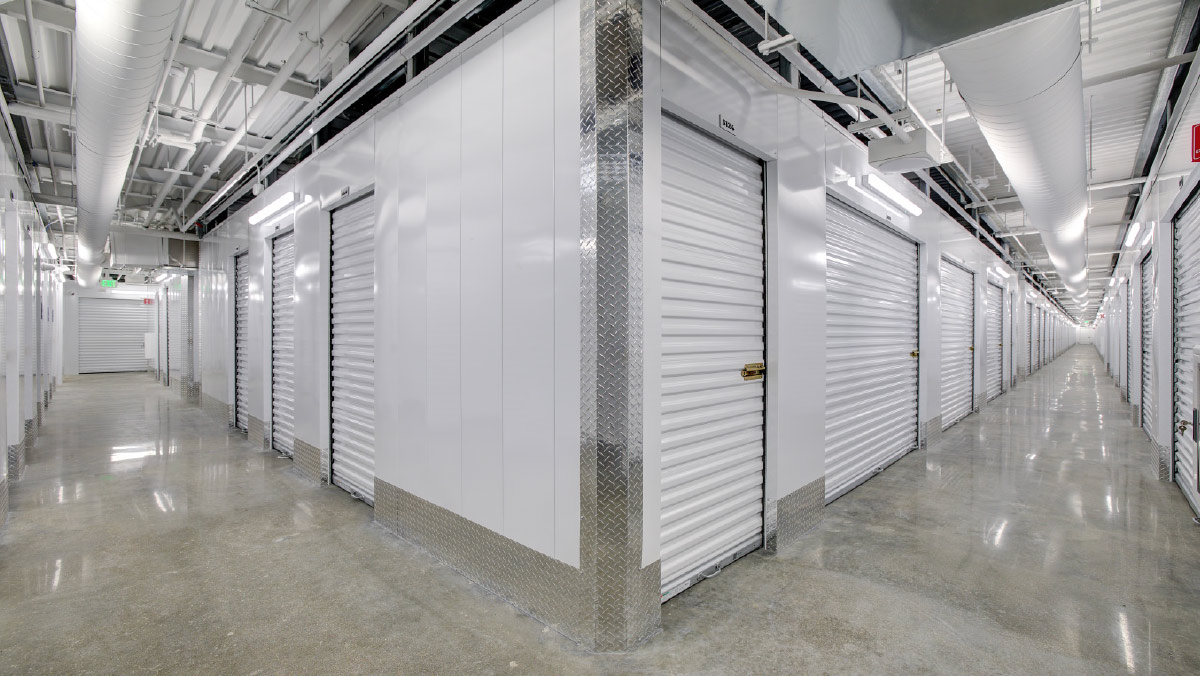
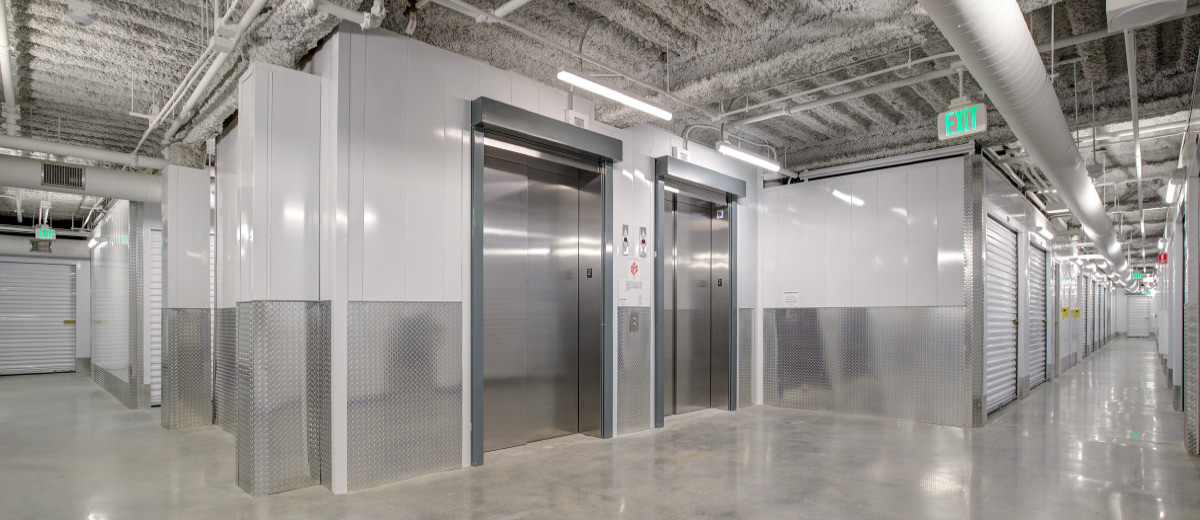





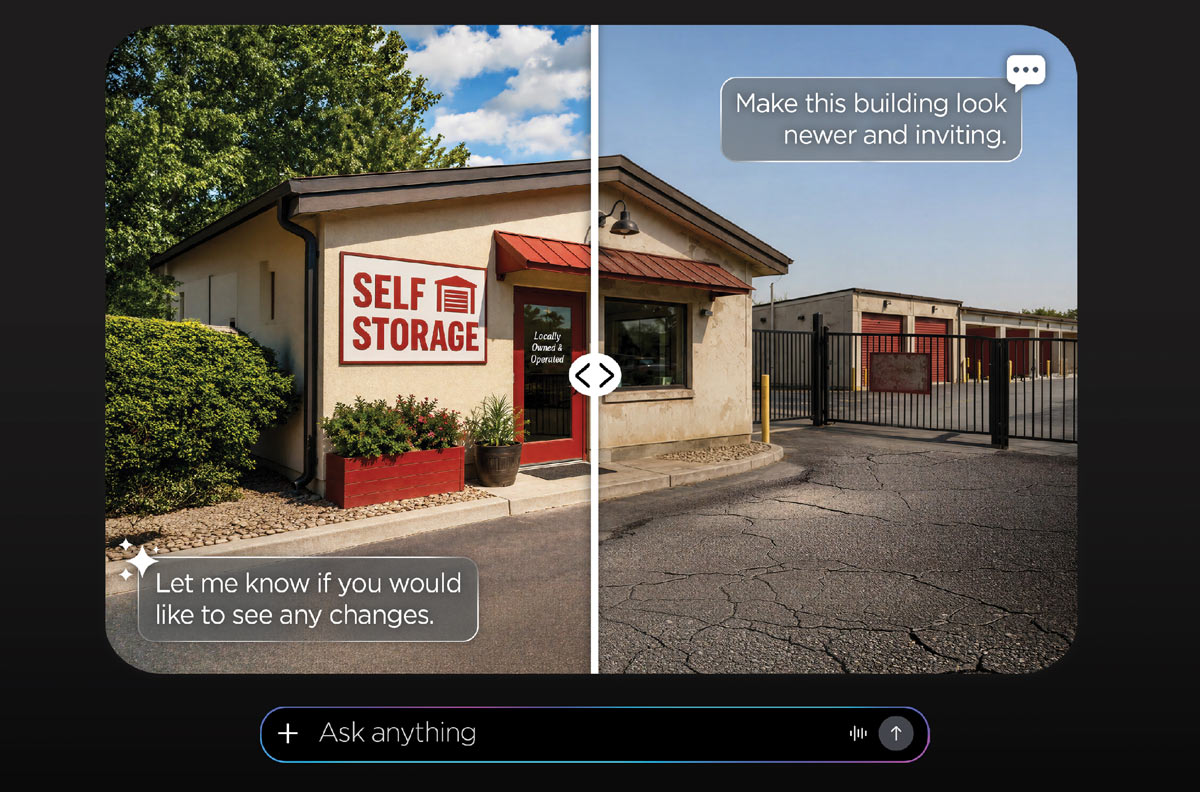
rtificial intelligence is the driving force behind many, if not most, business transactions. It certainly drives self-storage. Public Storage, Extra Space, U-Haul, CubeSmart, and other large operators likely have entire teams dedicated to further integrating AI into their finances, operations, marketing, and customer service. And AI isn’t powering just the giants. StorageBlue, with 25 self-storage facilities in New York and New Jersey, typifies smaller regional outfits. It has implemented a full suite of AI-powered tools across its operation to assist with compliance workflows, customer service, marketing, revenue management, and workforce optimization that are designed to improve efficiency, increase responsiveness, optimize revenue, and create a more seamless customer experience. CEO Alan Mruvka couldn’t be clearer, saying, “We believe AI will fundamentally reshape how self-storage businesses operate, from customer acquisition and pricing to workforce management and lien processing. StorageBlue is the first operator in the space to fully embrace that shift.” He’s no longer alone. AI has turbocharged self-storage for the mid-sized and national enterprises.
But what are the options for a small, single-site operator? Take a look at SpaceVault Self-Storage in Lafayette, Ind. New ownership, headed by Alex Straffin, took over what was a barely functioning, poorly performing, unsecured facility. SpaceVault automated operations and transformed the site with advanced security, fully digital access, and community-focused pricing—all of which were shaped and driven by AI. Lafayette is home to Purdue University, so Straffin knew that he needed a secure site that met his customers’ need for 24-hour internet-friendly service. With AI, he could fast-track surveillance, security, and financial management. And he could quickly get a customer service function up and running that would meet the market’s needs. His target market wants app-friendly contact, and he could continually tune it in real time with AI. AI doesn’t merely automate operations. It allows SpaceVault to fine tune them without having to get back to a supplier or maintain a large staff. The ultimate goal is automated response that matches human interface.

SpaceVault Self-Storage utilizes AI to help it compete with larger operations, with the goal of always improving and scaling up its quality of service. AI helps SpaceVault move fast and adjust to changing scenarios. Straffin has been a technology services leader for nearly two decades, so he was not quite a rookie when he chose to employ AI to build his management system.
Most small operators don’t have Straffin’s background, so what can a non-techie do? Start. If you haven’t started using AI, or you are just using AI to improve existing systems, you are falling behind the competition. Yes, AI can help with surveillance and billing systems, pricing strategies, customer interface, and sign-in. Are you content with these operations, or do you need a free assessment of your entire operation?
A free site assessment is just a click away. Just download any AI app. Here are the top five, compiled by Claude:
- ChatGPT – The undisputed leader, ChatGPT pulled over a billion downloads in 2025 and has surpassed 363 million downloads in the first five months of 2026, according to Udonis.
- Google Gemini – Per Appfigures, Gemini is firmly in the global top five with around 32 million monthly downloads, and its presence there is getting harder to treat as temporary.
- Doubao – Udonis reports that Doubao, from ByteDance, delivers AI-powered writing, Q&A, and study aids, with 113 million lifetime downloads and 33 million monthly active users.
- Microsoft Copilot – In the U.S. specifically, Microsoft Copilot ranks second after ChatGPT in downloads, with Google Gemini close behind, according to Backlinko.
- Claude – Claude joined ChatGPT and Gemini in the global top 10 as of April 2026, making it one of the fastest-rising AI apps per Appfigures.
Then, ask any simple question, like does enhancing customer interface bring the fastest bang for the buck for self-storage with AI?
The short answer is no. Customer-facing interface (chatbot/website) is good, but it’s not the fastest payback. Lead-response speed and ECRI are faster.

You won’t be surprised that Claude will then offer to take you through a set of prompts to create this function. If you have a move-in script in place, take a look at Claude’s. It’s pretty much free and hands-free to create.
So, ask another marketing or operations question that’s been bugging you.
“Can you perform a unit price survey for self-storage in Middlesex County, Mass.?”
Have you done this exercise lately? How long did it take? Claude will prompt you for unit size and narrow down the locale. It will take about five minutes to produce a detailed spread sheet.Look upon your AI virtual assistant as an encyclopedic business consultant who can offer answers to virtually any question. The answers may not always be right or always pass legal muster—always check with an attorney before following AI’s legal suggestions—but they will get you on the road to finding your best answer.
Successful storage businesses are not static. Working with AI as a flexible business consultant will yield even greater benefits than just using it to automate your tasks.
Whatever the size of your operation, AI can help to level the playing field and provide fast, low-cost assessments for opportunities and problems as they arise. AI can automate and streamline your operation, but its greatest benefit delivers quick insights and tactics that will keep you thriving around the giants.

- Which AI-powered tools or features has your facility currently adopted?
- How would you rate the impact of AI on your facility’s operational efficiency?
- What is your biggest barrier to adopting or expanding AI at your facility?
- In which area do you see the greatest potential for AI to benefit your self-storage operation?
- Within the next 12 months, do you plan to invest in new AI-powered tools for your facility?





torage facilities provide a simple yet essential service: They exist to provide a safe and secure place for individuals, families, businesses, and organizations to house their overflow items. Basic though this may seem, there are several factors that can determine the efficacy and trustworthiness of the facility in question. For example, keeping assets safe and sound isn’t only a matter of securing the perimeter. It also involves keeping temperatures consistent.
That’s because, for many stored assets, fluctuations in temperature and humidity levels can lead to degradation. This is true for paper documents, electronics, and more. What’s tricky is that due to their large, open floorplans and spaces, storage facilities are famously challenging to heat, particularly in a way that is also economical and efficient. Facilities teams have their work cut out for them simply ensuring temperature levels remain fairly steady throughout the seasons.
One solution that can’t be overlooked is the destratification fan. Not only do these fans help ward off temperature stagnation, ensuring a stable climate even throughout expansive facilities, but they do so in a way that doesn’t require high levels of excess energy generation. For operators seeking a sensible way to keep their facilities temperate, even amidst seasonal extremes, installing a destratification fan may be the answer.
This is particularly acute in storage facilities that include high bays or lofty ceilings. Simply put, warm air, including the air heated by centralized heaving systems, rises to the ceiling, while cooler air tends to gather closer to the floor. This is basic physics, but it can lead to significant problems for storage facilities.
For one thing, it can make it extremely inefficient to keep the entire facility a stable temperature. The trapped heat that rises to the ceiling is wasted energy. The temperature sensor, positioned closer to the ground, will get a colder reading, prompting the centralized heating unit to work extra hard. All of this can cause utility bills to balloon.
It’s not just monthly expenditure that goes up; temperature stratification can also affect long-term capital budgets. That’s because, when heating and cooling systems are forced into overdrive, it accelerates wear and tear. Facilities teams will need to repair or even replace these systems earlier and more frequently than they would otherwise.
There are several advantages to installing a destratification fan in any large storage facility, particularly one with notably high ceilings.
For example:
- Destratification fans boost energy efficiency. It’s crucial to understand that destratification fans don’t actually generate any new heat; they simply help to reclaim heat that’s already been generated and gone to waste. As such, they avoid any negative impact on monthly utility bills.
- They’re made for harsh settings. Destratification fans aren’t simply glorified versions of residential ceiling fans. These things are heavy duty, designed to withstand the rigors of manufacturing and industrial settings. What that means for storage facilities is that destratification fans can take a lot of wear and tear and continue to perform.
- They protect HVAC equipment. Another reason to invest in a destratification fan: By recirculating air and creating a more consistent temperature, destratification fans minimize the workload of centralized heating and cooling systems. This can prolong their useful life and mediate maintenance needs.
- They promote comfort. Not only do more even temperatures protect temperature-sensitive assets, but they also ensure the facilities are more comfortable for employees. That’s to say nothing of customers who are on site to deposit, organize, or withdraw their items.
The first thing to think about is the size of the facility. Different fans are rated for different-sized areas, and depending on the storage facility’s needs, it may be necessary to invest in multiple fans to ensure optimal results.
To get the most out of destratification fans, it’s also important to minimize any obstacles that might impede airflow. Avoid mounting anywhere directly above in-house equipment, furniture, or architectural rafters and beams.

elling self-storage and RV properties requires far more than simply listing an asset for sale. Today’s buyers evaluate not just the real estate itself but operational efficiency, market positioning, and upside potential.
At the same time, sophisticated owners are focused not only on maximizing sale price but on optimizing after-tax proceeds, reinvestment flexibility, and long-term wealth preservation through strategies such as 1031 exchanges, reverse exchanges, Delaware Statutory Trusts (DSTs), seller financing, and Opportunity Zone investments. As institutional capital continues flowing into the storage sector, successfully selling a facility has become a far more strategic process than many owners realize.
Public REITs, private equity groups, and family offices remain highly active, seeking scalable alternative real estate with operational upside. Unlike office or retail assets tied to long-term leases, storage runs on month-to-month agreements, allowing dynamic pricing; many larger operators now use AI-driven revenue management to optimize rates.
RV and boat storage also benefits from favorable long-term demand trends, including growing RV ownership and HOA restrictions that limit outdoor vehicle parking. Meanwhile, rising construction costs and tightening zoning restrictions have made existing, well-located storage facilities increasingly valuable.
Tax and reinvestment strategy should also start early; 1031 exchanges, reverse exchanges, installment sales, and certain trust or estate planning structures require planning before a transaction is under contract.
For self-storage facilities, buyers focus heavily on physical and economic occupancy, achieved rental rates, revenue per occupied square foot, NOI margins, and operational efficiency. Even small discrepancies in documented income can materially impact valuation, so owners should normalize financials by removing one-time or non-operational expenses. Modern property management systems such as Storable, Sitelink, and Unit Trac streamline reporting, and pre-loading documentation into a secure virtual data room (VDR) before marketing begins improves buyer confidence and shortens diligence timelines.
During diligence, buyers closely scrutinize occupancy, delinquency, maintenance history, vendor contracts, operational trends, and local competition. Maintaining strong operations while under contract is critical. Occupancy declines or operational disruptions can lead to renegotiations or retrades. Transparency is equally essential: Sophisticated buyers respond far better when issues are disclosed proactively rather than discovered late in diligence.
In competitive acquisition environments, reverse 1031 exchanges allow owners to acquire replacement properties before selling. Owners nearing retirement increasingly use Delaware Statutory Trusts (DSTs) to move into passive, institutional-quality ownership while preserving deferral, and larger operators may evaluate 721 exchange or UPREIT strategies, contributing assets to REIT operating partnerships in exchange for units rather than triggering a taxable sale. Opportunity Zone investments and Charitable Remainder Trusts (CRTs) may also play a role in broader estate planning.
In today’s higher interest rate environment, seller financing has re-emerged as a useful tool; properly structured installment sale treatment under IRC Section 453 may allow sellers to spread taxable gains over multiple years while generating passive income from the note. Because these structures involve strict timelines and significant complexity, sellers should coordinate with qualified tax, legal, and exchange advisors well before closing.

here is a version of the self-storage business that works extremely well at scale. Centralized operations, standardized processes, algorithmic pricing, and leaner staffing models spread across multiple locations. In the right markets, with the right asset profiles, that approach produces real efficiency and real returns. The large public operators have built sophisticated businesses around it, and those businesses perform.
That said, there are markets where that model does not translate and where the assumptions built into it become liabilities rather than advantages. Secondary and tertiary markets are where you find that boundary most clearly, and it’s where operators who have designed their businesses around scale start to run into problems that scale alone cannot solve.
Secondary and tertiary markets do not offer that buffer. The customer base is smaller, the demand pool is thinner, and the margin for operational neglect is much lower. Poor lead follow-up, inconsistent staffing, deferred maintenance, weak local visibility—in a primary market, these issues might show up gradually in the numbers. In a smaller market, they show up quickly, and they are harder to recover from because the reputation effects travel faster in a tighter community.
The REIT cost model is not built for that kind of operational environment. Their expense structures are designed around standardization and efficiency at scale, which in practice means reducing labor, centralizing customer interactions, and managing properties by process rather than by the specific conditions of the local market. In primary markets, that works. In secondary markets, it tends to produce facilities that are technically operational but not well operated.
Public companies also face consistent pressure to maintain margin across their portfolios quarter after quarter. That creates an incentive to cut costs at the property level that does not always align with what a specific facility in a specific market actually needs. The asset gets managed to hit a number rather than to perform at its ceiling.
The practical consequences compound over time. Vacant units sit unrented longer because nobody is consistently walking the property, following up on leads in real time, or engaging with prospective tenants the way an on-site operator would. Delinquencies drift upward because collections become less personal and more automated. Maintenance issues accumulate because there is no one accountable for noticing them quickly. Security problems go undetected longer. The facility starts to feel less cared for, and customers notice that immediately, particularly in smaller markets where people still expect a real local presence and a real person they can talk to.
The irony is that the labor savings that make this model attractive on a spreadsheet often end up creating operational drag that hurts revenue and retention. The cost reduction is real. The revenue cost of that reduction is frequently underestimated.
Expense management is also more consequential in these markets. In a primary metro, strong demand can mask the financial impact of operational inefficiencies for a period of time. There is less cushion in a tertiary market. Every occupancy loss, every payroll decision, every deferred maintenance item has a larger proportional impact on NOI, and the feedback loop between operational quality and financial performance is tighter and faster.
That requires a management approach built around attention and adaptability rather than standardization and scale. You must be willing to staff differently, market differently, price differently, and make decisions based on what is actually happening in that community rather than what a national template says should be happening.
The case we make is that secondary and tertiary markets reward operational attention in ways that do not show up evenly across a large portfolio. An owner with a facility in a smaller market is not best served by a management partner whose primary competitive advantage is the ability to run thousands of locations efficiently. They are best served by someone who will treat their asset as its own operating challenge, staff it appropriately for the local market, make pricing and marketing decisions based on actual local conditions, and stay close enough to the property to catch problems before they become expensive.
We have taken over facilities in secondary markets after national operators, and the pattern is fairly consistent. The issues are rarely catastrophic. They are cumulative: deferred maintenance, soft occupancy despite reasonable market fundamentals, weak lead follow-up, and inconsistent customer experience. When you restore real operational presence, performance tends to recover faster than owners expect, because the underlying market demand was there the whole time. What was missing was someone paying close enough attention to capture it.










igital marketing has become one of the most important drivers of growth in the self-storage industry. As more consumers begin their search for storage online, operators can no longer rely only on location, signage, or traditional advertising to maintain occupancy. Success increasingly depends on being visible when prospective renters are searching and on understanding which marketing efforts actually produce revenue.
A strong digital marketing strategy begins with expertise. Working with a Google Partner provides an important advantage because Google Partners receive access to platform insights, training, product updates, and recommended best practices. In an environment where Google Ads and search algorithms evolve constantly, timely information can directly influence campaign performance.
Technical knowledge is equally important. Self-storage operators benefit from working with marketing teams that include nationally recognized experts in SEO, Google Analytics, and Google Ads. At Tenant Inc Digital Marketing Agency, this expertise is combined with deep knowledge of the self-storage industry, including seasonality, unit mix, local competition, occupancy, rental rates, and market demand.
Hyperlocal marketing knowledge is also essential. Most storage renters choose a facility near where they live, work, or are moving. That makes local SEO, Google Business Profile optimization, location-focused content, paid search targeting, and neighborhood-level competitive analysis critical to reaching the right customers.
One of the biggest gamechangers in digital marketing has been the ability to connect marketing channels directly to rental revenue. Historically, operators often questioned whether their advertising dollars were truly driving business growth. Revenue reporting by marketing channel, combined with Return on Ad Spend (ROAS) reporting, removes much of that ambiguity.
This attribution provides operators with actionable business intelligence, showing which channels and campaigns are producing reservations and rentals. It also gives digital marketing strategists better information to optimize campaigns around actual business outcomes rather than clicks or impressions alone. Equally important, feeding high-quality conversion data back into Google Ads helps its automated bidding and optimization systems focus on the actions that matter most.
For most operators, the strongest results come from combining SEO and PPC. SEO builds long-term organic visibility and authority, while PPC provides immediate exposure for high-intent searches. Together, they create a broader and more consistent presence across the search landscape.
In our experience, Tenant Inc customers who invest in both SEO and PPC achieve the strongest results in reaching their occupancy goals. When industry expertise, hyperlocal strategy, revenue attribution, and ROAS reporting work together, digital marketing becomes more than advertising—it becomes a measurable engine for self-storage growth.


Learn how and request a quote at bajacarports.com/carport-experts.
Proven platform yielding results for owners since 1998, driving revenue and maximizing NOI.
- 265+ stores across Canada – a household name in Storage with scale.
- Highly trained and motivated team delivering results for your store.
- Resources and an infrastructure that responds immediately with boots on the ground.
- A Canadian company that understands the Canadian market and delivers results for you!



Business Development | 416.358.5991
jbelik@storagevaultcanada.com
storagevaultcanada.com
