


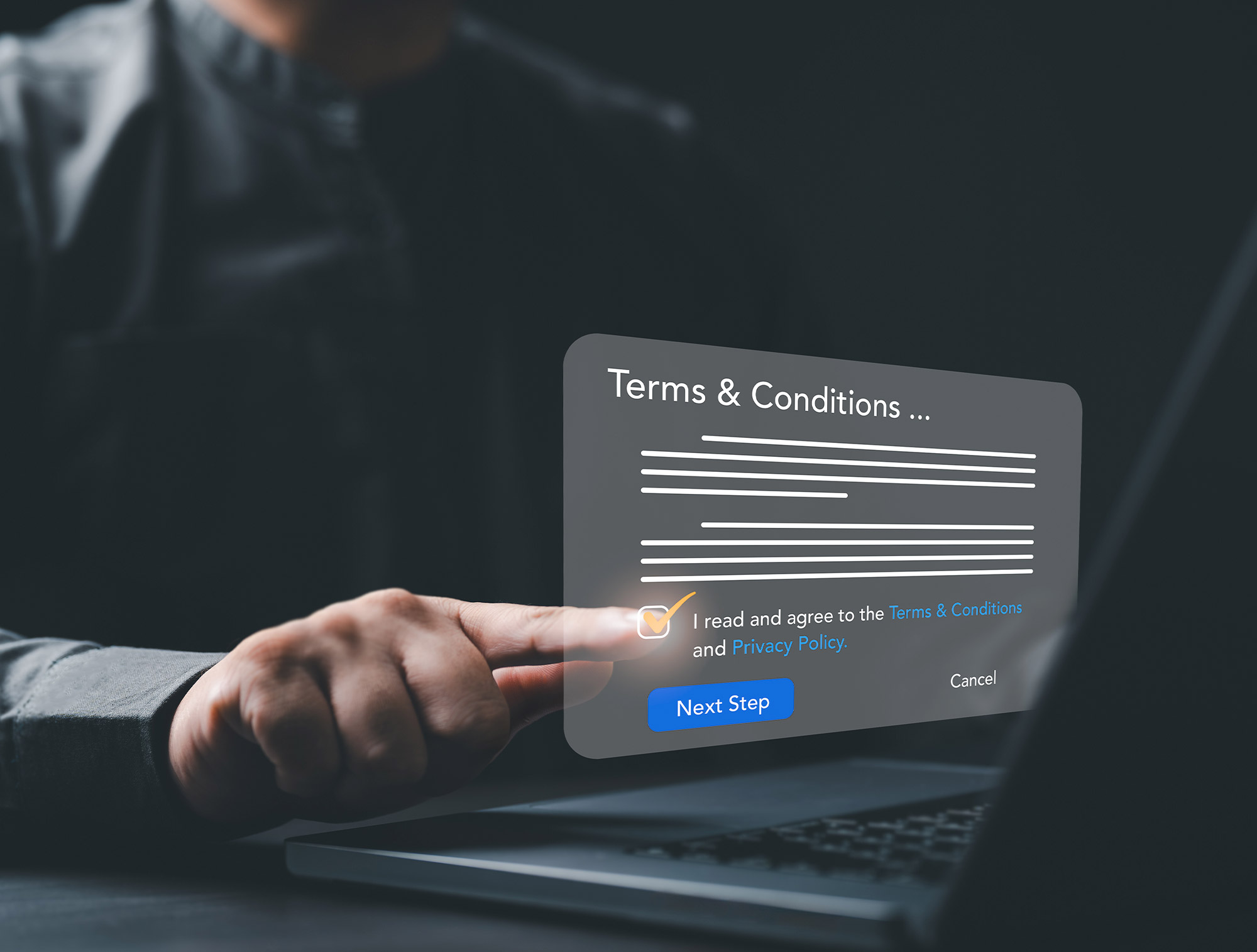
f you’re reading this article, you have likely signed an online wrap agreement. In fact, you’ve signed many of them. Think of all the user agreements where you’ve scrolled all the way down and clicked “I agree,” even though you hadn’t read them. It happens with software licenses, applications on your phone, and subscription services, to name a few. And while it’s become part and parcel of modern life, there are instances when such agreements do require careful reviewing: as a user, to be aware of what you’re agreeing to, and as a business owner, to ensure all your bases are covered in the event a client wants to challenge them.
From a self-storage standpoint, there are several factors to keep in mind. These can vary from state to state, and there are elements you’ll also want to consider depending on the type of storage you offer.
There are several types of wrap agreements, and it’s important to be aware of how they work so that you’re as protected as possible in the event a self-storage tenant challenges these agreements.
Browsewrap
Browsewrap agreements are passive. They are usually included in the footer of a website, where users may or may never see them. The idea behind them is that the users are implying their consent by the mere fact that they’re visiting the site.
Clickwrap
Clickwrap agreements actually require proactive consent from the website or application’s users. Think of the check boxes by statements along the lines of “I Agree” or “By clicking ‘submit’ you agree to [the company’s] terms and conditions.” The terms are linked somewhere in the text, but you can click the box, regardless of whether you actually clicked on the link to read such terms and conditions.
Scrollwrap
Scrollwrap agreements include the entirety of the terms and conditions in a pop-up box, and the user must scroll all the way to the end of the content in order to click on “I agree.” Without clicking on that box or button, the user cannot move further on the website or application.
That doesn’t mean that enforceability would be a sure bet. Zucker also cautions about always conducting due diligence. “A common drafting mistake that undermines enforceability is simply not following the specific requirements of the state’s lien laws in your rental agreement. Every state has its own unique provisions and notices that must be included in the lease to be enforceable.”
Jeff Greenberger, partner at Greenberger & Brewer, LLP agrees. “Some states require that the signature be at the end of the document. This is not something that’s specific to self-storage but in contract law in general.” He points out that while some practices may be standard in certain jurisdictions, such as initialing every page, unless that is required by law, it is not indicative that the user has seen or failed to see the content in each of the pages, and sometimes initial spaces on rental agreements are missed. Nevertheless, he advises to always study the local legal requirements.
This requires a lot more than ticking a box. Operators should use facility management systems that require uploading photo identification and that managers cross check all entered information. In addition, storage owners should highlight that agreements be entered into under the tenant’s full legal name. “Giving the wrong name isn’t always necessarily malicious. Some people use their nicknames or don’t include ‘Jr., Sr., II, or III’ when providing their names,” says Greenberger. “This can make things a lot harder down the road if you store motor vehicles, since many states require to notify all known lienholders. If the names don’t match when we send that letter to the bank, the bank could potentially flag the sale or tow if they don’t think the tenant is the actual owner.”
Ensuring the correct name up front can also make a difficult process a lot smoother in the case of loss, damage, or default; it can reduce the likelihood of a tenant claiming identity theft as well. “It’s always nice to be able to make sure that the person who says they’re renting from you is who they say they are,” says Greenberger, who advises being clear when drafting the agreement, regardless of whether the tenant has taken the time to read all of it. “One thing I have seen that is an advantage in the storage industry is that even if the tenant didn’t read the rental agreement all at execution, the agreement will still be enforceable if they continue a month-to-month tenancy, because even if they were in a rush when they first entered into the contract, they could’ve gone home and read it carefully a week later; and if they didn’t like it, they could’ve moved out at the end of the term. But if six months later the tenant says that he didn’t read it or understand it, that’s his own responsibility. The operator complied with his end of the bargain by being transparent with the terms.”
When asked about whether these types of agreements could be challenged if they include class action waivers or arbitration clauses, Zucker mentions that courts are usually reluctant to ignore the terms of an agreement accepted by both parties. “There are exceptions where the contract is made under duress or the capacity of the parties is questioned,” he says, “but generally, the courts support arbitration provisions with class action waivers.”
Ultimately, clickwrap agreements are ubiquitous and have become a part of daily life. “I would say that if courts were ever to decide to invalidate wrap agreements, self-storage operators would be at the end of a very long line of people fighting it,” says Greenberger. “It would upset rental car companies, Apple, and everyone who uses them.”