


o cultivate a profitable self-storage business, you first need to know your customers. Knowing your customer base enables you to customize your marketing, offer the features and amenities your prospects need and/or want, and increase your success within your market.
This section takes a national look at the traits of self-storage customers, with much of the referenced data sourced from the Self Storage Association’s (SSA) 2025 Self Storage Demand Study. These national trends will shed light on customers in your market, but employing local sources to obtain more granular data is necessary for the best results. For instance, realtors tend to have valuable information about an area’s number of households, household income, poverty, and other helpful statistics.
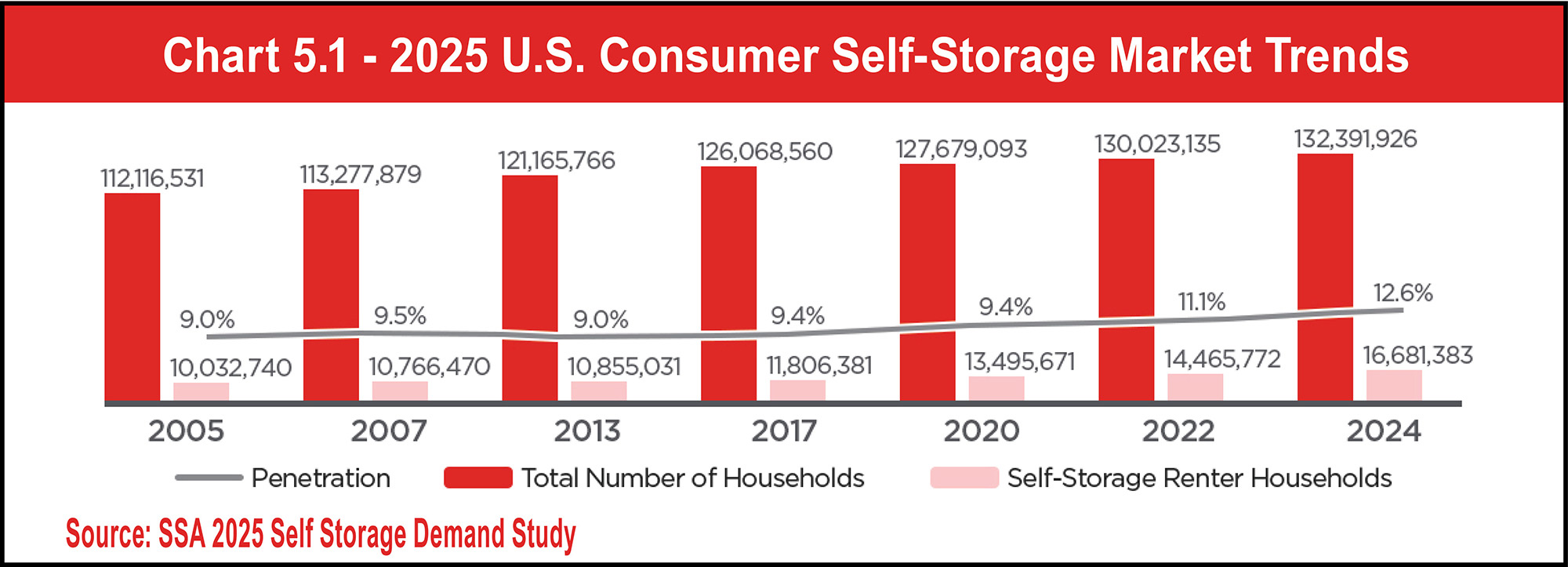
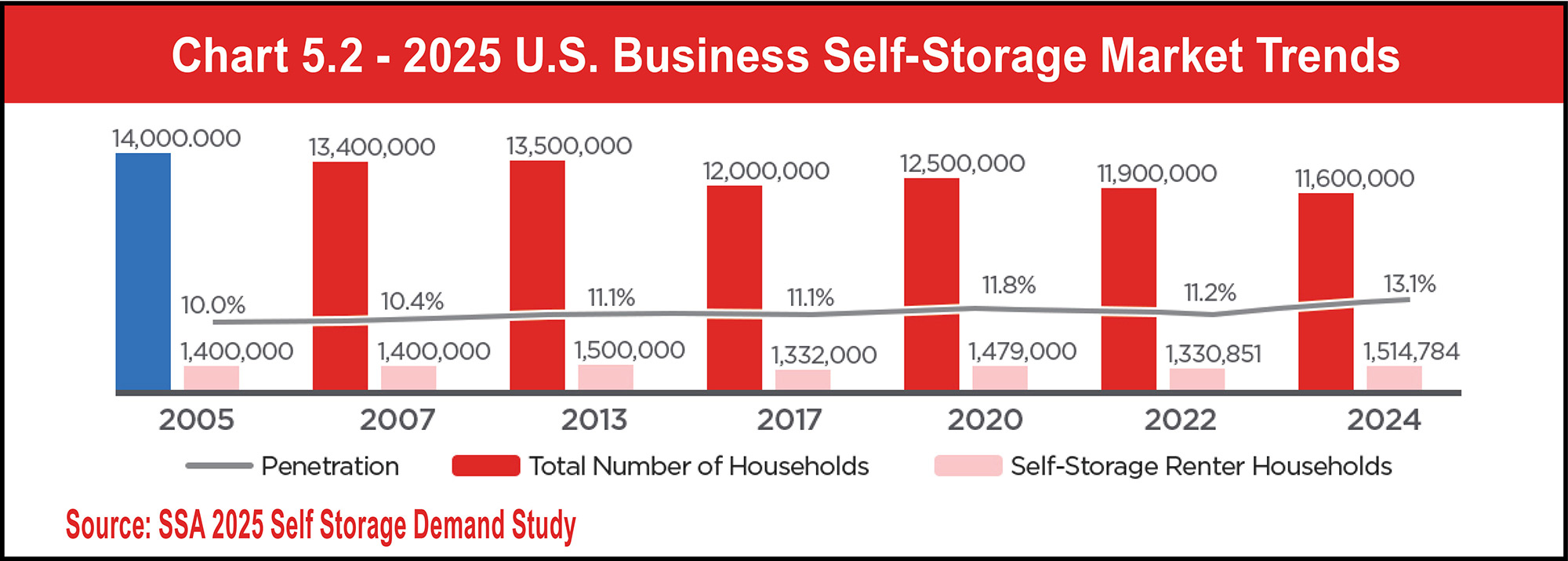
See Charts 5.1 and 5.2.
See Chart 5.3.
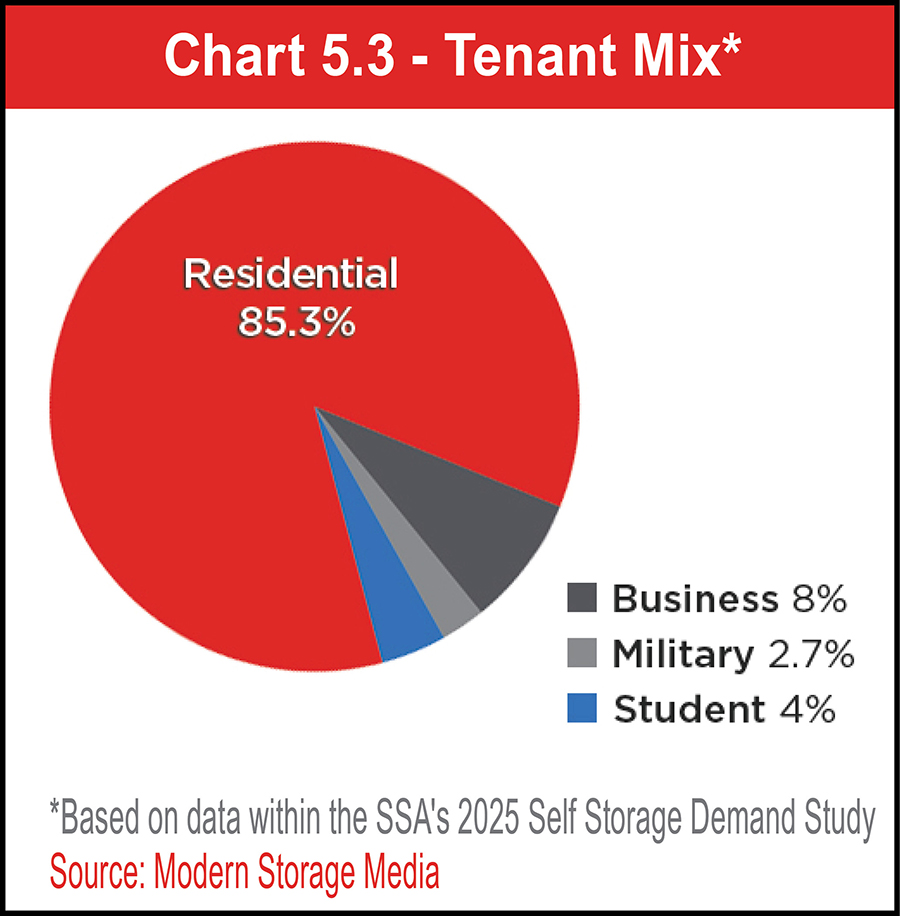
To attract commercial customers, many self-storage operators focus on forming strategic, business-to-business alliances with professionals and businesses most likely to need storage or refer customers, such as realtors who need storage for items used to stage houses for sale, businesses requiring file/record storage, small businesses needing to store inventory, drug reps needing to securely store drug samples in a climate-controlled setting, service providers needing to store equipment and supplies, and package delivery services in need of last-mile storage. Your local chamber of commerce is a great source for information about businesses in your market area.
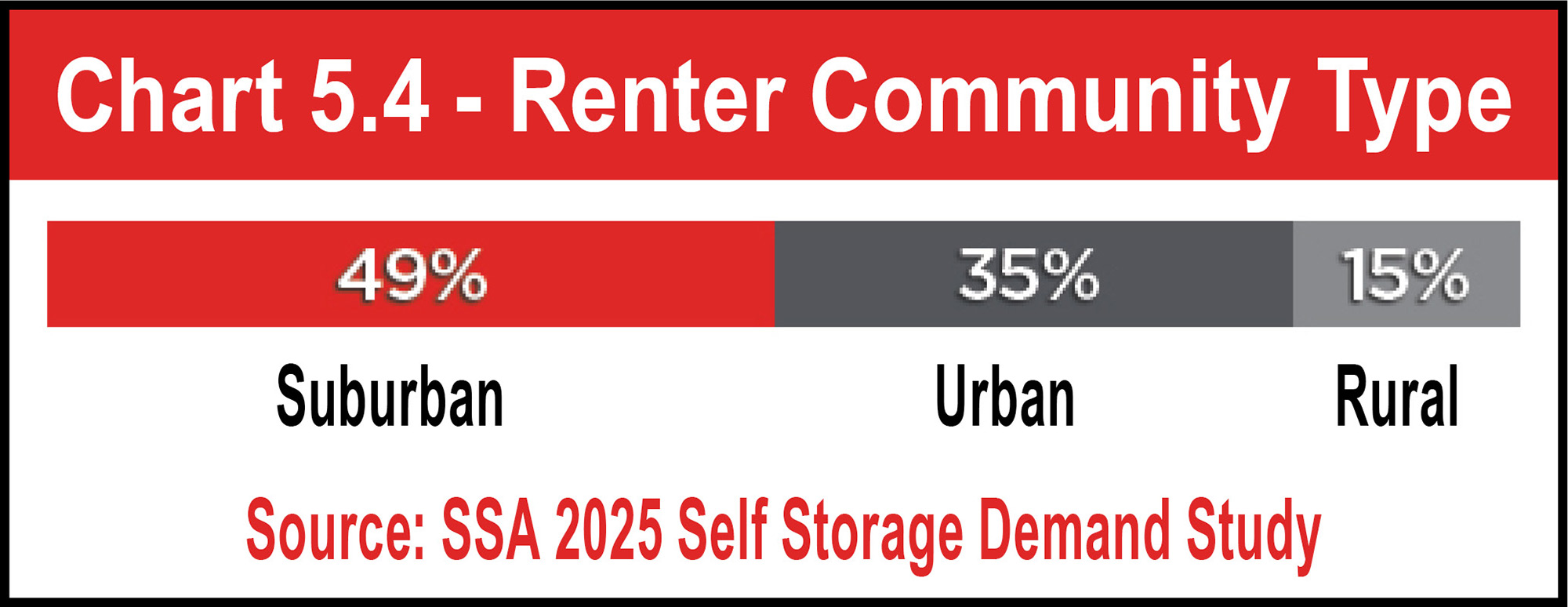
See Chart 5.4.
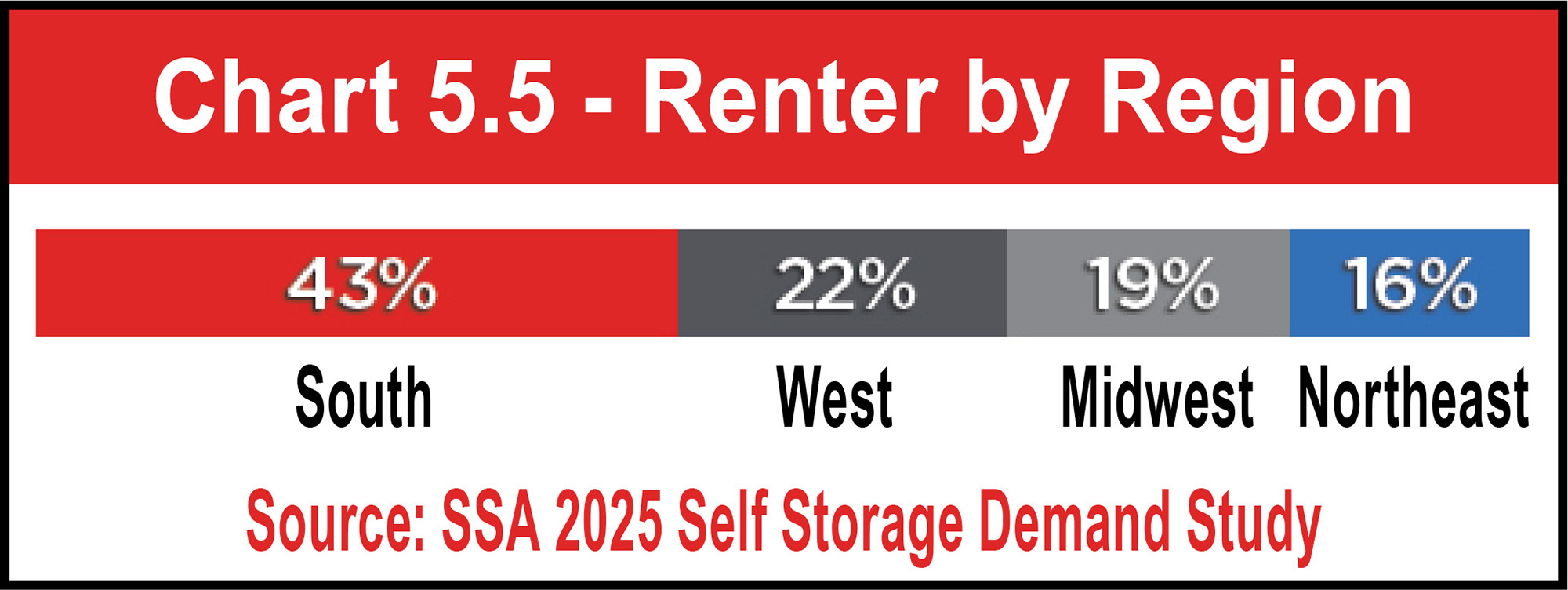
Chart 5.5 shows that there are nearly twice as many renters in the South than other regions in the United States. Forty-three percent of all households in the South use self-storage, whereas only 22 percent rent in the West, 19 percent rent in the Midwest, and 16 percent rent in the Northeast.
See Chart 5.5.
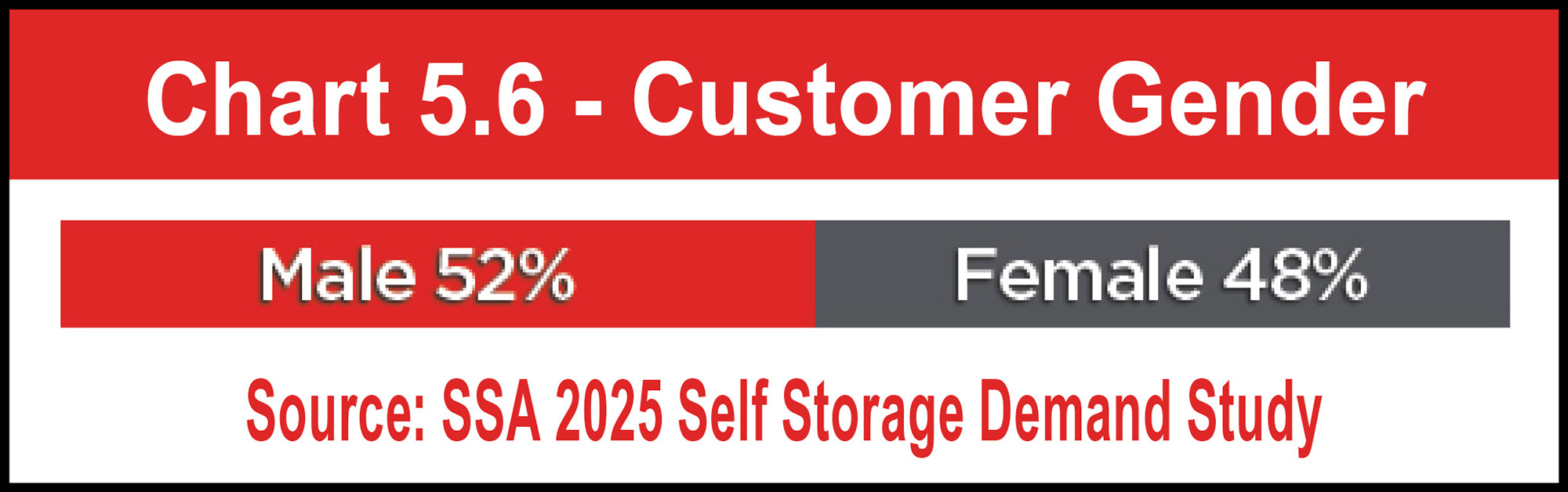
See Charts 5.6 and 5.7.

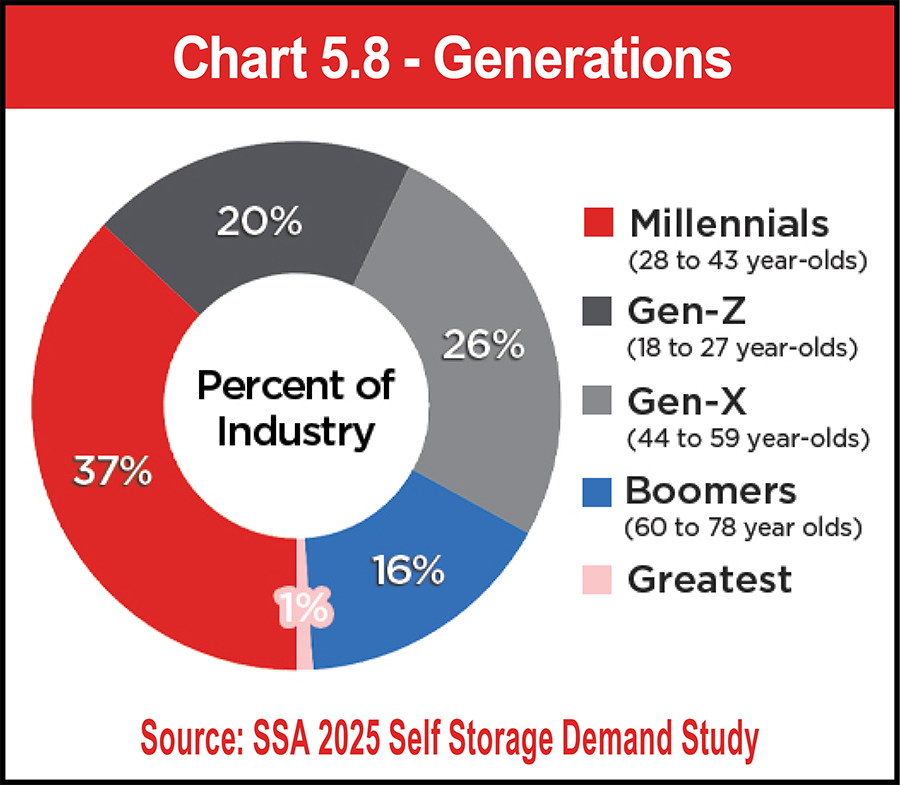
Looking at demographic data by generation brings other shifts to light. For starters, there are more younger renters than ever. At 57 percent, Gen-Z and millennials make up more than half of the consumer self-storage market. Simultaneously, the number of boomers and Gen-Xers renting self-storage units continues to shrink (16 percent and 26 percent, respectively), and the Greatest generation is on the brink of disappearing from the data by representing only 1 percent of renters.
See Chart 5.8.
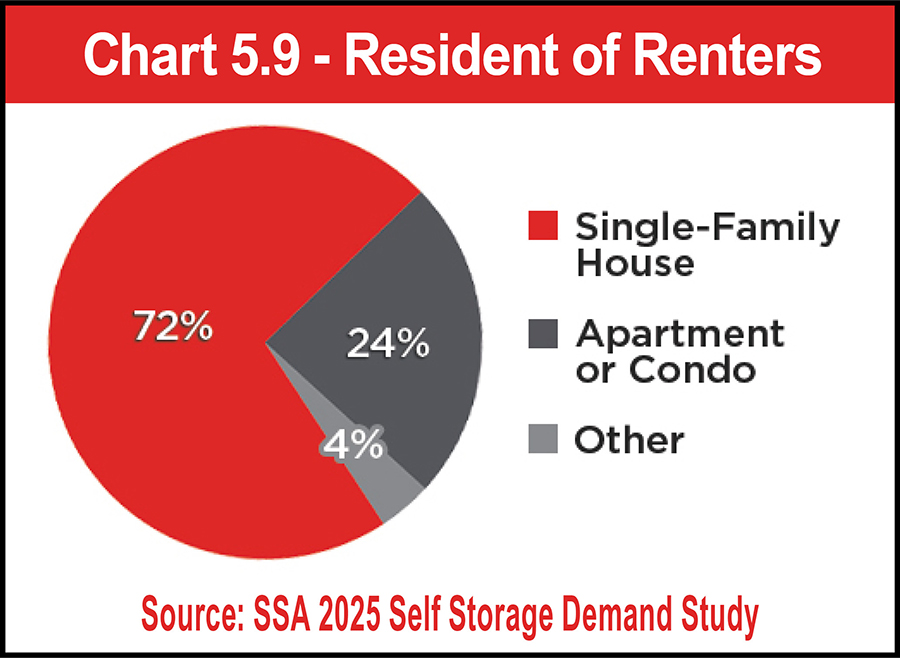
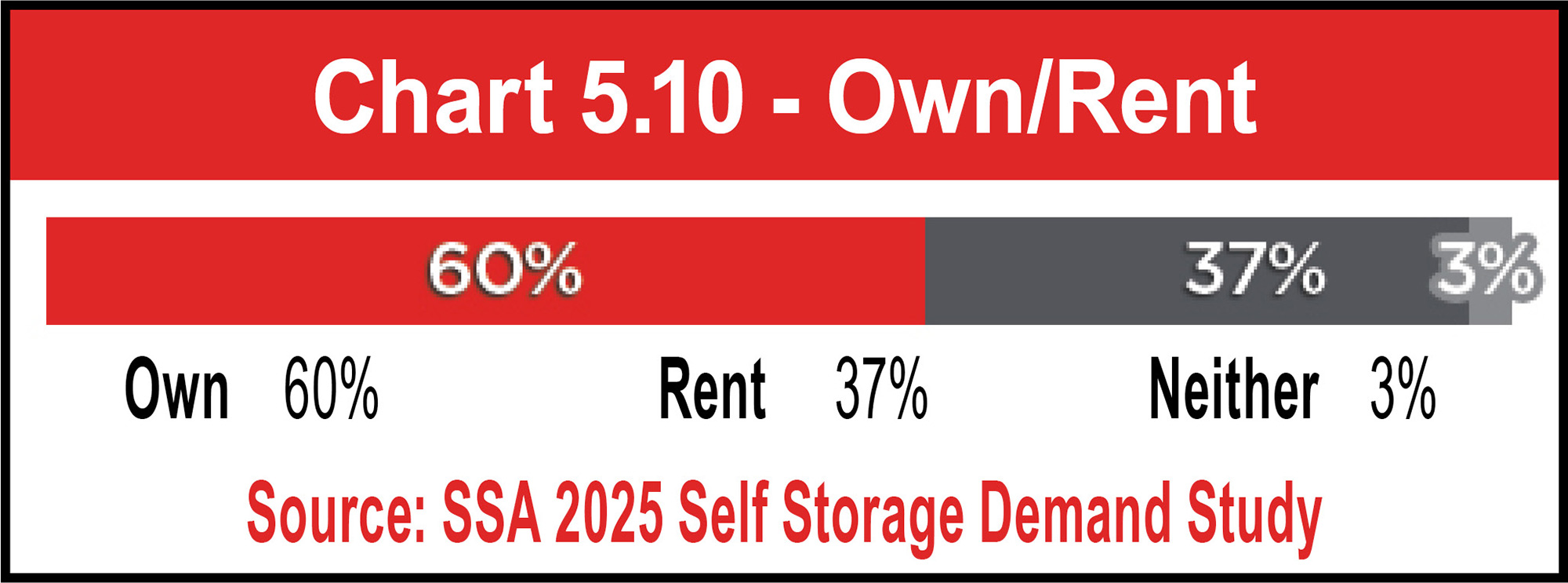
Along that line, nearly one-fourth of renters (24 percent) live in an apartment or condominium, whereas 72 percent reside within a single-family home. According to the 2025 Self Storage Demand Study, more than half of those single-family houses also provide at-home storage space via garages and attics. This proves that many Americans have more stuff than space, regardless of their residence type. But perhaps homeowners, who make up 60 percent of self-storage renters, are simply using their extra square footage for living instead of storing—a trend that peaked during the COVID-19 pandemic era.
See Charts 5.9 and 5.10.
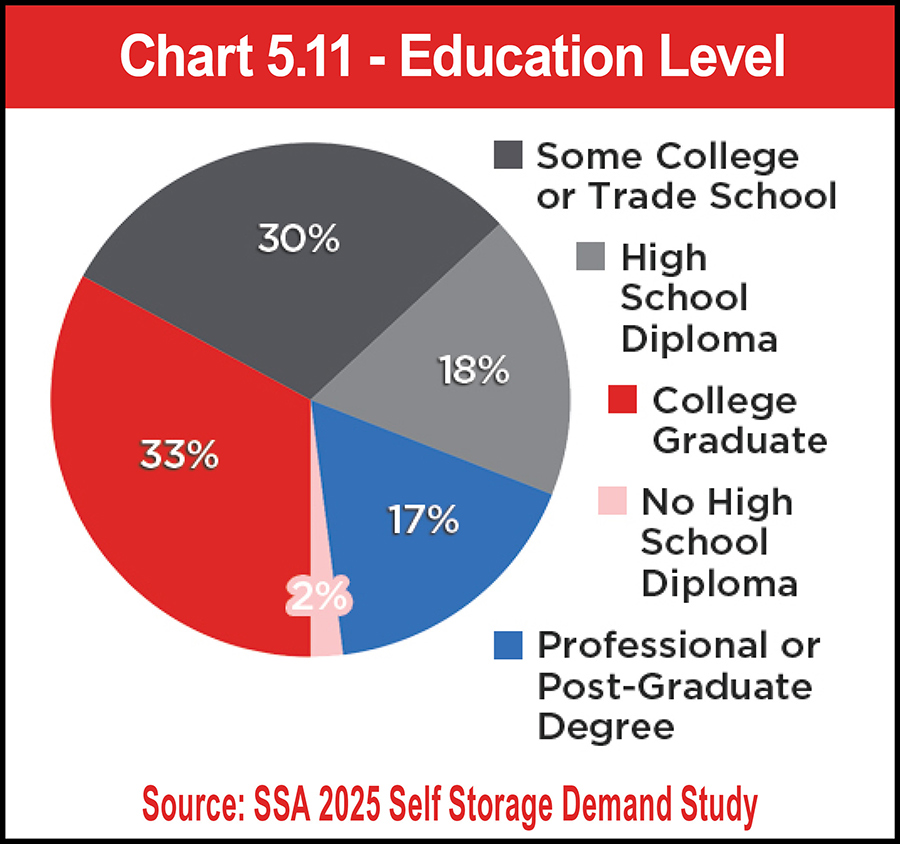
See Chart 5.11.
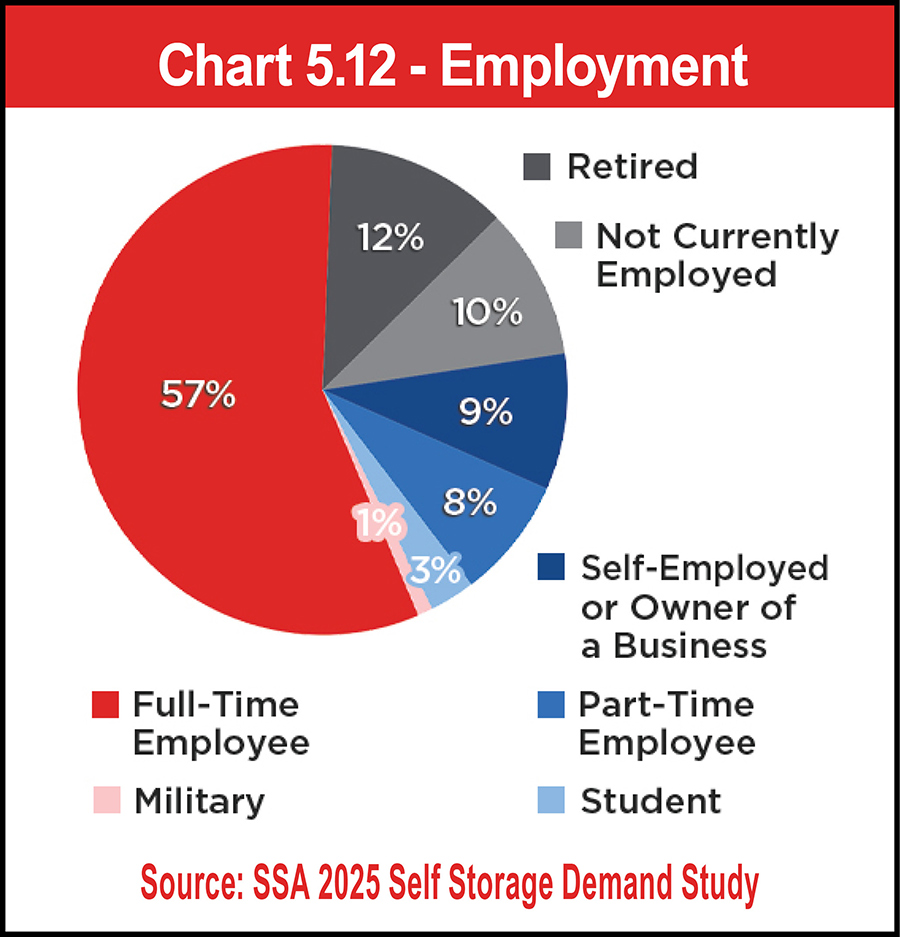
Obviously, education level can have an impact on employment and income. Of consumer renters, 57 percent are employed full time and 8 percent are employed part time. Although boomers and the Greatest generations make up 17 percent of renters, only 12 percent of renters are retired, which likely means that a portion of younger boomers are still active within the workforce. Nine percent of renters fall into the “self-employed and owner of a business” category. Another 10 percent of renters are currently unemployed.
See Chart 5.12.
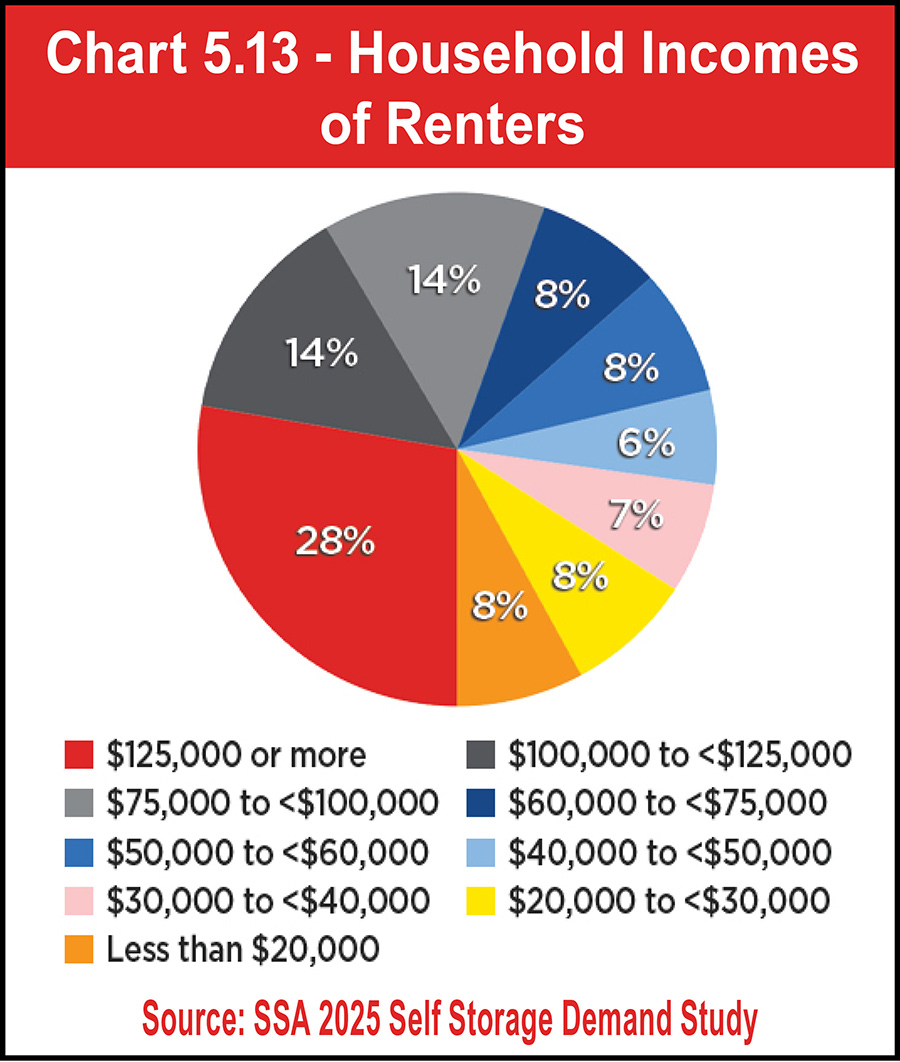
See Chart 5.13.
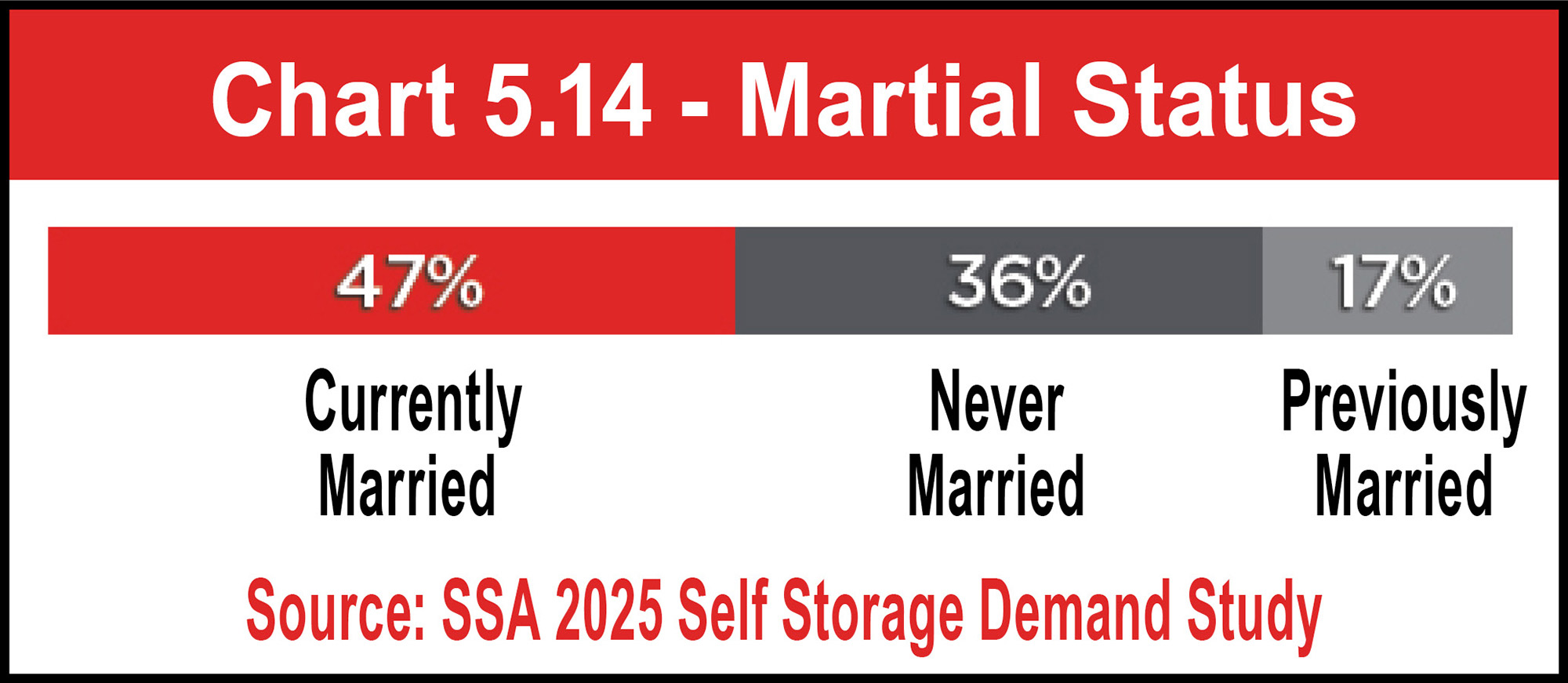
Of course, for married renters, household income would include their spouses’ wages. According to Chart 5.14, 47 percent of renters are currently married. While 17 percent were previously married, 36 percent have never been married. Fortunately for self-storage operators, all martial statuses can necessitate self-storage demand. Newlyweds may need to store belongings after consolidating two homes into one, whereas couples going through divorces may require storage as they sort through the home they once shared and make other living arrangements. Those never married may be impacted by the other “Ds” of demand: death, downsizing, distribution, dislocation (or disaster), and decluttering.
See Chart 5.14.
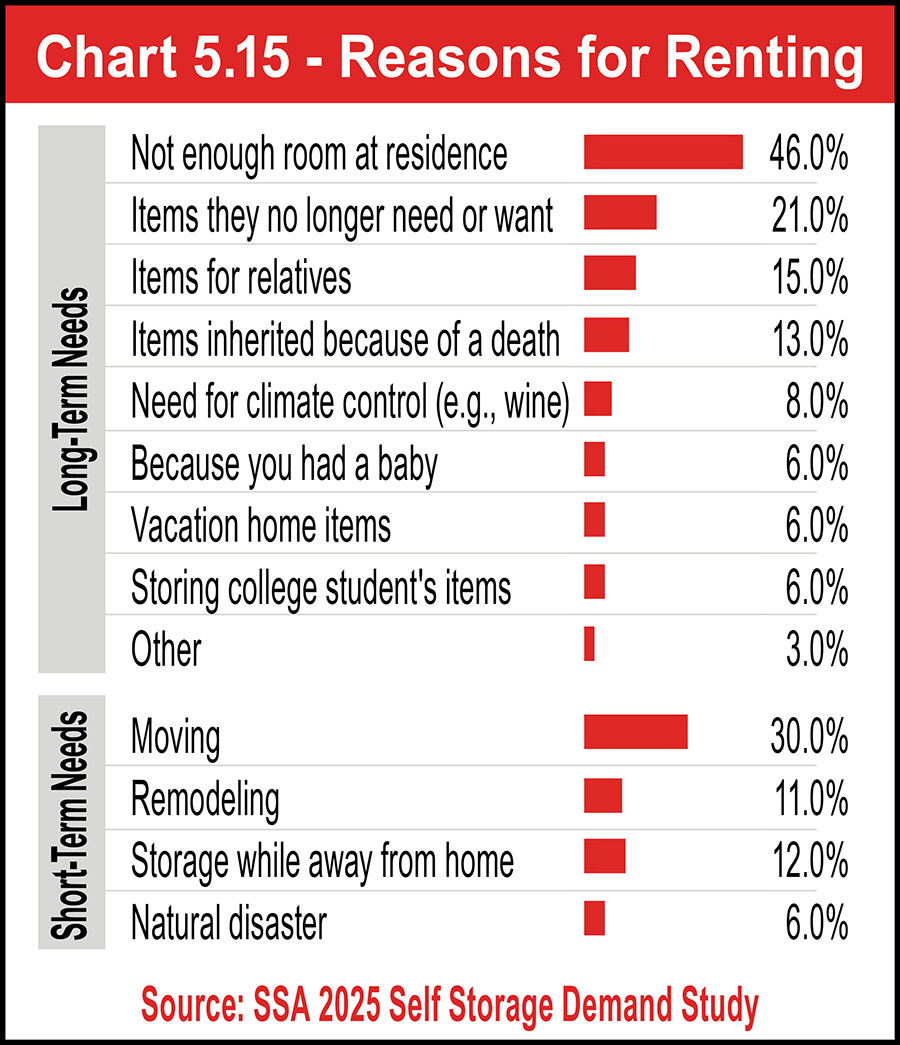
Among short-term needs, moving still tops the list at 30 percent. However, since the 2023 Self Storage Demand Study was released, the percentage of renters using storage during a change a residence has dropped 5 percent. The main reason for this decline is people have been moving less due to high housing costs and expensive mortgages with high interest rates. Moreover, unlike traditional in-person employment opportunities, remote work may make moving unnecessary, so this percentage could continue to decrease. Needing storage while away from home is the reason 12 percent of customers rent units. Six percent use it due to a natural disaster, and 11 percent use storage during remodeling projects.
See Chart 5.15.
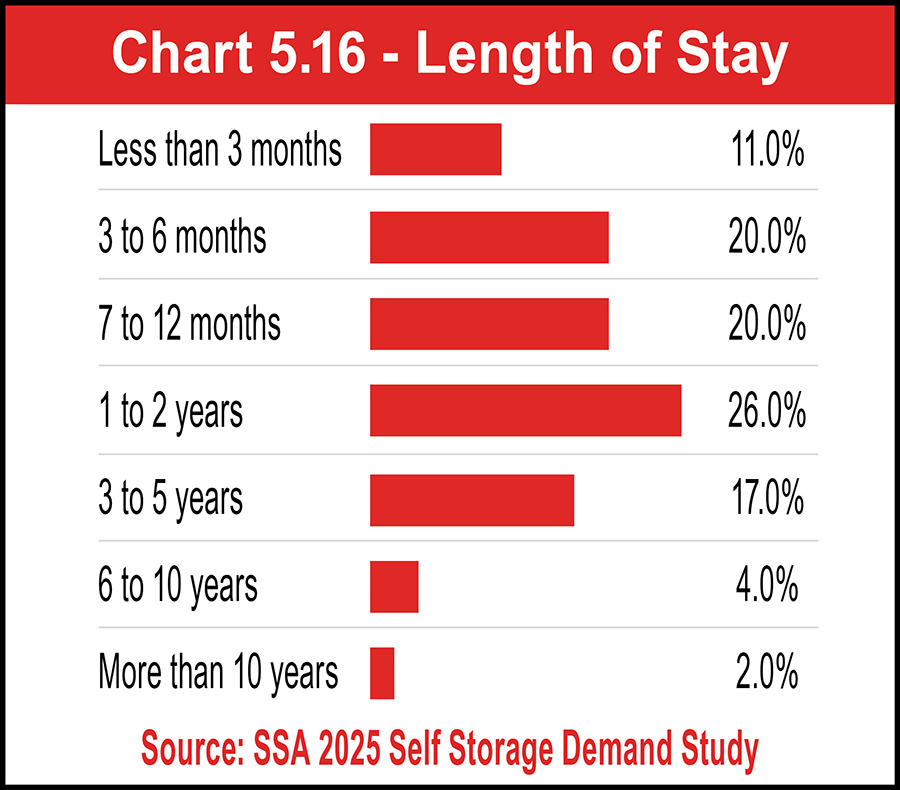
See Chart 5.16.
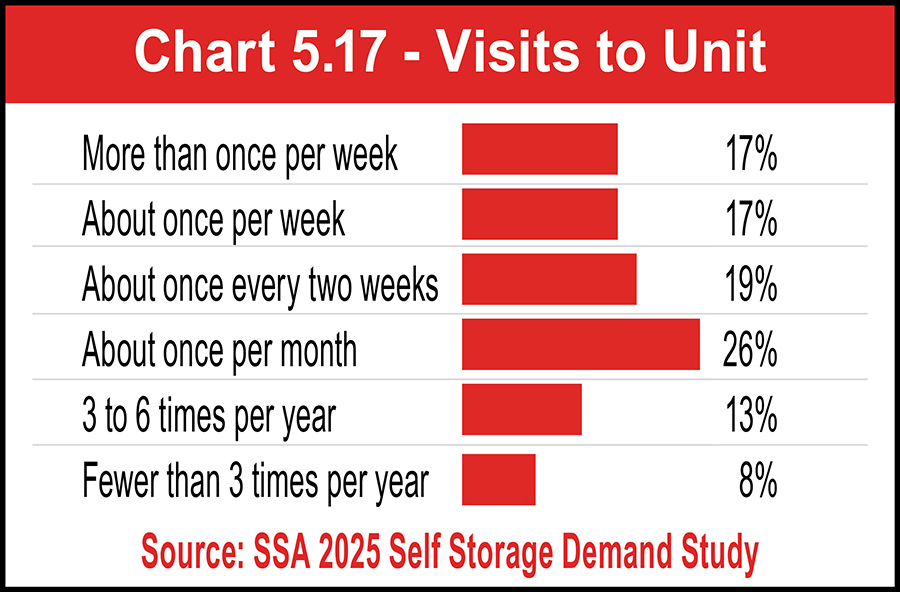
As such, it should come as no surprise that units are being visited more frequently than ever before. In fact, the percentage of renters visiting their units more than once per week has increased by 5 percent in two years to 17 percent. Now, only 8 percent of renters visit their stored belongings fewer than three times per year—a 2 percent decrease from 10 percent in 2023. Additional visits to units can be helpful for early detection of mold, mildew, pests, and other potential damages, but increased foot traffic at a facility could prompt renters to request more amenities, products, and/or services.
See Chart 5.17.
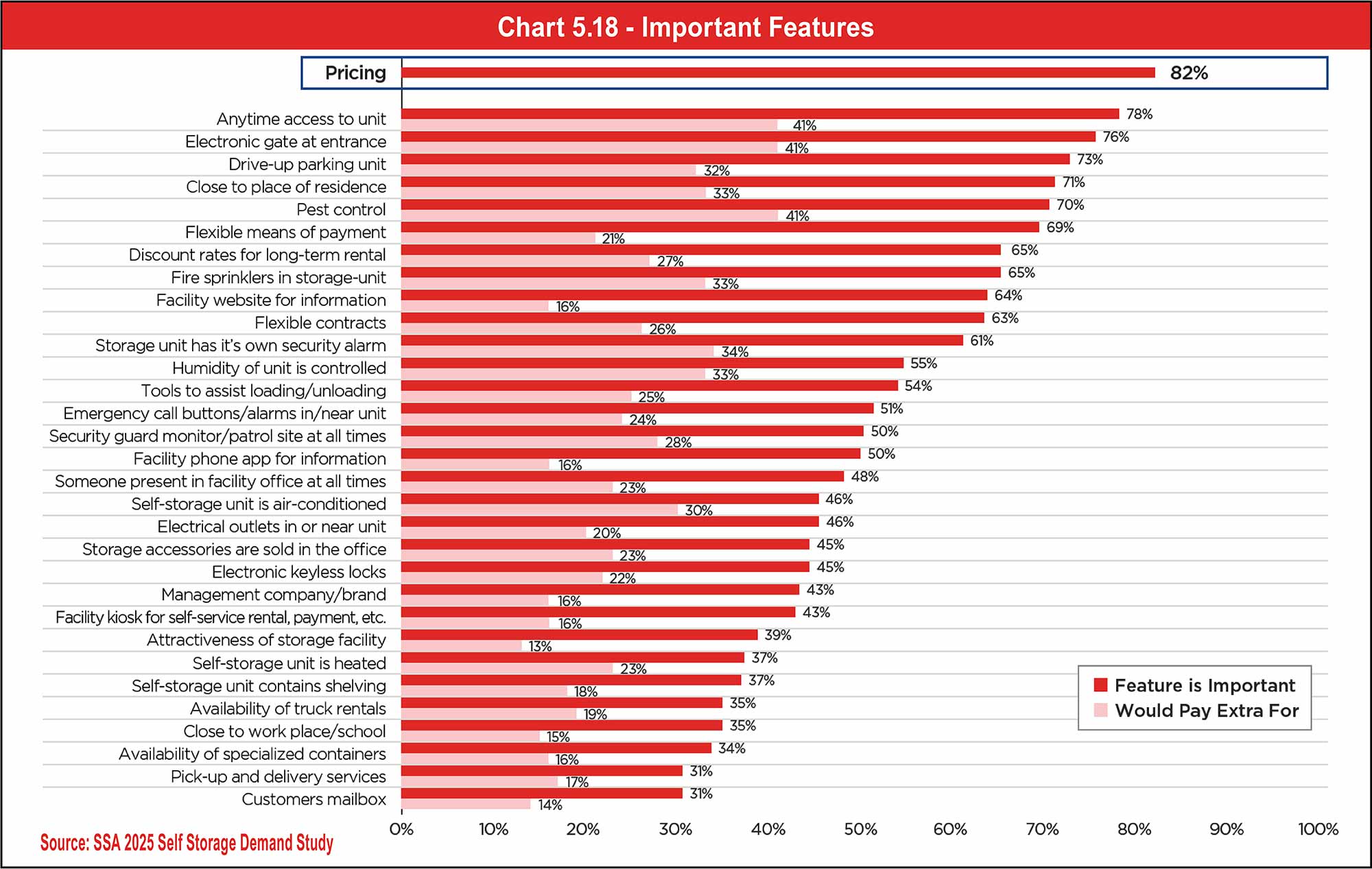
See Chart 5.18.
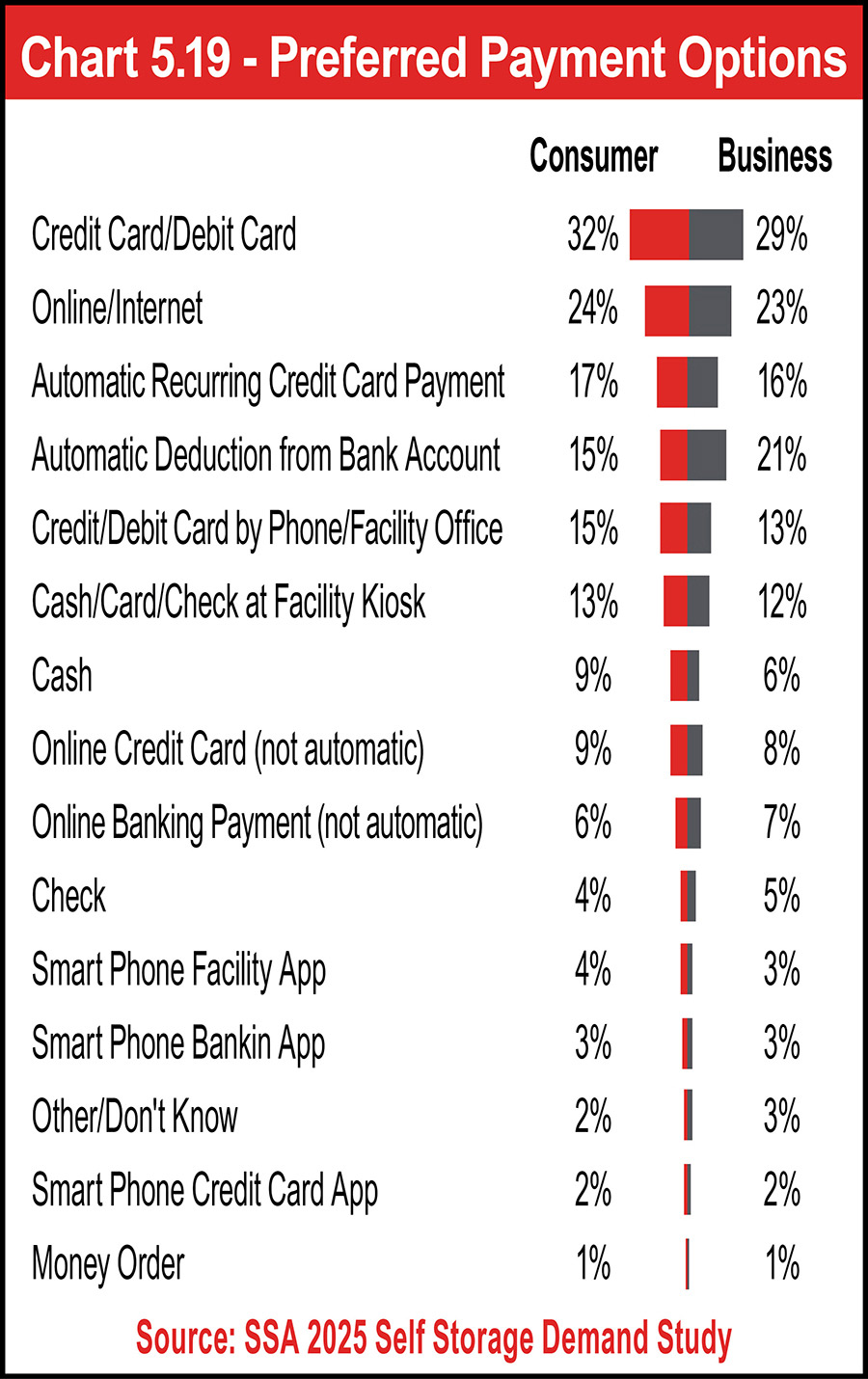
See Chart 5.19.
See Chart 5.20.
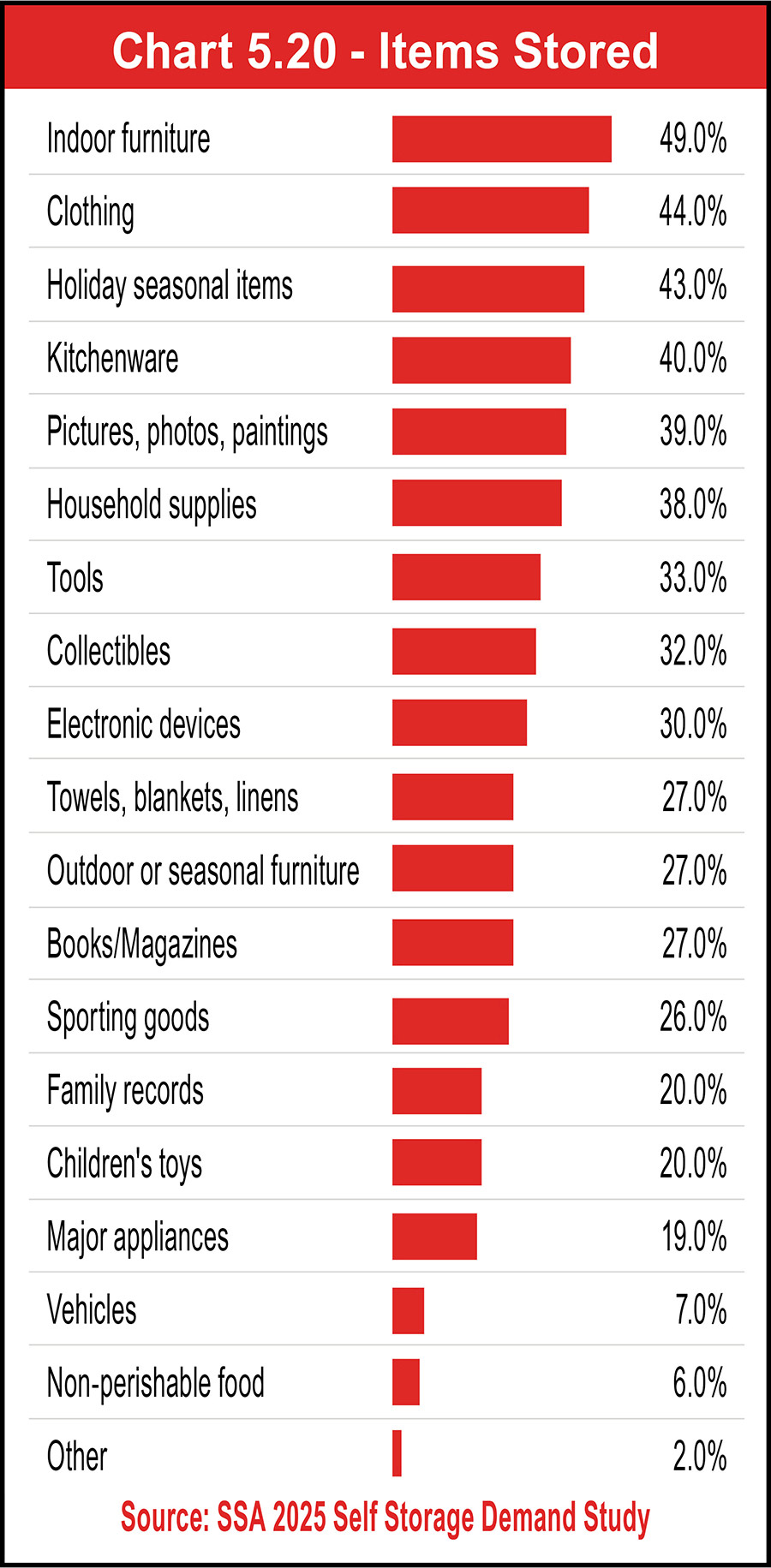
Quite simply, there’s a lot that can be learned from knowing what a customer is storing, and asking helps you know and safeguard your valuable customers from danger and competitors.