



f you own or manage storage facilities, you are well aware of the many things that go into budgeting, including roofing, landscaping, exterior maintenance, and security systems, just to name a few. Yet asphalt and concrete repairs often end up at the bottom of the list. Many people simply put them off, hoping the problems will magically go away.
Unfortunately, there isn’t an asphalt fairy fixing parking lots while we sleep. The longer pavement issues go without repair, or if they are repaired incorrectly, the more money owners end up wasting. Small issues become larger problems, which ultimately lead to more expensive repairs down the road. This can wreak havoc on yearly budgets.
Something I see countless times as a national account executive at The Pavement Group is facilities teams and owners completing permanent spot repairs year after year until they eventually decide to mill and pave the entire lot. Without a plan, you are essentially throwing money out the window. Those permanent patches that were installed along the way often get milled up and sent back to the plant to be recycled into new asphalt for your next self-storage paving project.
That’s why having a five-year plan is so important. Ask yourself:
- What is the goal for the property over the next five years?
- How much budget will be allocated to pavement maintenance?
- Are you planning to sell the property?
- Are there safety hazards that need immediate attention?
Sharing the answers to these questions with your paving contractor will help them develop a structured plan that is best for your property.
You wouldn’t start a business without a five-year plan. You wouldn’t try to lose weight without a plan. So why do so many owners manage one of their most valuable assets in a reactive way?
Let’s be honest: The most expensive asphalt repair is rarely the large paving project owners plan for—it’s the emergency repair that happens when pavement fails years earlier than expected.
There are five important things self-storage facility owners may not know about their asphalt.
Crack filling alligator or spider web cracking is like putting a bandage on a broken bone. It simply doesn’t address the real problem. Even if you seal the larger cracks and apply sealcoat, there will still be numerous intrusion points for water. Water will continue to work its way beneath the surface and break down the asphalt. As many contractors say, this approach is essentially “putting lipstick on a pig.”
A reliable contractor would not recommend this as a long-term solution for pavement that has already reached this stage of deterioration. However, budget limitations are a reality for many property owners. In those cases, contractors have a job to clearly explain that this type of work would be only cosmetic in nature, would not extend the structural life of the pavement, and should not be viewed as a repair. When clients fully understand those limitations, some may still choose this approach as a short-term appearance improvement while planning for more substantial repairs in the future.
While expanding the repair area may cost slightly more upfront, it often leads to a much longer lifespan for the repair. It can also reduce future mobilization costs for crews that would otherwise need to return the following year. Additionally, there’s rarely a cheaper time to buy asphalt than today! Fixing the problem correctly the first time is often the most cost-effective solution.
For this reason, it is often recommended to convert asphalt to concrete in dumpster areas, at least where truck wheels typically sit during service. Concrete handles heavy loads much better in these high-stress locations.
The same principle applies to other areas with frequent heavy traffic or tight turning movements. In these areas, additional asphalt depth or conversion to concrete can significantly improve longevity.
For this reason, it is often best to squeegee sealcoat near buildings instead of spraying it. While squeegeeing is typically more expensive and takes longer, it greatly reduces the risk of overspray and damage.
Asking contractors about this during the bidding process can save significant headaches later.
Sometimes a specific area of pavement collects standing water. Property owners often request that a contractor regrade a small patch to redirect the water. Unfortunately, this is not always possible.
True regrading typically requires work down to the subgrade level. In addition, the edges of the repair must tie into the surrounding pavement. Because of this, there is very little ability to adjust slope within a small repair area.
While improvements may sometimes be possible when asphalt is removed and replaced over larger sections of the lot, properties with persistent drainage issues often benefit from consulting a civil engineer to develop a long-term solution. An engineer can provide guidance on options such as adding storm structures, adjusting grading for proper sheet drainage, or redesigning drainage patterns. It is also important to remember that drainage solutions must be carefully designed. Water cannot simply be redirected off your property onto neighboring properties, and doing so can create additional issues and potential liability.
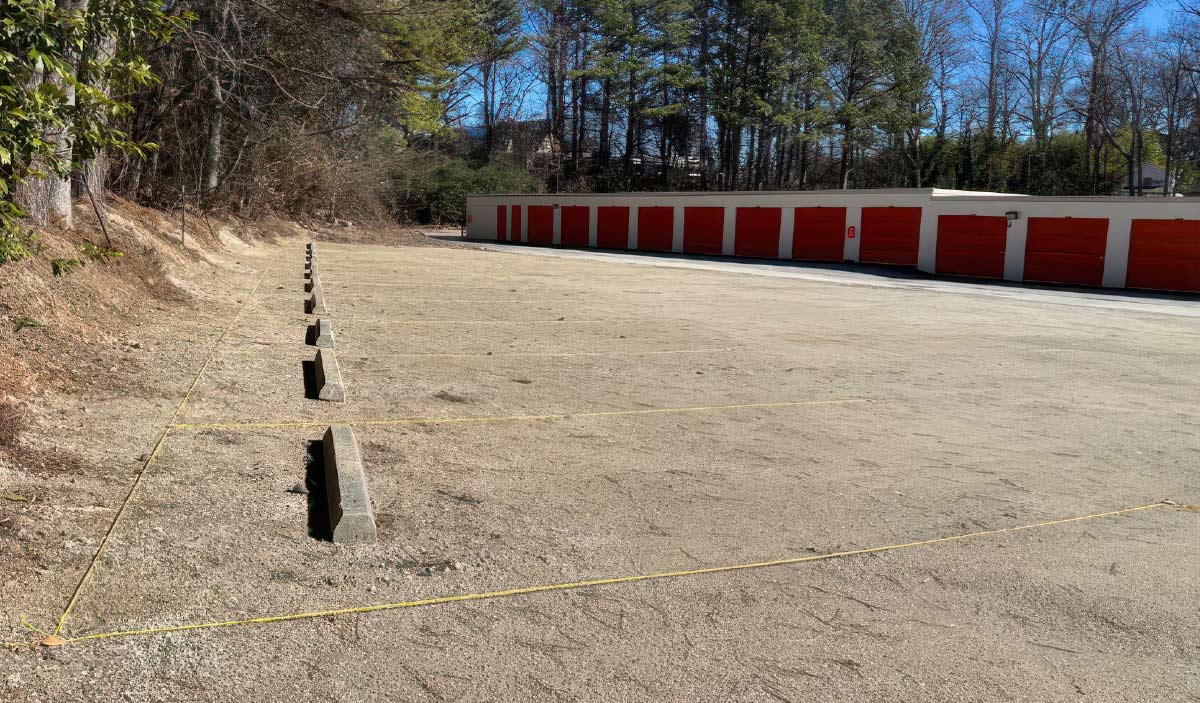
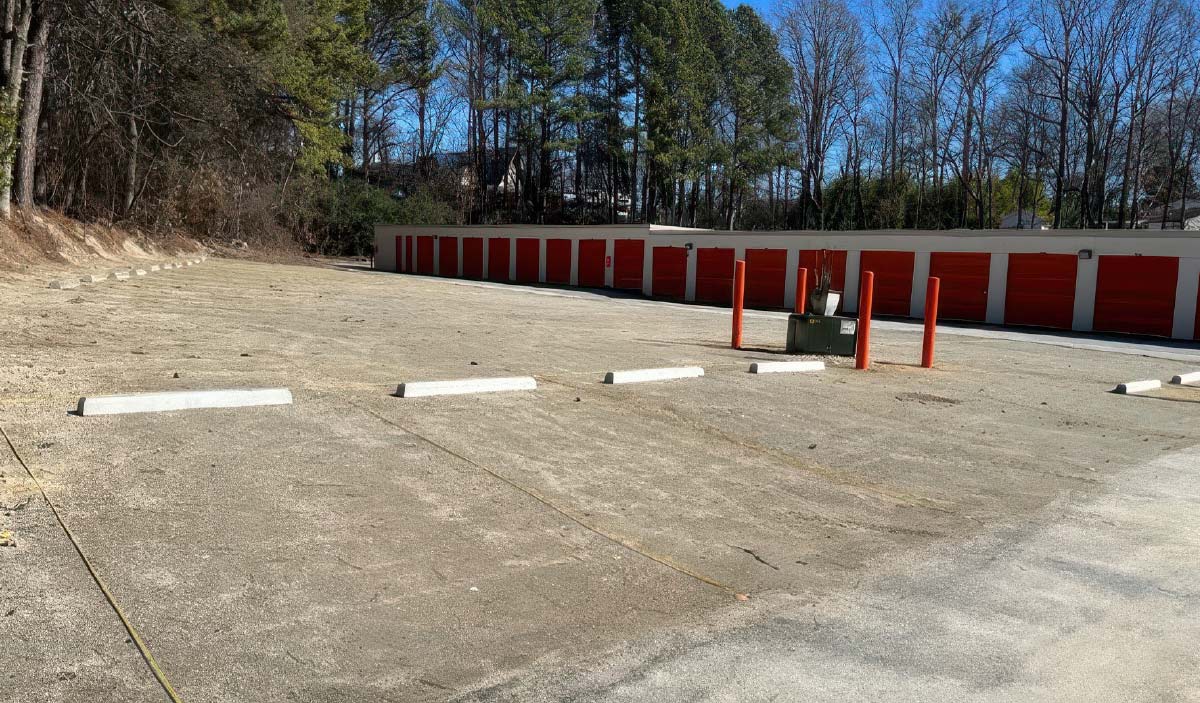
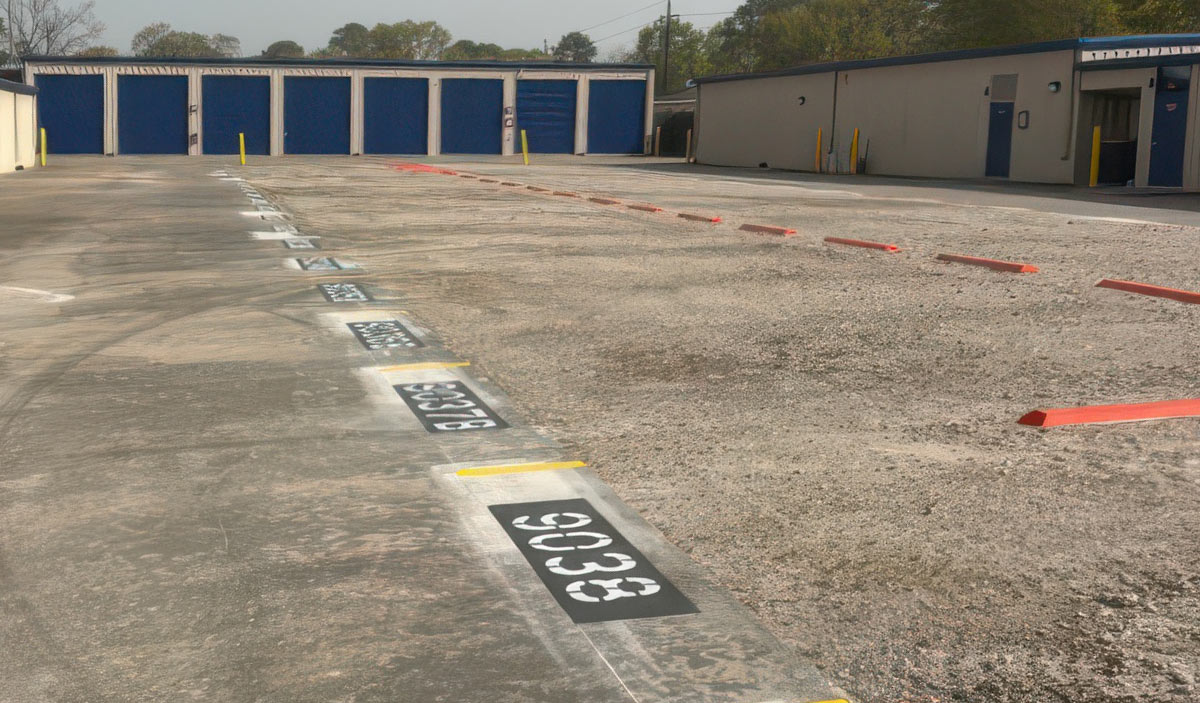
Over the years we have seen several different approaches:
- Rope and washers to outline stalls,
- Concrete wheel stops installed above grade,
- Flexible poles installed with rope between them, and
- Partially buried wheel stops painted for visibility.
One solution that has worked surprisingly well is striping directly on the gravel surface. While this is not typically recommended for high-traffic areas, storage parking stalls often experience very little movement. Vehicles such as boats, RVs, and cars may remain parked for months or even years at a time. Because traffic across the stall lines is minimal, the paint tends to last longer than expected.
Self-storage facilities also experience frequent move-ins and move-outs. If tenants encounter potholes, standing water, or trip hazards, the experience becomes frustrating and potentially unsafe.
Poor pavement conditions also increase liability exposure. A lawsuit from a trip-and-fall incident can cost far more than routine pavement maintenance.
Maintaining your parking lot improves safety, enhances brand perception, and helps retain tenants for years to come.
For facility managers responsible for regional or national portfolios, it can be extremely difficult to evaluate hundreds of properties and determine where pavement budgets should be prioritized. Too often, decisions are based on who complains the loudest or which site raises the biggest concern.
When a contractor like The Pavement Group can assess an entire portfolio, document pavement conditions with GPS-tracked photos, and assign PASER ratings to each property, owners gain clear visibility into the condition of their pavement and can develop a strategic plan for repairs and maintenance. This allows owners to prioritize properties with the greatest safety risks and the most urgent repair needs.
By allocating maintenance dollars strategically and focusing on the worst areas first, owners can build long-term maintenance plans that stretch budgets much further.
