


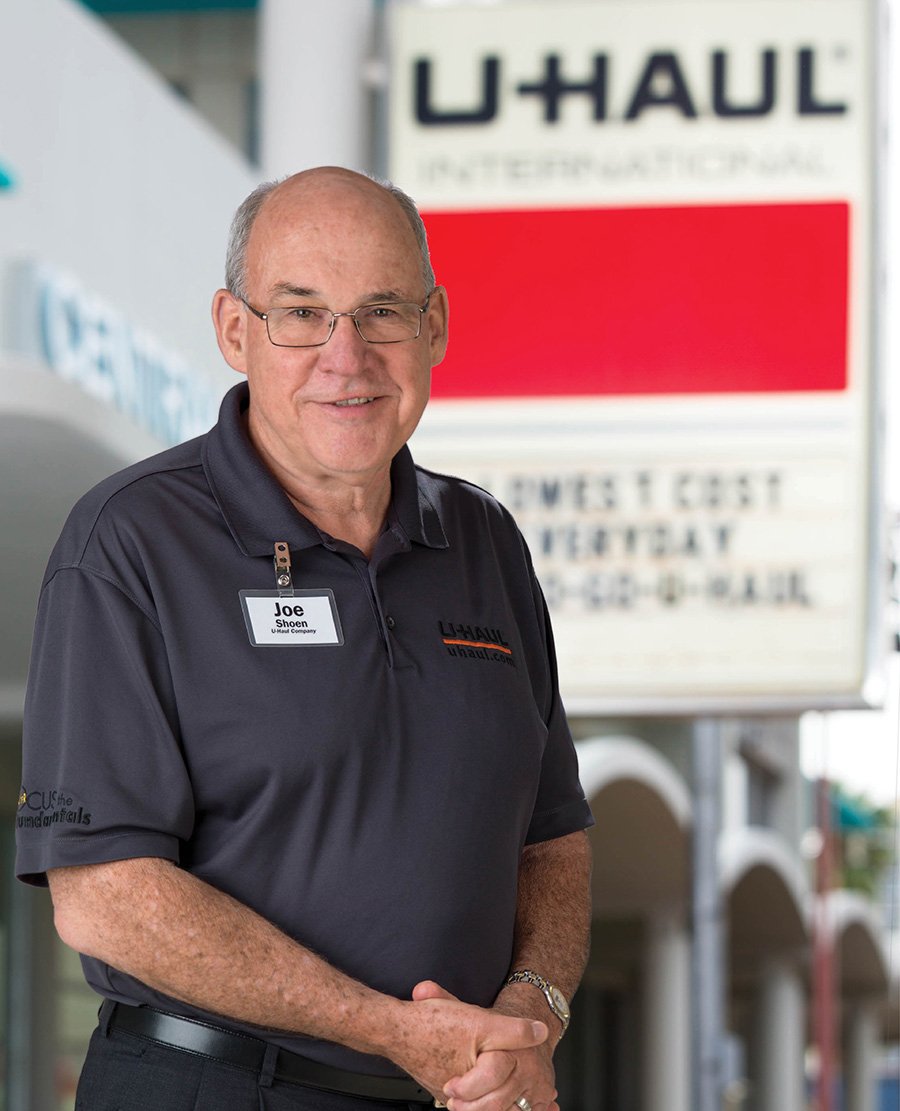
oe Shoen is taking a stand. In an exclusive interview, Shoen sat down with MSM to explain why he’s going against the grain when it comes to pricing. He says he’s “fed up” with what he describes as a strategy among major players (offering low introductory rates and then increasing them multiple times a year, sometimes before customers even move in), so he’s taking a different approach: offering customers a one-year rate lock guarantee.
Shoen had been circling the idea for a while, and then he got hold of a year-old article in Slate titled “Sneaky Self-Storage Unit Rate Increases.” He reads a piece of it aloud. “These kinds of massive rate increases [ECRIs] are more common among larger companies … familiar names like Public Storage, Extra Space Storage, U-Haul, National Storage Affiliates, CubeSmart, Prime, and StorageMart,” quotes Shoen, and he shakes his head. “The thing is, we don’t do that. We’ve never done that. I didn’t even know what ECRI meant until I read this. And now we’re being lumped in with those who are doing this because we’re all the biggest names in the industry. That sealed it. I thought, ‘I need to distance myself from these other guys.’”
Shoen says he’s had many people including industry colleagues tell him that he could make a lot more money if U-Haul did adopt aggressive ECRI practices. “I’ve heard it all. They say, ‘But all the REITs are doing it,’” says Shoen. “And the REITs, by doing this, they’re communicating to me that they are smarter than me. OK, maybe you are, but I’m not being sued by the city of New York.”
U-Haul is also famous for its “first month free” promotion with a truck rental. “We don’t require a dollar. There’s no admin fee, no insurance requirement. You need to have a lock, but it can be your own lock. It’s legitimately one month free. There are customers who come and stay for just one month, and they get it for free. Now, we’re hoping we can sell them a box or a lock, but it’s a straightforward promotion.”
U-Haul does increase rates over time, of course, but customers receive a notice 30 days in advance, and it’s never an “outrageous” amount. “We apply rent increases that are somewhat in line with inflation. We’ll perform an analysis by location, unit size, it’s pretty simple. If all our 10-by-10s are rented up, we’d probably consider a rate increase. But even that won’t happen now, not for a year from the move-in date.”
Is the first month free promotion going away with the new price lock guarantee? No, says Shoen. “They still get the first month free with a truck rental. So, for those customers, the price lock is 11 months. I had to double-check the literature to make sure it was written that way so that we weren’t locking in 12 months free,” says Shoen with a chuckle.
Photo courtesy: U-Haul
Because of their financial perspectives, Shoen doesn’t think they understand that storage can be a significant expense for a lot of customers. Instead, he says, “They’re attending seminars on how to squeeze the most amount of money out of people. How much can you crank it without incurring the wrath of the government? Can you crank it 30 percent? Can you crank it 40 percent? That’s a bit like people who’d raise the price of gas because it’s running out. There’s something wrong with that and that’s a real sore point for me.”
Shoen says it’s difficult enough for people these days without self-storage taking advantage of them. “Renting a unit for $34 when you know you want $99 for it, just to get them in the door, knowing full well you’re going to nearly triple that within 90 days, is disgraceful. People’s money and their belongings that they’ve entrusted to you are not something to be played with.”
What also infuriates him is that he understands that many customers have had a disturbance in their lives and they’re coming to you for help. “Maybe they lost their home. Maybe they had a death in the family. These things happen. To imagine preying on them in their time of need is ridiculous.”
Shoen also knows that at least half of the customers who need storage are very budget conscious and are living paycheck to paycheck or payment to payment. He says these same people are the ones who’ve helped make U-Haul the success it is today. “Why would you want to take advantage of them?” asks Shoen rhetorically. “There has to be some modest amount of reciprocation, so at U-Haul we say, ‘Service comes before profit.’ Unless you serve someone, why should they allow you to make a profit? You’ve not done anything, so service comes before profit.”
This is not naivety; Shoen knows he still has to pay the banks, the employees, and so on, but he doesn’t feel he needs to “trick customers” to do that.
“It’s offensive to me,” says Shoen. “The storage industry has spent years establishing itself as a legitimate consumer product, and now we’re gonna just throw it away?”

Photo courtesy: U-Haul
Shoen says nothing is going to change his mind. Has he spoken with the heads of other REITs about this? He shakes his head no. “I have not, and I went back and forth on that one. Maybe I’ll lose some friends over this, but I don’t want to tell them how to run their business. I’m just saying that it won’t work for me, so there was no need to have a discussion. I have spoken at other events and said that I didn’t think raising rates exorbitantly was a smart move, that it would bring the government into our business because they’d finally determine that this is a form of consumer fraud.”
In addition to U-Haul owned stores, the company also works with approximately 5,000 dealers who are independent self-storage operators. “These are people who own one, two, or three stores. They haven’t raised rates in two years. They get full enough that they’re happy, they’re making a return, they’re good. If you told them, ‘Move somebody in for $27, then jack the rate to $99,’ they’d look at you like you were crazy.”
Shoen says this is because this is the part of the industry that is not run by finance people. It’s run by small businesspeople who now are pretty big small business people, but they’re still small operators compared to the REITs. “They’re the heart of this industry. They’re just trying to serve the community and do their job. And that’s largely how we view ourselves at U-Haul too.”
Despite this hope, he does believe the industry is going to get price controls from this. “It’ll be a crying shame,” says Shoen. “You worry about making money, but you want to see what’s really going to increase your costs? Government regulation of anything. Your costs are going to go up and you’re not going to like it.”
Photo courtesy: U-Haul
If the regulators were to come to him today, Shoen would tell them exactly what he’s saying in this interview. “I’m not going to cover for others and say, ‘Well, they really just didn’t understand what they were doing,’ because they damn well know what they’re doing. They have conferences on how to do this. They have people who consult on how to do this. Go talk to them because I don’t engage in this.”
In California, where rent control bills were on the table with Senate Bill 709, the California Self Storage Association and the national Self Storage Association worked together to transform it into a bill about transparency; rate hikes were OK so long as proper disclosures were provided.
“There was a lot of lobbying done around that bill, and I supported that lobbying because I don’t like rent controls. They don’t work well.”
However, the outcome for disclosure, he says, is something that anybody can work around. “All the other majors have engineered around the California law, pure and simple. Sure, they disclose it to comply with the minimum requirements of the law, but it’s buried deep enough with a lot of other terms and conditions that people don’t pay attention or even see it. They’re just initializing boxes to get the contract signed.”
He thinks New York City won’t go for this. “I was told of a clip where [Zohran]Mamdani, in a live speech, mentioned both Public Storage and Extra Space,” he says. “I’m probably next. I’m number three. So, although he didn’t mention my company, it’s not a great leap to imagine the next time he adds, “and U-Haul.” I need that like a bad cold. And that’s why we’re going to set U-Haul apart from the crowd.”
He adds a few words of caution for the REITs. “Abusing the customer doesn’t work out in the long term; the customer figures a way to get even. It’s a complicated process and involves tens of millions of people, but it happens. You may be an economic behemoth today and can’t imagine taking a fall, but plenty of companies have come and gone because a customer changed their attitude towards the business.”
Shoen also hopes his actions show independents that operate with honesty and integrity that they’re doing it right. “I’m ashamed that I didn’t speak out publicly before now. What those smaller guys are doing is reasonable and fair, and I should be backing them up, so I’ve decided to separate myself from what really is all the other majors, who are all in this to one degree or another. So, just as that Slate article mentioned U-Haul with the others, I don’t want to be mentioned in that contest. U-Haul’s not in that contest.”
Shoen wraps up the interview by stating that by taking a stand, he’s hoping to do his part to make the industry better. For Shoen, what was once a fight to make self-storage legitimate as an asset class has now become a fight to make self-storage reputable again.