



elf-storage operators are facing pressure from all sides: economic headwinds, stagnant revenue, rising operational costs, and fierce competition. In this landscape, operational efficiency isn’t optional—it’s a strategic advantage.
While many have embraced automation in leasing, marketing, and payments, one critical process remains largely manual: lien compliance.
Lien compliance is more than a back-office burden. It carries legal risk, consumes significant staff time, and, if mismanaged, can hold back your bottom line. As the industry looks for ways to tighten operations and reduce exposure, automated lien compliance represents a high-impact opportunity to improve performance and mitigate risk.This article explores how operators can modernize lien compliance through technology, drawing on current market data, real-world pain points, and automation case studies.
Meanwhile, inflation is expected to persist through 2025, with consumer prices projected to rise 3.5 percent year over year. The Federal Reserve’s 2 percent inflation target makes meaningful rate cuts unlikely, further chilling home sales and, by extension, storage demand.
The result is more competition for fewer renters. Operators are facing slower lease-ups, declining marketing efficiency, and a need to differentiate through service and operational excellence.
Operating expenses are also climbing. According to MSM’s Self-Storage Expense Guidebook, off-site management costs rose 14.3 percent year over year, while on-site labor remains one of the largest cost centers.
- Delinquency rates that are well above market averages,
- Delayed auctions and long delinquency periods that slow down revenue recovery,
- Inconsistent or noncompliant lien and auction processes,
- Outdated systems that increase legal exposure, and
- Negative online reviews tied to poor communication, administration, or billing.
- How and when tenants must be notified,
- Waiting periods before a sale,
- Acceptable notice delivery methods, and
- Specific auction procedures and advertising standards.
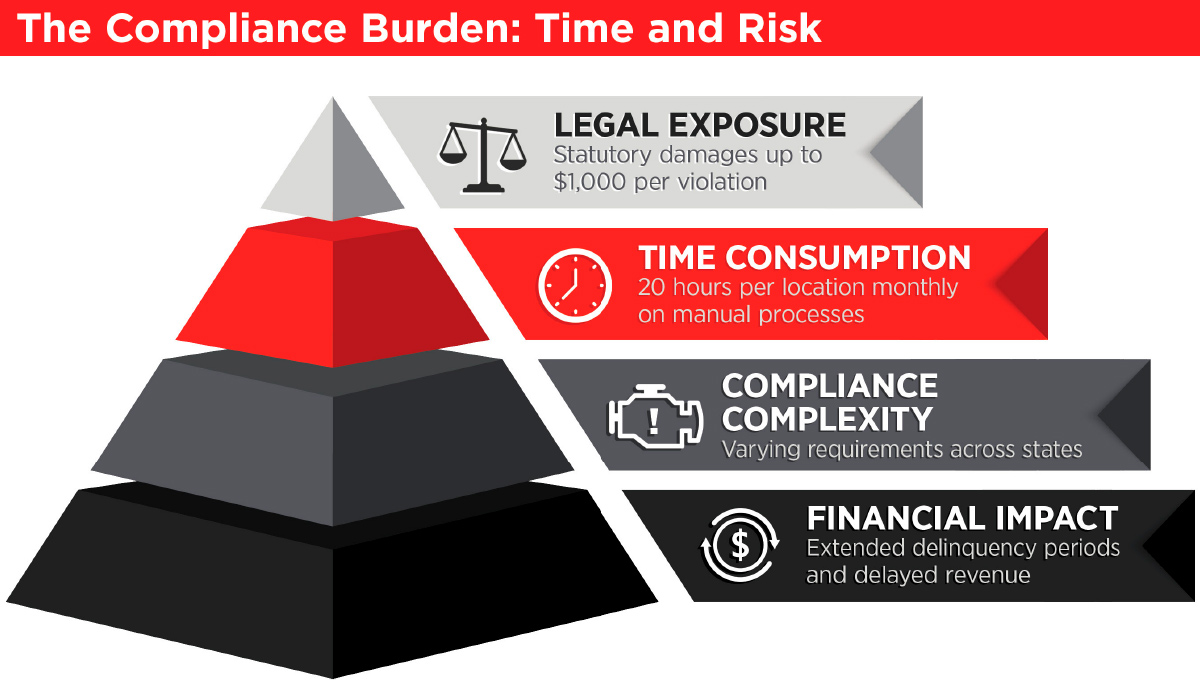
Operating in multiple states multiplies complexity. A manager in Florida cannot follow the same workflow as one in Texas or California without risking non-compliance.

Failure to comply isn’t just inefficient—it’s risky. Approximately 30 percent of pre-auction audits fail, and legal exposure can be severe. For example, Florida’s Consumer Collection Practices Act now allows statutory damages of up to $1,000 per violation for communications sent outside approved hours. In an era of increased litigation and regulation, lien missteps are a liability operators can no longer afford.
- Lead generation – SEO, digital ads, and listings are often handled by third parties or platforms.
- Leasing – Online applications, e-signatures, and payment portals are standard.
- Collections – Autopay systems, late notices, and credit card retries reduce delinquency.
- Operations – Climate monitoring and lock access free up operations to deliver higher value.
Lien compliance, however, is often stuck in the past. Operators rely on disconnected tools, site-by-site knowledge, and labor-intensive workflows.
Consistency
- Enforces uniform workflows across sites and states.
- Reduces human error and training requirements.
- Enables reliable and responsive customer support.
Time Savings
- Eliminates the need to move documents manually between systems.
- Gives time back to site managers and regional leads otherwise spent on manual tasks.
- Integrates seamlessly with your current facility management system (FMS).
Transparency
- Integrates with property management and auction systems.
- Enables centralized oversight and audit-readiness, even across multiple states.
- Well-documented processes protect operators from legal disputes.
Storage Star set out to become a premier brand in the storage industry but faced high delinquency rates, inefficient auction processes, complex legal compliance, and resource-draining manual operations. Missed auctions and inconsistent practices were common, threatening their ability to scale effectively.
To tackle these issues, Storage Star partnered with Ai Lean. By combining AI-driven automation, legal expertise, and human support, Ai Lean streamlined lien processes, empowered managers, and drove business results. Key solutions and results were:
- Automated Compliance And Communication – A web-based portal gave real-time visibility into account statuses, simplifying lien compliance across multiple states.
- Seamless Auction Management – Integrated tools reduced auction task time by 70 percent and ensured listings were accurate and compliant.
- Integrated Delinquency Management – Custom API integration flagged delinquent accounts in real time and guided the team through recovery processes.
- Operational Efficiency – Over 500 hours saved monthly by eliminating manual tasks and establishing a predictable auction schedule.
- Cultural Shift – The new structured processes built a culture of accountability, improving consistency and reducing missed auctions.
At a glance, impact includes:
- 80 percent improvement in delinquency rates (now below 2 percent).
- 500-plus hours saved monthly across the organization.
- 70 percent less time spent on auction-related tasks.
- Financial gains from reactivated units and reduced legal expenses.
“Using AI and automation has given Storage Star a competitive advantage. When more units are occupied by paying tenants, our prices can be lower, which makes customer acquisition easier,” said Bob Curry, district manager at Storage Star.
- Time Savings – Reduce monthly labor hours per site and reallocate staff to customer service and sales.
- Risk Mitigation – Avoid legal missteps with consistent, timely workflows.
- Operational Efficiency – Scale with confidence. Streamline multistep tasks into a single process that integrates with existing FMS.
- Cost Reduction – Minimize training, overhead, and rework.
The downstream impact is more bandwidth for managers to focus on customer service, marketing, and revenue growth.

Operators who adopt lien automation today will gain:
- Operational clarity across states and teams,
- A compliance-ready audit trail,
- Lower total cost of ownership for lien processing,
- Higher tenant satisfaction by reducing errors and confusion, and
- Lower overhead, enabling competition with larger REITs and operations.
In a crowded market, this efficiency becomes a strategic advantage.
In a market defined by tight margins and growing complexity, lien compliance shouldn’t be a bottleneck. With the right automation tools, it becomes a competitive advantage, reducing legal risk, increasing NOI, and freeing teams to focus on growth. Operators who act now will define the next standard of operational excellence.
- Lien compliance is legally risky and labor-intensive when handled manually.
- Economic and competitive pressures demand better operational efficiency.
- Automation offers consistency, time savings, and visibility across portfolios.
Early adopters of lien automation will gain a meaningful edge as the industry continues to evolve.