



o to any self-storage event or attend any self-storage call these days, and the conversation inevitably circles back to existing customer rate increases (ECRIs). Why is the topic weighing so heavily on the minds of operators? After all, ECRIs are nothing new. Insurance, telecommunications, and subscription-based services have been using them for decades, and for the most part, unless a customer was willing to switch providers and cancel services, they just put up with ECRIs. In self-storage, this may be even more prevalent, as people often have a tendency to choose convenience over cost. (How many customers are willing to pack up their unit, potentially rent a moving truck, and schlep everything to another facility?)
Recently, though, operators have been employing new ECRI strategies, attracting customers with low introductory rates and raising them aggressively, often without prior notice, within months of move-in. It’s a troubling trend, because while low move-in rates have always been common, they were obviously promotional prices that wouldn’t last (no reasonable person expects anything but the first month to be $1). But luring a customer in at $100 a month, which may seem reasonable to someone with no comparison anchor, and raising rates throughout the year until they’re paying $220 a month can be seen as deceptive, or a bait and switch. MSM recently covered this in a three-part series that I encourage you to read.
I monitor the ECRIs of operators in the industry closely, and I’m starting to grow a little bit concerned myself–not just about the perception of the industry when aggressive rate tactics are employed but as it pertains to net rent and customer value over time. To explain further, first we’ll need to take a look at what I’m seeing play out with a number of operators: $100 web rate vs. $200 in-store rate; 30 percent increase every four months for a year.
See Web Rates Table
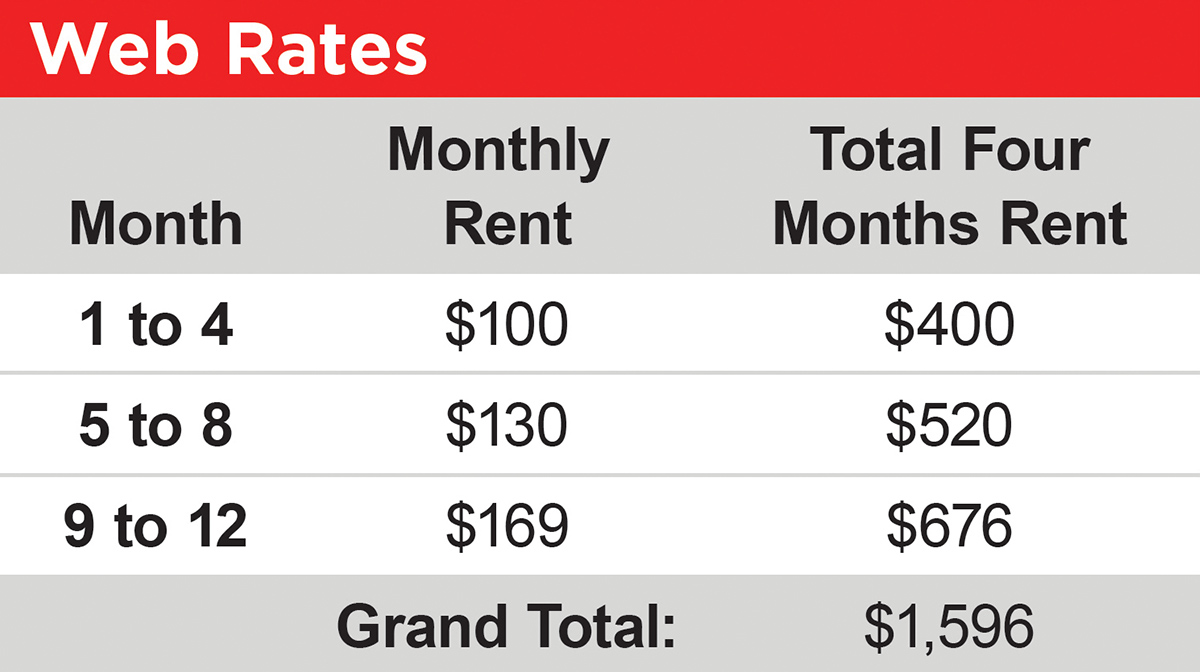
As the table shows, $1,596 is collected from customers who stay one year, which is a 33.5 percent discount from the $2,400 in-store rate.
The story doesn’t end there, of course; there’s churn that needs to be factored in. History tells us that about 30 percent of customers will leave within six months of renting, and another 20 percent will leave within 12 months. None of these customers are hitting the higher rate levels, so they’re making off with a hefty discount.
It’s tempting to think that because the other 50 percent of customers who stay wind up paying $220 per month, you’re recapturing some of the loss from the early move-outs. In theory, it makes sense. However, when doing these calculations, something else jumped out at me.
As already mentioned, we can expect approximately 50 percent annual customer turnover. So, on a stabilized facility, 50 percent of tenants have been there for two or more years, and maybe about 25 percent of them turn over every year or two. As the oldest customers, they’re typically the highest paying ones. This is especially true in our current cycle, given that many are still paying 2021 rates. (For operators using aggressive ECRI strategies, there’s often a huge spread between the “seasoned” customers and those under two years; we’re not seeing this as much with independents in tertiary markets.)
But this cycle is coming to an end, and as the mix of older, higher paying customers and newer, lower paying customers vacate every month, they’re only being replaced with very low rent customers.
The net rent/occupancy square footage seen on the Investor Relations pages of the REITs’ supplemental financials are only slightly reflective of the low-rent customers replacing vacates because you have to consider the rest of the rent roll, and churning through COVID-era renters will take time. But, once those high paying customers are out of the equation, I think the industry will be headed in a concerning direction. While ECRIs are a fine strategy (as mentioned, they’ve been around for a long time and have served the industry well), overly aggressive ECRIs becoming the norm may be damaging. In time, they will leave facilities with only the lower rent paying customers. There will be no seasoned “whales” to make up the difference.
Furthermore, much of the pricing is highly volatile and derived from algorithms that are constantly A/B tested by robust data science teams. It’s inarguable that this is a strategy worth exploring as shareholders pay close attention to quarterly revenue and occupancy trends while comparing one REIT to the next. However, the dependency on algorithms presents a difficult challenge to analysts, developers, and acquisitions persons seeking an accurate figure for their forecasts. Rental rates for a single unit can see 30 to 50 percent volatility within a week.
While it does seem like achieved rates haven’t moved much for the REITs just yet, which is remarkable and a testament to their ability to push the envelope, it’s still a bit too early to conclusively state the impact of ECRIs. With the Q2 earnings rolling in, we may start to see how they’re affecting things. If it does seem like the model is here to stay, it’s very important for other operators to understand exactly how to process these ECRIs consistently in order to compete for customers without damaging their annual returns.
*Note: While figuring market rental rate comparison volatility/accuracy was a challenge, don’t see the need to split web/in-store rates 50/50 to pull together an acceptable comp, since web rates tend to balance out with in-store rates over time.