









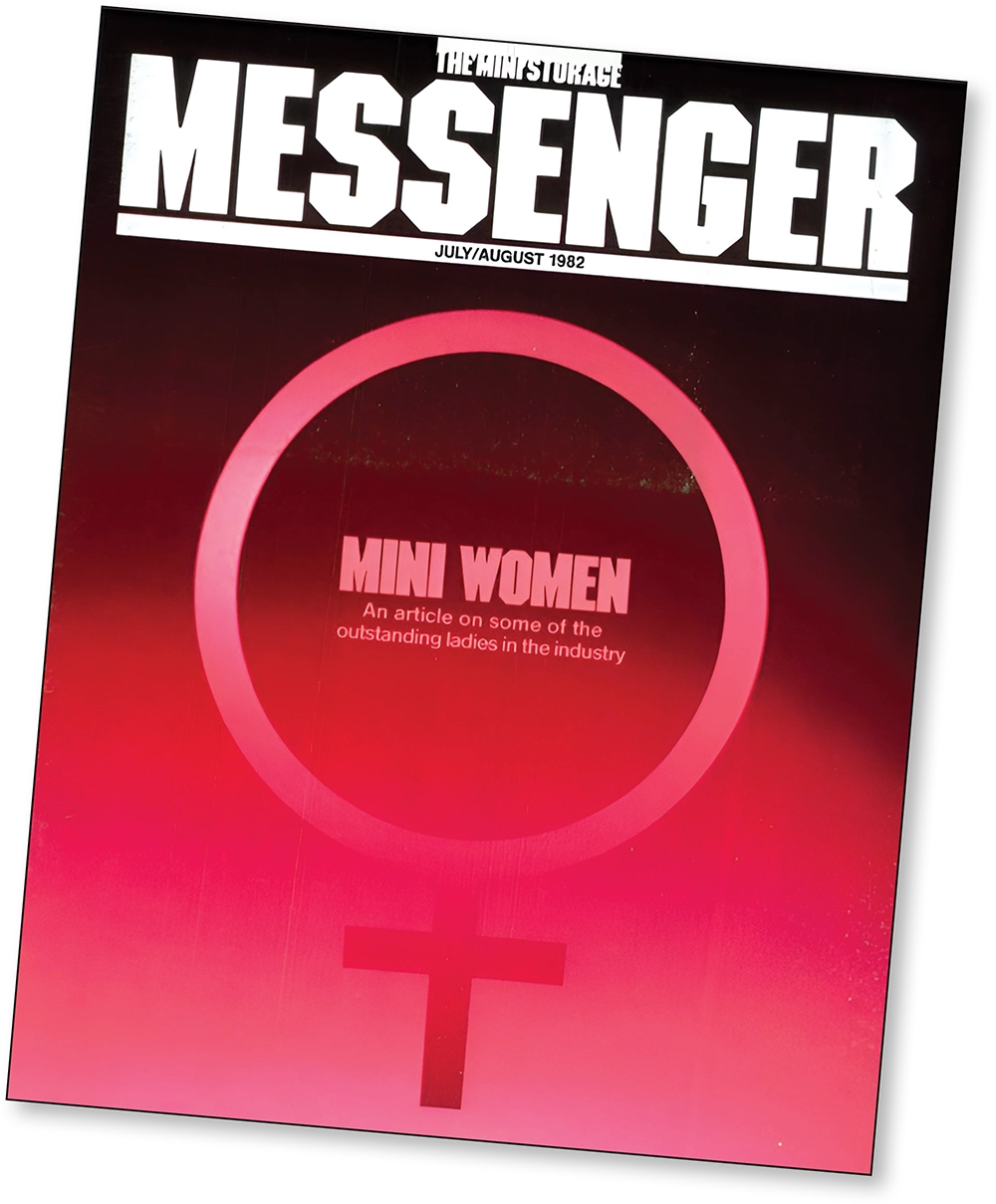
t’s 1982. Disco is dead, the economic downturn is ending, and the decade is finally coming out of the shadow of the 70s. Ronald Reagan is making his mark politically, while “Thriller,” “E.T.,” and “Dallas” are making an impression culturally. Amid these changes, another shift is taking place: Women, who had often been seen mainly in support roles, are stepping into leadership positions across industries long dominated by men, including the growing self-storage business.
That year, MSM interviewed female self-storage leaders for the cover story “Mini Women.” The topic was covered again in 1988’s “A Woman’s Touch” and 1995’s “Have You Come A Long Way, Baby?” Each time, although the ladies had plenty to say about their businesses, conversations often circled back to the challenges they faced as women in the industry. All these years later, we wondered how far we have come. We shared quotes from each story with some of today’s leading ladies of self-storage and asked if they were still relevant. We also caught up with an original “Mini Woman,” Dianne Tanna, who is featured in this month’s edition of “Women In Self-Storage.”
-Cheri Roush
“I don’t think gender is as applicable today,” says Martha Hargrove-Leeder, managing director at DXD Capital. “In my experience, everyone has to prove and distinguish themselves at a company.”
Alyssa Quill, CEO of Storage Asset Management (SAM), agrees. “Over my 24-year self-storage career, I’ve never seen this. Hard work gets noticed, period.”
Jenny Bortman, president of Universal Insurance Programs, feels that the landscape has improved over the years, with more women taking on leadership roles and being celebrated for their impact. “The path may have challenges, but I’ve found that commitment and integrity pave the way forward,” she says. “In this industry, I didn’t expect any shortcuts. I showed up, did the job, and took pride in doing it well. Recognition has not come from demanding it but by consistently delivering results.”
However, two women relate personally to the 1982 quote. “Early in my career, I knew I had to prove myself, but I came in confident and ready to challenge expectations,” says Holly Fiorello, director of field marketing at Storable. “I was not interested in waiting for recognition. Instead, I focused on delivering value and making myself impossible to overlook.” She now tries to pass that mindset on to others. “I encourage them to believe in themselves, take the shot, and push beyond what feels safe.”
CJ Stratte, president and CEO of On the Move, also dealt with this, but says she turned it into an advantage. “I focused on connecting with people on a personal level and showing my commitment,” she says. “Once they saw the effort I put in, the opportunities started coming my way.”
-Darby Bloodgood
That’s exactly what Quill has done. During her 15 years as an owner of SAM, she recalls this happening twice. “It was an easy decision not to do business with them. There are plenty of other great vendors and clients out there.”
Stratte, who has also been on the receiving end of comments like this, quickly realized she needed to speak up and let that person know that she was the one making decisions. “It’s funny how many people underestimate women in positions of power, but a little firm confidence and a direct approach can go a long way,” she adds.
Hargrove-Leeder just laughs. “If there are still people who behave that way today, they’re missing out on sales.”
-Darby Bloodgood
“Oh, I’ve definitely been there,” Stratte says, stating that early in her career, she had to prove herself time and again, especially when people didn’t immediately recognize her authority. “I learned quickly that a mix of persistence and a well-timed smile can get you a lot of respect.”
Bortman believes things are better today, but she has never dwelled on who was being acknowledged in the room, instead working hard and letting the results speak for themselves. “Over time, it’s been encouraging to see a growing respect for women in leadership across the industry,” she adds. “The shift has come, in part, because so many of us simply refused to let being overlooked slow us down.”
Brook Bland, marketing specialist at StorageDefender, doesn’t think the problem is 100 percent solved, but acknowledges that women have come a long way since then. “We have more of a voice, and we’re taken more seriously, but we’re still in a male-dominated industry. Some men hear what I say but don’t exactly listen to it. Maneuvering that is sometimes hard, so we have to speak up for ourselves.”
Bland also thinks that while women are seen more as business leaders today, some men may have an unconscious bias, which she’s witnessed at trade shows. “When there’s a couple, a lot of people will pitch to the man, even if the wife also makes decisions,” she says. “Even when the husband says, ‘Talk to my wife,’ the direction is still pointed at the man in the conversation.”
-Lynne Mishler
Christina Alvino, CEO and co-founder of StorSuite, agrees that some women carry a chip on their shoulder about how they should be treated. Her recommendation is to grow thicker skin. “Learn how to push back and learn how to manage men just like we expect to be managed ourselves. It’s a two-way street.”
This particular quote really hits home for Stratte. “I think we can sometimes make it harder on ourselves by assuming it’s all about gender,” she says. “I’ve learned that not everything is meant with bad intentions. Sometimes a misunderstanding can happen, but it’s important to approach each situation with an open mind … patience and humor go a long way in navigating these moments.”
Hargrove-Leeder takes a similar approach. “I try to give people the benefit of the doubt and assume they’re well intentioned, which is a good way to approach not just business but life.”
Bland has a different take; she believes men know what they can and cannot say to women. She also thinks people today are more banded together when it comes to defending women as well. “If a man does say something [inappropriate], even more men will call them out,” she says. “There’s a lot more social awareness and more advocacy as well.”
-Lynne Mishler
“I have been called ‘honey’ in meetings, talked over, and underestimated,” adds Fiorello. “It never stopped me. I learned quickly how to smile, get louder, and take the floor back without asking for permission.”
Alvino has had experiences like this throughout her career as well; although frustrating, she addresses the issue directly. “If someone thinks it’s appropriate to speak down to me or call me a pet name I don’t like, I’m going to let them know,” she says, adding that she might use humor or a snarky comment depending on the situation. “We don’t need to just grin and bear it.”
Moments like these never dissuaded Bortman; to her, they were just distractions. “Over time, I’ve found that when you’re steady, competent, and results-driven, people learn to listen,” she says. “I’ve met many great colleagues in this industry, men included, who have been incredibly supportive. I’ve stayed focused on the work, and that’s made all the difference.”
Maxwell, however, has a word of caution, noting that words like “honey” or “sweetie” are part of the vernacular in certain geographic areas, and that they are rarely intended as an insult. “Understanding the cultural relevance of the audience you are speaking to is important,” she says. “A woman from Chicago might not take as kindly to being called ‘honey’ as a woman from Georgia would. But the same might be true if it were a man from either place.”
Hargrove-Leeder has never experienced anything like this; she says the men she’s encountered in the industry are “sensitive and respectful.” Nor has Bland, however she sets very clear expectations with people when talking to them to avoid this sort of scenario. Either way, she feels women have made a lot of progress. “We are taken a lot more seriously than in 1982. We have more options for growth, and we can be more vocal.”
Quill doesn’t state specifically whether she’s been on the receiving end of unwanted comments, but she does say that this is where having grace can help women shine. “Not letting them see it bother you and moving forward will stop it from continuing to happen in most cases. I always think of Michelle Obama’s quote, ‘When they go low, we go high.’”
-Cheri Roush
However, Maxwell says it still happens and it’s up to the women owners and operators to speak up and break this assumption. “Use your voice, ladies! Let your experience and expertise demonstrate why you deserve a place at the table.”
Stratte has had her share of these moments. “It used to bother me, but I’ve learned how to handle those situations with confidence and grace, and it’s just made me better at what I do.”
Taking it all in stride is Quill. “People often don’t think that I own our company, but I don’t get offended by it. I like surprising them, impressing them. That’s right, a woman, even a young woman, can own a company and lead it to thrive!”
-Dianne Tanna
Fiorello agrees, describing emotional intelligence as a superpower. “You can be empathetic and direct; you can care about people and still hold a high bar,” she says. “That balance wins in business and in life, epecially in self-storage, where customers are often going through hard chapters in their life.”
Alvino and Stratte feel similarly. “Women often bring a unique level of intuition and emotional intelligence when it comes to working with people. Empathy is a huge asset in any role,” says Alvino. Adds Stratte, “Being able to understand people and read the room is something I’ve always done naturally.”
Taking exception to the quote is Hargrove-Leeder, who believes it’s an oversimplification of gender. “Sensitivity and attention to detail are important, but I don’t think women are better than their male counterparts … I know plenty of men who excel in both of those areas.”
-Yvonne DeValone
Hargrove-Leeder agrees. “This one is particularly outdated. There are many women in self-storage and beyond who have proven they’re just as good at the big picture; and I’m a salesperson and I’ve experienced success with sales.”
She’d get no argument from Bland, who says women can do anything they put their mind to, whether it’s being an engineer or an astronaut. “Women are more detail-oriented than men, but we can still look at the big picture, and a lot of times we can see it better than men.”
Stratte, however, relates to the quote at least on a personal level. “While I love the big-picture strategy, I’ve always had an eye for detail, which has been key in managing everything effectively. It’s also helped me build strong relationships with clients and customers, showing them that every little detail matters.
-Cheri Roush
Maxwell understands the sentiment, but she’s also seeing young people choosing to delay marriage, parenthood, and other pursuits to have more expendable income for investments and future-building. She also says many are entering self-storage intentionally. “They may inherit a property or business from their relatives or jump in because the asset class is becoming more well-known as a solid real estate investment.”
Alvino says that today, women are here on purpose, and they belong. “Over the last 15 years I have seen more women stepping into self-storage as owners, investors, operators, brokers, and more,” she says, reflecting on her own journey. “Honestly, I ‘just ended up here’ too, but I chose to stay, and it’s been a privilege to watch more and more women enter the industry and change it for the better.”
Stratte has a different perspective, since she did expect to eventually run the family business. “I’ve always felt a deep sense of pride in carrying on my family’s legacy. Running the business wasn’t something I planned, but it’s been an amazing journey, and I wouldn’t change a thing.”
Perhaps Hargrove-Leeder sums it up best. “At our company, everyone–women and men–says that you don’t necessarily choose self-storage, it chooses you. That may be what makes us a special breed. We all got chosen.”
Alejandra Zilak studied journalism, went to law school, and now writes for a living.