



nowing your numbers and understanding historical data is essential for making sound business decisions that result in boosted profits.
“We’re strong believers in using software for reporting,” says Sarah Beth DeFazio, vice president of sales and development at Universal Storage Group. “We rely on multiple layers of technology to help our sites run more efficiently. We don’t just review reports; we teach our new owners how to read and interpret them, what benchmarks we aim for, and how those metrics reflect the real-time performance of their site. This empowers our owners to not only stay informed but also to hold us accountable for results. Our managers go through similar training. You can’t be an effective manager if you don’t understand the ‘why’ behind the numbers or know what goals you’re working toward. Reporting isn’t just a tool—it’s a roadmap to success.”
Real-Time Data For Smarter Decisions
Automation Of Daily Tasks
Performance Tracking And Accountability
Prorize uses tech to help storage companies precisely right-price their units without the heavy lift of complex manual calculations and decision-making.
“We understand that pricing is multi- faceted in highly dynamic self-storage markets,” says Kuyumcu. “There isn’t a single logic that works in every situation. Setting an optimal price for a product or service in a dynamic, time-dependent fashion is the most complex and challenging domain of artificial intelligence (AI) and machine learning (ML). We leverage data, science, and facts to prevent customers from overreacting to market changes. We offer detailed information, demand forecasts, and rent recommendations, empowering them to make informed pricing decisions.”
Customers can either manually approve changes or establish rules for automatic approval, offering owners and investors a greater sense of control and comfort. Self-storage operations can also benefit from efficiency and transparency through advanced workflow and reporting capabilities.
“We do all the work necessary for system configurations,” says Kuyumcu. “Our fully automated, AI-based solution provides complete transparency on revenue, pricing, and the competitive landscape. It allows customers to focus on their core business rather than spending extensive hours configuring the system and managing pricing decisions.
“When we adjust prices, our software provides detailed explanations and related reports about why rents are changing. The ongoing system’s configuration is also automated and data-driven, saving our customers valuable time. As part of their software subscription, we provide quarterly executive updates to ensure high-level pricing strategies are effective and to identify any necessary fine-tunings.”
Implementing this kind of program can bring a surprisingly big bump to numbers.
“We’ve observed double-digit incremental revenue growth through the use of the RM technology. Market conditions in the self-storage industry change daily, and staying ahead of them is crucial for success.”
“In the snapshot below (Chart 1), Tenant’s Hummingbird revealed one customer initially had over 220 tenants (approximately 20 percent) without any rent changes for over 12 months,” says Tenant data analyst Gandhar Rane. “With data-driven scheduling of rent increases, they reduced this number to under 25, which directly contributed to a steady increase in monthly revenue from $77,000 to $103,000, without negatively impacting occupancy.”
See Chart 1.

“One notable success involved a customer who initially struggled with tenant delinquency rates hovering around 10 percent,” says Rane. “Upon adopting Tenant’s platform, they leveraged our intuitive BI dashboards and user-friendly features, particularly around autopay enrollment.”
See Chart 2.

- Autopay enrollment increased from 36.8 percent in November 2024 to 48.9 percent by April 2025.
- During the same period, delinquency counts dropped dramatically, from 33 down to just nine tenants.
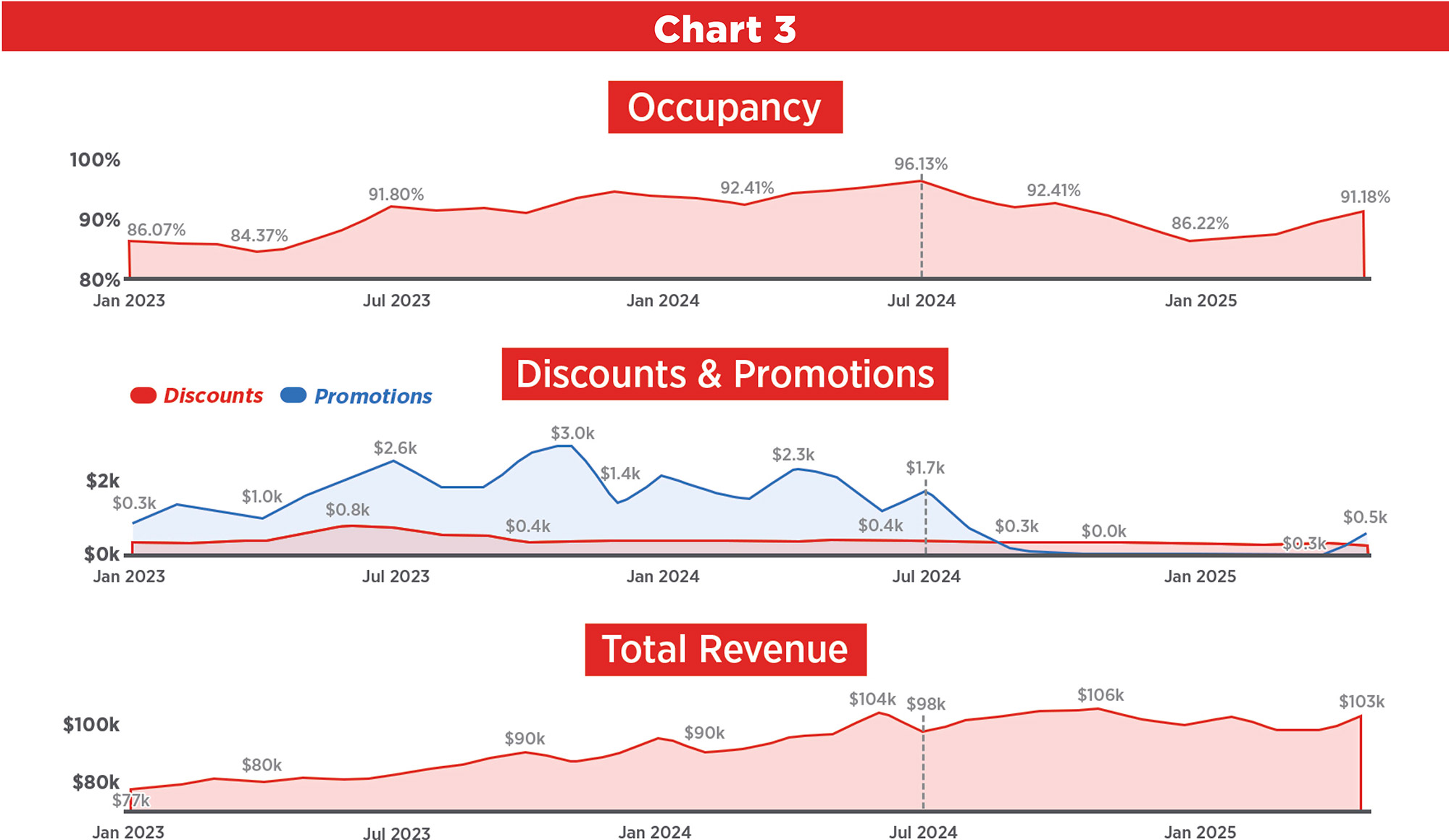
“In the below dashboard (Chart 3), we see a practical demonstration of dynamic pricing,” says Rane. “During early 2024, the customer was offering $3,000 to $4,000 in monthly promotions to boost occupancy. As the occupancy hit a peak of 96.13 percent, they tapered off these discounts while introducing a well-planned rent increase. Despite a modest occupancy dip to approximately 91 percent, revenue continued to climb, peaking at $106,000 and showcasing a higher yield per occupied unit. This approach not only maximized revenue but also created new leasing opportunities by slightly lowering occupancy to a manageable level, thereby allowing for fresh tenant acquisition at optimized rates. Tenant’s BI tools make it seamless to monitor such metrics and take timely, strategic actions.”
See Chart 3.
The right software should make your business easier to run and more profitable.
“Talk to management companies and other owners operating sites of the same caliber as yours to see what they’re using and why,” DeFazio says. “Then begin interviewing software companies until you find the one that fits your specific needs. The right partner will be just as invested in your success as you are. Remember, the software company works for you. You are the consumer, and they should provide continuing help and guidance. The average owner is not an IT expert—you should receive the one-on-one service you deserve.”
Universal Storage Group uses best-in-class software products available on the market in their management of properties.
“A good software provider should not only train you on all the ins and outs of the system but also tailor reporting to your operational needs,” says DeFazio. “The right partner will equip you with the tools necessary to run a successful business. We work closely with our software partners to make sure we have exactly what we need.” Know your numbers. Learn how to read the reports—and what those numbers actually mean. Ask questions, dig deeper, and stay engaged. In the process, remember to keep that precious data safe.
- Optimize Pricing Strategies
- Identify high-demand unit types and adjust prices dynamically based on occupancy, seasonality, and competitive positioning.
- Improve Operational Efficiency
- Track property performance to identify underperforming locations or units, enabling targeted operational interventions.
- Enhance Customer Experience
- Analyze customer behavior to understand preferences, enabling more tailored communication, better promotions, and improved retention.
- Forecast With Confidence
- Use historical data to forecast revenue, occupancy rates, and inventory needs, helping plan for expansions or marketing campaigns.
- Streamline Collections
- Identify patterns in delinquency to proactively manage risk and reduce auction volume.