



his writing discusses the various systems of framing the structure for a self-storage facility. Simply put, this is the skeleton or backbone of the building that holds the integrity of the structure together, supports the weight, resists forces such as wind, hurricanes, or earthquakes, and transfers those loads down to the foundation.
It should be noted here that the building’s exterior walls may or may not be an integrated part of the structural system. In some cases, these walls are simply applied and decorative; in other cases, they are an integral part of the structural support system itself. Each project must be evaluated on its own to determine this question.
The author has been in the business of constructing these types of facilities for over 40 years and has seen virtually every system utilized. This dates to the earlier days when pioneering developers adapted systems originally designed for other types of construction and applied them to these buildings. These systems soon proved to be less efficient and less friendly to this type of product and were eventually replaced with designs that were of better use for this intended purpose.
Light Gauge Framing
Light gauge framing – post and purlin

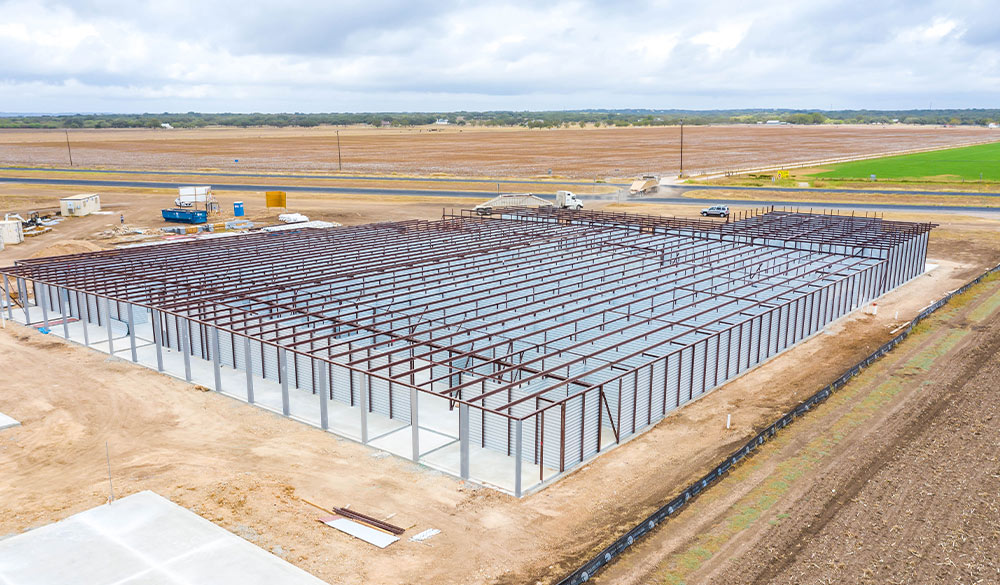
Rigid frame metal building

Rigid frame metal building

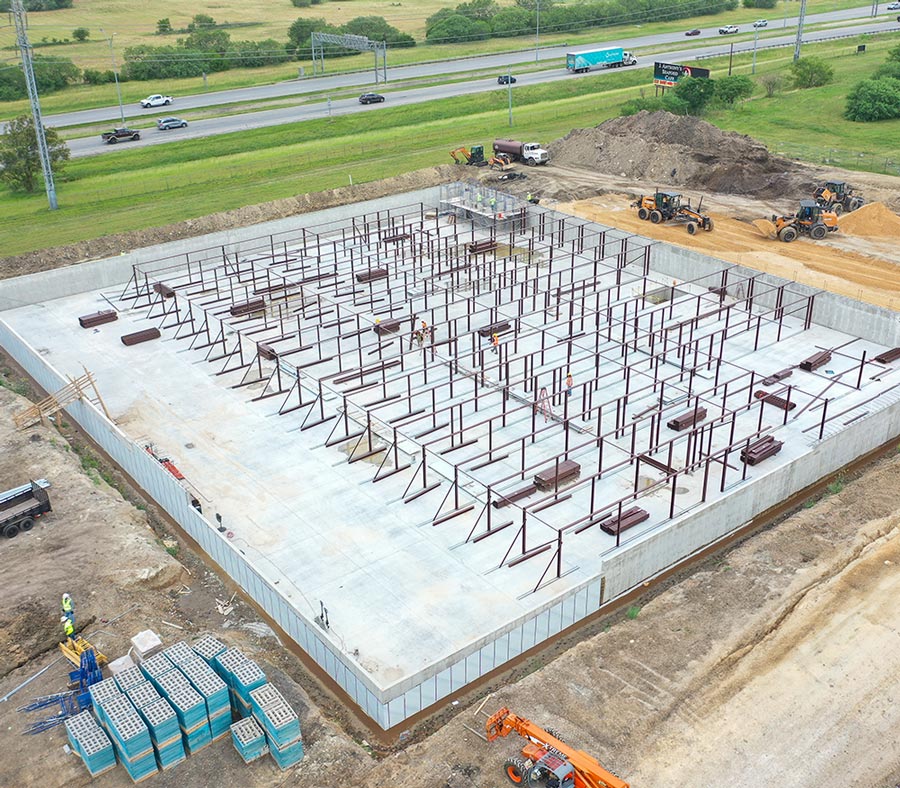


This decking is referred to as a composite deck, which means that it has nodules shaped into the deck, so that when the concrete is poured on top of it, it hooks into the nodules and makes it a complete system. This floor deck, combined with the concrete floor, creates a diaphragm used to resist forces again such as wind, earthquakes, etc.
With the load bearing system, the lowest level will have larger, thicker columns placed more closely together. With each floor that you go up, the columns get lighter and space out further apart. This is due to the combining of weight from above, not only for the framing system itself, but also for the weight that must be supported on the floors. In self-storage, the required weight to be designed for on the floors for live load (things that people place in the unit and store there) is 125 pounds per square foot. This is more than double the weight of support required for a typical office building. To make space for the hallways or corridors, headers are installed from load bearing wall to load bearing wall across this opening. In other words, the load bearing walls stop and start on each side of a corridor. The top floor of the building where the roof is to be installed is normally always framed utilizing the 5-foot-by-10-foot grid framing system described previously. This system is utilized on buildings up to five stories high.
It should be noted that most buildings utilizing this type of system install a standing-seam metal roof. The minimum pitch required for most standing seam roofs is one quarter of an inch of rise for each foot of travel. So, for example, a 30-foot-wide building would be 7.5 inches taller on the high side of the roof compared to the low side of the roof. A screw down type of roof is normally a minimum of one inch of rise for each foot of travel, therefore a 30-foot-wide building would be 30 inches taller on the high side, or 22.5 inches higher than the standing seam roof would require.
Rigid Frame Metal Building
To get a better picture of this type of building, think of an airplane hangar. This type of building has a big rigid frame which serves as the backbone. These rigid frames are typically spaced about every 25 feet apart. Then secondary framing members are attached to these rigid frames and that is what the exterior walls metal sheeting and the roof are attached to. What you create with this building is a large open floor where you install the storage units. While this building is not necessarily any less expensive to construct, the only real advantage is that the storage units could be removed later, and the building could be used for a different purpose. In my 39-plus years of experience constructing these facilities, I have rarely seen this done. In this type of structure, you would be installing what would be akin to a conversion type of storage unit system. These are normally just vertical metal sheeting for the walls with a wire mesh over the top of the units to prevent unit renters from easily gaining access to the adjacent units. However, there are some distinct disadvantages to this type of structure. Most of these buildings are constructed with a screw down type of roof. The buildings are normally large; and due to pitch required for the roof, this typically creates a large void open area up at the ceiling. Most of these buildings are climate controlled because they have indoor units, which means that you are climatizing this large void—heating it in the winter and cooling it in the summer. This can add significant requirements for additional HVAC systems and increase the cost of running them.


Cast in Place Concrete
This system is not widely used in the self-storage industry due to it being more expensive compared to other systems described herein. Where this is sometimes utilized is in taller-than-normal buildings, such as seven-story buildings or higher. The current building code allows for a building of this type to be built up to four stories, after which the entire structure must be fire rated. This is quite expensive and requires other use of a light gauge framing system, which also adds to the cost. To avert this, some building or fire authorities will allow you to pour a concrete pedestal and then utilize light gauge framing for the floors above, up to four stories. So, for example, a six-story building might have a two-story concrete pedestal with four floors of light gauge framing above.
Class a Structural
10-by-10 Grid Framing System
Wood Framing
I hope that this information has been helpful. Happy developing and best wishes for successful projects!