




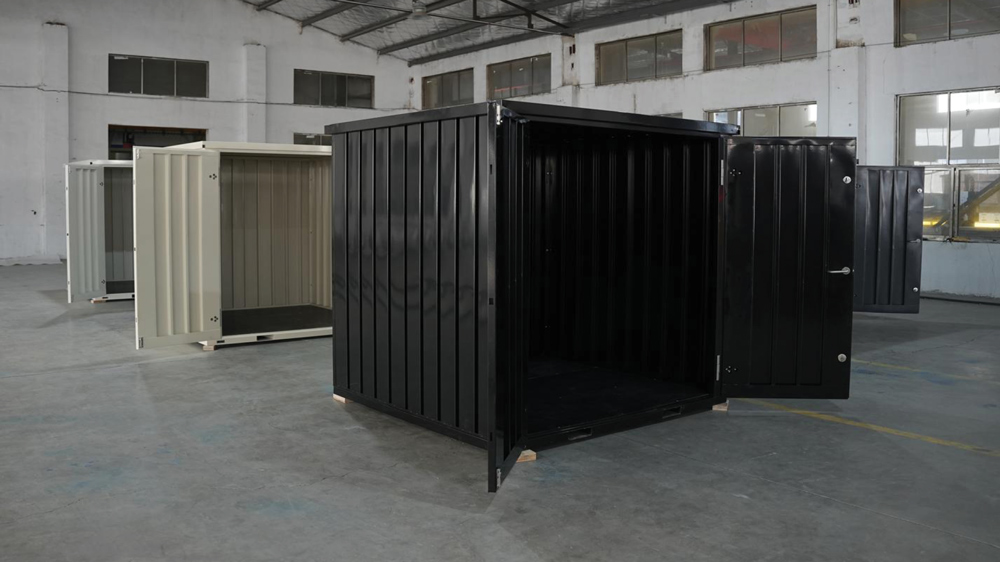
latbox was born out of a desire to be better. CEO Carlos Leal was buying their storage container products from another company for resale, but he was unhappy with them. “I’d find a lot of mistakes or inconsistencies,” recalls Leal. “I became tired of telling them what they needed to fix and how they needed to fix it.” Shortly after, Leal visited the factory and discovered that they weren’t even manufacturing the products—they were purchasing parts from other manufacturers and assembling them. “That’s when I saw the opportunity to do it myself and do it better.”
Leal spoke with his friend in China, and the duo partnered up to create a better Flatbox—one that was their own product. “We started a factory in order to do everything in-house. Then, we just fixed every issue we had with the previous products we were purchasing. We also made the product wider and taller, and painted the interior and exterior using a 20 metal gauge powder coat, whereas others only paint only the exterior with 25 metal gauge.”

That growth has come in many forms, from resellers to individuals needing a backyard shed to businesses that may need extra space for supplies. Now that Leal is making the rounds at self-storage trade shows, Flatbox is making a name for itself in self-storage. “A lot of self-storage facilities have unused space on their property, but they don’t want to build more permanent structures, or they can’t due to permitting issues. Flatbox is an easy way to expand and bring in more revenue,” says Leal.
Of course, permitting may be required for some Flatbox placements, but Leal explains that it’s on a country-by-country or state-by-state basis. “In Florida, for example, if it’s under 220 square feet, you don’t need a permit because it’s considered a shed. But regardless, it’s an easily movable unit that you can place on site one day and then move it later and do something else with it. With some other portables, you’ll need heavy equipment to place it and remove it.”
Many self-storage operators like that Flatbox products can be interlocked. “You can make the spaces wider, longer, and taller,” says Leal. “You aren’t limited to what you can do like you are with other products. Flatbox gives you options!”
Speaking of options, doors can also be placed anywhere on the unit, which is ideal for facilities that may want loading and unloading done on a particular side of the unit based on the space it will occupy. “Everything is customizable,” says Leal. This also includes locks, which can be built into a panel or added later by the operator if they want a specific brand of lock.
Flatbox also offers superior flooring and roofing, says Leal. Floors are made with rubber-wrapped marine board that’s designed to last, while roofs can be styled like a typical container or include gutters to draw water away. Either way, Flatbox puts up a good fight against Mother Nature. “We’re from Puerto Rico, and the weather here is crazy, pouring rain one moment and 100 degrees and sunny the next,” says Leal. “So, if they can power through Puerto Rico weather, they can handle just about anything.”
One last advantage that Leal wants to mention is how efficiently Flatboxes are shipped. The design of them allows for 20 units to be placed inside a 40-foot container. “To my knowledge, that’s more than any other supplier of flat-pack containers. The closest I’ve seen a competitor come is 16, but it’s much less for others.”
With all the customization options, one might think the Flatbox team has their hands full. While that may be true, Leal wouldn’t have it any other way. “It doesn’t matter,” he says matter-of-factly. “We are the factory. We have many options, but we’ll also make whatever the client wants. It’s fully customizable.”
To that end, Leal does say that the company is working to build out its distribution team across the world to handle all the logistics behind the product. This will allow them to continue customizing and creating new products –some of which are already available. Flatbox has already introduced a variety of new products, including kiosks (a Flatbox with a hinged canopy), offices (a literal Flatbox office space with windows), multi-compartment units (a sectioned Flatbox with multiple entry points), and accessories like shelves. “We’re constantly innovating and always improving,” says Leal with a smile.