



n April 1984, the first non-stop commercial flight between the U.S. and Australia took off, making the countries more accessible to one another than ever before. With that, American pop culture exploded with Australian influence. We ate at Outback Steakhouse, drank Foster’s Beer, and teased our locks with Aussie Hairspray. Mad Max and Crocodile Dundee became household names, Rick Springfield and Elle MacPherson adorned bedroom walls, and the sounds of Olivia Newton-John, INXS, and Men At Work’s “Land Down Under” hit the airwaves.
Around that time, while Americans were embracing Australian culture, Dallas Dogger was instead taking a cue from the U.S., which had begun embracing self-storage as a viable business. He may have even been one of those passengers on that first non-stop Qantas flight. “I had already been involved in advertising, marketing, and media,” he says, “but it was around that time that I zeroed in on the self-storage industry.”
In 1994, Dallas moved to Brisbane to start Storage Technology Pty Ltd, serving the growing self-storage industry from the technical side. While there, he worked to develop the Mini Storage Plus, RentPlus, and PTI brands in Australia, helping to internationalize them and turning them into brand leaders.
The millennium ushered in new endeavors. In 2000, Dallas founded Infrasmart Solutions Asia Pacific, taking on Storman from New Zealand with less than 20 customers. He developed the business into StorMan International, a self-storage management platform. “I took this fledgling software brand to market dominance locally in five years, and also my own branded access security product called AccessEzy,” he says. Of course, times were changing, with new tech on the horizon and the internet developing fast. So in 2007, the Centreforce Technology Group was created, which included R6 Digital, a full-service marketing agency specializing in the self-storage industry. The company built some of the first self-storage websites; today it’s Australia’s most awarded supplier of tech solutions for the self-storage industry.


“I’m very proud of what my father accomplished,” Michael says. “He’d always been a tech guy, but the self-storage market was so nascent there wasn’t any tech to use. To fly to America, attend the first ISS Tradeshow, hook up with U.S. software companies and experts … it doesn’t get more entrepreneurial than that.”
Michael expounds on the many relationships his father built over the years. “Because the self-storage market was small in Australia, he took U.S.-based products and internationalized them,” he says, citing PTI Security Systems, MSP, and RentPlus.
Perhaps his father’s biggest challenge was convincing U.S. manufacturers that investing in the Southern Hemisphere market was worthwhile. “Our entire market isn’t even the size of Florida,” says Michael. “But Dad always believed that self-storage would develop into a global market, and the early efforts done in Australia helped the brands he worked with forge a path into the U.K. and Europe.”
The platform was built in 2009, before anyone else had jumped on the bandwagon—and when many still felt no one would book self-storage units through a website. “We tried it out on Dad and Ian’s Capital Self Storage, and the first online move-in happened only an hour after it went live on their website,” says Michael. “It has grown enormously since that first move-in.”
What was the lightbulb moment that inspired RapidStor? “Hotels and airlines already did it, so why not give it a try?” Michael asks with a smile. “I created it to mirror sites like Expedia, which people were already familiar with. A competitor tried to create a similar platform, but it didn’t look like other booking sites at all, and people didn’t get it. So today, RapidStor still resembles other reservation sites. People like what’s familiar to them.”
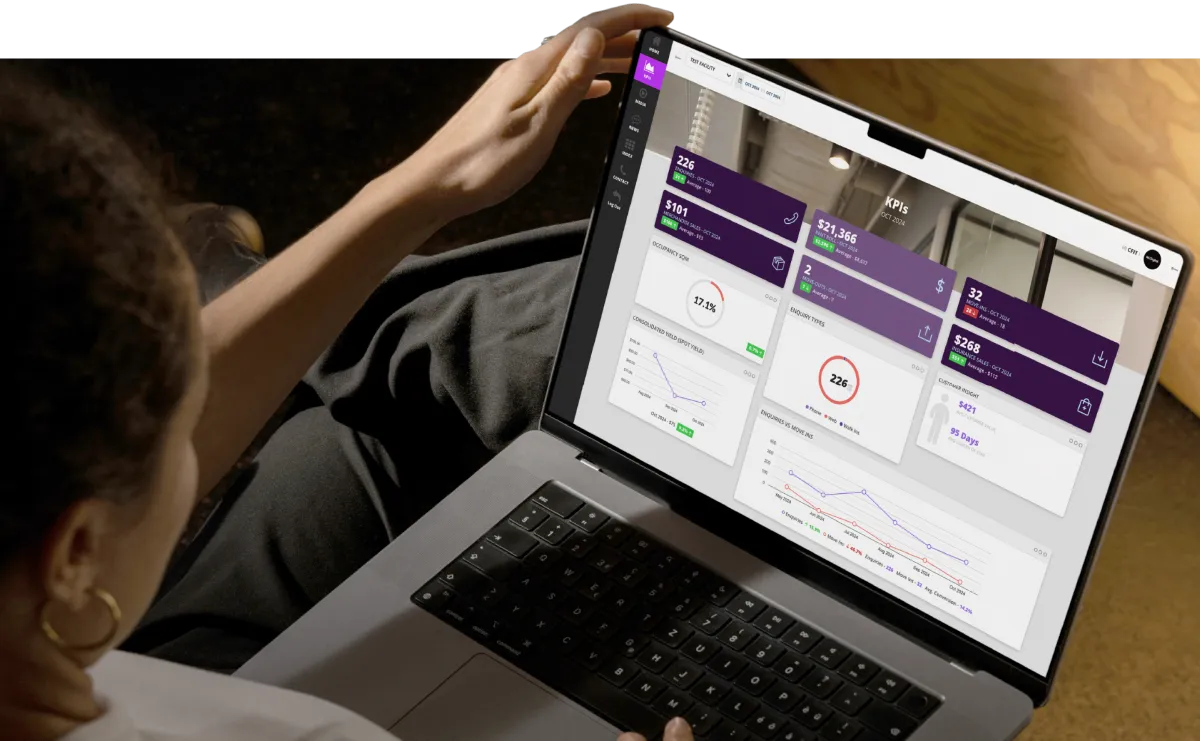
R6 Automate applies to the entire tenant journey. Customers can still use RapidStor to find and book storage spaces 24/7. StorApp further enhances the experience, providing operators with tools to refine offers, onboard new customers, and easily manage existing ones. R6 Automate also integrates with SiteLink Web Edition to streamline notices, billing, and CRM processes and offer advanced reporting dashboards for operators, investor portals for performance tracking, and marketing tools to measure and drive ROI.
“StorApp is one app that works with all self-storage solution providers,” says Michael. “The app integrates with OpenTech and Nokē, for example, replicating the functions of their own app. And it works for providers that don’t have an app, like Sentinel and PTI.”
Michael says that a new guy coming to market with an app like this wouldn’t have had much luck garnering support from the big names they work with. “On the surface, it might look like we are competing with some of the platforms we integrate with,” he says, “but we’ve been around for almost 25 years, so they trust us.”
Continues Michael, “There’s also the fact that an operator with multiple sites may be using different smart products across different facilities, and they don’t want multiple apps, but they won’t pay to retrofit thousands of units, so that one app will work for all of them. So that’s when R6 Automate’s StorApp can really make a difference, because it will integrate with all the providers.”
“Yeah, others would focus on ‘fluffy stuff,’” says Michael. “We were diving into the numbers in self-storage terms.” He adds that today the agency does offer that so-called fluffy stuff, especially since the agency has expanded to serving clients outside the self-storage industry who demand it. “We picked up a number of them during COVID, when other agencies went out of business.”
Michael goes on to say that serving too many industries eventually became confusing, resulting in splitting off the tech products into R6 Automate and leaving R6 Digital with a pure marketing and creative focus. “There were too many things under one umbrella, but until we had a clear value proposition, it didn’t make sense to split. With the development of R6 Automate, it was time.”
Of course, many operators take advantage of both R6 branches. “StoreLocal, for example, uses StorApp as well as our website, branding, and marketing services,” says Michael. “As Stephen said, self-storage is in our DNA, and those in the industry know that’s where our heart is at.”
With a finger in just about every self-storage pie, R6 has some thoughts on what to expect in the year ahead, and having just attended the annual Australasia conference, the team gained even more insights from other industry leaders.
“Our interest rates are very high right now, staffing is difficult because there’s a skills shortage, and inflation in the Oceania countries is the worst it’s been in a long time,” says Stephen Hughes, CMO of R6 Digital. “That means discretionary spending is down, and as a result, there’s been a lull in self-storage rentals.”
Hughes doesn’t want to paint a doom-and-gloom scenario, however. “That’s not to say things aren’t looking up,” he adds. “Interest rates are expected to decrease and inflation is forecasted to go down throughout 2025. So I think we’ll see a rebound in rentals.”
What types of rentals will these be? Hughes says that will be of interest, too. “Customers want a self-service storage experience, not a people experience, so moving to more remotely managed facilities might benefit owners and operators.”
While more facilities in the U.S. are going remote, many American tenants still want to know there’s a manager on site; what makes things different down under? “Self-storage has been around longer in the U.S., so ‘how it’s always been done’ is more entrenched in people’s minds,” says Michael Dogger, CEO of R6 Digital, adding that in Australia, the industry is newer and has always jumped on the latest tech. “There’s not as staunch of a mindset here that needs to be changed. Frankly, we have led the innovation here, developing and adopting industry tech earlier than our U.S. counterparts.”
Michael says the predilection to technology is even more apparent in Asian cities, where self-storage is a lot more novel. He recounts a conversation he had with a Hong Kong storage owner at a recent conference. “I mentioned something about a facility manager, and he looked at me curiously. Then he said, ‘You mean a person on property? What does he do?’ I responded that he oversaw the facility. Again, he just looked at me again like I was crazy and asked, ‘Why?’ I just had to laugh, but it’s something to think about.”