


hile some of the elements of RV and boat storage are facing challenges due to the uncertainty of financial times, there are several new and exciting developments in the recreational vehicle storage industry.
“We run a platform that allows our RecNation storage customers to list their RVs and earn revenue from renting out their recreation vehicles,” says Kait Wojtaszek, director of business development at RecNation RV & Boat Storage. “Very similar to Airbnb, owners can monetize their otherwise depreciating asset that’s just sitting in storage for much of the time throughout the year. Whenever they’re not using it, they can put their RV into our rental program.”
A renter who wants to spend some time with their family out on the road, taking the kids on camping trips or exploring with their partner for a long weekend in nature can access the program to rent quality RVs.
“It’s a win-win for everybody,” says Wojtaszek. “Our customer base can enjoy making revenue from their RV and some other happy renter gets a chance to experience what it’s like to have an RV for the weekend. It’s a really nice side layer of business that we have that remains complementary to what we’re doing.”
“We broker the deal, but our role ends when we put the parties in touch,” says Wojtaszek. “RV owners who store with us either manage it as their own business or we partner in a consignment system. They can either meet the renters, clean the RV before and after, check for damage, and run their own operations, or they can put their RV in as part of our rental fleet.”
For that option, the fleet operator will handle the rental from start to finish as a RecNation trust partner in various metro areas.
“The fleet operator would carry out all the operations and the RV owner would make their cut after the trip is complete, while the fleet operator makes a commission,” says Wojtaszek. “RecNation doesn’t manage the actual RV or the rental.”
This dovetails nicely with another unique service RecNation implemented: on-site cleaning and maintenance.
“The cleaning and the repair business is great for customers who come in and want somewhere convenient to store but prefer to spend their time enjoying the RV rather than maintaining and taking care of it,” says Wojtaszek. “We partner with different vendors across our various locations who offer repair services, who take care of appliances, tires, windows, and your roof, essentially anything that could go wrong in an RV, as well as the cleaning.”
“You can spend more time out there on the road and less time doing the administrative work,” says Wojtaszek. “It’s a concierge level of service at the same location you are storing your RV.”
RecNation partnered with Camping World to offer every customer buying a new RV one free month of storage. This program results in a healthy number of customers who are new to the world of recreation vehicles.
“When it comes to the repair side, there’s a lot of customers who just aren’t familiar with maintenance procedures,” says Wojtaszek. “You have to be pretty handy when you maintain an RV. If you’re not, you need to rely on somebody to go in and fix things. Little things add up, so it’s a great, convenient service for our customers.”
“We’re seeing higher levels of vacancy, and we’re seeing a reduction in street rate and the lack of rent growth,” says Scott Ramser, founder and CEO of Ramser Development Company. “I think the uncertainty surrounding the last year of the Biden administration, plus all of the turmoil of the election and the tariffs, has scared a lot of people.”
Another element to consider is whether the boom of recent years is now creating a natural decline.
“In some instances the consumer is very strong, and in other instances the consumer is weak,” says Ramser. “There could also be a supply glut that is creating the higher vacancy rate, lower street rate, and less rent growth because there’s been a lot of development.
“There were a lot of CofO deals in the RV storage space that ended up not getting sold because interest rates went up. A lot of those CofO deals didn’t get sold, so owners who never wanted to be an operator are panicking and they’re dumping rates, hoping to get occupancy. There’s a lot of distress in the market at this point in time because people are over-leveraged and they’re in positions that they did not expect to be in.”
Families choosing more conservative spending habits directly affect the RV and boat storage industry.
“Other than food and lodging, everything is discretionary,” says Ramser. “In a down economy, consumers start taking the lower-importance discretionary pieces out of their discretionary income budget. One of the most important things to do to protect yourself would be to be at a low leverage. If you’re at low leverage, you can weather the storm. If you’re at high leverage or you have debt that’s coming due, you’re going to be in distress.”
Quick fixes done the wrong way can create more problems. Some existing self-storage facilities feel like they can add on an RV and boat component to make some quick cash. However, this might not be the best time to make well-intentioned gambles.
“It’s a lot more difficult to just add on RV storage than people think,” says Ramser. “If you are thinking you have an excess three acres of land from your second phase of self-storage which didn’t happen, and now all you have to do is put up a fence and put down some gravel and rent it for RV storage, that’s not how it works.”
Grading, pavement, security, secured access, lighting, amenities, and ground water management concerns are serious aspects that must be addressed.
“The whole concept of ‘I’ll just take this extra two acres and fence it and start renting RV spots,’ that maybe happened 25 years ago, but it’s not very realistic,” says Ramser. “The current trend we most often see in California and Central Florida markets is the larger self-storage entities purchasing properties that have existing RV and boat storage components to immediately kick out all the RVs and build vertical for additional self-storage. This, ‘If you build it, they will come,’ is not happening anymore.”
Although the scene has changed, that doesn’t mean a downturn will be a lasting trend.
“There are still lots of people who want to use recreation vehicles to go out and have fun,” says Ramser. “There’s a lot of young families in the United States who will continue to buy boats and RVs. The overwhelming majority of those people are going to need to store them somewhere other than their house. The market can be strong again, but we’re definitely going through an oversupply situation combined with a little bit of consumer weakness at the moment, which is stifling the new vehicle sale market. It’s just a little bit of a slow situation right now.”
Industry data concurs.
“The core customer is a do-it-yourselfer,” says Whitney Jurjevich, owner of Ameripark Covered Storage and Covered RV & Boat Storage. “We’re seeing data right now that shows RV sales are going up in terms of number of units, however the total size and price tag is going down. The dollar amount isn’t coming back.”
A change in demographics of owners also changes the landscape for RV and boat storage.
“What was selling years ago were huge toy haulers, nice big coaches,” says Jurjevich. “Now we’re seeing inexpensive and smaller ball-hitch, tow-behind trailers that are inexpensive. Frankly, those are probably what people should have bought in the first place because they don’t use them enough to justify the big buys. But everybody was doing so well, they spent extra, they spent more. It’s the way economies work. Now people are back to sensible spending. I do want a travel trailer and I can afford a travel trailer, but I can afford a 32-foot, ball-hitch tow behind, not a 42-foot fifth wheel and a brand new $80,000 F250 to pull it.”
The key might be meeting the current level of demand where it is.
“Some of this we did do to ourselves because of the commoditization of the self-storage industry,” says Jurjevich. “So much institutional capital has flooded the industry. There’s just been a spectacular overbuilding and oversupply in so many of these markets, so we have to take a little responsibility for some of this ourselves.”
Taking advantage of data analysis and the latest in tech can help owners and investors weather the storm and make the most of the current market. This can be more productive than trying to upsell with promotions offering high-priced amenities.
“In a down market, where people are concerned and they have less money, the only promotion that gets them in the door is price,” says Ramser. “We use revenue management software. We use Hummingbird for our tenant management, which is very adequate. We also do monthly comp studies where we actually call or visit our competitive sites and get pricing from them, so we understand what’s happening in the market.”
“When you see pictures of Red Rock Storage, something will stand out,” says Jonathan “Jon” Erickson, president of Red Rock Mega Storage, LLC. “You’ll see artistic metal work, you’ll see stonework, things that you typically wouldn’t expect to see on a storage facility.
RV and boat storage often faces an uphill battle with communities who view it as an unattractive addition with little tax money and cash flowing into the town.
“When you go into a community where they don’t want any development at all, and then they see not just a plain steel building going up but one with artwork celebrating the region—a giant 30-foot-by-50-foot American flag made of patina steel, three giant bighorn sheep famous in Reno, the two part outline of the Red Rock mountainscape, planter boxes, and a large metal bristlecone pine tree [Nevada’s state tree]—the attitude changes.”
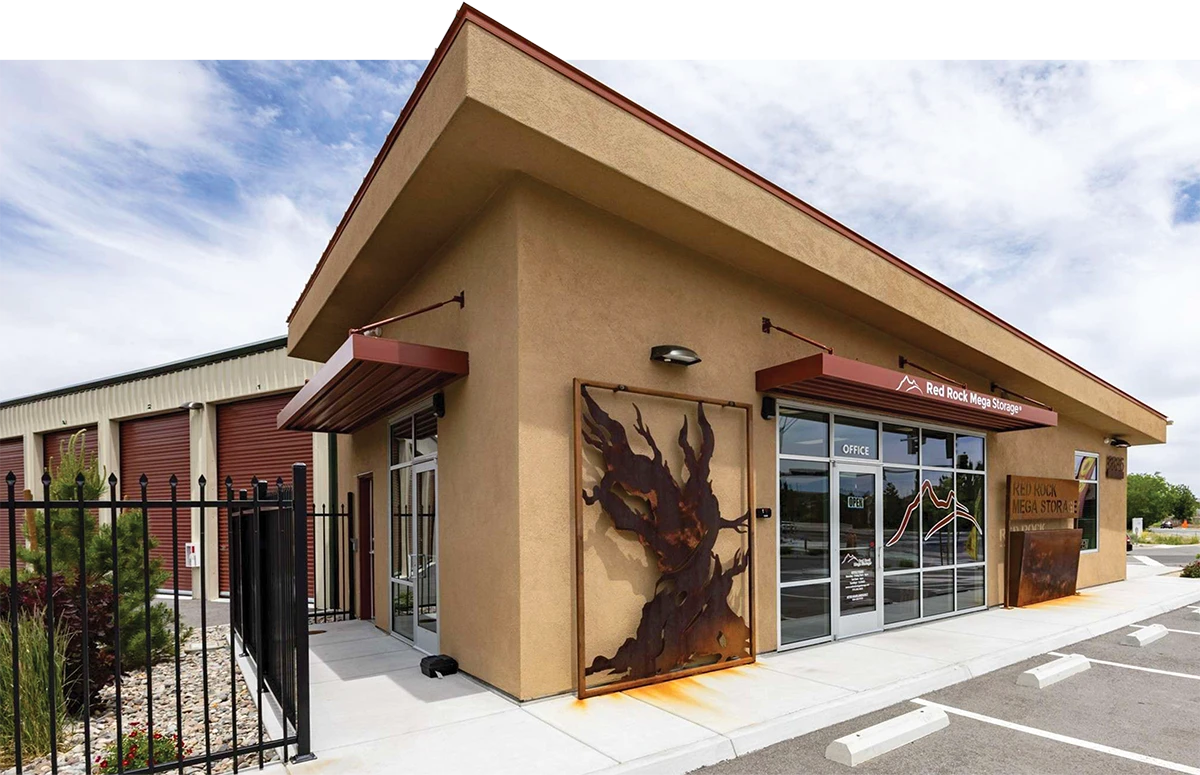
“When you come onto the property, you don’t feel like you’re in a storage facility because there are so many things that are appealing,” says Erickson. “People would argue that it’s a waste of money. My argument back is it is advertising because people are talking about it. If this is the nicest facility that they have seen, it makes a bold statement about the quality of where they store RVs, boats, the things they value.”
Erickson credits such attention to detail of the facility’s environment for helping to attract quality, higher-paying customers.
“Red Rock’s demographic is premium, oversized, climate-controlled and enclosed units,” says Erickson. “That’s my customer. One customer has five enclosed units, with one wooden boat in each. No debris, no boxes, no bikes, or clothing—just five units with beautiful wooden boats. He’s a retired fisherman and his hobby is rebuilding wooden boats. When he completes one, he puts it in storage. His wife came in once. Instead of having an issue with her husband paying $2,500 a month on storage, she says, ‘If I could only get him to get two more boats into storage, I could have my garage back.’ You just don’t know who your customers are going to be until you get out there and meet them.”
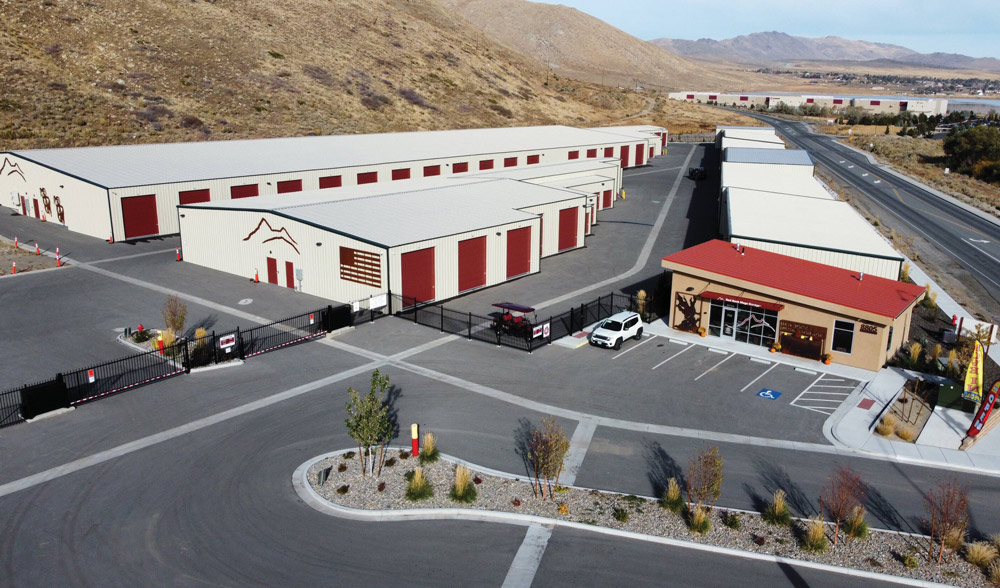
“The bristlecone pine is the tree of Nevada, but it is also the oldest living tree on the planet,” says Erickson. “They say the oldest is almost 5,000 years old. It’s incredible when you think how that tree made it through every ounce of change and floods and transitions and communities come through, and somehow the tree survived in that one location through it all. I have a big bristlecone pine, cut out of metal, against the office exterior, greeting every customer.”