



portfolio can look manageable on a map and still be unmanageable on a Tuesday morning.
That is the blind spot in many discussions about self-storage management style. The decision is often framed around facility count: One manager can cover three sites, five sites, perhaps more if the technology stack is strong. But doors do not create the daily operating burden, exceptions do. A gate that will not close, an access complaint tied to the wrong tenant record, a promised callback without an owner, and a delinquency workflow that stopped midway all compete for the same limited resource: verified managerial attention.
The better question is not, “How many facilities can one person manage?” but rather, “How much unresolved work can the operating model safely absorb before important signals lose ownership?”
An oversight load test helps answer that question. It is a practical method for selecting among on-site, hybrid, and remote management based on the character of the work, not a universal staffing ratio. The method does not predict injuries, losses, or financial performance. It makes the conditions that consume attention visible before an operator expands a manager’s span of responsibility.
Both have five facilities. Only one may be suitable for centralized remote management.
Technology can reduce repetitive work, but it can also move work out of sight. An automated notice may send successfully while the account remains unresolved. A work order may show “complete” while the physical condition has not been independently read back. A dashboard may display 10 normal sites and one red exception, yet the red exception may require three phone calls, a local dispatch, a customer update, and a second inspection.
That is why the unit of management capacity should be the open operational obligation. An obligation remains open until the required action, evidence, and communication are complete, not merely until a task changes status.
This emphasis is consistent with established control principles. The U.S. Government Accountability Office’s 2025 Green Book treats internal control as a management process for effective operations, reliable reporting, and compliance. OSHA’s recommended safety practices call for defined responsibilities, proactive hazard control, and evaluation of whether controls remain effective. Ready.gov places communications, recovery, and continuity planning inside business preparedness. NIST’s Cybersecurity Framework 2.0 separates governance, detection, response, and recovery rather than treating an alert as the end of the work. None of those sources sets a staffing ratio for self-storage. Together, they support a useful operating premise: responsibility, observation, action, and verification should remain connected.
- Open exceptions by consequence – Count unresolved safety, security, access, customer, maintenance, payment, and data-quality exceptions. Separate routine issues from those that could cause harm, lock out a customer, or leave a facility unable to operate normally.
- Time sensitivity – Identify which facts or conditions become less reliable with age. A gate photo from yesterday, a unit-status readback from last week, and a current customer access problem should not share the same clock.
- Verification effort – Record what is required to prove the result: system receipt, camera review, local inspection, customer confirmation, vendor documentation, or a second-person check.
- Commitment load – List promises that the operation has made to customers, vendors, and employees, including the owner and due time. An unanswered promise is operational work, even when no alarm is flashing.
- Recovery dependency – Note whether closure depends on local labor, a vendor, another platform, a credential holder, or a physical part. A remote manager cannot directly complete work that requires hands on site.
- Interrupt density – Measure how often the manager must abandon planned work to handle new events. A manageable queue can become unsafe when interruptions prevent deliberate follow-through.
The card should be reviewed at a defined cadence and whenever the portfolio changes materially. A new acquisition, access-system conversion, staffing loss, severe-weather event, or vendor outage can alter the load without changing the facility count.
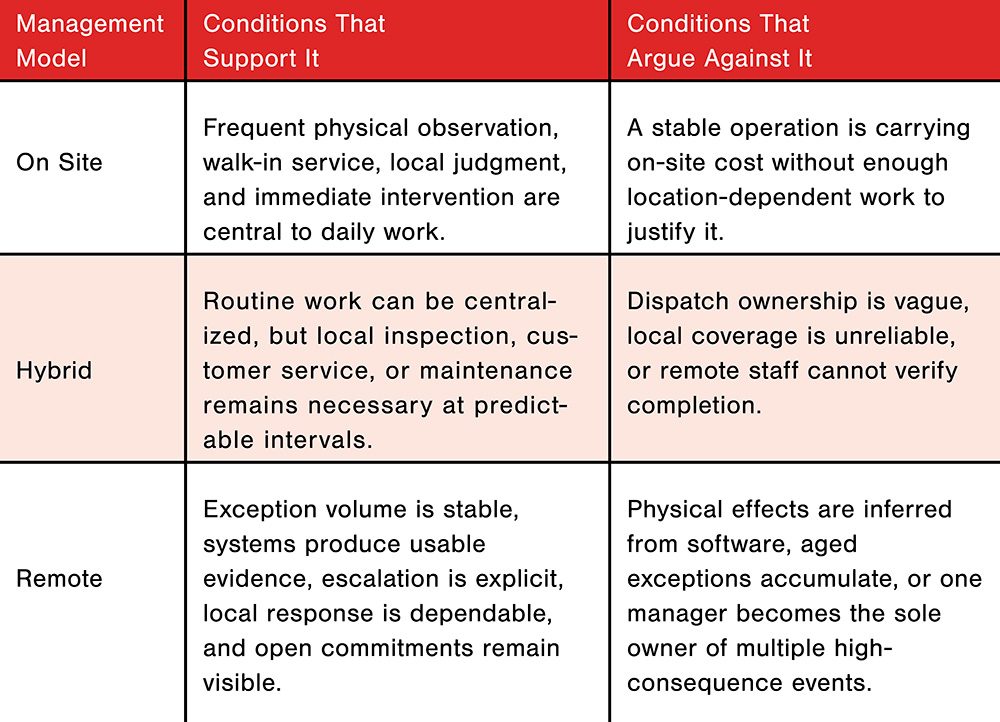
The test can also reveal that the current model is correct but the span is too broad. In that case, the answer may be to reduce the number of obligations carried by one manager, not to replace the model.
The raw count is 18. The oversight load card tells a different story.
The gate failure is high-consequence, time-sensitive, and dependent on local inspection. The access complaint requires a current account readback and customer confirmation. The refund is not technically complex, but it is a live commitment with a deadline. The maintenance tickets are controllable if vendor appointments and follow-up evidence are visible. The document corrections are routine unless they begin to age.
The immediate issue is not that eight sites are too many. It is that three different types of work require near-term attention and two require evidence the remote manager cannot create alone. If local inspection is dependable and the gate event has a named incident owner, the remote model may remain appropriate. If the manager must personally locate a vendor, reconstruct the transfer, and remember the refund while new interruptions arrive, the model has exceeded its safe oversight capacity for that period.
The responsible response is temporary and specific: assign local verification, place the customer commitments on a visible clock, defer noncritical planned work, and review whether the portfolio needs hybrid coverage until the load returns to normal. The operator should not turn this fictional example into an industry threshold. Its value is in showing why a small number of consequential obligations can matter more than a large number of routine tasks.
- No high-consequence exception may remain without a named owner and next action;
- A physical or access change is not closed until the required readback exists;
- Customer promises must have an owner, due time, and completion record;
- Local response dependencies must have a tested primary and backup route;
- One manager should not remain the sole coordinator for simultaneous high-consequence incidents; and
- Recurring aged work should trigger a capacity or process review, not repeated deadline extensions.
Those red lines are internal management choices. They should reflect the operator’s actual policies, legal obligations, insurance requirements, and risk tolerance. The important point is to establish them before a busy week tests the system.
The strongest model is therefore not the one with the fewest people or the most software. It is the one that keeps consequential work visible and owned while preserving enough capacity for the next interruption.
Counting facilities is easy. Governing obligations is harder—and far more useful. Before expanding a manager’s portfolio, run the oversight load test. If the organization cannot name the open obligations, their owners, their clocks, and the evidence required to close them, the next facility is not the only risk. The current management model is already asking attention to cover what the operating system cannot yet prove.