



e’ve been making the case that the most important D in self-storage may be the one that comes first: disposition. While death, divorce, downsizing, and displacement create the need for space, our reluctance to let go is what fills it. For three installments, we’ve taken you on a journey of the mind, provided real-world examples, and offered concrete data. Now, it’s time to make some money.

For those who’ve lost a loved one, operators may consider partnering with estate sale companies and professional organizers, promoting estate transition packages, or offering an introductory period that accommodates families clearing a home. Highlighting climate-controlled larger units for whole-house cleanouts can also benefit tenants and operators alike. Larger units not only give people more space to easily navigate the many items left behind when it’s time to sort through them, but they also tend to create long-term tenants.
“Someone renting a 5-by-5 unit may be able to pack it up and move relatively easily, whereas relocating the contents of a full 10-by-30 unit requires considerably more time and effort,” says Dr. Ahmet Kuyumcu, founder of Prorize, an AI-powered revenue management platform. “Variables such as unit type and size, payment method, and the customer’s proximity to the facility can help explain behavior and length-of-stay patterns. However, pricing decisions should be driven by market conditions, demand forecasts, and aggregate customer behavior—not by an individual customer’s personal circumstances.”
Kuyumcu adds that operators may consider offering customers a discounted rate in exchange for a minimum-length-of-stay commitment—something people handling an estate may be very open to. “Although this pricing structure is not yet widely used, some operators in certain countries and markets have offered it as an optional arrangement. It can give customers greater price predictability while helping operators forecast occupancy and length of stay.”
This type of arrangement could be especially appealing, for example, if the children handling the estate live in New York and their parent(s) lived in Miami. In these situations, remote account management will be a priority, so operators should offer autopay, provide digital access to documents, and clearly communicate rent increases, security issues, and pest control measures via email or text if they’ve opted in.

Separating couples may be attracted to flexible leases that allow for easy unit-size changes. As they begin going through belongings and deciding who gets what, items may gradually leave the unit, potentially necessitating consecutive moves from larger to smaller units. Making those transfers painless can keep the customer at the facility rather than giving them a reason to shop elsewhere.
Security and accountability may also matter more than usual. The ability to provide separate access codes to the same unit, for example, could create a record of which partner entered the property if/when a dispute over belongings arises, without the manager having to play referee.
Technology can help couples manage another problem: figuring out exactly what’s in storage. SecureInventory by SecureLease, powered by InstaBoxx, is an AI-assisted tool that allows renters to create a digital inventory of items they place in storage simply by photographing the contents of a box. The app categorizes those items with photos, descriptions, and estimated values. When something is added or removed, the inventory updates accordingly. “This adds another layer of value to the unit,” says Stacie Maxwell, vice president of growth and innovation at On The Move. “Inventory has always been the tenant’s responsibility—or more accurately, their problem. Tools like this provide a solution in a way that benefits both sides.”

These tenants are storing the portion of their old home that doesn’t fit into the new one for the foreseeable future. The storage unit becomes an extension of their home, so they’re likely looking for services and items that help manage belongings over an extended period. Shelving, storage bins, protective covers, and other organization products will be more appealing to someone planning to visit a unit repeatedly for years than to someone storing belongings for a few months.
A downsizer who intends to regularly access seasonal decorations, clothing, furniture, or hobby equipment also likely won’t pack a unit as tightly as possible. Suggesting a larger unit with shelving and an aisle may be more useful, and more profitable, than the smallest unit capable of containing everything.

A customer dealing with an eviction, job relocation, deployment, disaster, or other sudden disruption may go from having no need for storage to needing it within hours. To attract them, online renting should be seamless, unit availability should be current, pricing should be clear, and electronic leases should be easy to complete via phone.
Customers should also be able to determine what size they need without driving to the facility with a tape measure. Size guides help, but an AI-powered platform like Self-Storage.ai may be even more beneficial. The company’s SpaceStacker allows customers to add 3D representations of their own items to units of different sizes to visualize how they’ll fit. “The user experience is better, website engagement and SEO are improved, and clients see more conversions and fewer dropouts,” says Nylan Raufaste, co-founder of Self-Storage.ai.
Pickup services, moving or military partnerships, and truck rentals can also remove friction for people facing permanent or temporary displacement. For those who have recently experienced a disaster, an introductory offer can help get them in the door, provided the promotion and subsequent rate are communicated transparently. Following a catastrophe, participating U-Haul facilities will offer 30 days of free storage and U-Boxes when available. “When people are in a jam, our heart goes out to them,” says CEO Joe Shoen. “We don’t want their money. We’ve got the space, so we let them have it. And who knows, maybe they’ll remember us some day down the road when they need a moving truck or storage.”

- Preserve Your Memories.
- Protect What Matters.
- Safekeeping Till You Decide What You’re Keeping.
- Make Space For New Memories.
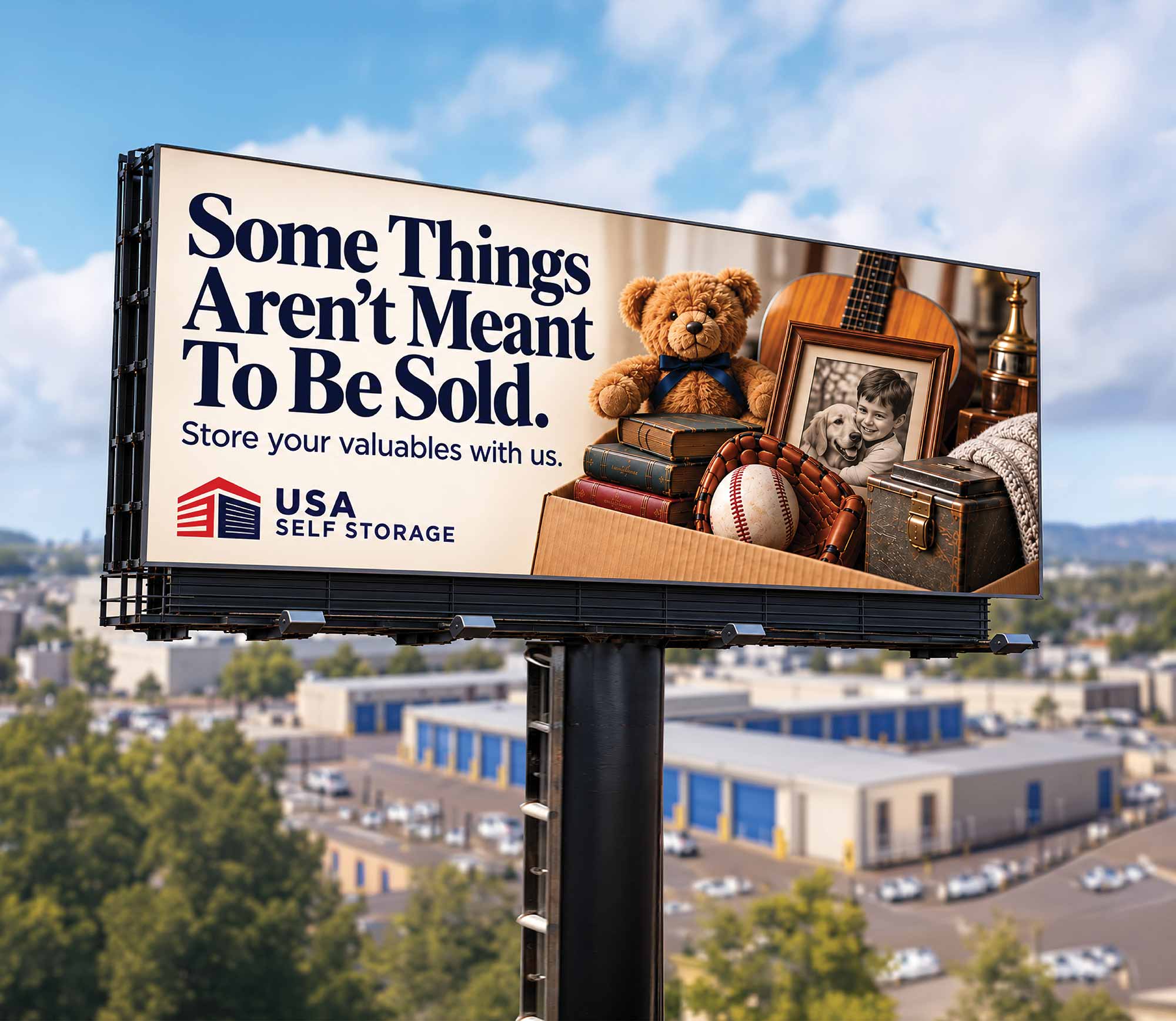
- Some Things Aren’t Meant To Be Sold.
Here’s another consideration: While someone searching online for “storage units near me” has already decided storage is the solution, what about the person searching for “what to do with a parent’s belongings,” “how to store family heirlooms,” or “what to keep when downsizing”? Content, landing pages, and paid-search campaigns built around those questions could introduce storage as a possible solution earlier in the process. An estate storage page might explain climate-control and larger-unit options, while downsizing content could discuss long-term storage and organization. Disaster-related messaging could emphasize immediate availability and fast online rentals, whereas divorce-related messaging could focus on privacy, security, flexibility, and access control. Instead of waiting for customers to search for storage, operators can meet them while they’re still deciding what to do with their stuff.
The same principles can apply to the sales process. When someone calls and says, “I need storage,” the natural response is to ask how much stuff they have to store. Understanding disposition can raise a useful question: Why? The answer can tell the manager whether the customer needs climate control, frequent access, a larger unit with room to navigate, moving assistance, packing supplies, digital inventory tools, or another product or service.
For operators, understanding that instinct turns disposition from a theory into an opportunity. It can determine the ways they market, what they offer, and how they sell. Because when possessions become part of who we are, making room for what matters creates value for both customers and operators.
Brad Hadfield is MSM’s lead writer and web manager.