


StorageCafe survey of more than 1,400 Americans found that lack of space—not moving—is now the leading reason people rent a unit. More than one in three respondents said clutter at home regularly overwhelms them. About one in four Americans currently uses self-storage, while another one in four is actively searching for a unit online.
Demand is strongest among people living in mid-size homes: 37 percent use self-storage, compared with 22 percent of those in smaller homes. Four in five renters visit their unit at least monthly, suggesting that storage units function as an extension of the home rather than simply a place to keep forgotten belongings.
Gen X leads all generations in current use at 35 percent, while Gen Z has the lowest rate (13 percent) but the highest future intent: Nearly one in three non-users plan to rent a unit. Hybrid workers also lead all work arrangements in current use at 34 percent, as their homes serve simultaneously as offices, living spaces, and storage areas. Meanwhile, self-storage searches across the 150 largest U.S. cities rose 23 percent year over year in 2025, nearly triple the 8 percent growth recorded in 2024.
In this housing context, a household may need another bedroom, a dedicated office, more room for children, or somewhere to put years of accumulated belongings. Moving could solve the problem, but higher home prices, mortgage rates, and transaction costs make an upgrade difficult.
A storage unit offers a pointed solution: While it does not add living space, it can relieve pressure inside the home without forcing the household into an unaffordable property.
The issue is not even confined to smaller places. In fact, the survey shows that 37 percent of people living in mid-size homes use self-storage, compared with 22 percent of those living in smaller homes. Therefore, more space does not eliminate storage demand; it may even make households more open to buying new belongings, supporting additional family members, or taking on new responsibilities.
Plus, homeowners are already more likely than renters to use self-storage, at 29 percent compared with 21 percent. They also have stronger future intent. Thirty-six percent of homeowners plan to use self-storage, compared with 15 percent of renters.
The two groups face different pressures. Renters are more likely to focus on the immediate cost of a unit. Homeowners are more likely to be managing long-term accumulation and the limits of a property they cannot, or do not want to, replace.
Four in five current users visit their units at least once a month, while 28 percent visit weekly. These customers are using their units as parts of their day-to-day lives, rather than a place you leave and forget your belongings for months on end.
Four-person households are the most frequent visitors, with 52 percent making weekly trips. Renters visit more often than homeowners, too. The survey found that 36 percent of renters visit weekly, compared with 25 percent of homeowners.
The stored items help explain these frequent visits: seasonal belongings, clothing, furniture, sporting equipment, and household overflow rotate between the home and the facility as needs change throughout the year. To operators, this means that customers who visit once a year have different expectations from those who use a facility as an additional room. Access, location, security, hours, and ease of entry become more important when storage is part of ordinary household life.
Remote and hybrid work have continued to intensify the pressure on residential space, too. Hybrid workers have the highest current self-storage use among work arrangements at 34 percent. Their homes may need to serve as offices, living areas, and storage spaces at the same time.
See Storage Use by Work Setup chart.
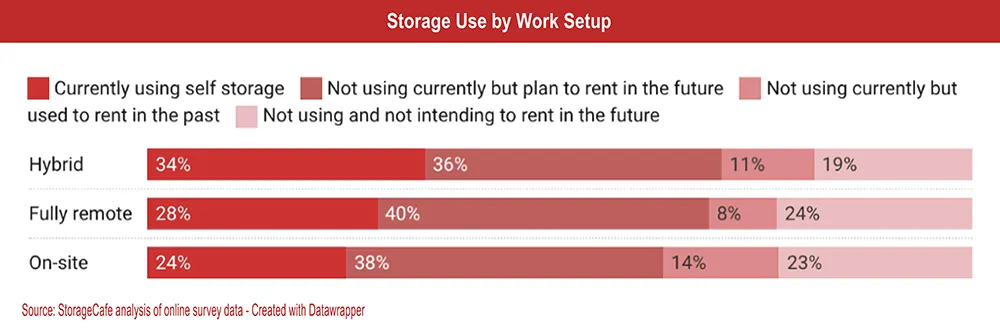
Therefore, while hybrid workers have already crossed into active use, fully remote workers may represent a future source of demand as permanent home offices continue to compete with household space.
This demographic data hints at the space pressures facing households that support children, adult children, and aging parents, since more people under one roof means more belongings competing for the same closets, rooms, garages, and spare corners.
See Self-Storage Across Generations (Present) chart.
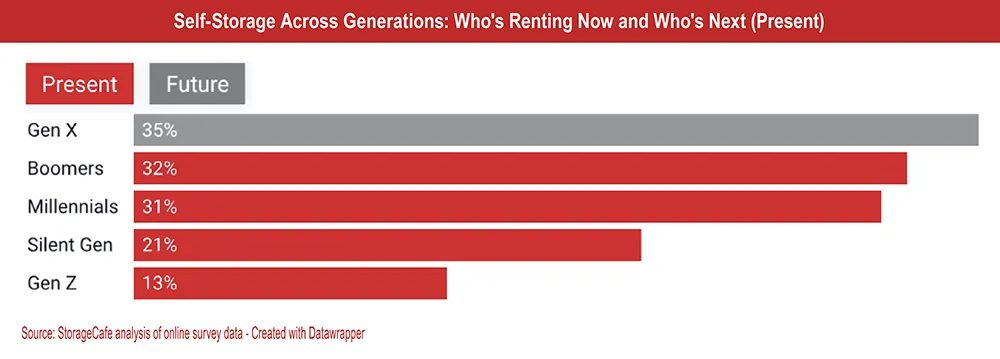
The demand is consistent with households managing belongings across multiple generations: One home may contain children’s furniture, aging parents’ possessions, seasonal equipment, and the accumulated contents of a household that has not yet reached a stable configuration.
See Self-Storage Across Generations (Future) chart.
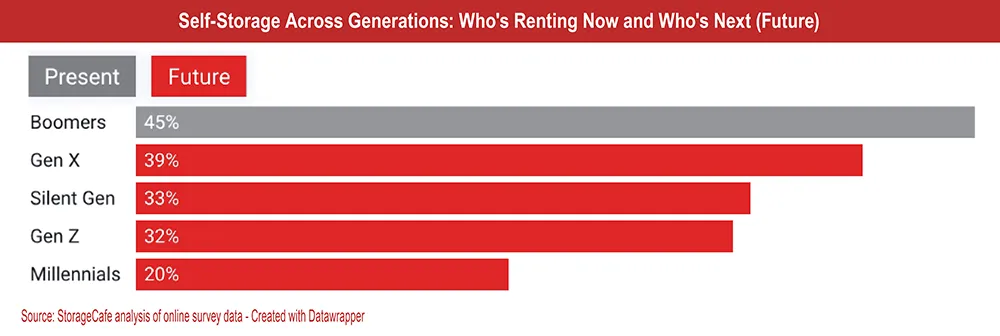
Gen Z is also the most space-starved and clutter-overwhelmed generation. Its future intent is more than double its current use, which suggests that storage is already part of how many younger adults think about housing, even before they become customers.
For this younger group, homeownership competes with rent, student debt, and everyday expenses. Many young adults are building full lives in smaller apartments while waiting for a more affordable opportunity to buy. A storage unit can help manage the interim: It can hold belongings between moves, support a smaller apartment, or accommodate items that do not fit in a first home.
Clothing ranks second, at 15 percent, and is especially prominent among residents of studios and one-bedroom residences, where 21 percent identify clothing as a stored category, compared with 7 percent of residents in four-bedroom homes. For smaller households, the unit can function as an overflow wardrobe.
See What Americans Demand From Their Storage Facility chart.
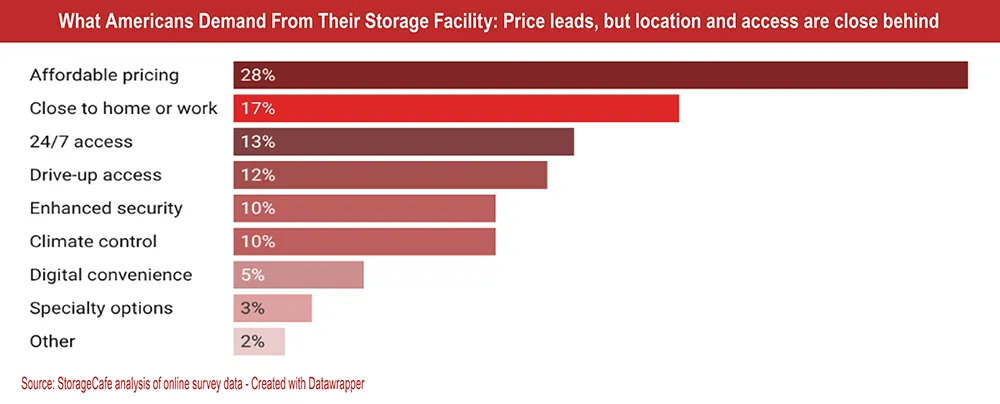
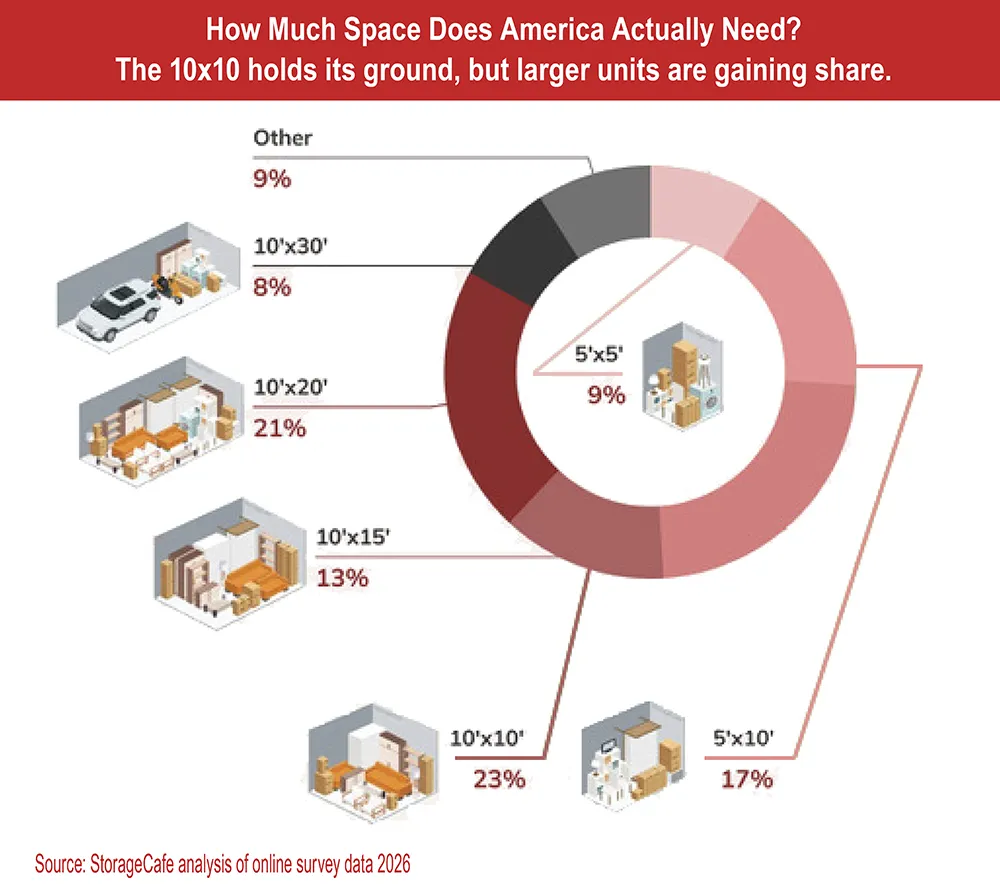
Homeowners are using storage to remain in homes that no longer provide enough room. Renters are using it to manage smaller apartments and frequent moves. Gen X is storing belongings associated with multigenerational households, while Gen Z is preparing for a housing market in which additional space may remain difficult to afford.
Hybrid work is increasing pressure inside the home. Clutter is making the shortage more visible. Rising search activity shows that consumers are actively looking for solutions.
The broader shift is clear. Self-storage is becoming part of how Americans make existing housing work.
As moving becomes more expensive and homes become less spacious, the storage unit is no longer only a temporary holding place. For a growing share of households, it is the additional room they cannot afford to build or buy.