


“Storage has been around since Noah’s Ark,” he said. “It was so simple, but no one really thought of it as a business. Then someone put lockers together and started a new industry that spread all over the world.”
“In the U.S., they’re good at coming together and exchanging ideas, learning from each other,” he explained. Kormos learned a lot from Russell and Victor and became convinced self-storage was a good idea. He returned home intent on rolling out self-storage in Canada.
Even in those early days, Kormos was always impressed by the innovation in self-storage. For instance, one of the first self-storage businesses he saw was on a leased field in Texas. It had Sears & Roebuck metal utility sheds on it. When a customer needed storage, they paid three months in advance, and the owner went to Sears to buy a new shed. He financed the purchases on a charge card. There were no employees and no property taxes on the leased land. “That’s very innovative,” said Kormos.
Without any precedents in Canada, Kormos came up with his own innovative solution: He took a job as a mortgage broker for a couple of years to look for financing for self-storage. Eventually, he found the first institution to lend money for self-storage in Canada—for his project. It took two years!
Then there was the building code. Self-storage buildings in those days were very simple. Canadian building code was quite complex, making it very expensive to build self-storage.
Breaking down that hurdle started when Public Storage came into Ontario in 1979. It turned out to be an effort that took more than a few years, but eventually the National Building Code for Ontario was revised. The process of getting permits and designing self-storage was simplified, and the cost to build self-storage was reduced by 20 to 30 percent.

Shortly before Kormos first learned about self-storage, Russell and Victor helped start the United States’ Self Storage Association in 1975. It had eight districts. A few years later, hetold them that Canada needed an association, so they made Canada District 9, with Kormos as its director.
As the industry grew and bigger businesses like Public Storage moved in, Canada formed its own association.
Kormos’ earliest efforts to create a Canadian association were met with resistance. Most self-storage owners were small businesses. “Membership was $300, and they wouldn’t join if I gave them $300. The timing wasn’t right.”
He didn’t give up. Kormos was actively providing feasibility studies all over Canada. “I learned a lot, but we needed an association,” he said. Kormos talked to three other owners, who caught the vision, and their combined efforts met with success. “Timing was just right, members joined, we became very professional, and we were able to get the law (the National Building Code) changed for the whole country—that was accomplished by the association,” according to Kormos.
“Starting up an association with clout is what I’m most proud of,” said Kormos. “We pulled everything together under one roof. We helped each other. If a small business had a problem, we helped them. If a big one had a problem, we helped them too. It operated very professionally. We achieved a lot through the association.”
Instead of narrow buildings “with a fence and guard dogs,” we have superior security features such as cameras and individual door alarms. “We used to be on the outskirts of town. Now our self-storage is in town, and it looks better than commercial buildings and hotels!”
Over the years, one innovation Kormos is especially pleased with is tenant insurance. “It took me 15 years to find a way to insure everyone. I always wanted tenant insurance, from day one.” He explains that facility owners do as much as they can to keep people’s stored goods safe, and no one wants any customer to suffer a catastrophic loss while using self-storage. “We can only protect tenants so far. They have to do something too, and that’s where tenant insurance comes in. We make it available. This is a good customer service.”
Kormos also talks about the changing nature of what people store, and how the industry has to keep up with that too. “We knew storing fire arms and explosives was a fire risk, and we excluded them in our lease. Now we have learned that lithium batteries are a fire hazard too, and they are also excluded. If someone stores their eBike, they have to take the battery out.”
From its early beginnings as tin sheds, Kormos has watched self-storage evolve to offer comprehensive services to people. “People really caught on to the idea. It takes a lot of courage, and money. They offer a range of services, including moving trucks, closet storage equipment for home, shredding service, even mobile pods and vaults with safe deposit boxes at some facilities.”
Kormos also believes in making it easy for people to do business with you. For instance, “People don’t know exactly when they are moving. Let them move out any time without notice. We also refund any unused rent.”
Another aspect of innovation he sees is in the professionalism of vendors, which has grown over the years. “Now we have more professional vendors—architects, security providers, contractors—upgrading all the time. Everything is evolving in the right direction.”
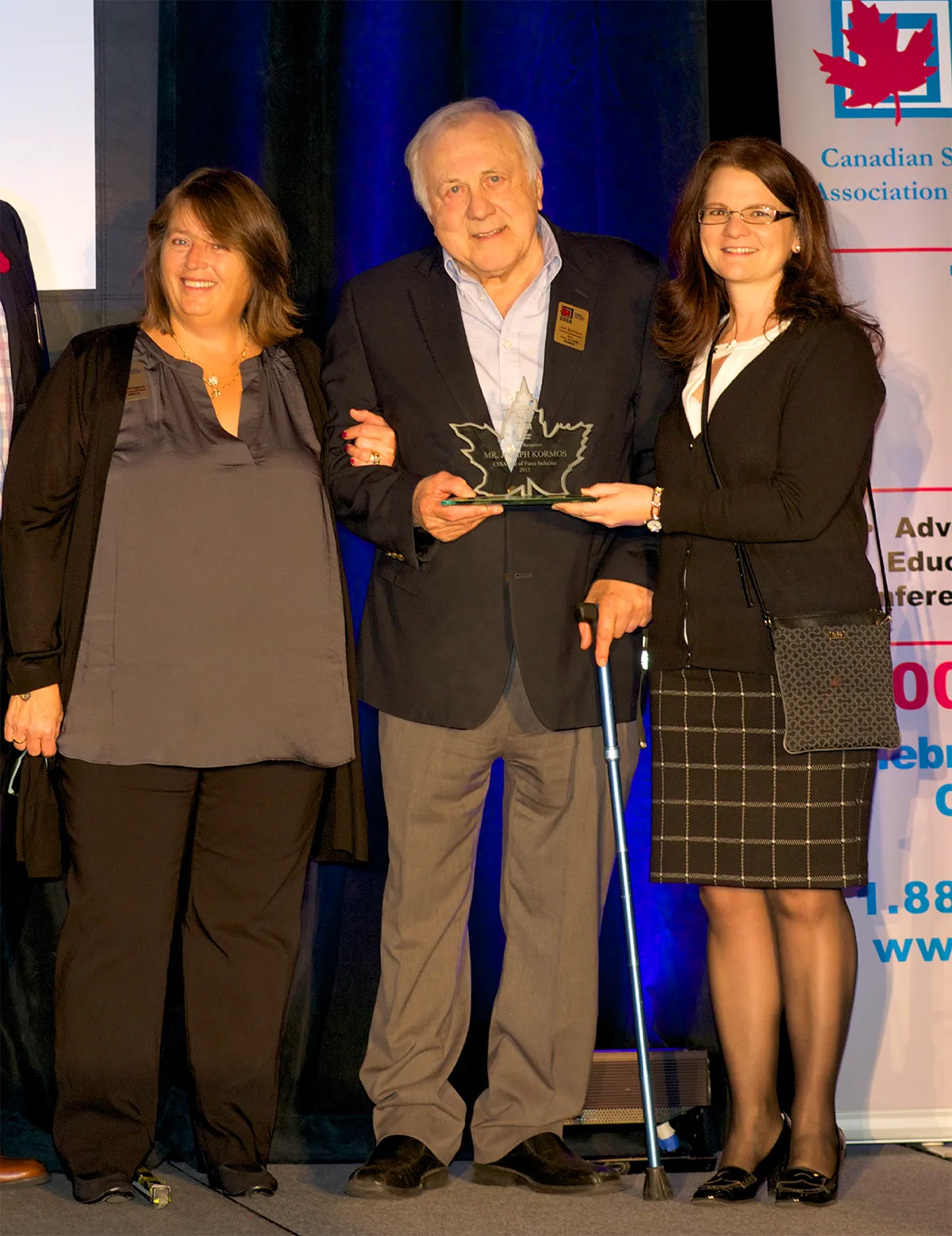
Self-storage helps businesses as well, such as “people starting up in business and other businesses that only need small amounts of storage.”
He said, “It’s a high-revenue business, so facilities should participate in charitable activities. This is a trend I’m seeing: Our industry getting more and more involved with the public as we grow and evolve.”
With his big tent thinking, he says, “This business is good enough for everyone to walk away smiling.” Anytime you talk to Kormos, you will walk away smiling too. His philosophy is simple, and his perspective is refreshing: “Give really good service. Don’t confuse customers. Make sure people are free to come and go. Give them tenant insurance. Make sure they don’t suffer a catastrophic loss,” and help them. “This is what being human is all about.”
Third-Party Management – He stopped offering third-party management. “To manage properties, you need a substantial infrastructure and a lot of labor, and it doesn’t pay very well. When the big companies started offering it, I stopped. They could bring scale and economies to it.”
The Importance Of Good Staff – “Good staff is very important, and they need support. We need good staff to establish bonding with customers. Empathy for your customers is the main characteristic your staff must possess.”
To explain what he means, he told a story. “About 20 years ago, I dropped into a facility on a Friday at 5 p.m. I always dressed in a suit and tie. Dress like you’re somebody and people pay attention to you,” Kormos explained before continuing with the story. “The manager was so nice. We were having a good conversation, the kind she had with her customers. Then a giant came in. He must have been 6 feet 6 inches tall. He stared at me in my suit and tie. The manager greeted him nicely, he paid his rent, he left, and then he burst back into the office to say, ‘If you fire her, you’ll have to answer to me!’ He thought it was a Friday 5 p.m. firing!” What a display of the value when staff bonds with customers!
Lessons Learned – “On my first project, I didn’t know there was seasonality in the business. We opened on Jan. 2, a terrible time to open. We made a deal with the McDonald’s down the street: If you drove through the property, we gave you a voucher for a Big Mac. McDonald’s did very well, but we didn’t get any rentals. We had an early spring, and by mid-March, the phone started ringing.”
What Being Human is All About – “We had a tenant who was a mechanic with a 10-by-10 full of tools. There must have been $30,000 worth of tools. He always paid on the first of the month, then he disappeared after a few months. I tried to find him but couldn’t. The manager wanted to sell his stuff, and I had to hold him off. Six months later, he came back. He explained that his blow torch blew up on him and he was badly burned over his whole body. He was in the hospital for three months to recover. He had recovered well enough to work, and he needed his tools.”
Kormos forgave all the back rent so he could get a fresh start. “People have hardships, and you have to accommodate that. Why wouldn’t you? This is what being human is all about. It’s one locker. At that site we had 800. How could one locker hurt me?”